

Pros and Cons of LiFePO4 Batteries: Complete Guide
LiFePO4 (LFP) batteries are known for long cycle life and strong safety characteristics, but they’re not automatically the “best” choice for every setup. This guide breaks down the real pros and cons, the tradeoffs that matter in daily use, and the checklist you should run before you buy.

What LiFePO4 is (and what it isn’t)
LiFePO4 stands for lithium iron phosphate, a lithium battery chemistry used in everything from portable power stations to RV house banks and some electric vehicles. People like it because it tends to hold up well under repeated cycling and it’s widely considered one of the more thermally stable lithium chemistries.

(This image is for illustrative purposes only and does not represent the actual internal structure of the product.)
Two quick clarifiers
- LiFePO4 is still “lithium.” Shipping rules, protective electronics (BMS), and good charging habits still matter.
- “LiFePO4” doesn’t guarantee quality. Cell grade, pack design, and BMS behavior are often more important than the chemistry label alone.
Quick cheat sheet: when LiFePO4 makes sense
If you just want the decision in 30 seconds, start here. LiFePO4 is usually a strong match when you care more about longevity, safety margin, and repeatable daily use than you care about having the lightest battery possible.

| Situation | LiFePO4 fit | Why | What to watch for |
|---|---|---|---|
| Daily cycling (RV house power, off-grid cabin, solar charging most days) | Great | Designed for frequent charge/discharge without feeling “fragile.” | Cold-weather charging limits; make sure your charger profile is compatible. |
| Home backup power (outages, essential loads, occasional heavy use) | Very good | Long service life and strong safety reputation; reliable for “sit and wait” scenarios. | Self-discharge is usually low, but storage habits still matter. |
| Portable, weight-sensitive use (backpacking, ultralight travel) | Sometimes | It works, but other lithium chemistries can offer higher energy density (lighter per Wh). | Compare total weight per usable Wh, not just the battery label. |
| Below-freezing winters (charging outdoors, unheated garages) | Depends | Discharging in cold is usually fine; charging cold is the tricky part. | Look for low-temp charge protection and practical storage/charging plans. |
| Budget-first backup (rare use, lowest upfront cost) | Maybe not | Lead-acid can cost less upfront in some setups. | Lead-acid is heavier and typically offers fewer usable cycles at deep discharge. |
Mobile tip: swipe the tables sideways.
Pros of LiFePO4 batteries (with real-world meaning)
“Pros” only matter if you know what they look like in daily use. Here are the LiFePO4 advantages people actually feel:

| Pro | What it means in real life | Where it matters most | Source links |
|---|---|---|---|
| Long cycle life potential | Better chance your battery still feels “useful” years later, even with regular cycling. | RV/off-grid solar, daily use power stations, frequent outages | Battery University (chemistry overview) |
| Thermal stability reputation | More forgiving chemistry under stress compared with some other lithium cathodes. | Indoor backup power, family homes, “set it and forget it” use | Battery University (LFP notes) |
| Flat voltage curve | Your inverter output tends to feel steady as the battery drains (less “saggy” feeling under normal loads). | Running electronics, network gear, small appliances | Battery University (nominal voltage discussion) |
| Low maintenance mindset | No “memory effect,” no watering, no acid fumes; fewer day-to-day rules than traditional lead-acid setups. | Cabins, workshops, RVs, emergency kits | PHMSA lithium battery safety background |
A practical upside people don’t mention enough
If you’re doing solar charging, LiFePO4 often pairs nicely with the “use it daily” lifestyle. Instead of babying the battery, you can focus on planning your loads. If you want a simple way to estimate runtime, UDPOWER has a runtime calculator and a full set of battery unit conversion tools (useful when labels show amps, volts, and watt-hours in different places).
Cons of LiFePO4 batteries (and how to reduce the pain)
LiFePO4 isn’t magic. The “cons” are very real—especially if you live somewhere cold or you’re chasing the lightest possible setup. The good news is most downsides can be planned around.

| Con | What you’ll notice | Why it happens | How to mitigate it |
|---|---|---|---|
| Cold-weather charging limits | Your battery may refuse to charge, charge slowly, or shut down charging protection in freezing conditions. | Charging lithium below freezing can cause damage, so many BMS systems block it. | Charge indoors or after warming; choose gear with sensible low-temp protection; plan winter solar realistically. Related reading: How cold is too cold for a solar generator? |
| Usually heavier than some lithium chemistries | For the same watt-hours, another lithium chemistry may weigh less. | LFP’s lower nominal voltage and energy density trade weight for longevity/safety characteristics. | Compare total system weight (battery + inverter/ports) and prioritize what matters: lifespan or portability. |
| State-of-charge can be “hard to read” by voltage | Voltage looks almost the same for a big portion of the battery’s usable range. | Flat discharge curve is great for steady output, but weak for estimating remaining capacity by voltage alone. | Trust the device’s battery meter (if well-calibrated) or track watt-hours used. Practical tools: runtime calculator and how to calculate Wh. |
| Upfront cost can be higher | Sticker price may feel steep compared with lead-acid options. | Better cells, BMS, and build quality often cost more. | Compare lifetime value (usable energy throughput), not just purchase price. See the cycle-life section below. |
| Quality varies wildly across brands | Two “LiFePO4” batteries can behave very differently. | Cell grade, pack design, BMS tuning, and QA control matter. | Ask for certifications and test standards; buy from brands that publish clear specs and support details. |
LiFePO4 vs NMC lithium-ion vs lead-acid
Most shoppers aren’t choosing “LiFePO4 vs nothing.” You’re usually choosing among three buckets: LiFePO4 (LFP), other lithium-ion chemistries (often NMC/NCA blends), and lead-acid (AGM/flooded).

| Factor | LiFePO4 (LFP) | Other lithium-ion (often NMC/NCA) | Lead-acid (AGM/flooded) |
|---|---|---|---|
| Best at | Frequent cycling, long service life goals, stable everyday use | Higher energy density (often lighter per Wh) | Low upfront cost in some setups |
| Typical “feel” | Steady output; strong for daily planning and repeat use | Great portability for the energy; depends heavily on pack design | Voltage sag under load is common; deep discharges are hard on lifespan |
| Cold weather | Discharge usually OK; charging is the main limitation | Also sensitive to cold charging; behavior varies by BMS | Charges in cold, but capacity drops and performance changes |
| Maintenance | Low maintenance; protective BMS is normal | Low maintenance; protective BMS is normal | AGM is lower maintenance; flooded can require more care |
| Safety & compliance (what to look for) | Look for recognized safety testing for the device/pack and transport compliance | Same | Different standards; fewer lithium shipping constraints |
If your priority is “lightest for the energy,” you may lean toward non-LFP lithium packs. If your priority is “buy once, use for years,” LFP is often the safer bet. Either way: the brand’s specs and protection design matter as much as the chemistry.
Voltage & charging basics (so you don’t cook anything)
Most real-world battery problems come from one of two mistakes: charging too cold, or charging with the wrong voltage profile. Here’s the simplest mental model that keeps you out of trouble.

| Item | Common LiFePO4 number | Why it matters | Source links |
|---|---|---|---|
| Nominal cell voltage | About 3.2V per cell | 4 cells in series ≈ “12V-class” (about 12.8V nominal) | Battery University |
| Typical full-charge cell voltage (datasheet standard charge) | Often 3.65V per cell | That’s why “12V LiFePO4” charging commonly lands around 14.4–14.6V (4 × 3.6–3.65V) | EVE LF280K datasheet (PDF) |
| Cold-weather charging rule of thumb | Avoid charging at/below freezing unless the system is designed for it | Many BMS systems block charging to protect cells; this is normal behavior, not “failure” | EVE LF280K datasheet (PDF) |
Solar charging safety note (don’t skip this)
Solar setups can fail in a weird way: your panel “watts” can look reasonable, but your voltage can still exceed the device’s input limit (especially in cold, bright weather). If you use a portable power station, treat the model’s solar input voltage range as a hard rule. UDPOWER’s guide walks through it in plain language: Solar Charging During an Outage: Panel Sizing + Input Voltage Safety.
The truth about “cycles” and long-life claims
When you see “3,000 cycles” or “4,000+ cycles,” your next question should be: under what conditions? Cycle-life claims can be honest and still be misleading if the test window doesn’t match your use.

| What to check | Why it changes cycle life | What “good” looks like | What to ask the seller |
|---|---|---|---|
| Depth of discharge (DoD) | Shallow cycles tend to be easier on the battery than deep cycles. | Clear DoD range stated (example: tested to 80% remaining capacity) | “Is the cycle count at 100% DoD, 80% DoD, or something else?” |
| Temperature | Heat accelerates aging; cold complicates charging and can reduce performance. | Testing at realistic temperatures (not just ideal lab conditions) | “What temp was the cycle test performed at?” |
| Charge/discharge rate (C-rate) | Hard charging/discharging can increase stress and heat. | Rates that match your real use (portable stations usually publish input/output limits) | “What charge rate and discharge rate were used for cycle testing?” |
| End-of-life definition | “3,000 cycles” may mean “to 80% capacity,” not “dead.” | Transparent EOL metric (80% is a common reference point) | “At what remaining capacity does the cycle spec end?” |
If you only remember one thing: use “cycle life” as a comparative hint, not a promise. Build quality, thermal management, and BMS tuning are what turn a chemistry into a reliable product.
Buying checklist: 12 questions that prevent regret
This is the list that saves you from buying the wrong battery “on paper.” Use it for portable power stations, RV batteries, and home backup systems.

- What’s the usable energy? If you’re comparing systems, focus on Wh (watt-hours) and realistic efficiency. Helpful: how to calculate Wh.
- What’s the continuous output and surge behavior? Your fridge and tools care about surge, not marketing.
- What’s the solar input voltage range and max watts? Don’t guess—verify the range and plan for cold-weather panel Voc. Read: solar input voltage safety.
- What’s the operating temperature for charging? “Works in winter” often means “can discharge,” not “can charge.”
- How does the BMS behave? Low-load auto-off, cold-charge protection, and overload protection are common and can surprise first-time users.
- Is the inverter pure sine wave? For sensitive electronics, pure sine wave is usually the safe bet.
- What certifications are listed for the device? Look for clear safety testing and transport compliance info.
- How long is the warranty and what does it exclude? Some warranties exclude commercial use or certain duty cycles.
- Can you get support and replacement parts? Adapters, charging cables, and accessories matter more than you think.
- How will you estimate runtime? If you don’t already track watts, use a plug-in watt meter and then run the math. Tools: runtime calculator.
- Do you need UPS behavior? If you’re protecting network gear or a home office, UPS transfer time and behavior matter. Related: UPS runtime (hours) guide.
- What’s your “plan for day 2”? For longer outages, recharge planning is the difference between “backup power” and “dead battery.” Start here: runtime planning for outages.
Best use cases: RV, backup power, off-grid, and more

1) RV & van life (daily cycling + solar)
If you’re using solar most days, LiFePO4’s biggest advantage is that it’s comfortable with repeated cycling—especially when you size your system realistically. If you’re building an RV plan from scratch, this guide is a good companion: How many watts of solar do I need for an RV?
2) Home backup power (outages and essential loads)
For outage prep, the question isn’t “How big is the battery?” It’s “What will I run first, and for how long?” Two pages that help you plan without overthinking: What to run first (fridge, medical, Wi-Fi) + load planning and Power Outage Checklist (24/48/72 Hours).
3) Home office & small business networks
LiFePO4-based power stations can work well for routers, modems, and small network switches—especially if you track the real load and choose a unit with stable AC output. Start with runtime math and avoid guessing: UPS runtime in hours.
4) Occasional camping and travel
If you only use your battery a few weekends per year, LiFePO4 still works—just don’t pay for “industrial daily cycling” if you’ll never use it. Prioritize portability, simple charging, and the ports you actually need.
UDPOWER LiFePO4 examples and recommendations
UDPOWER portable power stations use LiFePO4 (LFP) batteries. If you’re choosing among models, start with (1) how many watt-hours you need, and (2) how many watts your devices draw. Then choose the size that gives you breathing room.
Fast sizing method (no spreadsheets required)
- List what you want to run and the watts for each device (a plug-in watt meter helps).
- Estimate hours/day for each item.
- Wh/day = watts × hours. Add them up.
- Check your plan in the runtime calculator.
| Model | Picture | Battery | Capacity | AC output | Solar input (range / max) | UPS | Weight | Best fit | Product page |
|---|---|---|---|---|---|---|---|---|---|
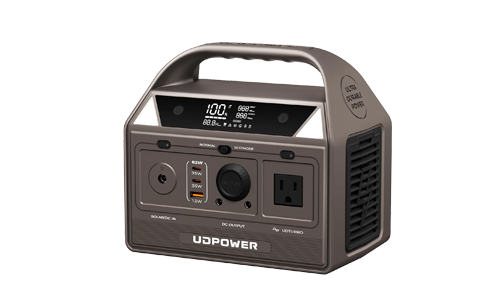
| UDPOWER C400 |  |
LiFePO4 (LFP) | 256Wh | 400W (surge 800W) | 11–28V, up to 150W | — | ~6.88 lb | Light trips, compact backup, small devices, jump-start feature | View C400 |
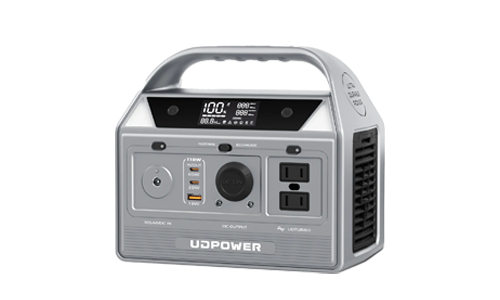
| UDPOWER C600 |  |
LiFePO4 (LFP) | 596Wh | 600W (surge 1200W) | 11–28V, up to 240W | — | ~12.3 lb | Medium off-grid use, car fridge, drones, “daily backup” for essentials | View C600 |
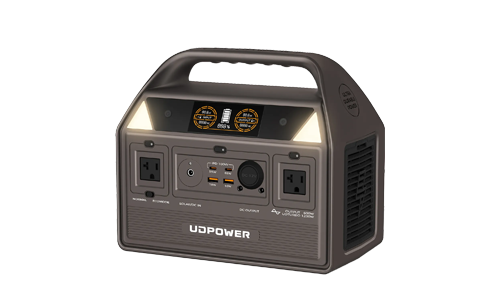
| UDPOWER S1200 |  |
LiFePO4 (LFP) | 1191Wh | 1200W (max 1800W) | 12–75V, 12A, up to 400W | ≤ 10ms | ~26 lb | Home backup essentials, home office/network, longer runtime with flexible solar voltage range | View S1200 |
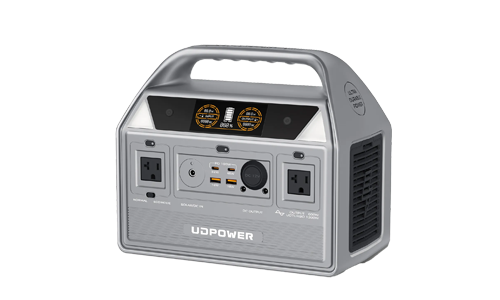
| UDPOWER S2400 |  |
LiFePO4 (LFP) | 2083Wh | 2400W (surge up to 3000W) | 12–50V, 10A, up to 400W | ≤ 10ms | ~40.8 lb | Higher output loads, multi-device backup, longer outages when you want more headroom | View S2400 |
Mobile tip: swipe the table sideways.
Lifetime value without price games: “energy throughput” example
One simple way to compare long-life batteries is to estimate how much total energy they can deliver over many cycles. This is not a warranty promise—just a way to think beyond the purchase day.
| Example model | Capacity (kWh) | Reference cycle spec (to 80%+ capacity) | Back-of-napkin lifetime energy (kWh) | Notes |
|---|---|---|---|---|
| UDPOWER C400 | 0.256 | 3,000 cycles (spec reference) | ~768 kWh (0.256 × 3000) | Real usable energy depends on load type, inverter losses, and how you cycle it. |
| UDPOWER C600 | 0.596 | 3,000 cycles (spec reference) | ~1,788 kWh (0.596 × 3000) | Use this to compare “useful work,” not marketing claims. |
| UDPOWER S1200 | 1.191 | 3,000 cycles (spec reference) | ~3,573 kWh (1.191 × 3000) | For AC loads, you’ll typically plan with a realism factor for conversion losses. |
| UDPOWER S2400 | 2.083 | 3,000 cycles (spec reference) | ~6,249 kWh (2.083 × 3000) | Great fit when you need higher output and longer multi-device runtime. |
Want to plan runtime realistically? Start with Wh math and then adjust for efficiency: How to calculate Wh (and estimate runtime). For outage planning specifically: runtime planning for outages.
Care tips that actually extend lifespan
You don’t need to obsess over a LiFePO4 battery, but a few habits can make the difference between “still great after years” and “why does this feel tired already?”
- Avoid hot storage. Heat is the quiet enemy of battery longevity. Store in a cool, dry place when possible.
- Don’t charge a freezing-cold battery. If the unit blocks charging in the cold, that’s protection doing its job.
- Keep vents clear while charging/using. Heat management matters more than people think.
- For long storage, don’t park it at 100% for months. A moderate state-of-charge is often kinder for storage.
- Use the right inputs. With solar, stay inside voltage limits—over-voltage is the fastest way to create a bad day: solar input voltage safety guide.
If you’re building an outage plan
Don’t wait for the outage to discover your true runtime. Do one “test evening” at home: plug in only the devices you’d run during an outage, track watts, and see what happens. If you want a ready framework, start here: what to run first + load planning table.
FAQ
Is LiFePO4 safer than other lithium batteries?
LiFePO4 is widely discussed as having strong thermal stability characteristics compared with some other lithium cathodes. That said, “safe” depends on the whole product: cells, pack design, BMS protections, thermal management, and compliance testing.
Do LiFePO4 batteries really last 10 years?
They can—if the system is well-built and your use matches the design (temperature, cycling depth, and charging habits). Treat “years” as a planning range, not a guarantee.
Can I charge LiFePO4 batteries below freezing?
Many systems block charging at or below freezing to protect the cells. If you live in a cold climate, plan to charge indoors, warm the battery first, or choose a setup designed for winter charging behavior.
Why does my LiFePO4 battery read “full” for a long time, then drop fast?
The voltage curve is flatter than lead-acid, so voltage isn’t a great fuel gauge. Track watt-hours used or rely on a well-calibrated meter. Helpful: Wh and runtime basics.
What’s the biggest mistake people make with solar + LiFePO4 power stations?
Ignoring input voltage limits. Panel “watts” don’t protect you from over-voltage. Read: solar input voltage safety.
Is LiFePO4 good for a UPS (home office / network gear)?
It can be a solid choice when paired with a unit that supports stable AC output and appropriate transfer behavior. If you’re estimating runtime, start here: UPS runtime in hours.
How do I choose between UDPOWER S1200 and S2400?
Start with your load: if you need higher continuous watts (or want more headroom for multiple devices), the S2400 is the step-up. If you’re powering essentials and want a strong balance of capacity, output, and solar flexibility, the S1200 is often the practical pick. Compare directly: S1200 vs S2400.
Do LiFePO4 batteries need special chargers?
Yes—your charger should match the battery’s recommended voltage profile. Many modern portable power stations manage charging internally, but for external systems (like RV house banks), use the correct LiFePO4 charge settings.
Is lead-acid ever the better choice?
Sometimes. If you need the lowest upfront cost and you won’t cycle deeply or often, lead-acid can still make sense. But for frequent cycling and longer-term value, many people prefer LiFePO4.
What’s a simple way to estimate how long my battery will run my device?
Use watt-hours. Runtime is roughly (usable Wh ÷ device watts), then adjust for efficiency and real-world behavior. UDPOWER tool: Portable Power Station Runtime Calculator.
What compliance items matter for shipping lithium batteries?
Transport rules typically require lithium cells/packs to meet UN 38.3 testing requirements. For a background overview (and why test summaries exist), see: PHMSA transporting lithium batteries.
If I’m planning for outages, what should I read next?
Start with the planning framework and then build your solar plan safely: runtime planning for outages, what to run first, and solar input voltage safety.
External standards & references mentioned above (for readers who like to verify details): UL portable power pack testing (UL 2743) • PHMSA lithium battery transport overview • IEC 62619 overview
Related Articles


