

Best Affordable Portable Power Stations in 2026: Budget Picks, Runtime & Real Value
Last updated: September 20, 2026
Quick answer: what is the best affordable portable power station?
The best affordable portable power station is not automatically the one with the lowest price. It is the least expensive model that can safely handle your highest-wattage device, store enough energy for the hours you actually need, and recharge fast enough for the way you use it.
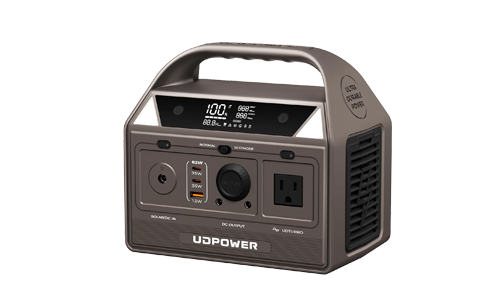
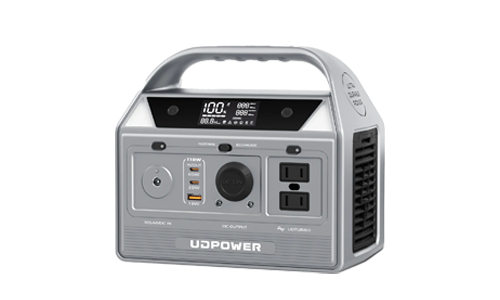
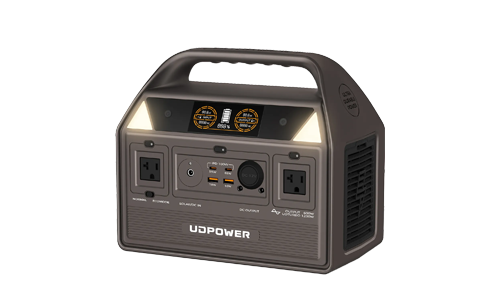
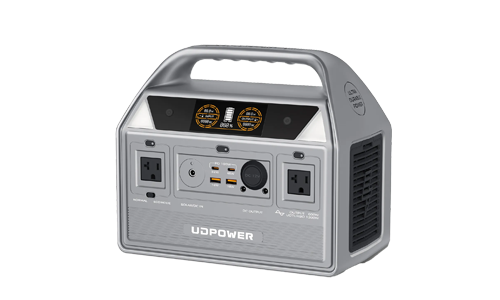
For light electronics and day trips, a 192–256Wh station such as the UDPOWER C200 or C400 keeps cost and weight low. For weekend camping, a roughly 600Wh model such as the C600 provides much more usable runtime. For refrigerator backup, CPAP equipment, Wi-Fi, laptops and household essentials, the S1200 is the stronger value step-up. The S2400 makes more sense when you need substantially more capacity and higher appliance output.
Our main buying rule: choose by required watts and watt-hours first, then compare price. Buying a station that is too small is rarely a bargain if you have to replace or upgrade it later.

UDPOWER publishes this article, so the product recommendations below focus on the current UDPOWER lineup. Product specifications were checked against the official product pages on September 20, 2026. Runtime figures are planning estimates rather than laboratory measurements. For AC-load planning, we use a 90% conversion-efficiency assumption for UDPOWER portable power stations unless a specific operating mode requires otherwise. Actual results vary with load, temperature, battery condition, inverter losses, device cycling and operating settings.
What “Affordable” Actually Means for a Portable Power Station
A $130 power station and a $700 power station can both be affordable purchases. The difference is what problem each one solves.
If you only need to recharge a phone, camera, drone battery or laptop, buying 2,000Wh of storage would be unnecessary. But if you need to keep a refrigerator and CPAP running during an outage, a tiny 200Wh station can become the expensive choice because it does not provide enough runtime.
A useful value comparison should include at least five numbers:
- Rated battery capacity in Wh: how much energy the battery stores.
- Rated AC output in W: how much continuous AC load the inverter is designed to supply.
- Estimated usable energy: the portion of rated capacity available after conversion losses.
- Weight: because portability has real value if you move the station frequently.
- Purchase price: compared against the capacity and capability you will actually use.
Estimated usable AC energy = rated battery Wh × 0.90
Estimated runtime = rated battery Wh × 0.90 ÷ device watts
Cost per estimated usable Wh = purchase price ÷ estimated usable Wh
The 90% figure is a planning assumption, not a promise that every appliance will receive exactly 90% of the battery's rated capacity. Very light loads, very heavy loads, temperature, inverter standby consumption and battery condition can all change the result.
If you want to calculate runtime from your own appliance wattage, use the UDPOWER battery runtime estimator guide.
Quick Picks by Budget and Use Case
| Buyer | Useful size range | Typical loads | UDPOWER match | When to move up |
|---|---|---|---|---|
| Lowest-cost light power | About 200Wh / 200W | Phones, cameras, lights, small electronics | C200 | You regularly use laptops, fans or AC appliances for hours |
| Compact car and camping kit | 250Wh+ / 400W | Laptop, camera gear, fan, lighting, emergency car support | C400 | You need overnight fridge or CPAP runtime |
| Weekend camping | 500–700Wh / 600W+ | Camping fridge, projector, laptop, fan, phones | C600 | You need high-watt cooking or much longer backup |
| Home essentials and CPAP | About 1,000Wh+ / 1,000W+ | CPAP, router, TV, laptop, refrigerator support | S1200 | You want more runtime or need to run several larger appliances |
| Larger backup loads | About 2,000Wh+ / 2,000W+ | Refrigerator, microwave, coffee maker, larger campsite | S2400 | You require 240V whole-home backup or much larger expandable storage |
For most shoppers, this is a better starting point than choosing a price ceiling first. Decide what you need to run, determine the required output and energy, and then shop within that class.
UDPOWER Affordable Portable Power Station Comparison
The table below uses the current product-page specifications and prices checked on September 20, 2026. Promotions and inventory can change, so use the linked product page for the current selling price before purchasing.
| Model | Price checked | Capacity | Rated AC output | Estimated usable AC energy | Weight | Solar input | Battery | Official source |
|---|---|---|---|---|---|---|---|---|
| UDPOWER C200 | $129.99 | 192Wh | 200W | About 173Wh | About 5.4 lb | 150W max | LiFePO4 | Product page |
| UDPOWER C400 | $239.99 | 256Wh | 400W | About 230Wh | 6.88 lb | 150W max | LiFePO4 | Product page |
| UDPOWER C600 | $289.99 | 596Wh | 600W | About 536Wh | 12.3 lb | Up to 240W | LiFePO4 | Product page |
| UDPOWER S1200 | $399.99 | 1,190Wh | 1,200W | About 1,071Wh | 26.0 lb | 400W max | LiFePO4 | Product page |
| UDPOWER S2400 | $699.99 | 2,083Wh | 2,400W | About 1,875Wh | 40.8 lb | Up to 400W | LiFePO4 | Product page |
The technical battery specifications for these models list LiFePO4 chemistry and 80%+ remaining capacity after 3,000 cycles under the stated cycle-life conditions. Product marketing blocks may summarize battery longevity differently, so this guide uses the more specific technical-specification figure where available.
You can also use the UDPOWER power station comparison tool to compare current models side by side.
Which Model Gives You the Most Battery Capacity for the Money?
Sticker price alone can hide a major difference in value. Using the prices checked on September 20, 2026 and the same 90% usable-energy planning assumption for each model gives a clearer picture.
| Model | Checked price | Rated capacity | Estimated usable energy | Price per rated Wh | Price per estimated usable Wh |
|---|---|---|---|---|---|
| C200 | $129.99 | 192Wh | 173Wh | About $0.68 | About $0.75 |
| C400 | $239.99 | 256Wh | 230Wh | About $0.94 | About $1.04 |
| C600 | $289.99 | 596Wh | 536Wh | About $0.49 | About $0.54 |
| S1200 | $399.99 | 1,190Wh | 1,071Wh | About $0.34 | About $0.37 |
| S2400 | $699.99 | 2,083Wh | 1,875Wh | About $0.34 | About $0.37 |
This illustrates why “cheapest” and “best value” are not the same thing. At the checked promotional prices, S1200 and S2400 provide considerably more battery capacity per dollar than the smaller models.
That does not automatically make a large unit the right purchase. If all you need is 150Wh for a day trip, paying for 1,190Wh does not create useful value. Cost per watt-hour should be used after you have already identified an appropriate size class.
For a deeper cost discussion, see How Much Does a Portable Power Station Cost? and How to Choose the Best Portable Power Station for the Money.
Real-World Runtime Estimates: What Will Each Size Actually Run?
Battery capacity becomes much easier to understand when you convert it into hours. The estimates below use:
Runtime ≈ battery capacity × 0.90 ÷ average device watts
| Example load | Planning watts | C200 192Wh | C400 256Wh | C600 596Wh | S1200 1,190Wh | S2400 2,083Wh |
|---|---|---|---|---|---|---|
| Router + modem | 20W | 8.6 hr | 11.5 hr | 26.8 hr | 53.5 hr | 93.7 hr |
| CPAP without heated humidification | 40W | 4.3 hr | 5.8 hr | 13.4 hr | 26.8 hr | 46.9 hr |
| Camping fridge average draw | 45W | 3.8 hr | 5.1 hr | 11.9 hr | 23.8 hr | 41.7 hr |
| Laptop workstation | 60W | 2.9 hr | 3.8 hr | 8.9 hr | 17.9 hr | 31.2 hr |
| TV or projector | 100W | 1.7 hr | 2.3 hr | 5.4 hr | 10.7 hr | 18.7 hr |
| 500W continuous load | 500W | Not within rated output | Not within rated output | About 1.1 hr | About 2.1 hr | About 3.7 hr |
| 800W continuous load | 800W | Not within rated output | Not within rated output | Above rated output | About 1.3 hr | About 2.3 hr |
| 1,200W continuous load | 1,200W | Not supported | Not supported | Not within rated output | About 0.9 hr | About 1.6 hr |
| 1,500W continuous load | 1,500W | Not supported | Not supported | Not supported | Higher-power battery mode required | About 1.2 hr |
These are constant-load planning estimates. A refrigerator compressor cycles. A CPAP may draw considerably more power when a heated humidifier or heated tube is enabled. A laptop changes consumption with CPU load and charging state. Those differences matter more as you get closer to the battery limit.
For refrigerator-specific planning, read Can a Portable Power Station Run a Refrigerator?. For sleep equipment, see the CPAP, APAP and BiPAP backup power guide.
What Size Portable Power Station Should You Buy?
200–300Wh: best for electronics and light trips
This class works when the job is mostly charging rather than running appliances. Phones, camera batteries, LED lights, drones and laptop top-ups are realistic targets.
The mistake is expecting a small station to become an emergency refrigerator, cooking or heating system simply because it includes an AC outlet.
500–700Wh: the useful middle ground for car camping
Once you reach roughly 600Wh, overnight loads become much more practical. A camping refrigerator, fan, laptop, projector and several small electronics can fit into a carefully managed weekend energy budget.
This is why a mid-size station can be more satisfying than an ultra-cheap model for campers: you are buying enough energy to get through the night instead of constantly watching the battery percentage.
1,000–1,200Wh: where home backup becomes more useful
This class is a strong starting point for CPAP equipment, internet equipment, lights, laptops, TVs and selective refrigerator backup. It also gives family campers more room for several devices instead of a single carefully rationed load.
2,000Wh+: when runtime and appliance flexibility matter more than minimum weight
A roughly 2kWh station is no longer something most people will casually carry down a hiking trail. It works better as a home, RV, overlanding or vehicle-supported basecamp power source.
The tradeoff is obvious: more weight and higher upfront cost, but much greater runtime and substantially more freedom when powering refrigerators, kitchen appliances and several devices at once.
For camping-specific sizing, see the Camping Power Station Buying Guide.
Three Buying Examples That Are More Useful Than a Generic “Best” List
Example 1: weekend car camping
Fan: 25W × 6 hours = 150Wh
Laptop: 60W × 2 hours = 120Wh
Lights: 10W × 5 hours = 50Wh
Phones and small devices = about 30Wh
Estimated daily total = 350Wh
A 256Wh C400 is too tight for that complete energy budget without recharging. A 596Wh C600 provides about 536Wh of estimated usable AC energy, leaving significantly more breathing room.
This is the difference between shopping by sticker price and shopping by the energy you actually need.
Example 2: one night of CPAP backup
Average CPAP load: 40W
Required time: 8 hours
Energy needed: 40W × 8 = 320Wh
Nominal battery required at 90% planning efficiency: 320Wh ÷ 0.90 = about 356Wh
That means a 192Wh or 256Wh station does not provide enough planning margin for this example. A 596Wh C600 is much more realistic for one night, while S1200 provides greater reserve for heated features, longer outages or additional devices.
Your CPAP may use less or substantially more than 40W, so measure or verify your own setup before purchasing.
Example 3: 12 hours of refrigerator backup
Assumed average refrigerator draw: 60W
Backup window: 12 hours
Energy requirement: 60W × 12 = 720Wh
Nominal battery target at 90% planning efficiency: 720Wh ÷ 0.90 = about 800Wh
That immediately pushes the purchase into roughly the 1kWh class. You also need enough inverter output to handle compressor startup. For this kind of job, S1200 is a more sensible starting point than repeatedly trying to stretch a smaller battery.
For longer outages, use the portable power station outage runtime planning guide to rank essential loads before deciding how large a battery you need.
Recommended UDPOWER Affordable Portable Power Stations
UDPOWER C200: lowest-cost option for light power needs

The C200 makes sense when low purchase cost and low carrying weight matter more than long appliance runtime. It is a practical step above a conventional USB power bank because it adds AC and DC power while remaining easy to move.
Good fit: phones, tablets, cameras, drones, LED lights, small fans, short laptop use and emergency electronics.
Skip it if: you are buying primarily for refrigerators, heated appliances, cooking equipment, multi-night CPAP use or long outages.
UDPOWER C400: compact camping and vehicle emergency power
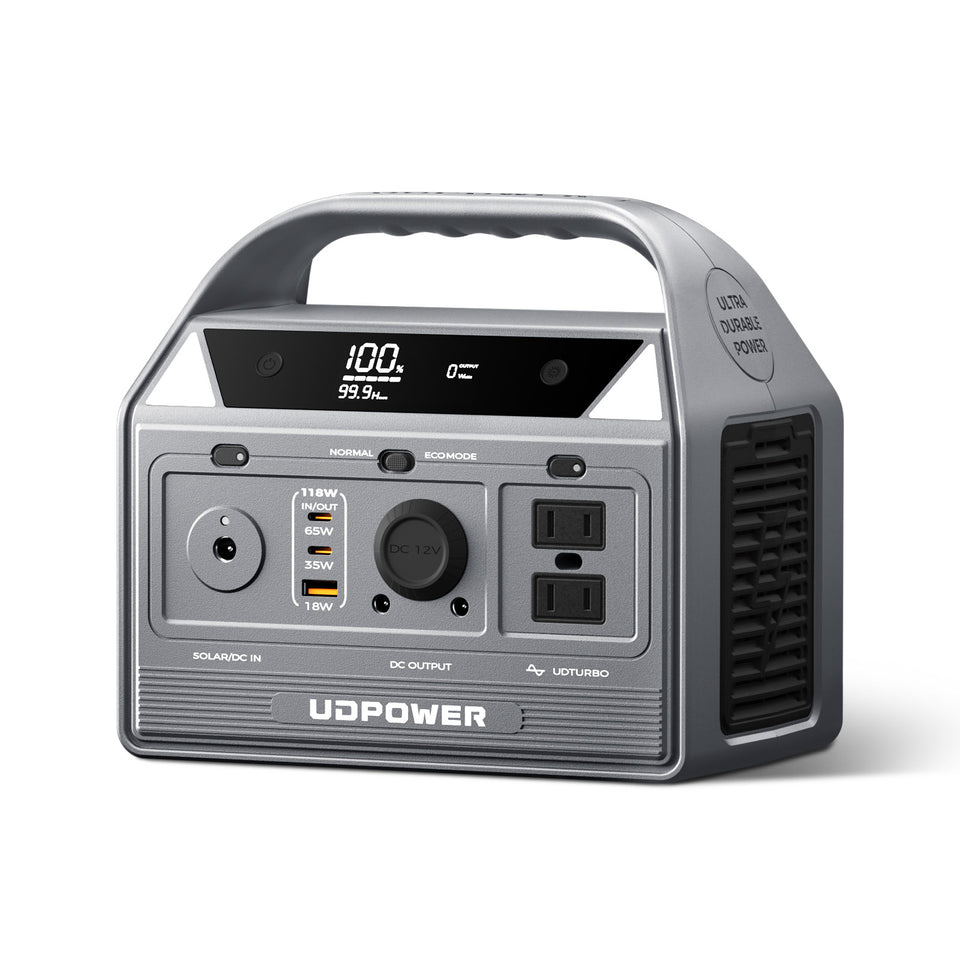
The C400 is for buyers who want a genuinely portable unit rather than a backup battery that mostly stays at home. Its 400W rated output gives it more flexibility than entry-level 200W models while keeping weight below seven pounds.
The integrated 12V vehicle jump-start capability also gives it a second role in a road-trip or emergency-car kit.
Good fit: day trips, weekend electronics, laptops, photography equipment, lighting, fans and roadside backup.
Skip it if: you expect reliable overnight refrigerator operation, long CPAP runtime or high-watt cooking.
UDPOWER C600: practical mid-size choice for weekend camping
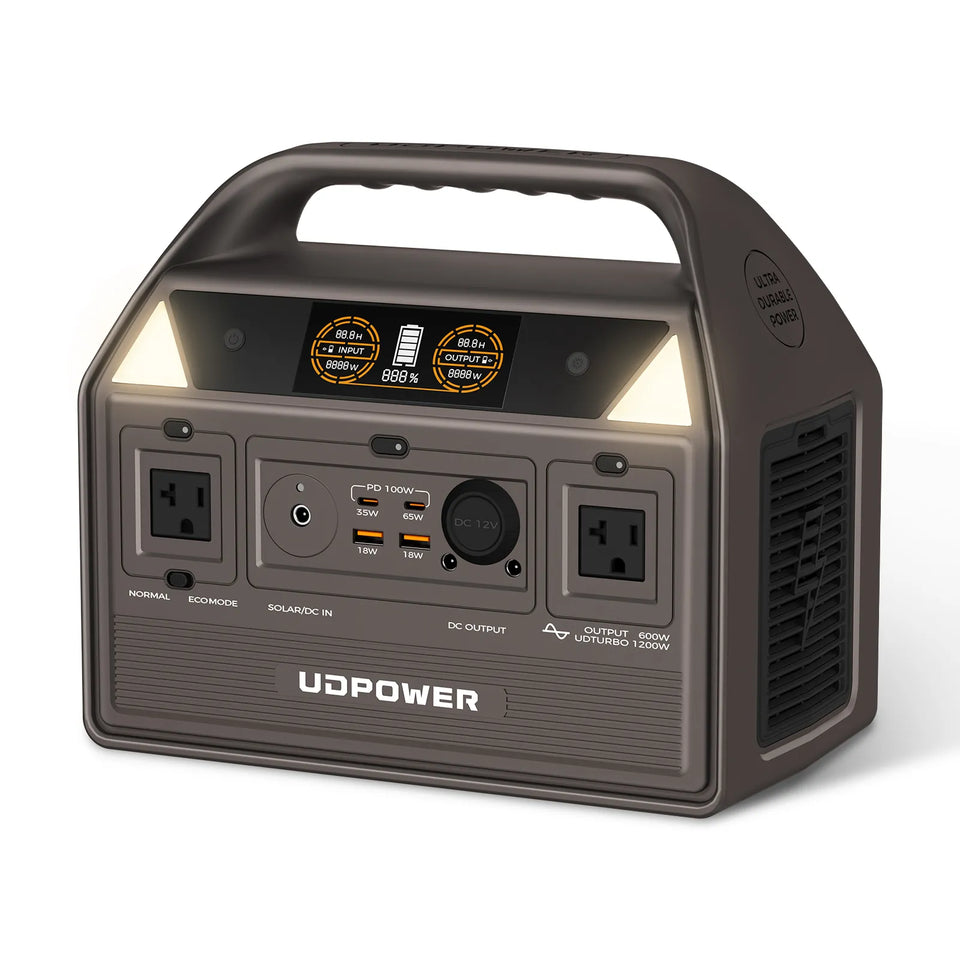
The C600 is where a portable station starts providing enough stored energy for more than casual charging. About 536Wh of estimated usable AC energy gives a camper much more room for a refrigerator, projector, laptop, fan, lighting and multiple small devices.
At 12.3 pounds, it is still easy enough to move between a vehicle, campsite table, RV compartment or room during an outage.
Good fit: weekend car camping, portable fridge support, remote work, projectors, drones, laptops and lighter emergency backup.
Skip it if: you regularly need appliances above its rated output or want substantially more than one night of energy without recharging.
Availability: the product page showed C600 as sold out when this guide was updated. Check the live page for current inventory.
UDPOWER S1200: strongest value step-up for home essentials and CPAP backup
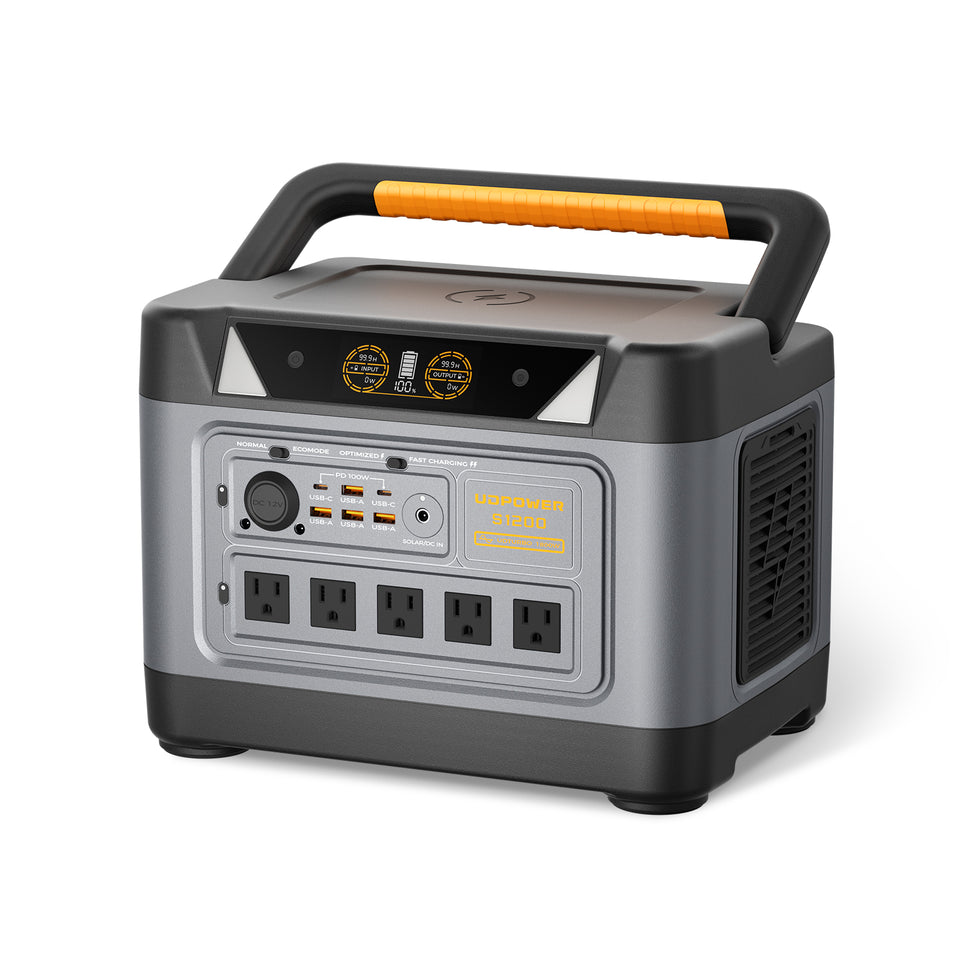
The S1200 is the point where an affordable portable power station becomes a serious home-essential backup source. Its 1,190Wh battery provides roughly 1,071Wh of estimated usable AC energy under the planning assumption used in this guide.
That is enough to make CPAP equipment, internet service, lights, laptops, TVs and selective refrigerator backup much easier to plan around than with a small 200–600Wh station.
The higher-power feature also needs to be understood correctly. When operating from its battery and inverter, S1200 supports compatible loads up to 1,800W through its higher-power operating capability. When the station is connected to wall power and supplying loads through UPS/bypass, use the 1,200W rated output limit. The 1,800W higher-power mode is not available through the bypass path.
Operating above rated output can also reduce conversion efficiency, so the normal 90% runtime shortcut should not be treated as an exact estimate in that mode.
Good fit: CPAP backup, refrigerator support, routers, home office equipment, family camping, RV use and shorter household outages.
Skip it if: your priority is minimum carrying weight or you routinely need several high-watt appliances operating simultaneously.
UDPOWER S2400: affordable high-capacity option for larger loads
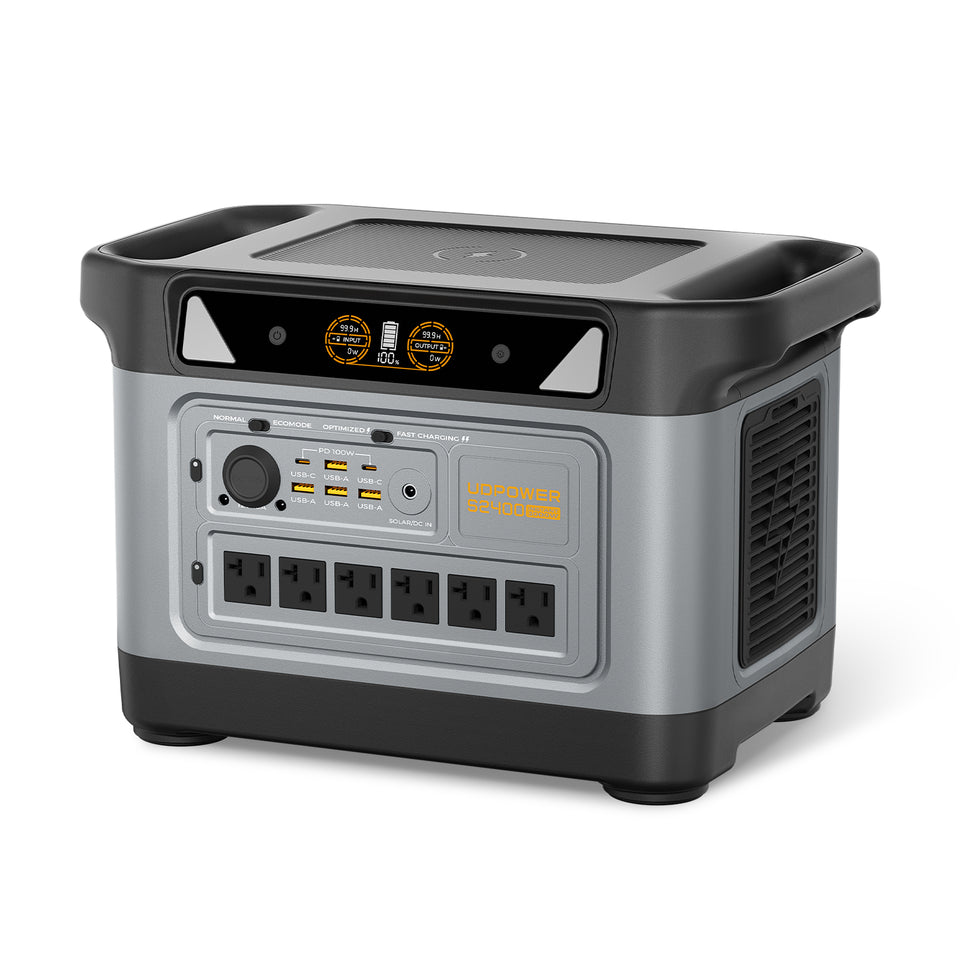
The S2400 is designed for buyers who have already moved beyond light backup. A 2,083Wh battery provides approximately 1,875Wh of estimated usable AC energy under the normal planning assumption, while the 2,400W rated inverter supports a much wider range of household and campsite appliances.
Like S1200, its higher-power capability is different from the UPS/bypass limit. S2400 can support compatible loads up to 3,000W when operating through the battery and inverter. When AC input is connected and the unit is operating through the bypass/UPS path, connected loads should remain within its 2,400W rated output.
Good fit: longer refrigerator backup, microwaves and other compatible kitchen appliances, larger RV or campsite setups, home essentials and multi-device emergency power.
Skip it if: you only need to charge small electronics or you frequently need to carry the station long distances.
How to Buy an Affordable Power Station Without Overpaying
1. Check rated output before battery capacity
A large battery does not help if its inverter cannot operate your appliance. If your microwave draws 1,400W from the wall, a station with a 600W rated inverter is the wrong tool even if the battery technically stores enough energy for a short cooking cycle.
2. Build a watt-hour budget instead of guessing
Watts tell you how much power a device needs at one moment. Watt-hours tell you how much energy it needs over time.
Daily energy use in Wh = device watts × hours of operation
Do this for every essential device and add the totals. That gives you a much better battery target than choosing from labels such as “camping power station” or “home backup.”
3. Separate average load from startup load
Refrigerators, pumps, compressors and power tools can briefly demand substantially more power when starting. Check both normal operating power and startup requirements.
Do not assume every number labeled “peak,” “surge,” “boost” or “high-power mode” works the same way across brands. Read the actual operating conditions for the specific model.
4. Decide whether you are carrying it or parking it
A 40-pound power station can be completely reasonable when it moves from a garage to an RV or from a vehicle to a campsite table. It is a poor backpacking choice.
Portability should therefore be measured against your trip, not against the word “portable” in the product category.
5. Do not buy battery capacity you cannot recharge
A larger battery lasts longer, but it also contains more energy that eventually needs to be replaced. For multi-day camping or extended outages, compare AC, vehicle and solar charging options before buying.
6. Compare current street price, not only MSRP
Portable power station pricing changes frequently. A model that looks expensive at list price may become one of the better capacity-per-dollar choices during a promotion.
This is why the tables in this article date the prices rather than treating them as permanent specifications.
Budget Mistakes That Cost More in the Long Run
Buying by the largest watt number on the box
Rated AC output, higher-power operation and startup capability are not interchangeable terms. Start with the station's normal rated output and then read how any additional high-power feature actually works.
Assuming advertised Wh equals appliance Wh
A 1,000Wh battery does not normally deliver exactly 1,000Wh through a 120V AC outlet. The inverter and internal electronics consume energy too.
Buying a tiny battery for resistance heating
Space heaters, electric kettles, hot plates and hair dryers convert electricity directly into heat and can consume hundreds or thousands of watt-hours quickly. Even when the inverter can operate them, runtime may be surprisingly short.
Ignoring the refrigerator's compressor
A refrigerator that averages 50–100W over time can demand much more when its compressor starts. Size the inverter for startup and the battery for the longer average energy requirement.
Confusing portable backup with whole-home backup
UDPOWER portable stations covered here provide standard 120V AC output for connected appliances. They should not be treated as automatic 240V whole-house systems. Any permanent home electrical integration should be evaluated by a qualified electrician.
Buying a solar panel without checking the input limits
Panel wattage is only one part of compatibility. Voltage, current and connector type must also match the station's supported input range.
When Is a Solar Panel Worth the Extra Cost?
Solar does not make every power station purchase better. It matters when you need to replace meaningful amounts of energy while you are away from the grid.
| Situation | Is solar useful? | Reason | Suggested path |
|---|---|---|---|
| Day trip with phones and camera | Usually unnecessary | The battery may already cover the full trip | C200 or C400 unit only |
| One-night camping | Optional | Depends on how much energy remains after the first night | C400 or C600 |
| Weekend camping with fridge | Often useful | Daytime solar can replace part of the previous night's consumption | C600 or S1200 with compatible panel |
| CPAP backup at home | Optional for short outages | Battery capacity is the first priority; solar becomes more useful as the outage extends | S1200 plus solar if longer outages are a concern |
| Multi-day outage | Useful | It creates a daytime recharge path without relying entirely on grid power | S1200 or S2400 with compatible panels |
| RV or vehicle-supported basecamp | Often worthwhile | Daily loads make repeat charging more important | Solar generator kit sized to daily Wh use |
Browse the current UDPOWER solar panels or complete solar generator kits. For a step-by-step explanation, read Can You Charge a Portable Power Station With a Solar Panel?.
What Independent Power Station Reviews Can Tell You That a Spec Sheet Cannot
A specification table is useful for narrowing down products, but independent testing can answer a different set of questions: how much energy a station actually delivers under a controlled load, how quickly it charges from empty, how it behaves near maximum output and how practical it is to move.
| Test | Why it matters | What a shopper should look for | Independent example |
|---|---|---|---|
| Measured discharged energy | Shows how much rated capacity reaches the load in a particular test | Compare the test method and load instead of assuming all efficiency numbers were measured the same way | Popular Mechanics |
| Constant-load output test | Checks operation near the inverter's rated limit | Look for stable output and protection behavior | OutdoorGearLab |
| Recharge timing | Determines how quickly the battery can be returned to service | Compare 0–80% and full-charge results under the same input method | Popular Mechanics |
| Weight and carry test | Published weight does not tell you how comfortable the unit is to move | Consider handle design, dimensions and how far you will actually carry it | OutdoorGearLab |
This article does not substitute calculated runtime for an independent laboratory measurement. The runtime numbers are intentionally presented as planning estimates so you can apply the same method to your own devices.
That distinction matters. If two products both claim 1,000Wh, a controlled discharge test may reveal different usable energy. If you do not have comparable test data, use published specifications conservatively and leave reserve instead of planning around the last few percent of the battery.
How Much Reserve Should You Leave?
If a calculation says you need exactly 500Wh, buying a battery with exactly 500Wh of rated capacity leaves almost no room for conversion losses, changing device loads, colder temperatures or an unexpectedly longer outage.
A more practical approach is to calculate the energy requirement first and then leave reserve based on how important the load is.
| Load type | Suggested planning approach | Reason |
|---|---|---|
| Phones, cameras and entertainment | Small reserve is usually acceptable | Running out is inconvenient rather than critical |
| Camping fridge | Leave meaningful overnight reserve | Hot weather and compressor cycling can increase demand |
| Remote work | Plan beyond the expected work period | Laptop charging, displays and internet equipment fluctuate |
| Refrigerator during outage | Use conservative average consumption and startup margin | Compressor operation is not a constant load |
| CPAP or other essential equipment | Measure the actual setup and add substantial reserve | Heated accessories and settings can materially change consumption |
The more important the load, the less sense it makes to buy a battery that only works on paper under ideal conditions.
What About UPS Backup?
UPS capability matters when equipment must remain powered while utility electricity fails. It is particularly useful for desktop computers, networking equipment and other devices where an abrupt shutdown is undesirable.
In the current UDPOWER lineup covered here, S1200 and S2400 include UPS functionality. There is an important power-limit detail:
- S1200: use the 1,200W rated output limit while operating through AC bypass/UPS.
- S2400: use the 2,400W rated output limit while operating through AC bypass/UPS.
The higher-power 1,800W and 3,000W battery/inverter capabilities are not available through the bypass path. This matters if you plan to leave a high-watt appliance permanently connected while the station is plugged into the wall.
Portable Power Station vs. Gas Generator: Which Is More Affordable?
The answer depends on what you are powering and for how long.
A battery power station has no gasoline engine, does not produce combustion exhaust at the point of use, needs less routine engine maintenance and can be used for appropriate indoor electronic backup according to the manufacturer's instructions. It is particularly convenient for CPAP equipment, Wi-Fi, electronics, camping and short outages.
A fuel generator can continue operating as long as fuel is available, which can make it more practical for prolonged high-energy demand. It also introduces fuel storage, engine maintenance, noise and carbon-monoxide risk.
Never operate a fuel-burning generator indoors, inside a garage or near openings where exhaust can enter an occupied building. See the CDC generator carbon monoxide safety guidance.
If your main loads are electronics, a refrigerator, medical equipment, lights and internet service, battery backup often provides a simpler experience. If your goal is several days of continuously powering large electrical loads, compare the total energy requirement before assuming that a portable battery is the least expensive solution.
Frequently Asked Questions About Affordable Portable Power Stations
What is the best affordable portable power station size for most people?
There is no single size that works for everyone. Around 200–300Wh is useful for electronics and light trips, around 500–700Wh is a practical range for weekend car camping, around 1,000Wh or more is better for CPAP, refrigerators and home essentials, and around 2,000Wh provides more freedom for larger loads and longer backup.
Is a cheap 200W portable power station worth buying?
Yes, when your devices are small. A 200W station can be a good value for phones, cameras, LED lights, small fans and other light electronics. It becomes poor value if you buy it expecting long refrigerator runtime, cooking or high-wattage appliance support.
How many watt-hours do I need for camping?
Light camping may require only 200–300Wh. A weekend campsite with a fan, laptop, lights and several devices often fits better around 500–700Wh. A CPAP, refrigerator, family campsite or multi-night trip can make 1,000Wh or more much more practical.
How do I calculate portable power station runtime?
For UDPOWER AC-load planning, a useful shortcut is battery capacity in Wh × 0.90 ÷ average device watts. For example, 596Wh × 0.90 ÷ 60W is about 8.9 hours. Actual runtime changes with the device, load level, temperature and battery conditions.
Can an affordable portable power station run a refrigerator?
Yes, if the station has enough inverter output for compressor startup and enough battery capacity for the desired backup window. For a typical home refrigerator, a roughly 1,000Wh-class station is a more practical starting point than a 200–600Wh model, while a 2,000Wh-class unit gives more runtime reserve.
Can a budget power station run a CPAP all night?
It can, but you need to calculate from your specific machine. An 8-hour night averaging 40W consumes about 320Wh before conversion losses. Heated humidification and heated tubing can increase consumption significantly. A 596Wh-class unit may cover many lower-power one-night setups, while a 1,190Wh station provides considerably more reserve.
Is LiFePO4 worth paying extra for?
For a power station that will be used and recharged regularly, battery longevity is an important part of value. The UDPOWER models covered here use LiFePO4 batteries, and their current technical specifications list 80%+ remaining capacity after 3,000 cycles under the specified cycle-life conditions.
Should I buy the largest portable power station I can afford?
Not necessarily. Larger batteries cost more and weigh more. Buy enough capacity and output for your real load list plus a reasonable reserve. If you only need phones, lights and a laptop, a 2,000Wh station may provide little practical benefit over a smaller model.
Is price per watt-hour a good way to compare portable power stations?
It is useful, but only after you have matched the inverter output and capacity to your needs. A low price per Wh does not help if the station is too heavy for your trip or cannot run your appliance. Use price per Wh as a value metric, not as the only buying criterion.
Do I need solar panels with a portable power station?
Not for every use. Solar becomes more valuable when you are away from grid power for multiple days or need to replace energy during an extended outage. For a day trip or occasional home backup, charging the station before use may be enough.
Can I connect any solar panel to a portable power station?
No. The panel's open-circuit voltage, current, total wattage and connector must fit the power station's supported solar input specifications. Always check the product page before connecting third-party solar panels.
Does the UDPOWER S1200 support wireless charging?
No. The current UDPOWER S1200 does not support wireless charging. Use its USB or AC outputs for compatible devices.
Does the UDPOWER S2400 support wireless charging?
No. The current UDPOWER S2400 does not support wireless charging. Use its available USB or AC output ports instead.
Can the S1200 provide 1,800W while operating as a UPS?
No. Its higher-power capability up to 1,800W applies when the station is supplying power through its battery and inverter. In AC bypass or UPS operation, connected loads should remain within the 1,200W rated output limit.
Can the S2400 provide 3,000W while operating in UPS or bypass mode?
No. S2400 can provide its higher-power capability up to 3,000W when operating from the battery and inverter, but the AC bypass or UPS path follows the 2,400W rated output limit.
Final Recommendation: Buy the Cheapest Station That Fully Solves the Job
The best affordable portable power station is not the model with the smallest price tag. It is the smallest, least expensive system that can handle your real devices with enough runtime and reserve to remain useful.
Choose C200 when the job is mainly light electronics. Choose C400 when portability and a more useful 400W inverter matter. Consider C600 when available if you want a balanced weekend-camping battery. Move to S1200 when the job includes CPAP, refrigerator support, internet equipment and meaningful home backup. Choose S2400 when longer runtime and larger appliance loads are more important than minimum weight.
Before ordering, write down three numbers: your highest simultaneous wattage, your total watt-hours for the period you need to cover, and how much energy you can realistically recharge before the next use. Those three numbers will tell you more than any “best power station” label.
Find the Right UDPOWER Power Station
Compare capacity, output, weight and solar charging before choosing your setup.
View All Portable Power Stations Compare UDPOWER Models View Solar Generator KitsRelated Articles


