

How Long Will a 2000W Power Station Run a Refrigerator?
Last updated: August 18, 2026
Quick Answer
A 2000W power station does not have one fixed refrigerator runtime. The 2000W rating tells you how much AC power the inverter can supply at one time. Battery capacity, measured in watt-hours (Wh), is what largely determines how long the refrigerator can keep running.
If a 2000W power station also has about a 2,000Wh battery, a useful planning estimate is roughly 17 to 34 hours for a refrigerator averaging 50 to 100 watts over a full day. That estimate assumes about 85% usable AC energy after conversion losses. A refrigerator averaging only 50W may approach 34 hours, while one averaging 100W is closer to 17 hours. A high-use refrigerator averaging 150W would be closer to 11 hours.
The quickest way to get a better answer for your refrigerator is to find its yellow EnergyGuide label and use the listed kWh/year, or measure actual consumption for 24–72 hours with a plug-in electricity meter.

At first glance, this sounds like a simple division problem: take 2000 and divide it by the refrigerator's watts. That approach fails because it mixes two different measurements.
A refrigerator also does not behave like a light bulb. Its compressor starts, runs, shuts off, starts again, and may occasionally operate a defrost heater, fans, ice maker, or other components. The number you see while the compressor is running is therefore not necessarily the number you should use for a 24-hour battery-runtime calculation.
This guide focuses specifically on how long a 2000W-class portable power station can keep a refrigerator running. For a deeper breakdown of compressor watts, startup demand, daily kWh consumption, and refrigerator types, see our refrigerator wattage guide .
2000W Power Station Refrigerator Runtime: Quick Table
Because “2000W power station” describes inverter output rather than battery storage, the table below compares several battery capacities that could all theoretically be paired with a 2000W-class inverter.
For the general calculations in this article, we use an 85% usable AC energy planning factor. This is not a claim that every power station is exactly 85% efficient. Actual inverter efficiency, standby consumption, battery management behavior, temperature, and load level vary by product.
Battery capacity (Wh) × 0.85 ÷ refrigerator average watts
| Battery Capacity | 50W Avg. Refrigerator | 75W Avg. Refrigerator | 100W Avg. Refrigerator | 150W Avg. Refrigerator | Method / Source |
|---|---|---|---|---|---|
| 1,000Wh | 17.0 hours | 11.3 hours | 8.5 hours | 5.7 hours | Runtime formula |
| 1,500Wh | 25.5 hours | 17.0 hours | 12.8 hours | 8.5 hours | Runtime formula |
| 2,000Wh | 34.0 hours | 22.7 hours | 17.0 hours | 11.3 hours | Runtime formula |
| 2,500Wh | 42.5 hours | 28.3 hours | 21.3 hours | 14.2 hours | Runtime formula |
Swipe or drag the table horizontally on smaller screens. These are calculated refrigerator-only estimates with no solar charging or additional loads.
Why 2000W Does Not Tell You How Long a Refrigerator Will Run
There are two separate questions when choosing refrigerator backup power:
- Can the station run the refrigerator?
- How long can it run the refrigerator?
Those questions use different specifications.
| Specification | What It Measures | Why It Matters | Example | Related Guide |
|---|---|---|---|---|
| Watts (W) | Instantaneous power output or consumption | Determines whether the inverter can support the refrigerator's load | 2,000W continuous output | What can a 2000W power station run? |
| Watt-hours (Wh) | Stored battery energy | Determines how much energy is available over time | 2,000Wh battery | How long will a 2000Wh power station last? |
| Running watts | Power while the refrigerator is actively cooling | Helps check continuous inverter compatibility | For example, 150W while cooling | Refrigerator watts guide |
| Daily kWh | Total energy consumed across compressor on/off cycles | Usually much more useful for estimating runtime | For example, 1.5kWh/day | FTC EnergyGuide |
Suppose one power station has a 2,000W inverter and a 1,024Wh battery, while another has the same 2,000W inverter rating and a 2,048Wh battery.
Both may be capable of powering the same refrigerator, but the second has roughly twice the nominal stored energy. Their runtime will therefore not be remotely the same.
Watts tell you whether the refrigerator can run. Watt-hours tell you how long it can run.
So How Long Does a 2000Wh-Class Battery Run a Refrigerator?
Once battery capacity is known, the calculation becomes much more useful.
A nominal 2,000Wh battery using the generic 85% planning factor provides:
Runtime then depends on the refrigerator's average energy demand over time.
| Average Refrigerator Load | Approx. Daily Energy Use | Estimated Runtime From 2,000Wh | What This Means | Calculation |
|---|---|---|---|---|
| 35W | 0.84kWh/day | 48.6 hours | Very low average energy demand | 1,700Wh ÷ 35W |
| 50W | 1.20kWh/day | 34.0 hours | More than one full day | 1,700Wh ÷ 50W |
| 75W | 1.80kWh/day | 22.7 hours | Close to a full day | 1,700Wh ÷ 75W |
| 100W | 2.40kWh/day | 17.0 hours | Strong overnight backup | 1,700Wh ÷ 100W |
| 125W | 3.00kWh/day | 13.6 hours | Overnight but limited next-day margin | 1,700Wh ÷ 125W |
| 150W | 3.60kWh/day | 11.3 hours | High average energy use | 1,700Wh ÷ 150W |
Notice that this table uses average watts, not the live wattage shown only while the compressor is running.
If your refrigerator draws 180W while cooling but averages only 60W across an entire day because the compressor switches off periodically, using 180W in the runtime formula would dramatically underestimate actual backup time.
The Best Quick Method: Use Your Refrigerator's EnergyGuide Label
For most U.S. homeowners, the yellow EnergyGuide label is the easiest starting point because it reports estimated annual electricity consumption in kilowatt-hours per year (kWh/year).
The Federal Trade Commission's EnergyGuide guidance explains how the label reports appliance energy use. You can also compare individual certified refrigerator models through the ENERGY STAR Refrigerator Product Finder .
Step 1: Find the annual kWh figure
Imagine your refrigerator is labeled:
Step 2: Convert that into daily energy
Step 3: Convert annual consumption into average watts
Step 4: Calculate runtime
That does not mean the refrigerator only draws 57W every second. It means that after all compressor-on, compressor-off, fan, defrost, and other operating periods are averaged together, the annual energy use is equivalent to an average load of about 57W.
2000Wh Battery Runtime by EnergyGuide Rating
| EnergyGuide Rating | Approx. kWh/Day | 24-Hour Average Load | 2,000Wh Estimated Runtime | Source / Method |
|---|---|---|---|---|
| 300 kWh/year | 0.82 kWh/day | 34.2W | 49.6 hours | ENERGY STAR / calculation |
| 400 kWh/year | 1.10 kWh/day | 45.7W | 37.2 hours | FTC EnergyGuide / calculation |
| 500 kWh/year | 1.37 kWh/day | 57.1W | 29.8 hours | FTC EnergyGuide / calculation |
| 600 kWh/year | 1.64 kWh/day | 68.5W | 24.8 hours | ENERGY STAR / calculation |
| 700 kWh/year | 1.92 kWh/day | 79.9W | 21.3 hours | FTC EnergyGuide / calculation |
| 800 kWh/year | 2.19 kWh/day | 91.3W | 18.6 hours | ENERGY STAR / calculation |
| 900 kWh/year | 2.47 kWh/day | 102.7W | 16.5 hours | FTC EnergyGuide / calculation |
| 1,000 kWh/year | 2.74 kWh/day | 114.2W | 14.9 hours | ENERGY STAR / calculation |
The Most Useful Home Test: Measure the Refrigerator for 24–72 Hours
If you want a runtime estimate based on the refrigerator sitting in your own kitchen rather than a standardized annual figure, use a properly rated plug-in electricity monitor.
A short instantaneous reading is not enough. You want accumulated kWh over at least one full day.
How to test it
- Reset the electricity meter to zero.
- Connect the refrigerator through the meter.
- Use the refrigerator normally.
- Measure for at least 24 hours.
- For a better result, continue for 48–72 hours.
- Record total kWh and test duration.
- If possible, also record maximum or startup watts.
Example: 48-hour measurement
Suppose the refrigerator consumes 2.8kWh in 48 hours.
A generic 2,000Wh battery at the 85% planning factor provides about 1.7kWh usable AC energy:
This method naturally captures compressor cycling, ordinary door openings, and some defrost behavior.
If the refrigerator is kept in a garage, consider repeating the test during hot weather. A garage refrigerator can behave very differently in summer than it does during mild spring weather.
Is a 2000W Power Station Enough to Start a Refrigerator?
For many household refrigerators, a 2000W continuous AC inverter provides substantial running-power headroom. But the continuous rating is only part of the compatibility check.
Compressor motors can require a higher amount of power when starting than after they are already running. Defrost heaters, fans, ice makers, and other refrigerator components can also change the instantaneous load.
This is why you should evaluate:
- continuous AC output,
- maximum supported output,
- the refrigerator's running draw,
- compressor startup behavior,
- and any other appliance using the station at the same time.
If your main question is whether a portable power station can operate the refrigerator at all, see Can a Portable Power Station Run Your Refrigerator?
How Much Battery Capacity Do You Need for 12, 24, or 48 Hours?
Instead of asking how long a particular battery will last, you can reverse the formula and size the battery around the outage duration you want.
The following table uses refrigerator daily energy consumption, which is often more useful than compressor running watts.
| Refrigerator Energy Use | Battery for 12 Hours | Battery for 24 Hours | Battery for 48 Hours | Method / Source |
|---|---|---|---|---|
| 0.8kWh/day | About 471Wh | About 941Wh | About 1,882Wh | EnergyGuide sizing method |
| 1.0kWh/day | About 588Wh | About 1,176Wh | About 2,353Wh | EnergyGuide sizing method |
| 1.5kWh/day | About 882Wh | About 1,765Wh | About 3,529Wh | ENERGY STAR / calculation |
| 2.0kWh/day | About 1,176Wh | About 2,353Wh | About 4,706Wh | ENERGY STAR / calculation |
| 2.5kWh/day | About 1,471Wh | About 2,941Wh | About 5,882Wh | EnergyGuide sizing method |
This table reveals something that is easy to miss when shopping by output watts alone. A refrigerator using 2.0kWh per day requires substantially more than a nominal 2,000Wh battery to provide a calculated full 24 hours at the 85% planning factor.
Conversely, a refrigerator using only 0.8kWh per day can potentially get close to two days from a battery near the 2,000Wh class.
What If the Refrigerator Is Not the Only Thing Plugged In?
This is one of the biggest differences between a spreadsheet estimate and a real blackout.
You may also want to run:
- a Wi-Fi router,
- phones,
- LED lights,
- a laptop,
- a CPAP machine,
- a television,
- or another freezer.
Every additional watt comes from the same battery.
The example below uses a 2,000Wh battery, the 85% planning factor, and a refrigerator averaging 75W.
| Refrigerator Average | Other Continuous Loads | Total Average Load | Estimated Runtime | Calculation |
|---|---|---|---|---|
| 75W | 0W | 75W | 22.7 hours | 1,700Wh ÷ 75W |
| 75W | 20W | 95W | 17.9 hours | 1,700Wh ÷ 95W |
| 75W | 50W | 125W | 13.6 hours | 1,700Wh ÷ 125W |
| 75W | 100W | 175W | 9.7 hours | 1,700Wh ÷ 175W |
That is why a refrigerator-only runtime claim can look very different from what you see during an actual outage.
A 10W router running all day is an energy load. A microwave drawing well over 1,000W for only a few minutes is a different kind of load: it may consume less total energy than the router over an entire day, but it places a much higher instantaneous demand on the inverter.
For long outages, think about both:
- peak power: what is running at the same moment, and
- energy budget: how many watt-hours all devices consume over time.
Why Your Refrigerator May Run for Less Time Than the Calculation
A formula gives you a planning estimate. A kitchen is not a controlled laboratory.
| Factor | Effect on Runtime | Why | What You Can Do | Related Resource |
|---|---|---|---|---|
| Hot room or garage | Shorter | The compressor may need to run longer to reject heat. | Measure consumption under realistic summer conditions. | Refrigerator energy guide |
| Frequent door openings | Shorter | Cold air leaves and warm, humid air enters. | Know what you need before opening the door. | FoodSafety.gov |
| Automatic defrost | Temporarily shorter | A heater may operate during the defrost cycle. | Use a 48–72 hour meter test to capture more operating cycles. | Refrigerator watts guide |
| Older refrigerator | Often shorter | Age, seals, compressor condition, and insulation can affect consumption. | Use measured kWh rather than generic assumptions. | ENERGY STAR refrigerators |
| Warm food added | Shorter | The refrigerator must remove additional heat. | Avoid loading large amounts of warm food during an outage. | FoodSafety.gov |
| Other devices connected | Shorter | They consume the same battery reserve. | Prioritize essential loads. | Shared-load example |
| Battery not fully charged | Shorter | You begin with less stored energy. | Recharge before forecast outages when possible. | Portable power stations |
A Real-World 2000W-Class Example: UDPOWER S2400
Now that the general calculation is clear, it makes sense to apply it to a real product.
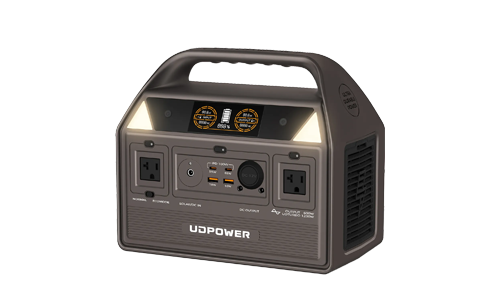
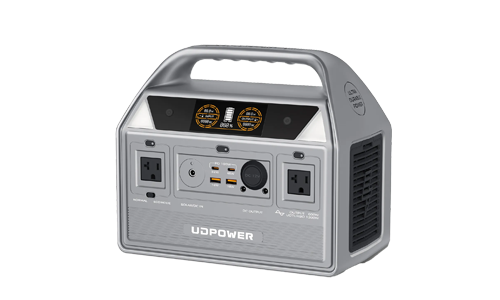
The UDPOWER S2400 sits in the 2000W-class category but provides 2,400W rated AC output and 2,083Wh of battery capacity.
UDPOWER S2400 Portable Power Station

| Specification | UDPOWER S2400 | Why It Matters for Refrigerator Backup | Official Source |
|---|---|---|---|
| Battery capacity | 2,083Wh | Determines available stored energy. | S2400 product page |
| Rated AC output | 2,400W pure sine wave | Provides substantial power headroom for compatible household refrigerators. | S2400 specifications |
| UDTURBO output support | Up to 3,000W | Provides additional high-load capability for compatible appliances. | S2400 specifications |
| AC outlets | 6 | Allows selected essential AC devices to share the station. | S2400 product page |
| Solar input | Up to 400W | Useful for replenishing energy during longer outages. | S2400 product page |
| Battery life | 4,000+ cycles | Designed for repeated portable and backup-power use. | S2400 specifications |
| UPSPRIME transfer | <10ms | Designed for fast transfer during brief grid interruptions. | S2400 specifications |
How Long Could the S2400 Run Different Refrigerators?
For UDPOWER runtime calculations, we use a 90% conversion-efficiency planning assumption.
| Refrigerator Daily Energy Use | Approx. Average Load | S2400 Estimated Runtime | Practical Interpretation | Product Source |
|---|---|---|---|---|
| 1.0kWh/day | 41.7W | About 45.0 hours | Potentially close to two days in refrigerator-only conditions | 2,083Wh S2400 |
| 1.5kWh/day | 62.5W | About 30.0 hours | One full day with additional margin | 2,083Wh S2400 |
| 2.0kWh/day | 83.3W | About 22.5 hours | Close to one day | 2,083Wh S2400 |
| 2.5kWh/day | 104.2W | About 18.0 hours | Strong overnight backup | 2,083Wh S2400 |
This is exactly why the S2400 appears here as an example, rather than being used as the definition of a “2000W power station.” Its 2,083Wh capacity and 2,400W output are specific to this model.
Can Solar Panels Extend Refrigerator Runtime?
Yes. Once solar charging is added, the question changes from:
“How long will the battery last?”
to:
“How much of the refrigerator's daily energy can I replace each day?”
Suppose your refrigerator consumes 1.5kWh per day. If your solar setup delivers 1.0kWh of actual energy into the power station during the day, the battery only needs to cover the remaining net energy demand plus overnight operation.
But panel nameplate wattage is not the same as daily harvested energy.
Real solar input changes with:
- cloud cover,
- shade,
- sun angle,
- season,
- panel temperature,
- charging-controller limits,
- and available peak-sun hours.
| Actual Average Solar Input | Effective Charging Time | Energy Collected | Equivalent Portion of 1.5kWh Fridge Day | Method / Related Guide |
|---|---|---|---|---|
| 100W | 4 hours | 400Wh | About 27% | Refrigerator solar sizing |
| 150W | 4 hours | 600Wh | About 40% | Refrigerator solar sizing |
| 200W | 4 hours | 800Wh | About 53% | Refrigerator solar sizing |
| 300W | 4 hours | 1,200Wh | About 80% | Refrigerator solar sizing |
The table uses actual average input displayed by the power station, not the solar panel's advertised maximum wattage.
For a full solar sizing calculation, read How Many Solar Panels Do I Need to Run a Refrigerator?
How to Use a 2000W Power Station for Refrigerator Backup During an Outage
The best refrigerator backup plan is not simply buying the largest battery you can afford. You want to know the refrigerator's real demand before the outage begins.
Before an outage
- Check the refrigerator's EnergyGuide kWh/year rating.
- Measure real consumption for 24–72 hours if possible.
- Observe startup or maximum watts.
- Make sure the power station can handle the startup demand.
- Fully charge the power station.
- Test the refrigerator on battery power before an emergency.
- Keep an appliance thermometer in the refrigerator.
- Keep required charging and solar cables accessible.
When the power goes out
- Connect the refrigerator first before adding optional loads.
- Keep refrigerator and freezer doors closed as much as possible.
- Monitor the power station's live output.
- Watch remaining battery percentage instead of relying only on a pre-calculated runtime.
- Use solar charging during available daylight if your system supports it.
- Avoid unnecessary high-wattage appliances when the refrigerator compressor is starting.
- Reduce nonessential loads if battery percentage is dropping faster than expected.
Don't Let the Runtime Number Replace Food-Safety Guidance
According to FoodSafety.gov , a refrigerator can generally keep food safe for up to 4 hours during a power outage if the door remains closed.
Refrigerator temperature should be kept at 40°F (4°C) or below. Do not rely on the fact that food still “feels cold” as your only safety check.
For a complete food-safety explanation, see How Long Can a Fridge Be Off For?
How to Choose the Right 2000W Power Station for a Refrigerator
If refrigerator backup is the main reason you are shopping for a portable power station, compare more than the headline watt rating.
| What to Check | Why It Matters | Better Question to Ask | Where to Verify |
|---|---|---|---|
| Battery capacity | Primary driver of runtime | How many Wh are actually stored? | Manufacturer specification page |
| Continuous AC output | Must support normal refrigerator operation | Can the inverter handle my refrigerator and other loads? | Manufacturer specification page |
| High-load capability | Important for compressor startup behavior | What happens when the compressor starts? | Power station manual and refrigerator test |
| Pure sine wave AC | Appropriate for household AC appliance operation | What waveform does the inverter provide? | Manufacturer specification page |
| Solar input | Can extend backup during multi-day outages | How much solar can the station actually accept? | Manufacturer charging specifications |
| Recharge speed | Determines recovery time between outages or battery cycles | How quickly can I restore the battery? | Manufacturer charging specifications |
| Battery chemistry and cycle life | Relevant for repeated backup use | How is the battery designed for repeated cycling? | Manufacturer specification page |
You can compare current UDPOWER options on the Portable Power Station collection .
The Bottom Line
The question “How long will a 2000W power station run a refrigerator?” has one important catch:
2000W alone cannot tell you the runtime.
A 2000W rating describes inverter output. Battery capacity in Wh and refrigerator energy consumption in kWh/day determine how long the appliance can keep running.
If the station has roughly a 2,000Wh battery, using the generic 85% planning factor gives approximately:
- 34 hours at a 50W average refrigerator load,
- 22.7 hours at 75W average,
- 17 hours at 100W average,
- and 11.3 hours at 150W average.
But those numbers are only useful if the average load is accurate.
For the best real-world estimate, use your refrigerator's EnergyGuide kWh/year or measure its actual consumption for 24–72 hours. Then compare that energy requirement with the power station's battery capacity.
In short:
Output watts tell you whether the refrigerator can run.
Battery watt-hours tell you how long it can run.
Refrigerator kWh/day tells you how quickly that battery will be used.
Frequently Asked Questions
How long will a 2000W power station run a refrigerator?
The 2000W rating alone cannot determine runtime. If the power station also has about 2,000Wh of battery capacity, a refrigerator averaging 50–100W may run for roughly 17–34 hours using an 85% usable-energy planning assumption. Actual runtime depends on refrigerator energy consumption, temperature, compressor cycling, battery condition, and other connected devices.
Is a 2000W power station enough for a refrigerator?
For many household refrigerators, 2000W of continuous AC output provides substantial running-power headroom. However, you still need to verify compressor startup demand and the power station's supported maximum output.
Is a 2000W power station the same as a 2000Wh power station?
No. Watts measure power output at a moment in time, while watt-hours measure stored energy. A 2000W power station could contain a 1,000Wh, 1,500Wh, 2,000Wh, or larger battery.
How long will a 2000Wh battery run a 100W refrigerator?
Using an 85% usable-energy planning factor, a 2,000Wh battery provides about 1,700Wh of usable AC energy. At a true 100W average load, the calculated runtime is approximately 17 hours.
How long will a 2000Wh battery run a 50W refrigerator?
At an average 50W load and an 85% planning factor, estimated runtime is about 34 hours. The key word is average: a refrigerator can draw considerably more than 50W when its compressor is actively running.
Why shouldn't I calculate runtime from refrigerator running watts?
Because the compressor normally does not run at the same wattage continuously for 24 hours. Daily kWh consumption captures the refrigerator's on-and-off cycling and usually provides a more useful battery-runtime estimate.
Where can I find my refrigerator's daily electricity use?
Look at the yellow EnergyGuide label for annual kWh consumption and divide that number by 365. For a more personalized result, measure the refrigerator with a plug-in electricity monitor for at least 24 hours.
How long will a 500 kWh/year refrigerator run on a 2000Wh power station?
A 500 kWh/year refrigerator averages about 57.1W over the year. With a 2,000Wh battery and an 85% usable-energy planning factor, estimated refrigerator-only runtime is approximately 29.8 hours.
Can a 2000W power station run a refrigerator overnight?
In many cases, yes, provided the battery capacity is large enough. For example, a 2,000Wh battery generally provides enough calculated energy for overnight operation across a wide range of refrigerator consumption levels. Startup compatibility still needs to be checked.
Can a 2000W power station run a refrigerator for 24 hours?
It depends on battery capacity and refrigerator energy use. With a 2,000Wh battery and an 85% planning factor, you have about 1.7kWh of estimated usable AC energy. A refrigerator consuming less than roughly 1.7kWh per day may mathematically approach or exceed 24 hours in refrigerator-only conditions.
Can a 2000W power station run a refrigerator and freezer at the same time?
It may have enough inverter output, but runtime depends on the combined daily energy consumption and startup behavior of both appliances. Add their measured kWh/day together before calculating battery runtime.
Can solar panels make a refrigerator run longer?
Yes. Solar can replace part of the energy consumed during the day and extend backup time. Whether it can keep pace depends on actual solar production, refrigerator daily kWh use, weather, available sunlight, and the power station's charging-input limit.
How can I get the most accurate refrigerator runtime estimate?
Measure the refrigerator's actual kWh consumption for 24–72 hours, confirm its compressor startup demand, find the power station's battery capacity in Wh, and apply a realistic usable-energy factor. This is more reliable than using a generic refrigerator wattage.
Find the Right Refrigerator Backup Power
Start with your refrigerator's actual energy use, decide how many hours of backup you need, and then choose enough battery capacity and inverter output to provide comfortable operating margin.
Compare UDPOWER Portable Power Stations View the UDPOWER S2400 Check Your Refrigerator's Power Use Read the Refrigerator Compatibility GuideSources and Calculation Notes
Generic runtime examples in this article use:
The 85% factor is a conservative planning assumption used for the generic examples and is not presented as the measured efficiency of every portable power station. Actual usable energy varies by inverter, battery management system, load level, temperature, standby consumption, and product design.
UDPOWER S2400 examples use a 90% conversion-efficiency planning assumption and the official 2,083Wh capacity.
Related Articles


