

Dispersed Camping 101: Rules, Legal Campsites, Gear & Off-Grid Power
Dispersed camping can give you something a developed campground rarely can: more space, fewer neighbors, no reservation loop, and a campsite that feels genuinely away from it all. The trade-off is that nobody has prepared the site for you. There may be no drinking water, toilet, trash service, cell signal, picnic table, electrical hookup, or ranger nearby.
More importantly, seeing public land on a map does not automatically mean you can drive to any open patch of ground and camp there. Land-management rules, vehicle routes, seasonal closures, fire restrictions, local stay limits, and designated camping zones can all change what is legal.
Quick Answer
Dispersed camping means camping outside a developed campground, usually without services or hookups. It is commonly available on Bureau of Land Management land and in many National Forests, but the exact rules are local.
For a first trip, identify the land manager, verify that overnight camping is allowed, confirm the road is legal for your vehicle, check current closures and fire restrictions, choose an already-disturbed campsite, bring your own water and waste system, and arrive with enough daylight to evaluate the road and site.
A good beginner plan is a one- or two-night vehicle-based trip with two backup campsites rather than driving deep into unfamiliar country after dark.

What Is Dispersed Camping?
In the United States, dispersed camping generally means staying overnight outside a developed campground on land where that type of camping is allowed. Instead of pulling into a numbered campsite with a reservation, picnic table, restroom and water spigot, you usually find an existing low-impact site along an authorized road or in another area permitted by the land manager.
The U.S. Forest Service describes dispersed camping as camping in a National Forest outside a developed campground. The Bureau of Land Management uses the term for camping away from developed recreation facilities.
That means you should plan as though the campsite provides nothing: no potable water, no toilet, no garbage pickup, no electrical outlet, no level parking pad and potentially no cell service.
| Camping Style | Typical Site | Services | Reservation | Best For |
|---|---|---|---|---|
| Developed campground | Numbered or defined campsite | May include toilets, water, tables, fire rings or hookups | Often reservable or first-come | Beginners who want predictable access and amenities |
| Open dispersed camping | Existing low-impact site outside a developed campground | Usually none | Usually none | Self-sufficient tent, car, van and RV campers |
| Designated dispersed camping | Specific numbered or approved primitive sites in a larger dispersed area | Usually limited | Often first-come, but local rules apply | High-use public-land areas where camping impact is being controlled |
| Backcountry camping | Reached mainly on foot, horseback or water | Usually none | Permit requirements vary | Campers prepared to travel away from their vehicle |
| Boondocking / dry camping | Broad RV term for camping without utility hookups | No hookups | Depends on location | Vans and RVs operating self-contained |
If you want a shorter explanation focused specifically on what makes a site a dispersed campsite, see our What Is a Dispersed Campsite? guide.
Where Is Dispersed Camping Legal?
The two land systems most American dispersed campers encounter are Bureau of Land Management land and National Forest System land. Both offer large dispersed-camping opportunities, but neither should be treated as one giant nationwide campground.
| Land Type | Is Dispersed Camping Common? | What You Must Verify | Official Starting Point |
|---|---|---|---|
| BLM land | Yes, on many lands unless closed or specially restricted | Field-office rules, stay limit, road access, closures, fire restrictions and local permits | BLM Camping |
| National Forests & Grasslands | Common in many forests, but local restrictions vary substantially | Specific forest/ranger district rules, Forest Orders, MVUM, seasonal closures and fire restrictions | U.S. Forest Service Dispersed Camping Guide |
| National Parks | Do not assume open dispersed vehicle camping | Park-specific backcountry zones, permits, designated campsites and overnight parking rules | Check the individual National Park Service unit before traveling |
| State forests / state trust lands | Depends heavily on the state | Permit, pass, overnight permission, vehicle access and fire rules | State land-management agency |
| Private land | Only with permission | Landowner permission and legal access | Landowner / local parcel information |
Dispersed does not always mean “camp anywhere”
High-use public lands sometimes change from open dispersed camping to designated dispersed camping. A useful example is the BLM's Hurricane Cliffs area in Utah, where camping is limited to designated numbered dispersed campsites rather than every open patch of ground.
See the BLM Hurricane Cliffs designated dispersed camping information for an example of how a high-use area can operate differently from the general rule.
The Rule Most Dispersed Camping Guides Oversimplify
There is no single stay limit, water setback, vehicle-access rule or campfire rule that applies to every dispersed campsite in the United States.
BLM's current general guidance says dispersed camping is generally limited to 14 days within a 28-day period, but BLM itself notes that the limit can vary by state and field office. The Forest Service is even more location-specific: individual National Forests and Ranger Districts can issue their own occupancy and use rules.
| Example | Published Rule | What It Teaches You | Source |
|---|---|---|---|
| BLM general guidance | Generally 14 days within a 28-day period; local rules may differ | “14 days” is a starting point, not permission to ignore a local field-office rule | BLM |
| Eldorado National Forest | Published maximum outside developed campgrounds: 10 days per district per calendar year | A National Forest can use a very different limit from BLM's general rule | Forest Service |
| Chequamegon-Nicolet National Forest | Current occupancy order prohibits remaining at the same dispersed location more than 21 days in a 28-day period | Even the definition of a long stay changes by forest | Forest Service Order |
Distance rules vary too. BLM's current general camping guidance advises staying at least 200 feet from lakes, rivers and streams. Some individual National Forest areas publish 100-foot rules, others publish 200-foot rules, and special zones can differ again.
So instead of memorizing a universal number, use this rule: find the local rule first, then choose a campsite that meets or exceeds it.
How to Find a Legal Dispersed Campsite: The Pin-to-Permission Method
Camping apps, satellite imagery and community reviews are excellent discovery tools. They are not the final authority. A safer workflow separates finding a possible site from proving you may legally use it.
Step 1: Identify who manages the land
Before choosing the campsite, determine whether the land is BLM, National Forest, state, tribal, National Park Service, county or private property. Do not rely on a map color without checking the legend and boundary.
For BLM land, start with the official BLM maps. For National Forest land, identify the individual National Forest and Ranger District.
Step 2: Search the exact management unit
Search the official agency website for the name of the forest, BLM field office or recreation area plus terms such as:
- dispersed camping
- occupancy and use
- alerts and notices
- forest orders
- fire restrictions
- road closures
- motor vehicle use map
This is more reliable than searching only “free camping near me,” because the legal answer usually lives on a local agency page rather than a national travel guide.
Step 3: Verify that your road is legal
A campsite can be legal while your route to it is not. On National Forest land, the Motor Vehicle Use Map (MVUM) is one of the most useful documents for vehicle-based dispersed campers.
MVUMs show roads, trails and areas designated for motorized use, vehicle classes, seasonal allowances and some dispersed-camping travel allowances. A route not shown as open to your vehicle should not be treated as a legal shortcut simply because tire tracks are visible.
See this Forest Service MVUM explanation and finder example.
Step 4: Check current temporary closures
An MVUM tells you about legal motorized designations, but it may not show every temporary closure caused by wildfire, flooding, washouts, snow, landslides or road work. Check the management unit's current alerts immediately before the trip.
Step 5: Check the fire restriction separately
Do not assume a campsite's existing stone fire ring means fires are currently legal. Fire restrictions can change faster than campsite reviews and saved maps.
Step 6: Save your evidence offline
Before losing cell service, download or screenshot:
- the land-management map;
- the local dispersed-camping rule page;
- the applicable MVUM or road map;
- current closure and fire-restriction information;
- your route back to pavement;
- contact information for the local office.
Step 7: Build three options, not one
Save a Site A, Site B and Site C before leaving home. Your first choice may be occupied, inaccessible after rain, closed, too rough for your vehicle or simply unsuitable once you see it in person.
The 10-Minute Dispersed Campsite Safety Check
Before unloading the cooler and opening the tent, walk the site. Ten minutes of inspection is much easier than moving an entire camp later.
| Check | What to Look For | Reason to Leave |
|---|---|---|
| Permission | Correct land unit, camping allowed, no closure or posted restriction | Private property, no-camping sign, restricted zone or uncertain boundary |
| Existing impact | Previously disturbed, durable campsite that does not require clearing vegetation | You would need to create a new track, flatten plants or enlarge the site |
| Road condition | You can safely drive both in and out with your actual vehicle | Deep mud, snow, washed-out shelf road, large rocks or no turnaround |
| Weather exposure | Ground is not a drainage path and site is protected from obvious hazards | Dry wash, narrow canyon during storm risk, flood debris or exposed ridge in severe weather |
| Overhead hazards | Healthy surroundings with no obvious unstable branches or rocks above camp | Dead overhead limbs, damaged trees, loose rock or burn-scar hazards |
| Water protection | Site satisfies the local land manager's setback rule | Site is too close to water, spring, wetland or sensitive riparian vegetation |
| Exit route | Vehicle is pointed or positioned for an uncomplicated departure | Trailer or vehicle can enter but cannot safely turn around |
| Waste plan | You can legally and responsibly handle human waste and trash | No legal waste method for the site or local pack-out requirement you cannot meet |
| Neighbor impact | Enough space to avoid crowding another established camp | You would effectively be camping inside another group's site |
On unfamiliar dirt roads, stop before the road becomes a commitment. Walking a rough section first is cheaper than discovering halfway through that your vehicle cannot clear a rock, cross a rut or turn around.
Pros and Cons of Dispersed Camping
| Advantages | Trade-Offs |
|---|---|
| Often free or inexpensive where permitted | No guaranteed campsite when you arrive |
| More privacy and space than many developed campgrounds | No restroom, potable water or trash service in most locations |
| No electrical hookup means quieter, more remote locations | You must bring and manage your own energy |
| Good access to public-land scenery and dark skies | Road quality and weather can determine whether the site is accessible |
| Flexible trip style without a campground loop | More research is required to prove that a campsite and route are legal |
| Works well for tents, vehicle camping, vans and capable RVs | Large RVs may be limited by road width, grade, tree clearance and turnaround room |
The freedom is real, but dispersed camping transfers work from the campground operator to you. You become responsible for site research, water, sanitation, power, weather, road access and leaving the site in good condition.
Dispersed Camping Gear Checklist: Pack for Failure, Not Just Comfort
A generic camping checklist tells you to bring a tent and sleeping bag. A more useful dispersed-camping checklist asks: what happens when the nearest faucet, restroom, electrical outlet and cell tower are not available?
Sleep and shelter
- Tent, vehicle sleeping system or RV appropriate for expected weather
- Sleeping bag or quilt rated for overnight conditions
- Sleeping pad
- Rain protection
- Extra layers for temperature changes after sunset
Water and food
- Enough drinking and cooking water for the trip plus an emergency reserve
- Food that does not depend entirely on a campfire
- Cooler or 12V camping refrigerator where appropriate
- Food-storage method appropriate for local wildlife rules
- Simple cleaning system that keeps wash water away from natural water sources
Navigation and communication
- Downloaded offline maps
- Saved local rules and MVUM where applicable
- Backup navigation method
- Headlamp plus spare light
- Emergency communication device for trips beyond reliable cell service, when appropriate
Vehicle and road recovery
- Full-size or serviceable spare tire
- Jack and tools that actually work with your vehicle
- Tire-pressure gauge
- Portable air compressor for remote-road travel
- Basic tire repair equipment if you know how to use it
- Recovery gear suited to your vehicle and terrain
- Extra fuel margin instead of planning to reach the campsite on an almost-empty tank
Waste and sanitation
- Trash bags, including one dedicated to micro-trash
- Portable toilet or approved waste bags where appropriate
- Trowel only where catholes are permitted
- Toilet-paper pack-out bags
- Handwashing or sanitizing supplies
Power
- Charged power banks or portable power station
- Charging cables for every essential device
- 12V charging cable if you plan to recharge while driving
- Portable solar panel for longer stationary trips where sunlight is dependable
For a deeper electricity-focused checklist, read our Camping Power Station Buying Guide.
Water, Toilets, Trash and Wildlife: The Part You Have to Provide Yourself
Carry more water than your perfect-day calculation
Do not build your entire water plan around finding a stream or spring. Natural water can be seasonal, inaccessible or contaminated, and treating water does not solve every contamination problem.
Calculate drinking, cooking, pet, hygiene and cleanup needs based on the weather, elevation, activity level and number of people in your group, then carry an emergency reserve. Hot desert camping requires a very different water plan from a cool overnight trip near home.
Know whether you must pack out human waste
Leave No Trace recommends packing out waste where required or appropriate. Where catholes are permitted, its general guidance is to dig a cathole 6–8 inches deep and at least 200 feet from water, camp and trails. Local regulations can be stricter and some areas require full pack-out, so check the local rule before assuming burial is allowed.
Read Leave No Trace: Dispose of Waste Properly.
Micro-trash counts
Bottle caps, food wrappers, twist ties, foil scraps, fruit stickers, cigarette filters, pieces of toilet paper and food scraps are all trash. Before leaving, walk the site slowly rather than judging it from the driver's seat.
Do not wash directly in a stream or lake
Carry washing water away from natural water sources. Leave No Trace recommends moving about 200 feet from streams or lakes for washing and using only small amounts of biodegradable soap where appropriate.
Wildlife rules are local too
Food-storage requirements vary by region and wildlife risk. In bear country, a cooler sitting beside your tent may not be an acceptable storage system. Check the managing agency's current food-storage requirements before the trip.
Campfire Rules: Never Let an Old Fire Ring Answer the Question
Fire restrictions are one of the most time-sensitive parts of dispersed camping. Conditions can change after an article, map screenshot or campsite review was published.
The presence of an old fire ring tells you only that somebody previously had a fire there. It does not tell you whether wood fires, charcoal or even certain flame-producing equipment are legal today.
Before leaving home
- Open the official page for the National Forest, BLM field office or other land manager.
- Check its current alerts and fire restrictions.
- Determine whether a permit is required.
- Check whether the restriction applies only to campfires or also to charcoal and other flame sources.
- Plan meals that do not depend on a wood fire.
Check again on the day you arrive
Fire conditions are dynamic. Make the final check while you still have service rather than relying on information downloaded a week earlier.
How Much Off-Grid Power Do You Need for Dispersed Camping?
Dispersed campsites normally have no electrical hookup, so your power plan should be based on daily watt-hours, not on how many USB ports you expect to use.
Start with watt-hours
A simple estimate is:
Daily energy use (Wh) = device watts × hours used per day
For rechargeable electronics, use the battery energy if it is known or make a conservative allowance for charging losses. Refrigerators, pumps and some other appliances cycle on and off, so their label wattage multiplied by 24 hours can significantly overstate or understate real use depending on conditions.
| Example Camp Load | Planning Assumption | Approx. Daily Energy |
|---|---|---|
| Two phones | About 15Wh each for one full recharge | 30Wh |
| LED camp light | 8W × 5 hours | 40Wh |
| Camera / small-device charging | Trip-dependent allowance | 50Wh |
| Small camp fan | 25W × 8 hours | 200Wh |
| Laptop | 60W × 2 hours | 120Wh |
| 12V refrigerator example | 20W average over 24 hours after cycling | 480Wh |
The refrigerator row is deliberately shown as an average-power example, not a promise. Real consumption changes with ambient temperature, thermostat setting, insulation, how often the lid is opened, food temperature and the specific refrigerator.
Three useful campsite power budgets
| Camping Style | Example Loads | Approx. Daily Need | Battery Class to Consider |
|---|---|---|---|
| Minimal overnight | Phones, lights, camera | About 120Wh/day | 200–300Wh class |
| Comfort camping | Phones, lights, fan, laptop | About 390Wh/day | 500–600Wh class with reserve |
| Fridge-based basecamp | 12V fridge example, phones, lights, laptop | About 670Wh/day | 1,000Wh-class battery or a smaller battery with dependable daily recharge |
Do not count solar twice
Solar should be treated as energy recovery, not guaranteed battery capacity. A 120W panel does not provide 120Wh every hour from sunrise to sunset. Clouds, shade, panel angle, heat, season and the power station's input limits all affect real charging.
For a two-night trip, it is safer to calculate whether the battery can cover the trip's critical loads even if solar underperforms, then treat good solar production as extra margin.
You can learn more in Are Solar Panels Worth It for Camping? and our Off-the-Grid Camping Guide.
Best UDPOWER Power Stations for Dispersed Camping
The best portable power station is not automatically the largest one. For dispersed camping, battery capacity has to be balanced against weight, vehicle space, daily load and your ability to recharge.
| Model | Capacity | Rated AC Output | Weight | Solar Input | Best Dispersed Camping Fit |
|---|---|---|---|---|---|
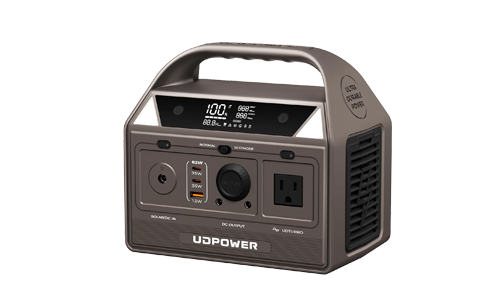
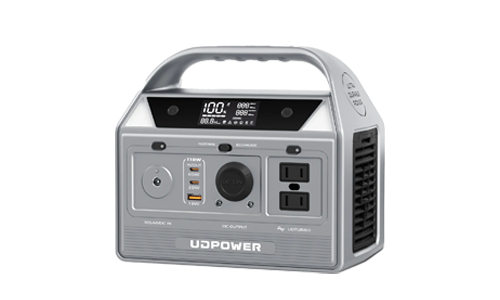
| UDPOWER C400 | 256Wh | 400W pure sine wave, 800W surge | 6.88 lb | Up to 150W | Light overnight trips, phones, lights, cameras, laptop top-offs and small fans |
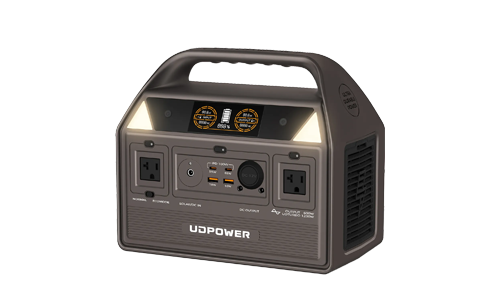
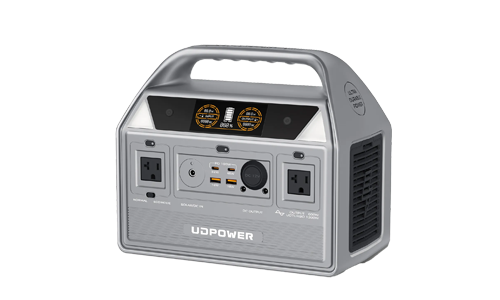
| UDPOWER C600 | 596Wh | 600W pure sine wave, up to 1,200W max | 12.3 lb | Up to 240W within supported input requirements | Weekend car camping, laptops, cameras, fans and moderate campsite loads |
| UDPOWER S1200 | 1,190Wh | 1,200W pure sine wave, UDTURBO up to 1,800W for compatible higher-power devices | 26.0 lb | Up to 400W | Longer weekends, family basecamps, refrigerators and several devices sharing one power source |

UDPOWER C400 — Best for Light, Short Dispersed Camping Trips
The C400 is the easy choice when you would rather save trunk space than carry a large reserve battery. It combines a 256Wh LiFePO4 battery, 400W rated pure sine wave AC output and 800W surge capability in a unit weighing about 6.88 lb.
It is best suited to camps where electricity is mainly for phones, lighting, camera batteries, a laptop top-off and smaller low-wattage gear rather than an all-day refrigerator-based setup.
- 256Wh capacity
- 400W rated AC output
- 800W surge
- 6.88 lb
- LiFePO4 battery
- Up to 150W solar input

UDPOWER C600 — Best Balanced Pick for a Weekend Basecamp
The C600 gives you substantially more energy without moving into a large power-station footprint. It has a 596Wh LiFePO4 battery, 600W rated pure sine wave output, up to 1,200W maximum AC output capability and weighs about 12.3 lb.
It makes sense when your campsite includes a laptop, camera gear, lights, fans, multiple phones and other moderate loads, or when a small overnight battery would leave too little reserve.
- 596Wh capacity
- 600W rated AC output
- Up to 1,200W maximum AC output capability
- 12.3 lb
- LiFePO4 battery
- Up to 240W solar input within the supported voltage range
For solar charging, UDPOWER currently recommends its 120W folding solar panel for the C600. The official panel page specifically notes that the C600 should not be used with the 210W panel.
View UDPOWER C600
UDPOWER S1200 — Best for Longer Weekends and a Powered Basecamp
When the campsite becomes a multi-device basecamp, the S1200 gives you more room to handle daily energy uncertainty. The current 5-AC version has a 1,190Wh capacity, 1,200W rated pure sine wave output, UDTURBO support up to 1,800W for compatible higher-power devices, and 14 total output ports.
At about 26.0 lb, it is better suited to vehicle-based camping than carrying any significant distance. Its larger battery reserve fits longer weekends, family camps, portable refrigerators, laptop work, lighting and several people sharing one power source.
- 1,190Wh capacity
- 1,200W rated AC output
- UDTURBO up to 1,800W for compatible higher-power devices
- 14 output ports on the current 5-AC version
- 26.0 lb
- LiFePO4 battery
- Up to 400W solar input

UDPOWER 120W Portable Solar Panel — Add Daily Energy Recovery
For camps where the vehicle will stay parked for several days, a portable panel can reduce how much battery capacity you have to bring from home. The UDPOWER 120W panel uses monocrystalline cells, is rated at 120W, lists 22% or higher conversion efficiency and has an IP65 weather-resistance rating.
Solar production still depends on direct sunlight, season, panel angle, temperature, shade and the connected power station's input limits. Repositioning the panel through the day can make more difference than simply leaving it wherever camp was easiest to set up.
View 120W Portable Solar PanelTo browse by camping style instead of individual model, visit Portable Power Stations, Solar Generators or Portable Solar Panels.
A Beginner-Friendly First Dispersed Camping Trip
Your first dispersed trip does not have to be the most remote campsite you can find. The goal is to learn the process while keeping the consequences of a mistake small.
48 hours before departure
- Choose one BLM field office or one National Forest/Ranger District.
- Confirm that dispersed camping is currently permitted in your target area.
- Download the relevant map or MVUM.
- Check the weather forecast and recent precipitation.
- Check current fire restrictions.
- Save Site A, Site B and Site C.
- Fill fuel before entering the backcountry.
- Charge every essential battery and portable power station.
- Tell someone where you expect to be and when you expect to return.
Arrival day
Plan to reach the public-land road with at least a couple of hours of usable daylight. If the road gets rough, stop and inspect it before committing. If Site A is occupied or unsafe, move to Site B instead of trying to squeeze into vegetation beside another camper.
Once parked, do the site check before unloading. Confirm weather exposure, drainage, tree hazards, road clearance, water setback and your ability to leave.
First evening
- Keep food and scented items stored according to local wildlife rules.
- Protect batteries and electronics from rain, excessive heat and direct campfire exposure.
- Keep your keys, headlamp and shoes in the same predictable place.
- Note where the road exits instead of relying on phone service after dark.
Departure morning
- Pack your own gear first.
- Walk the entire campsite for trash.
- Check the fire area carefully if fires were legal and used.
- Look beneath the vehicle for dropped items.
- Pick up small trash left by previous users when practical.
- Leave without widening roads or creating a new exit track.
12 Common Dispersed Camping Mistakes
- Assuming “BLM land” means every square foot is open to camping. Local closures and designated areas still apply.
- Using a campsite app as legal proof. Use apps to discover possibilities; use the land manager to verify permission.
- Assuming every National Forest uses a 14-day limit. Individual forests and districts can publish very different limits.
- Arriving after dark. Darkness hides road damage, drainage channels, low branches and poor turnaround space.
- Driving off the authorized route to create a better campsite. Existing tire tracks do not necessarily make cross-country driving legal.
- Building a new campsite next to an empty existing one. Concentrating use on already-disturbed ground usually creates less impact.
- Assuming an old fire ring means today's fire is legal. Always check current restrictions.
- Planning water with no reserve. A hot day, delayed departure or unavailable water source can quickly change your needs.
- Underestimating road conditions after rain. A dry dirt road and the same road after a storm may be completely different routes.
- Buying battery capacity without calculating daily energy. Start with Wh/day, then choose the battery.
- Assuming solar will deliver nameplate output all day. Shade, weather and panel angle can reduce energy recovery.
- Leaving food scraps because they are “biodegradable.” Food waste is still waste and can attract wildlife.
When Dispersed Camping Is Not the Right Choice
A developed campground is sometimes the smarter trip, especially when the conditions remove the margin for learning.
Consider changing plans when:
- major fire restrictions or nearby wildfire activity make the area unsuitable;
- heavy rain creates flash-flood or impassable-road risk;
- snow or mud exceeds your vehicle's capability;
- you cannot verify land ownership or overnight permission;
- your only campsite requires questionable off-route driving;
- you do not have enough water or a legal waste solution;
- your vehicle cannot safely turn around on the access road;
- you would arrive deep in unfamiliar terrain after dark;
- the trip depends on cell service that does not exist there;
- you have no backup campsite if the first location is occupied.
Turning around is not a failed camping trip. It is one of the basic skills that makes remote camping sustainable.
Dispersed Camping vs. Developed Campground: Which Should You Choose?
| Question | Dispersed Camping | Developed Campground |
|---|---|---|
| Want privacy? | Usually better | Sites may be close together |
| Need a guaranteed place to sleep? | No guarantee | Reservation may provide certainty |
| Need toilets or potable water? | Usually bring your own solution | More likely to be available |
| Driving a large RV? | Research road width, clearance and turnaround carefully | Published site length makes planning easier |
| First-ever camping trip? | Possible with preparation and a conservative location | Usually easier for learning basic camping skills |
| Need electricity? | Bring a portable power system | Some developed sites offer hookups |
| Want no reservation schedule? | Major advantage | Popular campgrounds can book early |
Frequently Asked Questions About Dispersed Camping
What does dispersed camping mean?
Dispersed camping generally means camping outside a developed campground in an area where overnight camping is permitted. The site usually has no potable water, toilet, trash service, reservation system or electrical hookup.
Is dispersed camping free?
It is often free on BLM and National Forest lands, but not universally. Some areas require permits, passes, designated sites or other fees. Check the exact land-management unit before traveling.
Can you camp anywhere on BLM land?
No. BLM allows dispersed camping on many public lands, but closed areas, special recreation zones, designated-site areas, vehicle restrictions, local stay limits, fire restrictions and other rules can apply. Verify the specific BLM field office or recreation area's current rules.
Can you camp anywhere in a National Forest?
No. Many National Forests provide extensive dispersed-camping opportunities, but individual forests and Ranger Districts may restrict camping near developed areas, water, roads, high-use zones or sensitive resources. Forest Orders and Motor Vehicle Use Maps may also affect access.
Is dispersed camping always limited to 14 days?
No. BLM's general rule is typically 14 days within a 28-day period, but BLM local offices can differ. National Forest stay limits vary by forest and district, with published examples ranging well outside a single nationwide 14-day rule.
How far should a dispersed campsite be from water?
Follow the specific land manager's rule for your location. BLM's current general guidance says to stay at least 200 feet from lakes, rivers and streams, while individual National Forest areas can publish different setback requirements. Do not assume one number applies everywhere.
Do you need a permit for dispersed camping?
Many dispersed-camping areas do not require a standard campsite reservation or permit, but permits can be required for specific areas, activities, group sizes or fires. Check the local agency rather than assuming no permit is needed.
Can you have a campfire while dispersed camping?
Only when current regulations allow it. Fire restrictions can temporarily prohibit wood fires or impose additional limits. An existing fire ring does not prove that a fire is legal today.
Can you dispersed camp in a van or RV?
Yes, where overnight camping and vehicle access are allowed, but vehicle size changes the site-selection problem. Check road width, grade, surface, overhead clearance, parking space and turnaround room before taking a large RV or trailer down an unfamiliar road.
How do beginners find dispersed campsites?
Start by identifying BLM or National Forest land, then verify the exact local dispersed-camping rules on the official agency website. For vehicle travel in a National Forest, check the applicable Motor Vehicle Use Map. Use camping apps and satellite maps to discover possible sites, but use official rules to confirm legality.
Is a portable power station useful for dispersed camping?
Yes when your trip uses phones, lights, cameras, laptops, fans, a 12V refrigerator or other electronics. Choose capacity by estimating your daily watt-hour consumption and leave reserve for poor weather or lower-than-expected solar charging.
Should a beginner use solar panels while dispersed camping?
Solar can be useful on multi-day vehicle-based trips, but it should not be treated as guaranteed energy. Shade, clouds, season, panel position and charging-input limits can reduce production. Begin the trip with the battery fully charged and treat solar as a way to extend your energy budget.
Official Sources Used for This Guide
Rules change, so these sources are intended as starting points. Always check the individual forest, ranger district, BLM field office or other management unit for the place you plan to visit.
| Source | Useful For | Link |
|---|---|---|
| Bureau of Land Management | General dispersed-camping rules, stay limits, road use and camping practices | BLM Camping |
| Bureau of Land Management | Public-land maps and local map resources | BLM Maps |
| U.S. Forest Service | National Forest dispersed-camping overview and reminder that motor-vehicle rules vary by forest | Forest Service Guide |
| U.S. Forest Service | Understanding Motor Vehicle Use Maps and legal motorized routes | MVUM Information |
| Leave No Trace | Waste disposal, catholes, trash and washing away from natural water | Dispose of Waste Properly |
Build Your Dispersed Camping Power Setup
Start with what you actually need to run each day, then choose enough battery capacity to cover the trip with a useful reserve. Add solar when the trip is long enough and the campsite has dependable sunlight.
Compare Portable Power Stations View Solar Generator Setups Get the Camping Power Sizing GuideLast updated: August 7, 2026. Public-land access, fire restrictions, stay limits and road conditions can change. Verify current local rules with the responsible land-management agency before every trip.
Related Articles


