

Battery Cycle Life Explained: What 4,000 Cycles Mean
Last updated: July 15, 2026
A portable power station advertised for 4,000 battery cycles sounds as though it should last almost forever. But that number is easy to misunderstand. It does not mean you can plug the station in exactly 4,000 times, and it does not mean the battery suddenly stops working on cycle 4,001.
This guide explains what a battery cycle actually is, how partial discharges are counted, what the common 80% capacity threshold means, how to estimate years of service, and which battery-life specifications deserve the most attention when comparing portable power stations.
Quick Answer: What Does 4,000 Battery Cycles Mean?
Four thousand cycles usually means the battery can complete about 4,000 equivalent full discharge-and-recharge cycles before its usable capacity falls to a specified test threshold.
One cycle is based on the total amount of energy used—not the number of times you connect a charger. Using 50% of the battery today and another 50% tomorrow adds up to approximately one equivalent full cycle.
At one full equivalent cycle every day, 4,000 cycles equals about 11 years. At four cycles per week, it equals about 19 years. Actual service life may be shorter because batteries also age with time, temperature, storage conditions, charging power, and operating load.
A battery reaching 80% capacity is normally still usable. It simply stores about 20% less energy than it did when new, so runtime becomes shorter.

What Counts as One Battery Cycle?
A battery cycle measures cumulative energy removed from and restored to a battery. It is often called an equivalent full cycle, or EFC.
You do not need to discharge a power station from 100% to 0% in one session for a cycle to count. Smaller discharges add together over time.
| Usage pattern | Total battery capacity used | Approximate equivalent cycles |
|---|---|---|
| Use from 100% to 0%, then recharge | 100% | 1.0 cycle |
| Use 50%, recharge, then use another 50% | 100% total | 1.0 cycle |
| Use 25% on four separate days | 100% total | 1.0 cycle |
| Use 10% each day for ten days | 100% total | About 1.0 cycle |
| Recharge from 80% to 100% five times | 100% total energy restored | About 1.0 cycle |
This cumulative method is also used to explain charge cycles in consumer electronics. Apple, for example, states that one cycle is completed after an amount equal to 100% of battery capacity has been used, even when that use occurs across multiple charging sessions. See the battery cycle explanation.
The practical takeaway: Topping up a portable power station after every trip does not automatically consume a complete cycle. What matters most is the cumulative amount of energy that moves through the battery.
A Charge Session Is Not Necessarily a Battery Cycle
People often use the words “charge” and “cycle” as though they mean the same thing. They do not.
| Term | What it measures | Example |
|---|---|---|
| Charge session | Each time the power station is connected to a charging source | Plugging into a wall outlet for 20 minutes |
| Partial discharge | A portion of the battery capacity used between charges | Running the battery from 100% to 70% |
| Equivalent full cycle | Cumulative use equal to 100% of rated battery capacity | Two 50% discharges or four 25% discharges |
| Calendar aging | Battery aging that occurs simply as time passes | Capacity loss while a unit sits unused in a hot garage |
Solar charging can create many short charging sessions as clouds pass over the panels. Those changes do not automatically create separate full cycles. The battery management system tracks energy movement and battery conditions rather than treating every temporary solar interruption as a complete cycle.
What Does “4,000 Cycles to 80% Capacity” Mean?
A cycle count is incomplete unless it is paired with a remaining-capacity threshold. One of the most common thresholds is 80%.
When a manufacturer states that a battery retains at least 80% capacity after a specified number of cycles, it means a battery that originally stored 1,000 watt-hours may store roughly 800 watt-hours at that point under the stated test conditions.
It does not mean the battery is dead. The power station may still operate normally, but the energy “tank” has become smaller. Runtime decreases even though the inverter, outlets, display, and charging system may continue to function.
| Original battery capacity | Capacity at 90% retention | Capacity at 80% retention | Capacity lost at 80% retention |
|---|---|---|---|
| 256Wh | 230Wh | 205Wh | 51Wh |
| 500Wh | 450Wh | 400Wh | 100Wh |
| 1,000Wh | 900Wh | 800Wh | 200Wh |
| 2,000Wh | 1,800Wh | 1,600Wh | 400Wh |
Why the test conditions matter
Cycle life can change depending on how a battery is tested. Important variables include:
- Battery chemistry and cell design
- Depth of discharge used for each test cycle
- Charge and discharge rate
- Cell temperature during testing
- Voltage limits used by the battery management system
- The remaining-capacity threshold used to end the test
Research reviewed by the National Renewable Energy Laboratory describes depth of discharge as an important battery-life variable. See the NREL storage technology modeling report.
A stronger specification: “3,000 cycles to 80% remaining capacity under defined conditions” is more useful for comparison than “4,000 cycles” with no capacity threshold or test information.
How Many Years Can 4,000 Battery Cycles Last?
The simple calculation is:
= 4,000 cycles ÷ equivalent full cycles per year
| Average use | Equivalent full cycles per year | Time required to reach 4,000 cycles | Likely practical interpretation |
|---|---|---|---|
| 1 full equivalent cycle every day | 365 | About 11.0 years | Heavy daily use |
| 5 full equivalent cycles per week | 260 | About 15.4 years | Frequent work, RV, or off-grid use |
| 4 full equivalent cycles per week | 208 | About 19.2 years | Regular multi-day use |
| 2 full equivalent cycles per week | 104 | About 38.5 years | Moderate recreational use |
| 1 full equivalent cycle per week | 52 | About 76.9 years | Calendar aging will matter much sooner |
| 1 full equivalent cycle per month | 12 | About 333 years | Not a realistic battery lifespan estimate |
The last two rows reveal an important limitation of cycle-count math: batteries also age while sitting unused. A light-use owner will not realistically keep the same battery for 77 or 333 years simply because the cycle counter remains low.
Battery researchers generally separate degradation into cycle aging, caused by use, and calendar aging, which occurs with time. Temperature, state of charge, cycling conditions, and battery design can influence both processes. Readers interested in the underlying research can review this review of lithium-ion calendar and cycle aging.
Bottom line: Four thousand cycles can support more than a decade of very heavy daily use, but the cycle count should not be treated as a guaranteed number of calendar years.
Calculate Your Personal Cycle Budget
Most portable power station owners do not drain the battery completely every day. A more realistic estimate begins with the amount of energy your appliances consume.
Step 1: Estimate annual appliance energy
= appliance watts × operating hours × number of use days
Step 2: Account for inverter conversion
AC appliances do not receive every watt-hour stored in the battery. Some energy is used by the inverter and internal electronics. For the planning examples below, this article uses a 90% conversion assumption. Real results vary with load size, temperature, power factor, standby consumption, and operating mode.
= AC energy used ÷ 0.90
Step 3: Convert energy use into equivalent cycles
= annual battery energy used ÷ rated battery capacity
Example using a 1,190Wh power station
| Use pattern | Estimated AC energy delivered | Estimated equivalent cycles per year | Cycle-count-only time to 4,000 cycles |
|---|---|---|---|
| Weekend camping | 700Wh per week | About 34 cycles | About 118 years |
| Emergency backup for 30 days per year | 500Wh per backup day | About 14 cycles | About 286 years |
| 40W device used 8 hours every day | 320Wh per day | About 109 cycles | About 37 years |
| Mixed daily use | 800Wh per day | About 273 cycles | About 14.7 years |
| Near-full equivalent cycle every day | About one battery capacity per day | 365 cycles | About 11 years |
These are planning examples, not guaranteed runtime or lifespan figures. Extremely long cycle-based estimates simply mean calendar aging is more likely to become the limiting factor.
Useful buying insight: Occasional backup users may gain more practical value from choosing the right battery capacity, output power, warranty, and storage conditions than from choosing between two already-high cycle counts.
How Much Lifetime Energy Can 4,000 Cycles Represent?
Cycle count becomes more meaningful when it is combined with battery capacity. Four thousand cycles from a 2,000Wh battery represent much more lifetime energy throughput than 4,000 cycles from a 500Wh battery.
= rated capacity in kWh × cycle count
For a more conservative illustration, assume:
- Capacity gradually declines from 100% to 80%
- Average capacity across the period is approximately 90%
- Average AC conversion efficiency is approximately 90%
= rated capacity × 4,000 × 0.90 average capacity × 0.90 conversion
| Original battery capacity | Nominal throughput across 4,000 cycles | Illustrative battery-side throughput with gradual fade | Illustrative AC energy delivered at 90% conversion |
|---|---|---|---|
| 500Wh | 2,000kWh | About 1,800kWh | About 1,620kWh |
| 1,000Wh | 4,000kWh | About 3,600kWh | About 3,240kWh |
| 1,500Wh | 6,000kWh | About 5,400kWh | About 4,860kWh |
| 2,000Wh | 8,000kWh | About 7,200kWh | About 6,480kWh |
These calculations are illustrations rather than product guarantees. Battery fade is not always perfectly linear, and actual conversion efficiency changes with the appliance. The table is useful because it shows why battery capacity and cycle count should be evaluated together.
How Does Battery Aging Change Real-World Runtime?
The most noticeable effect of battery aging is shorter runtime. Maximum inverter output does not automatically fall in direct proportion to battery capacity, but the station has fewer watt-hours available to keep an appliance running.
The following table uses current UDPOWER rated capacities, 80% remaining battery capacity, and a 90% AC conversion planning assumption.
| Model | Original rated capacity | Battery capacity at 80% retention | Estimated AC energy available at 90% conversion | Simple runtime example at a constant 100W load |
|---|---|---|---|---|
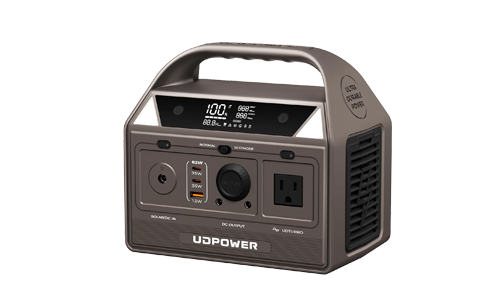
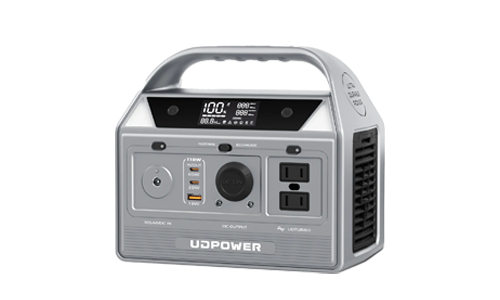
| UDPOWER C400 | 256Wh | About 205Wh | About 184Wh | About 1.8 hours |
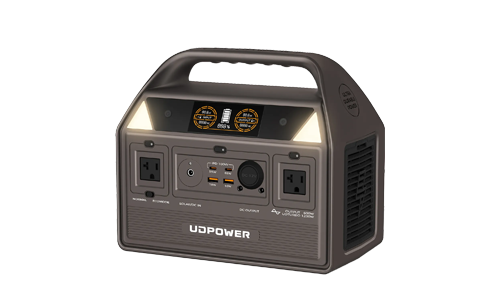
| UDPOWER C600 | 596Wh | About 477Wh | About 429Wh | About 4.3 hours |
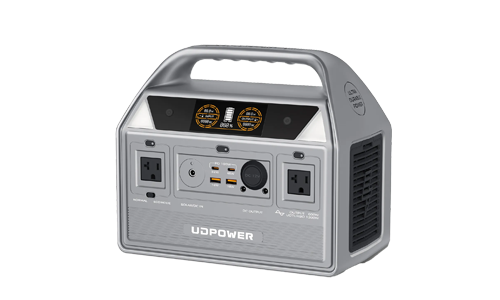
| UDPOWER S1200 | 1,190Wh | About 952Wh | About 857Wh | About 8.6 hours |
| UDPOWER S2400 | 2,083Wh | About 1,666Wh | About 1,500Wh | About 15.0 hours |
Runtime estimates exclude appliance startup surges, cycling compressors, low-load shutdown behavior, temperature effects, and other system consumption. A refrigerator, for example, normally turns on and off instead of drawing its rated power continuously.
What Shortens Battery Cycle Life?
Cycle life is not controlled by a single habit. It reflects the combined effect of temperature, charging conditions, discharge depth, storage, and load.
1. Prolonged heat exposure
High temperature can accelerate unwanted chemical reactions inside a lithium battery. Avoid leaving a power station in a closed vehicle, unventilated shed, or direct summer sun for extended periods.
2. Repeated deep discharges
A full discharge is acceptable when the energy is genuinely needed, but routinely running the station to automatic shutdown can place more stress on the battery than shallower everyday use.
3. Charging outside the published temperature range
Charging a very cold or overheated battery may be restricted by the battery management system. Allow the unit to return to an acceptable temperature before charging and follow the operating limits listed in the product manual.
4. Blocking cooling vents
Inverters and charging components create heat. Do not cover the unit, push it tightly against a wall, or place bags and bedding over the ventilation openings while it is charging or powering appliances.
5. Storing the battery empty for a long period
A stored battery continues to consume a small amount of energy. Leaving it deeply discharged for months may allow the state of charge to fall too low. Check and recharge stored units periodically.
6. Holding the battery at maximum charge in high heat
A full battery is useful before a storm, trip, or outage. The less favorable combination is long-term storage at 100% in a hot environment. Storage temperature and time matter as much as the number displayed on the screen.
7. Sustained loads near the system limit
A power station is designed to support loads within its rated output, but continuous high-power operation creates more heat than a moderate load. Choose a model with enough output headroom rather than planning to operate at its maximum rating for long periods.
Battery-aging research also identifies temperature, depth of discharge, battery chemistry, and cell design as important variables. See this research summary on lithium-ion degradation and modeling.
A Practical Battery-Care Routine
You do not need to constantly watch the battery percentage. A few repeatable habits provide more value than trying to follow a perfect charging schedule every day.
For regular daily use
- Keep the unit in a dry, ventilated location.
- Leave clear space around cooling vents.
- Recharge before the battery remains empty for an extended period.
- Use chargers, solar panels, and cables that meet the input specifications.
- Choose a model with comfortable output headroom for your appliances.
- Let the battery cool after unusually heavy use before immediately recharging at maximum speed.
Before emergency season or a planned trip
- Charge the power station fully when maximum backup time is the priority.
- Test essential devices before the outage or trip.
- Confirm that appliance startup power remains within the inverter limit.
- Inspect charging cables and connectors for damage.
- Update any applicable app or device settings before the unit is needed.
For long-term storage
- Follow the storage state-of-charge guidance in the product manual.
- Avoid hot attics, freezing outdoor storage, and sealed vehicles.
- Check the battery every three to six months.
- Recharge when the state of charge has fallen significantly.
- Turn off outputs that are not required during storage.
Do you need to follow the 40–80 rule? Keeping a lithium battery away from the extremes can reduce stress during routine use, but it is not a reason to limit emergency preparedness. Charging to 100% before a forecast outage is a reasonable use of the battery. Learn more in the 40–80 rule for lithium batteries guide .
How to Compare Battery Cycle-Life Claims
Two products can both advertise “4,000 cycles” while using different test conditions. Use the following checklist before treating the numbers as equal.
| Specification to check | Why it matters | What a useful listing should tell you |
|---|---|---|
| Battery chemistry | Different chemistries have different durability, voltage, weight, and temperature behavior | For example, LiFePO4 or another clearly identified chemistry |
| Cycle count | Shows the claimed amount of cumulative use | A specific number rather than “long lasting” |
| Remaining-capacity threshold | Defines when the cycle-life test is considered complete | For example, at least 80% capacity remaining |
| Depth of discharge | Shallower and deeper test cycles can produce different results | The percentage range used during testing |
| Temperature | Heat and cold can affect degradation and charging behavior | A defined or standardized test environment |
| Charge and discharge rate | Higher current can increase heat and battery stress | The rate used for the cycle test |
| Warranty | A high laboratory cycle count is not the same as warranty coverage | Clear duration, terms, exclusions, and support process |
| Rated watt-hours | Determines the energy represented by each equivalent cycle | A clear Wh capacity, not only an amp-hour figure |
| Rated AC output | Determines which appliances the inverter can operate | Continuous output and surge or peak output |
A simple hierarchy for evaluating claims
- Prefer a cycle claim that includes a remaining-capacity threshold.
- Confirm the chemistry and rated watt-hour capacity.
- Check whether the output rating fits the appliances you plan to use.
- Review the warranty and support terms separately from the cycle claim.
- Treat unusually high numbers without test details as incomplete information rather than a guaranteed lifespan.
UDPOWER Long-Life Portable Power Station Options
The right model depends on the amount of energy and output power you need—not cycle count alone. A smaller battery may have the same cycle rating as a larger model, but each cycle contains fewer watt-hours.
Cycle-rating note: As of July 15, 2026, current UDPOWER product pages use “4,000+ cycles” in prominent product highlights, while detailed battery specification sections for the models below state at least 80% capacity after 3,000 cycles. For a conservative, apples-to-apples comparison, this article uses the detailed 3,000-cycle-to-80% specification and treats 4,000+ cycles as the broader product-page claim.
| Model | Battery capacity | Rated AC output | Surge or maximum output | Approximate weight | Detailed battery specification | Best suited to | Official source |
|---|---|---|---|---|---|---|---|
| UDPOWER C400 | 256Wh | 400W | 800W | 6.88 lb | 80%+ capacity after 3,000 cycles | Road trips, light devices, portable charging, and compact emergency kits | View C400 specifications |
| UDPOWER C600 | 596Wh | 600W | 1,200W | 12.3 lb | 80%+ capacity after 3,000 cycles | Overnight use, camping, mobile work, and moderate essential loads | View C600 specifications |
| UDPOWER S1200 | 1,190Wh | 1,200W | 1,800W surge | About 26 lb | 80%+ capacity after 3,000 cycles | Home backup, refrigerators, CPAP setups, camping, and balanced everyday use | View S1200 specifications |
| UDPOWER S2400 | 2,083Wh | 2,400W | 3,000W surge | 40.8 lb | 80%+ capacity after 3,000 cycles | Higher-power appliances, longer backup periods, RV use, and heavier daily loads | View S2400 specifications |
Choose by the Job You Need the Battery to Do

UDPOWER C600: Portable Capacity for Overnight and Mobile Use
The C600 provides more energy than an ultra-compact charger while remaining easier to carry than a large home-backup unit. Its 596Wh battery and 600W rated AC output make it a practical choice for electronics, lights, lower-power camping equipment, and carefully matched essential devices.
- 596Wh LiFePO4 battery
- 600W rated AC output
- 1,200W maximum output
- Up to 240W solar input
- Approximately 12.3 lb
- Detailed specification: 80%+ capacity after 3,000 cycles
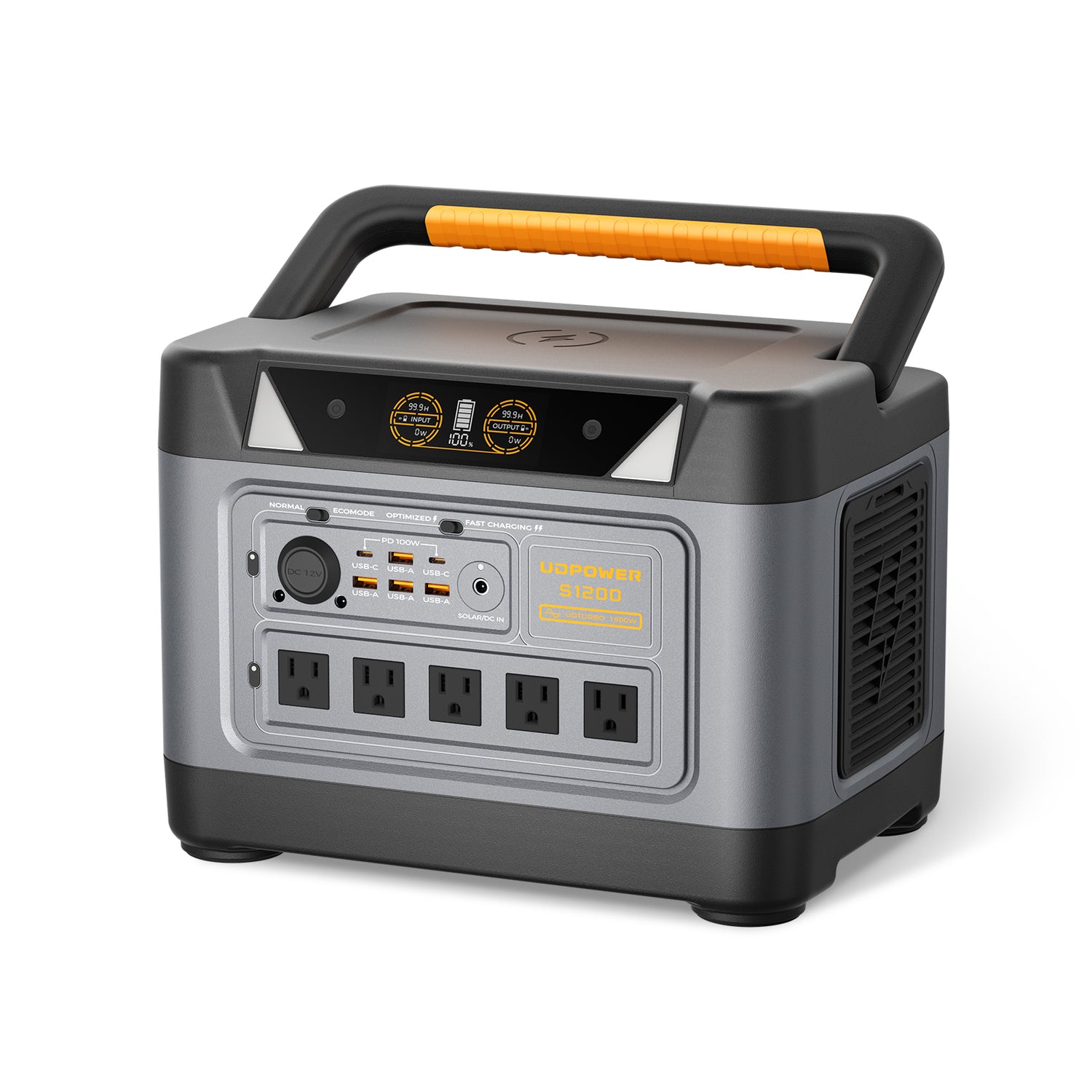
UDPOWER S1200: A Practical Balance of Capacity and Portability
The S1200 is the most balanced option for buyers who want enough capacity for meaningful backup without moving to a 40-pound-class power station. The 1,190Wh battery offers substantially more energy per cycle than a compact unit, while the 1,200W inverter supports a wider range of household and outdoor equipment.
- 1,190Wh LiFePO4 battery
- 1,200W rated AC output
- 1,800W surge output
- Up to 400W solar input
- Less than 10ms UPS transfer specification
- Approximately 26 lb
- Detailed specification: 80%+ capacity after 3,000 cycles
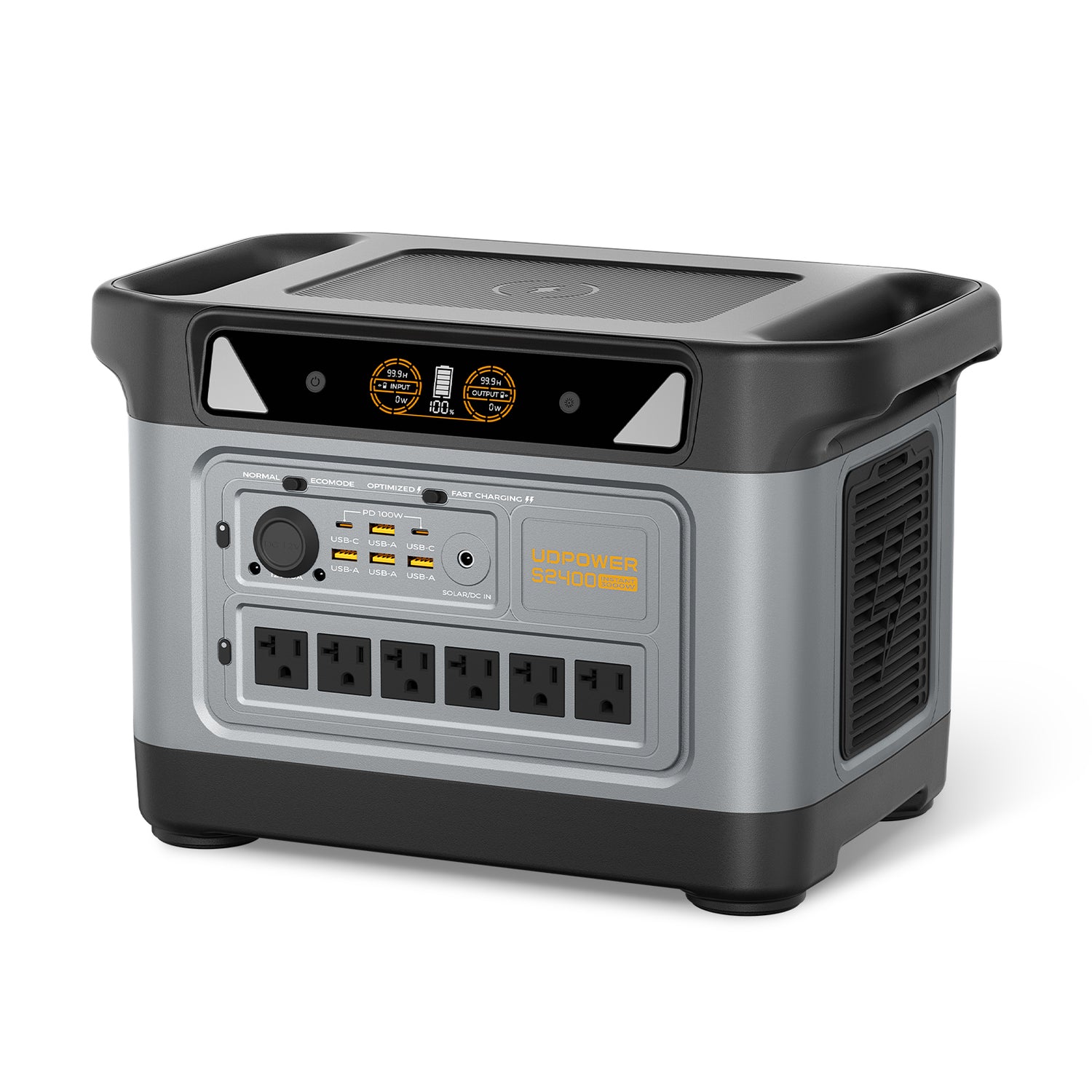
UDPOWER S2400: More Energy per Cycle for Larger Loads
The S2400 pairs a 2,083Wh battery with 2,400W rated AC output. It is better suited to buyers who need longer runtime, more appliance compatibility, or greater reserve capacity during an outage. Because each equivalent cycle contains more than two kilowatt-hours of nominal battery energy, the total lifetime energy potential is much greater than that of a small station with the same cycle count.
- 2,083Wh LiFePO4 battery
- 2,400W rated AC output
- 3,000W surge output
- Up to 400W solar input
- Less than 10ms UPS transfer specification
- Approximately 40.8 lb
- Detailed specification: 80%+ capacity after 3,000 cycles
Which Specification Should Matter Most to You?
There is no single best number for every buyer. Use the following priorities based on how the power station will be used.
| Your main use | Prioritize first | Why |
|---|---|---|
| Occasional outage backup | Capacity, storage care, self-discharge checks, and warranty | Calendar aging may matter more than cycle count |
| Daily off-grid use | Cycle life, capacity threshold, solar input, and thermal management | The battery may accumulate equivalent cycles quickly |
| High-power appliances | Continuous AC output, surge output, capacity, and connector compatibility | A high cycle count does not help if the inverter cannot start the appliance |
| Camping and road trips | Weight, capacity, solar charging, and output mix | Portability may matter more than maximum theoretical lifespan |
| Medical-device backup | Verified device wattage, runtime margin, output compatibility, and backup plan | Cycle life does not replace device testing or emergency planning |
| UPS-style use | Transfer time, pass-through behavior, load limit, and heat management | Continuous connection can create different operating conditions than occasional use |
Frequently Asked Questions About 4,000 Battery Cycles
Does 4,000 cycles mean I can charge the battery 4,000 times?
No. Connecting the charger is a charge session, not necessarily a full battery cycle. Partial discharges accumulate. Two uses of 50% capacity equal approximately one equivalent full cycle.
Does the battery stop working after 4,000 cycles?
Normally, no. A cycle-life rating usually identifies a remaining capacity threshold rather than a sudden failure point. If the threshold is 80%, the battery may continue working with roughly 20% less runtime than when new.
How long will 4,000 cycles last with daily use?
At one equivalent full cycle every day, 4,000 cycles equal about 10.96 years. Actual service life also depends on calendar aging, temperature, discharge depth, charging conditions, and product use.
Do partial charges damage a LiFePO4 battery?
Partial charging is a normal part of lithium-battery use. A recharge from 60% to 90% does not automatically count as a full cycle. The cumulative energy moved through the battery is what matters.
Does solar charging count as a battery cycle?
Solar charging contributes to the battery’s cumulative energy throughput, but each cloud interruption or short charging session is not a separate full cycle. Partial energy use and recharge add together over time.
Is 3,000 cycles to 80% better than 4,000 cycles with no threshold?
The 3,000-cycle claim is easier to evaluate because it defines the remaining-capacity endpoint. A 4,000-cycle claim may be stronger, but the comparison remains incomplete unless it also states the capacity threshold and test conditions.
Does fast charging use more than one cycle?
Fast charging does not automatically multiply the cycle count. Cycle counting is primarily based on cumulative energy throughput. However, charging power, heat, cell temperature, and battery management can affect long-term degradation.
Should I always keep my power station between 40% and 80%?
Not necessarily. Avoiding prolonged time at extreme states of charge can reduce stress during routine use, but charging to 100% before an outage or trip is reasonable when maximum runtime is needed. Follow the product manual for storage guidance.
Can a power station lose capacity even when it is not used?
Yes. Calendar aging continues while a battery is stored. High temperature and prolonged storage at an unfavorable state of charge can accelerate capacity loss even when the cycle count remains low.
Does UPS or pass-through use add battery cycles?
It depends on how the system operates. When incoming power directly supports the load, battery use may be limited. Small charging and discharging events, outages, and internal power management can still contribute to energy throughput. Follow the model’s UPS and pass-through instructions and keep the unit ventilated.
Is the cycle count shown by a battery management system exact?
It should be treated as a calculated operating record rather than a laboratory measurement of remaining capacity. Battery state estimates can depend on current, voltage, temperature, calibration, and the manufacturer’s counting method.
Which is more important: watt-hours or battery cycles?
Both matter. Watt-hours determine how much energy is available in each cycle, while cycle life indicates how many equivalent cycles the battery is designed to provide under specified conditions. Output power, warranty, weight, charging speed, and appliance compatibility must also be considered.
Are LiFePO4 batteries better for frequent portable power station use?
LiFePO4 batteries are widely used in modern power stations because they can provide long cycle life and strong thermal stability. The finished product’s battery management, cell quality, temperature control, warranty, and operating limits remain important.
Sources and Methodology
Product capacities, output ratings, weights, solar-input figures, UPS specifications, battery descriptions, and product images were reviewed against the current UDPOWER product pages on July 15, 2026. Runtime and energy-throughput figures in this article are mathematical planning estimates rather than guaranteed product performance.
- UDPOWER C400 official product specifications
- UDPOWER C600 official product specifications
- UDPOWER S1200 official product specifications
- UDPOWER S2400 official product specifications
- Apple explanation of cumulative battery charge cycles
- National Renewable Energy Laboratory storage technology modeling report
- Review of lithium-ion calendar and cycle aging
- Research summary on lithium-ion degradation and modeling
Choose a Power Station for the Way You Actually Use Energy
Cycle life matters most when it is considered alongside battery capacity, AC output, appliance startup power, portability, charging options, and warranty support. Start with your daily watt-hour needs, then choose enough capacity and output headroom for the devices you expect to run.
View All Portable Power Stations Compare the S1200 and S2400 Read the Power Station Maintenance GuideRelated Articles


