What Can a 5,000W Power Station Run? Appliance Chart
A 5,000W portable power station can run most individual 120V household appliances and multiple essential devices at the same time, provided their combined running wattage and startup surge remain within the unit’s limits. This guide includes detailed appliance wattage charts, realistic load combinations, battery runtime estimates, solar recharging calculations, and safety considerations. It also explains when a smaller UDPOWER power station may be a more practical choice for refrigerators, freezers, communication equipment, lighting, cooking appliances, and other essential backup loads.
Last updated: July 17, 2026
Quick Answer: What Can a 5,000W Power Station Run?
A 5,000-watt portable power station can usually run most individual 120V household appliances, including a refrigerator, freezer, microwave, coffee maker, toaster, hair dryer, vacuum, portable heater, window air conditioner, sump pump, television, internet equipment, computers, lights, and many corded power tools.
It may also run several of those loads at the same time, provided their combined running wattage stays below 5,000W and their overlapping startup surge does not exceed the power station’s surge rating.
However, a “5,000W” label describes inverter output—not battery runtime. A 5,000W unit with a 3,000Wh battery can deliver high power for a relatively short time, while a 5,000W unit with a 10,000Wh battery can support the same load much longer. You must also verify voltage, individual outlet limits, surge capacity, and battery capacity before assuming it can run a central air conditioner, electric dryer, range, well pump, or electric water heater.

What Does a 5,000W Power Station Really Mean?
A 5,000W power station has an inverter designed to supply up to approximately 5,000 watts of continuous AC power under its rated operating conditions. That number tells you how much power the unit can deliver at one moment. It does not tell you how much energy is stored in the battery.
This distinction is the source of most sizing mistakes. Watts describe power demand right now. Watt-hours describe how much energy is available over time.
| Specification | What It Tells You | Why It Matters | Common Mistake |
|---|---|---|---|
| Continuous output | The power the inverter can steadily supply | Your combined running loads must remain within this limit | Adding only the largest appliance instead of every active load |
| Surge output | The brief extra power available during startup | Motors and compressors may need much more power for a few seconds | Checking running watts but ignoring startup demand |
| Battery capacity in Wh | The amount of stored energy | Determines approximate runtime | Assuming every 5,000W power station has similar runtime |
| Output voltage | Whether the unit supplies 120V, 240V, or both | The appliance and power station must use compatible voltage | Assuming high wattage automatically means 240V support |
On a phone, swipe the tables sideways to view all columns.
Output Power Is Not Battery Capacity
Consider two hypothetical power stations. Both have 5,000W inverters, but one stores 3,000Wh and the other stores 10,000Wh. They may be able to start the same microwave, air conditioner, or power tool, yet the 10,000Wh model can run the same load for more than three times as long.
That is why the phrase “5,000W power station” is incomplete for runtime planning. To estimate real use, you need at least the continuous output, surge output, usable battery capacity, output voltage, and individual outlet ratings.
Five Checks Before Connecting Any Appliance
1. Add the Running Watts of Everything That Will Be On
If a refrigerator averages 150W while its compressor is running, a microwave draws 1,650W, a coffee maker draws 1,400W, and lights use 100W, the active running total is approximately 3,300W. That fits below a 5,000W continuous limit.
Do not use the appliance’s advertised cooking output when an input rating is available. For example, a microwave marketed as a “1,200-watt microwave” may draw considerably more than 1,200W from the outlet.
2. Check Startup Surge
Refrigerators, freezers, pumps, air conditioners, and some workshop tools can draw several times their normal running power when their motors start. A combination that appears safe on paper may overload the inverter if two compressors start at nearly the same moment.
Startup collision: A refrigerator, window air conditioner, and sump pump may have a modest combined running load, but their brief startup demands can overlap. Starting large motor loads one at a time reduces nuisance shutdowns.
3. Verify 120V or 240V Compatibility
Many 5,000W-class power stations are designed primarily for 120V appliances. Others provide true 120V/240V split-phase output. A 5,000W inverter rating by itself does not prove that a unit can run a 240V electric dryer, range, central air conditioner, large well pump, or water heater.
4. Check the Limit of the Individual Outlet
The total inverter may be rated for 5,000W, while each individual receptacle has a lower limit. A single high-draw appliance must fit within the rating of the specific receptacle and circuit being used—not merely the total inverter rating.
5. Check Battery Capacity for Runtime
An appliance can be electrically compatible and still be impractical because of energy consumption. Resistance heaters, electric water heaters, cooktops, and air conditioners can drain a battery much faster than refrigerators, lights, routers, or CPAP machines.
What Appliances Can a 5,000W Power Station Run?
The chart below uses representative manufacturer ratings and practical planning ranges. Your appliance label or manual should always take priority because two products in the same category can have very different power requirements.
| Appliance | Typical Running Demand | Startup Consideration | Likely Fit | What to Verify | Example Source |
|---|---|---|---|---|---|
| LED lights | 5–20W per bulb | Minimal | Yes | Total number of lights | Read the bulb label |
| Wi-Fi router and modem | 15–40W combined | Minimal | Yes | AC adapter input rating | Read each adapter label |
| Television | 50–200W | Low | Yes | Screen size and brightness | Read the TV energy label |
| Laptop and monitor | 50–200W | Low | Yes | Charger and monitor ratings | Read the power adapters |
| Refrigerator | Often 60–300W while running | Compressor surge | Yes | Startup watts and duty cycle | ENERGY STAR refrigerators |
| Chest or upright freezer | Often 50–300W while running | Compressor surge | Yes | Startup watts and ambient temperature | ENERGY STAR freezers |
| Countertop microwave | About 1,000–1,700W input | Brief startup demand | Yes | Input watts, not cooking watts | GE 1,650W input example |
| Single-serve coffee maker | About 1,000–1,500W while heating | Usually modest | Yes | Heating-cycle input | Keurig 1,400W example |
| Portable space heater | Commonly 1,500W on high | Usually modest | Yes, but short runtime | Continuous energy use and outlet rating | Lasko 1,500W example |
| Hair dryer | Often 1,500–1,875W | Usually modest | Yes | High-heat input rating | Remington dryer example |
| Portable induction cooktop | About 600–1,800W | Low to moderate | Yes | Selected cooking level | Nuwave cooktop example |
| Upright vacuum | Often 700–1,400W | Motor startup | Yes | Nameplate amperage or watts | Shark vacuum example |
| Window air conditioner | Roughly 500–1,500W for many units | Compressor startup can be substantial | Usually | Cooling capacity, CEER, startup demand, and outlet type | ENERGY STAR room AC listings |
| Portable air conditioner | Often 900–1,800W | Compressor startup | Usually | Actual input watts and surge | Read the unit’s data plate |
| Sump pump | Often 500–1,500W depending on size | Can have a high starting surge | Often | Horsepower, voltage, and locked-rotor/start demand | Wayne pump example |
| Jobsite table saw | Often 1,500–1,800W under load | High motor startup and cutting spikes | Often | Motor amperage, startup surge, and extension-cord size | DEWALT table saw example |
| Electric water heater | Common elements may draw about 4,500W | Primarily a voltage and continuous-load issue | Rarely practical | 240V output, element wattage, and circuit requirements | Rheem 4,500W example |
| Electric clothes dryer | Often several thousand watts | Heating element plus drum motor | Usually no | 240V/30A circuit and full input rating | Samsung dryer requirements |
| Full-size electric range | Can exceed 5,000W with multiple elements | High continuous draw | Usually no | 240V supply and total connected load | Samsung range requirements |
| Central air conditioner | Varies widely by system size | Potentially very high compressor startup | Usually no | 240V output, running amps, LRA, soft starter, and inverter surge rating | Check the outdoor unit nameplate and HVAC documentation |
Use the data plate, not a generic wattage chart, for the final decision. Appliance wattage changes with size, age, operating mode, temperature, motor load, and efficiency. A plug-in watt meter can help measure steady 120V loads, but it may not capture the full startup surge of a compressor or pump.
Realistic Appliance Combinations a 5,000W Power Station Can Run
Most people do not need to run a single 5,000W appliance. They need to operate several smaller loads during a blackout, camping trip, mobile workday, or off-grid project. The examples below show how quickly combined demand changes.
| Use Case | Example Loads | Estimated Active Running Total | 5,000W Output Fit | Important Limitation |
|---|---|---|---|---|
| Basic outage essentials | Refrigerator 150W + freezer 150W + router 25W + TV 100W + lights 80W | About 505W when both compressors are running | Easy fit | Allow for refrigerator and freezer startup surge |
| Essentials plus microwave | Basic essentials 505W + microwave 1,650W | About 2,155W | Good fit | The microwave sharply increases battery drain while operating |
| Home office backup | Desktop 250W + two monitors 80W + router 25W + printer 100W + lights 40W | About 495W | Easy fit | Laser printers can have short heating spikes |
| Summer outage | Window AC 900W + refrigerator 150W + router 25W + TV 100W + fan 60W | About 1,235W | Good fit | AC and refrigerator compressor starts may overlap |
| Cold-weather room backup | Space heater 1,500W + refrigerator 150W + router 25W + lights 80W | About 1,755W | Output fits | The heater can consume more energy than all other loads combined |
| Simple emergency cooking | Induction cooktop 1,800W + refrigerator 150W + lights 80W | About 2,030W | Good fit | Run the cooktop only when needed to conserve battery |
| Breakfast overload example | Microwave 1,650W + coffee maker 1,400W + toaster 1,500W + refrigerator 150W + lights 80W | About 4,780W | Too close for comfort | A compressor startup or label variation could exceed 5,000W |
| Workshop example | Table saw 1,800W + shop vacuum 1,200W + task lights 100W | About 3,100W | Possible | Motor startups and cutting loads require substantial surge headroom |
Why 4,780W Is Not a Comfortable Load on a 5,000W Unit
Operating at nearly 100% of the published inverter rating leaves little room for appliance variation, startup surge, hot-weather derating, or an additional device turning on unexpectedly. A more practical planning target is to keep normal continuous demand around 80% of the rated output when possible.
For a 5,000W inverter, that means designing normal simultaneous loads around 4,000W or less. This is a planning buffer—not a replacement for the manufacturer’s official limits.
Use load sequencing: Brew coffee first, turn the coffee maker off, and then use the microwave or toaster. Sequencing high-heat appliances can preserve enough headroom for refrigerators, pumps, and air conditioners to start.
How Long Will a 5,000W Power Station Run?
Runtime depends on battery capacity and average load—not the 5,000W inverter rating alone. A practical planning formula is:
The 90% factor is a planning assumption for conversion losses and system overhead. Actual usable energy varies by product, load type, battery temperature, state of charge, inverter efficiency, cable losses, and the unit’s protection settings.
Runtime Matrix for Different Battery Sizes
| Average Load | 3,000Wh Battery | 5,000Wh Battery | 10,000Wh Battery | Typical Use Example |
|---|---|---|---|---|
| 100W | About 27 hours | About 45 hours | About 90 hours | Router, lights, and small electronics |
| 300W | About 9 hours | About 15 hours | About 30 hours | Refrigeration plus internet and lights |
| 500W | About 5.4 hours | About 9 hours | About 18 hours | Moderate essential-load group |
| 1,000W | About 2.7 hours | About 4.5 hours | About 9 hours | Window AC or a mixed household load |
| 1,500W | About 1.8 hours | About 3 hours | About 6 hours | Portable heater on high |
| 2,500W | About 1.1 hours | About 1.8 hours | About 3.6 hours | Heavy mixed load or cooking equipment |
| 5,000W | About 0.5 hour | About 0.9 hour | About 1.8 hours | Full rated inverter load |
Example: Runtime From a 5,000Wh Battery
A 5,000Wh battery provides an estimated 4,500Wh of usable AC energy under the 90% planning assumption.
| Average Load | Estimated Runtime | What the Result Means |
|---|---|---|
| 25W router and modem | About 180 hours | Actual runtime may be limited by standby behavior and other connected devices |
| 150W home-office load | About 30 hours | Enough for several workdays if heavy appliances remain off |
| 250W average essential load | About 18 hours | Could include cycling refrigeration, internet, and a few lights |
| 625W average cooling load | About 7.2 hours | Actual AC consumption changes with temperature and compressor cycling |
| 1,500W space heater | About 3 hours | Resistance heat drains batteries quickly |
| 1,800W induction cooktop | About 2.5 hours | Cooking is normally intermittent, so several short meals may be practical |
| 5,000W full output | About 54 minutes | High output does not guarantee long full-load operation |
Running Watts Are Not Always the Same as Average Watts
A refrigerator may draw 150W while its compressor is operating but cycle off for much of the hour. Its hourly average can therefore be lower than 150W. A window air conditioner may also cycle, especially after the room reaches the target temperature.
A space heater set to high is different. It may draw close to 1,500W for long periods, making its average demand much closer to its running rating. Runtime estimates should use the appliance’s average energy use over time whenever that information is available.
For a more detailed planning method, see the UDPOWER guide to converting appliance watts into estimated battery runtime.
Can a 5,000W Power Station Run an Entire House?
It can often run a carefully selected group of essential household circuits, but it should not automatically be treated as a whole-house power source.
A typical home contains many loads that can turn on without warning: refrigeration compressors, pumps, heating equipment, cooking appliances, laundry equipment, lighting, electronics, and HVAC systems. Even when the average demand is below 5,000W, a single high-power appliance or overlapping startup event can exceed the inverter limit.
What a 5,000W Unit May Cover During an Outage
- One refrigerator and one freezer
- Internet equipment and phone charging
- LED lighting in several rooms
- Television, laptop, and basic home-office equipment
- A microwave or coffee maker used one at a time
- A compatible window air conditioner or portable AC
- A compatible sump pump, depending on startup surge
- Medical equipment within the unit’s output and reliability requirements
What It May Not Cover
- Central air conditioning without detailed electrical verification
- Electric range and multiple cooking elements
- Electric clothes dryer
- Large electric water heater
- Electric furnace resistance heating
- Large 240V well pump
- Multiple high-power appliances operating simultaneously
Never backfeed a home by plugging a power station or generator into a wall receptacle. Connecting backup power to household wiring requires compatible, listed transfer equipment and proper installation. Consult a qualified electrician and follow the power station manufacturer’s instructions. See the Electrical Safety Foundation International generator safety guidance.
Before an outage, create a load-priority plan. The UDPOWER power-outage load priority guide explains how to rank refrigeration, medical equipment, communications, lighting, cooking, and comfort loads.
Appliances That May Still Be a Poor Fit for 5,000W
Central Air Conditioning
Central AC systems often require 240V and can have a large compressor startup demand. Some systems may work with compatible split-phase output, sufficient surge capacity, correct transfer equipment, and a professionally selected soft starter. Others will remain beyond the practical capability of a 5,000W power station.
Electric Water Heaters
A common electric tank water heater may use a 4,500W heating element. Even if the power station provides the correct voltage and can support that element, the load leaves little capacity for other appliances and can consume a 5,000Wh battery in close to one hour.
Electric Ranges and Ovens
A single cooktop element may fit, but a full-size electric range can exceed 5,000W when several elements or the oven are active. A portable induction cooktop, microwave, propane appliance approved for its setting, or other lower-energy cooking method is usually easier to support during an outage.
Electric Clothes Dryers
Full-size electric dryers commonly need a 240V, 30A circuit. The heating element can use most or all of a 5,000W inverter’s capacity, leaving little startup or operating margin.
Large Pumps and Compressors
Well pumps, air compressors, and large shop equipment may appear compatible based on running watts but fail to start because of motor surge. Check voltage, full-load amps, startup current, and the power station’s surge duration.
Resistance Heating
Space heaters, electric kettles, hot plates, and hair dryers are usually easy to start but expensive in energy terms. They turn battery capacity directly into heat and can shorten runtime much faster than refrigeration, lighting, or communications equipment.
Do You Actually Need a 5,000W Power Station?
Many shoppers search for 5,000W because they want reliable home backup, not because their essential loads truly require 5,000W. Calculate your simultaneous load before paying for a larger and heavier system.
| Typical Continuous Output Range | Best Suited For | Common Limitations | Who Should Consider It |
|---|---|---|---|
| 500–1,000W | Phones, laptops, routers, lights, CPAP, small appliances | Limited compatibility with heating appliances and large motors | Camping, short outages, remote work, medical-device backup |
| 1,000–2,500W | Refrigerator, freezer, microwave, coffee maker, TV, tools, selected window AC units | High-power appliances often need to be used one at a time | Most essential-load backup users |
| 3,000–4,000W | Larger mixed loads, heavier tools, more simultaneous appliances | Battery capacity can still limit runtime | Users with larger kitchens, workshops, RVs, or multi-room backup needs |
| 5,000W and above | Multiple high-power appliances and larger backup circuits | Voltage, outlet limits, battery size, weight, cost, and transfer setup remain critical | Users with measured loads that exceed smaller inverter classes |
A Smaller Inverter With More Battery Can Sometimes Be Better
Suppose your normal outage load averages only 700W and never exceeds 2,000W. A 2,400W power station with sufficient battery capacity may deliver more useful runtime than a 5,000W model with a smaller battery.
Choose output based on your highest realistic simultaneous load and startup demand. Choose battery capacity based on how many watt-hours you expect to use before recharging.
Compare additional output classes in these guides: what a 2,000W portable power station can run and what a 3,000W portable power station can run.
UDPOWER Options for Essential Home Backup
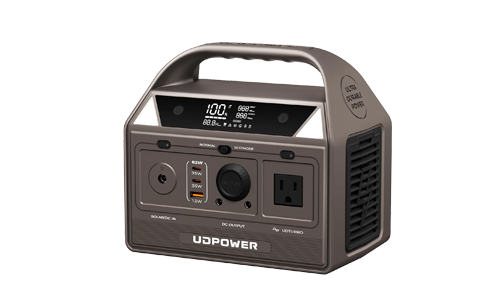
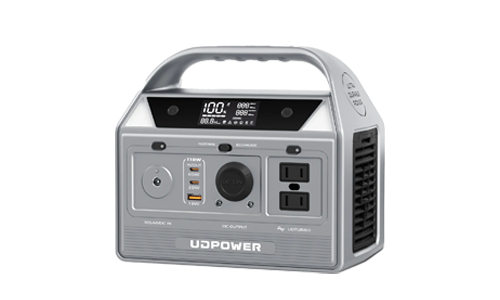
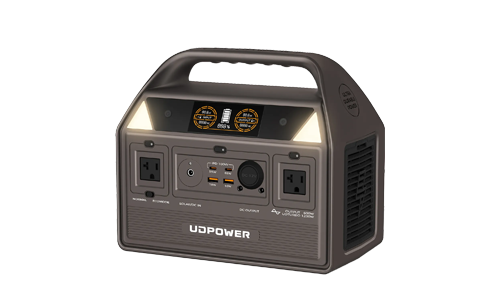
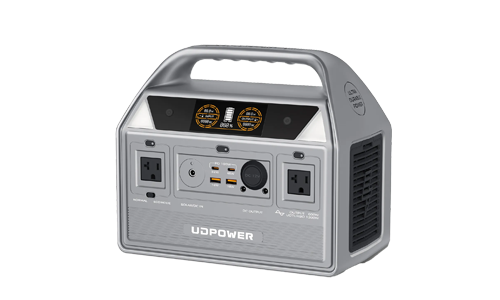
UDPOWER does not currently offer a portable power station with 5,000W of continuous AC output. The products below should not be presented as 5,000W substitutes. They are practical alternatives for users whose measured essential loads fit within a lower output class.
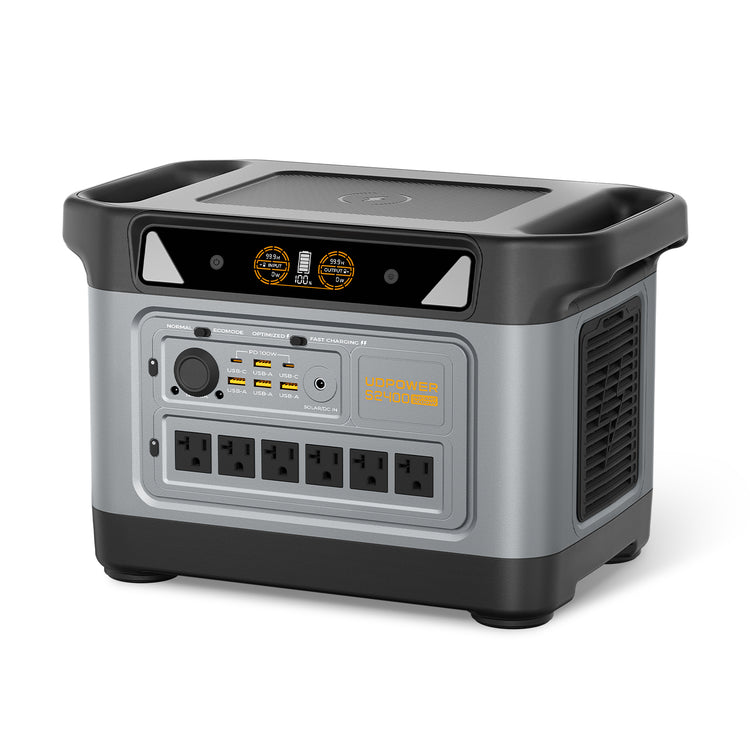
UDPOWER S2400: Best Match for Larger Essential-Load Groups
The S2400 is the closest current UDPOWER option for users who need to run refrigeration, communications equipment, lights, electronics, and one compatible high-power appliance within a 2,400W continuous limit.
- Battery capacity: 2,083Wh
- Continuous AC output: 2,400W pure sine wave
- Startup capability: Up to 3,000W
- AC outlets: 6
- Total device connections: Up to 16
- Battery chemistry: LiFePO₄
- Battery life: 4,000+ cycles
- UPS transfer time: Under 10 milliseconds
- Maximum solar input: Up to 400W
- Weight: Approximately 40.8 lb.
A realistic S2400 setup could include a refrigerator, freezer, router, lights, television, and short microwave use, provided the measured combined load and startup surge remain within the product limits. It is not designed to deliver 5,000W and should not be used for incompatible 240V household appliances.
View the UDPOWER S2400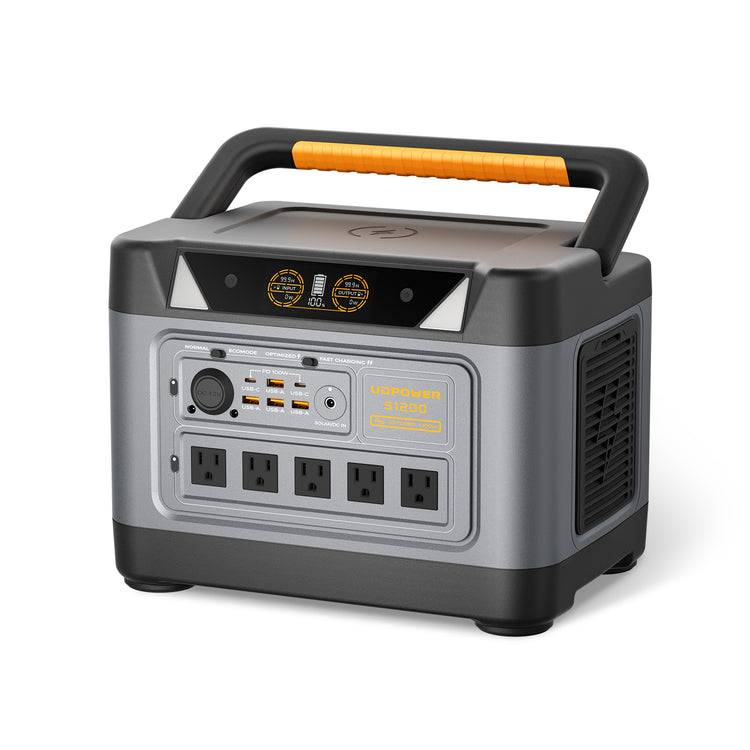
UDPOWER S1200: For Core Essentials and Portable Backup
The S1200 is better suited to customers who want refrigeration, internet access, electronics, lighting, CPAP support, and selected appliances without the size and weight of a larger backup system.
- Battery capacity: 1,190Wh
- Continuous AC output: 1,200W pure sine wave
- Surge output: Up to 1,800W
- AC outlets: 5
- Battery chemistry: LiFePO₄
- Battery life: 4,000+ cycles
- UPS transfer time: Under 10 milliseconds
- Maximum solar input: Up to 400W
- Weight: Approximately 26 lb.
Because its continuous output is 1,200W, users should not connect a 1,500W heater, high-power hair dryer, or other appliance that exceeds the rated output. The S1200 is most effective when reserved for lower-power essentials and compatible cycling loads.
View the UDPOWER S1200For a direct comparison of the two models, read UDPOWER S1200 vs. S2400.
Can Solar Panels Keep a 5,000W Power Station Running?
Solar panels can extend runtime, but solar input must be compared with daily energy consumption. A large inverter does not guarantee fast solar charging.
Use this planning formula:
For example, an 800W solar array receiving five effective peak-sun hours with an 80% planning factor could collect approximately:
If your appliances consume 5,000Wh per day, that solar setup would still leave an estimated 1,800Wh daily deficit. The battery would gradually decline unless you reduce the loads, add compatible solar capacity, receive more usable sun, or recharge from another source.
| Solar Array | Planning Calculation | Estimated Daily Collection | Best Use |
|---|---|---|---|
| 400W | 400 × 5 × 0.80 | About 1,600Wh | Replenishing light essential-load use |
| 800W | 800 × 5 × 0.80 | About 3,200Wh | Moderate daily backup consumption |
| 1,200W | 1,200 × 5 × 0.80 | About 4,800Wh | Larger daily loads when the power station supports the input |
| 2,000W | 2,000 × 5 × 0.80 | About 8,000Wh | High-energy systems with compatible controllers and input limits |
These are planning examples rather than guaranteed production. Clouds, shading, panel angle, temperature, cable losses, dirt, season, location, and the power station’s maximum solar input can reduce collection.
Before purchasing panels, verify the accepted input voltage, current, wattage, connector type, and whether series or parallel wiring is supported. Never assume that the inverter’s 5,000W AC output means the unit can accept 5,000W of solar charging.
Learn more in the UDPOWER guide to recharging a portable power station with solar panels during an outage, or browse UDPOWER solar generator options.
How to Size and Use a 5,000W Power Station Safely
- List the appliances you truly need. Separate essential loads from convenience loads.
- Record voltage and running watts. Use the product label, manual, or manufacturer specifications.
- Find startup requirements. Pay special attention to compressors, pumps, saws, and air conditioners.
- Add simultaneous loads. Do not total appliances that will never be used at the same time.
- Leave normal operating headroom. Aiming below the absolute inverter limit reduces overload risk.
- Verify each outlet. Confirm that the individual receptacle can support the appliance.
- Calculate daily watt-hours. Multiply each appliance’s average watts by expected operating hours.
- Choose enough battery capacity. Include conversion losses and a reserve for unexpected use.
- Plan recharging before the outage. Check AC, car, and solar charging times and input limits.
- Test the actual setup safely. Start one motor load at a time and verify stable operation before relying on it in an emergency.
Use Heavy Loads One at a Time
Heating and cooking appliances are easy to sequence. Avoid running a microwave, toaster, coffee maker, induction cooktop, hair dryer, and space heater simultaneously. Keeping one large discretionary load active at a time preserves power for refrigerators, pumps, internet equipment, and lights.
Avoid Undersized Extension Cords
Long or undersized extension cords can cause voltage drop and excess heat. Use cords rated for the appliance current, keep them as short as practical, inspect them for damage, and fully uncoil high-current cords during use.
Protect the Power Station From Moisture and Heat
Operate and store the unit within the manufacturer’s temperature and environmental limits. Keep ventilation openings clear. Do not place the power station in standing water, direct rain, a sealed compartment, or near combustible materials.
Build a 24-, 48-, and 72-Hour Plan
A backup system should be sized for more than the first hour of an outage. Estimate how your priorities change as stored energy declines. Refrigeration, medical equipment, communication, and lighting usually deserve priority over electric resistance heating and nonessential entertainment.
Use the UDPOWER 24-, 48-, and 72-hour outage checklist to create a longer-duration plan.
Frequently Asked Questions
Can a 5,000W power station run a refrigerator?
Yes. Most household refrigerators use far less than 5,000W while running. The main considerations are compressor startup surge and battery runtime. Use the refrigerator’s data plate or manual for final sizing.
Can a 5,000W power station run a refrigerator and freezer together?
Usually yes. Their combined running load is commonly well below 5,000W, but the inverter must also handle the possibility that both compressors start at nearly the same time. Start them separately during initial setup and verify stable operation.
Can a 5,000W power station run a microwave?
Most countertop microwaves should fit comfortably within a 5,000W continuous rating. Check the microwave’s electrical input rating rather than relying only on its advertised cooking output.
Can a 5,000W power station run a space heater?
A typical 1,500W portable heater is usually within the output limit, but it can drain the battery quickly. A 5,000Wh battery with 90% usable energy would provide approximately three hours at a continuous 1,500W load.
Can a 5,000W power station run an air conditioner?
It can often run a compatible window or portable air conditioner if the running watts, compressor startup demand, voltage, and outlet requirements fit the power station. Central air conditioning requires a system-specific electrical evaluation and is usually a poor match for a basic 5,000W portable unit.
Can a 5,000W power station run a central AC system?
Usually not without specialized equipment and careful verification. Central AC systems commonly need 240V and may have startup demands well above their normal running watts. Check the outdoor unit nameplate and consult the HVAC manufacturer or a qualified professional.
Can a 5,000W power station run an electric water heater?
Some 4,500W water-heater elements may appear to fit, but only if the power station provides the required voltage and outlet configuration. The load leaves little operating margin and can drain a 5,000Wh battery in roughly one hour, making it impractical for many portable systems.
Can a 5,000W power station run an electric dryer?
Most full-size electric dryers are not a practical match because they commonly require a 240V, 30A circuit and can use several thousand watts. A gas dryer may have a much lower electrical demand because gas supplies the heat, but its exact label still needs to be checked.
Can a 5,000W power station run a well pump?
Possibly, depending on the pump’s voltage, horsepower, running amps, and startup current. Many well pumps use 240V, and motor startup can exceed the apparent running load by a wide margin. Do not size the system from horsepower alone.
How many appliances can a 5,000W power station run at once?
There is no fixed number. It might run dozens of small electronics or only two or three high-power heating appliances. Add the running watts of every active device, check overlapping startup surges, and stay within the total and individual outlet limits.
How long will a 5,000Wh battery last at a 5,000W load?
Using a 90% usable-energy planning assumption, a 5,000Wh battery provides approximately 4,500Wh for AC loads. At a constant 5,000W draw, estimated runtime is about 0.9 hour, or 54 minutes. Actual runtime may be shorter or longer depending on the system.
Is a 5,000W power station the same as a 5,000W gas generator?
No. Both may provide similar rated output, but their operating characteristics differ. A battery power station stores a limited number of watt-hours and operates without fuel combustion at the point of use. A gas generator can continue running as long as it has fuel and is maintained, but it produces exhaust and must remain outdoors at a safe distance from buildings.
Can I connect a 5,000W power station directly to my home electrical panel?
Only when the product is specifically designed for that application and is connected through compatible, listed transfer equipment installed according to applicable requirements. Never attempt to energize home wiring by connecting the power station to a standard wall outlet.
Is 5,000W enough for emergency home backup?
It can be enough for a prioritized group of essential loads, especially refrigeration, communications, lighting, electronics, a compatible pump, and occasional cooking. It is generally not enough to operate every household appliance normally at the same time.
Related UDPOWER Guides
Choose Backup Power From Your Actual Load
Start with the appliances you need, calculate their simultaneous running and startup demand, and then choose enough battery capacity for the number of hours you want to cover.
View Portable Power Stations View Home Backup Options Get the Power-Outage Planning GuideAppliance wattages in this guide are planning ranges. Always follow the ratings, safety instructions, environmental limits, and connection requirements provided by the appliance and power-station manufacturers.
Related Articles