

What Can a 1200W Portable Power Station Run?
Last updated:
A 1200W portable power station is large enough to cover most low-to-medium household electronics, but it is not automatically compatible with every appliance that plugs into a standard wall outlet.
In practical terms, a standard 1200W power station can usually run phones, laptops, Wi-Fi equipment, televisions, lights, fans, CPAP machines, portable refrigerators, mini fridges, many household refrigerators, projectors, slow cookers, selected power tools, and some compact cooking appliances.
Appliances such as microwaves, coffee makers, space heaters, air fryers, electric kettles, hair dryers, and portable air conditioners require more careful checking. Some models stay below 1200W, while others exceed the station’s normal continuous-output limit.
Quick Answer: What Can a 1200W Portable Power Station Run?
A typical 1200W portable power station can continuously run one appliance or a group of appliances when their combined running wattage stays at or below 1200W. Motor- and compressor-driven appliances must also keep their startup demand within the station’s peak or surge limit.
It is generally a strong fit for electronics, internet equipment, lighting, fans, CPAP machines, televisions, portable refrigerators, many household refrigerators, small cooking appliances, and moderate power tools.
It is not a reliable universal match for 1500W heaters, 1550W coffee makers, large microwaves, full-size air fryers, electric kettles, high-setting hair dryers, central air conditioning, electric dryers, or several high-watt appliances operating together.

What Does “1200W Portable Power Station” Actually Mean?
The 1200W rating describes how much AC power the inverter can normally supply at one time. It does not describe battery capacity, runtime, charging speed, or how many hours an appliance will operate.
| Specification | What It Means | Question It Answers | Example |
|---|---|---|---|
| Rated or continuous output | Power the inverter is designed to supply continuously | Can the appliance keep running? | A standard 1200W station should support no more than 1200W of combined continuous load. |
| Peak or surge output | Additional output available under specific conditions | Can a motor or compressor start? | A refrigerator may use 150W after starting but require much more during compressor startup. |
| Battery capacity in Wh | Total stored electrical energy | How long can the appliance run? | A 1200Wh model usually runs the same appliance longer than a 768Wh model. |
| AC inverter efficiency | How much stored battery energy reaches the appliance | How much usable energy is available? | Actual AC runtime is lower than capacity divided by watts because conversion is not lossless. |
| Solar or AC charging input | Maximum rate at which the battery can be recharged | How quickly can capacity be restored? | A 400W solar input does not increase AC output; it only affects recharging. |
Watts and Watt-Hours Are Not the Same
Watts measure power at a particular moment. Watt-hours measure stored energy over time.
A 768Wh station and a 1500Wh station may both have 1200W inverters. Both may power a 500W appliance, but the 1500Wh model should provide substantially longer runtime.
The 1200W Limit Applies to the Combined Load
The output rating is shared by all AC outlets. A station with four AC outlets does not provide 1200W from every outlet.
For example, a 700W appliance, 250W appliance, 100W television, and 50W fan create a combined load of 1100W. That may fit within a 1200W limit. Adding a 150W laptop charger raises the total to 1250W, which exceeds the standard continuous rating.
Peak Power Varies by Manufacturer
Peak, surge, power-lifting, boost, and high-power modes are not identical across brands. On some products, the higher number is intended primarily for a brief startup spike. Other products use proprietary technology to continue powering certain appliances above the rated output, sometimes with reduced voltage or conversion efficiency.
1200W Portable Power Station Appliance Chart
The following table uses a conventional 1200W continuous-output limit. The wattages are practical planning ranges, not guaranteed specifications for every appliance.
| Device or Appliance | Typical Running Load | Standard 1200W Station | What to Check |
|---|---|---|---|
| Phone or tablet charger | 5W–30W | Yes | Use a direct USB output when available. |
| Camera or drone charger | 20W–150W | Yes | Add the wattage of all batteries charging together. |
| Wi-Fi router and modem | 10W–35W combined | Yes | Confirm whether the modem is a separate device. |
| Laptop | 45W–140W | Yes | Check the original charger or USB-C PD rating. |
| Desktop PC and monitor | 150W–700W | Usually | Gaming PCs can draw much more under a heavy GPU load. |
| LED television | 50W–200W | Yes | Add a streaming device, console, router, and soundbar. |
| LED lights | 5W–20W each | Yes | Efficient choice for outage lighting. |
| Box, tower, or pedestal fan | 35W–100W | Yes | Power use changes with fan speed. |
| CPAP machine | 20W–100W | Yes | Humidification and heated tubing may raise consumption. |
| 12V portable refrigerator | 35W–70W while cooling | Yes | Direct DC operation may reduce conversion loss. |
| Mini fridge | 50W–150W while running | Usually | Verify compressor startup demand. |
| Household refrigerator | 60W–250W during normal operation | Often | Check compressor startup, defrost, and ice-maker loads. |
| Chest or upright freezer | 80W–300W while running | Model dependent | Older compressors may have demanding startup spikes. |
| Electric blanket | 50W–150W | Yes | Thermostat cycling may extend runtime. |
| Projector | 100W–350W | Yes | Add speakers and the source device. |
| Slow cooker | 150W–350W | Yes | Long cooking periods can consume substantial energy. |
| Blender | 300W–1200W | Often | Check the highest setting and motor startup. |
| Power drill | 300W–900W | Often | Binding or heavy load can increase motor demand. |
| Small circular saw | 900W–1500W | Model dependent | Running and startup demand may exceed 1200W. |
| Toaster | 800W–1500W | Model dependent | Compact models may fit; larger models may exceed the limit. |
| Coffee maker | 600W–1550W | Model dependent | Check electrical input, not cup capacity. |
| Countertop microwave | 1000W–1650W input | Model dependent | Input watts may be much higher than advertised cooking watts. |
| Space heater on low | About 600W–900W | Often | Runtime will still be relatively short. |
| Space heater on high | About 1500W | Usually no | Exceeds a conventional 1200W continuous limit. |
| Air fryer | 1200W–1800W | Usually no | Even a 1200W label leaves no headroom for other loads. |
| Electric kettle | 1200W–1800W | Usually no | Many kettles exceed 1200W continuously. |
| Hair dryer | 1200W–1875W | Usually no on high | A low setting may work if its real input stays below 1200W. |
| Small portable air conditioner | 700W–1400W while cooling | Possibly | Both compressor startup and running input must fit. |
| Central AC, electric dryer, or electric range | Several thousand watts | No | Many also require 240V service. |
Real Appliance Examples Show Why Labels Matter
Generic appliance ranges are useful for planning, but the final decision should be based on the actual product label or manufacturer specification.
| Published Product Example | Published Power | Standard 1200W Station | What It Demonstrates | Source |
|---|---|---|---|---|
| Apple USB-C power adapter | 20W | Yes | Phone charging is a very light load. | Apple specifications |
| Samsung 43-inch T5300 television | 52W typical; 120W maximum | Yes | A television normally leaves substantial headroom for internet and lighting. | Samsung specifications |
| GE 0.9 cu. ft. countertop microwave | 1050W electrical input; 900W cooking output | Potentially yes | A compact microwave may fit within 1200W, but leaves limited headroom. | GE Appliances specifications |
| GE 1.1 cu. ft. countertop microwave | 1580W electrical input; 950W cooking output | No on a conventional 1200W limit | Advertised cooking watts can be much lower than wall input. | GE Appliances specifications |
| Ninja single-serve coffee maker | 1550W | No on a conventional 1200W limit | A compact appliance can still have a high-power heating element. | SharkNinja specifications |
| Honeywell HCE317B space heater | 750W low; 1500W high | Low yes; high no | The selected operating mode can completely change compatibility. | Honeywell specifications |
How Long Will a 1200W Portable Power Station Run an Appliance?
The 1200W inverter rating does not determine runtime. You need the station’s battery capacity in watt-hours and a reasonable allowance for conversion loss.
Portable power station efficiency varies with inverter design, load level, temperature, battery condition, and whether AC, USB, or DC output is used. For the generic comparisons below, this article uses an 85% planning factor. It is a neutral example rather than a specification for every brand.
Example: 1024Wh Power Station
| Example Load | Planning Wattage | Estimated Runtime From 1024Wh | Real-World Note |
|---|---|---|---|
| Router or modem | 20W | About 43.5 hours | Very light AC loads may be affected by inverter standby consumption. |
| CPAP | 40W | About 21.8 hours | Heating features can substantially increase draw. |
| Portable refrigerator | 60W | About 14.5 hours | Cycling may make real elapsed runtime longer. |
| TV and router | 100W combined | About 8.7 hours | Add consoles, speakers, and streaming devices. |
| Remote-work setup | 150W | About 5.8 hours | Actual laptop draw often changes as its battery charges. |
| Moderate appliance | 300W | About 2.9 hours | Assumes steady consumption. |
| Heavy appliance | 600W | About 1.5 hours | Battery percentage will fall quickly. |
| Compact microwave | 1050W | About 0.8 hours continuously | Microwaves normally run for minutes rather than continuously. |
| Maximum continuous output | 1200W | About 0.7 hours | No output headroom remains for other AC loads. |
1200W Output Does Not Mean Every Station Has the Same Runtime
The following table compares several hypothetical battery capacities, all paired with the same 1200W inverter output. Each estimate uses the same 85% planning factor.
| Battery Capacity | 20W Load | 60W Load | 100W Load | 300W Load | 600W Load | 1000W Load | 1200W Load |
|---|---|---|---|---|---|---|---|
| 768Wh | 32.6 hr | 10.9 hr | 6.5 hr | 2.2 hr | 1.1 hr | 0.7 hr | 0.5 hr |
| 1024Wh | 43.5 hr | 14.5 hr | 8.7 hr | 2.9 hr | 1.5 hr | 0.9 hr | 0.7 hr |
| 1200Wh | 51.0 hr | 17.0 hr | 10.2 hr | 3.4 hr | 1.7 hr | 1.0 hr | 0.8 hr |
| 1500Wh | 63.8 hr | 21.2 hr | 12.8 hr | 4.2 hr | 2.1 hr | 1.3 hr | 1.1 hr |
Rounded planning estimates. Actual runtime varies by power station and appliance.
Why Capacity Often Matters More Than Output
If your devices total only 150W, all four example stations have enough output. The larger battery gives you more hours, not more compatibility.
If your appliance draws 1400W, none of these hypothetical standard 1200W stations is automatically compatible, regardless of whether the battery is 768Wh or 1500Wh.
Can a 1200W Portable Power Station Run a Refrigerator?
Often, yes. Many refrigerators consume far less than 1200W after the compressor starts. The two important questions are:
- Can the inverter handle the compressor’s startup demand?
- Does the battery have enough capacity for the required outage period?
Running Watts Alone Are Not Enough
A refrigerator may draw only 100W to 200W during active cooling but require a much higher input for a short period when the compressor starts. A power station that cannot handle that startup may shut down even though the normal running watts appear compatible.
Use the EnergyGuide Label for Runtime Planning
The yellow EnergyGuide label can provide estimated annual energy consumption. The Federal Trade Commission explains how the label helps consumers compare appliance energy use.
See the FTC EnergyGuide explanation
| Annual Refrigerator Use | Calculated Average Load | Runtime on 768Wh | Runtime on 1024Wh | Runtime on 1200Wh |
|---|---|---|---|---|
| 300 kWh/year | About 34W | About 19.2 hr | About 25.6 hr | About 30.0 hr |
| 400 kWh/year | About 46W | About 14.2 hr | About 18.9 hr | About 22.2 hr |
| 500 kWh/year | About 57W | About 11.5 hr | About 15.3 hr | About 17.9 hr |
| 600 kWh/year | About 68W | About 9.6 hr | About 12.8 hr | About 15.0 hr |
Read the dedicated refrigerator backup guide for a more detailed sizing process.
Can a 1200W Portable Power Station Run a CPAP?
Yes. CPAP machines generally require only a small portion of a 1200W inverter’s output. Battery capacity and machine settings are more important than inverter size.
| CPAP Planning Load | 768Wh Battery | 1024Wh Battery | 1200Wh Battery | What May Change Runtime |
|---|---|---|---|---|
| 30W | About 21.8 hr | About 29.0 hr | About 34.0 hr | Heating features disabled or used lightly |
| 50W | About 13.1 hr | About 17.4 hr | About 20.4 hr | Moderate humidification or pressure demand |
| 80W | About 8.2 hr | About 10.9 hr | About 12.8 hr | Heated tubing and humidification |
Some CPAP power supplies display a maximum rating that is higher than the machine’s normal operating draw. A plug-in watt meter or manufacturer runtime guidance can provide a more realistic number.
For overnight planning, read How Long Will a CPAP Run on a Battery Backup?
Can a 1200W Power Station Run a Microwave or Coffee Maker?
Sometimes. Kitchen appliances are difficult because heating elements consume substantial continuous power.
Microwave
Use the microwave’s electrical input rating—not the cooking-power number on the front. A microwave advertised as 900W may draw 1050W and fit within a standard 1200W limit. Another advertised as 950W may draw 1580W and exceed it.
Coffee Maker
Small drip coffee makers may draw 600W to 1000W, while larger or faster machines can draw 1200W to 1550W. Check the product label before assuming a compact machine is compatible.
Toaster, Kettle, and Air Fryer
A toaster below 1200W may operate if used alone. Many kettles and air fryers draw 1500W or more and are not compatible with a conventional 1200W continuous-output limit.
Short Use Still Consumes Less Energy Than Continuous Use
| Appliance Load | Use Time | Energy Delivered to Appliance | Practical Meaning |
|---|---|---|---|
| 800W | 5 minutes | About 67Wh | A short toaster cycle uses a limited amount of total capacity. |
| 1000W | 5 minutes | About 83Wh | A compact microwave cycle may be practical. |
| 1200W | 5 minutes | About 100Wh | The appliance uses the inverter’s full rated output. |
| 1200W | 10 minutes | About 200Wh | A longer cooking cycle makes a noticeable battery impact. |
Battery-side consumption is higher than the energy delivered to the appliance because conversion is not perfectly efficient.
Can a 1200W Portable Power Station Run an Air Conditioner?
It may run a small window or portable air conditioner, but this is one of the hardest appliance categories to match correctly.
The air conditioner must meet two conditions:
- Its continuous cooling input must remain within the inverter limit.
- Its compressor startup demand must remain within the peak-output limit.
Even when compatible, runtime may be short. A 900W air conditioner would use the planning energy in a 1024Wh station in roughly one hour of continuous compressor operation.
A fan usually provides far longer outage runtime than an air conditioner. For example, a 60W fan can theoretically run around 15 times longer than a 900W AC load on the same battery.
Realistic Multi-Device Setups
The most useful way to evaluate a power station is to build a load plan around the devices that will operate at the same time.
| Scenario | Devices | Estimated Combined Load | 1200W Compatibility | Estimated Runtime on 1024Wh |
|---|---|---|---|---|
| Internet backup | Router, modem, and phone charging | About 35W | Comfortable | About 24.9 hours |
| Remote work | Laptop, monitor, router, and LED light | About 140W | Comfortable | About 6.2 hours |
| CPAP night | CPAP, phone charging, and small light | About 65W | Comfortable | About 13.4 hours |
| Entertainment | TV, router, streaming device, and lights | About 110W | Comfortable | About 7.9 hours |
| Camping essentials | Portable fridge, fan, lights, and device charging | About 140W | Comfortable | About 6.2 hours if all loads remain continuous |
| Refrigerator backup | Fridge average load, router, and lights | About 110W average | Check fridge startup | About 7.9 hours by average load |
| Compact microwave use | 1050W microwave with small loads disconnected | About 1050W | Fits with limited headroom | Best calculated by minutes per use |
| Heater plus electronics | 750W heater, TV, router, and lights | About 900W | Fits but drains quickly | About 1 hour |
| High heat setting | 1500W heater | 1500W | Exceeds standard limit | Not applicable |
Time-Shift High-Watt Appliances
When an appliance operates close to 1200W, temporarily turn off nonessential AC devices. This creates output headroom and lowers the chance that another motor or compressor will start at the same time.
After the high-watt task is complete, return to low-power essentials.
The Five-Step Test Before Plugging In an Appliance
- Find the appliance’s electrical input. Check its label, manual, power adapter, or manufacturer specification page.
- Calculate watts when only volts and amps are listed. A basic estimate is watts = volts × amps. For example, 120V × 5A equals 600W.
- Check startup demand. Refrigerators, freezers, air conditioners, pumps, blenders, and power tools may briefly draw much more than their normal running watts.
- Add every simultaneous load. All AC outlets share the same inverter output budget.
- Calculate runtime separately. Output proves that a device can operate. Battery capacity determines whether it can operate long enough.
| Device Type | Best Place to Check | Common Mistake |
|---|---|---|
| Phone or laptop | Original charger or USB-C adapter | Using the device battery capacity instead of charger watts |
| Television | Rear label or manufacturer specification page | Forgetting connected speakers, console, or streaming device |
| Refrigerator | Nameplate, EnergyGuide label, and measured startup demand | Looking only at average annual energy use |
| Microwave | Electrical input label | Using advertised cooking watts |
| CPAP | Power supply and actual settings | Ignoring humidification and heated tubing |
| Power tool | Nameplate, manual, or watt meter | Ignoring motor startup or heavy working load |
See How to Know If a Portable Power Station Can Run Your Device for a complete device-checking process.
When Is a 1200W Portable Power Station Not Enough?
A standard 1200W station is usually too small when your power plan includes:
- An appliance that continuously draws more than 1200W.
- A compressor or motor whose startup demand exceeds the peak rating.
- Several appliances whose combined running load exceeds 1200W.
- A refrigerator and high-watt kitchen appliance operating together.
- Long-duration electric heating or air conditioning.
- Large power tools or pumps with heavy startup demand.
- 240V appliances such as many dryers, ranges, well pumps, and central AC systems.
- A long outage that requires substantially more battery capacity.
Moving to a larger station does two things: it increases appliance compatibility and may also provide more stored energy. These are separate benefits and should be evaluated separately.
For heavier loads, read What Can a 2000W Portable Power Station Run?
How Is the UDPOWER S1200 Different From a Standard 1200W Station?
The general compatibility guidance above assumes a conventional 1200W continuous-output ceiling. The UDPOWER S1200 adds a special capability that changes the answer for selected high-watt appliances.
Its normal rated AC output is 1200W. Through UDTURBO, it can continue supplying compatible appliances up to 1800W. This is not limited to a momentary startup spike. However, conversion efficiency decreases above the normal 1200W rated-output range, so the battery drains faster.
| Feature | Conventional 1200W Station | UDPOWER S1200 |
|---|---|---|
| Normal rated AC output | 1200W | 1200W pure sine wave |
| Continuous loads above 1200W | Usually unsupported unless the manufacturer specifies otherwise | Compatible appliances can continue operating up to 1800W through UDTURBO |
| Efficiency above rated output | Not applicable or product may shut down | Conversion efficiency decreases |
| 1500W heater | Usually exceeds the continuous limit | Can operate through UDTURBO, but runtime is short |
| 1550W coffee maker | Usually exceeds the continuous limit | Can operate through UDTURBO if total load remains within 1800W |
| 1580W microwave input | Usually exceeds the continuous limit | Can operate through UDTURBO if startup and total load remain within 1800W |
| Battery capacity | Varies by model | 1190Wh marketed capacity |
How Runtime Calculations Change on the S1200
For normal loads at or below 1200W, UDPOWER planning uses 90% conversion efficiency unless a specific test or operating condition indicates otherwise.
Loads above 1200W operate with lower conversion efficiency. They should not use the same 90% formula because it would overestimate runtime.
| S1200 Load | Operating Mode | Runtime Guidance |
|---|---|---|
| 100W | Normal rated-output range | Approximately 10.7 hours using the 90% planning factor |
| 500W | Normal rated-output range | Approximately 2.1 hours using the 90% planning factor |
| 1000W | Normal rated-output range | Approximately 1.1 hours using the 90% planning factor |
| 1200W | Upper rated-output boundary | Approximately 0.9 hours using the 90% planning factor |
| 1500W | UDTURBO high-power range | Can operate, but real runtime is shorter than a standard 90% calculation |
| 1800W | Maximum UDTURBO output | Can operate with no additional output headroom and reduced efficiency |
Recommended UDPOWER Options
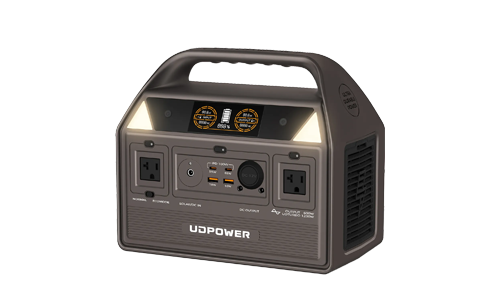
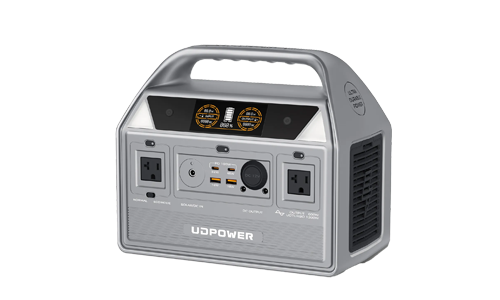
UDPOWER S1200 Portable Power Station
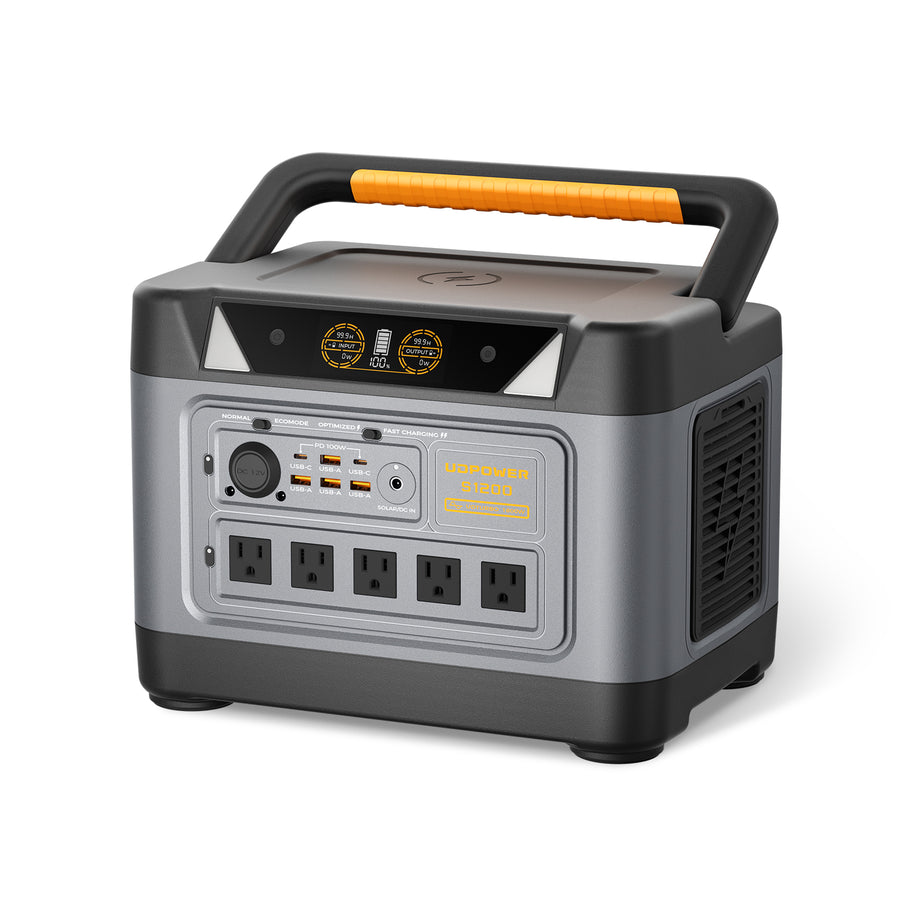
The S1200 is designed for users who want normal 1200W-class portability without being limited to 1200W appliances in every situation.
- Battery capacity: 1190Wh
- Rated AC output: 1200W pure sine wave
- High-power capability: Up to 1800W continuous appliance support through UDTURBO, with reduced conversion efficiency above 1200W
- AC outlets: 5 on the current gray version
- Total output ports: 15
- USB-C: Two ports with up to 100W output
- Solar input: Up to 400W
- Fast AC charging: Approximately 1.5 hours
- UPS switchover: Less than 10ms
- Battery chemistry: LiFePO4
- Weight: Approximately 26 lb
- Warranty: 5 years
Best for: Refrigerator backup, CPAP, remote work, camping, RV trips, electronics, moderate appliances, and occasional high-watt appliances between 1200W and 1800W.
UDPOWER S2400 Portable Power Station
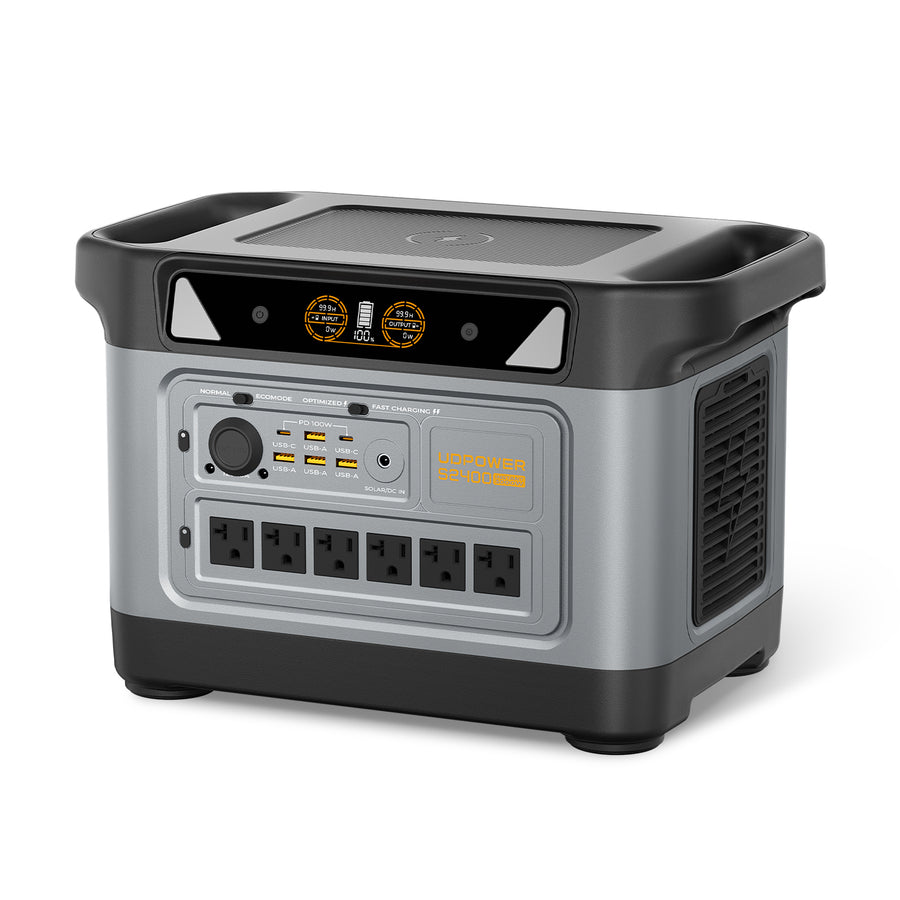
Choose the S2400 when several high-watt appliances must operate together, when motor startup requires more headroom, or when 1190Wh does not provide enough outage runtime.
- Battery capacity: 2083Wh
- Rated AC output: 2400W pure sine wave
- Peak output: Up to 3000W
- AC outlets: 6
- Total output ports: 16
- Solar input: Up to 400W
- Fast charging: Approximately 1.5 hours
- UPS switchover: Less than 10ms
- Battery chemistry: LiFePO4
- Weight: Approximately 40.8 lb
Best for: Longer home outages, microwaves, coffee makers, tools, refrigerators plus other appliances, family camping, and RV setups.
UDPOWER Solar Generator Kits

A solar panel does not increase the power station’s AC output. It restores battery energy during daylight and can extend camping trips or help manage longer outages.
Solar charging speed depends on sunlight, panel angle, shading, temperature, panel wattage, and the station’s input limit.
Frequently Asked Questions
Can a 1200W portable power station run a refrigerator?
Often, yes. Many refrigerators use far less than 1200W during normal operation. The main compatibility check is the compressor’s startup demand, which must remain within the power station’s peak-output limit.
How long will a 1200W power station run a refrigerator?
Runtime depends on battery capacity and the refrigerator’s average energy consumption. A 1024Wh station using an 85% planning factor may run a refrigerator averaging 60W for about 14.5 hours. Compressor cycling, temperature, defrost cycles, and door opening can change the result.
Can a 1200W portable power station run a microwave?
It can run a microwave whose electrical input remains within the station’s continuous and peak-output limits. Some compact microwaves draw around 1050W and may work, while larger models can draw 1580W or more and exceed a conventional 1200W limit.
Can a 1200W power station run a coffee maker?
It depends on the coffee maker. Models drawing less than 1200W may operate, while high-power models drawing around 1500W or more exceed a conventional 1200W continuous-output limit.
Can a 1200W power station run a space heater?
A heater using about 750W on its low setting may operate, but runtime will be short. A typical 1500W high setting exceeds the continuous limit of a conventional 1200W power station.
Can a 1200W power station run an air fryer?
Most full-size air fryers draw between 1200W and 1800W, so they usually exceed or completely consume the output of a conventional 1200W station. Check the appliance’s electrical input before use.
Can a 1200W portable power station run a CPAP all night?
In many cases, yes. CPAP output requirements are normally well below 1200W. Overnight runtime depends on battery capacity, humidifier use, heated tubing, pressure settings, and the machine’s actual consumption.
Can it run a TV, laptop, router, and lights at the same time?
Usually, yes. A realistic combination of these devices may use only 150W to 300W, leaving substantial output headroom. Add the actual wattage of every connected device before relying on the estimate.
What is the difference between 1200W and 1200Wh?
1200W measures how much power the station can provide at one moment. 1200Wh measures how much energy the battery stores. Watts determine appliance compatibility, while watt-hours help determine runtime.
Does a 1200W power station always have a 1200Wh battery?
No. Output and battery capacity are separate specifications. A 1200W power station may have a battery capacity of 768Wh, 1024Wh, 1200Wh, 1500Wh, or another value.
Can I use all of the AC outlets at the same time?
Yes, provided the combined running load and startup demand remain within the power station’s limits. All AC outlets share the same inverter output capacity.
Can a 1200W power station run a 1500W appliance?
A conventional 1200W station generally cannot continuously run a 1500W appliance. Some models offer proprietary high-power modes that can support selected loads above the rated output, so the manufacturer’s instructions must be checked.
How is the UDPOWER S1200 different from a typical 1200W station?
The UDPOWER S1200 has 1200W rated output and can continuously support compatible appliances up to 1800W through UDTURBO. Conversion efficiency decreases above 1200W, so high-power runtime is shorter.
Should I choose a 1200W or 2400W portable power station?
Choose a 1200W station for electronics, CPAP, refrigeration, camping, remote work, and essentials-first backup. Choose a 2400W-class model when you need more simultaneous appliances, heavier kitchen equipment, larger tools, greater startup headroom, or longer runtime.
Choose a Power Station From Your Appliance List
First, add the running watts of every appliance that may operate at the same time. Then check the highest startup demand and calculate how many watt-hours you need for the desired runtime.
A conventional 1200W station is a strong essentials-first option. The UDPOWER S1200 adds more flexibility by continuously supporting compatible appliances up to 1800W through UDTURBO.
Related Articles


