

What Is the Most Reliable Portable Power Station?
Portable Power Station Buyer’s Guide
Reliability isn’t a brand name—it's a behavior. The “most reliable” portable power station is the one that: (1) starts the loads you actually own (including surges), (2) stays stable under heat/cold and long runtimes, (3) protects itself safely when something goes wrong, and (4) is backed by a warranty that’s clear and honored.
This guide shows you exactly what to look for (and how to verify it), then gives a few scenario-based picks—without pretending one model is perfect for everyone.

What “reliable” means for a portable power station
If you’re buying a portable power station for emergencies, camping, medical devices, or remote work, “reliable” usually means three things:

1) Electrical reliability (it powers your stuff without drama)
- Handles startup surges (fridges, pumps, compressors, power tools)
- Pure sine wave AC output for sensitive electronics
- Stable voltage under load (no random shutoffs)
- Good idle behavior (doesn’t waste battery when you’re not using it)
2) Safety reliability (it protects itself—and you)
- Battery management that reacts fast to overheating/overcurrent/short circuits
- Real thermal monitoring (multiple sensors, not a single “guess” point)
- Battery chemistry built for longevity and stability (LiFePO₄ is the common pick)
- Meaningful safety testing/certifications for a portable power pack
3) Ownership reliability (it stays reliable over years)
- Clear warranty length + clear claim process
- Transparent spec sheets (input ranges, surge ratings, temperature limits)
- Quality control that reduces early-life failures
- Support that can troubleshoot quickly (and replacement parts that exist)
A lot of people buy based on capacity (Wh) alone. Capacity matters, but reliability is usually decided by the BMS, inverter quality, thermal design, and whether the published specs match real behavior.
The reliability checklist (what to demand before you buy)
If you want to avoid the “it looked great on paper” regret, use this checklist. It’s written in plain language, but every line maps to something you can verify from a spec sheet or certification list.

| Reliability factor | Why it matters | What to look for (minimum) | How to verify |
|---|---|---|---|
| Battery chemistry | Controls safety margin, heat stability, and long-term cycle aging. | LiFePO₄ (LFP) for long cycle life and stability. | Spec sheet lists battery type (not “lithium” only). Look for published cycle-life target. |
| BMS protection | Prevents damage from overloads, short circuits, overheating, and charging issues. | Multi-layer protection + multi-point temperature monitoring. | Look for explicit protections and sensor count (or “multi-temp sensors”) in the technical description. |
| Pure sine wave inverter | Cleaner AC power reduces weird behavior with chargers, medical gear, and sensitive electronics. | Pure sine wave AC output. | Spec sheet should literally say “pure sine wave.” If it’s missing, assume it’s not. |
| Continuous watts + surge behavior | Most “failures” are actually surge trips (motor/compressor startup). | Published continuous rating + published surge rating + realistic language (not just “peak”). | Compare your loads. If you run a fridge/pump, surge headroom matters more than you think. |
| Thermal design + noise | Heat is the silent killer of inverters and battery packs. Excess fan noise is often a symptom. | Clear operating temperature ranges + stable fan behavior under load. | Look for published charge/discharge temperature range. In reviews, watch for “overheat” patterns. |
| Solar input range (voltage) | Charging reliability fails when panel voltage/current doesn’t match input limits. | Published solar input voltage range + max current + max watts. | Match your panel/string open-circuit voltage to the station’s input range (with buffer in cold weather). |
| UPS / fast switchover (if you need it) | If you want router/modem backup, transfer time is everything. | Published UPS mode with transfer time (ms). | Spec sheet should list UPS response time. If it’s vague, treat it as “no UPS.” |
| Safety standards & transport testing | Not every “certified” badge means the same thing. | UL 2743 (portable power packs) + UN 38.3 (transport) listed on the spec page. | Verify on product spec page and cross-check brand support pages. (See the standards section below.) |
| Warranty clarity | Reliability includes “what happens if something goes wrong.” | At least 2–5 years for serious use + a clear claim process. | Read the actual warranty policy. Look for what’s covered, what proof you need, and turnaround steps. |
If you’re shopping fast: prioritize LiFePO₄ + clear BMS protection + pure sine wave + published surge behavior + a real warranty. Everything else is a bonus.
Certifications & labels that actually matter (UL, UN38.3, FCC, RoHS)
Certifications won’t guarantee a perfect product—but they do reduce your odds of buying a “mystery box.” Here’s a clean way to interpret the most common ones you’ll see in portable power station specs.

| Label / standard | What it generally indicates | Why it helps reliability | Where to learn more (external) |
|---|---|---|---|
| UL 2743 | Safety evaluation framework for portable power packs (portable battery-based power sources). | Pushes design toward safer fault handling and construction expectations. | UL: Portable power pack testing (UL 2743) |
| UN 38.3 | Transport testing requirement for lithium batteries (shipping safety). | Reduces risk in handling/transport; also signals more formal battery documentation. | PHMSA: lithium battery test summaries (UN 38.3) |
| FCC | Electromagnetic compatibility expectations for electronics sold in the U.S. (limits harmful RF interference). | Not a “battery safety” certification, but a sign the electronics weren’t skipped over. | SGS explainer: FCC approval |
| RoHS | Restricted hazardous substances compliance. | Helps ensure more controlled materials and manufacturing discipline. | EU overview: RoHS directive |
| DOE compliance listings (context) | Public database for certain regulated product certifications/compliance statements. | When a brand points to a government database, it’s at least verifiable paperwork. | DOE: compliance certification database |
Quick reality check: “certified” badges vary by scope. UL 2743 and UN 38.3 are commonly referenced in portable power specs. FCC and RoHS are important, but they don’t replace battery safety design.
Common red flags that predict problems
These are patterns that show up again and again when a “portable power station” is unreliable in real life. One red flag doesn’t automatically kill a product—but multiple flags should make you pause.

- No real spec sheet (only marketing bullets, no voltage ranges, no temperature limits, no surge info)
- “Peak watts” used like it’s continuous (especially for motor loads)
- Vague battery description (“lithium battery” without chemistry, cycle-life, or protections)
- Missing solar input range (a classic cause of charging failures)
- Warranty that sounds big but reads small (lots of exclusions, unclear claim steps, no proof requirements listed)
- Overheating complaints that repeat (especially when the unit isn’t being pushed near its rating)
If you’re buying for emergencies, don’t gamble on vague specs. Reliability starts with transparency.
A quick at-home reliability test you can do in 30 minutes
This is a simple “sanity test” you can do right after delivery (or before the return window closes). It won’t replicate a lab, but it will catch the most common real-world issues.

| Test | What you’re checking | How to do it | What “good” looks like |
|---|---|---|---|
| Baseline charge & display | State-of-charge reporting and stability. | Charge to 100%. Let it sit 20 minutes. Turn AC on/off and watch the display. | Stable readout, no unexpected errors. |
| Steady load test | Inverter stability under normal draw. | Run a steady ~100–300W load (lamp + small fan, or a resistive load) for 20 minutes. | No flicker, no random shutoff, reasonable fan behavior. |
| Surge moment | Whether it starts “real” appliances. | Try a compressor load (fridge) or a motor load briefly. Start it while already running a small load. | Starts cleanly without tripping. (If it trips, you likely need more surge headroom.) |
| UPS handoff (if advertised) | Transfer time behavior for router/modem. | Plug station into wall (charge), keep router on AC output, then unplug wall input. | Router stays up (no reboot). If it reboots, UPS transfer may not be fast enough for your gear. |
| Solar input handshake | Charging reliability with your actual panel. | Connect your panel in good sun. Confirm input watts appear and remain stable for 10 minutes. | Stable input readings, no cycling on/off. |
If you want a deeper sizing explainer (watts vs surge vs solar input voltage), UDPOWER has a plain-English guide you can reference here: Solar and Power Inverters: How They Work Together. (That article also links out to DOE/NREL/Sandia resources; external links there are informational.)
How UDPOWER designs for reliability (BMS/EMS/MPPT + inverter platform)
Most reliability problems happen in the “invisible” parts: battery protection logic, heat control, and the inverter/charging system. UDPOWER’s design philosophy (as described on their portable power station technical overview) focuses heavily on those core systems. Here are the reliability-relevant pieces, in normal language:

BMS 3.0: faster protection + more sensing
UDPOWER describes its BMS 3.0 as a 32-bit MCU-based system with multiple temperature sensors and multi-layer protection. In plain terms: it’s watching the pack more closely, and it can cut off abnormal behavior faster.
Source (UDPOWER tech overview): BMS 3.0 + protection details
Overcharge/over-discharge protection Overcurrent/short circuit Thermal monitoring Active balancingEMS (explicitly self-developed): system-level coordination
UDPOWER states its EMS is a fully self-developed architecture that coordinates the BMS, inverter, and cooling system (not an off-the-shelf module). System-level coordination matters because it’s how you avoid weird edge cases: sudden shutdowns, bad idle drain, or unstable behavior under changing loads.
Source (UDPOWER tech overview): EMS self-developed description
Load-aware discharge strategy Fault warnings & self-diagnosis Low idle drain modeMPPT (self-developed): stable solar charging
Solar charging reliability fails when tracking is slow or unstable under changing light. UDPOWER describes a self-developed MPPT algorithm designed to respond quickly to sunlight changes and maximize power tracking efficiency. If you rely on solar charging, MPPT quality is not a “nice to have”—it’s the difference between steady charging and constant dropouts.
Source (UDPOWER tech overview): MPPT tracking description
Inverter platform: SiC efficiency + lower heat (a reliability lever)
Inverters fail faster when they run hot. UDPOWER highlights a Silicon Carbide (SiC) inverter approach aimed at high conversion efficiency and lower thermal loss. Lower heat isn’t just “nice”—it reduces thermal stress during long runtimes and heavy loads.
Source (UDPOWER tech overview): SiC inverter overview
UDPOWER reliability-focused comparison (S1200 vs S2400 vs C600)
Below is a spec-based comparison focused on reliability indicators (chemistry, certifications, temperature limits, UPS mode, etc.). All specs are linked directly to the official UDPOWER pages.
| Model | Battery / cycle life | AC output & surge | UPS mode | Solar input | Operating temp (discharge / charge) | Certifications listed | Warranty | Spec source |
|---|---|---|---|---|---|---|---|---|
|
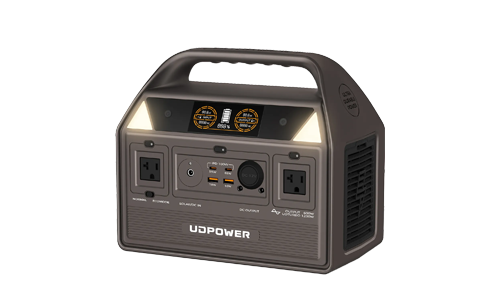
UDPOWER S1200 1191Wh • ~26 lb |
LiFePO₄ (LFP) 80%+ capacity after 3000 cycles |
Pure sine wave 1200W continuous 1800W max (surge) |
UPS mode response time ≤10ms |
Max 400W 12–75V ⎓ 12A max |
-4°F to 113°F 23°F to 104°F |
UL2743, PSE, FCC, ROHS, UN38.3 | 5-year limited warranty | S1200 product page (specs) |
|
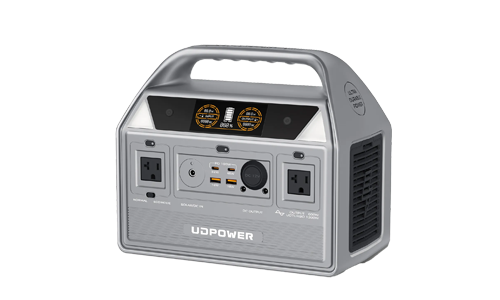
UDPOWER S2400 2083Wh • ~40.8 lb |
Brand new LFP battery 80%+ capacity after 3000 cycles |
Pure sine wave 2400W continuous UDTURBO surge up to 3000W |
UPS mode response time ≤10ms |
12–50V ⎓ 10A max | -4°F to 113°F 23°F to 104°F |
UL2743, FCC, ROHS, UN38.3 | 5-year limited warranty | S2400 product page (specs) |
|
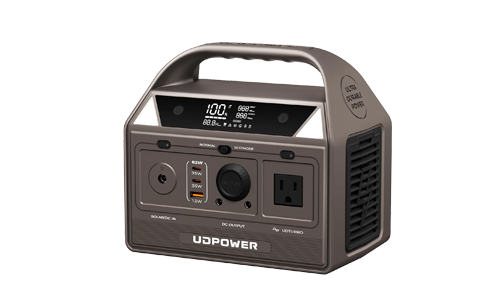
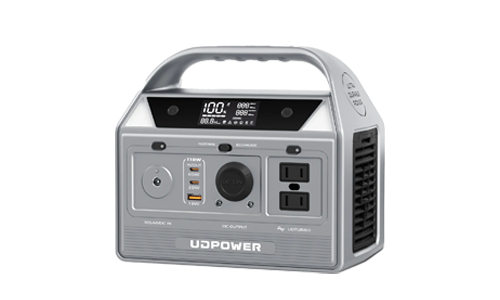
UDPOWER C600 596Wh • 12.3 lb |
LFP (LiFePO₄) 80%+ capacity after 3000 cycles |
Pure sine wave 600W rated 1200W max |
(See page for features) Designed for quiet indoor/camping use |
Solar input 240W max 11–28V input range |
-4°F to 113°F 32°F to 104°F |
UL2743, PSE, FCC, ROHS, UN38.3 | 5-year limited warranty | C600 product page (specs) |
Notes:
• If you care about “solar compatibility,” the solar input voltage range is usually the first thing that breaks setups.
• If you care about “router doesn’t reboot,” UPS transfer time matters. Both S-series models list ≤10ms.
Picking the “most reliable” model for your scenario
Here’s the practical truth: reliability is partly about matching. A “reliable” station that’s undersized for your surge loads will still trip. A “reliable” station with the wrong solar input range will still charge poorly. So instead of picking one universal winner, pick the most reliable option for the way you’ll actually use it.
Emergency home essentials + router/modem backup
- Prioritize: UPS mode, pure sine wave, clear surge behavior
- Typical loads: router/modem, phones, lights, maybe a fridge cycle
A reliable fit often looks like: UDPOWER S1200 if your loads are moderate, or step up to UDPOWER S2400 if you need higher continuous watts and more stored energy.
Fridge + motor loads (surge-heavy)
- Prioritize: surge headroom + thermal stability
- Reliability failure mode: the fridge runs… until it tries to start again
For surge-heavy use, the S2400 is built around higher continuous watts and explicit surge behavior, which tends to be what keeps compressor loads happy.
Camping + “quiet overnight” + small appliances
- Prioritize: quiet operation, efficient DC/USB charging, solid build
- Use AC only when needed; DC/USB often feels more “reliable” in practice
If you want something easier to carry and still built for serious safety standards, the C600 sits in the “portable but capable” category.
Solar-first users (charging reliability matters most)
- Prioritize: solar input voltage range + MPPT stability + max solar watts
- Big mistake: buying by panel watts only
For a solar-first build, use a station with a wider solar input voltage range and clear current limits. Start with the S1200 solar input range and match your panel string accordingly: S1200 solar input specs.
Helpful reading: solar + inverter sizing (plain English)
Maintenance & storage habits that keep any station reliable
Even the best hardware gets unreliable if it’s stored poorly or used outside its temperature window. Here’s a low-effort routine that keeps performance predictable.
| Frequency | What to do | Why it helps reliability | Quick tips |
|---|---|---|---|
| Monthly (or every 6–8 weeks) | Top up charge and run a short load test (10–15 minutes). | Keeps the pack active and confirms outputs still behave normally. | Use a small AC load + a USB-C device; watch for errors or odd fan behavior. |
| Before storm season / trips | Do a surge-start test with your “hardest” appliance. | Surge behavior is the #1 surprise failure. | If it trips, you need more surge headroom—not “more Wh.” |
| Always | Respect charging temperature limits. | Charging cold can trigger protection or degrade long-term performance. | Warm the unit to the listed charging range before charging in winter. |
| Storage | Store in a moderate temperature range; avoid hot cars and freezing sheds. | Heat accelerates aging; extreme cold can temporarily reduce usable capacity. | Indoor closet beats garage shelf for long-term reliability. |
FAQ
Is LiFePO₄ always more reliable than “regular lithium”?
In portable power stations, LiFePO₄ is often chosen because it’s thermally stable and known for long cycle life. Reliability still depends on BMS quality, inverter design, and thermal management—but chemistry is a strong foundation.
Why do some power stations shut off with very small loads?
Many models have an “eco mode” or low-load cutoff to prevent wasting energy when the inverter is on with nothing meaningful connected. If you’re powering tiny loads (like a router or a security base station), look for UPS mode or eco-mode controls—and test it with your exact devices.
Does “pure sine wave” actually matter for reliability?
It can. Pure sine wave AC output tends to reduce buzz, heat, and compatibility quirks with sensitive electronics. Reliability isn’t just “it turns on”—it’s “it behaves normally,” and clean waveform helps.
What’s more important: watt-hours (Wh) or watts (W)?
For reliability: watts decide what you can run (and whether it starts). Watt-hours decide how long you can run it. If your station can’t start the device, more Wh won’t fix it.
What should I look for if I want a battery backup for my router/modem?
Look for UPS mode with a published transfer time (ms), then test it at home by unplugging the wall input. If your router reboots, the handoff wasn’t fast enough for your specific power brick.
How do I avoid solar charging “not working” even though my panel has enough watts?
Match the station’s solar input voltage range and max input current first—panel watts are second. Voltage mismatch is the most common silent failure.
Are third-party solar panels okay?
Usually, yes—if the connectors are compatible and the panel/string stays inside the power station’s input voltage range and current limits. Always prioritize voltage limits first.
What does UL 2743 tell me?
UL 2743 is a safety standard commonly referenced for portable power packs. It’s not a guarantee of zero problems, but it’s a meaningful signal that the product category is being evaluated against a safety framework.
What does UN 38.3 tell me?
UN 38.3 is about lithium battery transport testing. It’s especially relevant if you’re worried about shipping safety and documentation discipline.
Should I buy based on “peak watts”?
No. Use continuous watts for “what can I run,” and surge behavior for “what will start.” Peak-only marketing is one of the fastest ways to buy something unreliable for your needs.
What’s the simplest way to choose a reliable station without overthinking it?
Pick LiFePO₄, demand pure sine wave, verify a real spec sheet (including solar input range and temperature limits), and choose a warranty you’re comfortable relying on. Then buy the watt rating that actually fits your loads.
Sources & spec links
- UDPOWER technical overview (BMS/EMS/MPPT/SiC inverter/QC): https://udpwr.com/collections/portable-power-station
- UDPOWER S1200 specs: https://udpwr.com/products/udpower-s1200-portable-power-station
- UDPOWER S2400 specs: https://udpwr.com/products/udpower-s2400-portable-power-station
- UDPOWER C600 specs: https://udpwr.com/products/udpower-c600-portable-power-station
- UDPOWER warranty policy: https://udpwr.com/pages/warranty-policy
- Plain-English inverter & sizing guide (UDPOWER blog): https://udpwr.com/blogs/portable-power-station-knowledge/solar-and-power-inverters
- External: UL portable power pack testing (UL 2743): https://www.ul.com/services/portable-power-pack-testing
- External: PHMSA lithium battery test summaries (UN 38.3 context): https://www.phmsa.dot.gov/training/hazmat/new-un-requirement-test-summaries
- External: DOE compliance certification database (general reference): https://www.regulations.doe.gov/certification-data/
Related Articles


