

How Long Will a 2000Wh Power Station Last?
Last updated:
How Long Will a 2,000Wh Power Station Last?
A 2,000Wh portable power station can provide approximately 1,800Wh of usable AC energy when calculated at 90% conversion efficiency. That is enough for about 18 hours at a steady 100-watt load, 9 hours at 200 watts, 3.6 hours at 500 watts, or 1.8 hours at 1,000 watts.
For emergency planning, it is safer to keep about 10% of the battery in reserve. That leaves approximately 1,620Wh for planned use. Under that more conservative approach, a 100-watt load lasts about 16.2 hours and a 500-watt load lasts about 3.24 hours.
| Average load | Runtime at 90% efficiency | Runtime with 10% reserve | Calculation source |
|---|---|---|---|
| 20W | 90 hours | 81 hours | Battery runtime method |
| 50W | 36 hours | 32.4 hours | Battery runtime method |
| 100W | 18 hours | 16.2 hours | Battery runtime method |
| 200W | 9 hours | 8.1 hours | Battery runtime method |
| 500W | 3.6 hours | 3.24 hours | Battery runtime method |
| 1,000W | 1.8 hours | 1.62 hours | Battery runtime method |
| 1,500W | 1.2 hours | 1.08 hours | Battery runtime method |
These estimates assume a steady load. Refrigerators, pumps, heating devices, and appliances with motors cycle on and off, so their real elapsed runtime may be different.

How to Calculate 2,000Wh Power Station Runtime
A power station's battery capacity is measured in watt-hours. One watt-hour represents one watt of power supplied for one hour. In a perfect system, a 2,000Wh battery could run a 200-watt appliance for 10 hours.
Portable power stations are not perfect systems. The inverter, internal electronics, cabling, and voltage conversion all consume some energy. For practical UDPOWER planning, this guide uses 90% conversion efficiency.
Example: A 120-Watt Television Setup
The first result is a useful runtime estimate. The second result is a more cautious figure for an outage, storm, medical backup plan, or trip where reaching 0% would create a problem.
2,000Wh Is Not the Same as 2,000W
These two ratings answer different questions:
- Watt-hours measure energy capacity. A 2,000Wh rating helps estimate how long the battery can support a load.
- Watts measure output power. A 2,000W output rating indicates how much power the station can supply at one time.
A power station could have a 2,000Wh battery but a 1,500W inverter, or a 2,000Wh battery and a 2,400W inverter. The capacity may be similar, but the second station can support more demanding appliances.
For more examples, see what a 2,000W portable power station can run .
2,000Wh Power Station Runtime by Average Load
The following table separates the normal 90%-efficiency estimate from a more conservative outage-planning estimate that holds 10% of the usable battery in reserve.
| Average load | 90% usable energy | Runtime | Runtime with 10% reserve | Typical use category | Source |
|---|---|---|---|---|---|
| 10W | 1,800Wh | 180 hours | 162 hours | Single LED light or small electronics | Runtime formula |
| 20W | 1,800Wh | 90 hours | 81 hours | Internet equipment or small DC loads | Runtime formula |
| 30W | 1,800Wh | 60 hours | 54 hours | Low-setting medical or communication equipment | Runtime formula |
| 40W | 1,800Wh | 45 hours | 40.5 hours | Small fan or efficient portable refrigerator average | Runtime formula |
| 50W | 1,800Wh | 36 hours | 32.4 hours | Fan, laptop, or grouped small loads | Runtime formula |
| 65W | 1,800Wh | 27.7 hours | 24.9 hours | Laptop charger or similar electronics | Runtime formula |
| 75W | 1,800Wh | 24 hours | 21.6 hours | Communications or entertainment setup | Runtime formula |
| 100W | 1,800Wh | 18 hours | 16.2 hours | Compact work or entertainment setup | Runtime formula |
| 150W | 1,800Wh | 12 hours | 10.8 hours | Television, computer, or mixed essentials | Runtime formula |
| 200W | 1,800Wh | 9 hours | 8.1 hours | Office setup or multiple small appliances | Runtime formula |
| 300W | 1,800Wh | 6 hours | 5.4 hours | Large television setup or intermittent pump use | Runtime formula |
| 500W | 1,800Wh | 3.6 hours | 3.24 hours | Power tools or higher-demand appliance group | Runtime formula |
| 800W | 1,800Wh | 2.25 hours | 2.03 hours | Pump, cooking appliance, or tool | Runtime formula |
| 1,000W | 1,800Wh | 1.8 hours | 1.62 hours | Microwave or high-power tool | Appliance output guide |
| 1,200W | 1,800Wh | 1.5 hours | 1.35 hours | Cooking or heating appliance | Appliance output guide |
| 1,500W | 1,800Wh | 1.2 hours | 1.08 hours | Space heater, kettle, or air fryer | Appliance output guide |
| 2,000W | 1,800Wh | 0.9 hour | 0.81 hour | Very high-power appliance, if output permits | Appliance output guide |
Runtime at high wattage represents cumulative operating time. A microwave used for ten minutes does not consume the same energy as a microwave left on continuously for an hour.
How Long Can a 2,000Wh Power Station Run Common Appliances?
Appliance labels often show maximum or rated input, not the long-term average. The figures below are planning examples. Replace the example wattage with the reading from your appliance label, energy meter, or power station display whenever possible.
| Appliance or load | Example average load | 2,000Wh estimated runtime | UDPOWER S2400 estimated runtime | Important limitation | Source or method |
|---|---|---|---|---|---|
| LED lamp | 10W | 180 hours | 187.5 hours | Actual draw depends on the bulb and fixture. | Runtime calculation |
| Router and modem | 20W | 90 hours | 93.7 hours | Cellular gateways and satellite systems may use more. | Wi-Fi outage guide |
| Portable fan | 50W | 36 hours | 37.5 hours | Higher speed settings shorten runtime. | Runtime calculation |
| Laptop charger | 65W | 27.7 hours | 28.8 hours | A laptop usually draws less after its battery is charged. | Runtime calculation |
| Television and streaming device | 120W | 15 hours | 15.6 hours | Screen size, brightness, and audio equipment change usage. | Runtime calculation |
| Desktop computer and monitor | 250W | 7.2 hours | 7.5 hours | Gaming and rendering can increase consumption significantly. | Runtime calculation |
| Efficient refrigerator | 45.7W annual average | 39.4 hours | 41 hours | Based on a 400kWh-per-year example; startup surge still matters. | ENERGY STAR refrigerator data |
| Sump pump | 800W while running | 2.25 hours of pump-on time | 2.34 hours of pump-on time | Elapsed backup time depends on cycling and startup surge. | Runtime calculation |
| Microwave | 1,000W input example | 1.8 hours of total heating time | 1.87 hours of total heating time | Use the input wattage, not only the advertised cooking output. | 2,000W appliance guide |
| Space heater | 1,500W | 1.2 hours | 1.25 hours | Resistance heating drains batteries rapidly. | 2,000W appliance guide |
How Long Will a 2,000Wh Power Station Run a Refrigerator?
A refrigerator is one of the most common reasons to buy a 2,000Wh-class battery, but its nameplate wattage is often a poor basis for estimating elapsed runtime. The compressor cycles, and modern refrigerators may also run fans, lights, defrost heaters, and electronic controls.
A more useful starting point is the refrigerator's annual energy-use figure from its EnergyGuide label or product specification.
Once the annual energy use is converted to average watts, divide the power station's usable energy by that average.
| Refrigerator annual use | Calculated average load | 2,000Wh runtime at 90% | S2400 runtime at 90% | Data source |
|---|---|---|---|---|
| 300kWh/year | 34.2W | 52.6 hours | 54.8 hours | ENERGY STAR Product Finder |
| 400kWh/year | 45.7W | 39.4 hours | 41 hours | ENERGY STAR Product Finder |
| 500kWh/year | 57.1W | 31.5 hours | 32.8 hours | ENERGY STAR Product Finder |
| 588kWh/year | 67.1W | 26.8 hours | 27.9 hours | U.S. Department of Energy |
| 700kWh/year | 79.9W | 22.5 hours | 23.5 hours | U.S. Department of Energy |
| 900kWh/year | 102.7W | 17.5 hours | 18.3 hours | U.S. Department of Energy |
These are energy-based estimates, not guaranteed runtimes. Hot rooms, frequent door openings, damaged door seals, ice buildup, defrost cycles, and an older compressor can increase energy use.
You must also confirm that the power station can handle the refrigerator's compressor startup. Battery capacity determines duration; inverter output determines whether the compressor can start.
See the dedicated guide to running a refrigerator from a 2,000W power station for additional examples.
A Daily Energy Budget Is More Useful Than One Appliance Number
During a real outage or camping trip, you rarely run just one device. The better question is: how many watt-hours will the entire setup use each day?
The examples below use conservative planning energy: 1,620Wh from a generic 2,000Wh station and approximately 1,687Wh from the 2,083Wh UDPOWER S2400. Both figures include 90% conversion efficiency and a 10% reserve.
| Use plan | Example daily loads | Daily energy use | 2,000Wh planning duration | S2400 planning duration | Related guide |
|---|---|---|---|---|---|
| Communications first | Router and modem: 20W × 24 hours Two LED lamps: 20W × 6 hours Phone charging: 10W × 4 hours |
640Wh/day | 2.53 days | 2.64 days | Keep Wi-Fi running |
| Efficient refrigerator and communications | Refrigerator at 400kWh/year: about 1,096Wh/day Router and modem: 480Wh/day Lighting: 120Wh/day Phone charging: 40Wh/day |
About 1,736Wh/day | 0.93 day | 0.97 day | Outage power priorities |
| CPAP and work essentials | CPAP: 60W × 8 hours Router and modem: 20W × 24 hours Laptop: 65W × 4 hours Lighting: 20W × 4 hours |
1,300Wh/day | 1.25 days | 1.30 days | CPAP outage backup |
| Quiet camping setup | Portable refrigerator average: 45W × 24 hours Fan: 50W × 8 hours Lighting: 20W × 5 hours Device charging: 30W × 2 hours |
1,640Wh/day | 0.99 day | 1.03 days | Solar generator options |
These are example load profiles, not appliance guarantees. Replace each example wattage and operating time with your own measured values.
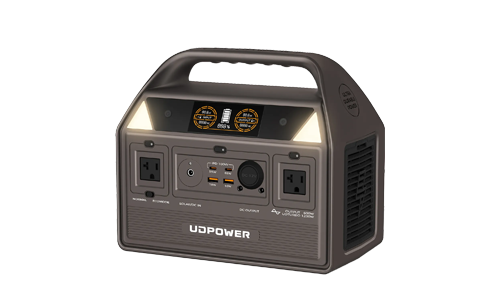
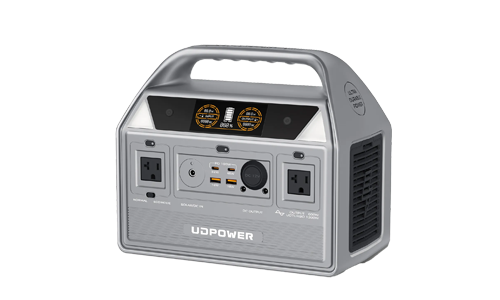
UDPOWER S2400 Portable Power Station
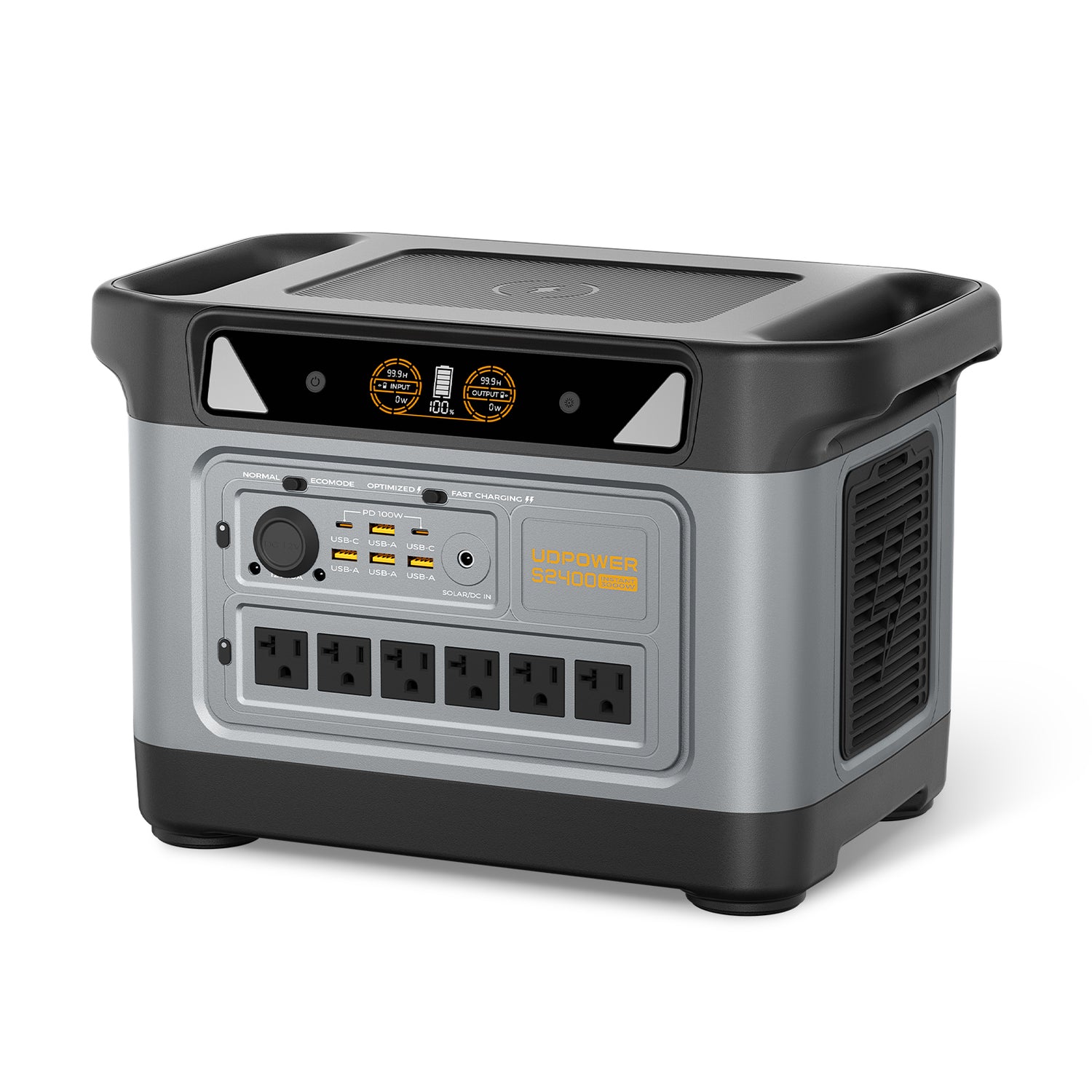
The UDPOWER S2400 is the closest match for shoppers looking for a true 2,000Wh-class portable power station. Its official battery capacity is 2,083Wh, slightly higher than the 2,000Wh reference used throughout this guide.
When a 10% emergency reserve is included, the practical planning budget is approximately 1,687Wh. A continuous 100-watt load would therefore last about 18.75 hours under the normal 90%-efficiency estimate, or about 16.87 hours with the reserve.
| S2400 specification | Official rating | Why it matters | Official source |
|---|---|---|---|
| Battery capacity | 2,083Wh | Directly determines the available energy budget. | S2400 product page |
| Continuous AC output | 2,400W pure sine wave | Supports higher-demand appliances within the output limit. | S2400 specifications |
| Surge capability | Up to 3,000W with UDTURBO | Helps with brief startup demand from compatible appliances. | S2400 specifications |
| AC outlets | 6 outlets | Allows several essential devices to be connected. | S2400 port details |
| USB outputs | 4 USB-A and 2 USB-C ports | Supports phones, tablets, laptops, and small electronics. | S2400 port details |
| USB-C output | Up to 100W | Can charge compatible laptops without using an AC adapter. | S2400 port details |
| Solar input | Up to 400W | Allows daytime energy replacement when conditions permit. | S2400 charging specifications |
| UPS transfer time | 10ms or less | Provides fast transfer for supported backup applications. | S2400 UPS specifications |
| Battery cycle specification | 80%+ capacity after 3,000 cycles | Indicates long-term battery-retention expectations. | S2400 technical specifications |
| Weight | 40.8 lb | More portable than installed backup systems, but substantial. | S2400 dimensions and weight |
| Dimensions | 15.8 × 9.5 × 10.1 inches | Helps with storage, RV, vehicle, and emergency-kit planning. | S2400 dimensions and weight |
Compare the UDPOWER S1200 and S2400
How Many Nights Can a 2,000Wh Power Station Run a CPAP?
CPAP power use varies with pressure, humidification, heated tubing, altitude settings, mask leakage, and whether the machine uses AC or a compatible DC connection. Do not estimate runtime only from the maximum rating printed on the power adapter.
The following table uses three planning loads and assumes eight hours of operation per night.
| Average CPAP load | 2,000Wh total runtime | 2,000Wh eight-hour nights | S2400 total runtime | S2400 eight-hour nights | Planning source |
|---|---|---|---|---|---|
| 30W | 60 hours | 7.5 nights | 62.5 hours | 7.8 nights | CPAP backup guide |
| 60W | 30 hours | 3.75 nights | 31.2 hours | 3.9 nights | CPAP backup guide |
| 90W | 20 hours | 2.5 nights | 20.8 hours | 2.6 nights | CPAP backup guide |
Heated humidification and heated tubing can materially change consumption. For example, the ResMed AirSense 11 documentation identifies humidification and heated-tube features that should be considered when building a backup plan. Review the ResMed AirSense 11 user guide .
High-Wattage Appliances Should Be Calculated by Each Use
Continuous runtime can make short-use appliances look more demanding than they are. A kettle may draw 1,500 watts, but it might run for only five minutes. Calculate the energy used by each cooking or heating event.
| Appliance example | Example use | Energy per use | Approximate uses from 1,800Wh | Practical note | Method source |
|---|---|---|---|---|---|
| Electric kettle | 1,500W for 5 minutes | 125Wh | About 14 uses | Confirm the station supports the kettle's input wattage. | 2,000W appliance guide |
| Microwave | 1,000W input for 10 minutes | 167Wh | About 10 uses | Use electrical input watts, not cooking-output watts. | 2,000W appliance guide |
| Coffee maker | 1,000W for 10 minutes | 167Wh | About 10 cycles | Some machines keep a warming plate powered afterward. | 2,000W appliance guide |
| Air fryer | 1,500W for 20 minutes | 500Wh | About 3 full cycles | Thermostatic cycling may reduce actual energy use. | 2,000W appliance guide |
| Toaster | 1,200W for 5 minutes | 100Wh | About 18 uses | Actual cycle length depends on the browning setting. | 2,000W appliance guide |
| Space heater | 1,500W for 60 minutes | 1,500Wh | About 1.2 hours total | Continuous resistance heating consumes nearly the full battery. | 2,000W appliance guide |
The table already uses the 1,800Wh usable-energy estimate. Real results change with the appliance's measured draw, cycling pattern, and power station operating conditions.
Eight Factors That Change Real-World Runtime
1. Average Power Consumption
Runtime depends on average watts over time. A device that cycles between 0 and 200 watts may average only 50 watts over several hours.
2. Inverter and Conversion Losses
AC power requires the station's inverter. USB and regulated DC outputs follow different conversion paths, so the same battery may deliver slightly different results depending on the port used.
3. Startup Surge
Refrigerators, freezers, pumps, compressors, and some power tools may briefly require much more power when starting than during normal operation. Check both running watts and startup demand.
4. Very Small Loads
Inverter overhead becomes a larger percentage of total consumption when the connected appliance uses only a few watts. Some power stations also include energy-saving or automatic shutoff settings that can affect unattended low-power devices.
5. Temperature
Battery performance and appliance consumption can change in very hot or cold conditions. A refrigerator in a hot garage, for example, may run longer than the same refrigerator in a climate-controlled kitchen.
6. Battery State and Age
A battery that starts at 80% cannot deliver the same runtime as a fully charged battery. Available capacity can also change gradually over years of use.
7. Multiple Devices Running Together
A 100-watt refrigerator average, 20-watt internet setup, 65-watt laptop, and 30 watts of lighting create a combined average load of 215 watts. Using only the refrigerator number would overstate runtime.
8. Your Reserve Target
Using every available watt-hour may be acceptable during a controlled test. During an outage, retaining a reserve for communication, lighting, or medical equipment is usually more practical.
How to Measure Your Real Power Use
For cycling appliances, a 24-hour energy measurement is usually more useful than a single wattage reading. The U.S. Department of Energy recommends measuring fluctuating loads over time and dividing the recorded energy by the measurement period to determine average power. See the DOE measurement guidance .
- Fully charge the power station before the test.
- Connect only the appliance or group of appliances you want to evaluate.
- Reset the power station's energy reading or use a plug-in energy meter.
- Operate the appliance normally for a representative period.
- Record the watt-hours used, not only the instantaneous watts.
- Use the measured energy in your daily backup calculation.
Example: A Refrigerator Uses 1.1kWh in 24 Hours
If a refrigerator consumes 1,100Wh during a representative 24-hour test:
- A generic 2,000Wh station provides about 1.64 days at 90% conversion: 1,800Wh ÷ 1,100Wh/day.
- With a 10% reserve, the same station provides about 1.47 days: 1,620Wh ÷ 1,100Wh/day.
- The S2400 provides about 1.70 days at 90% conversion: 1,874.7Wh ÷ 1,100Wh/day.
- With a 10% reserve, the S2400 provides about 1.53 days: 1,687.2Wh ÷ 1,100Wh/day.
How Much Average Load Can Last 12, 24, 48, or 72 Hours?
Instead of asking how long a known load will run, outage planning can reverse the calculation: decide how long the battery must last, then calculate the maximum average load budget.
The table below includes 90% conversion efficiency and a 10% reserve.
| Required backup duration | 2,000Wh average-load budget | S2400 average-load budget | What that budget may support | Planning source |
|---|---|---|---|---|
| 12 hours | 135W average | 140.6W average | Refrigeration plus a limited amount of communication and lighting | Outage runtime planning |
| 24 hours | 67.5W average | 70.3W average | One efficient cycling appliance or a carefully limited essentials plan | Outage runtime planning |
| 48 hours | 33.8W average | 35.2W average | Internet, lighting, device charging, or intermittent critical loads | Outage runtime planning |
| 72 hours | 22.5W average | 23.4W average | Very limited communication and lighting unless solar is available | Outage runtime planning |
A 72-hour plan does not mean every device must stay below 22.5 watts at every moment. It means the total energy used over 72 hours must average no more than 22.5 watts. A 1,000-watt appliance can still be used briefly if the station supports it and the rest of the energy budget is reduced.
For a practical order of operations, see what to power first during an outage .
Can Solar Panels Make a 2,000Wh Power Station Last Longer?
Yes. Solar input can replace part or all of the energy used during the day. The important number is not only the panel's advertised wattage. It is the actual input shown on the power station after sunlight, angle, shade, temperature, cabling, and input limits are considered.
| Actual input shown on station | 4 productive hours | 5 productive hours | 6 productive hours | Practical interpretation | Source |
|---|---|---|---|---|---|
| 100W | 400Wh | 500Wh | 600Wh | Offsets communication, lighting, or part of a refrigerator load. | Solar outage guide |
| 200W | 800Wh | 1,000Wh | 1,200Wh | Can replace a substantial part of a moderate daily energy budget. | Solar outage guide |
| 300W | 1,200Wh | 1,500Wh | 1,800Wh | May support a near-continuous essentials plan in favorable weather. | Solar outage guide |
| 400W | 1,600Wh | 2,000Wh | 2,400Wh | Can theoretically replace a 2,000Wh-class daily budget under strong conditions. | S2400 solar-input specification |
The 2,400Wh value in the final row is harvested energy over six hours, not additional battery capacity. Once the battery is full, extra solar energy must be used by connected loads or it cannot be stored.
Example: Solar-Supported Refrigerator Backup
Suppose your refrigerator and essential devices consume 1,500Wh per day, while your panels deliver 1,200Wh to the station:
A 1,800Wh usable battery could theoretically support that net deficit for about six days instead of a little over one day. Cloudy weather, shading, shorter winter days, and changing appliance consumption make it important to retain a reserve.
Explore UDPOWER portable solar panels or read the complete solar charging guide for power outages .
Is a 2,000Wh Power Station Enough for You?
A 2,000Wh-Class Station Is a Strong Fit When You Need To:
- Keep an efficient refrigerator operating overnight.
- Support a CPAP for several nights, depending on settings.
- Maintain internet, lighting, phones, and a laptop during an outage.
- Power an RV or camping refrigerator, fan, lights, and electronics.
- Use a microwave, kettle, coffee maker, or tool for short periods.
- Store enough daytime solar energy for evening and overnight use.
You May Need More Capacity or Another Power Source When You Need To:
- Run resistance heating continuously.
- Operate a central air conditioner or an entire home.
- Support several large appliances simultaneously for multiple days.
- Power an electric range, electric water heater, or clothes dryer.
- Maintain long-duration backup without reliable recharging.
Browse the UDPOWER portable power station collection to compare capacity and output options.
Frequently Asked Questions
How long does a 2,000Wh power station last at 100 watts?
At 90% conversion efficiency, a 2,000Wh station provides approximately 1,800Wh of usable AC energy. A steady 100-watt load would therefore last about 18 hours. With a 10% emergency reserve, plan for about 16.2 hours.
How long does a 2,000Wh power station last at 500 watts?
A steady 500-watt load lasts approximately 3.6 hours using the 90%-efficiency estimate. Keeping 10% of the usable battery in reserve reduces the planning estimate to about 3.24 hours.
Can a 2,000Wh power station run a refrigerator overnight?
In many cases, yes. A refrigerator averaging 400kWh per year has an annual average load of about 45.7 watts, producing a mathematical runtime of roughly 39.4 hours from a 2,000Wh station at 90% efficiency. Real runtime depends on startup surge, room temperature, door openings, defrost cycles, age, and actual measured energy use.
Is 2,000Wh the same as a 2,000W power station?
No. A 2,000Wh rating measures stored energy and helps estimate runtime. A 2,000W rating measures output power and indicates how much load the station can supply at one time.
Can a 2,000Wh power station run a microwave?
It can when the station's continuous and surge output ratings support the microwave's electrical input. A microwave drawing 1,000 watts for ten minutes uses approximately 167Wh, excluding any additional variation in actual draw.
Can a 2,000Wh battery run a space heater?
It may run a compatible space heater, but runtime will be short. A continuous 1,500-watt heater would use approximately 1,500Wh in one hour and would deplete a 2,000Wh-class power station in roughly 1.2 hours under the 90%-efficiency estimate.
How many nights will a 2,000Wh station run a CPAP?
At a 30-watt average load, the estimate is about 7.5 eight-hour nights. At 60 watts, it is about 3.75 nights. At 90 watts, it is about 2.5 nights. Heated humidification, heated tubing, pressure settings, and connection type can change the result.
Does a 2,000Wh power station provide exactly 2,000Wh to AC appliances?
Usually not. The inverter and internal electronics consume some energy. This guide uses 90% conversion efficiency, which provides an estimated 1,800Wh of usable AC energy.
Can solar panels keep a 2,000Wh power station running indefinitely?
Only when the energy collected from solar panels consistently equals or exceeds the energy consumed by connected devices. Weather, shade, panel angle, seasonal sunlight, charging losses, and the station's input limit all affect the daily balance.
How long will the 2,083Wh UDPOWER S2400 last?
At 90% conversion efficiency, the S2400 provides approximately 1,874.7Wh of usable AC energy. Divide 1,874.7 by the average connected load. That equals about 18.75 hours at 100 watts, 9.37 hours at 200 watts, 3.75 hours at 500 watts, or 1.87 hours at 1,000 watts.
Calculation Method and Sources
Runtime figures in this guide are estimates based on stated battery capacity, a 90% AC conversion-efficiency assumption, and the average load shown in each example. Product specifications were checked against the official UDPOWER product page. Appliance energy use should be confirmed with the appliance label, manufacturer documentation, EnergyGuide data, or a representative energy-meter test.
- UDPOWER S2400 official product specifications
- ENERGY STAR Certified Residential Refrigerator Product Finder
- U.S. Department of Energy Refrigerator and Freezer Energy Data
- U.S. Department of Energy Power Measurement Guidance
- FDA Food and Water Safety During Power Outages
- ResMed AirSense 11 User Guide
Choose the Right Backup Power Capacity
Calculate your daily watt-hour needs first, then compare battery capacity, continuous output, surge support, charging speed, and solar input.
Compare Portable Power Stations View the UDPOWER S2400 Get the Outage Runtime Planning GuideRelated Articles


