What Can a 1000W Portable Power Station Run?
ZacharyWilliamA 1000W portable power station sits in a very practical part of the market: strong enough for laptops, routers, TVs, lights, CPAP machines, fans, mini fridges, and a surprising number of everyday backup loads, but still small enough to stay portable and easy to store.
The two questions that matter are simple: can the inverter handle the device right now, and is the battery large enough to keep it running long enough to matter? That is the difference between a station that merely powers something and one that actually solves your problem.

Table of Contents
What 1000W Really Means
A 1000W portable power station can continuously deliver up to 1000 watts of AC power. That means one 800W appliance may fit fine, but an 800W appliance plus a 300W appliance at the same time does not.
Easy formula: if your device only shows amps, a quick U.S. household estimate is Watts ≈ Volts × Amps. For many outlets that means about 120V × amps.
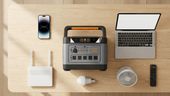
Common Devices a 1000W Portable Power Station Can Run
This table assumes a roughly 1000Wh battery with about 85% usable capacity on AC. Real results vary with inverter efficiency, device behavior, temperature, and whether the load cycles on and off.
| Device | Typical power (W) | Estimated runtime | Compatible? | Notes |
|---|---|---|---|---|
| Laptop | 60 | ~14 hours | Yes | USB-C PD is often the most efficient route. |
| Smartphone charger | 15 | ~56 hours | Yes | Best through USB output when available. |
| Tablet | 30 | ~28 hours | Yes | Small, easy load for any 1000W-class unit. |
| Wi-Fi router | 12 | ~71 hours | Yes | One of the best outage basics. |
| LED desk lamp | 10 | ~85 hours | Yes | Switching to LED stretches backup dramatically. |
| Monitor (24–27") | 50 | ~17 hours | Yes | Useful for work-from-home backup. |
| Small desktop PC | 250 | ~3.4 hours | Yes | Gaming or workstation towers can be much higher. |
| Electric blanket | 100 | ~8.5 hours | Yes | Usually a better battery use than a space heater. |
| CPAP machine | 40 | ~21 hours | Yes | Humidifier and heated hose can change the math fast. |
| Camping fan | 15 | ~56 hours | Yes | Great for overnight comfort. |
| Coffee maker | 800 | ~1 hour continuous | Usually yes | Best used as the only major load while brewing. |
| Blender | 500 | ~1.7 hours continuous | Often yes | High-end models can push much higher at startup. |
| Toaster | 1000 | ~0.85 hours continuous | Borderline | Very little headroom remains for anything else. |
| Mini fridge | 70 average | ~12 hours | Usually yes | Compressor startup matters more than average watts. |
| Cordless tool charger | 100 | ~8.5 hours | Yes | Good match for worksite charging. |
| Small electric drill | 600 | ~1.4 hours continuous | Often yes | Motor surge still matters. |
| Small TV (32–42") | 80 | ~10.6 hours | Yes | Useful for outage comfort and camping. |
| Projector | 200 | ~4.2 hours | Yes | Check brighter models carefully. |
| Game console | 200 | ~4.2 hours | Yes | Newer consoles vary a lot by game and mode. |
| Electric shaver | 20 | ~42 hours | Yes | Extremely easy load. |
| Portable speaker | 20 | ~42 hours | Yes | Usually better charged by USB/DC when possible. |
| Camera battery charger | 15 | ~56 hours | Yes | Great for travel or off-grid work. |
| LED string lights | 10 | ~85 hours | Yes | Excellent campsite or backup lighting load. |
| Electric skillet | 1000 | ~0.85 hours continuous | Borderline | Possible on paper, but with almost no margin. |
| Rice cooker (small) | 500 | ~1.7 hours continuous | Usually yes | Often more practical than higher-heat appliances. |
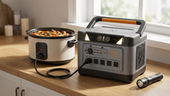
| Small slow cooker | 250 | ~3.4 hours | Yes | Good for low-and-slow loads. |
| Handheld vacuum | 400 | ~2.1 hours | Often yes | Motor startup can still matter. |
| Car fridge (12V) | 50 | ~17 hours | Yes | Often more efficient on DC than on AC. |
| Starlink router/system | 50–100 | ~8.5–17 hours | Usually yes | A very common modern outage and off-grid load. |
| NAS / home server | 30–120 | ~7–28 hours | Usually yes | Check your exact setup and attached drives. |
| Portable monitor | 10–20 | ~42–85 hours | Yes | Great with laptop work kits. |
| USB heated clothing charger | 20–80 | ~10–42 hours | Usually yes | Often more battery-friendly than room heating. |
What It Usually Cannot Run Well
A 1000W power station is versatile, but it is not the right match for everything. These are the common disappointments:
This does not mean every one of those loads always fails. It means this size class is usually not where you want your plan to live if those appliances are central to your use case.
How Runtime Really Works
Once you know the load, runtime is mostly a battery-capacity question. A common real-world planning shortcut is:
Estimated runtime (hours) ≈ (Battery Wh × 0.85) ÷ Load wattsExample: a 60W laptop on a 1000Wh-class battery with ~85% usable capacity gives about 850 ÷ 60 ≈ 14 hours. For short-burst appliances like microwaves and coffee makers, the continuous runtime number is less important than knowing you can use them a few times without overloading the inverter.
Fridge note: average refrigerator draw is often much lower than startup draw because compressors cycle. That is why a mini fridge can look scary on startup and still be a realistic overnight load.
Tips to Get More from a 1000W Station
- Use USB and DC ports first for phones, tablets, cameras, and many laptops when possible.
- Do not stack heat-heavy loads like a coffee maker plus toaster plus microwave.
- Start motor loads alone before adding smaller electronics.
- Keep a watt meter handy if you rely on a fridge, pump, or tool and want certainty.
- Prefer efficient comfort loads like fans, LED lights, and electric blankets over space heaters.
- Remember that runtime and compatibility are different questions. A load can fit the inverter and still drain the battery too fast to be useful.
How 1000W Compares with Other Sizes
1000W is usually the first wattage class that feels like more than just “charge phones and run a lamp.” It is where real backup use starts. But it is also the class where people most often ask whether they should have gone smaller or larger.
Useful comparison path: read 800W if you want to see what you lose by stepping down, 1200W if you want a little more headroom for fridges and borderline kitchen loads, 2000W if you want a noticeably more forgiving home-backup setup, and 3000W if you expect much heavier overlap or larger appliances. You can also compare lighter-use guides at 600W, 500W, 300W, and 200W.
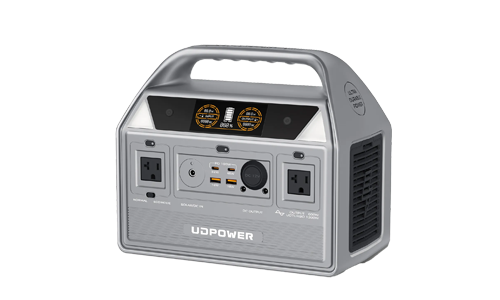
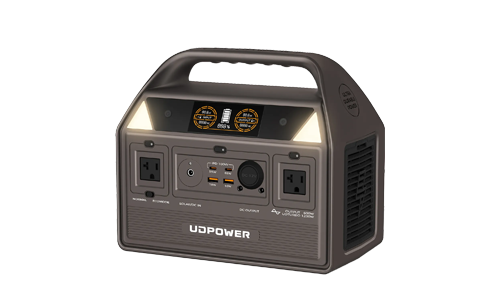
In UDPOWER’s current product lineup, the nearest practical references around this topic are the C600 on the lighter side and the S1200 on the step-up side, because the current product pages do not present a mainline exact “1000W” model.
FAQ
Can a 1000W portable power station run a refrigerator?
Often a mini fridge, yes. Some efficient full-size refrigerators may also work, but startup surge is the deciding factor. A fridge that looks safe by running watts can still trip a 1000W-class unit if compressor startup is too aggressive.
Can it run a microwave?
Sometimes, but only if the microwave’s actual input wattage fits comfortably under the inverter limit. Smaller models may work. Larger models often do not. The important number is input watts or amps, not only “cooking watts.”
Is a 1000W power station enough for home backup?
For essentials, often yes. It can cover lights, Wi-Fi, laptops, phone charging, TV, CPAP, fans, and sometimes mini-fridge duty. It is not the right size for whole-home backup or heat-heavy appliances.
Can a 1000W power station run a coffee maker?
Many coffee makers are around 800W, so yes, often. The safest approach is to treat brewing as the only major load while it is running, rather than combining it with other borderline appliances.
How many devices can I run at the same time?
As many as you want as long as the combined draw stays below the station’s continuous output and the startup behavior of motor-driven devices stays in bounds. In practice, a router, lights, laptop, and TV together are easy. A toaster plus coffee maker plus microwave is not.
Can a 1000W station run a CPAP overnight?
In many cases, yes. CPAP without heated humidity is often one of the strongest real-world use cases for this size class. Heated humidity and heated hose use can reduce runtime much faster than people expect.
Should I buy 800W, 1000W, 1200W, or 2000W?
Choose 800W if your use is lighter and you mainly care about electronics and small essentials. Choose 1000W if you want a more versatile all-around middle ground. Choose 1200W if you want more margin for fridges and borderline appliances. Choose 2000W if you want a noticeably more comfortable home-backup setup with fewer compromises.
Does higher wattage always mean longer runtime?
No. Runtime depends on battery capacity in watt-hours, not just inverter size. Higher-wattage units often include larger batteries, but that is not automatic. Always check both numbers.
Conclusion
A 1000W portable power station is one of the easiest sizes to recommend because it covers a wide range of real-life needs without jumping into heavier, more expensive gear. It is strong enough for most electronics, many comfort loads, and a surprising amount of everyday backup use, but it still rewards realistic expectations around microwave-class loads, heat-heavy appliances, and motor startup.
If your goal is phone charging, lights, Wi-Fi, laptops, TV, CPAP, and maybe a mini fridge, 1000W can be a very practical size. If your real plan keeps drifting toward kettles, hair dryers, and heavier kitchen overlap, you are probably already shopping the next class up.










![How to Live In The Woods [Complete Guide]](http://udpwr.com/cdn/shop/articles/Off-Grid_Cabin_Option_f6c94fe7-1ae7-4c3a-baf5-ed9fe684c832.png?v=1763523215&width=170)