

How Long Will a 1kWh Battery Last? Real Runtime by Watts & Device
Last updated: October 19, 2026

A 1kWh battery stores 1,000 watt-hours of energy. In perfect conditions, that means 10 hours at 100W, 2 hours at 500W, or 1 hour at 1,000W.
Real AC runtime is usually shorter because the inverter and power station itself use some energy. For a generic 1,000Wh portable power station, using 85% usable AC energy is a practical planning shortcut. That gives roughly 850Wh available to the load:
If the battery is for an outage, CPAP, refrigerator, or another situation where reaching 0% would be a problem, keep about 10% in reserve. With both an 85% AC planning factor and a 10% reserve, plan around approximately 765Wh of usable emergency energy from a nominal 1kWh battery.
1kWh Battery Runtime Chart
Start here if you already know the average wattage of your device.
The table shows three different numbers because a single “runtime” figure can be misleading:
- Ideal runtime assumes all 1,000Wh reaches the device.
- AC planning runtime assumes about 85% usable energy, or 850Wh.
- Emergency planning runtime uses the same 85% assumption but keeps 10% of the battery in reserve, leaving about 765Wh for planned use.
| Continuous Load | Ideal Runtime | AC Planning Runtime | With 10% Reserve | What It Feels Like |
|---|---|---|---|---|
| 10W | 100 hr | 85 hr | 76.5 hr | Very small electronics or LED lighting |
| 15W | 66.7 hr | 56.7 hr | 51 hr | Router or low-power medical/electronic setup |
| 20W | 50 hr | 42.5 hr | 38.3 hr | Modem plus router or several small devices |
| 30W | 33.3 hr | 28.3 hr | 25.5 hr | Small fan or low-draw CPAP setup |
| 40W | 25 hr | 21.3 hr | 19.1 hr | CPAP planning example or small electronics |
| 50W | 20 hr | 17 hr | 15.3 hr | Fan, laptop-class average, small TV |
| 60W | 16.7 hr | 14.2 hr | 12.8 hr | Laptop, fan, or light workstation |
| 75W | 13.3 hr | 11.3 hr | 10.2 hr | Larger fan or entertainment load |
| 100W | 10 hr | 8.5 hr | 7.7 hr | TV, workstation, or measured average load |
| 150W | 6.7 hr | 5.7 hr | 5.1 hr | Desktop setup or several electronics |
| 200W | 5 hr | 4.3 hr | 3.8 hr | Heavy electronics or multiple devices |
| 300W | 3.3 hr | 2.8 hr | 2.6 hr | Combined outage or campsite load |
| 500W | 2 hr | 1.7 hr | 1.5 hr | Short appliance sessions |
| 800W | 1.25 hr | 1.06 hr | About 57 min | High-power kitchen or work appliance |
| 1,000W | 1 hr | About 51 min | About 46 min | Near full-load use on compatible equipment |
| 1,200W | About 50 min | About 43 min | About 38 min | Only if the inverter supports this load |
Source: calculated from rated capacity using the runtime method described below. For your own appliance, enter measured wattage and capacity in the UDPOWER Portable Power Station Runtime Calculator.
How to Calculate 1kWh Battery Runtime
The basic calculation is simple:
For a 1,000Wh battery and a 100W device:
1,000Wh ÷ 100W = 10 hours
That is useful for understanding the relationship between capacity and load, but it assumes perfect energy conversion.
A more useful AC planning formula
Using an 85% planning factor:
1,000Wh × 0.85 ÷ 100W = 8.5 hours
The difference accounts for normal losses and operating overhead associated with supplying AC power.
For emergency planning, add a reserve
Running a battery to 0% may be acceptable during casual testing. It is a less useful strategy when the battery is keeping a CPAP, refrigerator, internet connection, or emergency lighting alive.
For a simple 10% reserve:
A 100W continuous load would then have a planning window of:
765Wh ÷ 100W = 7.65 hours
This does not mean every 1kWh battery delivers exactly 85% through AC. Different power stations, load levels, temperatures, battery conditions, inverter designs, and shutdown limits produce different results. The point is to leave realistic margin instead of planning around perfect laboratory math.
Use average watts, not automatically the largest watt number you can find
A device label or power adapter often shows the maximum electrical input the equipment is designed to accept. That may not be its normal consumption.
For the best estimate, measure the actual device with a plug-in power meter or read the power station's live output display while the device is operating normally.
This is especially important for refrigerators, CPAP machines with heaters, computers, chargers, power tools, and other equipment whose consumption changes while in use.
1kW vs. 1kWh: One Letter Changes the Entire Answer
“1kW battery” and “1kWh battery” are often used as if they mean the same thing. They do not.
| Term | What It Measures | Plain-English Meaning | Why It Matters |
|---|---|---|---|
| 1kW | Power | 1,000 watts being supplied or consumed at a moment | Helps determine whether the system can run an appliance |
| 1kWh | Energy | 1,000 watt-hours stored or consumed over time | Helps determine how long the appliance can run |
| Rated AC output | Inverter capability | How much continuous AC power the station can normally supply | A 1kWh battery can still have a 600W, 1,200W, or 1,800W inverter |
| Startup demand | Short high-power requirement | Extra power some motors and compressors require when starting | A fridge may fit the battery capacity but fail to start if output headroom is insufficient |
Think of watt-hours as the fuel in the tank and watts as how quickly that fuel is being used.
A 1kWh battery powering a steady 100W load lasts far longer than the same battery feeding a 1,000W load, even though the battery itself has not changed.
If your question is actually about a power station with a 1,000W output rating, read How Long Does a 1000W Power Station Last?.
How Long Will a 1kWh Battery Run Common Devices?
The following figures use approximately 850Wh as a simple AC planning budget. Device wattages are examples, not guarantees for every model.
| Device or Setup | Example Average Load | Estimated AC Runtime | What to Check Before Relying on It |
|---|---|---|---|
| Wi-Fi router | 10W | About 85 hr | Check router and modem separately if both need power |
| Modem + router | 20W | About 42.5 hr | Add fiber ONT, switch, or mesh nodes if used |
| LED lighting | 20W total | About 42.5 hr | Add the wattage of every light operating together |
| Small fan | 30W | About 28.3 hr | Higher speed settings can increase consumption |
| CPAP example | 40W average | About 21.3 hr | Humidifier and heated tubing can raise power use substantially |
| Laptop | 60W average | About 14.2 hr | A 60W charger does not mean the laptop draws 60W constantly |
| TV | 100W | About 8.5 hr | Screen size, brightness, HDR, and picture mode affect draw |
| Desktop + monitor | 200W | About 4.3 hr | Gaming or heavy processing can raise consumption sharply |
| Mixed electronics | 300W | About 2.8 hr | Use the combined measured load |
| Small appliance | 500W | About 1.7 hr | Check continuous and startup requirements |
| Coffee maker class load | 1,000W | About 51 min if continuous | Usually used for only a few minutes at a time |
For high-power appliances, “51 minutes” does not mean you should run a coffee maker continuously for 51 minutes. Runtime tables are most useful for comparing energy consumption. Actual use patterns usually matter more.
Short high-power use can be surprisingly affordable in watt-hours
A 1,000W coffee maker running for six minutes uses:
1,000W × 0.1 hour = 100Wh
That is very different from a 1,000W appliance running continuously for an hour, which would require 1,000Wh before conversion losses.
This is why a high-wattage device is not automatically a bad match for a 1kWh battery. The two questions are:
- Can the inverter safely supply the appliance's wattage?
- How many minutes or hours will you actually run it?
How Long Will a 1kWh Battery Run a Refrigerator?
Refrigerators are one of the easiest appliances to calculate incorrectly.
A refrigerator may draw 100–250W or more while actively cooling, but the compressor normally switches on and off. It may also use extra power during compressor startup, defrost cycles, ice making, or other operating states.
That means this calculation is often misleading:
1,000Wh ÷ refrigerator running watts
For long-duration refrigerator backup, the yellow EnergyGuide annual kWh figure is usually a more useful starting point because it reflects energy use over time rather than one operating moment. The FTC explains that EnergyGuide labels disclose appliance energy consumption and allow comparison between models. See the FTC EnergyGuide explanation.
Use your refrigerator's annual kWh
First convert annual consumption into daily consumption:
For example, a refrigerator rated at 500kWh per year averages:
500 ÷ 365 = about 1.37kWh per day
If you use the conservative 765Wh emergency budget from a 1kWh battery:
0.765kWh ÷ 1.37kWh/day × 24 = about 13.4 hours
| Refrigerator EnergyGuide Use | Average Daily Energy | Approx. Runtime Using 765Wh Planned Energy | Practical Meaning |
|---|---|---|---|
| 300kWh/year | 0.82kWh/day | About 22.3 hr | Efficient refrigerator |
| 400kWh/year | 1.10kWh/day | About 16.8 hr | Good short-outage potential |
| 500kWh/year | 1.37kWh/day | About 13.4 hr | Roughly overnight-scale backup |
| 600kWh/year | 1.64kWh/day | About 11.2 hr | Shorter outage window |
| 700kWh/year | 1.92kWh/day | About 9.6 hr | Higher-consumption refrigerator |
| 900kWh/year | 2.47kWh/day | About 7.4 hr | High-consumption or demanding conditions |
These figures are planning estimates. Actual refrigerator runtime changes with room temperature, thermostat setting, door openings, food temperature, defrost operation, compressor behavior, battery losses, and startup requirements.
The EnergyGuide method solves only the capacity question
You still need to confirm that the power station can start the refrigerator's compressor.
A battery can contain enough watt-hours to keep the refrigerator running for many hours yet still be paired with an inverter that cannot handle compressor startup.
For a full refrigerator sizing method, see Can a Portable Power Station Run Your Refrigerator? and How Many Watts Does a Refrigerator Use?.
How Long Will a 1kWh Battery Run a CPAP?
A 1kWh battery can be a strong overnight CPAP backup because CPAP equipment usually requires much less continuous power than heating or cooking appliances.
The difficult part is that CPAP consumption changes dramatically when heated humidification and heated tubing are enabled.
| Average CPAP Load | Energy Needed for 8 Hours | Runtime on 850Wh AC Budget | 8-Hour Overnight Fit |
|---|---|---|---|
| 15W | 120Wh | About 56.7 hr | Large reserve |
| 20W | 160Wh | About 42.5 hr | Large reserve |
| 40W | 320Wh | About 21.3 hr | Comfortable |
| 60W | 480Wh | About 14.2 hr | Comfortable |
| 90W | 720Wh | About 9.4 hr | Much less reserve |
If the CPAP is essential overnight equipment, do not size the battery using the machine's lowest possible consumption. Test your exact pressure, humidifier level, heated tube setting, and normal accessories.
For device-specific planning, read How Long Will a CPAP Run on a Battery Backup? or compare the UDPOWER CPAP battery backup options.
How Long Will 1kWh Last With Multiple Devices?
There are two good ways to answer this, depending on how your equipment is used.
Method 1: Add watts for devices running at the same time
If a laptop draws 60W, a router 12W, and lights 20W while all three are operating:
60W + 12W + 20W = 92W
Using an 850Wh AC planning budget:
850Wh ÷ 92W = about 9.2 hours
This works well when the devices stay on continuously.
Method 2: Build a watt-hour budget for devices used at different times
This is usually better for an outage.
| Device | Average Power | Planned Use | Energy Needed |
|---|---|---|---|
| Wi-Fi equipment | 12W | 12 hr | 144Wh |
| Laptop | 60W | 6 hr | 360Wh |
| Two LED lights | 18W total | 5 hr | 90Wh |
| CPAP | 40W | 8 hr | 320Wh |
| Total | — | — | 914Wh |
This setup needs about 914Wh at the devices before allowing for AC conversion losses. A nominal 1kWh battery is therefore much tighter than it first appears.
If you want to preserve a reserve, you could reduce laptop time, lower lighting use, power the laptop directly through USB-C instead of its AC charger when compatible, or recharge during the day.
Why a 10W Device May Not Really Run for 85 Hours
The simple formula becomes less reliable at very low AC loads.
If your device draws only 10W but the power station also needs energy to keep its inverter, display, control electronics, communication circuits, or cooling system active, the station's own consumption can represent a meaningful share of the total load.
This is why:
850Wh ÷ 10W = 85 hours
should be treated as a mathematical reference rather than a guaranteed result.
Direct DC or USB can make more sense for small electronics
Many electronics already operate internally on DC power. If you run a laptop through an AC outlet, the energy path may look roughly like:
Battery DC → AC inverter → laptop charger → DC laptop battery
When compatible, USB-C or a proper direct DC connection can remove an unnecessary conversion stage.
That does not mean DC is always dramatically more efficient, but it is worth considering for routers, phones, tablets, laptops, and other low-power equipment when maximizing runtime matters.
Why 1kWh Feels Small With Heating Appliances
Heating appliances convert electrical energy into heat very quickly. That makes them some of the fastest ways to drain a portable battery.
Consider a 1,500W load.
Even using ideal math:
1,000Wh ÷ 1,500W = about 40 minutes
Using 850Wh for AC planning:
850Wh ÷ 1,500W = about 34 minutes
And that calculation is irrelevant unless the inverter can actually deliver 1,500W continuously.
This is why space heaters, electric kettles, hair dryers, air fryers, toaster ovens, and similar heating devices can make a 1kWh battery feel much smaller than it does when powering communication equipment, a CPAP, lights, laptops, or a cycling refrigerator.
Capacity is not the first limit for every appliance
Before calculating runtime, use this order:
- Check continuous appliance wattage.
- Check startup or temporary peak demand if applicable.
- Confirm the power station can supply that demand.
- Then calculate whether the battery contains enough watt-hours for the desired runtime.
This prevents a common mistake: buying more battery capacity when the real problem is insufficient output power.
Can Solar Make a 1kWh Battery Last Longer?
Yes, but a solar panel does not change the battery's physical capacity. It adds energy back while you are using the system.
The important comparison is between actual solar input and actual load.
If solar input is greater than the load
Suppose the power station is actually receiving 180W from solar while your equipment is consuming 100W.
There is enough incoming power to cover the load, with the remaining energy potentially available for charging after system losses and charging limits are considered.
If solar input is lower than the load
Suppose the connected devices use 300W while the panels are producing 150W.
The battery will still discharge, but solar can slow the rate of depletion.
Think in watt-hours for the whole day
If your panels actually deliver an average of 150W for four hours:
150W × 4 hours = 600Wh of incoming solar energy
Actual energy stored will be affected by panel conditions, charge-controller behavior, wiring losses, temperature, shading, battery state of charge, and charge taper.
For solar-first setups, see Are Foldable Solar Panels Worth It? or browse portable power stations for camping and RV use.
Is a 1kWh Battery Enough for a Power Outage?
It can be enough for a focused essentials plan. It is usually not enough to make a normal electrically intensive home operate as though the grid were still available.
| Outage Goal | 1kWh Fit | Why |
|---|---|---|
| Keep phones and internet online | Very good | These are relatively low-energy loads |
| Run CPAP overnight | Often very good | Many configurations use a fraction of 1kWh overnight |
| Power lights and electronics | Very good | LED lighting and electronics can be managed efficiently |
| Short refrigerator backup | Often practical | Runtime depends on annual energy use and compressor startup |
| Work from home | Often practical | Runtime depends heavily on desktop vs. laptop use |
| Run high-power cooking equipment for short periods | Possible on compatible systems | High watts consume the battery quickly |
| Run electric heat for many hours | Poor fit | Resistive heating consumes energy too quickly |
| Whole-home backup with normal appliance use | Poor fit | A typical home can consume several times 1kWh very quickly |
The best 1kWh outage strategy is prioritization
Instead of trying to power everything, divide equipment into three groups:
- Critical: medical equipment, refrigerator, communication, emergency lighting.
- Useful: laptops, TV, fans, device charging.
- Optional high-draw loads: heating, cooking, hair care, and other energy-intensive appliances.
Use the battery first for critical equipment. Add comfort loads only after you know how much energy the essentials require.
For home-focused options, browse UDPOWER portable power stations for home backup.
How to Make a 1kWh Battery Last Longer
1. Measure instead of guessing
A plug-in watt meter or the power station's live output display can reveal that a device consumes far less—or far more—than you assumed.
2. Turn off AC output when you do not need it
Keeping an inverter active can consume energy even when connected devices use very little power.
3. Use USB-C or DC directly when practical
For compatible electronics, avoiding unnecessary AC conversion can reduce conversion stages.
4. Use watt-hours to schedule an outage
A 1,000W appliance used for six minutes consumes about 100Wh. A 100W appliance used for ten hours consumes 1,000Wh. High watts are not the whole story; time matters just as much.
5. Reduce heating features on battery-powered equipment when appropriate
CPAP humidifiers, heated hoses, heated seats, warming equipment, and resistive heating can consume far more energy than electronics alone.
6. Keep refrigerator and freezer doors closed
Every door opening allows warm air in and can increase compressor runtime.
7. Keep emergency reserve
If your plan only works when the battery reaches exactly 0%, the plan has no room for colder weather, unexpected appliance cycling, battery aging, a longer outage, or an additional critical device.
8. Recharge whenever energy is available
During a multi-day event, charging strategy can matter as much as battery size. Wall charging during temporary utility restoration, vehicle charging during travel, or solar input during daylight can extend useful operating time.
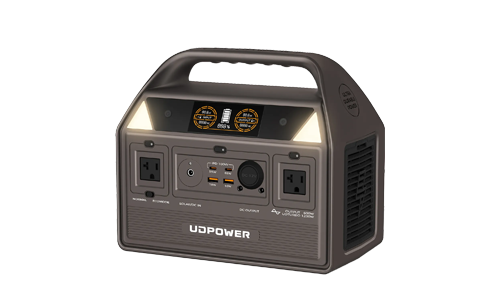
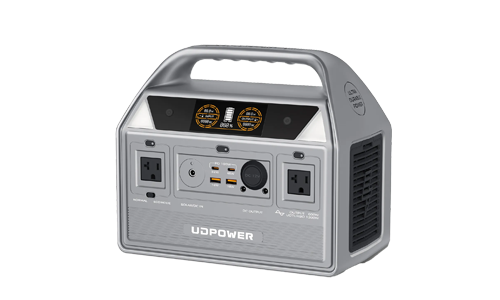
A Practical 1kWh-Class Example: UDPOWER S1200
A nominal 1,000Wh battery is useful for understanding the math, but portable power stations do not all stop exactly at 1,000Wh.
The UDPOWER S1200 stores 1,190Wh, giving it about 19% more rated battery capacity than a literal 1,000Wh battery.
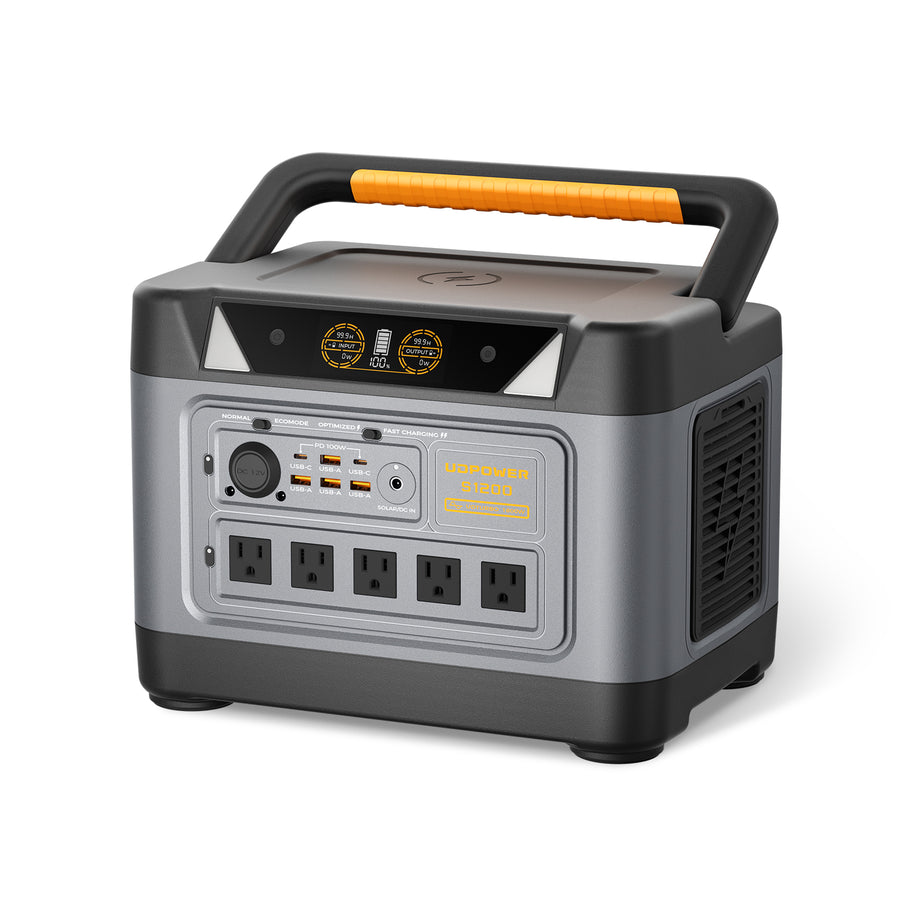
UDPOWER S1200 Portable Power Station
Best for: refrigerator backup, CPAP, internet equipment, laptops, TVs, family camping, home-office backup, and other situations where a literal 1,000Wh battery leaves too little reserve.
- Capacity: 1,190Wh LiFePO4
- Rated AC output: 1,200W pure sine wave
- Higher-power operation: UDTURBO supports compatible loads up to 1,800W in battery/inverter operation, with lower conversion efficiency above rated output
- Solar input: up to 400W
- AC recharge: approximately 1.5 hours under specified charging conditions
- UPS: ≤10ms UPSPRIME switching
- Weight: approximately 26 lb
- Configurations: 3-AC and 5-AC versions available
- Battery lifecycle reference: approximately 80% remaining capacity after 3,000 cycles and approximately 70% after 4,000 cycles
- Warranty: 5 years
S1200 runtime using a 90% UDPOWER planning factor
For UDPOWER runtime planning, this guide uses approximately 90% conversion efficiency:
| Continuous Load | Generic 1kWh at 85% | UDPOWER S1200 at 90% | S1200 Difference |
|---|---|---|---|
| 20W | 42.5 hr | About 53.6 hr | About 11.1 hr more |
| 40W | 21.3 hr | About 26.8 hr | About 5.5 hr more |
| 60W | 14.2 hr | About 17.9 hr | About 3.7 hr more |
| 100W | 8.5 hr | About 10.7 hr | About 2.2 hr more |
| 300W | 2.8 hr | About 3.6 hr | About 0.8 hr more |
| 500W | 1.7 hr | About 2.1 hr | About 0.4 hr more |
| 1,000W | About 51 min | About 64 min | About 13 min more |
The extra capacity matters most when the battery is being used for longer-running essentials rather than very short appliance sessions.
At 100W, for example, the difference is more than two hours of calculated planning runtime. That can matter for a long workday, overnight communication equipment, or an outage that lasts a little longer than expected.
Current S1200 specifications and configurations are available on the official UDPOWER S1200 product page.
How Long Does a 1kWh Battery Last in Years?
Sometimes “How long will a 1kWh battery last?” means battery lifespan rather than runtime per charge.
Capacity alone does not answer that question.
A 1kWh battery could use LiFePO4, NMC, lead-acid, or another chemistry, and each product can have a different cycle-life specification, battery-management strategy, temperature range, warranty, and usable depth of discharge.
For example, the UDPOWER S1200 uses LiFePO4 cells. UDPOWER's lifecycle planning reference is approximately:
- 80% remaining capacity after 3,000 charge cycles.
- 70% remaining capacity after 4,000 charge cycles.
A cycle does not necessarily mean “one calendar day.” Using 50% of the battery one day and another 50% later adds up to roughly one equivalent full cycle.
Battery age is also influenced by storage temperature, state of charge, discharge rate, charging conditions, and time. A cycle-life figure therefore should not be converted into an exact number of years without considering how the battery is actually used.
How to Decide Whether 1kWh Is Enough
You can usually answer this in five minutes.
- List only the devices you actually need.
- Find their measured or realistic average watts.
- Multiply watts by hours of use to get watt-hours.
- Add conversion loss and a reserve.
- Check continuous and startup output separately.
If your planned device energy is comfortably below about 750–850Wh, a 1kWh-class battery may be a good match for one recharge cycle.
If your plan already requires close to 1,000Wh before conversion losses, a nominal 1kWh battery gives you almost no margin. Either reduce the load, add a recharging plan, or choose more capacity.
If your energy requirement is small but your appliance requires high instantaneous wattage, buying more battery capacity alone may not solve the problem. You may need a power station with a stronger inverter.
For broader sizing help, see The Ultimate Guide to Buying a Portable Power Station.
Related 1kWh Battery & Runtime Guides
- How Long Does a 1000W Power Station Last?
- What Can a 1200W Portable Power Station Run?
- Can a Portable Power Station Run Your Refrigerator?
- How Many Watts Does a Refrigerator Use?
- How Long Will a CPAP Run on a Battery Backup?
- How Does a Portable Power Station Work?
- Portable Power Station Runtime Calculator
- Portable Power Stations for Home Backup
- Portable Power Stations for Camping & RV Use
Frequently Asked Questions
How long will a 1kWh battery last at 100W?
Ideal runtime is 10 hours because 1,000Wh ÷ 100W = 10 hours. For AC-powered devices, using an 85% planning factor gives about 8.5 hours. If you also keep 10% of the battery in reserve for an outage, plan on about 7.7 hours.
How long will a 1kWh battery last at 500W?
Ideal runtime is 2 hours. Using an 85% AC planning factor gives about 1.7 hours. With an additional 10% emergency reserve, the planning figure is about 1.5 hours.
How long will a 1kWh battery last at 1,000W?
Ideal runtime is 1 hour. A more realistic AC planning estimate at 85% usable energy is about 51 minutes. With a 10% emergency reserve, plan on roughly 46 minutes. The power station must also have enough continuous output to support a 1,000W load.
How long will a 1kWh battery run a refrigerator?
It depends on the refrigerator's actual energy use rather than only its compressor-running wattage. Using 765Wh as a conservative emergency energy budget, a refrigerator rated at 400kWh per year works out to roughly 16.8 hours, 500kWh per year about 13.4 hours, and 700kWh per year about 9.6 hours. Actual runtime varies with temperature, door openings, defrost cycles, efficiency, and compressor startup requirements.
Will a 1kWh battery run a CPAP all night?
Often yes. An 8-hour CPAP load averaging 40W uses about 320Wh before conversion loss, while a 60W average uses about 480Wh. Heated humidifiers and heated tubing can raise consumption significantly, so test the exact CPAP configuration before relying on it for overnight backup.
How long can a 1kWh battery run Wi-Fi?
If the router and modem together average 20W, a generic 1kWh battery using an 85% AC planning factor provides about 42.5 hours mathematically. Very low AC loads can be affected by inverter and control-system overhead, so actual runtime may be shorter.
Is 1kWh enough for an overnight power outage?
It can be enough when you prioritize essentials such as internet equipment, phones, LED lights, a CPAP, or short refrigerator backup. It is not enough to operate a typical electrically intensive home normally through the night, especially if electric heating, cooking, or air conditioning is included.
Is 1kWh the same as 1,000W?
No. One kilowatt-hour, or 1kWh, is an energy quantity equal to 1,000Wh. One kilowatt, or 1kW, is 1,000 watts of power at a moment in time. Watt-hours help determine runtime, while watts help determine whether the power station can operate the connected appliance.
How much usable energy do you really get from a 1kWh battery?
It depends on the battery system, output type, load, inverter, temperature, and protection settings. For generic AC runtime planning, this guide uses 85%, or about 850Wh. That is a planning assumption rather than a guarantee for every 1kWh battery.
Does USB-C last longer than using an AC outlet?
It can be more efficient for compatible electronics because direct USB-C avoids converting battery DC to AC and then back to DC inside a charger. The size of the difference depends on the power station, device, voltage conversion, charger, and load.
Can solar panels make a 1kWh battery last all day?
Potentially, if the solar system produces enough usable energy to replace what your devices consume. Compare total daily device watt-hours with actual daily solar energy delivered to the power station. Cloud cover, shade, panel angle, temperature, charge limits, and charging losses all affect the result.
How do I calculate runtime when several devices are connected?
If they run at the same time, add their average watts and divide usable battery energy by that combined load. If they are used at different times, calculate watt-hours for each device by multiplying watts by hours of use, then add all of those watt-hour requirements together.
Why does my 1kWh battery run for less time than the calculation says?
Common reasons include inverter overhead, conversion losses, battery temperature, changing appliance demand, battery age, cooling fans, low-load inefficiency, startup surges, cables, power adapters, and automatic shutdown settings. Using measured average wattage usually gives a better estimate than relying only on a device label.
Is a 1kWh battery good for camping?
Yes, a 1kWh-class battery is a useful size for family camping when you need to run lights, phones, laptops, fans, camera equipment, a CPAP, or a portable refrigerator. High-wattage cooking equipment will consume the battery much faster, so calculate the trip's total watt-hour requirement before leaving.
How long does a 1kWh battery last before it needs replacement?
Battery service life depends on chemistry, cycle rating, temperature, charging behavior, storage conditions, and how deeply it is discharged. Capacity alone does not determine lifespan. For example, the LiFePO4 UDPOWER S1200 lifecycle reference is approximately 80% remaining capacity after 3,000 cycles and 70% after 4,000 cycles.
Sources & Calculation Notes
Runtime values in this guide are mathematical planning estimates rather than laboratory promises. Generic 1kWh AC examples use an 85% usable-energy planning factor. UDPOWER product examples use a 90% conversion-efficiency planning factor.
Product specifications are based on the UDPOWER S1200 official product page. Refrigerator EnergyGuide methodology is supported by the Federal Trade Commission's EnergyGuide consumer guidance.
Always verify the exact device wattage, startup requirement, connector, voltage, operating instructions, and power-station limits before relying on a calculated runtime.
Stop Guessing Your Battery Runtime
Start with the appliances you actually need, calculate their watt-hours, leave room for conversion loss and reserve capacity, then choose a power station that meets both the energy and output requirements.
View the UDPOWER S1200 Compare Power Station Sizes Calculate Your Runtime Get the Portable Power Station Buying GuideRelated Articles


