

How Long Will a 1000W Portable Solar Generator Run a Refrigerator?
Last updated:
The important distinction is that 1000W tells you whether the generator can power the refrigerator. Battery capacity in watt-hours tells you how long it can keep the refrigerator running.

Refrigerator runtime is often presented as one simple number, but a refrigerator is not a steady load. Its compressor starts, stops, defrosts, and works harder when the room is hot or the door is opened. That is why one household may get nearly a full day from a 1,000Wh battery while another gets only half a day from a similarly sized power station.
This guide shows how to estimate your own runtime from the yellow EnergyGuide label, how startup demand differs from daily energy use, how solar charging changes the answer, and which UDPOWER model makes sense for different outage lengths.
How Many Hours Will a 1000W Solar Generator Run a Refrigerator?
For most households, a realistic planning range is 10–20 hours when the power station has approximately 1,000–1,200Wh of battery capacity.
| Refrigerator situation | Approximate average load | Estimated runtime from 1,000Wh battery | What to expect |
|---|---|---|---|
| Efficient refrigerator, already cold | 35–50W average | About 18–26 hours | May cover an overnight outage and much of the following day |
| Typical full-size refrigerator | 50–75W average | About 12–18 hours | A practical range for many modern household refrigerators |
| Large refrigerator or warm kitchen | 75–100W average | About 9–12 hours | Frequent compressor cycling shortens the backup window |
| Older unit, hot garage, or cold recovery | 100–150W average | About 6–9 hours | Plan conservatively or choose a larger battery |
Estimates use approximately 900Wh of planning energy from a 1,000Wh battery after applying a 90% conversion allowance. Actual results vary by refrigerator and operating conditions.
1000W Is Not the Same as 1000Wh
The terms look similar but answer different questions.
- Watts (W): how much power the generator can deliver at one time.
- Watt-hours (Wh): how much energy is stored in the battery.
A generator rated for 1000W may have a 500Wh battery, a 1,000Wh battery, or a much larger battery. All three may be capable of starting the same refrigerator, but their runtimes will be very different.
| Power station example | AC output rating | Battery capacity | Estimated runtime at 60W average |
|---|---|---|---|
| Small-capacity 1000W unit | 1000W | 500Wh | About 7.5 hours |
| Typical 1000W-class unit | 1000W | 1,000Wh | About 15 hours |
| High-capacity 1000W-class unit | 1000–1200W | 1,190Wh | About 17.9 hours by formula |
This is also why the broader guide to what a 1000W portable power station can run separates appliance compatibility from battery runtime.
The Most Accurate Way to Estimate Refrigerator Runtime
The best starting point is usually the yellow EnergyGuide label on the refrigerator. Look for the number listed as annual energy use in kilowatt-hours per year, or kWh/year.
This number is more useful than the wattage printed near the power cord because annual energy use already reflects normal compressor cycling under standardized test conditions.
Step 2: Runtime = battery Wh × 0.90 ÷ average watts
Example using a 500 kWh/year refrigerator
- 500 kWh × 1,000 = 500,000Wh used per year.
- 500,000Wh ÷ 8,760 hours = approximately 57W average.
- A 1,000Wh battery provides about 900Wh of planning energy at 90% efficiency.
- 900Wh ÷ 57W = approximately 15.8 hours.
If you cannot find the label, search the refrigerator model number in the ENERGY STAR refrigerator database or check the manufacturer’s product manual.
Runtime Table Using Annual Refrigerator Energy Use
The following table lets you match the kWh/year number on your refrigerator label to a practical runtime estimate.
| EnergyGuide rating | Energy per day | Average watts | 1,000Wh battery | UDPOWER S1200 |
|---|---|---|---|---|
| 300 kWh/year | 0.82 kWh/day | 34.2W | About 26.3 hours | About 31.3 hours |
| 362 kWh/year | 0.99 kWh/day | 41.3W | About 21.8 hours | About 25.9 hours |
| 404 kWh/year | 1.11 kWh/day | 46.1W | About 19.5 hours | About 23.2 hours |
| 500 kWh/year | 1.37 kWh/day | 57.1W | About 15.8 hours | About 18.8 hours |
| 600 kWh/year | 1.64 kWh/day | 68.5W | About 13.1 hours | About 15.6 hours |
| 700 kWh/year | 1.92 kWh/day | 79.9W | About 11.3 hours | About 13.4 hours |
| 900 kWh/year | 2.47 kWh/day | 102.7W | About 8.8 hours | About 10.4 hours |
Calculations use 90% planning efficiency. The U.S. Department of Energy provides annual-use examples of approximately 362–404 kWh for an 18.1-cubic-foot top-freezer refrigerator in its residential refrigerator purchasing guidance.
These results assume the refrigerator is already cold and operating normally. A refrigerator that has warmed during a long outage may draw more energy while it returns to its set temperature.
Runtime Based on Average Running Watts
Use this table when you have measured the refrigerator’s true average load rather than only reading its compressor-on wattage.
| Measured average load | 1,000Wh battery | UDPOWER S1200 | Practical interpretation |
|---|---|---|---|
| 35W | About 25.7 hours | About 30.6 hours | Very efficient refrigerator or compact compressor fridge |
| 50W | About 18 hours | About 21.4 hours | Efficient full-size refrigerator under mild conditions |
| 60W | About 15 hours | About 17.9 hours | Useful baseline for many refrigerator calculations |
| 75W | About 12 hours | About 14.3 hours | Warmer room, larger refrigerator, or heavier use |
| 100W | About 9 hours | About 10.7 hours | Older unit, hot garage, frequent opening, or extra features |
| 150W | About 6 hours | About 7.1 hours | Use a larger battery if this is the real long-term average |
A station display showing 150W while the compressor is on does not necessarily mean the refrigerator averages 150W all day. Watch the display through multiple compressor cycles or measure total kWh over 24 hours.
Will a 1000W Generator Start the Refrigerator?
Many modern refrigerators can run from a 1000W pure sine wave inverter, but the generator must also handle the compressor’s startup demand.
Startup demand is different from everyday running power. A refrigerator that settles at 100–200W after starting may briefly request considerably more power as the compressor begins operating.
Check these three numbers
- Refrigerator running watts: the power required after the compressor starts.
- Refrigerator startup requirement: found in technical documentation or measured with a meter that records peak watts.
- Power station output: compare both rated output and the manufacturer’s stated higher-output capability.
A power station may shut down even when the refrigerator’s normal running watts appear low if the startup request exceeds the station’s supported output, the battery is nearly empty, or another appliance is already using part of the available power.
What Changes Refrigerator Runtime in Real Life?
1. Starting cold versus recovering from warm
A pre-cooled refrigerator only needs to maintain temperature. A refrigerator that has been without power for several hours may run the compressor for much longer as it cools the cabinet and food again. This recovery period can consume a noticeable portion of a small battery.
2. Kitchen or garage temperature
A refrigerator in a 72°F kitchen normally works less than the same refrigerator in a hot garage. High room temperature increases heat entering the cabinet and makes the compressor run more often.
3. Door openings
Every door opening releases cold air and introduces warmer, more humid air. During an outage, decide what you need before opening the refrigerator and close the door promptly.
4. Ice makers, door heaters, and defrost cycles
Automatic defrost heaters, ice production, anti-condensation heaters, displays, and smart features can increase energy use. Disable optional features when practical during a prolonged outage.
5. How full the refrigerator is
A moderately full refrigerator generally holds temperature better than an almost empty one. Water bottles can add thermal mass, but do not block internal air vents or pack the cabinet so tightly that cold air cannot circulate.
6. Other devices connected to the power station
Phones and LED lights use relatively little energy, but a television, fan, desktop computer, coffee maker, microwave, or electric cooking appliance can substantially reduce refrigerator runtime.
| Additional load | Energy used in four hours | Approximate refrigerator runtime lost from a 60W average fridge |
|---|---|---|
| 10W Wi-Fi router | 40Wh | About 40 minutes |
| 20W of LED lighting | 80Wh | About 1 hour 20 minutes |
| 50W fan | 200Wh | About 3 hours 20 minutes |
| 100W television | 400Wh | About 6 hours 40 minutes |
| 1,000W appliance used for 15 minutes | 250Wh | About 4 hours 10 minutes |
The last row explains why short use of a coffee maker, microwave, toaster, or cooking appliance can take a surprisingly large bite out of a refrigerator backup battery.

UDPOWER S1200: A Practical Match for Refrigerator Backup
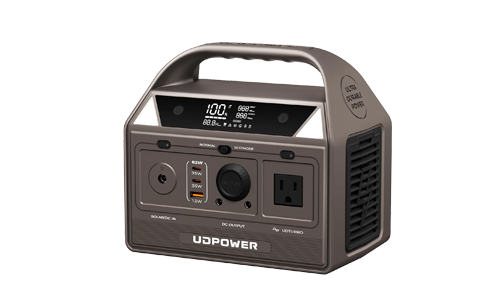
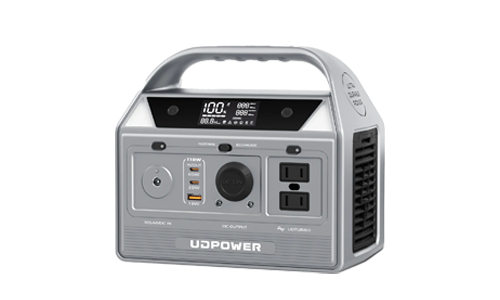
The UDPOWER S1200 Portable Power Station is positioned for shoppers comparing 1000W-class power stations, while providing a larger 1,190Wh battery and 1,200W rated pure sine wave output.
- Battery capacity: 1,190Wh
- Rated AC output: 1,200W pure sine wave
- Higher-output capability: UDTURBO up to 1,800W
- Maximum solar input: up to 400W
- Weight: approximately 26.0 lb
- Best fit: refrigerator backup, home essentials, RV use, camping, and short-to-medium outages
With a 90% conversion allowance, the S1200 provides approximately 1,071Wh of planning energy. That equals about 17.9 hours at a true 60W average load or about 10.7 hours at a 100W average load.
UDPOWER’s current product guidance gives a conservative estimate of approximately 10–15 hours for a standard refrigerator averaging 60–100W. For emergency planning, use that lower range unless you have measured your refrigerator’s 24-hour energy use.
View the UDPOWER S1200When the S2400 is the better choice
Choose a larger-capacity model when you need a full day of refrigerator backup, have an older or high-consumption refrigerator, expect cloudy weather, or want to power additional essentials.
| UDPOWER model | Battery capacity | Rated AC output | Official refrigerator range | Best use |
|---|---|---|---|---|
| S1200 | 1,190Wh | 1,200W | About 10–15 hours for a 60–100W average refrigerator | Overnight backup, apartments, camping, and shorter outages |
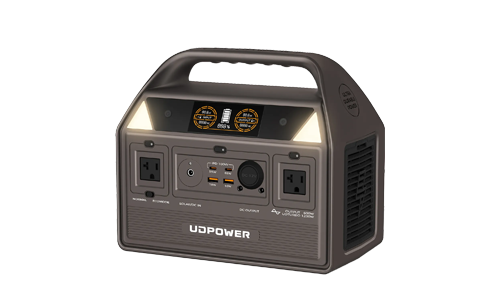
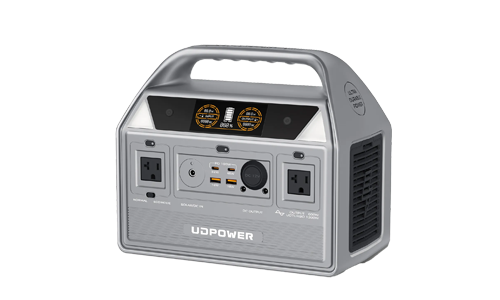
| S2400 | 2,083Wh | 2,400W | About 18–30 hours for a 60–100W average refrigerator | Longer outages, larger refrigerators, and multiple essential devices |
For a detailed calculation using the larger battery, see how long a 2000W power station can run a refrigerator.
How Much Can Solar Extend Refrigerator Runtime?
Solar panels do not change the amount of energy already stored in the battery. They add energy during the day, which can slow the battery’s decline or recharge it while the refrigerator continues operating.
| Average input shown on station | Productive sun time | Energy added | Equivalent runtime for a 60W average fridge |
|---|---|---|---|
| 75W | 4 hours | About 300Wh | About 5 additional hours |
| 100W | 4 hours | About 400Wh | About 6.7 additional hours |
| 150W | 4 hours | About 600Wh | About 10 additional hours |
| 200W | 4 hours | About 800Wh | About 13.3 additional hours |
| 300W | 4 hours | About 1,200Wh | About 20 additional hours |
These are energy-balance examples based on average input displayed by the power station. Panel rating is not the same as real input. Clouds, shade, sun angle, panel temperature, cable losses, and available daylight all affect charging.
Can solar keep a refrigerator running indefinitely?
It is possible to maintain a refrigerator for multiple days when daily solar production consistently replaces the refrigerator’s daily energy use. It should not be described as guaranteed or unlimited, because poor weather can reduce charging for several days.
A refrigerator rated at 400 kWh/year uses approximately 1.1 kWh per day. For a dependable off-grid plan, aim to collect more than that amount during good weather and keep battery reserve for cloudy periods and other devices.
Browse the current UDPOWER solar panel options or compare complete solar generator packages.
12-, 24-, and 48-Hour Refrigerator Outage Planning
| Expected outage | Recommended planning approach | Battery guidance | Solar importance |
|---|---|---|---|
| Up to 4 hours | Keep the refrigerator closed and assess whether backup power is needed immediately. | A small reserve may be enough if no other essentials are required. | Usually not essential for such a short outage. |
| 4–12 hours | Run the refrigerator continuously once connected and minimize door openings. | A 1,000–1,200Wh station is practical for many refrigerators. | Helpful but not always necessary. |
| 12–24 hours | Measure or estimate daily refrigerator energy before choosing the battery. | A 1,190Wh unit may work for an efficient fridge; a 2,000Wh-class unit provides more margin. | Recommended when daylight is available. |
| 24–48 hours | Plan for refrigerator energy, other essential loads, and at least one poor charging period. | A 2,000Wh-class station or a solar-supported system is the safer choice. | Important for restoring energy during the day. |
| More than 48 hours | Use a multi-day energy budget rather than relying on one full battery charge. | Larger battery capacity and backup charging options are recommended. | Strongly recommended, with weather reserve. |
A better outage strategy than running every appliance
During a long outage, reserve the power station for cold storage, communication, lighting, and necessary medical equipment. Avoid high-wattage heating and cooking devices unless your energy budget clearly allows them.
A 1,000W microwave used for ten minutes consumes roughly 167Wh before conversion losses. That energy could operate a refrigerator averaging 60W for nearly three hours.
How to Connect a Refrigerator Safely
- Fully charge the portable power station before severe weather or a planned trip.
- Place the power station indoors in a dry, ventilated location.
- Confirm that the refrigerator’s normal and startup power requirements are within the station’s supported output.
- Turn on the power station and activate its AC output.
- Plug the refrigerator directly into an AC outlet on the power station whenever practical.
- Watch the display during compressor startup for overload warnings or unusually high output.
- Keep ventilation openings on both the refrigerator and power station clear.
- Check battery level periodically and begin solar or AC recharging before the battery is nearly empty.
Can you use an AC extension cord?
Direct connection is preferable. When an AC extension cord is unavoidable, use a short, appliance-rated grounded cord that is suitable for the refrigerator’s current. Do not use a damaged, coiled, undersized, or lightweight household cord.
For a broader compatibility checklist, read Can a Portable Power Station Run Your Refrigerator?
Food Safety During a Power Outage
Backup power helps protect refrigerated food, but battery runtime should never replace temperature-based food safety decisions.
| Situation | Recommended action | Why it matters | Source |
|---|---|---|---|
| Power has just failed | Keep refrigerator and freezer doors closed. | Closed doors slow temperature rise and reduce compressor recovery time later. | FoodSafety.gov |
| Refrigerator has been off for up to 4 hours | Food is generally safe when the door remained closed. | This provides a short response window during an outage. | FoodSafety.gov |
| Perishable food has been above 40°F for too long | Discard affected perishable food rather than tasting it. | Appearance and smell cannot reliably confirm food safety. | U.S. FDA |
| Preparing for future outages | Keep an appliance thermometer in the refrigerator and freezer. | Actual temperature is more reliable than estimating safety from time alone. | FoodSafety.gov |
For a complete outage timeline, see How Long Can a Fridge Be Off For?
Frequently Asked Questions
Can a 1000W portable solar generator run a full-size refrigerator?
Usually, yes. The generator must have enough rated output for normal operation and enough higher-output capability for compressor startup. You must also check battery capacity because the 1000W rating does not indicate runtime.
How long will a 1000Wh power station run a refrigerator?
A 1,000Wh power station commonly runs a full-size refrigerator for about 9–20 hours after allowing for conversion losses. An efficient refrigerator may run longer, while an older unit or a refrigerator in a hot room may run for less time.
Is a 1000W power station the same as a 1000Wh power station?
No. A 1000W rating describes how much power the inverter can supply at one time. A 1000Wh rating describes how much energy the battery stores.
How do I find my refrigerator’s average wattage?
Use the annual kWh number on the EnergyGuide label and multiply it by 1,000, then divide by 8,760. For the most accurate home result, measure total kWh with a plug-in power meter over 24 hours.
Why does my refrigerator show 150W but average much less?
The refrigerator may draw around 150W while the compressor is active, then use very little power while the compressor is off. The all-day average includes both periods.
Why does the power station shut off when the refrigerator starts?
The compressor’s startup demand may exceed the station’s supported output. Other possible causes include a low battery, another appliance using available output, or an unsuitable AC cord.
Can I run the refrigerator while charging the power station with solar panels?
Compatible power stations can support devices while receiving solar input. Actual battery level will rise, remain stable, or fall depending on whether solar input is greater than the refrigerator and other connected loads.
How much solar power do I need for a refrigerator?
Start with the refrigerator’s daily kWh consumption. A refrigerator using 1.1 kWh per day needs more than 1.1 kWh of daily solar production after allowing for changing weather, charging conditions, and system losses.
Will a refrigerator run longer if it is already cold?
Yes. Maintaining an already cold cabinet normally requires less energy than cooling a refrigerator that has warmed during an outage or has just been filled with warm food.
Can a 1000W solar generator run a refrigerator and freezer together?
It may be possible when their combined running and startup requirements remain within the station’s output. Runtime will be much shorter because both appliances draw from the same battery.
How long will a 1000Wh battery run a mini fridge?
A compressor mini fridge averaging 25–50W may run for approximately 18–36 hours from a 1,000Wh battery using a 90% conversion allowance. Thermoelectric coolers can use more energy because many run continuously.
Should I choose a 1,000Wh or 2,000Wh power station for refrigerator backup?
A 1,000–1,200Wh station is practical for overnight backup and many shorter outages. A 2,000Wh-class station is better when you want a full day or more, have a high-consumption refrigerator, need to power other essentials, or expect limited solar charging.
Final Answer
A 1000W-class portable solar generator can usually run a refrigerator, but the 1000W label alone cannot tell you how long it will last. With approximately 1,000–1,200Wh of battery capacity, most users should plan for roughly 10–20 hours of full-size refrigerator backup.
Use the refrigerator’s EnergyGuide kWh/year number for a better estimate, confirm that the power station can handle compressor startup, and leave additional battery reserve for heat, door openings, defrost cycles, and other connected devices.
For overnight refrigerator backup, the 1,190Wh UDPOWER S1200 is the closest match to this article’s 1000W-class use case. For longer outages or multiple essential devices, the 2,083Wh S2400 provides substantially more runtime margin.
Choose the Right Refrigerator Backup
Compare battery capacity, rated output, portability, and solar charging options before choosing your setup.
View Portable Power Stations View Solar Generator Packages Read the 2000W Refrigerator GuideRelated Articles


