

What Can a 600W Portable Power Station Run?
For runtime, wattage alone is not enough. A 596Wh power station such as the UDPOWER C600 provides about 536Wh of planning energy after applying a 90% conversion allowance. That is enough for roughly 9 hours at 60W, 5.4 hours at 100W or 1.8 hours at 300W.
“600W” tells you how much power a station can deliver at one time. It does not tell you how long that power will last. To decide whether a 600W unit will work for your refrigerator, CPAP, laptop setup or campsite, you need to check continuous wattage, startup wattage and battery capacity separately.

What Can a 600W Portable Power Station Run?
A 600W portable power station is best suited to electronics, medical-support equipment, lighting, communication devices and small appliances with modest heating or motor loads.
- Smartphones, tablets and USB accessories
- Laptops and portable monitors
- Wi-Fi routers, modems and satellite internet equipment
- LED lights and string lights
- Box fans, desk fans and camping fans
- Most CPAP machines
- Televisions, streaming devices and small projectors
- Camera, drone and power-tool battery chargers
- 12V compressor refrigerators and many mini fridges
- Selected blenders, rice cookers and other appliances rated below 600W
- Space heaters and electric fireplaces
- Electric kettles and most drip coffee makers
- Most microwaves and toaster ovens
- Hair dryers, curling tools and clothes irons
- Electric grills, hot plates and induction cooktops
- Window or portable air conditioners
- Large compressors, pumps and high-draw power tools
An appliance rated under 600W is not automatically compatible. Refrigerators, pumps and motorized tools may pull several times their normal running wattage for a fraction of a second when they start.
The Three Tests Every Appliance Must Pass
Before plugging in any appliance, check all three of the following limits.
1. Continuous output
Continuous output is the amount of power the station can supply during normal operation. With a 600W station, the combined load of everything connected should remain below 600W.
For better reliability, do not plan around exactly 600W. A practical target is approximately 450W or less, leaving about 25% headroom for brief fluctuations, charging losses and unexpected load changes.
2. Startup or surge output
Appliances containing compressors or motors often need a short burst of extra power when starting. A refrigerator that runs at 120W, for example, might briefly require 600W, 900W or more when its compressor switches on.
Compare the appliance’s startup requirement with the power station’s stated peak or surge limit. Do not treat peak output as continuous output.
3. Battery capacity
Output wattage determines whether the appliance can start and remain powered. Battery capacity, measured in watt-hours, determines how long it can run.
A 600W output rating describes the maximum continuous load. A 596Wh battery capacity describes the amount of stored energy. A station can therefore support a 500W appliance but only for a relatively short period.
600W Portable Power Station Appliance Chart
The ranges below are intended for planning. The label, manual or measured wattage of your specific device should always take priority.
| Device | Typical Running Load | Startup Concern | 600W Compatibility | Practical Note |
|---|---|---|---|---|
| Smartphone charging | 5–30W | None | Yes | Use a USB port directly when possible. |
| Tablet | 10–45W | None | Yes | Suitable for repeated charging during an outage or trip. |
| Laptop | 35–100W | Minimal | Yes | Gaming and workstation laptops may draw more under heavy use. |
| Wi-Fi router and modem | 10–30W combined | None | Yes | An efficient emergency load with relatively long runtime. |
| LED lights | 5–15W each | None | Yes | Add the wattage of every light used at the same time. |
| Desk or camping fan | 20–60W | Low | Yes | Lower speed settings can noticeably extend runtime. |
| Box fan | 50–100W | Low to moderate | Usually | Check high-speed wattage rather than relying on the lowest setting. |
| CPAP machine | 30–90W | Low | Usually | Heated humidifiers and heated tubing can significantly increase consumption. |
| Television | 50–150W | Low | Usually | Screen size, brightness and display technology affect power use. Compare models with the ENERGY STAR TV finder. |
| Portable projector | 50–250W | Low | Usually | Check power draw at the brightness mode you intend to use. |
| 12V compressor refrigerator | 35–60W while running | Moderate | Usually | Direct 12V operation may avoid unnecessary AC conversion. |
| Mini refrigerator | 60–150W while running | Moderate to high | Check surge | Verify compressor startup wattage before relying on it. |
| Full-size refrigerator | Approximately 100–250W while running | High | Model dependent | Some may start successfully, while others can exceed the station’s peak limit. Read the refrigerator power station guide. |
| Game console and TV | 150–350W combined | Low | Usually | Add the console, display, router and audio equipment together. |
| Camera battery charger | 10–40W | None | Yes | Well suited to travel and field photography. |
| Drone battery charger | 40–150W | Low | Usually | Some multi-battery hubs charge sequentially rather than simultaneously. |
| Power-tool battery charger | 50–300W | Low | Usually | Fast chargers may draw considerably more than standard chargers. |
| Small blender | 300–600W | Moderate to high | Check carefully | A 600W label leaves no operating headroom, and motor startup may cause an overload. |
| Small rice cooker | 300–600W | Low | Model dependent | Check both cooking and keep-warm wattage. |
| Electric blanket | 50–200W | Low | Usually | Thermostat cycling may reduce average consumption. |
| Microwave | Often 900–1,500W input | High | No | The advertised cooking wattage is often lower than actual electrical input. |
| Space heater | 750–1,500W | Low | No | Resistance heating consumes battery capacity extremely quickly. |
| Electric kettle | 1,000–1,500W | Low | No | Choose a higher-output station or a non-electric heating method. |
| Hair dryer | 1,000–1,875W | Low | No | Even low-heat settings may exceed 600W. |
| Window air conditioner | 500–1,500W or more | Very high | Generally no | Compressor startup and long runtime make a larger system necessary. |
How Long Will a 600W Portable Power Station Run?
Runtime depends on battery capacity, not the 600W output rating. The following calculations use the UDPOWER C600’s 596Wh battery and a 90% planning efficiency.
This provides approximately 536.4Wh of usable planning energy. Real results may be lower because of temperature, inverter standby consumption, changing appliance loads, battery age and device-specific conversion losses.
| Continuous Load | Example Use | Calculation | Estimated Runtime |
|---|---|---|---|
| 10W | Single LED light or low-power USB device | 536.4Wh ÷ 10W | About 53.6 hours |
| 20W | Router and modem or several LED lights | 536.4Wh ÷ 20W | About 26.8 hours |
| 40W | CPAP without high-draw heated features | 536.4Wh ÷ 40W | About 13.4 hours |
| 60W | Laptop, fan or compact workstation | 536.4Wh ÷ 60W | About 8.9 hours |
| 80W | CPAP with heated accessories or medium fan | 536.4Wh ÷ 80W | About 6.7 hours |
| 100W | Television or laptop plus internet equipment | 536.4Wh ÷ 100W | About 5.4 hours |
| 150W | Entertainment setup or continuously running mini fridge | 536.4Wh ÷ 150W | About 3.6 hours |
| 200W | TV, game console and router | 536.4Wh ÷ 200W | About 2.7 hours |
| 300W | Small appliance or multiple electronics | 536.4Wh ÷ 300W | About 1.8 hours |
| 400W | Small cooker or compact blender | 536.4Wh ÷ 400W | About 1.3 hours |
| 500W | High-draw appliance near the recommended limit | 536.4Wh ÷ 500W | About 1.1 hours |
| 600W | Maximum rated continuous load | 536.4Wh ÷ 600W | About 53 minutes |
A refrigerator cycles on and off, a laptop changes consumption with workload, and a CPAP may use more power when its heater activates. For essential applications, plan for at least 15% to 25% less runtime than the calculated maximum.
What Can a 600W Power Station Run at the Same Time?
Add the wattage of every connected device. The total must remain below 600W, and any compressor or motor must still stay within the station’s startup limit.
| Use Case | Example Devices | Combined Load | Estimated Runtime |
|---|---|---|---|
| Emergency communication | Router, modem, two LED lights and phone charging | About 60W | About 8.9 hours |
| Remote work | Laptop, portable monitor, router, modem and phone | About 115W | About 4.7 hours |
| Camping evening | Portable fridge, fan, LED lights and device charging | About 130W average | About 4.1 hours at a constant 130W |
| CPAP backup | 40W CPAP, phone charging and a small light | About 50W | About 10.7 hours |
| Movie night | Television, streaming device, router and two lights | About 135W | About 4 hours |
| Photography setup | Laptop, camera charger, drone charger and two lights | About 220W | About 2.4 hours at a constant 220W |
For a refrigerator or other cycling appliance, the table’s constant-load estimate may be conservative during mild conditions. However, hot weather, frequent door opening and warm food can cause the compressor to run more often.

Recommended 600W Model: UDPOWER C600
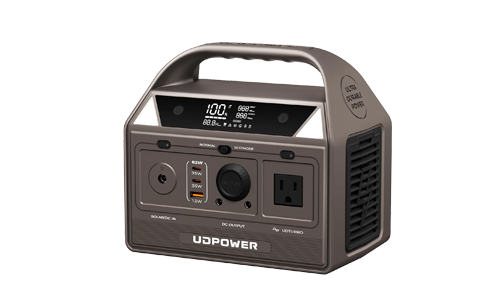
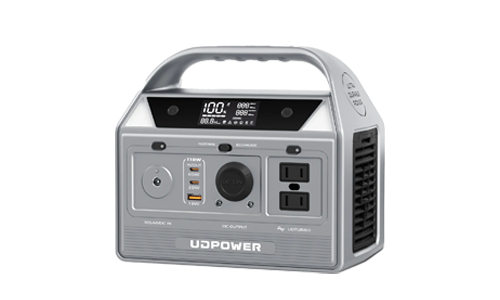
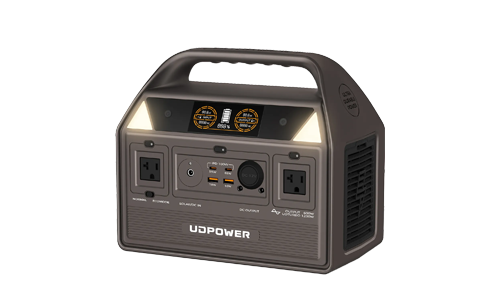
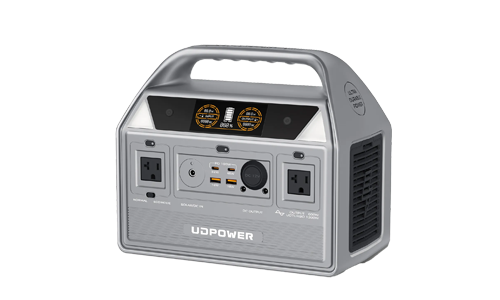
The UDPOWER C600 Portable Power Station is designed for camping, short home outages, CPAP backup, mobile workstations, photography equipment and other loads that stay within its 600W continuous rating.
- Battery capacity: 596Wh
- Rated AC output: 600W pure sine wave
- Maximum/peak output: Up to 1,200W
- Battery chemistry: LiFePO4
- Outputs: Nine device outputs
- USB-C: Up to 65W Power Delivery
- Solar input: Up to 240W
- Weight: 12.3 lb
- Dimensions: 11.1 × 6.1 × 9.4 inches
- Warranty: Five years
Its 596Wh capacity is large enough for overnight low-wattage use but remains compact enough to move between a vehicle, campsite, office or bedroom. The pure sine wave AC output is also appropriate for sensitive electronics within the station’s supported load range.
View the UDPOWER C600 Compare Portable Power StationsCan a 600W Portable Power Station Run a Refrigerator?
It can run many portable refrigerators and selected household refrigerators, but the answer depends more on compressor startup than normal running wattage.
First check whether the refrigerator can start
A refrigerator may consume only 100W to 250W while its compressor is running, yet require a much larger burst at startup. If that surge exceeds the power station’s peak-output protection, the station may shut down even though the normal running wattage appears safe.
Look for “starting watts,” “locked rotor amps,” “LRA” or compressor amperage on the refrigerator label or service documentation. When no startup figure is available, testing with a watt meter is more reliable than guessing.
Then estimate runtime from annual energy use
Refrigerators do not normally draw their rated running wattage every minute. The compressor cycles on and off. For a more realistic estimate, use the refrigerator’s yellow EnergyGuide label, which lists estimated annual electricity consumption in kilowatt-hours.
| Annual Refrigerator Use | Average Load | Calculated Runtime | Conservative Planning Range |
|---|---|---|---|
| 200 kWh per year | About 23W average | About 23.5 hours | Approximately 18–20 hours |
| 300 kWh per year | About 34W average | About 15.7 hours | Approximately 12–13 hours |
| 400 kWh per year | About 46W average | About 11.7 hours | Approximately 9–10 hours |
| 500 kWh per year | About 57W average | About 9.4 hours | Approximately 7–8 hours |
| 700 kWh per year | About 80W average | About 6.7 hours | Approximately 5–5.5 hours |
These estimates apply only after the refrigerator successfully starts. Runtime will also change with room temperature, thermostat setting, food temperature, door opening, frost buildup and refrigerator condition.
When a 600W Station Is Too Small
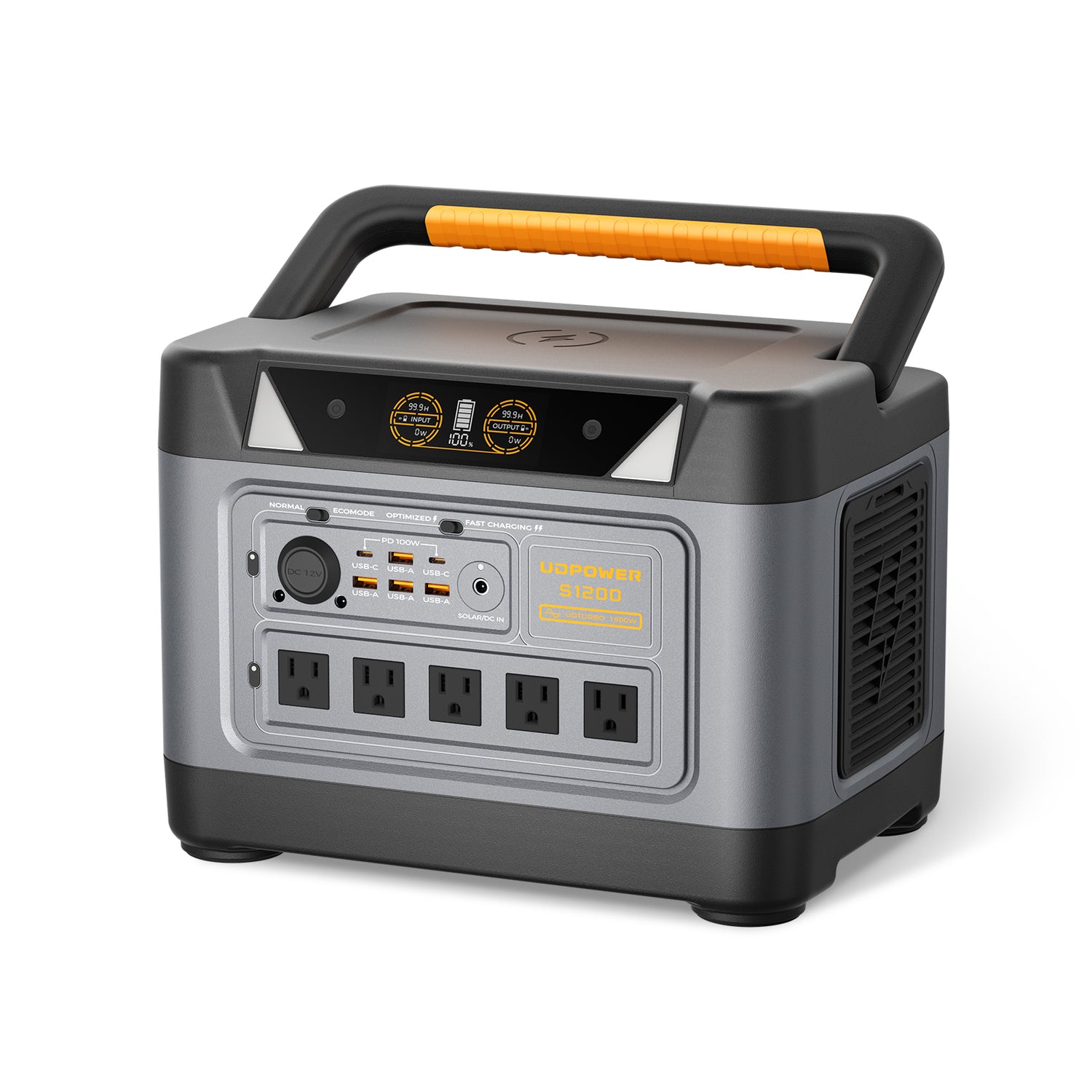
Choose a larger power station when your appliance approaches 600W, has an uncertain compressor surge, or needs to operate for more than one night. The UDPOWER S1200 provides more operating headroom and approximately twice the battery capacity of the C600.
- Battery capacity: 1,190Wh
- Rated AC output: 1,200W
- UDTURBO output: Up to 1,800W
- Outputs: 14 total outputs, including five AC outlets
- Solar input: Up to 400W
- UPS transfer: Less than 10 milliseconds
- Weight: Approximately 26 lb
- Warranty: Five years
The S1200 is the more practical choice for household refrigerators, larger entertainment setups, longer CPAP backup, multiple work devices or appliances with loads above the comfortable operating range of a 600W model.
View the UDPOWER S1200 Compare C600, S1200 and Other ModelsWhat Will a 600W Portable Power Station Not Run?
The main limitation is electric heating. Appliances that turn electricity directly into heat typically consume far more power than phones, computers, lights or fans.
Space heaters
Most household space heaters draw approximately 1,500W on their high setting. Even a reduced setting commonly exceeds 600W. A heated blanket or heated mattress pad is usually a more realistic low-wattage option, provided its label remains within the station’s limits.
Electric kettles and coffee makers
Kettles often require 1,000W to 1,500W. Many coffee makers also exceed 600W while heating water, even if their warming plate consumes less after brewing.
Microwaves
Do not confuse microwave cooking output with electrical input. A microwave advertised as “700 watts” may draw more than 1,000W from the outlet.
Hair dryers and styling tools
Hair dryers commonly draw 1,000W to 1,875W. Some compact travel models offer a low-wattage mode, but the actual label must be checked before use.
Air conditioners
Air conditioners combine substantial running consumption with a compressor startup surge. A 600W station is generally not a dependable choice for household air conditioning.
High-draw power tools
Small battery chargers are usually compatible. Corded saws, shop vacuums, grinders, air compressors and pumps often exceed either the 600W continuous limit or the station’s peak limit.
How to Check Whether Your Appliance Will Work
-
Find the appliance’s rated input.
Check the rear label, power adapter, EnergyGuide label or owner’s manual. Use input wattage rather than advertised output wattage. -
Convert amps to watts when necessary.
Multiply volts by amps. For example, a 120V appliance rated at 3A may draw up to 360W. -
Check startup demand.
Look for starting watts, surge watts, LRA or compressor specifications. This is essential for refrigerators, pumps and motor-driven tools. -
Add every simultaneous load.
Include chargers, lights, routers, displays and accessories. Do not evaluate each appliance separately if they will operate together. -
Leave operating headroom.
Aim to keep planned continuous consumption near 450W or lower rather than building a system around the exact 600W maximum. -
Estimate runtime from watt-hours.
Multiply battery capacity by 0.90, then divide by the expected average load. -
Test before an emergency.
Run the actual setup while utility power is available. Confirm startup, normal operation, runtime and automatic shutdown behavior.
How to Make a 600W Power Station Last Longer
Use USB-C or DC output when appropriate
When a laptop, phone, router or portable refrigerator can run directly from a compatible USB-C or DC output, this may avoid an unnecessary AC conversion stage. Always confirm voltage, current and connector compatibility first.
Turn off unused output sections
Disable AC or DC output when no connected device needs it. Inverter standby consumption matters more during long, low-wattage use.
Reduce unnecessary settings
Lower a television’s brightness, use a fan at a lower speed, enable a laptop’s energy-saving mode and disconnect chargers after batteries are full.
Manage CPAP heating features carefully
Heated humidification and heated tubing can materially reduce CPAP runtime. Use only settings that are appropriate for your normal treatment and follow the CPAP manufacturer’s instructions. See the detailed CPAP battery runtime guide.
Pre-cool refrigerators
Cool the refrigerator and its contents before switching to battery power. Keep the door closed and leave space for internal air circulation.
Avoid very hot or cold operating conditions
Extreme temperatures can affect both battery performance and appliance demand. For example, a refrigerator may run more frequently in a hot vehicle or tent.
Add solar charging for daytime use
Compatible solar panels can replenish part of the energy used during the day. Solar input changes with sunlight, season, panel angle, shade and temperature, so panel wattage should not be treated as guaranteed continuous output.
Review the UDPOWER portable solar panel collection or read Are Foldable Solar Panels Worth It? before building a solar charging setup.
Is 600W Enough for Camping?
A 600W station is a practical size for tent camping, vehicle camping and short weekend trips when the main loads are a portable refrigerator, lights, phones, cameras, fans and a laptop.
It becomes less suitable when the trip depends on electric cooking, electric heating, air conditioning or several days of refrigerator operation without recharging.
Before choosing a capacity, make a 24-hour energy budget. Multiply each device’s wattage by the number of hours it will run, then add the results.
For example, a 45W portable refrigerator averaging 12 hours of compressor operation uses approximately 540Wh per day. That single appliance would consume nearly the full planning capacity of a 596Wh station.
For a complete trip estimate, use the camping watt-hour sizing guide.
Is 600W Enough for a Home Power Outage?
A 600W portable power station works best as a targeted backup, not a whole-home power source. It can keep communication, lighting and selected medical or refrigeration equipment running, but it cannot support central heating, air conditioning, electric water heating or large kitchen appliances.
A sensible outage priority order is:
- Medical or accessibility equipment
- Phones and emergency communication
- Internet equipment
- Essential lighting
- Refrigeration, after startup compatibility is confirmed
- Comfort and entertainment devices
Prioritizing loads prevents a television, game console or unnecessary charger from reducing the runtime available for essential equipment later in the outage.
Frequently Asked Questions
Can a 600W portable power station run a TV?
Yes. Many modern televisions use approximately 50W to 150W, although large, bright or older displays may consume more. A 100W television could run for about 5.4 hours from a 596Wh C600 using a 90% efficiency estimate. Streaming equipment and internet hardware must be added to the total.
Can a 600W power station run a CPAP all night?
Often, yes. A CPAP averaging 40W could run for approximately 13.4 hours from a 596Wh battery at 90% planning efficiency. At 80W with heated features, the estimate falls to about 6.7 hours. Actual results depend on pressure, mask leakage, humidification, heated tubing and machine model.
Can a 600W power station run a refrigerator?
It can run many portable refrigerators, mini fridges and selected efficient household refrigerators if the compressor startup surge remains within the station’s peak limit. Full-size refrigerator compatibility should be tested before an emergency.
Can a 600W power station run a microwave?
Generally no. Most microwaves draw more than 600W from the outlet, even when their advertised cooking output appears lower.
Can it run a coffee maker?
Most standard drip coffee makers exceed 600W while heating water. A very small low-wattage model may work if its actual input remains comfortably below the station’s continuous rating, but runtime will be short.
Can a 600W station run a blender?
Selected compact blenders may work, but many models are rated near or above 600W and can have a substantial motor startup surge. A blender labeled exactly 600W leaves no useful operating headroom.
Can it run an electric blanket?
Usually. Many electric blankets consume less than 200W. Check the controller and blanket label, especially for dual-zone models that may have two heating circuits.
Can it charge an electric vehicle?
It is not a practical electric-vehicle charging source. Standard EV charging requires much more sustained power and energy than a compact 600W, 596Wh station can provide.
Can I use all the outlets at once?
Multiple ports can be used at the same time, but the combined output must remain within the applicable AC, USB, DC and total device limits. Having several outlets does not multiply the station’s 600W continuous rating.
What happens if I connect more than 600W?
The power station’s overload protection should stop AC output to protect the system. Disconnect the excessive load, allow the unit to reset if necessary and restart it according to the owner’s manual.
Should I buy a 600W or 1,200W power station?
Choose 600W for electronics, lights, fans, CPAP equipment, portable refrigerators and compact travel use. Choose 1,200W when you need greater refrigerator startup margin, larger appliances, more simultaneous devices or longer runtime.
How many phone charges can a 596Wh station provide?
A phone with a 15Wh battery would theoretically receive about 35 full charges from 536.4Wh of planning energy. Actual results will vary because the station, charging cable, phone and battery-management system all use some energy during charging.
Can solar panels power appliances while charging the station?
Compatible systems may support charging while supplying connected loads, but solar generation is variable. If the appliances consume more power than the panels provide, the battery will continue to discharge, only more slowly.
Choose the Right Portable Power Station
A 600W model is a strong fit for portable electronics, communication equipment, CPAP backup, camping refrigerators and other moderate loads. Move up to a 1,200W or larger model when startup demand, appliance wattage or required runtime exceeds that range.
View the Power Station Selection Guide Shop Portable Power Stations Get Product Selection HelpCalculation method: Runtime estimates in this guide use the UDPOWER C600’s official 596Wh capacity multiplied by a 90% conversion allowance. Appliance wattage ranges are planning estimates only. For final compatibility, use the appliance’s official input label, startup specification or measured power consumption.
Related Articles


