What Can a 1200W Portable Power Station Run?
ZacharyWilliamA 1200W portable power station can run most everyday electronics and many small appliances, but success depends on two different limits: whether the inverter can handle the device right now, and whether the battery is large enough to run it for the hours you care about.
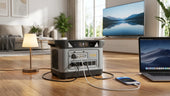
This is why 1200W is such a practical middle ground. It is strong enough for Wi-Fi, laptops, TVs, CPAP machines, lights, fans, and many kitchen or fridge-related use cases, but it is still small enough to carry, store, and actually use without overbuilding your setup.

Table of Contents
What “1200W” Really Means
A 1200W portable power station can typically supply up to 1200 watts of continuous AC power. That is enough for common electronics, many outage essentials, and a good number of small appliances, as long as the combined load stays under the inverter’s ceiling.

Simple device check: look for watts on the label, power brick, or manual. If it only shows amps, a rough estimate for many U.S. devices is Watts ≈ Volts × Amps, usually around 120V on standard household outlets.
What a 1200W Power Station Can Run (Quick Chart)
The table below uses typical wattage ranges to show what is usually an easy match, what is borderline, and what usually belongs in a larger power class.

| Device / appliance | Typical power draw | Will a 1200W station run it? | Notes (what to watch) |
|---|---|---|---|
| Phone / tablet chargers | 5–30W | Yes | Best through USB ports when available. |
| Laptop | 45–100W | Yes | USB-C PD is often more efficient than AC. |
| Wi-Fi router + modem | 10–30W | Yes | One of the best outage-use cases for this size. |
| LED lights | 5–60W | Yes | Check the total if powering many lights together. |
| TV (LED) | 60–200W | Yes | Large TVs can draw more than expected. |
| Box fan / small fan | 30–120W | Yes | Excellent comfort load during outages. |
| CPAP (no heated humidifier) | ~30–60W | Yes | Humidifier heat can change the math a lot. |
| Mini fridge / compact fridge | ~60–150W running | Usually yes | Startup surge matters more than the steady draw. |
| Full-size refrigerator | ~150–400W running | Depends | Often fine once running, but startup can trip weaker systems. |
| Microwave | Varies widely | Depends | Check input watts or amps on the label, not just “cooking watts.” |
| Coffee maker | ~900–1200W | Borderline / depends | If it is close to 1200W, avoid running other heavy loads at the same time. |
| Blender | ~300–800W | Yes, often | Some high-power models can still exceed the comfort zone. |
| Toaster / toaster oven | ~800–1800W | Usually no | Many toaster ovens are simply too close to or above the limit. |
| Hair dryer | ~1200–1875W | Usually no | Even when it “works,” it leaves almost no room for anything else. |
| Space heater | ~750–1500W | Often no on high | High draw and poor battery efficiency make it a weak fit. |
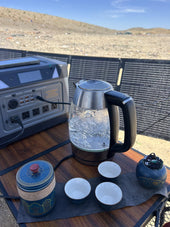
| Electric kettle / hot plate | ~1200–1500W+ | Usually no | These are classic examples of loads that belong in larger classes. |
If this list feels close to your needs but a little tight, compare it with the 1000W guide and the 2000W guide. That is usually the most useful side-by-side decision set for buyers hovering around 1200W.
How Long Will It Run? Runtime Math + Realistic Examples
Runtime depends on battery capacity and the size of the load. A practical estimate many people use for AC devices is:
Estimated runtime (hours) ≈ (Battery Wh × 0.85) ÷ Load watts
Using a ~1,190Wh class battery like the UDPOWER S1200 gives a helpful real-world baseline. The 0.85 factor is a simple planning estimate for AC efficiency; your exact runtime will vary with temperature, device behavior, and inverter losses.
| Load (example) | Assumed draw | Estimated runtime | Real-world notes |
|---|---|---|---|
| Wi-Fi router + modem | 20W | ~50.6 hours | Excellent “keep the house online” load. |
| Laptop | 60W | ~16.9 hours | USB-C often stretches runtime a little further. |
| LED lighting | 30W | ~33.7 hours | One of the easiest ways to make backup last. |
| CPAP (no heated humidifier) | 40W | ~25.3 hours | Heated humidifier can reduce runtime sharply. |
| TV + streaming box | 100W | ~10.1 hours | Large TVs may draw more. |
| Box fan | 60W | ~16.9 hours | Good comfort load for outage planning. |
| Small blender (intermittent) | 300W | ~3.37 hours continuous | In real life you use it for minutes, not hours. |
| Microwave (intermittent) | 700W example | ~1.45 hours continuous | Check the actual input watts on the label. |
| Coffee maker | 900W | ~1.12 hours continuous | Brewing cycles are short, but overlap matters. |
| Maxing the inverter | 1200W | ~0.84 hours (~51 minutes) | Good for short tasks, not for all-day high-watt use. |
A better way to estimate refrigerators: refrigerators cycle on and off, so the average draw is often much lower than the running watts on a label. For fridge-specific planning, use annual kWh data when available, then convert to average watts. That is more realistic than guessing from startup numbers alone.
Surge Loads: Fridges, Pumps, and Motor Tools
Surge is why some devices that look “small enough” on paper still trip a station in real life. Mini fridges, some full-size refrigerators, small pumps, and certain tools need extra power for a moment when they start.

- Start one device at a time, then add smaller electronics after the motor is already running.
- Keep other heavy loads off while the compressor or motor starts.
- Use short, appropriate extension cords to reduce avoidable voltage drop.
- If it trips, reduce the load first instead of rapidly retrying over and over.
Real-Life Bundles You Can Power
Most people do not buy a station to run only one device. They buy it to keep a small bundle going when the grid is down or when they are away from an outlet.

| Scenario | What you run | Typical combined watts | What to avoid at the same time |
|---|---|---|---|
| Work-from-home backup | Laptop + monitor + router + phone charging | ~120–250W | Microwave, heater, hair dryer |
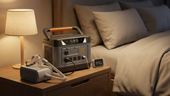
| CPAP night kit | CPAP + phone + bedside light | ~40–90W | Heated humidifier if it pushes draw too high |
| Camping comfort | LED lights + fan + charging devices | ~60–200W | Electric griddle / hot plate |
| Quick kitchen support | Coffee maker or blender, one at a time | ~300–1200W | Running both together plus other heavy loads |
| Fridge saver (outage) | Refrigerator, then router/lights after startup | Varies | Starting the fridge while another big appliance is already running |
Related reading: If 1200W feels close but not quite right, compare it directly with the 1000W guide below it and the 2000W guide above it. If your real plan includes more appliance overlap, the 3000W guide is the clearest step-up comparison.
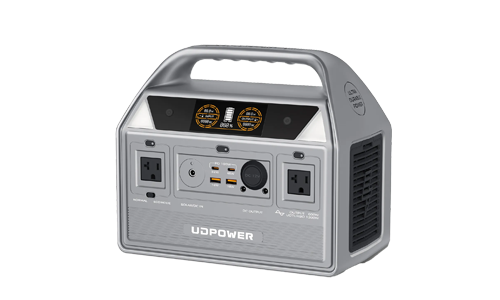
Example 1200W Option: UDPOWER S1200
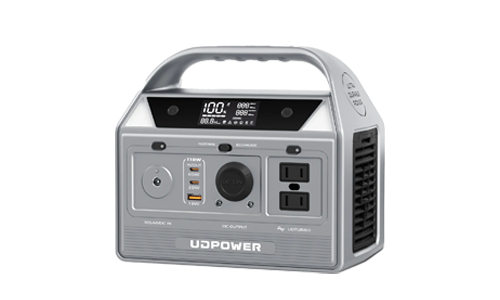
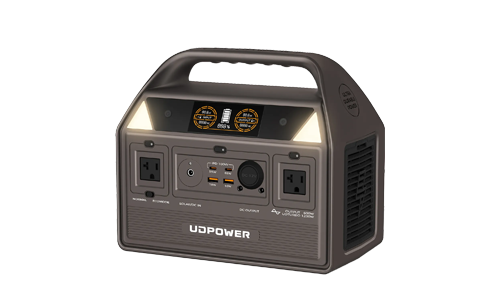
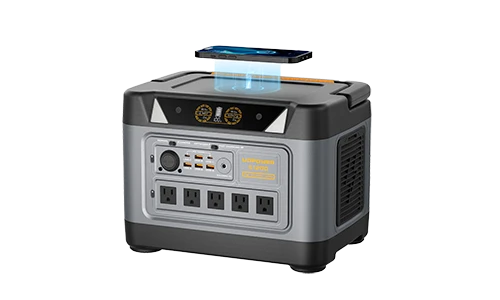
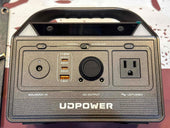
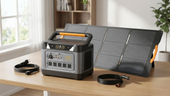
If you are using this article to size a real unit, the UDPOWER S1200 is a useful baseline. It pairs a 1200W rated pure sine wave inverter with a roughly 1.19kWh battery, which is why it sits in a practical middle zone between “small emergency kit” and “larger appliance-focused backup.”

| Spec | UDPOWER S1200 | Why it matters |
|---|---|---|
| Battery capacity | 1,190Wh | This is the main driver of runtime. |
| AC output | 1,200W rated, pure sine wave | Sets the continuous load ceiling. |
| Surge capability | Up to 1,800W (UDTURBO) | Helps with startup-heavy loads like small compressors and motors. |
| Ports | 5 AC outlets + 10 DC outputs | Useful when you want to run many small devices without extra strips. |
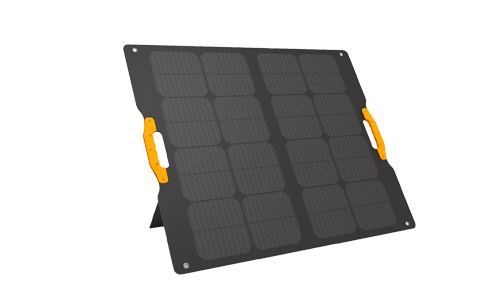
| Solar input | 12V–75V, 12A, 400W max | Determines what solar array can charge it safely. |
| UPS function | <10 ms switchover | Helpful for routers and certain sensitive electronics. |
| Weight | 26.0 lbs | Still portable enough for camping, RV use, and home carry. |
| Battery chemistry | LiFePO₄ | Supports longer cycle life and safer daily-use behavior. |
Safety and Performance Tips
- Do not build your whole plan around max output. High-watt loads are best kept short.
- Use DC and USB where you can for phones, tablets, cameras, and many laptops.
- Test important devices before you need them, especially fridges and medical equipment.
- Respect solar input limits before connecting third-party panels or mixed arrays.
- Keep realistic expectations around heating loads. Power-wise is not the same as runtime-wise.
Still deciding whether 1200W is too much or not enough? The lower end of the same topic is covered in the 800W guide, 600W guide, 500W guide, 300W guide, and 200W guide.
FAQ
Can a 1200W portable power station run a refrigerator?
Often yes, especially for mini fridges and many modern refrigerators. The part to watch is startup surge, not just the normal running watts. A fridge that runs comfortably once it is on can still trip a small inverter if the compressor startup is high.
Can a 1200W portable power station run a microwave?
Sometimes. The deciding number is the microwave’s actual input wattage or amps, not only the cooking watts shown on the front. Smaller models may fit well. Larger ones can exceed the comfort zone very quickly.
Can it run a coffee maker?
Often yes, but only if that coffee maker is not pushing too close to the 1200W ceiling and you are not stacking other heavy loads at the same time. Brewing is usually a short task, so output margin matters more than all-day runtime.
Can a 1200W power station run a CPAP all night?
In many cases, yes. A CPAP without heated humidifier is often an excellent match for this size class. The question is usually runtime, not inverter power. Heated humidity and heated hose use can cut runtime much faster than people expect.
Can it run a space heater?
Usually not well. Many space heaters are 1500W on high, which is above the continuous limit of a 1200W station. Even lower settings drain battery quickly, so heaters are one of the weakest use cases for this class.
What can I realistically run at the same time on a 1200W unit?
A practical mix is router + lights + laptop + phone charging + TV, or a refrigerator plus a few small essentials after startup. Trouble usually starts when several heat-heavy or motor-driven appliances overlap.
Is 1200W enough for home backup?
For essentials, often yes. It is a very good size for keeping the house connected, lit, and functional. It is not meant to replace large heating appliances, full electric kitchens, or whole-home generator behavior.
Should I choose 1000W, 1200W, 2000W, or 3000W?
Choose 1000W if your loads are lighter and you mainly care about electronics and basic backup. Choose 1200W if you want a more comfortable middle ground for essentials plus some appliance use. Choose 2000W if you want more overlap and fewer compromises. Choose 3000W if you expect heavier appliance mixing and want much more margin.
Sources & References
- UDPOWER S1200 official specifications: UDPOWER product page
- Appliance energy estimation methods: U.S. Department of Energy
- Refrigerator annual energy references: ENERGY STAR Product Finder
- CPAP battery guidance: ResMed Battery Guide (PDF)
- Typical wattage benchmark list: TCNJ typical wattages guide











![How to Live In The Woods [Complete Guide]](http://udpwr.com/cdn/shop/articles/Off-Grid_Cabin_Option_f6c94fe7-1ae7-4c3a-baf5-ed9fe684c832.png?v=1763523215&width=170)