How Many Watts Does a Crock Pot Use?
ZacharyWilliamSlow Cooker Power Guide
A practical guide to Crock-Pot wattage, electricity cost, battery runtime, and how to size a portable power station for cooking during camping, RV trips, or short power outages.
Last updated: April 30, 2026
Quick Answer
Most Crock-Pot-style slow cookers use about 70–400 watts, depending on size, setting, and model. A small 1.5–3 quart unit may use about 70–150W, a common 4–6 quart family slow cooker often falls around 150–250W, and larger 7–10 quart models can reach 250–450W+.
The exact number is on the rating label, usually on the bottom or back of the slow cooker. If the label lists amps instead of watts, use this simple estimate: watts ≈ volts × amps. On a U.S. 120V outlet, a 2.0A slow cooker is about 240W.
For backup power planning, wattage tells you whether a power station can run it, while watt-hours tell you how long it can keep running. For example, a 180W Crock-Pot running for 8 hours uses about 1.44 kWh.

Crock Pot Wattage by Size and Setting
There is no single wattage for every Crock-Pot. The heating base, stoneware size, control type, and thermostat behavior all matter. The numbers below are practical planning ranges for common U.S. slow cookers. Always check your own label before choosing a battery backup.
| Slow cooker size | Typical use | Common wattage range | Backup power note |
|---|---|---|---|
| 1.5–3 quart | Dips, oatmeal, small meals, one or two servings | 70–150W | Easy load for most power stations, but runtime still depends on battery capacity. |
| 4 quart | Small family meals, soups, sauces, sides | 120–220W | Good match for compact and mid-size battery stations. |
| 5–6 quart | Family meals, chili, pulled pork, stews | 150–300W | Often the sweet spot for camping and outage cooking. |
| 7–8 quart | Large family meals, meal prep, larger roasts | 250–400W | Use a larger power station if cooking for many hours. |
| 10 quart or extra-large | Parties, large batch cooking, big cuts of meat | 350–450W+ | Check the label carefully. A small battery may run it, but not for long. |
Important: a slow cooker does not always pull its maximum wattage every second. Once it heats up, the thermostat may cycle the heating element on and off. For backup power, plan with the rated wattage first, then use a plug-in watt meter if you want a more accurate average.
Low vs High vs Warm: What Changes?
On many slow cookers, Low and High do not mean completely different final food temperatures. They often change how quickly the cooker reaches and maintains cooking temperature. High gets there faster. Low takes longer. Warm is meant to hold already cooked food warm, not cook raw ingredients.
| Setting | Typical power behavior | Best use | What not to do |
|---|---|---|---|
| Low | Lower average draw over a longer cook time | All-day cooking, stews, roasts, chili | Do not assume Low always uses half the energy of High; the longer runtime can offset the lower draw. |
| High | Higher draw, faster heat-up | Starting a meal, shorter recipes, thick ingredients | Do not leave delicate foods too long on High unless the recipe calls for it. |
| Warm | Lower holding draw after food is cooked | Keeping finished food warm for serving | Do not use Warm to cook raw meat, poultry, beans, or frozen ingredients. |
How to Find Your Exact Crock Pot Watts
The fastest method is to turn the slow cooker over and read the rating label. Look for one of these formats:
| What the label says | How to read it | Estimated watts |
|---|---|---|
| 120V, 60Hz, 1.0A | 120 volts × 1.0 amp | About 120W |
| 120V, 60Hz, 1.5A | 120 volts × 1.5 amps | About 180W |
| 120V, 60Hz, 2.0A | 120 volts × 2.0 amps | About 240W |
| 120V, 60Hz, 3.0A | 120 volts × 3.0 amps | About 360W |
| 240W | Already listed in watts | Use 240W for planning |
If you use a plug-in watt meter, test the slow cooker after it has warmed up and with real food or water inside. A cold empty test can exaggerate the first heat-up period and miss the normal cycle pattern.
How Much Electricity Does a Crock Pot Use?
Use this formula:
kWh = watts ÷ 1,000 × hours used
For example, a 180W slow cooker running for 8 hours uses:
180 ÷ 1,000 × 8 = 1.44 kWh
Using the EIA February 2026 U.S. residential average of 17.65 cents per kWh, that 8-hour cook would cost about $0.25. Your actual cost depends on your utility rate, time-of-use plan, and local fees.
| Slow cooker wattage | 4-hour recipe | 6-hour recipe | 8-hour recipe | Approx. cost for 8 hours at 17.65¢/kWh |
|---|---|---|---|---|
| 100W | 0.40 kWh | 0.60 kWh | 0.80 kWh | $0.14 |
| 150W | 0.60 kWh | 0.90 kWh | 1.20 kWh | $0.21 |
| 180W | 0.72 kWh | 1.08 kWh | 1.44 kWh | $0.25 |
| 250W | 1.00 kWh | 1.50 kWh | 2.00 kWh | $0.35 |
| 320W | 1.28 kWh | 1.92 kWh | 2.56 kWh | $0.45 |
| 450W | 1.80 kWh | 2.70 kWh | 3.60 kWh | $0.64 |
A Crock-Pot is usually not a major energy drainer compared with ovens, space heaters, dryers, or electric stovetops. The catch is time: a low-watt appliance can still use meaningful energy when it runs all day.
How Long Can a Portable Power Station Run a Crock Pot?
For realistic AC runtime, use this formula:
Estimated runtime = power station capacity × 0.85 ÷ Crock Pot watts
The 0.85 factor allows for inverter loss and real-world conditions. If you want to keep a reserve, stop earlier instead of planning to drain the battery to 0%.
| Crock Pot load | UDPOWER C600 596Wh |
UDPOWER S1200 1,190Wh |
UDPOWER S2400 2,083Wh |
Practical meaning |
|---|---|---|---|---|
| 80W small cooker | About 6.3 hours | About 12.6 hours | About 22.1 hours | Easy load; capacity matters more than output. |
| 120W compact cooker | About 4.2 hours | About 8.4 hours | About 14.8 hours | Good for small meals and warm holding. |
| 180W common family cooker | About 2.8 hours | About 5.6 hours | About 9.8 hours | Mid-size battery is better for full recipes. |
| 250W 5–6 quart cooker | About 2.0 hours | About 4.0 hours | About 7.1 hours | Good reason to choose a larger power station. |
| 320W large cooker | About 1.6 hours | About 3.2 hours | About 5.5 hours | Useful for short windows, not all-day cooking on small batteries. |
| 450W extra-large cooker | About 1.1 hours | About 2.2 hours | About 3.9 hours | Consider cooking in shorter sessions or using a smaller cooker. |
These are planning estimates. A thermostat-controlled slow cooker may average less than its label wattage after warm-up, but you should not rely on that when sizing emergency backup power.
Recommended UDPOWER Options for Crock Pot Use
If your goal is only to keep food warm for a short period, a compact battery may be enough. If you want to cook a full 6–8 hour recipe during a blackout or campsite meal, battery capacity becomes the key number.
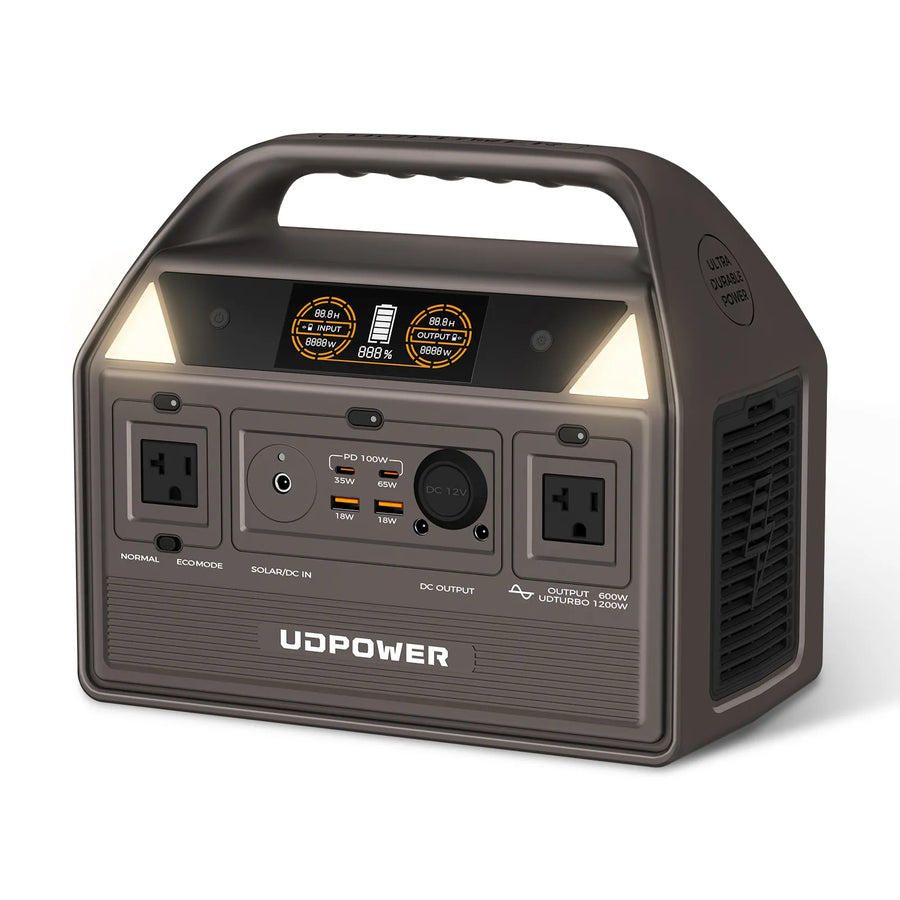
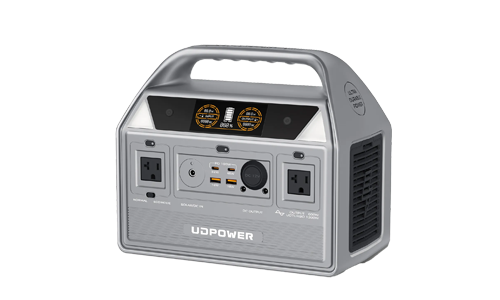
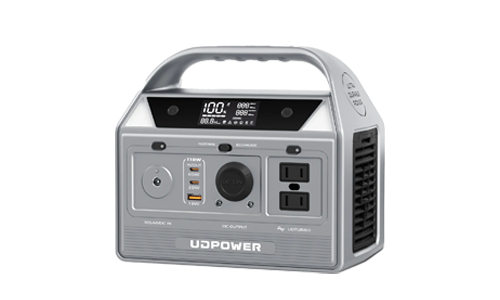
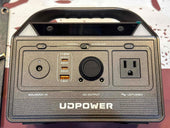
UDPOWER C600 — Best for Small Crock Pots and Short Cooking Windows
- Capacity: 596Wh LiFePO4 battery
- AC output: 600W pure sine wave, 1200W max
- Ports: 2 AC outlets, USB-C, USB-A, car outlet, DC output
- Best match: small slow cookers, warm holding, short recipes, compact camping setups
Choose the C600 if your slow cooker label is safely under the 600W continuous AC output limit and you only need a few hours of runtime. For a 180W cooker, plan around 2–3 hours of real-world AC runtime.
View UDPOWER C600
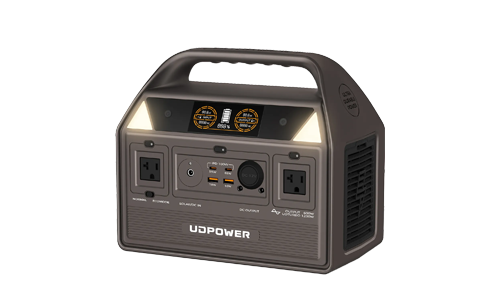
UDPOWER S1200 — Best Balance for Family Slow Cookers
- Capacity: 1,190Wh LiFePO4 battery
- AC output: 1,200W pure sine wave, UDTURBO up to 1,800W
- Ports: 5 AC outlets plus DC and USB outputs on the 5-AC version
- Best match: 4–6 quart slow cookers, RV meals, weekend camping, short outage cooking
The S1200 is the practical middle choice for most slow cooker users. It gives more room for a 150–250W Crock-Pot and still leaves capacity for phones, lights, a fan, or a Wi-Fi router if you manage loads carefully.
View UDPOWER S1200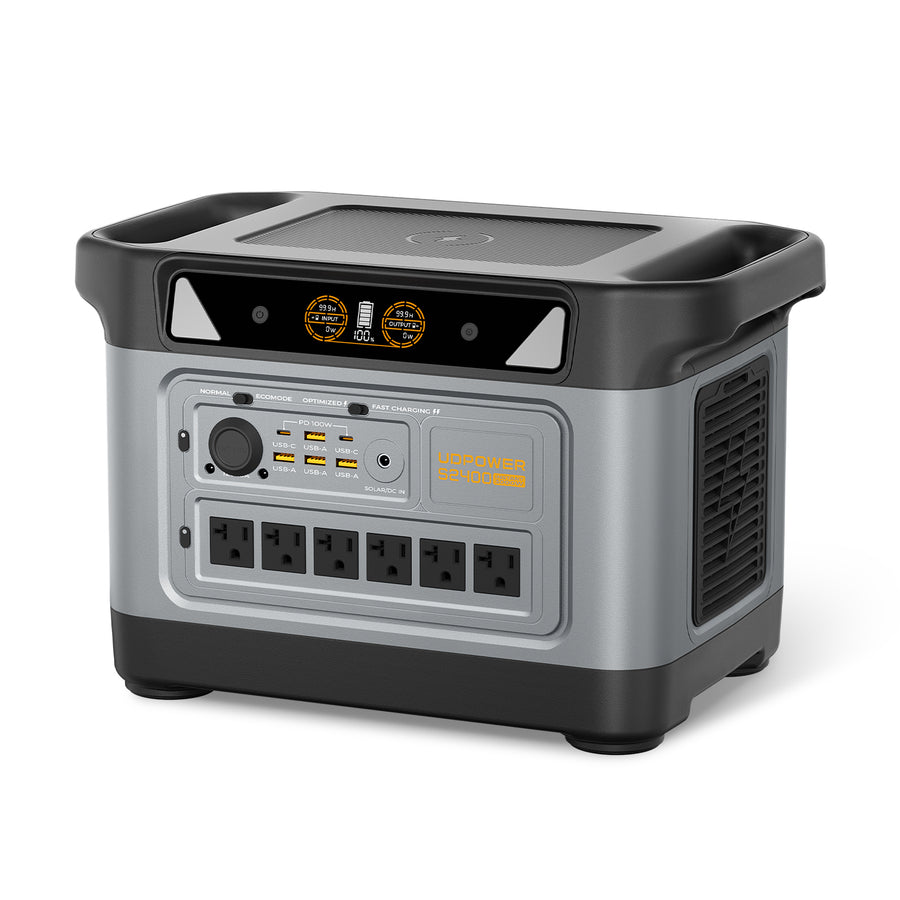
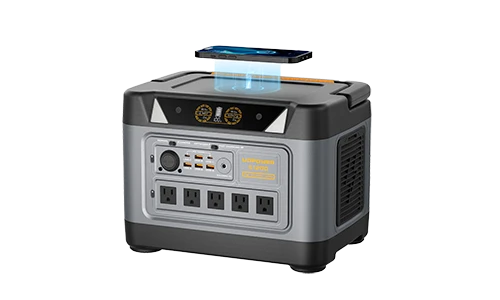
UDPOWER S2400 — Best for Outage Meals Plus Essentials
- Capacity: 2,083Wh LiFePO4 battery
- AC output: 2,400W pure sine wave, UDTURBO surge support up to 3,000W
- Ports: 6 AC outlets plus USB-A, USB-C, DC5521, car outlet, and wireless charging
- Best match: longer Crock-Pot runtime, refrigerator support, router, lights, TV, and multiple essentials
Choose the S2400 if you are planning for a real outage day, not just one appliance. A 180W slow cooker can run for roughly 9–10 hours in a simple estimate, or you can split capacity between cooking and essentials.
View UDPOWER S2400Not sure which size fits your whole load list? Start with the UDPOWER battery runtime estimator guide, then compare the full portable power station collection.
Using a Crock Pot During a Power Outage
A slow cooker can be a smart outage appliance because it uses far less power than an electric oven. But it is not the first thing to run if your battery is limited. During an outage, prioritize food safety, medical devices, refrigerator windows, communication, and lighting first.
| Situation | Best move | Why it matters |
|---|---|---|
| You only have a small power station | Use the Crock-Pot for a short warm-holding window, not a full 8-hour cook. | Cooking for hours can drain capacity needed for fridge, router, lights, or phones. |
| You have a 1,000Wh-class station | Use a 150–250W cooker and keep a reserve. | This is the most realistic range for a family-size slow cooker meal. |
| You have a 2,000Wh-class station | Plan meal windows and essential-device windows separately. | You can cook and still keep capacity for selected essentials if you do not run everything at once. |
| The battery may run out mid-cook | Do not start raw meat or poultry unless you have enough runtime to finish safely. | Interrupted cooking creates a food safety problem, not just a power problem. |
For a full outage plan, use this related UDPOWER guide: Power Priorities: What to Run First During an Outage. If you are building a broader backup plan, also see Portable Power Station Runtime Planning for Outages.
What Makes Crock Pot Runtime Tricky?
Many quick answers online treat a slow cooker as if it pulls the same wattage all day. That is useful for a conservative estimate, but real cooking is more complicated.
- Heat-up uses more continuous power. The cooker works hardest when the stoneware and food are cold.
- Thermostat cycling changes the average. Once hot, the element may turn on and off to maintain temperature.
- Opening the lid wastes energy. Heat escapes, the cooker has to recover, and cooking time may stretch.
- Cold or overfilled food increases demand. A very full pot takes longer to heat safely.
- Warm mode is not a cooking mode. It is for already cooked food, not raw ingredients.
Crock Pot vs Oven: Which Uses More Electricity?
For many slow-cooked meals, a Crock-Pot is usually more energy-efficient than a full-size electric oven because it heats a much smaller chamber and uses a lower-watt heating base. The tradeoff is time: a slow cooker may run for 6–10 hours, while an oven may run for a shorter period at much higher wattage.
| Appliance | Common power range | Typical use pattern | Backup power fit |
|---|---|---|---|
| Crock-Pot / slow cooker | About 70–400W for most common models | Long, low-temperature cooking | Good fit if battery capacity is sized correctly |
| Microwave | Often 1,000–1,700W input draw depending on model | Short bursts | Needs higher output, but runtime is short |
| Electric oven | Often several thousand watts | High heat, larger cavity | Usually not a practical match for small portable power stations |
| Space heater | Commonly around 1,500W | Continuous heating | Drains batteries quickly |
Related reading: if you are comparing other kitchen loads, see How Many Amps Does a Microwave Use? and Refrigerator Power Backup: What Size Battery Do You Need?.
Slow Cooker Safety Notes for Real Use
Power planning is only half the story. Slow cooking is safe when the food reaches and stays at safe temperatures, the unit is used correctly, and the cook is not interrupted for too long.
- Thaw meat or poultry before putting it in the slow cooker.
- Keep perishable food refrigerated until it is time to cook.
- Do not overfill the slow cooker; many safety guides recommend keeping it around half to two-thirds full for reliable heating.
- Keep the lid on as much as possible, especially during the first part of cooking.
- Do not cook raw food on Warm.
- If power is interrupted and you do not know how long the food sat without heat, treat the food safety risk seriously.
If you rely on a slow cooker during outages, choose a power station with enough battery capacity to finish the cooking window safely. A battery that can “start” the Crock-Pot but dies halfway through the recipe is not a reliable cooking plan.
Best Practical Setup for Camping or RV Meals
For camping, the easiest setup is not the biggest slow cooker you own. It is the smallest cooker that fits the meal.
| Camping meal plan | Recommended cooker size | Power station size to consider | Tip |
|---|---|---|---|
| Dip, oatmeal, small soup | 1.5–3 quart | Compact to mid-size | Pre-heat only when needed; do not leave it on all day if battery is limited. |
| Family chili or stew | 4–6 quart | 1,000Wh-class or larger | Start on High if the recipe calls for it, then switch to Low when appropriate. |
| Long cook plus fridge/router/lights | 4–6 quart | 2,000Wh-class or larger | Cook in a planned window instead of running all devices at once. |
| Large batch cooking | 7–10 quart | Larger backup setup | Check label wattage and expected hours before relying on battery power. |
Planning a campsite power setup? See Portable Power Station for Camping and How Many Wh Do I Need for Camping?.
Bottom Line
A typical Crock-Pot uses far less wattage than an oven, but long cook times make battery capacity important. For most readers, the safest planning shortcut is simple: check the label, estimate runtime with battery Wh × 0.85 ÷ watts, and keep a reserve.
For short warm-holding, the UDPOWER C600 may be enough. For normal family slow cooker meals, the UDPOWER S1200 is the better balance. For outage cooking plus essentials, the UDPOWER S2400 gives much more room.
View Portable Power Stations Get Runtime Guide View S2400FAQ
How many watts does a Crock Pot use on Low?
Many Crock-Pot-style slow cookers use roughly 75–150W on Low, but the exact number depends on size and model. A larger unit can use more, and the heating element may cycle after the food is hot. Check the label or use a plug-in watt meter for the most accurate number.
How many watts does a Crock Pot use on High?
Many common slow cookers use about 150–300W on High, while larger 7–10 quart models can go higher. High usually heats the food faster, which can matter for food safety and recipe timing.
Does a Crock Pot use a lot of electricity?
No, not compared with ovens, space heaters, dryers, or large stovetop burners. The main issue is runtime. A 180W Crock-Pot used for 8 hours consumes about 1.44 kWh.
Can a portable power station run a Crock Pot?
Yes, if the Crock-Pot wattage is within the power station’s AC output rating and the battery has enough watt-hours for the cook time. For example, a 180W slow cooker is an easy output load for many stations, but an 8-hour recipe needs meaningful capacity.
What size power station do I need for a Crock Pot?
For short use or small slow cookers, a 500–600Wh station may work. For a family-size 4–6 quart slow cooker, a 1,000Wh-class station is more practical. For a full outage plan with cooking plus essentials, a 2,000Wh-class station gives much more usable reserve.
Can I cook raw meat on Warm?
No. Warm is for holding already cooked food. Use Low or High according to the recipe, and follow food safety guidance for meat, poultry, and leftovers.
Is Low always cheaper than High?
Not always. Low uses less power at a given moment, but it often runs longer. The total energy depends on both watts and hours.
What is the easiest way to measure my slow cooker’s real power use?
Use a plug-in watt meter. Measure during heat-up and again after the cooker has stabilized. For the best estimate, test with water or real food inside, not an empty cooker.
Sources and Useful References
- U.S. Energy Information Administration: Average residential electricity price
- USDA: Slow cooker food safety tips
- Crock-Pot: Instruction manuals
- Energy Use Calculator: Slow cooker electricity use range
- UDPOWER C600 official product page
- UDPOWER S1200 official product page
- UDPOWER S2400 official product page










![How to Live In The Woods [Complete Guide]](http://udpwr.com/cdn/shop/articles/Off-Grid_Cabin_Option_f6c94fe7-1ae7-4c3a-baf5-ed9fe684c832.png?v=1763523215&width=170)