

How Many Watts Does a Dialysis Machine Use?
Latest updated: August 26, 2026
Those are not interchangeable numbers and they do not describe the same type of equipment. For backup-power planning, use the electrical requirements for your exact dialysis machine, voltage, treatment setup, support equipment and required operating time.

If you are trying to choose backup power for home dialysis, asking only "How many watts does a dialysis machine use?" is not quite enough. You actually need three numbers: the highest electrical requirement your system may demand, its realistic average power use over time, and the number of hours your emergency plan requires.
That distinction matters because a battery may have enough inverter output to turn equipment on but not enough stored energy to keep it operating for the required period. The reverse can also happen: a large battery may have plenty of watt-hours but still be unsuitable if its AC output, waveform, grounding or transfer behavior is not approved for the dialysis equipment.
The Three Numbers That Matter More Than a Generic Dialysis Wattage
A useful way to avoid undersizing backup power is to separate three different electrical questions.
1. Maximum or peak electrical requirement: Can the backup source safely support the machine when its electrical demand is highest?
2. Average operating load: How much power does the complete system actually consume over time?
3. Required operating time: Does your emergency plan need minutes, two hours, four hours, an overnight period, or an alternate treatment location instead?
The first number helps screen inverter compatibility. The second and third determine battery capacity. Treating all three as the same number is one of the biggest sources of unrealistic dialysis backup estimates online.
| Question | Number to Look For | Why It Matters | Common Mistake |
|---|---|---|---|
| Can the source support the equipment? | Maximum watts, VA, voltage, frequency and manufacturer requirements | Determines whether the inverter is electrically suitable | Choosing an inverter from average wattage alone |
| How long can it run? | Realistic average watts | Average watts drive battery consumption over time | Using the maximum rating as if the machine draws it constantly |
| How large should the battery be? | Average watts × required hours | Converts the treatment or outage window into watt-hours | Looking only at the power station's watt rating instead of Wh capacity |
Real Manufacturer-Rated Dialysis Power Examples
Generic appliance charts often place "dialysis machine" into one wattage range. That can be misleading because automated peritoneal dialysis, home hemodialysis and dialysate or water-treatment equipment are very different electrical loads.
Manufacturer documentation provides a better starting point.
| Equipment | Manufacturer-Stated Electrical Figure | What the Number Covers | What You Should Not Assume | Source |
|---|---|---|---|---|
| Fresenius Liberty Select Cycler | 480W at 100V 700W at 240V 100–240V, 50/60Hz |
Power-consumption specification for the Liberty Select peritoneal dialysis cycler | Do not invent a 120V wattage by simply interpolating between the published 100V and 240V figures | Fresenius Rev B Manual |
| NxStage PureFlow SL | 400VA intermittent peak Average load comparable to a continuously operated 100W bulb at 65–72°F |
Dialysate preparation and purification support equipment | This is not a complete NxStage home hemodialysis system wattage | NxStage Therapy Handbook |
| Your home dialysis setup | Use the current label and manual for every required component | Main machine plus equipment that must operate with it | Do not assume another patient's model, configuration or accessories match yours | Confirm with your dialysis program and manufacturer |
Why Dialysis Machine Power Consumption Varies So Much
Peritoneal dialysis cyclers and home hemodialysis systems are different
An automated peritoneal dialysis cycler primarily manages dialysate movement, timing and warming. Home hemodialysis can involve a treatment console plus separate dialysate preparation, water purification, heating, monitoring and communications equipment.
That is why it is better to identify your dialysis modality and exact equipment before searching for a battery size.
Heating causes changing electrical demand
Heating elements do not necessarily draw the same power throughout an entire treatment. The NxStage PureFlow SL documentation, for example, explains that its 400VA peak occurs intermittently when its dialysate heaters are operating.
A wattage observed at one random moment can therefore be much lower than the highest demand the equipment needs to handle.
The whole setup may use more power than the machine you see
A dialysis console is not always the entire electrical system. Depending on the prescribed setup, required loads may include water-treatment equipment, dialysate preparation, a heater, modem or gateway and other accessories.
Voltage matters
The current Liberty Select manual illustrates this clearly: its specification is not one universal wattage. It states 480W at 100V and 700W at 240V. Use the electrical information for the actual version and installation in your home rather than converting from a different voltage specification on your own.
Treatment duration matters as much as wattage
A lower-power machine operating for many hours may consume more total energy than a higher-power device used for a shorter period.
For example, a constant 200W load operating for eight hours uses 1,600Wh before inverter losses are considered. A constant 500W load operating for two hours uses 1,000Wh.
How to Find the Exact Watts for Your Dialysis Machine
Do this before comparing portable power stations.
Step 1: Record the exact model
Write down the full model name, model number, version and installed voltage. If your treatment uses separate support equipment, record those models too.
Step 2: Photograph the electrical label
Look for the manufacturer's label on the machine and any separate power supply. Keep the photo with your emergency information so you do not have to move equipment during an outage to read it.
Step 3: Find the current manufacturer manual
Look for headings such as Electrical Specifications, Power Requirements, Input, Installation Requirements or Machine Specifications.
Step 4: Write down W, VA, V, A and Hz exactly as published
Do not turn every number into "watts." Watts and VA are related but are not automatically identical for AC equipment.
Step 5: Identify everything that must run at the same time
Ask whether the main machine, water system, dialysate preparation system, heater, gateway or other accessory needs power during your planned outage window.
Step 6: Ask whether inverter or UPS power is allowed
Provide your dialysis program or equipment manufacturer with the backup source's AC voltage, frequency, waveform, rated output, transfer behavior and other requested electrical details.
Step 7: Define the actual outage goal
There is a major difference between bridging a brief interruption, having enough time to follow a trained shutdown procedure and attempting to support several hours of treatment. Your backup-power plan should start with the goal established with your dialysis team.
Watts vs. VA vs. Volts and Amps
Dialysis equipment manuals may use more than one electrical unit. Understanding the label prevents a common sizing error.
| Label | What It Means | How to Use It | Do Not Assume |
|---|---|---|---|
| W | Watts, or real electrical power | Useful for power and energy calculations when the manufacturer states watts | That the machine draws its maximum watt rating continuously |
| VA | Volt-amps, or apparent power | Keep it as a separate equipment requirement when reviewing inverter compatibility | That 400VA always means exactly 400W |
| V | Voltage | Backup AC voltage must match the equipment requirement | That a specification at another voltage describes your installation |
| A | Current in amps | Voltage × amps gives VA for an AC load | That the result automatically equals exact real watts |
| Hz | AC frequency | Confirm compatibility with the required frequency | That matching voltage alone is sufficient |
| Wh | Watt-hours of energy | Used to calculate how long a battery can support a load | That Wh tells you how much instantaneous power an inverter can deliver |
Calculate the Entire Dialysis Treatment-System Load
For backup planning, make a separate inventory of every device that may need power. Do not reserve battery capacity for household convenience loads until the approved critical load has been accounted for.
| Possible Load | Where to Find the Requirement | Number to Record | Question to Ask |
|---|---|---|---|
| Main dialysis cycler or console | Machine label and manufacturer manual | Voltage, frequency, W and/or VA | Is inverter or battery backup operation approved? |
| Dialysate preparation system | Manufacturer manual | Peak VA/W and average consumption if provided | Does it need to run during treatment? |
| Water-treatment equipment | System manual and equipment label | Operating and peak demand | Can treatment proceed if water service is interrupted? |
| Heater or warmer | Integrated or separate equipment documentation | Heating demand and operating pattern | Can it operate at the same time as the main system? |
| Gateway, modem or communications equipment | Power adapter and treatment-system documentation | Required input | Is connectivity required during the outage? |
| Scale or monitoring equipment | Device label or adapter | Operating or charging requirement | Can it be fully charged in advance? |
| Phone | Phone charger | Charging requirement | Should emergency communications use a separate small battery? |
| Refrigerator, microwave, coffee maker or space heater | Appliance label | Running watts and startup requirement | Can this non-dialysis load be disconnected to preserve reserve? |
During an emergency, a 1,000W microwave used for only several minutes can consume energy you intended to reserve for critical equipment. A space heater can drain a portable battery even faster. A dedicated critical-load plan is more predictable than treating one power station as a general-purpose household outlet.
How Much Battery Capacity Does a Dialysis Setup Need?
First check electrical compatibility
Battery capacity is irrelevant if the proposed backup source does not meet the dialysis equipment's approved electrical requirements. Confirm compatibility first.
Then calculate energy
The 0.90 factor represents a 90% planning efficiency for the UDPOWER runtime examples in this article. Real-world results can be shorter because of inverter overhead, battery condition, temperature, load variation, power factor and other conditions.
Example: 400W average load for four hours
400W × 4 hours = 1,600Wh delivered to the load.
1,600Wh ÷ 0.90 = approximately 1,778Wh of nominal battery capacity before adding any additional planning reserve.
Battery capacity required for an 8-hour window
| Verified Average Load | Energy Used in 8 Hours | Minimum Nominal Capacity at 90% Efficiency | Illustrative Capacity With 25% Extra Planning Cushion |
|---|---|---|---|
| 100W | 800Wh | About 889Wh | About 1,111Wh |
| 200W | 1,600Wh | About 1,778Wh | About 2,222Wh |
| 400W | 3,200Wh | About 3,556Wh | About 4,444Wh |
| 480W | 3,840Wh | About 4,267Wh | About 5,333Wh |
| 600W | 4,800Wh | About 5,333Wh | About 6,667Wh |
| 700W | 5,600Wh | About 6,222Wh | About 7,778Wh |
The 25% column is an illustrative electrical-planning cushion, not a dialysis-industry or medical requirement.
You can enter your verified load and battery size into the UDPOWER Portable Power Station Runtime Calculator for additional estimates.
Estimated UDPOWER S1200 and S2400 Runtime by Load
The following table uses the current official capacities of 1,190Wh for the S1200 and 2,083Wh for the S2400, with 90% conversion efficiency.
| Average AC Load | S1200 1,190Wh |
S2400 2,083Wh |
Planning Context |
|---|---|---|---|
| 100W | About 10.7 hours | About 18.7 hours | Comparable numerically to the PureFlow SL average-load example under stated conditions, but not a complete NxStage treatment-system estimate |
| 200W | About 5.4 hours | About 9.4 hours | Illustrative verified average-load scenario |
| 400W | About 2.7 hours | About 4.7 hours | Do not equate a 400W runtime calculation with PureFlow's 400VA peak rating |
| 480W | About 2.2 hours | About 3.9 hours | Numerically matches the Liberty Select's published 100V power-consumption figure |
| 600W | About 1.8 hours | About 3.1 hours | Illustrative higher average-load scenario |
| 700W | About 1.5 hours | About 2.7 hours | Numerically matches the Liberty Select's published 240V power-consumption figure |
These are mathematical runtime estimates, not medical-device compatibility claims. Real runtime can be shorter.
A More Useful Question: What Average Load Can the Battery Support for a Target Time?
If your dialysis team has already defined an approved backup window, working backward from the number of hours can be more useful.
| Target Backup Time | S1200 Maximum Mathematical Average Load at 90% | S2400 Maximum Mathematical Average Load at 90% | How to Read This |
|---|---|---|---|
| 2 hours | About 536W | About 937W | A higher verified load leaves less runtime reserve |
| 4 hours | About 268W | About 469W | Useful for comparing an approved four-hour requirement with measured average load |
| 6 hours | About 179W | About 312W | Longer windows require substantially lower average consumption |
| 8 hours | About 134W | About 234W | Shows why "overnight" backup cannot be inferred from inverter wattage alone |
This reverse calculation is especially helpful when a power station is advertised primarily by its output wattage. A 2,400W inverter does not mean a 2,083Wh battery can supply 2,400W for several hours.
UDPOWER Options to Discuss With Your Dialysis Program
UDPOWER portable power stations are consumer emergency-power products. They are not dialysis machines, prescribed medical-device accessories or substitutes for the emergency plan provided by your dialysis program.
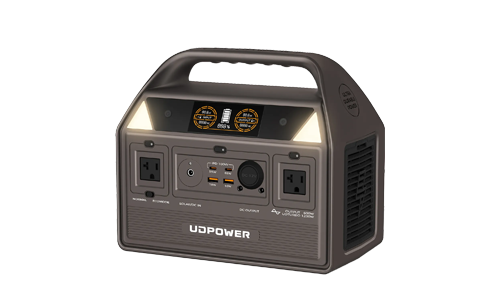
The S1200 and S2400 are included here because they provide more battery capacity and AC-output headroom than UDPOWER's smaller portable models, making them more relevant candidates for an electrical compatibility discussion.
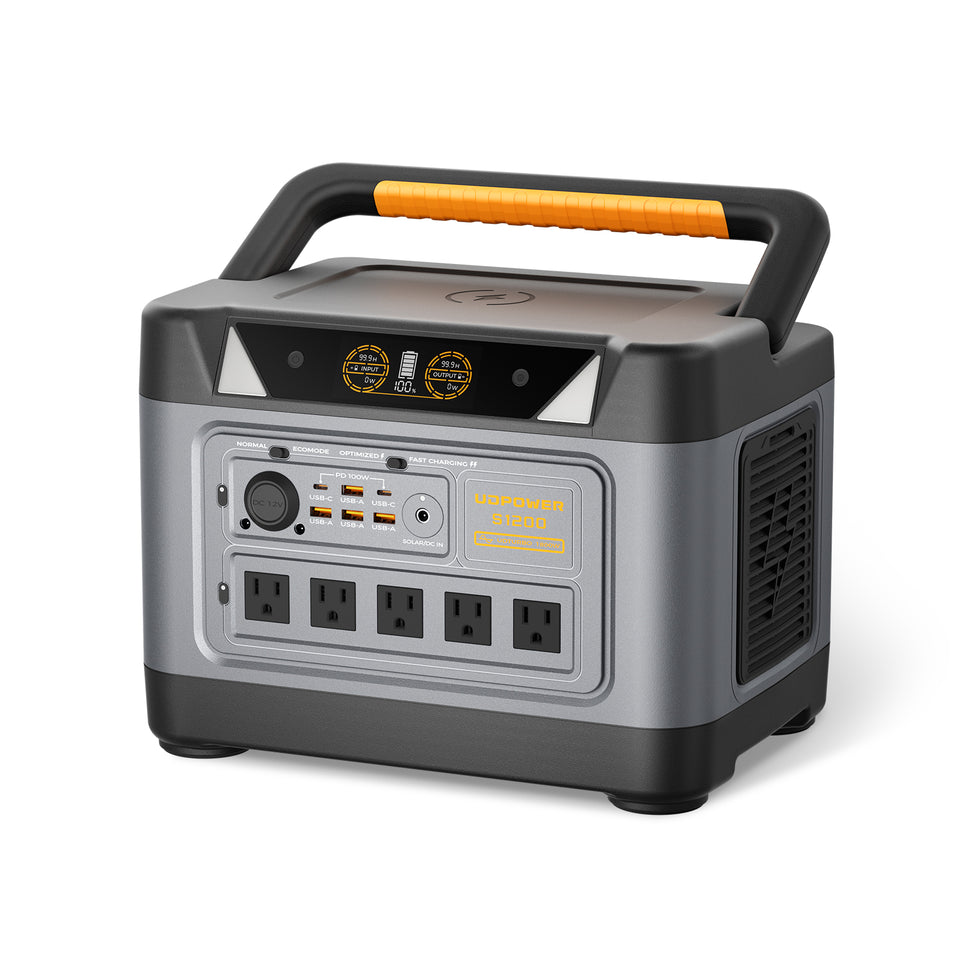
UDPOWER S1200 Portable Power Station
- Battery capacity: 1,190Wh
- Rated AC output: 1,200W
- UDTURBO: up to 1,800W for compatible loads
- AC waveform: Pure sine wave
- AC output: 120V, 60Hz
- UPS Prime response: ≤10ms
- Battery: LiFePO4, 4,000+ cycles
At a constant 480W average AC load, the mathematical runtime estimate is about 2.2 hours. At 700W, it falls to roughly 1.5 hours.
That makes the S1200 more realistic as a short-term battery candidate than as a blanket "overnight dialysis backup" claim.
View S1200 Specifications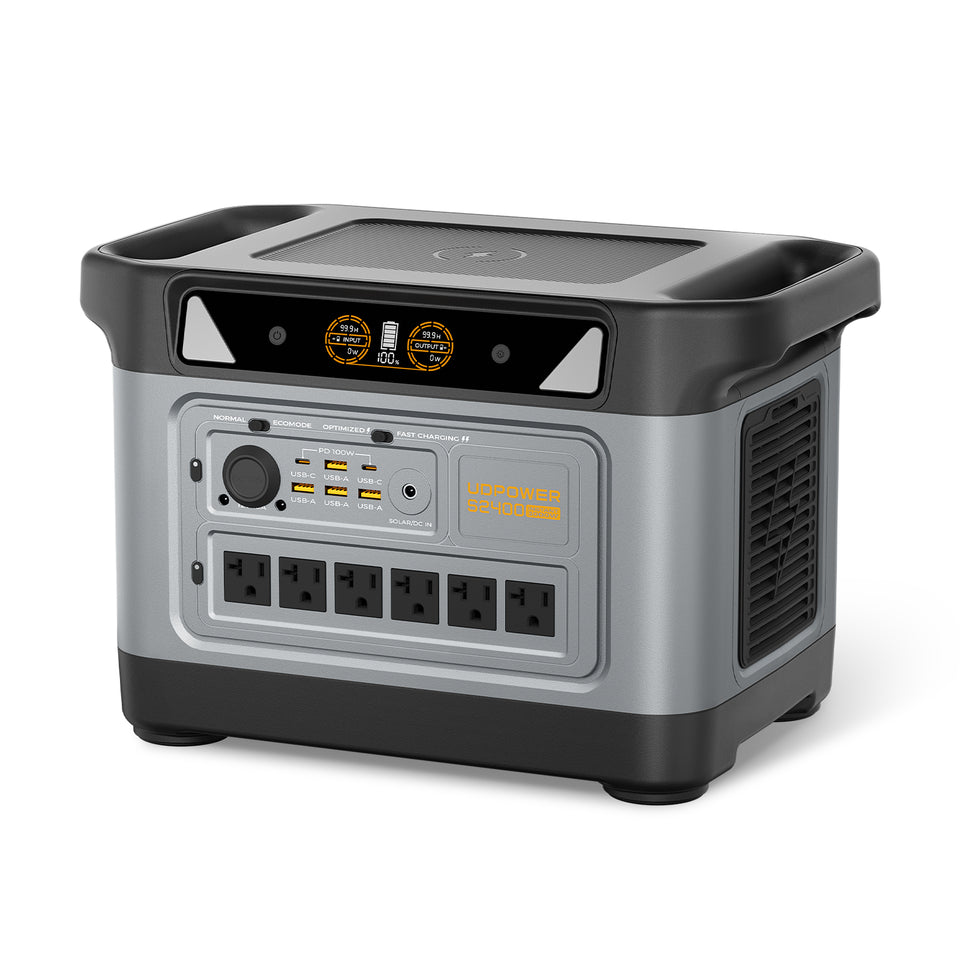
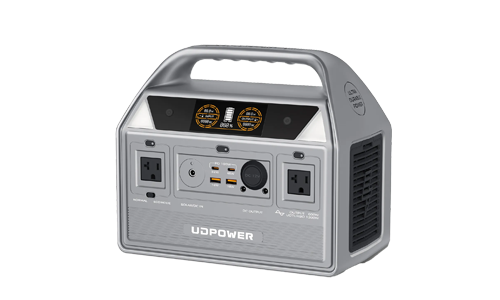
UDPOWER S2400 Portable Power Station
- Battery capacity: 2,083Wh
- Rated AC output: 2,400W
- UDTURBO: up to 3,000W for compatible loads
- AC waveform: Pure sine wave
- AC output: 120V, 60Hz
- UPS Prime response: ≤10ms
- Battery: LiFePO4, 4,000+ cycles
At a constant 480W average AC load, the mathematical runtime estimate is approximately 3.9 hours. At 700W, it is approximately 2.7 hours.
The additional capacity gives more short-term runtime and inverter headroom than the S1200, but it still should not be described as an eight-hour dialysis solution unless the verified complete load is low enough and the proposed power arrangement has been approved.
View S2400 SpecificationsBuild a Practical Dialysis Power-Outage Plan
The best emergency plan starts before severe weather or a utility outage begins.
Decide what your backup power is supposed to accomplish
| Outage Goal | What Matters Electrically | Main Risk | Preparation |
|---|---|---|---|
| Bridge a brief power interruption | Approved transfer behavior and enough instantaneous output | Assuming any device labeled "UPS" is automatically compatible | Ask the machine manufacturer about the permitted backup arrangement |
| Provide time for the trained outage procedure | Sufficient approved runtime | Assuming every machine reacts to power failure the same way | Follow the exact procedure taught by your dialysis team |
| Support a longer outage window | Peak compatibility plus enough usable Wh | Calculating from the main machine only | Inventory the entire required electrical system |
| Prepare for a multi-day outage | Backup power plus a dependable recharge and alternate-treatment plan | Treating battery capacity as the only emergency resource | Coordinate transportation, alternate care location, supplies, communications, water and power |
Power Is Only One Part of Home Hemodialysis Preparedness
Read the FDA guidance for dialysis systems after loss of power and water.
Before an Outage
- Keep your dialysis program's normal and after-hours phone numbers available.
- Save the equipment manufacturer's technical-support number.
- Photograph the electrical labels on the machine and required support equipment.
- Keep model and serial numbers with your emergency information.
- Confirm what to do if treatment is interrupted.
- Confirm whether an inverter, generator, UPS or portable battery is permitted.
- Keep approved backup equipment charged and ready.
- Know which loads are essential and which should remain disconnected.
- Plan transportation to an alternate dialysis location.
- Make sure a care partner or family member knows where your emergency information is stored.
The CDC also recommends that dialysis patients prepare emergency contacts and register with water and power companies in advance where special priority programs are available.
See CDC dialysis emergency-preparedness guidance.
During an Outage
Follow the instructions provided in your training and the machine's alarms or display. Do not change treatment settings, bypass alarms or improvise a treatment procedure based on an online power article.
After Power Returns
Restored utility power does not automatically mean all dialysis equipment is ready to resume operation. If water service was lost, the room flooded, equipment became wet or a machine fails its checks, follow manufacturer and dialysis-program instructions before attempting to resume treatment.
Do Not Build the Plan Around Perfect Solar Conditions
Solar panels can be useful for recharging portable batteries during an extended outage, but solar production changes with clouds, shade, panel angle, temperature, season and available daylight.
For a critical backup plan, the approved battery reserve should not depend on receiving the solar panel's advertised wattage continuously. Treat solar primarily as a variable recharge source rather than guaranteed real-time dialysis power.
7 Common Dialysis Backup-Power Sizing Mistakes
1. Searching for one universal "dialysis machine wattage"
There is no dependable universal figure. Different dialysis modalities and support systems have different electrical requirements.
2. Treating a 100W average figure as a 100W maximum
The NxStage PureFlow SL example demonstrates why this fails: the same manufacturer material that describes average consumption comparable to a 100W bulb also states a 400VA intermittent peak.
3. Treating VA and watts as identical
They may be numerically close for some loads but they are not interchangeable by definition. Preserve the manufacturer's VA requirement when checking compatibility.
4. Looking only at inverter watts
A 2,400W power station does not contain 2,400Wh simply because the numbers look similar. Inverter output is power. Battery capacity is energy.
5. Ignoring treatment duration
A low average load running for eight or ten hours can require more total energy than a much higher load used briefly.
6. Forgetting support equipment
The complete dialysis setup may include water treatment, dialysate preparation, heating, communications or other equipment.
7. Assuming a battery solves a water outage
For home hemodialysis, loss of safe water can make continued treatment inappropriate even when electricity is available. Follow the guidance from your dialysis program and equipment manufacturer.
Frequently Asked Questions
What is the typical wattage of a home dialysis machine?
There is no reliable universal wattage. The current Fresenius Liberty Select manual lists 480W at 100V and 700W at 240V. NxStage documentation for the separate PureFlow SL support system lists a 400VA intermittent peak and an average load comparable to a continuously operating 100W bulb under stated conditions. Always use your exact equipment specifications.
Why do some websites say dialysis machines use around 100 watts?
A low number may describe average consumption, one operating state or one component rather than an entire treatment setup. In the NxStage example, approximately 100W refers to the average electrical load of PureFlow SL under specified conditions, while the same system has a 400VA intermittent peak.
How many watts does a peritoneal dialysis cycler use?
It depends on the model and voltage. Fresenius currently lists its Liberty Select Cycler at 480W at 100V and 700W at 240V. Do not treat those numbers as specifications for other PD cyclers.
Should I use maximum watts or average watts when choosing backup power?
You need both types of information for different reasons. Maximum or peak electrical requirements help determine whether the inverter can support the equipment. Average watts help estimate how quickly the battery's stored energy will be consumed.
Can I calculate dialysis machine watts by multiplying volts by amps?
For AC equipment, volts multiplied by amps gives volt-amps, or VA. Actual real power in watts can differ because of power factor. Use manufacturer-published W and VA values whenever available.
Can a portable power station run a dialysis machine?
A portable power station may have enough electrical output and capacity for some equipment, but that alone does not establish medical-device compatibility. Confirm the proposed backup source and connection arrangement with the dialysis program and equipment manufacturer before relying on it.
Can the UDPOWER S1200 run a dialysis machine overnight?
There is no general yes-or-no answer. Using 90% conversion efficiency, a constant 100W load produces a mathematical estimate of about 10.7 hours, but at 480W the estimate falls to about 2.2 hours. More importantly, the actual complete dialysis-system load and compatibility must be verified first.
Can the UDPOWER S2400 provide eight hours of dialysis backup?
Only at sufficiently low verified average loads. With 2,083Wh of capacity and a 90% efficiency assumption, an eight-hour mathematical target corresponds to an average load of roughly 234W before adding extra reserve. At a constant 480W, estimated runtime is approximately 3.9 hours.
Does pure sine wave output guarantee dialysis machine compatibility?
No. Pure sine wave output is only one electrical characteristic. Voltage, frequency, VA capacity, grounding, protective-earth requirements, connection method and transfer behavior can also matter.
Does a UPS transfer time of 10 milliseconds guarantee compatibility?
No. Fast transfer can be useful for many electronic loads, but the medical-device manufacturer must determine whether a specific backup arrangement is acceptable for the dialysis equipment.
Can solar panels keep a dialysis machine running indefinitely?
No dependable emergency plan should assume continuous rated solar output. Solar production changes throughout the day and with weather, shading and panel conditions. Solar is better treated as a potential battery recharge source rather than guaranteed treatment power.
What should I do if both electricity and water are unavailable?
Follow your dialysis program's emergency plan. FDA guidance advises home hemodialysis users who lose power or water to contact their clinic or nephrologist when unsure whether treatment can safely resume. Do not perform home dialysis when water safety is uncertain.
Sources and Editorial Method
Manufacturer specifications are used instead of generic appliance-wattage lists whenever an official source is available. UDPOWER runtime estimates use the current published product capacities and a 90% conversion-efficiency assumption.
- Fresenius Liberty Select Cycler User's Guide, Revision B — electrical specifications and operating information.
- NxStage Hemodialysis Treatment Therapy Handbook — PureFlow SL electrical-load information.
- U.S. Food and Drug Administration: Dialysis Systems After Restoration of Power and Water — outage, water and equipment guidance.
- CDC: What to Do When You Need Dialysis During an Emergency — dialysis emergency-preparedness guidance.
- ADA National Network Emergency Power Planning Guide — general emergency planning for electricity-dependent medical equipment.
- UDPOWER S1200 Official Product Page — current capacity, AC output, battery and UPS specifications.
- UDPOWER S2400 Official Product Page — current capacity, AC output, battery and UPS specifications.
Choose Backup Power From Verified Numbers, Not a Generic Wattage
Before comparing batteries, collect your exact dialysis machine model, electrical-label information, current manufacturer manual, required outage duration and every support device that must remain powered.
Once you have those numbers, you can compare inverter output and estimated battery runtime without guessing.
View UDPOWER Portable Power Stations Calculate Your Estimated Runtime Compare UDPOWER ModelsRelated Articles


