

How Many Watts Does an Air Purifier Use? (2026 Guide)
Last updated: August 12, 2026
Quick answer: Most residential air purifiers use roughly 20 to 100 watts while running, although compact models can use less and high-capacity units can exceed 100 watts. Actual power draw changes with fan speed, room size, airflow requirements, and the purifier itself.
For a useful real-world reference, HouseFresh reports an average measured draw of 57.69 watts at maximum fan speed across 60 air purifiers it tested. A 50W purifier running 24 hours a day would use about 36 kWh per month. At the U.S. residential average electricity price of 18.44¢/kWh for May 2026, that works out to roughly $6.64 per month.

That short answer is enough if you only need a ballpark number. But if you are comparing air purifier watts for your electric bill, sizing a backup battery, or choosing between two models, wattage by itself does not tell the whole story.
A 30W purifier is not automatically more efficient than a 60W purifier. The more useful question is how much clean air the purifier delivers for the electricity it consumes. That is where room size, Clean Air Delivery Rate (CADR), fan speed, and energy efficiency become important.
How Many Watts Does an Air Purifier Use?
For most household units, a practical planning range is about 20W to 100W. Small desktop or bedroom purifiers may operate below 20W on their lowest setting, while large-room models running at maximum speed can exceed 100W.
Independent testing gives us a better reference than a single manufacturer's rated number. HouseFresh says the average maximum-speed draw across 60 purifiers it tested was 57.69W.
Source: HouseFresh air purifier energy testing
The important word here is maximum. If your purifier spends most of the day on Auto, Low, or Sleep mode, its average daily power draw can be considerably lower than its maximum rated wattage.
Air Purifier Wattage Chart
The following ranges are useful for estimating ordinary residential air purifiers. They are planning ranges rather than specifications for a particular model.
| Air Purifier Type | Typical Power Range | Likely Use | What Can Change the Number? |
|---|---|---|---|
| Personal / desktop purifier | About 5–25W | Desk, dorm, very small room | Fan speed, filter resistance, motor design |
| Small bedroom purifier | About 15–50W | Bedroom or home office | Sleep mode versus high speed |
| Medium-room HEPA purifier | About 25–70W | Bedroom, office, smaller living area | CADR, fan speed, filter design |
| Large-room purifier | About 40–100W | Living room or open-plan area | Airflow requirement and room rating |
| High-CADR / high-capacity purifier | About 60–150W+ | Large spaces or high-airflow applications | Maximum airflow, motor size, filters |
The table is intentionally broader than a single “average watts” number because two products advertised for similar spaces can have very different power consumption.
Rated Watts vs. Real-World Power Use
The wattage printed on the back of your purifier is useful, but it may not represent what the unit draws every minute of the day.
Maximum or rated wattage
A specification such as “60W” commonly tells you the model's rated or maximum operating power. It is the safer number to use when checking whether a battery backup or portable power station can support the appliance.
Actual operating wattage
Your real power draw may be lower when the fan slows down. A purifier that reaches 60W on High might spend much of the day below that level when running in Auto or Sleep mode.
Average daily wattage
If the purifier automatically changes speeds, no single watt number describes an entire day. For electricity-cost and battery-runtime planning, a plug-in power meter measured over several hours or a full day gives a better estimate.
How Much Does an Air Purifier Cost to Run?
Air purifiers are usually inexpensive to operate compared with appliances that create heat or cooling, but continuous 24/7 operation still adds up over a year.
The latest U.S. Energy Information Administration monthly data available when this article was updated puts the national residential electricity average at 18.44 cents per kilowatt-hour in May 2026.
Source: U.S. Energy Information Administration, Electric Power Monthly
Monthly cost = Monthly kWh × your electricity rate
Air purifier monthly electricity cost
| Purifier Power | 8 Hours/Day | Estimated Monthly Cost at 8 Hours | 24 Hours/Day | Estimated Monthly Cost at 24 Hours |
|---|---|---|---|---|
| 10W | 2.4 kWh/month | $0.44 | 7.2 kWh/month | $1.33 |
| 20W | 4.8 kWh/month | $0.89 | 14.4 kWh/month | $2.66 |
| 30W | 7.2 kWh/month | $1.33 | 21.6 kWh/month | $3.98 |
| 50W | 12.0 kWh/month | $2.21 | 36.0 kWh/month | $6.64 |
| 60W | 14.4 kWh/month | $2.66 | 43.2 kWh/month | $7.97 |
| 80W | 19.2 kWh/month | $3.54 | 57.6 kWh/month | $10.62 |
| 100W | 24.0 kWh/month | $4.43 | 72.0 kWh/month | $13.28 |
| 150W | 36.0 kWh/month | $6.64 | 108.0 kWh/month | $19.92 |
| 200W | 48.0 kWh/month | $8.85 | 144.0 kWh/month | $26.55 |
These calculations use the May 2026 U.S. residential average of $0.1844/kWh and a 30-day month. Your actual bill may differ substantially because electricity prices vary by state, utility, rate plan, and time of use.
Example: a 50W air purifier running 24/7
A 50W purifier running continuously uses:
- 0.05 kW × 24 hours = 1.2 kWh per day
- 1.2 kWh × 30 days = 36 kWh per month
- 36 kWh × $0.1844 = about $6.64 per month
- 438 kWh per year = about $80.77 per year at the same electricity rate
Why CADR Matters More Than Watts Alone
If you are choosing an efficient air purifier, comparing wattage alone can be misleading.
Imagine two models:
- Purifier A uses 30W but moves relatively little filtered air.
- Purifier B uses 50W but delivers much more clean air to the room.
Purifier A uses fewer watts, but Purifier B may clean the room more efficiently for each watt consumed.
This is why ENERGY STAR evaluates room air cleaners using measures that connect cleaning performance with energy use rather than simply rewarding the product with the lowest wattage. ENERGY STAR says certified room air cleaners are more than 50% more energy-efficient than standard models and can save about 211 kWh per year.
Source: ENERGY STAR Room Air Cleaners
When comparing two purifiers for the same room, look at both:
- Operating watts — how much electrical power the purifier needs.
- CADR — how much filtered air it can deliver.
A higher clean-air output per watt is more meaningful than simply choosing the lowest-watt machine on the shelf.
How Room Size Changes the Air Purifier You Need
A purifier should be large enough to actually clean the room. Choosing an extremely low-watt unit for a large space may save electricity while failing to provide the airflow you bought it for.
For particle removal, the EPA recommends choosing a purifier with a CADR appropriate for the room. A commonly used rule is a smoke CADR of at least two-thirds of the room's floor area in square feet.
For example:
- 120 sq. ft. room → smoke CADR of about 80 or higher
- 200 sq. ft. room → smoke CADR of about 133 or higher
- 300 sq. ft. room → smoke CADR of about 200 or higher
- 400 sq. ft. room → smoke CADR of about 267 or higher
- 500 sq. ft. room → smoke CADR of about 333 or higher
Sources: U.S. EPA Guide to Air Cleaners in the Home and AHAM air filtration guidance
Approximate room-size planning table
| Room Area | Approx. Minimum Smoke CADR Using 2/3 Rule | Typical Purifier Power Range You May Encounter | Good Starting Point |
|---|---|---|---|
| 100 sq. ft. | 67+ | About 10–35W | Small office or personal room |
| 150 sq. ft. | 100+ | About 15–45W | Small bedroom |
| 200 sq. ft. | 133+ | About 20–50W | Average bedroom |
| 300 sq. ft. | 200+ | About 30–70W | Large bedroom or office |
| 400 sq. ft. | 267+ | About 40–90W | Living room |
| 500+ sq. ft. | 333+ | About 50–120W+ | Large living or open-plan area |
The wattage ranges above are only practical examples. CADR and actual room coverage should come first when you choose the purifier.
What about wildfire smoke?
Wildfire smoke is one situation where minimizing wattage should not be your first priority. Current EPA guidance recommends selecting a portable air cleaner with sufficient smoke CADR for the room. In a cleaner-air room during a smoke event, the EPA advises operating the air cleaner continuously on its highest fan setting.
Source: U.S. EPA — How to Create a Cleaner Air Room at Home
That matters for backup-power planning because the purifier may draw closer to its maximum wattage during the exact emergency when you need the longest battery runtime.
Best UDPOWER Power Stations for Running an Air Purifier
Most residential air purifiers are relatively light electrical loads. That means the main difference between power stations is usually runtime, not whether the inverter has enough wattage to start the purifier.
For practical backup planning, these three UDPOWER models cover different needs.

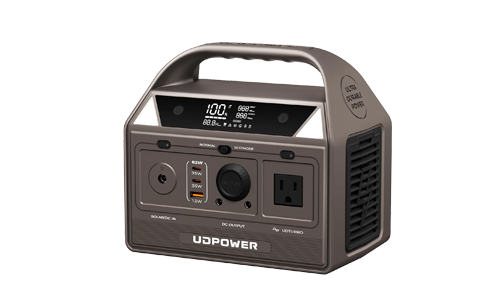
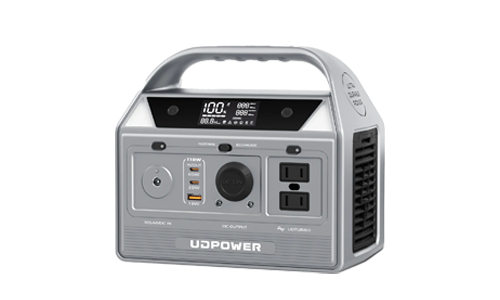
UDPOWER C600 — Compact Overnight Backup
596Wh capacity · 600W rated output
The C600 makes sense when your priority is one purifier plus a few small essentials. At a steady 60W purifier load, a 90% conversion-efficiency estimate gives about 8.9 hours of runtime.
It is the most practical option here for a bedroom purifier, short outage, apartment backup kit, RV, or travel setup where you do not need a large battery.
View UDPOWER C600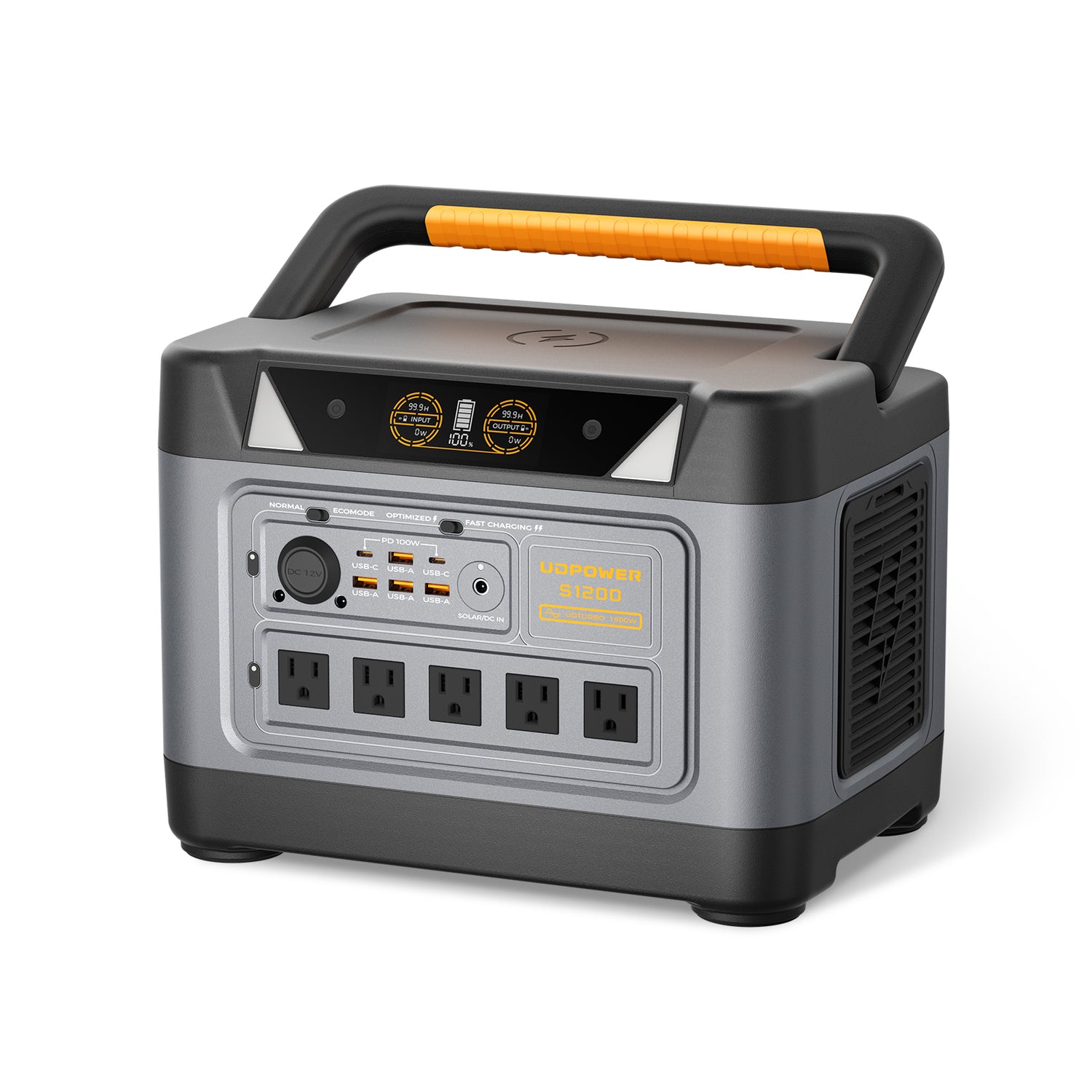
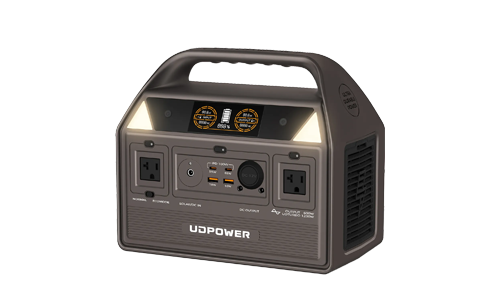
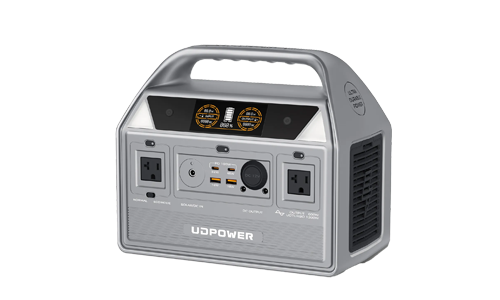
UDPOWER S1200 — Best All-Around Choice for Home Air Purifier Backup
1,190Wh capacity · 1,200W rated output
The S1200 offers considerably longer air-purifier runtime without moving into a very large battery system. A steady 60W purifier works out to about 17.9 hours at a 90% conversion-efficiency estimate.
That makes it a stronger fit for overnight outages, wildfire-season preparedness, or a backup plan that includes an air purifier plus a router, lights, phones, or other low-power essentials.
If you want to see what else this output class can handle, read What Can a 1200W Portable Power Station Run?
View UDPOWER S1200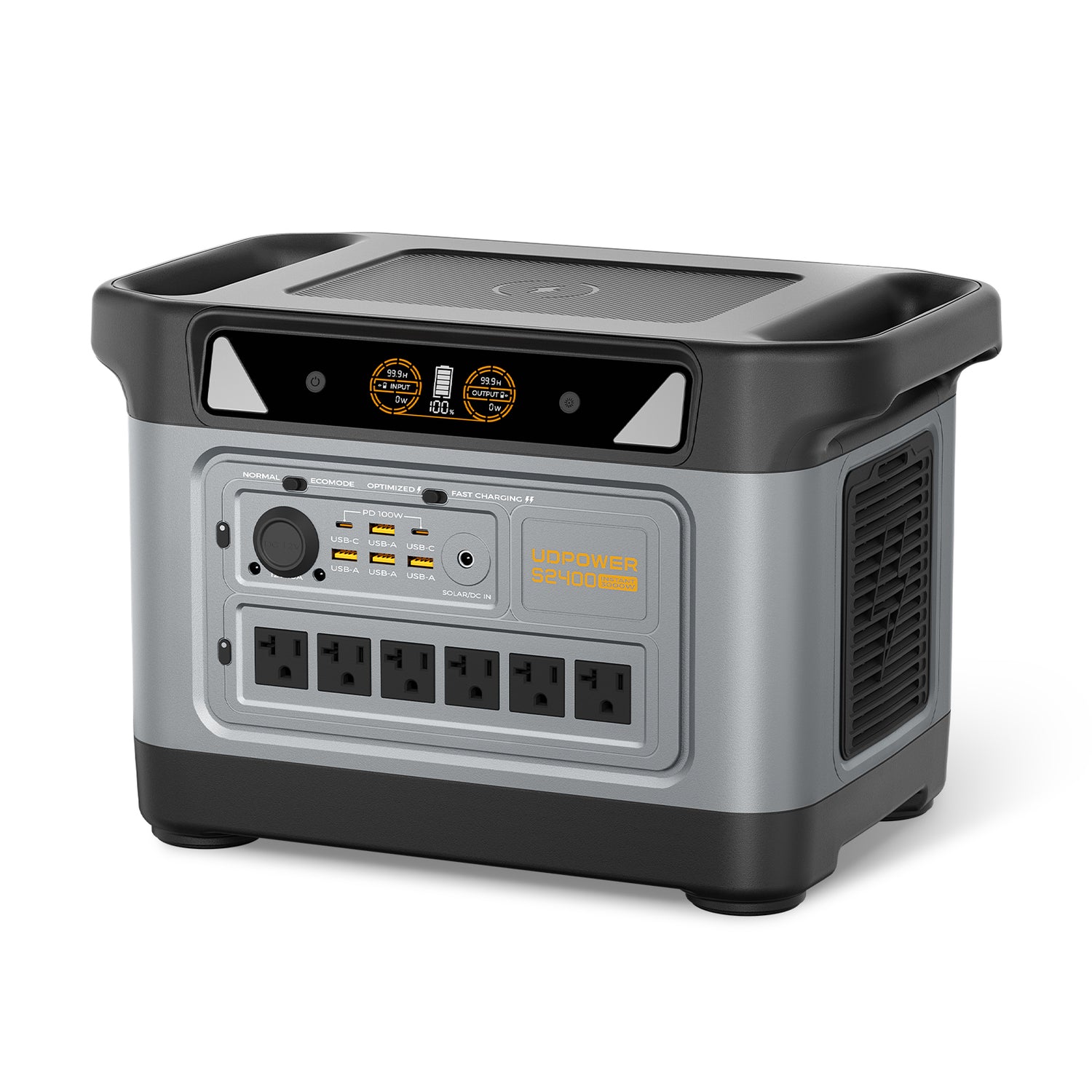
UDPOWER S2400 — Longer Multi-Device Emergency Backup
2,083Wh capacity · 2,400W rated output
If the goal is to keep an air purifier running while also supporting more household essentials, the S2400 provides much more stored energy. A steady 60W purifier alone has an estimated runtime of about 31.2 hours using the same 90% planning method.
It is usually more battery than you need for an air purifier alone, but the extra capacity becomes useful when the purifier is only one part of a larger outage load plan.
View UDPOWER S2400Compare the full lineup on the UDPOWER Portable Power Station collection.
How Long Can a Portable Power Station Run an Air Purifier?
For UDPOWER runtime planning, use:
The 0.90 factor provides a practical allowance for conversion losses when powering an AC appliance.
| UDPOWER Model | Battery Capacity | 30W Air Purifier | 50W Air Purifier | 60W Air Purifier | 80W Air Purifier | 100W Air Purifier |
|---|---|---|---|---|---|---|
| C600 | 596Wh | 17.9 hr | 10.7 hr | 8.9 hr | 6.7 hr | 5.4 hr |
| S1200 | 1,190Wh | 35.7 hr | 21.4 hr | 17.9 hr | 13.4 hr | 10.7 hr |
| S2400 | 2,083Wh | 62.5 hr | 37.5 hr | 31.2 hr | 23.4 hr | 18.7 hr |
These are planning estimates for a steady load. Real runtime can change because an air purifier changes fan speed, the power station itself consumes some energy, and temperature, battery state, other connected devices, and operating mode all affect usable runtime.
You can enter your purifier's actual wattage in the UDPOWER Portable Power Station Runtime Calculator for a custom estimate.
Why average watts matter for battery runtime
Suppose your purifier is rated at 80W but normally spends most of the day drawing around 35W on Auto mode. Calculating runtime at 80W gives a conservative estimate, while calculating at a measured 35W gives a better estimate of ordinary use.
During an emergency such as wildfire smoke, however, you may intentionally operate at a higher speed. In that case, size your battery around the higher load rather than your quiet overnight setting.
How to Find Your Air Purifier's Actual Wattage
You have four useful options.
1. Check the rating label
Look on the rear or bottom of the purifier. Many models list wattage directly.
2. Check the manual or manufacturer's specifications
This is useful if the rating label only shows voltage and current or if you want to know whether different operating modes have separate power ratings.
3. Measure it with a plug-in power meter
This is the best way to answer “How many watts does my air purifier use?” rather than relying on an internet average.
- Plug the power meter into the wall outlet.
- Plug the purifier into the meter.
- Record the wattage on Sleep or Low.
- Record the wattage on Medium.
- Record the wattage on High or Turbo.
- If you normally use Auto mode, leave the meter connected for 24 hours and check total kWh.
A 24-hour kWh measurement is particularly useful because it captures changing fan speeds rather than one instant in time.
4. Calculate watts from volts and amps when appropriate
If a simple device label lists voltage and current but not watts, the basic relationship is:
For more unit conversions, use the UDPOWER Battery & Power Unit Conversion Tools.
What Changes an Air Purifier's Wattage?
Fan speed
This is usually the most obvious factor. High or Turbo mode moves more air and generally consumes more electricity than Sleep or Low mode.
Purifier size and CADR
A purifier designed to deliver clean air across a large room generally needs more airflow than a personal desktop unit. That does not mean the larger purifier is inefficient; it may simply be doing more work.
Auto mode
An automatic purifier can spend long periods at low power and then increase fan speed when its sensor detects more particles. That makes average daily wattage different from maximum wattage.
Filter and airflow condition
A dirty or obstructed filter can reduce airflow and cleaning performance. Do not assume that every purifier will simply draw more watts as a filter gets dirty; motor controls differ by model. The practical reason to maintain the filter is to preserve airflow and the purifier's intended performance.
Extra functions
Displays, sensors, Wi-Fi, UV components, humidification, fans, or heating functions can change total power consumption. A multifunction appliance should be evaluated in the mode you actually plan to use.
How to Reduce Air Purifier Energy Use Without Undersizing the Unit
The goal is not to make the watt number as small as possible. It is to get the air-cleaning performance you need without wasting energy.
- Choose the right CADR for the room. An undersized purifier may need to operate at maximum speed constantly and still fail to deliver enough clean air.
- Use Auto mode when conditions allow. A sensor-controlled purifier can reduce fan speed when particle levels are lower.
- Use Sleep or Low mode when appropriate. Lower fan settings can reduce both power draw and noise.
- Keep air intake and exhaust openings clear. Do not push the purifier into a corner or place objects against its vents unless the manufacturer's instructions specifically allow it.
- Maintain the filters. Follow the purifier manufacturer's replacement and cleaning schedule so airflow remains close to the design condition.
- Compare cleaning efficiency, not just watts. ENERGY STAR certification and CADR-related efficiency information can help distinguish between a low-watt purifier and a genuinely efficient purifier.
- Measure your real usage. If electricity cost matters, a plug-in energy meter removes the guesswork.
Do Air Purifiers Use More Electricity Than Other Household Devices?
Usually not. A normal room air purifier is a relatively low-power continuous appliance. It is more useful to compare it with electronics and small fans than with heating appliances, electric cooking appliances, or air conditioners.
| Device | Typical / Practical Power Range | Power-Use Pattern |
|---|---|---|
| Air purifier | About 20–100W for many home units | Often runs for long periods |
| Wi-Fi router | Often roughly 10–30W | Usually continuous |
| LED television | Often roughly 50–150W | Several hours per day |
| Refrigerator | Often roughly 60–250W while actively cooling | Compressor cycles on and off |
| Space heater | Commonly 750–1,500W | High-power heating load |
For more context on household electricity demand, see How Many Watts Does a House Use?
Air Purifier Wattage FAQs
Do air purifiers use a lot of electricity?
Usually not. Many residential air purifiers operate somewhere around 20–100W, although actual consumption depends on model and fan speed. A 50W purifier running continuously would use about 36 kWh in a 30-day month.
How many watts does a HEPA air purifier use?
There is no single wattage for HEPA purifiers. Small room models may use only a few dozen watts, while large high-CADR machines can use considerably more. Check the exact model's operating power and CADR rather than assuming the filter type determines wattage.
How many watts does a small bedroom air purifier use?
A practical range for many small bedroom units is roughly 15–50W. Sleep mode may use less, while maximum fan speed may push the purifier toward the upper end of its range.
How many watts does a large-room air purifier use?
Many large-room residential purifiers fall around 40–100W, with some high-capacity models exceeding 100W. Larger airflow requirements generally require more power.
How much electricity does a 50W air purifier use in 24 hours?
A steady 50W load uses 1.2 kWh in 24 hours. Over 30 days, that equals 36 kWh.
How much does a 50W air purifier cost to run all month?
At the May 2026 U.S. residential average of 18.44¢/kWh, a 50W purifier running continuously for 30 days costs about $6.64 in electricity.
Can I leave an air purifier running 24/7?
Many room air cleaners are designed for extended operation, but you should follow the operating instructions for your specific model. Continuous operation also means electricity use should be calculated from daily kWh rather than wattage alone.
Does Low mode use less electricity than High mode?
Generally, yes. Lower fan speeds usually draw less power. The exact difference can be large enough that measuring each setting with a plug-in power meter is worthwhile when battery runtime or electricity cost matters.
Is a lower-watt air purifier always more energy efficient?
No. A lower-watt purifier may also deliver less clean air. Compare CADR and energy efficiency as well as watts so that you are comparing cleaning performance, not just electrical input.
Does a dirty air filter increase an air purifier's wattage?
Not necessarily in every design. A clogged filter can restrict airflow and reduce cleaning performance, but the electrical response depends on the motor and control system. Replace or clean filters according to the manufacturer's instructions rather than using wattage as a filter-condition indicator.
Can a portable power station run an air purifier?
Yes, in most cases. Residential air purifiers are relatively small loads. Check the purifier's rated wattage against the power station's AC output and then use battery capacity in watt-hours to estimate runtime.
How large a power station do I need for an air purifier overnight?
First multiply the purifier's average watts by the number of hours you want to run it. A 60W purifier for eight hours consumes about 480Wh before conversion losses. A 596Wh UDPOWER C600 provides an estimated 8.9 hours at a steady 60W load using a 90% conversion-efficiency estimate, while larger units provide substantially more reserve.
Can I run an air purifier from solar power?
Yes, an air purifier can be powered from a solar-charged portable power station as long as the power station supports the purifier's load. Solar production varies with sunlight and panel conditions, so the battery provides the buffer between changing solar input and the purifier's continuous demand.
Does an air purifier need a large startup surge?
Most ordinary residential air purifiers are much easier backup loads than compressors, pumps, or large heating appliances. Even so, use the electrical specifications for your exact purifier when sizing a power source rather than assuming every model behaves the same way.
Bottom Line
Most household air purifiers are low-to-moderate power appliances, with many models falling around 20–100 watts. But the best number to use is always the wattage of your actual purifier at the fan speed you normally run.
If you are comparing electricity costs, convert watts into kWh and use your local utility rate. If you are choosing a purifier, compare CADR and energy efficiency instead of chasing the lowest wattage. And if you are planning for an outage, calculate runtime from the purifier's real average power draw and the usable watt-hours available from your backup battery.
Need Backup Power for Your Air Purifier?
Compare UDPOWER portable power stations by battery capacity, output, and expected runtime, or enter your own air purifier wattage into the runtime calculator before choosing a model.
Related Articles


