

Solar and Power Inverters: How They Work Together (and How to Size Them Without Guessing)

Solar + inverter basics in plain English
If you’re trying to power normal U.S. devices—phone chargers, laptops, a small fridge, a coffee maker, even tools—solar alone won’t plug into those loads. Solar panels output DC power, and most household outlets deliver 120V AC. That’s why a “solar setup” usually includes:

| Component | What it does | What to look for |
|---|---|---|
| Solar panel(s) | Generate DC electricity from sunlight | Rated watts, voltage, current, connector type |
| Charge controller (often MPPT) | Controls charging safely and helps harvest more power by tracking the best operating point | MPPT capability, input voltage range, max input current |
| Battery (storage) | Stores energy so you can use power when clouds roll in or at night | Capacity (Wh), cycle life, safety (LiFePO₄ is common in portable units) |
| Power inverter | Converts DC (battery/solar) into AC for your devices | Continuous watts, surge watts, waveform (pure sine wave vs modified) |
The main decision is whether you want a standalone inverter + separate battery + charge controller, or an all-in-one portable power station that already contains a battery, charge controller, and inverter.
What a power inverter actually does
Inverters do DC-to-AC conversion. The U.S. Department of Energy explains that an inverter switches DC rapidly to produce AC, and filtering can create a clean sine wave output (DOE overview). NREL also notes that PV modules produce DC and inverters convert it to AC (NREL ATB: PV AC-DC translation).

- Wattage determines what you can run.
- Surge capability determines whether motors/compressors start reliably.
- Waveform quality affects noise, heat, and compatibility with sensitive electronics.
“Solar inverter” setups: grid-tie vs portable
People use “solar inverter” to mean two different things:

| Setup | Where it’s used | What matters most |
|---|---|---|
| Grid-tied (home) solar inverter | Rooftop solar feeding your home and/or the grid | Grid compliance, efficiency, monitoring, string sizing, interconnection rules |
| Portable inverter (battery-based) | Camping, RV, emergency backup, job sites | Continuous watts + surge, battery Wh, solar input limits, portability |
This article focuses on the second category: portable solar + power inverter setups—because that’s where most people get tripped up by watts/volts/amps.
How to size an inverter: watts, surge, waveform
1) Continuous watts (your “normal running” power)
Add up the devices you want to run at the same time. Your inverter’s rated output should exceed that number with breathing room. If your appliance label says 1500W, don’t buy a 1500W inverter and hope—aim higher.

2) Surge watts (startup power for motors/compressors)
Some devices draw more power for a short moment when starting. That’s why product pages often list a surge rating. If you’re powering anything with a compressor or motor (fridge, pump, some power tools), surge headroom is what keeps the system from tripping.
3) Waveform: pure sine vs modified sine
If you care about electronics behaving normally—especially medical devices, chargers, audio gear, and anything that “buzzes” on cheap inverters—pure sine wave is the safer default. Many portable power stations use pure sine wave output for this reason.
| If you want to run… | Prioritize | Notes |
|---|---|---|
| Phones, tablets, laptops, camera batteries | Battery capacity (Wh) + USB-C PD | You may barely use AC at all. |
| CPAP, router, TV, small fan | Pure sine wave + overnight Wh | Plan for night use (no sun) and keep a buffer. |
| Mini fridge / compressor loads | Surge rating | Startup is the make-or-break moment. |
| Kitchen appliances (kettle, toaster, microwave) | High continuous watts | These loads can drain batteries fast even when the inverter can handle them. |
Solar-side math: watts vs volts vs amps (series/parallel)
Solar input limits are where many “it should work” setups fail. Your inverter or power station will usually specify: (1) max solar watts, (2) an input voltage range, and sometimes (3) a max input current.

- Series adds voltage (V goes up), current stays roughly the same.
- Parallel adds current (A goes up), voltage stays roughly the same.
MPPT (maximum power point tracking) helps the system operate at the best voltage to harvest power as sunlight and temperature change. Sandia’s PV Performance Modeling Collaborative notes MPPT adjusts operating voltage to maximize power, and it’s commonly performed by an inverter or DC-DC converter (Sandia PVPMC: MPPT overview).
| Wiring | What changes | Typical reason to use it | Typical risk |
|---|---|---|---|
| Series | Voltage increases | Reach the device’s preferred MPPT voltage range | Exceeding max input voltage |
| Parallel | Current increases | More total watts without raising voltage | Exceeding max input current (amps) |
How to match solar panels to an inverter or power station
When you’re pairing solar with an inverter-based system, don’t start with “panel watts.” Start with these three lines from the inverter/power station spec sheet:

- Solar input voltage range: your panel/string voltage must land inside this window.
- Max solar input current (amps): if listed, your parallel current must stay under it.
- Max solar input watts: extra panel wattage above this may be clipped/limited.
VOC decreases with higher temperature—implying higher voltage in colder conditions: PV Education: open-circuit voltage.) Practical implication: avoid building a solar string that sits right at the device’s max voltage with no buffer.UDPOWER examples (spec-based) + best-fit scenarios
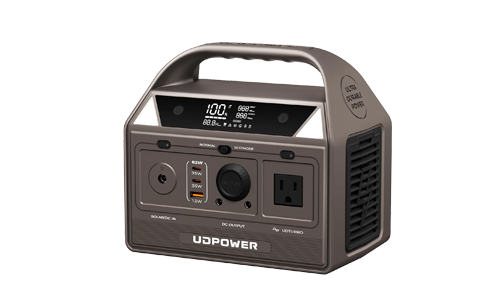
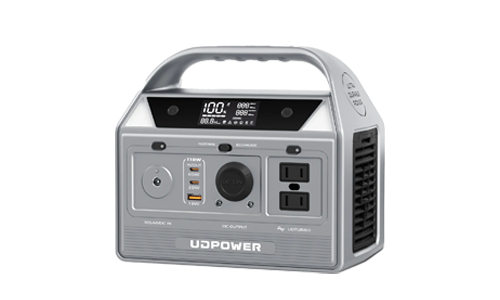
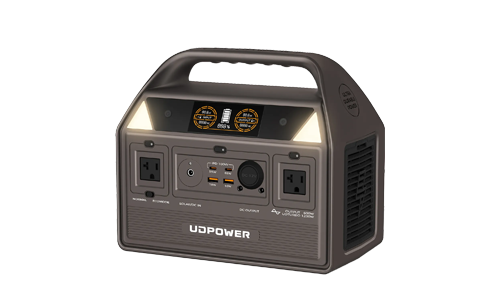
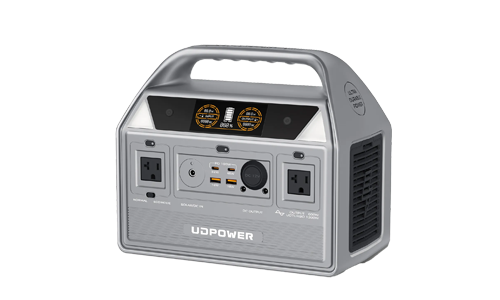
Below are UDPOWER options where the inverter and solar input are already integrated—so you’re not piecing together separate components. The table is built from the official product specifications.

UDPOWER inverter + solar input comparison
| Model | Picture | Battery capacity | AC inverter output | Solar input (max) | Solar voltage range | Solar current limit | Best fit |
|---|---|---|---|---|---|---|---|
| UDPOWER C200 |
 |
192Wh | Pure sine wave, 120V/60Hz, 200W (surge 400W) | 150W | 11V–28V | Not listed | Day trips, phones/laptops, light AC loads |
| UDPOWER C400 |
 |
256Wh | Pure sine wave, 120V/60Hz, 400W (surge 800W) | 150W | 11V–28V | Not listed | Compact backup + jump starter + light AC |
| UDPOWER C600 |
 |
596Wh | Pure sine wave, 120V/60Hz, 600W (1200W Max) | 240W | 11V–28V | Not listed | Longer outings, small fridge, higher daily energy |
| UDPOWER S1200 |
 |
1191Wh | Pure sine wave, 120V/60Hz, 1200W (surge 1800W) | 400W | 12V–75V | 12A max | Serious portable AC power + solar charging |
| UDPOWER S2400 |
 |
2083Wh | Pure sine wave, 120V/60Hz, 2400W (surge 3600W) | 400W | 12V–50V | 15A max | Higher-power appliances + bigger energy needs |
UDPOWER portable solar panels (spec snapshot)
| Panel | Picture | Rated power | Voltage (as listed) | Current (as listed) | Water resistance | Notes |
|---|---|---|---|---|---|---|
| UDPOWER 120W Portable Solar Panel |
 |
120W | Open Circuit Voltage: 17.8V • Maximum Voltage: 21.7V | Short Circuit Current: 6.65A • Maximum Current: 6.17A | IP65 | Site note: C600 “only supports 18V solar panels” and advises not using the 210W panel for C600. |
| UDPOWER 210W Portable Foldable Solar Panel |
 |
210W | Open Circuit Voltage: 48V • Maximum Voltage: 40V | Short Circuit Current: 5.9A • Maximum Current: 5.3A | IP65 | Higher voltage panel—pair only with devices whose input voltage range supports it. |
- Portable electronics + small AC loads: C200/C400 are straightforward choices when you don’t need big surge headroom.
- “Weekend camp + fridge + charging everything”: C600’s larger Wh and higher solar input headroom help reduce “battery anxiety.”
- High-watt AC appliances or multi-device use: S1200/S2400 give you the inverter headroom, plus higher solar input voltage ranges for flexible panel wiring.
Want to keep it simple? The cleanest setup is usually: pick the inverter size first (what you need to run), then size battery Wh (how long), and only then decide how much solar you need (how fast you want to recharge).
A simple sizing worksheet you can reuse
Step 1: List what you’ll run at the same time
Example: laptop (65W) + lights (20W) + fan (30W) + router (15W) ≈ 130W. Pick an inverter with headroom (for example, 200W+)—and if you expect motor loads, make sure the surge rating is comfortable.
Step 2: Estimate daily energy (Wh)
Energy is the real limiter for “how long.” Use: Watts × hours = watt-hours (Wh). If your gear averages 130W for 6 hours, that’s 780Wh.
Step 3: Add real-world losses
In real life, some energy is lost in conversion (DC→AC), heat, and charging. PVWatts uses a default total system loss assumption on the order of a low-teens percentage (NREL PVWatts v5 manual). For portable setups, a “buffer” is still a good habit: don’t plan to use 100% of the label capacity.
Step 4: Size solar for recharge goals
If you want to replenish 780Wh in a day, and you expect ~4 good sun hours, you’d want roughly 780Wh ÷ 4h ≈ 195W of solar before losses. In practice, people either accept a slower recharge or increase panel wattage (within the device’s max solar input).
Common mistakes that make people think “solar doesn’t work”

- Buying by panel watts only. If the input voltage is wrong, the system may charge slowly—or not at all.
- Ignoring max input current. Parallel wiring can push amps over the limit even when voltage looks fine.
- Planning to run high-watt kitchen loads “all day.” The inverter might handle it, but the battery empties fast.
- No surge headroom for compressors. The device runs… until it tries to start.
- Expecting rated solar output in imperfect conditions. Angle, heat, clouds, and cable loss all reduce harvest.
FAQ
Can a solar inverter run normal household appliances?
Yes—if the inverter output and surge rating match the appliance demand. For portable setups, the bigger constraint is often battery capacity (Wh), not whether the inverter can briefly power the device.
What’s the difference between “solar inverter” and “power inverter”?
Technically, both convert DC to AC. In conversation, “solar inverter” often refers to home PV inverters tied to the grid, while “power inverter” can mean a standalone inverter used with batteries (cars/RVs/portable power).
Do I need a separate charge controller?
If you’re using an all-in-one portable power station, the solar charge controller is built in. If you’re building a custom system (panel + battery + inverter), you usually need a charge controller between panel and battery.
What does “400W solar input max” really mean?
It’s the maximum the device is designed to accept. If you connect panels capable of more than that, the unit may “clip” the input. The key is still staying inside the voltage range and (if specified) the current limit.
Is series or parallel better for solar panels?
Neither is universally “better.” Series helps you reach a higher voltage (often useful for MPPT) while keeping current lower. Parallel keeps voltage similar but increases current. The right choice depends on your device’s allowed voltage range and amp limit.
How long will it take to charge from solar?
A rough estimate is: Battery Wh ÷ Real solar watts = hours. “Real solar watts” is typically below panel rating due to angle, temperature, clouds, and conversion losses.
Can I use third-party solar panels?
Usually yes—if the connector is compatible and the panel/string stays within the device’s input voltage range and current limits. Always prioritize voltage limits first.
Does a pure sine wave inverter matter for laptops and phone chargers?
Many chargers will still work on modified sine wave, but pure sine wave reduces the chance of buzzing, excess heat, or compatibility quirks—especially with sensitive gear.
Will the inverter drain the battery when nothing is plugged in?
Inverters can have idle draw. If you’re trying to stretch runtime, turn AC output off when you don’t need it and use DC/USB outputs directly when possible.
Is solar “enough” for emergency backup?
It depends on your loads and local sun. For essentials (phones, lights, communications), solar + battery is often enough. For high-watt appliances, you’ll need a bigger inverter and a lot more stored energy (Wh).
Sources & references
- U.S. Department of Energy on inverter DC-to-AC conversion: Inverters and grid services basics
- NREL on PV modules producing DC and inverters converting to AC: PV AC-DC translation (NREL ATB)
- Sandia PVPMC on MPPT and maximizing PV power: Array utilization / MPPT overview
- DOE note on using real appliance wattage values: Estimating appliance energy use
- NREL PVWatts notes on system losses assumptions: PVWatts v5 manual (PDF)
- PV Education on how open-circuit voltage varies with temperature: Open-circuit voltage
Related Articles


