

Ultimate Guide to Computer Power Supply: ATX, SFX, TFX, &EPS
Whether you are building your first gaming PC or upgrading a workstation, choosing the right computer power supply unit (PSU) is critical. The wrong PSU can cause random shutdowns, limit future upgrades, or even damage components. This guide explains the most common PSU form factors—ATX, SFX, TFX, and EPS—and helps you size, select, and protect your system’s power the right way.
We will also look at how external backup options like UDPOWER portable power stations can help keep your desktop or home lab online during outages, without replacing the internal ATX/SFX power supply.

What Is a Computer Power Supply?
A computer power supply unit (PSU) converts AC power from the wall outlet into low-voltage DC power your motherboard, CPU, GPU, and drives can safely use. It also distributes power through different rails and connectors while controlling voltage, current, and protection features.
In modern desktops, a quality PSU is often more important than a slightly faster CPU or GPU. A reliable PSU:
- Provides clean, stable voltage for sensitive components.
- Protects your system from surges, shorts, and over-current events.
- Runs efficiently, creating less heat and noise.
- Leaves headroom for future upgrades like a bigger graphics card.
How a Computer Power Supply Works
At a high level, your PSU does four main things:
- AC to DC conversion: It takes 100–240 V AC from the wall and converts it to multiple DC outputs: +12 V, +5 V, and +3.3 V.
- Voltage regulation: It keeps voltages within tight tolerances even when your system load quickly changes (for example, when the GPU goes from idle to full load).
- Power distribution: It sends power to the motherboard, CPU, GPU, drives, and peripherals via dedicated connectors.
- Protection: Quality PSUs include over-voltage, under-voltage, over-current, short-circuit, and over-temperature protection to prevent damage.
PSU Form Factors: ATX, SFX, TFX, and EPS

Form factor describes the physical size, shape, and mounting pattern of a power supply. Your case usually specifies which form factors it supports. The most common desktop PSU form factors today are:
| Form Factor | Approx. Dimensions (W × H × L) | Typical Use |
|---|---|---|
| ATX (ATX PS/2) | 150 × 86 × 140 mm (length varies) | Standard mid-tower and full-tower desktops. |
| SFX | 125 × 63.5 × 100 mm | Small form factor (SFF) and compact builds. |
| TFX | Approx. 85 × 65 × 175 mm | Slim desktops and low-profile OEM systems. |
| EPS / Server PSUs | Varies by chassis (often narrow and long) | Servers and high-end workstations in rackmount cases. |
The key idea: you generally cannot mix and match form factors. An ATX case needs an ATX PSU (or an SFX unit with an adapter bracket). A TFX case must use a TFX PSU, and server racks use EPS/server PSUs designed for those chassis.
ATX Power Supplies
ATX is the most common PSU form factor in consumer desktops. If you are building a gaming PC or mid-tower workstation, there is a good chance your case expects an ATX power supply.
Key characteristics of ATX PSUs
- Size & compatibility: Standard ATX PS/2 units are about 150 mm wide and 86 mm tall, with case-dependent length. Most mid-tower and full-tower cases are designed around this footprint.
- Higher wattage options: ATX PSUs commonly range from 450 W to 1,000 W+ and are ideal for systems with powerful GPUs and multiple drives.
- Wide selection: Because ATX is the default form factor, you will find the largest selection of brands, efficiencies, and cable configurations.
When to choose ATX
- You are using a standard ATX or micro-ATX case.
- You need 600–1,000 W+ for a high-end CPU and GPU.
- You want the broadest choice of 80 PLUS Gold/Platinum and fully modular units.
SFX Power Supplies
SFX PSUs are smaller than ATX and are designed for compact cases like mini-ITX and some micro-ATX builds. Despite their size, modern SFX units can deliver serious power.
Key characteristics of SFX PSUs
- Compact dimensions: Typically around 125 mm wide and 63.5 mm tall, with a shorter body than ATX.
- Tight space requirements: Ideal for small form factor (SFF) cases where every millimeter counts.
- Adapter brackets: Many SFX PSUs ship with an SFX-to-ATX bracket, letting you use them in ATX cases for ultra-clean cable management.
When to choose SFX
- You are building in a mini-ITX or SFF case that calls for SFX.
- You want a smaller PSU even in an ATX case to free up space.
- You still need good efficiency and enough wattage for a mid-range GPU.
TFX Power Supplies
TFX power supplies are long and narrow. They appear mostly in slim desktops, OEM office machines, and some home theater PCs (HTPCs).
Key characteristics of TFX PSUs
- Thin profile: The tall, narrow shape allows TFX PSUs to fit low-profile chassis where an ATX or SFX unit simply will not fit.
- Lower wattages: Many TFX units are in the 200–400 W range, targeted at modest office or media systems rather than high-end gaming rigs.
- OEM-focused: You will see TFX more often in prebuilt systems than custom builds.
When to choose TFX
- Your case specifically calls for a TFX PSU.
- You are upgrading a slim or OEM system and must match the existing form factor.
- You do not need high wattage or multiple PCIe power connectors.
EPS Power Supplies & EPS12V Connectors
EPS (Entry-Level Power Supply Specification) is most commonly associated with EPS12V CPU power connectors and server/workstation PSUs. In the context of PC building, you will see EPS in two ways:
- EPS12V CPU connectors: High-end motherboards often have one or two 8-pin EPS12V connectors near the CPU socket. These supply additional +12 V power for power-hungry CPUs and overclocking.
- EPS/server PSUs: In rackmount or workstation chassis, EPS PSUs are hot-swappable units designed for redundancy, often with proprietary shapes that slide into bays at the rear of the server.
How Much Wattage Do You Really Need?
Beginners often overestimate or underestimate PSU wattage. Too small, and your system may crash under load; too big, and you waste money on capacity you never use.
Step 1: Estimate your system load
Add up the approximate power draw of your main components:
- CPU: Use the processor’s TDP as a baseline.
- GPU: Check the card’s typical gaming power draw (not just the peak).
- Motherboard, RAM, fans: Often 50–80 W combined.
- Drives and accessories: 5–10 W per SSD/HDD, plus any USB devices.
For a mid-range gaming PC, total sustained draw might be 350–450 W. A high-end system with an enthusiast GPU could reach 600–700 W under full load.
Step 2: Add headroom
- For most builds, add 30–40% headroom above your estimated peak load.
- Example: If you estimate 450 W maximum, a quality 650–750 W PSU is a solid choice.
- For very high-end systems or heavy overclocking, larger PSUs (850–1,000 W+) make sense.
Remember: wattage is not the only metric. A high-quality 650 W PSU from a reputable brand is safer than a no-name 850 W unit with poor regulation and protections.
Key PSU Connectors (24-Pin, PCIe, EPS, SATA)

When comparing ATX, SFX, TFX, and EPS PSUs, form factor decides the shape—but connectors determine what you can actually power.
- 24-pin ATX: The main power plug for your motherboard. Every modern PSU and board uses this.
- EPS12V (4+4-pin or 8-pin): CPU power near the socket. High-end boards may need two 8-pin connectors.
- PCIe 6/8-pin (or 12VHPWR): GPU power. Make sure you have enough PCIe connectors for your graphics card(s).
- SATA power: For SSDs, HDDs, and some accessories like RGB controllers.
- Molex (4-pin peripheral): Legacy connector for older fans and devices; still present on some PSUs but less common.
Check both your PSU specs and your motherboard/GPU requirements before buying. Adapters can help in a pinch, but it is better to have native connectors.
Efficiency Ratings: 80 PLUS, Bronze, Gold & Beyond
Efficiency describes how much of the power drawn from the wall becomes useful DC power versus waste heat. Higher efficiency means:
- Less energy wasted as heat.
- Lower electricity bills over time.
- Cooler, often quieter operation.
Common 80 PLUS tiers you will see on ATX/SFX PSUs include:
- 80 PLUS Bronze: Good baseline; fine for budget builds.
- 80 PLUS Gold: Sweet spot for gaming and productivity systems.
- 80 PLUS Platinum/Titanium: Premium, usually in high-end or always-on rigs.
For most home and gaming PCs, an 80 PLUS Gold ATX or SFX PSU offers a strong balance of efficiency, noise, and cost.
How to Choose the Right PSU for Your Build

Here is a simple decision path you can follow:
- Check your case: Confirm which PSU form factor(s) it supports (ATX, SFX, TFX).
- Calculate power needs: Estimate your load and add 30–40% headroom.
- Verify connectors: Make sure the PSU provides enough EPS and PCIe plugs for your motherboard and GPU.
- Pick an efficiency tier: Aim for at least 80 PLUS Bronze, ideally Gold.
- Decide on cable style: Non-modular, semi-modular, or fully modular based on your preference for cable management.
- Consider future upgrades: If you might add a stronger GPU later, give yourself a bit more wattage now.
Using UDPOWER Portable Power Stations as Backup

Your internal ATX, SFX, TFX, or EPS PSU powers the PC itself. But what happens when utility power fails? That is where an external backup source like a portable power station or UPS comes in. Instead of installing inside your case, these devices sit outside and provide AC power to your PC, monitor, and router through standard outlets.
UDPOWER’s LiFePO4-based portable power stations are one option if you want quiet, battery-based backup that can also be used for travel or camping. They do not replace your ATX/SFX PSU—rather, they feed it with clean 120 V AC when the grid goes down.
Light Backup: Router, NAS & Small Form Factor PCs

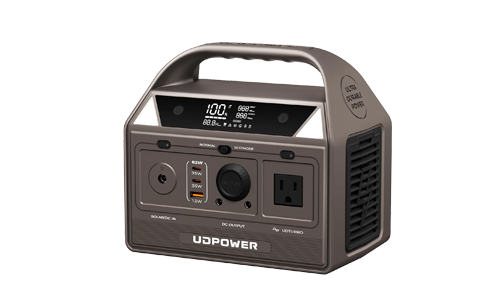
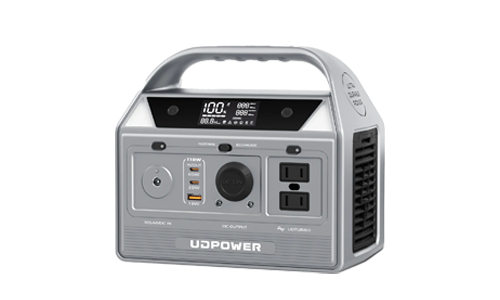
For small SFF builds, home routers, and NAS devices, compact units like the UDPOWER C200 and UDPOWER C400 offer portable backup without taking up much space.
- C200: 192 Wh capacity, 200 W pure sine AC output (up to 400 W surge), about 5.4 lbs, LiFePO4 cells rated for 4,000+ cycles.
- C400: 256 Wh capacity, 400 W rated / 800 W surge, around 6.88 lbs, LiFePO4 battery and multiple outputs including 2× AC, USB-C, USB-A, DC, and a jump-starter port.
These are well-suited for keeping a Wi-Fi router, external drives, and a low-power mini-PC or NUC running through shorter outages.
Mid-Range Backup: Desktop + Monitor

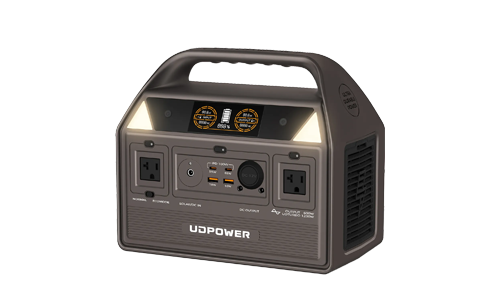
If you run a typical gaming or productivity desktop that draws a few hundred watts under load, the UDPOWER C600 provides more headroom.
- Capacity: 596 Wh LiFePO4 battery.
- Output: 600 W rated, up to 1,200 W max with 2× 120 V AC outlets (60 Hz).
- Ports: USB-C, USB-A, 12 V car socket, and DC outputs, around 12.3 lbs total weight.
For many mid-range ATX or SFX systems, the C600 can keep your tower and a monitor powered long enough to save work, shut down safely, or ride through short-to-medium outages, depending on load.
UPS-Style Backup: Full Desktop Setup & Longer Outages

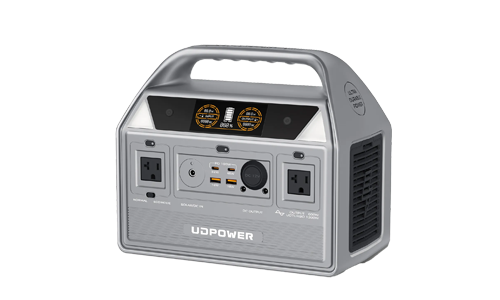
For heavier systems or longer backup times, the UDPOWER S1200 is designed as a higher-capacity option that can also serve as a fast-charging home backup.
- Capacity: 1,190 Wh LiFePO4 battery pack.
- Output: 1,200 W rated with up to 1,800 W surge (UDTURBO mode) through pure sine AC outlets.
- UPS function: Switchover time under 0.01 s in UPS mode, designed to help keep sensitive electronics like desktops, workstations, and NAS boxes running across brief power interruptions.
- Longevity: 4,000+ cycles advertised, with fast AC charging (around 1.5 hours from empty to full under optimal conditions).
For many ATX gaming rigs drawing 400–600 W plus a monitor and networking gear, the S1200 can act as a quiet, fume-free UPS alternative and short-term backup during longer outages, as long as you keep total draw within its rated output.
FAQ: PC Power Supplies & Backup Power
1. Can I install a portable power station like UDPOWER inside my PC as the main PSU?
No. Portable power stations are external devices that provide AC power to your standard ATX/SFX/TFX PSU via a wall-style outlet. They are not designed to be mounted in a PC case or wired directly like an internal PSU. Your system still needs a proper ATX/SFX/TFX or EPS unit inside the case.
2. Is an ATX PSU always better than SFX?
Not necessarily. ATX PSUs are larger and often available in higher wattages, but modern SFX units can be very efficient and powerful. If you are building in a compact case, a high- quality SFX PSU is the right choice and can perform just as well as an ATX unit of similar quality and wattage.
3. Do I need an EPS12V connector if I am not overclocking?
Most modern motherboards require at least one 8-pin EPS12V connector for the CPU, whether you overclock or not. Some boards add a second EPS connector for extra stability when pushing high-end CPUs. Always follow your motherboard manual; never boot the system with required CPU power connectors missing.
4. What happens if my PSU wattage is too low?
If your PSU is undersized, the system may crash or reboot under load, particularly during gaming or heavy workloads. In worst-case scenarios, the PSU can fail under stress. That’s why matching wattage and quality to your build is crucial.
5. Can a UDPOWER power station replace a traditional UPS for my PC?
In many home setups, yes. A unit like the UDPOWER S1200, with pure sine wave output, 1,200 W rated power, and sub-10 ms UPS mode, can function like a high-capacity UPS for desktops, monitors, and networking gear, while also doubling as portable power for camping or travel. Just confirm that your total system draw stays below the station’s rated output and follow all manufacturer safety guidelines.
Related Articles


