

CPAP Battery Backup During a Power Outage: Setup, Humidifier Tips, and Runtime Planning
Back to the Power Outage Checklist (24/48/72)

If you use a CPAP, a power outage can turn bedtime into a stress test. The good news: with the right setup, a CPAP is usually one of the easier “medical essentials” to back up—especially if you’re willing to run without heated humidification when you need to conserve power.
Important: This guide is general preparedness information, not medical advice. If you have severe sleep apnea, oxygen therapy, or other clinical needs, follow your clinician’s plan and test your backup setup ahead of time.
If you’re planning the rest of your home loads too, pair this article with: Power Priorities: What to Run First and Battery Runtime Basics (Watts → Watt-hours).
What you need for CPAP backup
Think in three layers: (1) power, (2) connections, (3) comfort.
1) Power
- Portable power station (pure sine wave AC output, or DC output when using a CPAP DC converter).
- Enough battery capacity for your goal (one night, weekend, or “until the grid comes back”).
- Optional recharge plan for outages longer than 1–2 nights (solar or vehicle charging).
2) Connections
- Your CPAP’s standard power supply (AC brick) and a safe extension cord if needed.
- Preferred: the manufacturer-approved DC/DC converter for your CPAP model (many common devices use 24V and require a specific converter).
- Backup fuses/adapters if your converter uses a vehicle-style plug.
3) Comfort (the “I can actually sleep” kit)
- Distilled water (if you normally humidify; some people switch to passover/unheated mode during outages).
- Hose wrap/cover (helps reduce condensation and can make unheated humidity feel better).
- Spare mask cushion + filters (a leak can quietly increase power use and ruin sleep).
Fast setup during an outage (10 minutes)
This is the “it’s dark, I’m tired, and I just want it to work” version.
- Move the power station to a safe spot: flat surface, ventilated, away from bedding and pets.
- Start in power-saver mode: set your CPAP to no heated humidifier and heated hose off (you can dial comfort back up later if you have battery headroom).
-
Connect the CPAP (best → good options):
- Best: CPAP-specific DC/DC converter → power station DC output (or car outlet, if the converter uses that plug).
- Good: CPAP’s standard AC power brick → power station AC outlet.
- Do a quick “start/stop” test: power on, confirm airflow, confirm humidifier heat is off (if conserving), then stop/start once more.
-
Lock in a safer night:
- Keep cords routed so you won’t trip.
- Keep the battery display visible if possible.
- If you’re also running a fridge or Wi-Fi, use a priority plan: What to Run First (Load Planning).
If you’re considering a gas generator as your backup path, read this first: Portable Power Station vs Generator for Power Outages. Never run a generator indoors or in a garage.
Humidifier + heated hose tips to stretch runtime
Comfort features can be worth it—but they’re also the fastest way to cut your runtime in half. If you’re aiming for “get through the night,” start conservative and add comfort only if the battery level allows.
| Setting / choice | What you feel | Impact on battery runtime | Practical tip |
|---|---|---|---|
| Heat OFF (recommended for outages) | Drier air for some people | Best runtime | Use a hose cover + a glass of water near the bed; many users find this “good enough” for a night or two. |
| Passover / unheated humidity | Slight humidity without heating | Usually close to “heat off” | Use distilled water if you can; keep the device level and below head height to avoid spills. |
| Low heat | More comfort, less dryness | Moderate runtime hit | Try low heat only after you confirm you have enough battery for your target hours. |
| High heat + heated hose | Most comfortable for dryness | Largest runtime hit | Use only if you have lots of battery capacity or a solid recharge plan (solar/vehicle). |
The exact wattage depends on your model, pressure settings, leak rate, and how aggressively the heater runs in your room conditions. That’s why the best plan is always a “test night” (see below).
How to find your CPAP watts (without guessing)
Don’t rely on generic “CPAP wattage” lists. Two steps get you a much better answer:
- Check the manual’s power section (your device may list typical and peak consumption). If you can’t find it, check the label on the power brick—it shows the maximum it can draw.
-
Measure a real night:
- If you use AC: plug the CPAP into a plug-in watt meter (often called a “Kill A Watt” style meter) for 10–15 minutes, then again with heat/hose enabled.
- If you use a power station: many units display real-time watts. Note your average with heat OFF, then with your normal comfort settings.
If you want to understand the math behind your estimate (and plan your whole-house essentials), use: Battery Runtime Basics: Watts → Watt-hours.
Runtime math + planning tables
The simple formula
Nightly energy (Wh) ≈ Average watts × Hours used
Nights of runtime ≈ (Battery Wh × efficiency factor) ÷ Nightly Wh
For AC use, an efficiency factor of ~0.80–0.90 is a realistic planning range (inverter and conversion losses vary). DC setups often do better than AC, but it depends on the converter and load.
Planning table: what does one night cost?
| Scenario (8 hours) | Average draw (example) | Overnight energy | When this is common |
|---|---|---|---|
| CPAP only (heat off) | 30–60W | 240–480Wh | Most “outage mode” setups; best chance of multi-night runtime. |
| CPAP + some comfort | 60–90W | 480–720Wh | Low heat, colder rooms, or higher pressures. |
| CPAP + high humidifier + heated hose | 90–130W+ | 720–1,040Wh+ | “Full comfort” settings—great for sleep, tough on batteries. |
Example runtime estimates (UDPOWER S1200 vs S2400)
These examples assume ~85% usable energy for AC use. Your results can vary—do a test night and adjust.
| Power station | Battery capacity | Example CPAP mode | Overnight energy | Estimated nights (AC) |
|---|---|---|---|---|
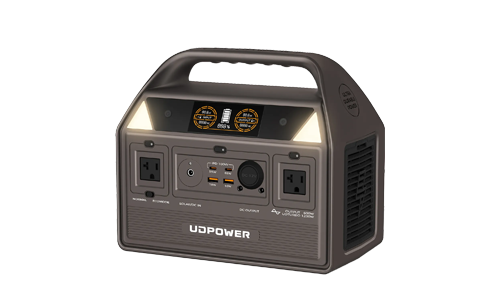
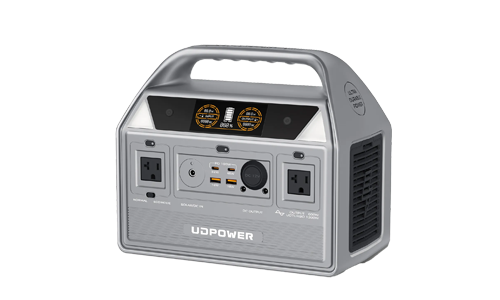
| S1200 | 1,190Wh | Heat off (approx. 50W avg × 8h) | ~400Wh | ~2 nights |
| S1200 | 1,190Wh | Higher comfort (approx. 80W avg × 8h) | ~640Wh | ~1 night (plus) |
| S2400 | 2,083Wh | Heat off (approx. 50W avg × 8h) | ~400Wh | ~4 nights |
| S2400 | 2,083Wh | Higher comfort (approx. 80W avg × 8h) | ~640Wh | ~2–3 nights |
Want a faster estimate using your exact wattage? Use your measured average watts with: Watts → Watt-hours runtime planning (and if you keep home internet running too, see: How to Keep Wi-Fi Running During a Power Outage).
Choosing a portable power station size for CPAP backup
For CPAP-only backup, capacity is usually the deciding factor. If you also want to keep the fridge, lights, or Wi-Fi running, you’ll care about output power and ports too.
| Model | Good fit for | Battery (Wh) | AC output | UPS support | Solar input (for outages) |
|---|---|---|---|---|---|
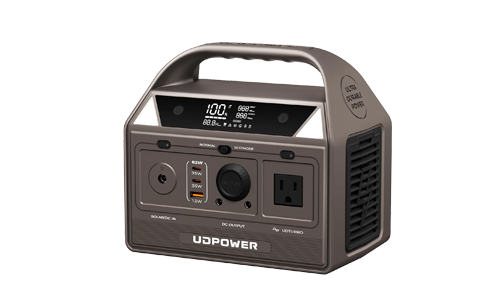
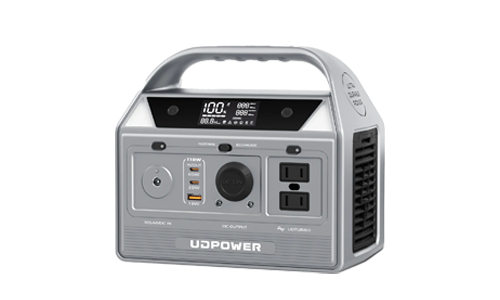
| UDPOWER S1200 | Single CPAP + a few small essentials | 1,190Wh | 1,200W rated (UDTURBO up to 1,800W) | ≤10ms switchover (test with your device) | 12–75V, 12A, up to 400W |
| UDPOWER S2400 | CPAP + longer runtime, or CPAP + more home loads | 2,083Wh | 2,400W rated (UDTURBO up to 3,000W) | ≤10ms switchover (test with your device) | 12–50V, 10A, up to 400W |
If you’re deciding between battery power and a generator specifically for outages, compare real-world tradeoffs here: Portable Power Station vs Generator (Safety, Noise, Use Cases).
Multi-day outage strategy: recharge with solar (safely)
If your outage can last more than 1–2 nights, you want a way to add energy back each day. Solar is one of the simplest options—as long as you match voltage limits.
- Start with your daily CPAP need (Wh), then aim to replace that energy during daylight.
- Keep panels within the station’s input range (over-voltage is the #1 avoidable solar mistake).
- Plan for weather: cloudy days mean you may only get a fraction of panel rating.
Read next (recommended): Solar Charging During an Outage: Panel Sizing + Input Voltage Safety.
Printable “CPAP Outage Night” checklist
Before you go to bed
- Power station is charged and placed on a flat, ventilated surface.
- CPAP is set to heated humidifier OFF and heated hose OFF (start conservative).
- CPAP connected (prefer DC/DC converter if you have it; otherwise AC power brick is fine).
- Quick start/stop test completed; airflow feels normal.
- Battery level noted (so you can sanity-check in the morning).
- Distilled water ready (if using passover/unheated humidity).
In the morning
- Note remaining battery % (or Wh used if your unit shows it).
- Decide comfort level for next night based on remaining energy.
- If outage continues: begin recharge plan (solar/vehicle) during daylight.
If you’re also managing food during outages, read: Food Safety During a Power Outage (Fridge/Freezer Rules).
FAQ
Can a portable power station run a CPAP all night?
Usually, yes. The key is matching energy (battery Wh) to your CPAP’s overnight watt-hours. For the longest runtime, run with heated humidification off and use the correct DC converter when available.
Is it better to power a CPAP with DC or AC during an outage?
DC is often more efficient because you avoid extra conversion losses. Many popular CPAPs require a model-specific DC/DC converter (often to 24V). If you don’t have it, using the standard AC power brick on a pure sine wave AC outlet is a solid backup plan.
How many nights can I expect from a 1,000–2,000Wh class power station?
It depends mostly on whether heat features are on. Many users can get multiple nights in “heat off” mode, while high humidifier and heated hose settings can cut runtime sharply. Use the planning tables above, then confirm with a test night.
Will my CPAP work with UPS mode on a power station?
Many devices tolerate fast switchover, but compatibility varies. If UPS behavior matters for you, test your exact CPAP and settings at home. If it doesn’t like switchover, you can still run CPAP directly off the power station during an outage—just start it from battery power when needed.
What’s the easiest way to reduce CPAP power use?
Turn off heated humidification and heated hose first. Then reduce comfort settings incrementally only if you confirm you have enough battery for the night.
Do I need a special inverter for CPAP?
If you’re using AC, a pure sine wave output is preferred for many electronics and is commonly recommended in manufacturer guidance. If you can power via the correct DC converter, that can be simpler and more efficient.
Can I recharge a CPAP backup power station with solar during a blackout?
Yes, and it’s one of the best multi-day strategies. Just match your panel setup to the station’s solar input limits (voltage range and max current). Read: Solar input voltage safety (avoid over-voltage).
What if I can’t use CPAP for one night?
If you have severe apnea or medical risk, don’t improvise—follow your clinician’s guidance. For many people, a single missed night may feel rough but is manageable; however, safety comes first. Build a backup plan you can trust.
Read next
- Power Outage Checklist (24/48/72 Hours) + Printable List
- Power Priorities: What to Run First (Fridge/Medical/Wi-Fi)
- Battery Runtime Basics: Watts → Watt-hours (Real-World Efficiency)
- Solar Charging During an Outage: Panel Sizing + Input Voltage Safety
- How to Keep Wi-Fi Running During a Power Outage
- Portable Power Station vs Generator for Power Outages
- Food Safety During a Power Outage (Fridge/Freezer Rules)
- Emergency Water for a 3-Day Outage: How Much to Store
Sources & further reading
External links open in a new tab and are marked nofollow.
- ResMed: AirSense 10 user guide (power specs & typical/peak consumption): AirSense 10 device with humidifier (PDF)
- ResMed: Battery guidance and inverter considerations: ResMed Battery Guide (PDF)
- CDC: Preparedness guidance for backup power sources (including medical devices): CDC — Power Sources
- CDC: Power outage safety basics (generator safety and CO risk): CDC — Protect yourself during a power outage
Related Articles


