

How Many Watts Does an RV AC Use? Wattage & Runtime Guide
Last updated: July 10, 2026

RV Air Conditioner Wattage Chart
The following ranges are useful for initial planning, but they should not replace the electrical label or manual for your exact model. Two air conditioners with the same BTU rating can have noticeably different compressor designs, fan motors, efficiency levels, and startup behavior.
| RV AC type | Typical cooling capacity | Planning range while cooling | Startup behavior | Best use |
|---|---|---|---|---|
| Small window or compact camper AC | 5,000–8,000 BTU | About 450–900W | Often 2× or more than running demand for a brief moment | Teardrop trailers, vans, truck campers, and small enclosed spaces |
| Small rooftop RV AC | 9,000–11,000 BTU | About 900–1,500W | Traditional compressors may still have a substantial surge | Smaller travel trailers and compact motorhomes |
| Standard rooftop RV AC | 13,500 BTU | About 1,300–1,900W | Startup is frequently the limiting factor for batteries and small generators | Common travel trailers, fifth wheels, and motorhomes |
| Large rooftop RV AC | 15,000 BTU | About 1,500–2,000W | Usually requires more startup headroom and longer runtime capacity | Larger RVs and hotter climates |
| Variable-speed or inverter RV AC | Varies by model | May ramp from a few hundred watts to more than 1,500W | Usually starts more gradually than a fixed-speed compressor | Battery-based systems and owners prioritizing efficiency |
Planning ranges are not compatibility guarantees. Confirm voltage, compressor current, fan current, and startup requirements for the exact AC model.
Real Examples From Official RV AC Specifications
Manufacturer specifications show why a single universal answer can be misleading. Even units with the same 13,500 BTU rating can list different compressor and fan currents.
| Official example | Cooling capacity | Published current | Conservative nameplate estimate | Published startup information |
|---|---|---|---|---|
| Dometic AirCommand AC-1361 | 13,500 BTU | 12.5A cooling at 115V | About 1,438 volt-amps from 115 × 12.5 | 63A locked-rotor current |
| Dometic AirCommand AC-1511 | 15,000 BTU | 13.0A cooling at 115V | About 1,495 volt-amps from 115 × 13.0 | 63A locked-rotor current |
| Dometic Penguin II 650015C85X | 13,500 BTU | 13.1A compressor plus 2.6A fan at 120V | About 1,884 volt-amps from 120 × 15.7 | 63A compressor LRA; manual lists a 3.5kW minimum generator guideline for one unit |
| Dometic Penguin II 650016C75X | 15,000 BTU | 12.9A compressor plus 2.6A fan at 120V | About 1,860 volt-amps from 120 × 15.5 | 52A compressor LRA; manual lists a 3.5kW minimum generator guideline for one unit |
Sources: Dometic AirCommand installation manual and Dometic Penguin II installation manual.
Running Watts vs. Starting Watts
An RV air conditioner has several different power states. Treating all of them as one number is a common reason power systems are undersized.
| Operating state | What is happening | Typical power pattern | Why it matters |
|---|---|---|---|
| Off | Thermostat and control board may remain active | Very low standby consumption | Usually insignificant compared with compressor use |
| Fan only | Indoor blower runs without the compressor | Lower and relatively steady | Useful for measuring the fan separately |
| Compressor startup | Compressor begins turning from a stop | Very high but brief current demand on fixed-speed units | Can overload an inverter even when running watts appear acceptable |
| Compressor running | AC actively removes heat | Highest sustained operating load | Determines continuous inverter size and battery drain |
| Thermostat cycling | Compressor switches off after reaching the set temperature | Average hourly consumption falls | Determines real-world runtime more accurately than maximum running watts alone |
Why LRA Is Not the Same as “Startup Watts”
A specification sheet may list LRA, meaning locked-rotor amps. It indicates how much current the compressor could draw when its rotor is not yet moving. It is a warning that the startup event is demanding, but multiplying LRA by voltage does not produce a reliable generator or inverter wattage requirement.
Startup duration, power factor, inverter overload duration, compressor condition, line voltage, and any installed soft starter all affect whether the AC actually starts. That is why an official manual may show more than 7,000 volt-amps from LRA math but recommend a 3.5kW generator rather than a 7.5kW generator.
How to Calculate RV AC Watts From the Data Plate
Look for a label on the rooftop unit, inside the ceiling assembly, or in the installation manual. The most useful values are voltage, compressor amps, fan amps, rated-load amps, full-load amps, and locked-rotor amps.
Apparent power in VA ≈ Voltage × Amps
Example 1: One Combined Cooling-Amp Rating
If the label lists 12.5 cooling amps at 115 volts:
Use roughly 1,440VA as a conservative nameplate estimate. Actual measured watts may be somewhat different.
Example 2: Compressor and Fan Listed Separately
If the compressor is rated at 13.1A and the fan at 2.6A:
120V × 15.7A = 1,884VA
Data-Plate Terms That Are Easy to Misread
| Label term | Meaning | How to use it |
|---|---|---|
| RLA | Rated-load amps | Useful for estimating normal compressor current |
| FLA | Full-load amps | Useful for conservative running-load planning |
| LRA | Locked-rotor amps | Shows startup severity, not normal running consumption |
| MCA | Minimum circuit ampacity | Used for circuit and wire sizing; do not assume it is the AC’s normal draw |
| MOCP or maximum fuse | Maximum overcurrent protection | A circuit-protection value, not appliance wattage |
| BTU/h | Cooling capacity | Use it to compare cooling output, not electrical input |
For quick conversions, use the UDPOWER battery and power conversion tools.
Watts, Watt-Hours, and “Watts per Hour”
Watts measure the rate at which the AC uses power. Watt-hours and kilowatt-hours measure the total energy consumed over time.
A 1,500W air conditioner running continuously for one hour consumes approximately:
However, an RV AC does not always run continuously. After the RV cools down, the thermostat may cycle the compressor on and off. This duty cycle has a major effect on battery runtime.
| 1,500W AC compressor duty cycle | Approximate compressor energy per hour | What it may represent |
|---|---|---|
| 40% | About 600Wh per hour | Mild conditions, shaded RV, good insulation, or a cooled interior |
| 60% | About 900Wh per hour | Moderate summer conditions |
| 80% | About 1,200Wh per hour | Hot weather or significant solar heat gain |
| 100% | About 1,500Wh per hour | Initial cooldown, extreme heat, or an undersized AC |
Fan energy and other RV loads must still be added. The most accurate approach is to measure average energy use over several hours.
30-Amp vs. 50-Amp RV Service
RV service ratings are often misunderstood. A 50-amp RV connection does not merely provide 20 amps more than a 30-amp connection.
| RV electrical service | Electrical arrangement | Theoretical maximum | Practical AC use |
|---|---|---|---|
| 15A household outlet | One 120V circuit | About 1,800W | May operate some smaller ACs, but startup and other RV loads can trip the breaker |
| 20A household outlet | One 120V circuit | About 2,400W | More headroom than 15A, but still requires careful load management |
| 30A RV service | One 120V leg | About 3,600W | Usually suitable for one rooftop AC if major appliances are not stacked |
| 50A RV service | Two separate 120V, 50A legs | Up to about 12,000W total | Commonly supports two ACs and more simultaneous appliances, subject to branch-circuit limits |
Why a 30-Amp RV Can Still Trip With One AC
A 1,500W air conditioner appears to leave roughly 2,100W of theoretical capacity on a 30-amp service. The problem is that other loads may be operating without being obvious:
- The converter may be charging a depleted house battery.
- The refrigerator may be running in electric mode.
- The water heater may be using its electric heating element.
- A microwave, coffee maker, or hair dryer may be switched on.
- A second AC may try to start while the first one is already running.
Can a Portable Power Station Run an RV Air Conditioner?
Yes, but only when three separate requirements are met:
- Continuous output: The power station must support the AC’s sustained compressor and fan load.
- Startup capability: Its surge rating and overload duration must handle compressor startup.
- Battery capacity: It must store enough watt-hours to provide useful cooling time.
| Check | What to compare | Minimum planning approach | Common mistake |
|---|---|---|---|
| Running load | Measured compressor-on watts vs. rated AC output | Leave headroom rather than operating at the inverter limit | Buying a 1,500W inverter for an AC that measures exactly 1,500W |
| Startup load | Measured inrush vs. surge rating | Test under hot conditions and after the compressor has cycled | Assuming a 2,000W inverter can start every AC that runs below 2,000W |
| Energy capacity | Usable battery Wh vs. average hourly AC consumption | Calculate with conversion loss and realistic duty cycle | Confusing inverter watts with battery watt-hours |
| Other RV loads | Converter, refrigerator, lights, pumps, and appliances | Measure the entire RV rather than only the AC | Leaving the converter or electric water heater on during testing |
Traditional Rooftop AC vs. Variable-Speed AC
A traditional fixed-speed compressor switches fully on and fully off. It often has a sharp startup surge. A variable-speed or inverter-driven compressor can ramp up more gradually and reduce output after the RV reaches the desired temperature.
That difference can matter more than the BTU label. A well-designed variable-speed 13,500 BTU unit may be easier for a battery inverter to start than an older fixed-speed unit with a lower BTU rating.
Will a Soft Starter Help?
A compatible soft starter can reduce the current spike during startup and may allow an AC to start on a smaller inverter or generator. It does not create extra continuous output, and it does not significantly change the energy required to keep the compressor running.
Installation normally requires access to rooftop electrical components. Use an RV HVAC technician when the installation instructions, wiring, or warranty requirements are unclear.
Which UDPOWER Model Makes Sense for an RV AC?
The honest answer depends on the AC type. The S2400 is UDPOWER’s most appropriate current option for lower-surge RV cooling, while the S1200 is better suited to RV essentials and smaller measured loads.
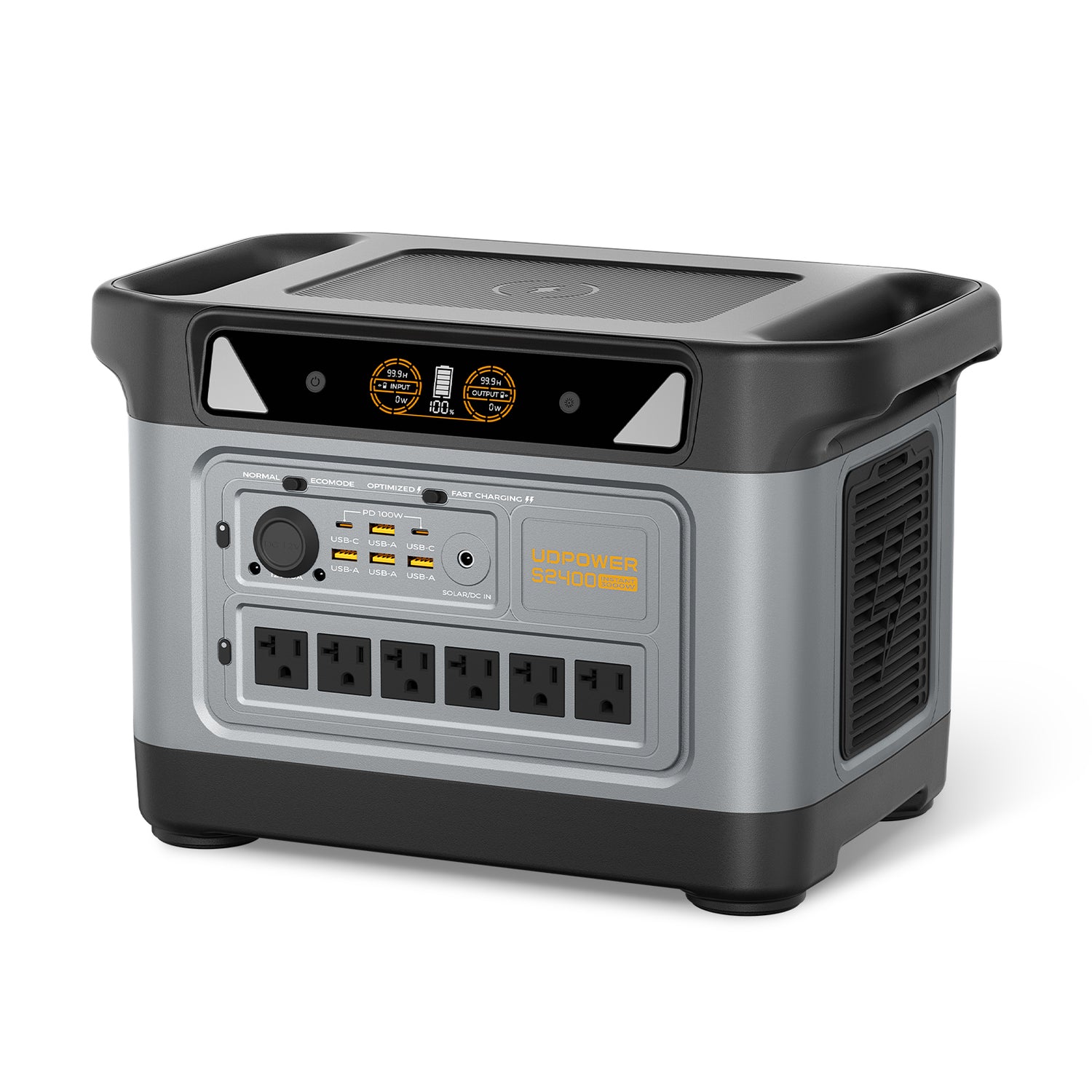
UDPOWER S2400: Best Current UDPOWER Option for Measured Low-Surge RV Cooling
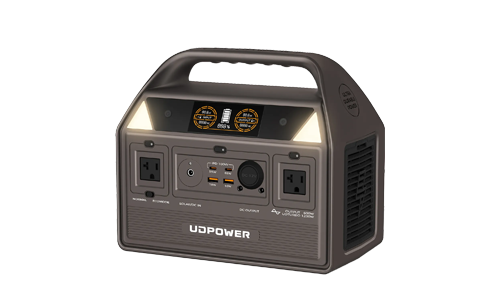
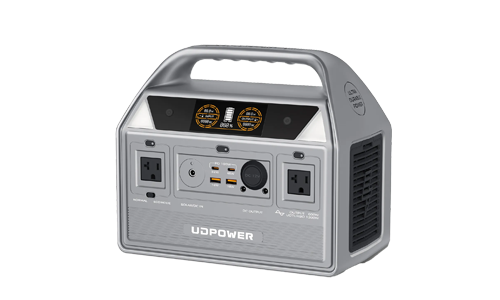
- Battery capacity: 2,083Wh
- Rated AC output: 2,400W pure sine wave
- Surge support: Up to 3,000W
- Solar input: Up to 400W
- AC outlets: 6
- Battery chemistry: LiFePO4
- Weight: 40.8 lb
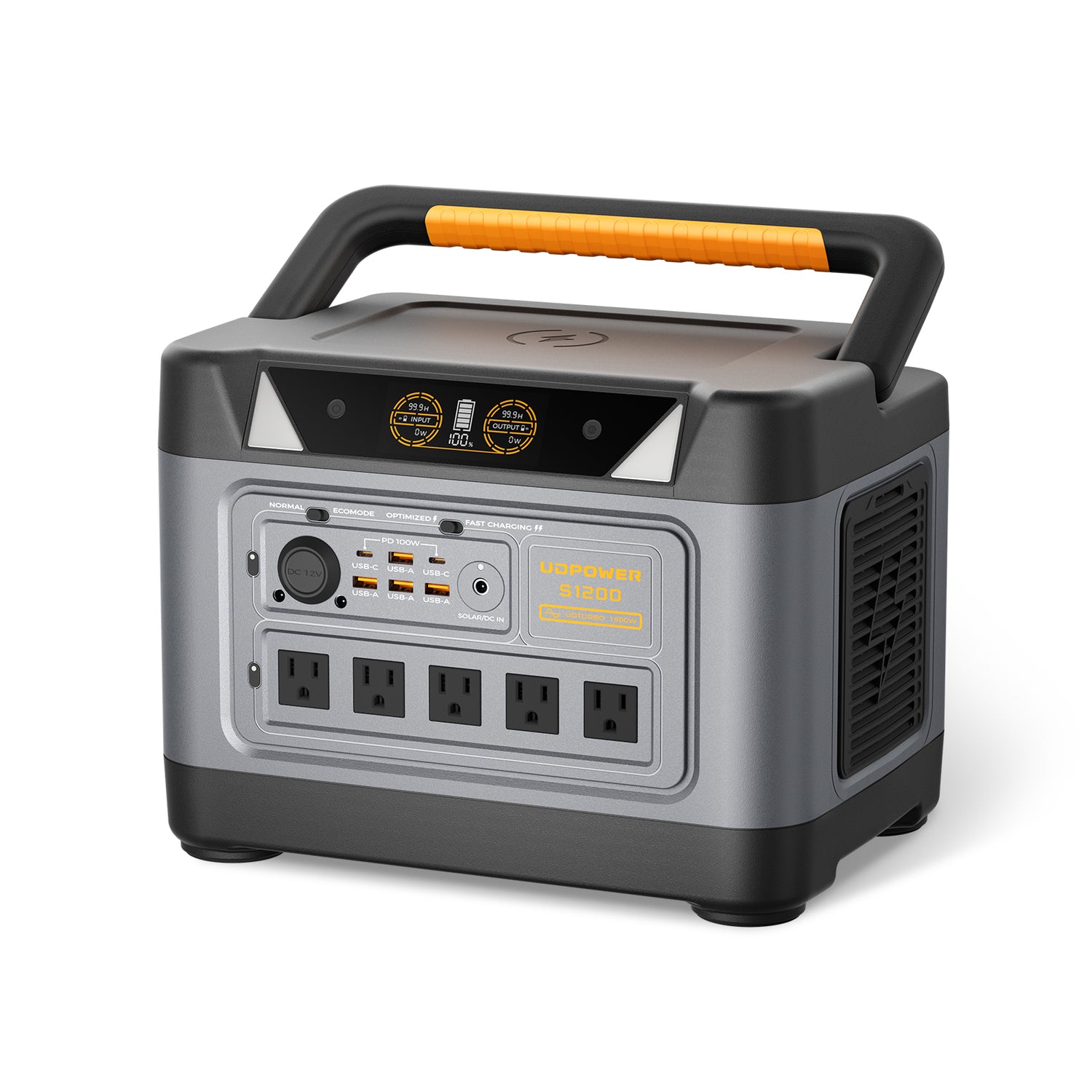
UDPOWER S1200: Better for RV Essentials Than a Standard Rooftop AC
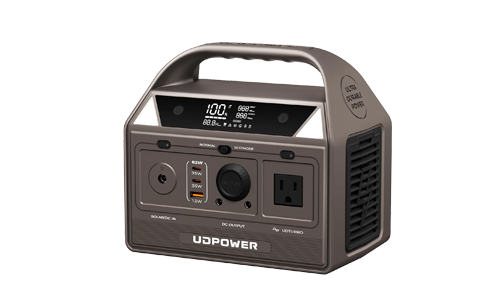
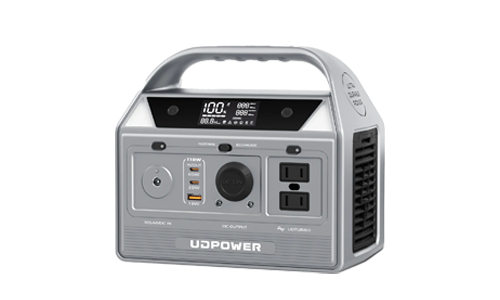
- Battery capacity: 1,190Wh
- Rated AC output: 1,200W pure sine wave
- Surge support: Up to 1,800W
- Solar input: Up to 400W
- AC outlets: 5
- Battery chemistry: LiFePO4
- Weight: About 26 lb
Browse all UDPOWER portable power stations or compare solar generator kits for RV and off-grid charging.
How Long Can a Power Station Run an RV AC?
A useful battery-only estimate is:
The 90% factor allows for normal inverter conversion loss. Actual runtime can be shorter because of temperature, inverter overhead, battery protection limits, fan use, and other RV loads.
| Average measured load | S2400 estimated runtime 2,083Wh |
S1200 estimated runtime 1,190Wh |
Compatibility note |
|---|---|---|---|
| 700W | About 2.68 hours | About 1.53 hours | Possible for some compact or reduced-output AC systems |
| 900W | About 2.08 hours | About 1.19 hours | Startup still needs separate verification |
| 1,200W | About 1.56 hours | About 0.89 hour mathematically | S1200 would be at its continuous output limit and has no useful headroom |
| 1,500W | About 1.25 hours | Not compatible with its 1,200W continuous rating | Common running-load territory for rooftop RV ACs |
| 1,800W | About 1.04 hours | Not compatible with its 1,200W continuous rating | S2400 startup compatibility must still be confirmed |
Estimates use 90% conversion efficiency and assume a constant load. They do not guarantee that the AC compressor will start.
How Compressor Cycling Changes the S2400 Estimate
Suppose an AC draws 1,500W while the compressor is operating. Its approximate S2400 runtime changes substantially depending on how often the compressor runs:
| Compressor duty cycle | Simplified average load | S2400 estimated runtime |
|---|---|---|
| 40% | About 600W | About 3.12 hours |
| 60% | About 900W | About 2.08 hours |
| 80% | About 1,200W | About 1.56 hours |
| 100% | About 1,500W | About 1.25 hours |
These simplified duty-cycle examples exclude fan consumption while the compressor is off. Use the portable power station runtime calculator after measuring your actual average load.
Can Solar Panels Keep an RV Air Conditioner Running?
Solar panels can extend battery runtime, but a portable solar array usually cannot fully replace the energy consumed by a standard rooftop RV AC.
For example, the S2400 accepts up to 400W of solar input. If the air conditioner is drawing 1,500W and the panels are producing the full 400W, the system still has a power deficit of at least 1,100W before accounting for conversion and charging losses.
| Example condition | RV AC load | Solar input | Approximate remaining demand |
|---|---|---|---|
| Strong sun and ideal panel placement | 1,500W | 400W | At least 1,100W still supplied by the battery |
| Good but imperfect conditions | 1,500W | 300W | At least 1,200W still supplied by the battery |
| Clouds, poor angle, or partial shade | 1,500W | 100–200W | Most of the load still comes from the battery |
Solar works best as a runtime extender and daytime recharge source. It is especially useful when paired with shade, efficient ventilation, and short strategic AC sessions rather than continuous cooling.
Learn more in Can You Charge a Portable Power Station With a Solar Panel? and the UDPOWER off-grid load calculator.
How to Reduce RV AC Power Consumption
1. Cool the RV Before the Hottest Part of the Day
It takes much more energy to cool an RV that has been heat-soaking in direct afternoon sun. Pre-cooling while connected to shore power can reduce the initial battery load later.
2. Park With the Largest Windows Away From Direct Sun
Parking orientation matters. Use awnings, windshield covers, reflective window panels, and exterior shade where permitted. Reducing solar heat entering the RV often saves more energy than lowering the thermostat another few degrees.
3. Clean the Return-Air Filter
Restricted airflow reduces cooling performance and can make the compressor run longer. Clean or replace the filter according to the AC manufacturer’s instructions.
4. Inspect Rooftop Coils and Airflow
Dirt, leaves, damaged fins, or blocked condenser airflow can reduce efficiency. Disconnect power and follow the manufacturer’s maintenance instructions before accessing rooftop equipment.
5. Seal Air Leaks
Check slide seals, roof vents, door seals, plumbing openings, and pass-through storage areas. Small leaks continuously allow hot, humid outdoor air into the RV.
6. Use a Roof Vent Fan Before Starting the AC
When the interior is hotter than the outside air, exhaust the trapped hot air first. Once the inside temperature approaches outdoor temperature, close the RV and start the AC.
7. Avoid Unnecessary Electrical Loads
Switch the water heater and refrigerator away from electric mode when appropriate, avoid using resistance-heating appliances, and reduce converter charging during AC startup.
8. Consider a Compatible Soft Starter
A soft starter may reduce the startup burden of a traditional compressor. It will not solve an undersized continuous inverter or insufficient battery capacity.
9. Consider a Variable-Speed Replacement AC
RV owners who frequently camp without shore power may gain more from a high-efficiency variable-speed AC than from continually adding larger batteries to an inefficient fixed-speed unit.
How to Measure Your RV AC Before Buying a Power Source
Practical Test Checklist
- Record the exact AC model number and photograph its data plate.
- Turn off the electric water heater, microwave, and other large appliances.
- Note whether the RV converter is charging the house battery.
- Measure the fan-only load.
- Start cooling mode and record steady compressor-on watts.
- Measure the startup event with a meter capable of capturing inrush.
- Repeat the test during a hot afternoon, not only on a cool morning.
- Record total RV power, not just AC power, when you plan to power the RV through its shore-power inlet.
Plug-In Meter or Clamp Meter?
A plug-in power meter is convenient for a cord-connected air conditioner that stays within the meter’s ratings. Most rooftop RV air conditioners are hardwired, so a qualified technician may need to use a clamp meter or measure power at the RV input.
Check the RV’s EMS or Surge Protector
Some RV electrical management systems may interpret the floating-neutral design of a portable power station as an open-ground condition. Do not bypass a safety device simply to make the connection work. Check the power station and RV equipment instructions or consult a qualified RV electrician about an approved solution.
Which Power Source Is Best for Your RV AC?
| Power option | Best advantage | Main limitation | Best RV use |
|---|---|---|---|
| Campground shore power | Long, continuous operation without draining a battery | Only available at powered campsites; pedestal voltage can vary | Extended summer stays and continuous cooling |
| Fuel inverter generator | Can provide high output for many hours with refueling | Noise, fuel, exhaust, maintenance, and campground restrictions | Traditional rooftop AC during long off-grid stays |
| Portable power station | Quiet, indoor-safe at the power station, and easy to operate | Limited battery runtime and surge capability | Short cooling sessions, efficient ACs, and quiet hours |
| Power station plus solar | Solar can extend runtime and replace part of the used energy | Portable solar input is usually much lower than rooftop AC demand | Daytime support and mixed RV loads |
| Hybrid battery and generator setup | Quiet battery use with generator support for heavy loads or recharging | More equipment and planning | Boondocking where generator hours are limited |
For a deeper comparison, see Inverter Generator vs. Portable Power Station and Portable Power Station vs. Generator for Camping.
Frequently Asked Questions
How many watts does a 13,500 BTU RV air conditioner use?
Many traditional 13,500 BTU rooftop units use approximately 1,300–1,900W while actively cooling. Official Dometic examples range from about 1,438VA for a combined 12.5A rating at 115V to about 1,884VA when separate compressor and fan currents are added. Check the exact model and measure true watts for the most accurate result.
How many watts does a 15,000 BTU RV air conditioner use?
A traditional 15,000 BTU rooftop RV AC commonly falls around 1,500–2,000W while cooling. One official Dometic example lists 13A at 115V, while another lists 12.9A for the compressor plus 2.6A for the fan at 120V.
How many starting watts does an RV AC need?
There is no universal number. Fixed-speed compressors can have a large but brief startup demand. Some manufacturers recommend a generator of about 3,500W for one traditional rooftop unit, but inverter design, soft starters, voltage, temperature, and the exact compressor all affect startup.
Will a 2,000-watt generator run an RV AC?
It may run a smaller or efficient AC, especially with a compatible soft starter, but it is not a reliable universal choice for traditional 13,500–15,000 BTU rooftop units. The generator may have enough continuous output but fail during compressor startup.
Will a 3,000-watt power station run an RV AC?
It can run many RV air conditioners when both running and startup demands stay within its ratings. Verify the power station’s continuous output, surge output, overload duration, battery capacity, and outlet voltage. A 3,000W label alone does not guarantee compatibility.
Can the UDPOWER S2400 run an RV air conditioner?
The S2400 provides 2,400W continuous output and surge support up to 3,000W. It is a reasonable match for many smaller or variable-speed ACs and some soft-start-equipped rooftop units. Traditional RV ACs with startup demand above 3,000W may not start, even when their running load is below 2,400W.
Can the UDPOWER S1200 run a rooftop RV AC?
A standard fixed-speed 13,500 or 15,000 BTU rooftop AC is generally not a good match for the S1200’s 1,200W continuous output. The S1200 is better used for RV essentials or a smaller AC that has been measured below its continuous and surge limits.
Can one RV air conditioner run on 30-amp service?
Usually yes. A 30-amp, 120V RV connection provides up to about 3,600W theoretically. One rooftop AC commonly fits, but the microwave, electric water heater, converter, refrigerator, or a second AC can cause the main breaker to trip.
Can two RV air conditioners run on 30 amps?
Sometimes two efficient units can be carefully managed, particularly with soft starters and load-shedding controls, but it is often unreliable. Two traditional rooftop units can consume most or all of a 30-amp service before other RV loads are included.
Does a soft starter reduce RV AC running watts?
Its main job is to reduce the startup current spike. It generally does not create a large reduction in the power required after the compressor is running. You still need enough continuous inverter output and battery capacity.
Can solar panels run an RV AC directly?
Portable solar panels normally charge a battery or power station, and the inverter then supplies AC power. Because a standard rooftop AC may use 1,500W or more while a portable solar input may be only a few hundred watts, solar usually extends runtime rather than supporting the entire load by itself.
Why does my RV AC use more power in hot weather?
A hot roof and higher outdoor temperature increase heat entering the RV and make it harder for the condenser to reject heat. The compressor may run longer, cycle less often, and draw more current. Low campground voltage and restricted airflow can make conditions worse.
What is the most accurate way to find my RV AC wattage?
Record the exact model and nameplate values, then measure true running watts and startup inrush under realistic summer conditions. For a hardwired rooftop AC, have a qualified technician use suitable test equipment.
Build an RV Power Plan Before You Buy
Start with the AC’s measured running and startup load. Then add the refrigerator, converter, lights, pumps, CPAP, internet equipment, and other devices you plan to use at the same time.
Use the off-grid load calculator, compare portable power stations, or explore UDPOWER camping and RV power options.
View Portable Power StationsRelated RV and Air-Conditioning Guides
Sources and Calculation Method
Product specifications and images were checked against the current official UDPOWER product pages. RV air-conditioner examples were calculated from official manufacturer manuals. External source links open in a new tab and include the nofollow attribute.
- Dometic AirCommand 13,500 and 15,000 BTU Installation, Operation and Maintenance Manual
- Dometic Penguin II Installation and Operating Instructions
- Coleman-Mach RV Air Conditioner Support and Power-Consumption Guidance
- UDPOWER S2400 Official Product Page
- UDPOWER S1200 Official Product Page
Runtime estimates use the formula battery watt-hours × 90% conversion efficiency ÷ average load watts. Real runtime varies with startup behavior, temperature, power-station settings, battery state, solar conditions, and simultaneous RV loads.
Related Articles


