

Basics of LFP Home Battery Backups: What Homeowners Should Know Before an Outage

An LFP home battery backup stores electricity in a lithium iron phosphate battery so essential devices can keep running when utility power fails. For most renters and homeowners, the simplest version is a portable LFP power station that can safely power compatible appliances directly from its outlets without gasoline, engine noise, or exhaust.
The most important sizing rule is simple: do not buy a battery because it says "home backup." Buy it around the devices you actually need to keep running. A few hundred watt-hours may be enough for Wi-Fi, phones, lights, and a laptop. Refrigerator, CPAP, fan, and overnight household backup often make a 1,000Wh-class battery more practical. Longer outages can justify 2,000Wh or more plus meaningful solar recharging.
Three numbers matter most: battery capacity in Wh, inverter output in W, and recharge capability in W. Capacity determines how long you can run devices. Output determines what you can run at the same time. Recharge capability determines whether your setup can recover during a multi-day outage.
What Is an LFP Home Battery Backup?
LFP stands for lithium iron phosphate, also written as LiFePO4. It is a lithium-ion battery chemistry widely used in modern portable power stations and energy-storage products.
A home battery backup stores electricity before you need it. When the grid goes down, the battery sends that stored energy through an inverter, USB output, or DC output so compatible equipment can continue operating.
For a typical household, that might mean keeping:
- a modem and Wi-Fi router online;
- phones and tablets charged;
- LED lights running after dark;
- a laptop available for work;
- a CPAP operating overnight;
- a refrigerator cold during a longer blackout;
- a fan running during warm weather;
- selected small kitchen appliances available for short use.
That is very different from powering every circuit in a large house. Portable batteries are usually most effective when they are used as essential-load backup.
Why Is LFP Popular for Home Backup Batteries?
Home emergency equipment has an unusual job. It may sit unused for weeks or months, then suddenly be expected to work for many hours during a storm or utility outage. A battery chemistry used for this purpose needs to tolerate repeated charging, storage, and discharge without requiring much maintenance.
| Characteristic | Why It Matters for Home Backup | What the Buyer Should Look For |
|---|---|---|
| Long cycle life | A backup battery may also be used for camping, RV use, work, or everyday solar storage. | Look at capacity retention after thousands of cycles, not only a large cycle number. |
| Thermal stability | Battery systems may be used for hours at a time indoors or during warm-weather outages. | Choose equipment with a BMS, defined temperature limits, proper certification, and ventilation instructions. |
| Low routine maintenance | Emergency gear needs to remain easy to prepare and test. | Check charge periodically, keep cables organized, and perform an outage drill before storm season. |
| High usable capacity | More of the stored energy can be used for appliances without dealing with liquid fuel. | Compare usable watt-hours and real runtime, not only battery chemistry. |
| Quiet operation | Useful around bedrooms, home offices, apartments, and CPAP users. | Remember that cooling fans may still run when charging or supplying heavier loads. |
| No combustion exhaust during use | Portable battery stations can be used indoors according to their operating instructions. | Do not confuse a battery power station with a gasoline generator, which produces carbon monoxide. |
Cycle Life Does Not Mean the Battery Suddenly Dies
A cycle-life specification is commonly misunderstood. Reaching the stated number of cycles does not normally mean the battery becomes unusable the next day. It describes how much original capacity the battery is expected to retain after repeated charge and discharge cycles under stated conditions.
For current UDPOWER LFP lifecycle planning, use this standard:
- After 3,000 cycles: approximately 80% or more of original capacity remains.
- After 4,000 cycles: approximately 70% or more of original capacity remains.
That distinction matters. A battery with 70% of its original capacity can still provide useful backup power; it simply provides less runtime than when it was new.
For a deeper explanation, see LiFePO4 Battery Life: Cycles, Years & Lifespan.
Portable LFP Power Station vs Installed Home Battery
These two products are often described using the same phrase—"home battery backup"—but they solve different problems.
| Backup Type | Typical Connection | Best Use | Main Limitation | Safety / Standards Context |
|---|---|---|---|---|
| Portable LFP power station | Devices plug directly into AC, USB, or DC outputs | Wi-Fi, lights, refrigerator planning, CPAP, laptops, fans, short appliance use | Limited by battery capacity, output, voltage, and ports | UL portable power guidance |
| Portable solar generator | Power station paired with portable solar panels | Longer outages where daytime recharging is valuable | Sunlight and input limits determine recovery | UDPOWER solar generator kits |
| Installed residential energy storage system | Professionally connected to selected circuits or home electrical system | Automatic circuit backup and larger energy requirements | Higher cost, permitting and installation complexity | UL ESS installation guidance |
| Gas generator | Extension cords or approved transfer equipment | High continuous output when fuel is available | Fuel, noise, maintenance, and carbon monoxide risk | Ready.gov power outage guidance |
UL distinguishes portable power equipment from stationary residential energy-storage systems. Residential stationary systems have different installation and certification requirements, including UL 9540-related requirements. A portable battery should not be treated as an installed residential ESS simply because it has a large battery.
The Three Limits That Decide What Your Battery Backup Can Actually Do
Most backup-power mistakes happen because shoppers focus on only one specification.
1. Battery Capacity: Wh
Watt-hours tell you how much energy is stored.
A 2,083Wh battery stores roughly twice as much energy as a 1,000Wh battery. That affects runtime, but it does not tell you whether the inverter can start a particular appliance.
2. Inverter Output: W
Watts tell you how much electrical power can be delivered at one time.
A 2,400W inverter can handle much larger simultaneous loads than a 600W inverter. But a 2,400W output rating does not mean the battery can deliver 2,400W for many hours.
3. Recharge Rate: W
Recharge capability becomes increasingly important when the outage lasts longer than one battery charge.
A battery that covers one night but cannot replace the energy used the next day may be less useful during a multi-day outage than a well-balanced battery-and-solar setup.
A Better Way to Think About Backup Power
Wh answers: How long?
W answers: What can I run?
Input W answers: How quickly can I recover?
How Long Will an LFP Home Battery Backup Run Common Devices?
For the UDPOWER examples in this guide, runtime planning uses 90% conversion efficiency.
The 90% figure is a planning allowance rather than a guarantee. Actual runtime changes with inverter load, temperature, battery condition, AC versus DC output, appliance cycling, cables, and standby consumption.
| Example Load | Planning Watts | C600 596Wh | S1200 1,190Wh | S2400 2,083Wh | Practical Note |
|---|---|---|---|---|---|
| Router + modem | 20W | 26.8 hr | 53.6 hr | 93.7 hr | One of the most energy-efficient outage loads |
| CPAP example | 40W | 13.4 hr | 26.8 hr | 46.9 hr | Humidifier and heated hose can materially increase consumption |
| Laptop | 60W | 8.9 hr | 17.9 hr | 31.2 hr | Gaming and heavy workloads can use more |
| Box fan | 60W | 8.9 hr | 17.9 hr | 31.2 hr | Far easier on a battery than air conditioning |
| Illustrative refrigerator average | 80W | 6.7 hr | 13.4 hr | 23.4 hr | Actual refrigerators cycle; startup surge must also be checked |
| TV | 100W | 5.4 hr | 10.7 hr | 18.7 hr | Entertainment should usually come after critical loads |
| Mixed essentials | 130W | 4.1 hr | 8.2 hr | 14.4 hr | Example: fridge-equivalent load + internet + lights |
| Microwave example | 1,000W | Above normal C600 rated output | About 1.1 hr continuous | About 1.9 hr continuous | Usually used for minutes, not continuously |
| Space heater | 1,500W | Not suitable | Above S1200 rated output | About 1.25 hr theoretical | Very poor use of limited battery energy |
How Much Average Load Can You Support for 4, 12, 24 or 48 Hours?
Runtime is often easier to understand when you reverse the formula.
Instead of asking, "How long will this battery run my equipment?" ask:
| Target Backup Time | C600 536Wh Planning Energy |
S1200 1,071Wh Planning Energy |
S2400 1,875Wh Planning Energy |
|---|---|---|---|
| 4 hours | About 134W average | About 268W average | About 469W average |
| 8 hours | About 67W | About 134W | About 234W |
| 12 hours | About 45W | About 89W | About 156W |
| 24 hours | About 22W | About 45W | About 78W |
| 48 hours | About 11W | About 22W | About 39W |
This table explains why a battery that looks enormous during a two-hour outage can feel surprisingly small during a two-day outage.
If you want an S1200 to operate for a full 24 hours without recharging, for example, your average consumption needs to stay around 45W. That does not necessarily mean every appliance has to be below 45W. A refrigerator may draw more when its compressor is running and nothing when it is off. What matters for capacity is total energy used over time.
A Real Home Uses Several Loads, Not One
Single-device runtime charts are useful, but an actual outage usually includes a mixture of short and continuous loads.
Consider this illustrative overnight plan:
| Outage Load | Example Consumption | Hours Used | Energy Required |
|---|---|---|---|
| Router + modem | 20W | 12 hr | 240Wh |
| CPAP example | 40W | 8 hr | 320Wh |
| LED lighting | 20W | 4 hr | 80Wh |
| Laptop | 60W | 2 hr | 120Wh |
| Phone charging | Variable | Several charges | Approx. 30Wh planning allowance |
| Total | — | — | About 790Wh |
A setup like this fits comfortably inside the S1200's approximately 1,071Wh AC planning budget and leaves roughly 281Wh for additional loads or reserve.
Now add refrigerator operation and the calculation changes quickly. That is why refrigeration often becomes the dividing line between a compact backup kit and a larger household backup setup.
For a more detailed priority system, see What to Run First During a Power Outage.
Refrigerator Backup: Do Not Size It From Running Watts Alone
A refrigerator is one of the most common reasons people buy home backup power—and one of the easiest appliances to size incorrectly.
Three separate numbers matter:
- Running watts: what the compressor uses while operating.
- Startup demand: the short power spike when the compressor starts.
- Energy over time: how much electricity the appliance actually consumes over several hours or a day.
A refrigerator that appears to draw 100W while running does not necessarily consume 100W continuously for 24 hours. Its compressor cycles. At the same time, startup demand can be much higher than the steady running number.
The best method is to measure your own appliance with a compatible energy meter over several hours or use its manufacturer energy data.
Source: USDA Food Safety and Inspection Service.
For refrigerator-specific sizing, read Can a Portable Power Station Run Your Refrigerator?
UPS Mode Is Useful, but It Does Not Create More Battery Capacity
Some portable power stations include a UPS-style backup function. This is useful for devices that you want to keep running when utility power disappears.
But two different questions are involved:
| Question | What Determines the Answer? |
|---|---|
| Will the device stay on when the grid goes down? | Transfer behavior, device sensitivity, wiring, and compatibility |
| How long will the device keep running? | Battery capacity and the device's actual energy consumption |
The UDPOWER S1200 lists UPSPrime transfer behavior under 10ms, while the S2400 lists UPS response of 10ms or less under stated operating conditions.
That can be useful for routers, computers, communication equipment, and other compatible electronics. However, a transfer-time specification should not automatically be treated as a guarantee for every medical device, server, or unusually sensitive piece of equipment.
For critical medical equipment, follow the medical-device manufacturer's backup-power requirements.
Solar Recharging Changes the Math During a Multi-Day Outage
A battery gives you stored energy. Solar gives you a chance to replace some of the energy you used.
That leads to a useful concept for extended outages:
If your essential loads consume 1,000Wh per day and your solar setup replaces 500Wh, your recovery ratio is 0.5. The battery will continue declining, but more slowly.
If you replace roughly the same energy you consume, the system can potentially maintain a similar state of charge from day to day, subject to weather, battery losses, and available sunlight.
Why Panel Wattage Alone Is Not Enough
A 420W panel array does not produce exactly 420W from sunrise until sunset. Actual solar input changes with:
- cloud cover;
- panel angle;
- shade;
- season;
- temperature;
- time of day;
- cabling and conversion losses;
- the battery's current state of charge;
- the power station's voltage, current, and maximum solar-input limits.
As a simple ceiling example, a 420W array receiving four equivalent hours at full rated output would represent 1,680Wh of theoretical panel energy before real-world losses. Actual recovered energy is normally lower.
For location-based solar-resource estimates, see the NREL PVWatts Calculator. PVWatts is designed around photovoltaic system modeling rather than portable folding panels, but it is useful for understanding how solar resource varies by location and season.
Recommended UDPOWER LFP Home Backup Options
The best backup battery is not automatically the largest model. Choose enough capacity and inverter output for your actual priority loads, then decide whether portability or solar recovery matters more.
Prices and inventory below were checked on October 23, 2026 and can change.
UDPOWER S1200

- Battery capacity: 1,190Wh
- Planning AC energy at 90%: about 1,071Wh
- Rated AC output: 1,200W pure sine wave
- Higher-power capability: up to 1,800W for compatible loads
- Maximum solar input: up to 400W
- UPSPrime: under 10ms under stated conditions
- Weight: approximately 26 lb
- Current starting price: $399.99 for the listed 3-AC version
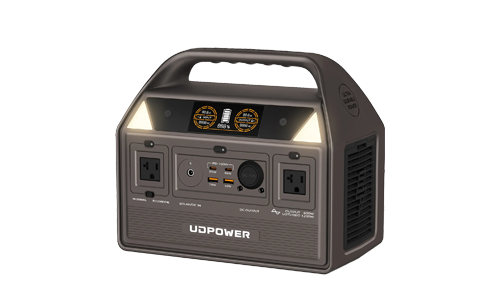
The S1200 is a strong middle ground for refrigerator planning, CPAP, Wi-Fi, lights, laptops, fans, TV, and short appliance use. It provides substantially more energy than compact power stations without moving into the weight of a 2kWh-class unit.
It is especially suitable when your goal is an overnight outage rather than only phone charging.
View UDPOWER S1200UDPOWER S2400
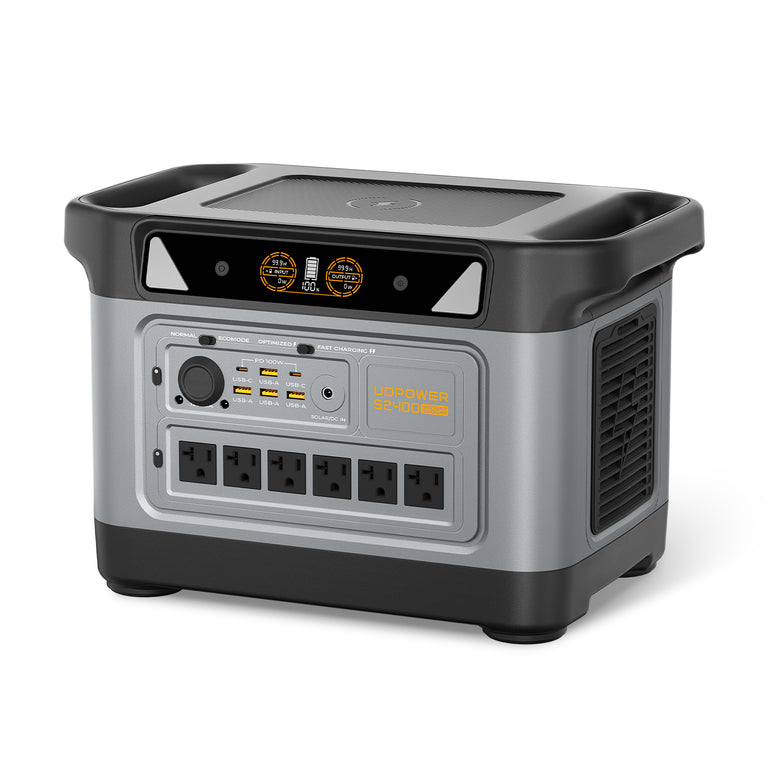
- Battery capacity: 2,083Wh
- Planning AC energy at 90%: about 1,875Wh
- Rated AC output: 2,400W pure sine wave
- Startup peak: up to 3,000W
- Maximum recommended solar input: 420W
- UPSPrime: 10ms or less under stated conditions
- AC outlets: 6
- Weight: approximately 40.8 lb
- Current unit-only price: $699.99
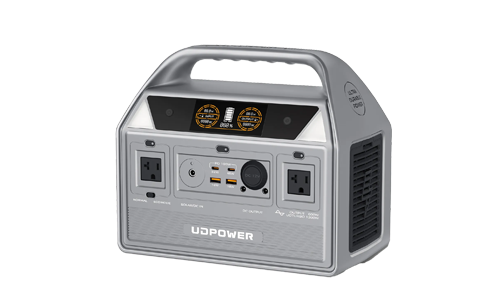
The S2400 is the stronger option when refrigerator backup is only one part of the plan. Its larger battery and inverter leave more room for CPAP, internet, lights, laptops, fans, TV, and selected short-duration kitchen loads.
Its solar capability also makes more sense for extended outages. Current solar-generator configurations include S2400 kits with 120W, 210W, 240W, or 420W-class panel combinations depending on the selected bundle.
View UDPOWER S2400 View S2400 Solar Generator KitsUDPOWER C600

- Battery capacity: 596Wh
- Planning AC energy at 90%: about 536Wh
- Rated AC output: 600W
- Peak: up to 1,200W
- Maximum solar input: 240W
- Weight: approximately 12.3 lb
- Listed price: $289.99
- Availability when checked: sold out
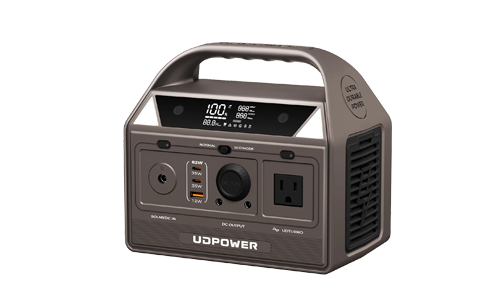
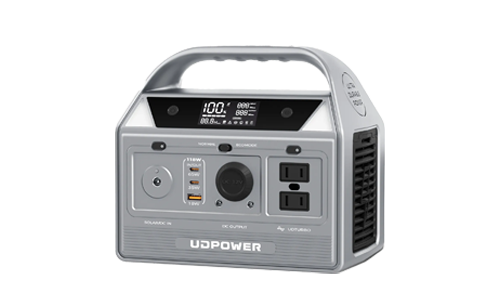
The C600 makes more sense for a compact outage kit: router, phones, laptop, lighting, fan, camera equipment, and selected low-power refrigeration. Its 600W rated output makes it a different class of product from the S1200 and S2400.
Check C600 AvailabilityFor a side-by-side comparison, use the UDPOWER Portable Power Station Comparison.
How to Use an LFP Home Battery Backup Safely
LFP chemistry is only one part of a safe system. The enclosure, battery-management system, inverter, cables, temperature limits, certification, and how the owner uses the product all matter.
| Do | Why | Avoid |
|---|---|---|
| Use the battery on a stable, dry surface with clear ventilation. | Inverters and charging electronics produce heat. | Do not cover cooling vents. |
| Check appliance running and startup requirements. | Compressors, pumps, and motors can demand high startup power. | Do not assume plug shape determines compatibility. |
| Use suitable cables and extension cords. | Heavy loads require correctly rated wiring. | Avoid overloaded or daisy-chained power strips. |
| Follow the listed charging and storage temperature limits. | Temperature affects battery performance and longevity. | Do not leave a battery in extreme heat for extended periods. |
| Keep the station accessible during an outage. | You need to see warnings, input, output, and battery level. | Do not bury it behind furniture or stored items. |
| Use professionally designed equipment if supplying home circuits. | Electrical-panel connections require correct transfer, protection, grounding, and configuration. | Never backfeed a wall outlet. |
Portable Battery Safety Standards Are Not the Same as Installed ESS Standards
UL identifies UL 2743 as a standard associated with portable power packs. Larger stationary residential energy-storage systems fall into a different installation category, where UL 9540 and UL 9540A-related requirements may apply.
That distinction is important because buying a large portable power station does not automatically make it suitable for permanent installation into household wiring.
Sources: UL portable power pack testing and UL energy storage installation guidance.
Battery Backup vs Gas Generator Indoors
A portable battery does not burn gasoline while supplying power, which makes it fundamentally different from a combustion generator. Gasoline, propane, and similar combustion equipment can produce carbon monoxide and must follow outdoor-use rules.
Ready.gov advises operating generators outdoors and at least 20 feet away from windows, doors, and attached garages.
Source: Ready.gov Power Outages.
The Two-Hour Test Every Home Backup Owner Should Run
The most useful runtime information is not a generic chart. It is the data from your own refrigerator, router, CPAP, laptop, and lights.
Before storm season, run a controlled test while grid power is still available.
- Charge the power station fully. Record the starting battery percentage.
- Connect only your planned emergency loads. Do not add entertainment or convenience loads that are not part of the plan.
- Write down the displayed output. Watch for compressor or motor startup events.
- Operate normally for two hours. Use the equipment the way you would during a real outage.
- Record the ending battery percentage.
- Calculate your observed consumption rate.
- Identify the first weak point. It may be battery capacity, output, a forgotten device, refrigerator surge, a cable, or simply too many low-priority loads.
- Adjust the plan and repeat if necessary.
Example
If your battery falls from 100% to 82% during a two-hour test, you used about 18% of the battery under those conditions.
A simple first estimate would suggest roughly 11 hours from 100% to empty at the same usage pattern. In practice, leave reserve rather than planning to reach zero.
This test also catches problems that a wattage table cannot: a refrigerator that surges higher than expected, a CPAP heater that dramatically increases consumption, or a router system that includes an overlooked modem or fiber ONT.
Use an Outage Log to Improve the Next Backup Plan
After a real outage, write down what actually happened. This takes five minutes and can be more useful than buying a larger battery based on guesswork.
| Record | Why It Helps Next Time |
|---|---|
| Outage start and restoration time | Shows the backup duration your location actually experiences |
| Starting and ending battery percentage | Reveals real household energy use |
| Highest displayed wattage | Shows whether inverter headroom is sufficient |
| Which appliance caused the biggest drop | Identifies where load reduction matters most |
| Solar energy recovered | Shows whether your panel setup can replace overnight use |
| What you wished you could power | Helps decide whether the next upgrade should be capacity, output, or solar |
Real outage data makes future sizing far more reliable than adding another 500Wh simply because it sounds safer.
How Should You Store and Maintain an LFP Backup Battery?
LFP batteries are low-maintenance, but emergency equipment still needs periodic attention.
| When | What to Do | Why |
|---|---|---|
| After purchase | Charge it and test your actual priority devices. | Confirms compatibility before an emergency. |
| Every few months | Check battery level, cables, ports, and physical condition. | Prevents discovering an empty or damaged unit during a storm. |
| Before storm season | Run the two-hour outage drill. | Updates your runtime estimate using current household equipment. |
| After heavy use | Allow the unit to cool, recharge it, and inspect it before storage. | Keeps emergency equipment ready for the next outage. |
| After buying a new refrigerator or medical device | Repeat load and runtime testing. | Your old energy budget may no longer be accurate. |
| When adding solar panels | Confirm voltage range, current limit, connector, and maximum input. | Panel wattage alone does not determine compatibility. |
LFP Home Battery Buying Checklist
Use this order. It prevents buying around marketing specifications instead of your household needs.
- List must-run devices. Separate critical loads from convenience loads.
- Record voltage. A portable 120V power station cannot replace every 240V household circuit.
- Measure or confirm running watts.
- Check startup demand. Pay particular attention to refrigerators, freezers, pumps, and motors.
- Calculate watt-hours. Multiply average watts by expected operating time.
- Add conversion loss and reserve. This guide uses 90% conversion efficiency for UDPOWER runtime planning.
- Choose inverter output. Make sure simultaneous loads stay within the station's capability.
- Decide whether one battery charge is enough.
- If not, plan recovery. Compare solar input and likely daylight availability.
- Check transfer behavior if UPS use matters.
- Confirm charging and storage temperature limits.
- Check physical weight. A 40 lb battery and a 12 lb battery serve different portability needs.
- Review certification, warranty, and support.
- Test the complete system before you need it.
When Should You Choose a Larger Battery?
Moving to a larger LFP battery makes sense when one or more of these conditions apply:
- your refrigerator is a must-run load;
- someone needs overnight medical equipment;
- multiple people need internet and work equipment;
- you expect outages longer than eight to twelve hours;
- you need more inverter headroom for motors or kitchen appliances;
- you want enough reserve that the battery does not need to be managed minute by minute.
When a Bigger Battery Is Not the Best Upgrade
A larger battery is not always the first thing you need.
If a 1,190Wh battery already gets you comfortably through the night but you regularly face two-day outages, adding meaningful solar recovery may be more useful than buying extra stored energy.
If your problem is starting a high-power motor, the issue may be inverter output rather than battery capacity.
If the problem is central air conditioning or 240V circuits, neither a small nor a larger 120V portable station solves the fundamental system requirement.
What an LFP Portable Power Station Is Not Designed to Replace
Portable LFP backup works best when it protects a small set of high-value loads.
It is generally not a direct replacement for:
- central air conditioning;
- whole-home electric heating;
- electric water heaters;
- electric ranges;
- electric clothes dryers;
- large 240V well pumps;
- Level 2 EV charging;
- every circuit in a large home operating normally.
If your goal is to back up fixed household circuits, start with the actual circuit loads and voltage before choosing the battery. Then have the transfer method and electrical installation evaluated appropriately.
For more detail, see Transfer Switch vs Interlock Kit.
Frequently Asked Questions About LFP Home Battery Backups
What does LFP mean in a home battery backup?
LFP means lithium iron phosphate, also written LiFePO4. It is a lithium battery chemistry commonly used in modern portable power stations and energy-storage products because it offers long cycle life, strong thermal stability, and relatively low maintenance.
Is an LFP home battery backup the same as a UPS?
No. A UPS is primarily intended to bridge power interruptions and keep compatible electronics from shutting down. A home battery or portable power station is primarily about stored energy and runtime. Some power stations include UPS-style transfer functionality, but transfer time and battery runtime are separate specifications.
How big of an LFP battery do I need for home backup?
For Wi-Fi, phones, lights, and a laptop, a few hundred watt-hours can be enough. Refrigerator, CPAP, fans, and overnight essentials often make a 1,000Wh-class battery more practical. Larger mixed loads or longer outages may justify 2,000Wh or more plus a recharging plan. Size the battery around your actual watt-hours rather than the size of your house.
Can an LFP battery backup run a refrigerator?
Yes, provided the power station has enough inverter output for the refrigerator's startup demand and enough battery capacity for the required runtime. Refrigerators cycle on and off, so measuring energy use over time is more useful than looking only at running watts.
How long will a 1,000Wh-class battery run home essentials?
It depends on the combined load. The 1,190Wh UDPOWER S1200 provides about 1,071Wh of planning AC energy at 90% efficiency. A continuous 100W average load works out to about 10.7 hours, while a 50W average load works out to about 21.4 hours. Actual runtime varies with the connected equipment and operating conditions.
Can I connect a portable LFP power station directly to my electrical panel?
Do not backfeed a wall outlet or household panel. Supplying fixed home circuits requires compatible transfer equipment, correct electrical design, and professional installation where applicable. Portable power equipment and installed residential energy-storage systems are not the same product category.
Is LFP safe to use indoors?
Portable LFP power stations are designed for battery-powered use without combustion exhaust, but they still need to be operated according to the manufacturer's instructions. Keep the unit dry, provide ventilation around cooling openings, stay within charging and operating temperature limits, and use compatible loads and cables.
Is solar required for an LFP home backup battery?
No. A power station can normally be charged from a wall outlet before an outage. Solar becomes increasingly useful when an outage lasts longer than one battery charge because it gives you a way to recover part of the energy used during the previous day.
How much solar do I need for a home backup battery?
Start with daily energy consumption rather than battery size. If your essential loads consume 1,000Wh per day, the goal is to replace as much of that 1,000Wh as practical during daylight. Panel wattage, sunlight, shade, season, system losses, and the power station's solar-input limit all affect how much energy you can actually recover.
Can an LFP battery run a space heater?
A large enough inverter may operate some space heaters, but heating is usually a poor use of limited battery capacity. A 1,500W heater consumes energy very quickly, so even a 2kWh-class battery provides relatively short runtime compared with low-power loads such as Wi-Fi, lights, fans, or CPAP equipment.
How many cycles does an LFP battery last?
Cycle life depends on battery design, temperature, charging behavior, depth of discharge, and the manufacturer's specification. For UDPOWER LFP lifecycle planning, use approximately 80% or more remaining capacity after 3,000 cycles and approximately 70% or more remaining capacity after 4,000 cycles.
Should I buy the largest home backup battery I can afford?
Not necessarily. Bigger batteries cost more, weigh more, and may not solve the actual limitation. If your problem is startup power, you may need more inverter output. If your problem is a multi-day outage, better solar recovery may be more useful. If your problem is a 240V household circuit, a portable 120V station may not be the right system regardless of battery size.
What is the best way to test a home battery before an outage?
Fully charge it and run the actual equipment in your emergency plan for about two hours. Record the starting and ending battery percentage, average output, and any startup peaks. This gives you a household-specific runtime estimate and exposes compatibility problems while grid power is still available.
Build Your Backup Plan Around the Loads That Matter
A useful LFP home backup system is not the battery with the largest number on the box. It is the setup that can start your essential appliances, provide enough watt-hours for the outage window you care about, and recover energy fast enough if the blackout continues.
Start with your must-run devices, measure their actual energy use, test the setup before storm season, and add battery capacity or solar only where your real outage data shows you need it.
Compare UDPOWER Models View Home Backup Power Stations View Solar Generator Kits Get the 24/48/72-Hour Outage GuideRelated Articles


