

Portable Power Station for Outdoor Events: How Much Power Do You Need?
Last updated: October 27, 2026

An outdoor event can look electrically simple until everything is plugged in at the same time. A card reader needs a tablet. The tablet needs Wi-Fi. The display needs lighting. Someone adds a fan. The photographer wants to charge batteries. Then a projector, powered speaker, refrigerator, coffee maker, or food warmer appears and completely changes the power plan.
That is why I do not size event power by saying, “This is a wedding, so you need a 2,000Wh battery,” or, “This is only a farmers market, so a small station is enough.” The useful question is: What equipment will actually be running, how many watts can overlap, and for how many hours?
This guide walks through that process for outdoor weddings, farmers markets, vendor booths, craft fairs, community festivals, school and church events, outdoor movie nights, parade setups, pop-ups, registration tables, exhibitions, small performances, and food or beverage booths.
How Much Power Does an Outdoor Event Need?
There is no single correct battery size for an outdoor event. A four-hour craft booth running a tablet and LEDs has almost nothing in common with a four-hour movie night running a projector and powered speakers.
As a starting point, most setups fall into these broad categories:
| Event Power Level | Typical Equipment | Suggested Continuous Output Range | Typical Capacity Starting Point | Best Fit |
|---|---|---|---|---|
| Light | Phones, tablet, POS terminal, LED lights, small laptop | 200–400W | 200–500Wh | Short vendor booths, check-in tables, small displays |
| Standard | Laptops, lighting, fans, small cooler, charging station, compact audio | 600–1,200W | 800–1,500Wh | Farmers markets, craft fairs, pop-ups, school events |
| Higher Demand | Projector, powered speakers, refrigeration, multiple vendors, larger displays | 1,200–2,400W | 1,500–3,000Wh+ | Outdoor movies, weddings, exhibitions, larger booths |
| Commercial / Production | Large PA systems, stage lighting, commercial cooking, HVAC, refrigeration trailers | Often above 2,400W | Several kWh or more | Large festivals, professional stages, catering operations |
These are planning categories, not guarantees. The label on your own equipment always takes priority over a generic wattage chart.
Watts vs. Watt-Hours: You Need to Check Both
Outdoor event power planning becomes much easier once you separate two measurements.
Watts tell you what can run at the same time
Watts are the instantaneous electrical load. If a projector uses 250W, two powered speakers draw 150W each, and a laptop draws 60W, the combined planning load is:
Your portable power station must be able to support the actual simultaneous load, plus any startup requirement from equipment with compressors or motors.
Watt-hours tell you how long the event can run
If that 610W setup averaged 610W for three hours:
That is already more energy than many 1,000Wh-class batteries store, even before conversion losses and reserve are included.
This distinction matters because high-wattage equipment used briefly can consume less battery than a modest load that runs all day.
| Example | Power | Operating Time | Energy Used |
|---|---|---|---|
| 1,000W coffee maker | 1,000W | 10 minutes | About 167Wh |
| 100W display | 100W | 8 hours | 800Wh |
| 200W food warmer | 200W | 6 hours | 1,200Wh |
| 1,500W griddle | 1,500W | 30 minutes | 750Wh |
Outdoor Event Equipment Wattage Chart
The table below is useful for early planning. Actual power draw varies by model, operating mode, brightness, volume, thermostat cycle, battery charging state, and other factors. Check the equipment label, manual, or a watt meter before event day.
| Equipment | Typical Planning Range | Load Type | What to Watch | Source |
|---|---|---|---|---|
| LED string lights | 10–100W | Continuous | Total wattage increases with the number and length of light strings | Outdoor wattage guide |
| Bluetooth speaker | 20–100W | Continuous / rechargeable | Actual charging draw may be lower after its internal battery fills | Outdoor wattage guide |
| Powered speaker | 100–500W | Variable audio load | Check actual AC input, not only advertised audio wattage | Outdoor wattage guide |
| Outdoor projector | 100–350W | Continuous | Brightness mode can materially change consumption | Outdoor wattage guide |
| Box or pedestal fan | 40–100W | Continuous | High-speed operation uses more energy | Outdoor wattage guide |
| Mini refrigerator / beverage cooler | 50–150W while running | Cycling compressor | Startup demand can be higher than normal running power | Outdoor wattage guide |
| Electric food warmer | 200–500W | Heating | Long operating time can consume substantial Wh | Outdoor wattage guide |
| Electric grill | 1,000–1,800W | High-power heating | Can drain a portable battery very quickly | Outdoor wattage guide |
| Phone / tablet charging | 5–30W each | Variable charging | Draw usually falls as the device approaches full charge | Outdoor wattage guide |
| Event AV, POS, refrigeration and lighting | Use equipment nameplate data | Varies | If the label gives volts and amps, watts can be estimated from volts × amps | United Rentals event planning guide |
How to Calculate Your Outdoor Event Power Requirement
This is the process I recommend using before choosing a battery.
Step 1: Make a complete equipment list
Do not write “DJ setup” or “vendor booth.” Write down the individual equipment:
- Projector
- Powered speaker 1
- Powered speaker 2
- Laptop
- LED lighting
- Tablet / POS terminal
- Wi-Fi hotspot
- Phone chargers
- Fan
- Cooler or refrigerator
- Printer
- Camera battery chargers
Step 2: Find the wattage of each device
Use the actual device label or manual whenever possible. If an appliance lists volts and amps instead of watts, a basic estimate is:
For example, a 120V device drawing 2A represents approximately 240W of input.
Step 3: Calculate your maximum simultaneous load
Do not add every device if they will never operate together. Add the devices that could realistically overlap.
If your booth normally runs at 180W but you occasionally start a 600W appliance, the output requirement is not simply 180W.
For compressors, pumps, refrigerators, and other motor-driven equipment, also check startup demand.
Step 4: Calculate energy use in watt-hours
Calculate each load separately if operating times differ, then add the results.
Step 5: Account for conversion losses
For UDPOWER runtime planning, I use a 90% conversion-efficiency estimate rather than assuming every labeled watt-hour reaches an AC appliance.
Actual runtime can vary with load level, temperature, inverter overhead, battery condition, compressor cycling, and whether you are using AC, USB, or DC output.
You can also use the UDPOWER Runtime Calculator for a quick estimate.
Step 6: Keep a reserve instead of planning to finish at 0%
For an event where power loss would interrupt payments, audio, lighting, check-in, refrigeration, or communications, I prefer to plan around a reserve rather than using every theoretical watt-hour.
If you want approximately 20% battery remaining at the end of the event, a useful planning equation is:
That means a setup expected to consume 720Wh would ideally start with roughly:
This is more conservative than simply buying a 720Wh battery and hoping conditions stay perfect.
How Much Power Do Different Outdoor Events Need?
The following table is designed as a planning shortcut. The ranges are not substitutes for checking your own equipment.
| Event Type | Common Electrical Loads | Practical Planning Concern | UDPOWER Starting Point |
|---|---|---|---|
| Outdoor weddings | PA, microphones, decorative LEDs, DJ support, camera chargers, laptops | Separate ceremony audio from decorative and vendor loads so one overload does not affect everything | S1200 for a focused ceremony/media circuit; S2400 for larger mixed loads |
| Farmers markets | POS terminal, tablet, phones, lights, fan, small cooler | Long operating time often matters more than maximum wattage | S1200 for most full-day powered booths; C400 for short low-load setups |
| Vendor booths | POS, laptop, displays, lights, chargers, fan | Calculate the entire selling day, including setup and teardown | C400 for very light booths; S1200 for longer multi-device use |
| Craft fairs | LED displays, payment devices, phones, tablets, small tools | Multiple low-watt devices can still consume significant energy over eight hours | C400 or S1200 depending on duration |
| Community festivals | Booth lighting, PA, registration devices, displays, refrigeration | Plan power per booth or functional zone instead of trying to power the entire festival from one station | S1200 or S2400 per power zone |
| School events | Check-in equipment, projector, laptop, PA, charging station | Keep communications and registration separate from entertainment loads | S1200 for standard setups; S2400 for projector plus audio and longer operation |
| Church events | PA, microphones, musical equipment, projector, lights | Audio reliability is usually more important than powering every convenience appliance | S1200 or S2400 depending on sound system |
| Outdoor movie nights | Projector, powered speakers, laptop or streaming device, lights | Projector and audio run continuously, so energy use accumulates quickly | S1200 for compact setups; S2400 for larger systems |
| Parade setups | LED decorations, illuminated signs, small audio equipment | Weight, secure placement, cable routing, and moving operation matter | S1200 is a proven UDPOWER use case |
| Pop-up events | POS, display lighting, phones, laptop, small monitor | Setup should be fast and independent of venue outlets | C400 for light use; S1200 for longer or higher-load pop-ups |
| Registration / check-in tables | Laptops, tablets, printers, phones, hotspot | Low wattage does not mean low total Wh if the table operates all day | S1200 for an all-day multi-device table |
| Outdoor exhibitions | Monitors, displays, lighting, laptops, demo equipment | Demo equipment may create short high-load periods | S1200 or S2400 |
| Small stages / performances | Powered speakers, mixer, instruments, stage lights, laptop | Professional audio and lighting can quickly exceed small-station capacity | S2400 for modest systems; professional temporary power for larger production |
| Food and beverage booths | Cooler, refrigerator, blender, warmer, coffee maker, cooking appliances | Heating and refrigeration dominate both wattage and energy consumption | S2400 for selected loads; venue or commercial temporary power for heavy cooking |
Three Realistic Event Power Calculations
Example 1: Eight-Hour Registration Table
Assume the table averages approximately 105W across a laptop, tablet/POS equipment, phone charging, hotspot, and intermittent printer use.
| Calculation | Result |
|---|---|
| Average load | 105W |
| Event duration | 8 hours |
| Estimated device energy | 105W × 8h = 840Wh |
| Rated capacity with 90% planning efficiency and 20% reserve | 840Wh ÷ 0.72 ≈ 1,167Wh |
This is a good illustration of why a check-in table can need more battery than expected. The instantaneous wattage is low, but the equipment may operate continuously for most of the day.
A UDPOWER S1200 is in the right capacity class for this example, but I would still measure the actual equipment because a printer, laptop charger, or additional devices could shift the calculation.
Example 2: Six-Hour Vendor Booth
Imagine a booth averaging around 165W with display lighting, laptop, POS equipment, fan, and charging.
Using the same reserve approach:
This is where blindly choosing a “1,000Wh power station” can leave too little reserve. If the fan runs less often, the laptop is already charged, or the booth uses direct USB power efficiently, actual consumption may be lower. But if 165W really is the measured average draw, a larger battery such as the S2400 gives much more operating margin.
Example 3: Three-Hour Outdoor Movie
Suppose the setup contains:
- Projector: 250W
- Powered speaker 1: 150W planning load
- Powered speaker 2: 150W planning load
- Laptop / media source: 60W
If you also want a 20% reserve:
This example is intentionally useful because it shows when even a 2,083Wh S2400 may not provide the reserve you want. The answer is not to pretend the calculation fits. You can reduce the actual average load, shorten runtime, use equipment with its own battery, split the load between two power sources, recharge during the event, or move to a larger temporary-power solution.
The Event-Power Strategy I Prefer: Separate Critical and Non-Critical Loads
One of the biggest improvements you can make is to stop treating an event as one giant electrical load.
I would divide equipment into three groups.
| Priority | Examples | What Happens if Power Fails? | Planning Approach |
|---|---|---|---|
| Critical | POS, check-in laptop, communications, ceremony microphone, essential refrigeration | Sales stop, guests cannot check in, communication fails, food may be affected | Give these loads protected capacity and reserve |
| Important | Main lighting, projector, standard PA, booth display | Event experience is degraded | Size carefully and monitor remaining runtime |
| Optional | Extra decorative lighting, public phone charging, secondary displays, convenience appliances | Event can continue | Disconnect first if reserve drops too quickly |
This approach is often better than plugging every vendor device into the same station. A coffee maker should not be able to take down your payment system. Decorative lights should not consume the reserve intended for the ceremony microphone.
Recommended UDPOWER Portable Power Stations for Outdoor Events
The correct model depends on measured load and event duration. These recommendations use the current specifications published on UDPOWER's product pages.

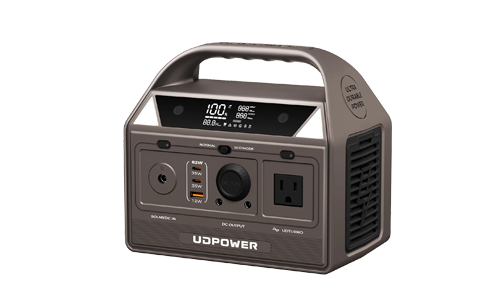
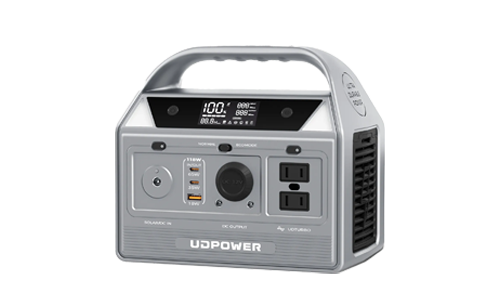
UDPOWER C400 — Best for Lightweight Event Power
The C400 makes the most sense when portability matters more than all-day capacity. It can support low-demand equipment such as payment devices, phones, laptops, compact displays, and LED lighting when the combined load remains within its limits.
- Capacity: 256Wh
- Rated AC output: 400W pure sine wave
- AC outlets: 2
- Weight: approximately 6.88 lb
- Solar input: up to 150W
- Best event use: short vendor booths, registration support, payment equipment, charging, small displays
At a constant 50W load, the 90%-efficiency planning estimate is approximately 4.6 hours. At 100W, it drops to about 2.3 hours. That is why I would not treat a 256Wh station as an all-day solution simply because the equipment fits within 400W.
View UDPOWER C400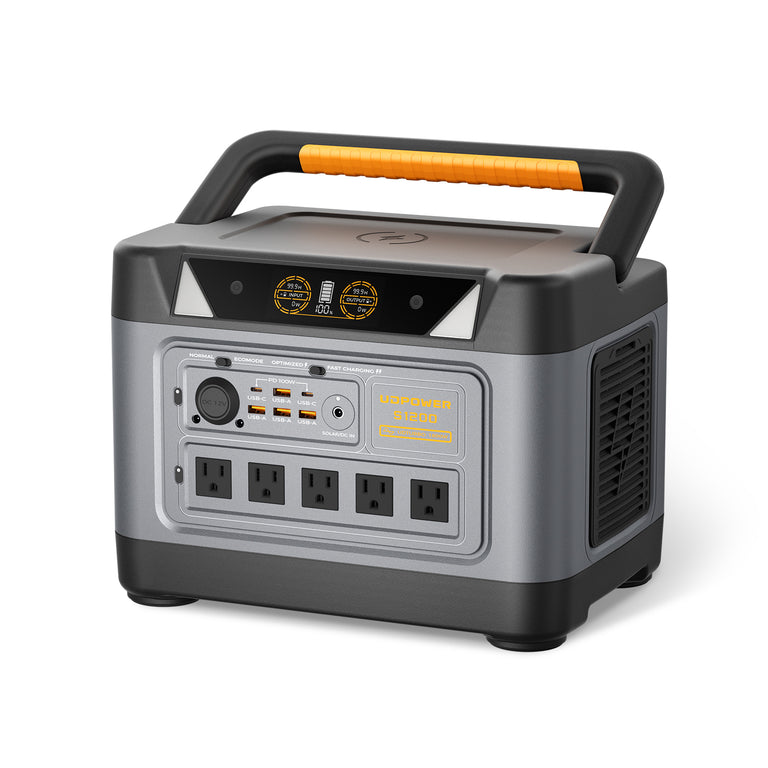
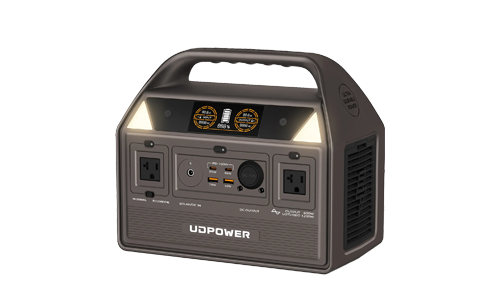
UDPOWER S1200 — Best All-Around Choice for Standard Event Setups
For many single-booth and single-zone event setups, the S1200 is the most balanced option. Its 1,190Wh battery gives substantially more runtime than a compact station while its 1,200W rated AC output covers a much broader range of event equipment.
- Capacity: 1,190Wh
- Rated AC output: 1,200W pure sine wave
- UDTURBO: up to 1,800W for compatible higher-power loads
- AC outlets: up to 5 on the 5-AC version
- Total outputs: up to 14 on the 5-AC version
- Weight: approximately 26 lb
- Solar input: up to 400W
- Best event use: full-day check-in, vendor booths, markets, wedding ceremony equipment, small AV systems, parade displays
For event planning, I would size around the 1,200W rated continuous AC output rather than assuming the higher UDTURBO figure is your normal continuous-load budget.
A 200W constant load works out to roughly 5.4 hours using a 90% planning factor. A 100W load is roughly 10.7 hours.
View UDPOWER S1200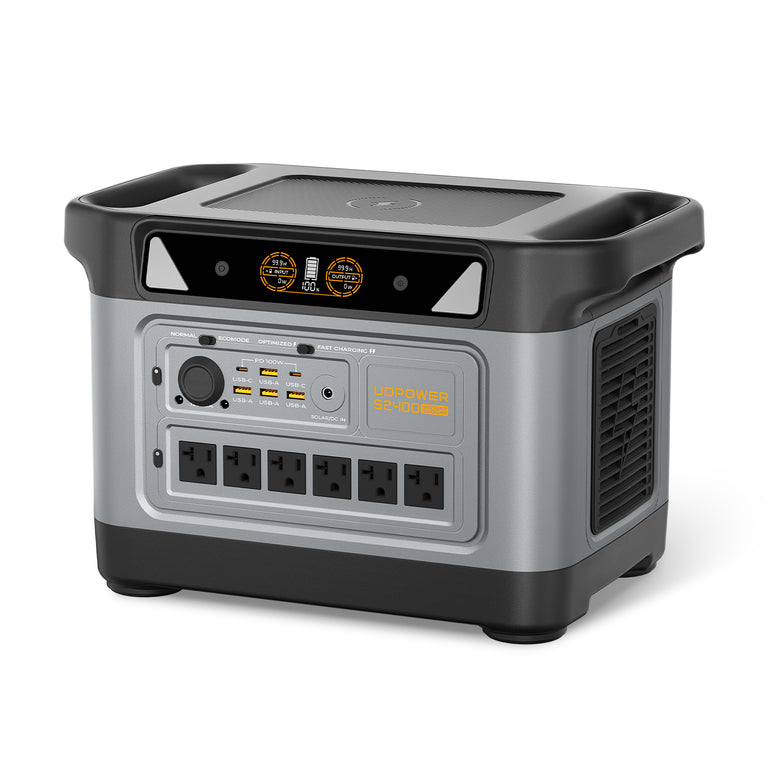
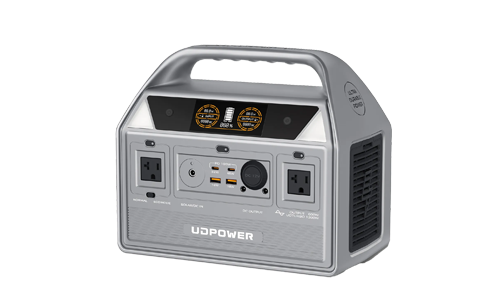
UDPOWER S2400 — Best for Higher-Demand Outdoor Events
The S2400 is the stronger choice when an event combines AV equipment, refrigeration, lighting, displays, or other larger loads. Its main advantage is not just the larger battery—it also provides much more continuous output headroom.
- Capacity: 2,083Wh
- Rated AC output: 2,400W pure sine wave
- Startup / surge support: up to 3,000W
- AC outlets: 6
- Total outputs: 15
- Weight: approximately 40.8 lb
- Solar charging: up to 420W under the current UDPOWER configuration guidance
- Best event use: larger vendor setups, outdoor movies, exhibitions, higher-demand wedding zones, modest stage systems, refrigeration and selected food-service loads
Using the same 90% planning factor, a steady 200W load works out to approximately 9.4 hours, 300W to about 6.2 hours, and 500W to about 3.7 hours.
The important limit is still energy. A 1,500W heating appliance can consume a large portion of the battery very quickly even though the S2400 has enough output wattage to run many such appliances.
View UDPOWER S2400| Model | Capacity | Rated AC Output | Approx. Runtime at 100W | Approx. Runtime at 200W | Event Fit |
|---|---|---|---|---|---|
| C400 | 256Wh | 400W | ~2.3 hr | ~1.2 hr | Short, low-load setups |
| S1200 | 1,190Wh | 1,200W | ~10.7 hr | ~5.4 hr | Standard booths and event zones |
| S2400 | 2,083Wh | 2,400W | ~18.7 hr | ~9.4 hr | Larger and higher-demand setups |
Runtime estimates use battery capacity × 90% ÷ load watts. Actual results vary with operating conditions and equipment behavior.
A Real Outdoor Event Example: An Illuminated Parade Float
One of the more useful real-world examples on the UDPOWER site comes from an illuminated night parade in San Antonio. A customer used an S1200 to support an illuminated parade float where quiet operation and avoiding combustion exhaust around the public were important considerations.
The example is relevant beyond parades because the same requirements appear at school activities, community festivals, nonprofit events, vendor booths, and public displays: the power source has to move with the setup, operate around people, and support lights or electronics without depending on a nearby wall outlet.
Read the UDPOWER S1200 parade float customer story.
Portable Power Station vs. Generator for Outdoor Events
A battery power station is not automatically better than a generator. Each solves a different problem.
| Factor | Portable Power Station | Fuel Generator |
|---|---|---|
| Noise | Generally much quieter; cooling fans may still operate | Engine noise is continuous when running |
| Combustion exhaust | No combustion exhaust at the point of use | Produces exhaust including carbon monoxide |
| Fuel | No gasoline or diesel required during operation | Requires fuel storage and refueling |
| Runtime | Limited by stored battery energy and available recharging | Can continue as long as safe fuel supply and operating conditions allow |
| Best use | Booths, check-in, lights, electronics, selected AV, small refrigeration | Long-duration high loads, large production systems, commercial temporary power |
For events near guests, vendors, ceremony spaces, microphones, or quiet public areas, battery power has an obvious practical advantage: there is no combustion engine running next to the activity.
Generators still make sense when loads are too large or too long for a practical battery system. Commercial cooking, large refrigeration systems, major stage production, electric heating, and multi-day continuous operation may require professional temporary power rather than a consumer portable station.
Should You Add Solar Panels During an Outdoor Event?
Solar can help, but I would treat it as supplemental energy unless you have tested the exact setup beforehand.
A panel labeled 400W does not mean you will continuously receive 400W from sunrise to sunset. Clouds, shade, sun angle, heat, panel orientation, wiring, and the station's input limit all affect charging power.
Solar is most useful for:
- Daytime farmers markets
- Multi-day festivals
- Long outdoor exhibitions
- Remote event setups with no wall outlet
- Maintaining battery level while low-to-moderate loads are running
Current UDPOWER S-Series solar-input guidance includes:
| Model | Solar Input | Useful Event Strategy | Official Source |
|---|---|---|---|
| S1200 | 12–75V, 12A, 400W max | Useful for daytime top-ups during markets, booths, or multi-day events | S1200 specifications |
| S2400 | 12–50V, 10A; current UDPOWER guidance supports up to 420W of nominal panel configuration | Better suited to higher daily energy use where solar recovery matters | S2400 specifications |
For a deeper explanation of voltage, wattage, connectors, and charging time, see Can You Charge a Portable Power Station with a Solar Panel?
Outdoor Event Power Safety: The Details That Matter
Keep the power station dry
Do not assume a portable power station is rainproof simply because it is designed for portable or outdoor use. Keep the battery, AC outlets, plugs, and electrical connections protected from rain, irrigation, wet grass, puddles, and spilled drinks.
Keep ventilation openings clear
Do not hide the station inside a sealed box, under fabric, or behind decorations that block cooling airflow. Shade can help with heat exposure, but the unit still needs ventilation.
Use extension cords rated for outdoor use
The Electrical Safety Foundation International recommends using cords rated for their intended environment and load, avoiding damaged cords, and not connecting extension cords to other extension cords.
Review ESFI extension cord safety guidance.
Protect walking areas
Event power is as much a cable-management problem as an electrical problem. Do not leave power cords loose across guest walkways, vendor aisles, stage access, or vehicle paths. Use appropriate cable protection and follow venue requirements.
Check the venue rules before arrival
Parks, schools, fairgrounds, churches, stadiums, event venues, and municipalities can have their own rules for temporary electricity, extension cords, generators, food-service equipment, and fire safety. A battery power station does not automatically exempt your setup from venue requirements.
Do not overload power strips
Having six outlets does not create six separate inverter capacities. The total connected AC load still has to remain within the power station's output limit.
When a Portable Power Station Is Not Enough
I would stop trying to force the event onto a portable battery if the plan depends on:
- Multiple commercial electric cooking appliances
- Large induction cooktops or electric grills operating for long periods
- Large refrigeration trailers
- Electric space heating or air conditioning
- Large professional stage lighting systems
- Major concert PA systems
- Three-phase equipment
- Several kilowatts of continuous demand for most of the day
- Mission-critical equipment without adequate redundancy
At that point, venue power, a professionally designed temporary electrical system, or an appropriately sized generator may be the more reliable choice.
A hybrid setup can also work well: use professional temporary power for catering or production equipment while a battery station handles quiet zones, registration, communications, cameras, lighting, or payment systems.
Outdoor Event Power Checklist
Before leaving for the venue, I would verify all of the following:
- List every device that will need power.
- Record its actual wattage or electrical input rating.
- Identify which devices will operate simultaneously.
- Check motor or compressor startup requirements.
- Calculate watt-hours for each device based on expected operating time.
- Include conversion losses.
- Keep a battery reserve instead of targeting 0% at closing time.
- Fully charge the station before departure.
- Test the entire setup before event day.
- Check venue rules for temporary power and generators.
- Use outdoor-rated cords where required.
- Protect plugs and the power station from water.
- Keep cables out of guest and vehicle traffic.
- Separate critical loads from optional loads where practical.
- Bring the correct charging cables and adapters.
- If using solar, verify panel voltage, current, connector, and station input limits.
Frequently Asked Questions
What size portable power station do I need for an outdoor event?
Start with the equipment, not the event name. Add the watts of everything that may operate simultaneously, then calculate the watt-hours each device will consume over the entire event. Small check-in or vendor setups may work with a few hundred watts of output, while projectors, powered speakers, refrigeration, and food equipment can push requirements above 1,000W very quickly.
Is a 1,000Wh power station enough for an outdoor event?
It can be. A roughly 1,000Wh-class unit is a practical range for many vendor booths, check-in tables, markets, and small AV setups. But a 200W average load running for eight hours requires 1,600Wh of device energy, so duration matters as much as the instantaneous wattage.
How long will a 1,190Wh S1200 run event equipment?
Using a 90% planning factor, the S1200 provides roughly 1,071Wh of estimated usable energy for AC runtime calculations. That is about 10.7 hours at 100W, 5.4 hours at 200W, or 3.6 hours at 300W under simplified constant-load assumptions. Actual runtime varies.
Can a portable power station run an outdoor movie projector?
Yes, if the projector and the rest of the system remain within the station's output limit and battery capacity. Many outdoor movie setups also include powered speakers, a laptop or streaming device, and lighting, so calculate the entire system rather than the projector alone.
Can I use a portable power station for an outdoor wedding?
Yes. Portable power stations can be useful for ceremony audio, decorative lighting, photography equipment, laptops, charging, and selected reception equipment. Larger DJ systems, extensive lighting, commercial catering, or HVAC may require a larger temporary-power solution.
What is the best portable power station for a farmers market?
It depends on booth equipment and market duration. A compact C400 can make sense for a short, low-power setup. An S1200 is a better starting point for longer booths using POS equipment, lights, laptop charging, a fan, or other devices throughout the day. Refrigeration and heating can justify moving to the S2400.
Can I power a vendor booth without a generator?
Often, yes. POS terminals, tablets, LED lighting, laptops, phones, displays, fans, and small electronics are well suited to battery power when their total wattage and runtime are calculated correctly. Heavy cooking or large refrigeration loads may still require venue or generator power.
Can a portable power station run a food booth?
It can power selected food-booth equipment, but electric heating changes the calculation quickly. Coolers, small refrigerators, POS equipment, lights, and brief blender use can be practical. Grills, induction cookers, hot-water equipment, coffee makers, and multiple food warmers can consume battery energy rapidly. Calculate each appliance separately.
Should I use solar panels at an outdoor event?
Solar can extend runtime during a daytime event, especially at markets, festivals, and remote locations. Do not assume the panel will continuously produce its rated wattage. Weather, sun angle, shade, temperature, and the power station's input limit affect real charging performance.
Is a battery power station better than a generator for a wedding or festival?
For moderate loads near guests, vendors, microphones, displays, or quiet areas, battery power is often easier because there is no combustion engine or fuel handling. A generator or professional temporary-power system can be better for very high loads or long-duration commercial equipment. Large events often benefit from using different power sources for different zones.
How much battery reserve should I keep for an event?
I prefer not to size a critical event setup to reach 0% exactly when the event ends. A planning reserve of around 20% gives room for longer operating hours, hotter weather, extra charging, equipment changes, and normal estimation error. Critical events may justify even more reserve or a second independent power source.
Final Takeaway
The best portable power station for an outdoor event is not necessarily the unit with the highest wattage. It is the one that can handle your maximum simultaneous load, provide enough watt-hours for the full event, handle any startup demand, and still leave enough reserve for the equipment that actually matters.
For lightweight booths and short check-in setups, a compact station such as the C400 may be enough. For farmers markets, vendor booths, ceremony equipment, registration tables, and standard event electronics, the S1200 offers a useful balance of capacity and portability. When the setup adds projectors, larger audio, refrigeration, multiple displays, or higher-power equipment, the S2400 provides substantially more headroom.
But there is also a point where a portable battery stops being the right tool. Commercial cooking, large stage production, major refrigeration, and several kilowatts of continuous demand should be planned as professional temporary power rather than squeezed onto one portable station.
Plan Your Outdoor Event Power
Start with your actual equipment list, estimate runtime, then compare the battery capacity and rated output you need.
Calculate Your RuntimeRelated Articles


