

LiFePO4 Battery Life: How Many Years and Cycles Can You Expect?
Last updated: June 17, 2026
Quick answer: A well-built LiFePO4 battery commonly delivers about 3,000 to 5,000 equivalent full cycles and may provide roughly 8 to 15 years of practical service. Some carefully managed systems can last longer.
A cycle-life rating usually means the battery is expected to retain about 70% to 80% of its original capacity after the stated number of cycles. It does not mean the battery suddenly stops working on the next charge.
Actual LiFePO4 battery life depends on more than chemistry. Heat, storage state of charge, depth of discharge, charging temperature, current rate, cell quality, battery management and calendar age can all determine whether a battery reaches its advertised cycle count.

LiFePO4, also called LFP or lithium iron phosphate, is widely used in portable power stations, RV battery systems, solar storage, marine power and home backup systems because it combines long cycle life with strong thermal stability. However, the headline cycle number on a product page is only useful when you understand what was measured and how your own use will differ.
This guide explains how LiFePO4 battery lifespan is measured, converts cycle ratings into realistic years, shows which habits cause the most degradation and provides a practical way to evaluate a battery before buying it.
How Long Does a LiFePO4 Battery Last?
For most ordinary buyers, a reasonable planning range is:
| Use pattern | Typical practical expectation | Main lifespan limit | What to watch |
|---|---|---|---|
| Daily solar or off-grid cycling | Approximately 8–12 years for a quality 3,000–4,000-cycle pack | Cycle aging and heat | Daily depth of discharge, charge rate and battery temperature |
| Frequent RV, van or marine use | Often 10 years or more when kept within normal temperature and load limits | Combination of cycle and calendar aging | Hot storage compartments, charger compatibility and deep discharge frequency |
| Weekend camping | The cycle count may theoretically cover several decades | Calendar aging usually arrives first | Long-term storage charge, heat and periodic maintenance |
| Emergency backup | Potentially 10–15 years or longer with proper storage and testing | Calendar aging and storage conditions | Leaving the battery empty, storing it in heat or never checking it |
These are planning ranges rather than guarantees. A low-quality battery with poorly matched cells can age faster than a premium pack even when both advertise the same chemistry. Likewise, a high-quality battery stored in a hot vehicle can lose capacity faster than one used more often but kept cool.
The most important distinction: LiFePO4 chemistry creates the potential for long life, but pack design determines how much of that potential you actually receive. Cell matching, cooling, charge control, low-temperature protection and the battery management system matter alongside the cells themselves.
LiFePO4 Battery Life Has Three Different Meanings
People often use “battery life” to describe three different things. Separating them prevents misleading comparisons.
| Term | What it means | Example | What determines it |
|---|---|---|---|
| Cycle life | The amount of accumulated charging and discharging completed before capacity falls to a specified threshold | 3,000 cycles until at least 80% capacity remains | Depth of discharge, temperature, current rate, cell quality and charge limits |
| Calendar life | Capacity loss caused by time, including periods when the battery is barely used | An emergency battery losing capacity after many years in storage | Age, storage temperature, state of charge and internal chemistry |
| Runtime per charge | How long the battery powers a device before it needs recharging | A 1,190Wh station running a 100W load for roughly 10 hours after conversion losses | Battery watt-hours, device watts, inverter efficiency, standby use and temperature |
A battery can have excellent cycle life but short runtime if its capacity is small. It can also have very few recorded cycles yet show aging because it spent years fully charged in a hot environment.
What Counts as One LiFePO4 Battery Cycle?
One cycle is better understood as one equivalent full cycle, not simply one occasion when you connect a charger.
Using 100% of the battery's rated capacity and restoring that energy equals approximately one full cycle. Partial discharges accumulate.
For example:
- Using 100% of the battery once is approximately one equivalent full cycle.
- Using 50% today and 50% tomorrow is approximately one equivalent full cycle in total.
- Using 25% four times adds up to approximately one equivalent full cycle.
- Charging from 70% to 100% does not automatically count as an entire cycle.
The exact internal cycle counter used by a battery management system may calculate energy throughput differently, but the equivalent-full-cycle method is the most useful way for an owner to estimate long-term use.
Why this matters: Someone who tops up a portable power station after every short trip may have hundreds of charging sessions but far fewer equivalent full cycles.
LiFePO4 Battery Cycles Converted Into Years
The basic calculation is simple:
| Usage pattern | Equivalent full cycles per year | 3,000-cycle rating | 4,000-cycle rating | How to interpret the result |
|---|---|---|---|---|
| One full cycle every day | 365 | About 8.2 years | About 11 years | A useful estimate for heavily cycled solar or off-grid systems |
| Half of the capacity used daily | About 183 | About 16.4 years | About 21.9 years | Calendar aging may become the limit before the cycle count is reached |
| Three 80% discharges per week | About 125 | About 24 years | About 32 years | The math shows cycles are unlikely to be the first limitation |
| One 80% discharge per week | About 42 | About 72 years | About 96 years | Not a realistic service-life forecast; calendar aging and hardware age will dominate |
The long figures in the lower rows are mathematical cycle equivalents, not promises that a battery will physically last for 70–90 years.
Why the cycle calculation can overestimate real life
A battery ages even when it is sitting unused. The electrolyte, electrode interfaces and other cell components continue to change over time. Electronics, relays, fans, seals, connectors and displays can also age independently of the cells.
This is why a 3,000-cycle battery used once per week should not be advertised as a 57-year battery. It may never consume all of its available cycle count before calendar aging becomes more important.
What Happens After a LiFePO4 Battery Reaches Its Rated Cycle Life?
Battery cycle life is normally measured to an end-of-life threshold, often 80% state of health. That threshold is a testing benchmark, not an on/off switch.
A 1,000Wh battery at 80% state of health may still store approximately 800Wh under the relevant test conditions. It can remain useful, but you may notice:
- Shorter runtime between charges
- A larger voltage drop under heavy loads
- Earlier low-battery shutdown
- Longer or less consistent charging behavior
- More noticeable differences between light-load and heavy-load performance
Whether the battery needs replacement depends on the application. Losing 20% capacity may be acceptable for campsite lighting but unsuitable for an emergency system that must support a medical device or refrigerator for a specified number of hours.
A better buying question: Do not ask only, “How many cycles does it have?” Ask, “How many cycles, at what depth of discharge, at what temperature, at what current rate and to what remaining-capacity threshold?”
What Affects LiFePO4 Battery Life the Most?
Multi-year battery testing shows that cells with the same chemistry can reach 80% capacity at very different cycle counts when discharge rate, depth of discharge and temperature change. In other words, chemistry alone does not determine service life.
| Factor | Effect on battery life | Practical action | Source |
|---|---|---|---|
| High temperature | Accelerates calendar aging and many internal degradation reactions | Keep the battery out of hot vehicles, direct sun and unventilated compartments | Battery-aging review |
| Depth of discharge | Deeper cycles generally create more stress per cycle than shallower energy use | Avoid treating 0% as a daily target when the full capacity is unnecessary | Sandia/OSTI study |
| Charge and discharge rate | Higher current can increase heat and internal stress | Use battery-care or slower charging modes when speed is not required | Commercial cell study |
| Long periods at extreme SOC | Storage state of charge can influence calendar degradation | Follow the manufacturer's storage recommendation instead of leaving the battery empty or full indefinitely | LFP calendar-aging study |
| Charging while too cold | Can cause lithium plating in cells not designed or protected for low-temperature charging | Observe the product's stated charging-temperature limit and allow a cold pack to warm before charging | UDPOWER LFP guide |
| Cell imbalance | The weakest cell group may reach its voltage limit first, reducing usable pack capacity | Use the approved charger and periodically allow the system to complete its recommended balancing process | UDPOWER S2400 battery-care system |
| Battery management quality | Protection against overvoltage, undervoltage, overcurrent and excessive temperature helps prevent damaging conditions | Choose a complete system with a properly designed BMS rather than judging cells alone | LFP buying guide |
1. Heat is often the most underestimated problem
Owners frequently focus on whether they charged to 90% or 100% while ignoring where the battery spends the summer. A battery left in a closed vehicle, metal trailer compartment or sun-facing shed may experience much more aging than one kept inside a temperature-controlled room.
One published calendar-aging model for a tested LiFePO4 cell estimated that the time to a 20% capacity loss at 50% state of charge decreased from about 23.8 years at 77°F to about 8.7 years at 104°F. Those numbers apply to the tested cell and model rather than every LFP battery, but the comparison illustrates how strongly storage heat can affect aging.
2. Deep discharge is allowed, but it does not have to be routine
LiFePO4 batteries tolerate deep discharge much better than many lead-acid batteries. That does not mean repeatedly driving the pack to shutdown is the best longevity strategy.
Use the capacity you need. An occasional deep discharge during an outage or off-grid trip is normal. For daily use, leaving a reasonable reserve can reduce stress and ensure that unexpected loads do not trigger a low-voltage shutdown.
3. Fast charging is a tool, not a requirement
Fast charging is valuable when preparing for an outage or turning around a battery between trips. When time is available, a battery-care or normal-speed charging mode can reduce heat and give the battery management system more time to balance cell groups.
4. Cold affects charging and available power differently
Cold temperatures can temporarily reduce available power and make the voltage fall faster under load. That performance may recover as the battery warms.
Charging is the more sensitive issue. Many LiFePO4 products limit charging at or near 32°F, although the exact limit depends on the complete system. Always follow the temperature range listed for the specific product rather than assuming every LFP battery has the same limit.
Long-Life UDPOWER LiFePO4 Portable Power Stations
UDPOWER portable power stations use LiFePO4 batteries and integrated battery management systems. The specification sections for the models below state 80% or more remaining capacity after 3,000 cycles. Some product-page feature graphics also describe the batteries as 4,000+ cycle designs, so buyers should use the formal 3,000-cycle-to-80% specification as the conservative comparison point.
Choose the model by both battery capacity in watt-hours and the continuous output required by your appliances. A larger cycle count does not compensate for buying a station that is too small for the intended load.

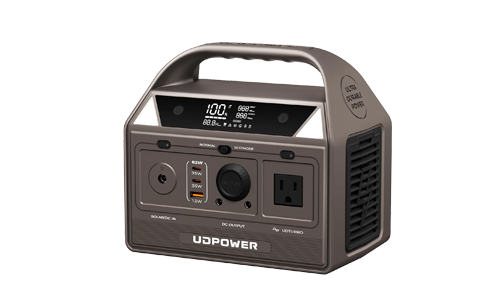
UDPOWER C400: Compact Power for Short Trips
The C400 is suited to phones, laptops, cameras, lights, fans, selected CPAP setups and other lower-power essentials. Its small battery is easier to carry, while the 400W rated AC output is intended for lighter appliances.
- Battery capacity: 256Wh
- Rated AC output: 400W
- Surge output: 800W
- Battery chemistry: LiFePO4
- Cycle-life specification: 80%+ capacity after 3,000 cycles
- Solar input: Up to 150W
- Weight: Approximately 6.88 lb
- Planning estimate for usable AC energy: About 230Wh at 90% conversion efficiency
- Best fit: Solo camping, road trips, electronics, compact emergency backup and 12V vehicle jump-start support

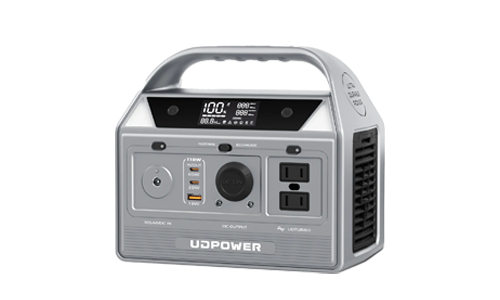
UDPOWER C600: Balanced Capacity for Camping and Daily Backup
The C600 offers more than twice the capacity of the C400 while remaining suitable for vehicle travel and campsite use. It is a practical middle choice for laptops, fans, small refrigerators, communications equipment and overnight essentials.
- Battery capacity: 596Wh
- Rated AC output: 600W
- Maximum output: 1,200W
- Battery chemistry: LiFePO4
- Cycle-life specification: 80%+ capacity after 3,000 cycles
- Solar input: Up to 240W
- Weight: Approximately 12.3 lb
- Planning estimate for usable AC energy: About 536Wh at 90% conversion efficiency
- Best fit: Family camping, laptops, fans, portable refrigeration and medium-duty backup
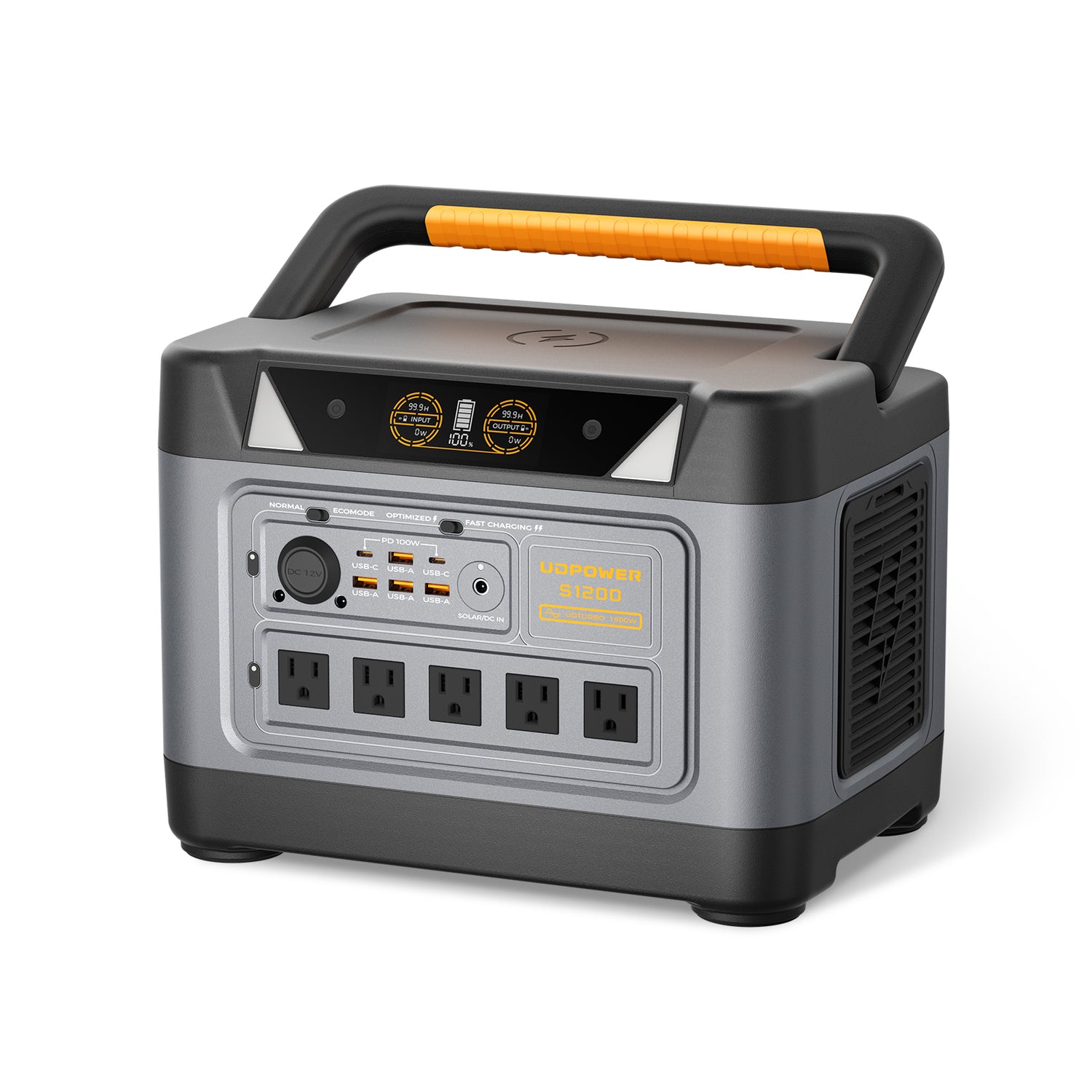
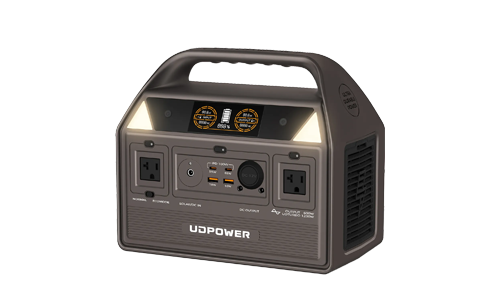
UDPOWER S1200: Home Essentials, CPAP and Refrigerator Backup
The S1200 combines a 1,191Wh battery with 1,200W rated AC output. It is a stronger fit for longer runtime, refrigerator backup, communication equipment, family camping and devices that require more output than compact power stations can provide.
- Battery capacity: 1,191Wh
- Rated AC output: 1,200W
- UDTURBO maximum: 1,800W
- Battery chemistry: LiFePO4
- Cycle-life specification: 80%+ capacity after 3,000 cycles
- Solar input: Up to 400W
- UPS transfer time: 10 ms or less
- Weight: Approximately 26 lb
- Planning estimate for usable AC energy: About 1,072Wh at 90% conversion efficiency
- Best fit: Home essentials, refrigerator backup, CPAP, longer camping trips and moderate appliances
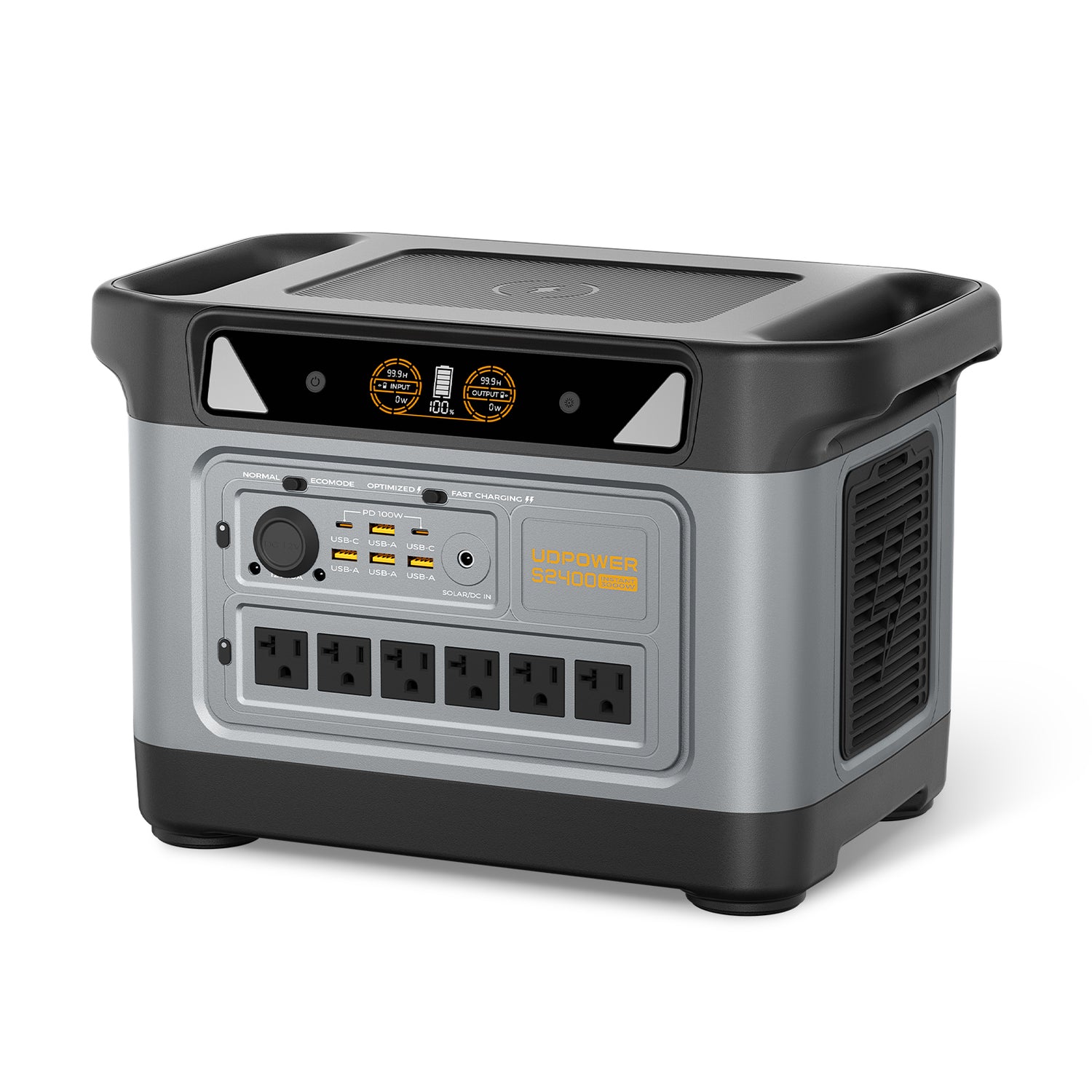
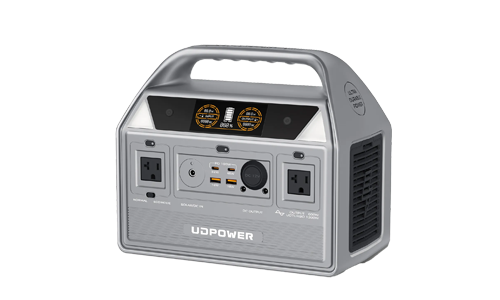
UDPOWER S2400: High-Capacity Backup and RV Power
The S2400 is designed for buyers who need both longer runtime and substantially higher appliance output. Its 2,083Wh capacity and six AC outlets make it suitable for home backup, RV use, larger campsite setups and selected cooking or power-tool loads.
- Battery capacity: 2,083Wh
- Rated AC output: 2,400W
- Surge output: Up to 3,000W
- Battery chemistry: LiFePO4
- Cycle-life specification: 80%+ capacity after 3,000 cycles
- Solar input range: 12–50V, 10A maximum
- Supported UDPOWER panel setup: Up to two 210W panels in parallel
- UPS transfer time: 10 ms or less
- Weight: Approximately 40.8 lb
- Planning estimate for usable AC energy: About 1,875Wh at 90% conversion efficiency
- Best fit: RVs, home outage preparation, refrigerators, microwaves, coffee makers and larger appliance groups
UDPOWER LiFePO4 Power Station Comparison
| Model | Capacity | Rated output | Maximum or surge output | Cycle-life specification | Estimated usable AC energy | Best use | Official source |
|---|---|---|---|---|---|---|---|
| C400 | 256Wh | 400W | 800W | 80%+ after 3,000 cycles | About 230Wh | Light camping and electronics | C400 specifications |
| C600 | 596Wh | 600W | 1,200W | 80%+ after 3,000 cycles | About 536Wh | Camping, laptops, fans and small refrigeration | C600 specifications |
| S1200 | 1,191Wh | 1,200W | 1,800W | 80%+ after 3,000 cycles | About 1,072Wh | Home essentials and longer trips | S1200 specifications |
| S2400 | 2,083Wh | 2,400W | 3,000W | 80%+ after 3,000 cycles | About 1,875Wh | RV use and high-capacity home backup | S2400 specifications |
Usable AC energy is a planning estimate based on 90% conversion efficiency. Actual output varies with load, temperature, inverter operation, battery condition and standby consumption.
Browse the complete UDPOWER portable power station collection, compare models for home backup, or explore portable power stations for camping and RV use.
How to Extend LiFePO4 Battery Life
You do not need to handle a LiFePO4 battery like a fragile laboratory sample. A good system is built for ordinary use. The goal is to avoid repeating the conditions that cause the most unnecessary stress.
1. Keep the battery away from prolonged heat
Do not leave a portable power station in a sealed vehicle, direct sun or an unventilated equipment compartment for long periods. Allow space around cooling vents and avoid covering the unit during charging or heavy output.
2. Do not make 0% your daily target
Use the full capacity when circumstances require it, but recharge before shutdown during routine use when practical. A reserve also gives you more protection against unexpected startup surges or changing appliance loads.
3. Use fast charging when it provides real value
Fast charging is useful before a trip, during a short generator window or between outage periods. When the battery can charge overnight, a normal or battery-care mode may produce less heat.
4. Stay within the approved input range
A third-party solar panel is not compatible merely because its connector fits. Confirm open-circuit voltage, operating voltage, current, polarity and connector type against the power station's input specification.
5. Avoid high output while the battery is already hot
Heavy AC loads produce more heat in the battery and inverter. If the unit has been sitting in the sun or charging rapidly, let it cool before operating near maximum output when circumstances permit.
6. Let the battery management system complete normal charging
Constantly disconnecting at random charge levels is not usually harmful, but periodically completing the manufacturer's recommended full charge can help some systems recalibrate the display or balance cell groups.
7. Use DC or USB output when it suits the device
Running a compatible DC or USB device directly can avoid turning on the AC inverter. This may reduce conversion loss, heat and unnecessary standby consumption.
8. Size the power station with output headroom
Operating close to maximum output for hours creates more thermal stress than running the same energy load on a larger system with adequate headroom. Check both normal running watts and startup surge watts.
Simple longevity routine
- Keep the power station dry and ventilated.
- Do not block its fans or air vents.
- Avoid prolonged storage in hot cars or direct sunlight.
- Recharge before the battery remains empty for an extended period.
- Check a stored emergency unit periodically.
- Follow the model-specific charging-temperature limit.
- Use approved charging equipment and compatible solar input.
- Investigate unusual heat, swelling, odor or repeated error codes immediately.
How Should You Store a LiFePO4 Battery?
Storage recommendations vary by product because a complete power station contains electronics that may draw a small amount of standby power. Always use the manual for the specific battery or power station as the primary instruction.
For storage lasting several months, a sensible general approach is:
- Turn the battery or power station fully off.
- Disconnect all loads, charging cables and accessories.
- Store it in a dry, ventilated location within the stated storage-temperature range.
- Avoid leaving it at 0% state of charge.
- Unless the manufacturer instructs otherwise, use a moderate storage charge rather than holding the pack at maximum charge for months.
- Check the state of charge periodically and recharge when necessary.
Emergency backup creates a practical compromise
A battery stored at a moderate charge may age more gently, but an emergency station must also be ready when an outage begins. Many owners choose to keep backup systems at a higher state of charge and accept a small longevity trade-off in exchange for greater immediate runtime.
The best choice depends on whether the battery's main job is long-term preservation or emergency readiness. A system that is perfectly preserved but only half charged when needed may not serve its purpose.
Do not store a depleted battery and forget it. Continued standby consumption or natural self-discharge can eventually push the pack below a recoverable level.
How to Test the Remaining Health of a LiFePO4 Power Station
The percentage on the display is an estimate of state of charge, not a direct measurement of remaining battery health. A practical capacity test can reveal whether runtime has changed significantly.
Basic home capacity test
- Place the power station at normal room temperature.
- Charge it fully using the approved charger.
- Allow the battery to rest briefly after charging.
- Connect a stable AC load that is comfortably below the station's rated output.
- Use a plug-in watt-hour meter between the power station and the appliance.
- Run the load until the power station reaches its normal low-battery shutdown.
- Record the watt-hours delivered to the appliance.
- Compare the result with the expected usable AC energy rather than comparing it directly with the battery's raw nameplate watt-hours.
For example, a new 1,191Wh power station will not normally deliver all 1,191Wh through its AC outlets because the inverter, internal electronics and cooling system consume energy. At a 90% planning efficiency, the comparison point would be approximately 1,072Wh, with real results varying by load and test conditions.
Keep the test conditions consistent
A test performed with a small 20W load can produce a different result from one performed at 800W. Battery temperature, inverter efficiency, display calibration and automatic shutdown settings also affect the measured output.
Use the same load and similar room temperature when comparing results over time. A single unusual result is less useful than a clear downward trend across repeated, controlled tests.
How to Read a LiFePO4 Cycle-Life Claim Before Buying
A cycle count without test conditions is incomplete. Use the checklist below when comparing batteries or portable power stations.
| Question to ask | Why it matters | Strong specification example | Weak specification example |
|---|---|---|---|
| What capacity remains? | 3,000 cycles to 80% is not equivalent to 3,000 cycles to 60% | “80%+ capacity after 3,000 cycles” | “3,000-cycle battery” |
| At what depth of discharge? | Shallow-cycle testing can produce a much larger headline number | Test depth is clearly disclosed | No DoD information |
| At what temperature? | Heat can significantly accelerate degradation | Test temperature or standard is listed | No environmental conditions |
| At what charge and discharge rate? | Higher current can increase thermal and electrochemical stress | C-rate or current is included | Only the final cycle number is shown |
| Does the pack include a BMS? | Cell protection and balancing affect usable pack life | Voltage, current and temperature protections are documented | Only the cell chemistry is mentioned |
| Is the warranty meaningful? | A long cycle claim has more value when the complete product is supported | Clear warranty period and policy | No accessible warranty terms |
| Are operating limits published? | The owner needs correct charging and storage temperatures | Charging, discharging and storage ranges are listed separately | One vague “operating temperature” range |
Unique cycle-count trap: Two batteries can both advertise 6,000 cycles while being tested under completely different conditions. One may be tested at shallow discharge and low current, while another uses deeper cycles. The larger number is not automatically the better battery.
Signs a LiFePO4 Battery Is Aging
Gradual capacity loss is normal. The following symptoms may indicate that the battery is approaching the point where its performance no longer meets your needs:
- Runtime is consistently shorter under the same load.
- The battery percentage falls unusually quickly under moderate output.
- The system reaches low-voltage shutdown earlier than expected.
- Heavy loads that previously worked now cause shutdown.
- Charging time or displayed percentages become inconsistent.
- The battery heats more than it did under the same conditions.
- Cell imbalance or battery-management errors occur repeatedly.
Stop using the battery and contact the manufacturer if you notice swelling, enclosure deformation, smoke, a strong chemical odor, liquid, damaged wiring, melted connectors or abnormal heat while the unit is idle.
Normal capacity aging alone does not usually create sudden visible damage. Physical changes or abnormal heat should be treated as a safety issue rather than ordinary wear.
Common LiFePO4 Battery Life Myths
Myth 1: Every time you plug in the charger, you use one cycle
Partial charging sessions do not automatically equal full cycles. Energy throughput accumulates into equivalent full cycles.
Myth 2: The battery dies after 3,000 cycles
A 3,000-cycle specification normally means the battery should still retain a stated percentage of its original capacity at that point. It may remain useful afterward.
Myth 3: LiFePO4 batteries should never reach 100%
Charging to 100% when you need the full capacity is normal. The larger concern is leaving a battery at an extreme state of charge for prolonged periods in unfavorable temperatures.
Myth 4: A rarely used battery lasts forever
Calendar aging continues even when the cycle counter barely changes. Heat and storage conditions can age an unused battery.
Myth 5: All LiFePO4 batteries last the same amount of time
Cell grade, matching, pack compression, thermal design, charge limits, BMS behavior and quality control can make two LFP products perform very differently.
Myth 6: Cold weather permanently destroys capacity
Cold can temporarily reduce output and available energy. Charging below the approved temperature is the more serious concern. Performance may recover after the battery returns to a suitable temperature.
Myth 7: The highest advertised cycle number is always the best value
The testing conditions, remaining-capacity threshold, usable watt-hours, warranty and system design matter more than an isolated headline number.
LiFePO4 Battery Life FAQ
How many years will a LiFePO4 battery last?
A quality LiFePO4 battery commonly provides around 8 to 15 years of practical service. Daily deep cycling may use the cycle allowance sooner, while occasional-use batteries are more likely to be limited by calendar aging.
Can a LiFePO4 battery last 20 years?
It is possible under favorable conditions, particularly with shallow cycling, moderate temperatures and a high-quality pack. It should not be assumed from the cycle count alone because calendar aging and electronic component life also matter.
What does 3,000 cycles to 80% mean?
It means the battery is specified to retain at least approximately 80% of its original capacity after completing the stated test cycles under the manufacturer's conditions. It does not mean the battery becomes unusable at cycle 3,001.
Does charging from 50% to 100% count as one cycle?
It is approximately half of an equivalent full cycle. Two similar 50% energy uses would add up to roughly one full cycle.
Is it okay to charge a LiFePO4 battery to 100%?
Yes, when you need the full capacity. For long-term storage, follow the manufacturer's recommendation instead of automatically leaving the battery at 100% for months.
Should I discharge a LiFePO4 battery completely?
An occasional deep discharge is normally acceptable in a properly protected system. Repeatedly running to automatic shutdown is unnecessary when you do not need the full capacity and may reduce long-term cycle life.
What temperature is best for LiFePO4 battery life?
Moderate room temperatures are generally favorable. The exact charging, discharging and storage limits depend on the product. Long periods of high heat should be avoided.
Can I charge a LiFePO4 battery below freezing?
Only if the complete battery system is specifically designed and approved for that temperature, such as a system with controlled heating or suitable low-temperature charge management. Otherwise, follow the product's published charging-temperature limit.
Does fast charging shorten LiFePO4 battery life?
Frequent high-rate charging can create more heat and stress than slower charging. A properly designed system manages the process, but using a battery-care or normal mode when speed is unnecessary may support better long-term conditions.
How often should I recharge a stored LiFePO4 power station?
Check the manufacturer's manual first. For emergency storage, inspect the state of charge periodically rather than leaving the unit unattended for many months. Recharge before the battery becomes deeply depleted.
Can a LiFePO4 battery be repaired?
Individual cells can sometimes be serviced in specialized battery systems, but sealed portable power stations should not be opened by consumers. Internal packs contain hazardous energy and should be inspected by the manufacturer or a qualified service provider.
How do I know when my LiFePO4 battery needs replacement?
Replacement becomes reasonable when reduced capacity, voltage drop or shutdown behavior prevents the battery from completing its required job. Physical swelling, abnormal heat, smoke, odor or enclosure damage requires immediate discontinuation of use.
Final Answer
LiFePO4 battery life is usually measured in thousands of equivalent full cycles, but the cycle number is only one part of the answer. A quality battery may provide roughly 8 to 15 years of practical service, while the exact result depends on heat, calendar age, depth of discharge, charge rate, cell quality and battery management.
For frequent use, choose a battery with a clearly stated capacity-retention threshold and enough watt-hours that you do not need to drain it completely every day. For emergency use, prioritize cool storage, periodic checks and enough stored energy to meet the actual backup requirement.
The simplest longevity rule is also the most useful: keep the battery reasonably cool, use approved charging equipment, avoid leaving it empty for long periods and operate within the manufacturer's stated limits.
Technical Sources
- Sandia National Laboratories and OSTI: Degradation of Commercial Lithium-Ion Cells as a Function of Chemistry and Cycling Conditions
- Energies: Degradation Behavior of LiFePO4/C Batteries During Long-Term Calendar Aging
- Batteries: Review of Cell-Level Battery Calendar and Cycling Aging Models
- Google Search Central: Optimizing for Generative AI Features
- UDPOWER C400 Official Specifications
- UDPOWER C600 Official Specifications
- UDPOWER S1200 Official Specifications
- UDPOWER S2400 Official Specifications
Choose a Long-Life LiFePO4 Power Station
Compare battery capacity, AC output, solar input and real-world use cases before choosing your backup system.
View All UDPOWER Portable Power StationsNeed more help with sizing? Read the portable power station runtime and lifespan guide.
Related Articles


