

Portable Power for Farms & Ranches: Equipment, Runtime & Sizing Guide
Last updated: October 27, 2026

Farm power is different from camping power.
On a campsite, most loads are clustered around one vehicle or shelter. On a farm or ranch, the electrical jobs may be hundreds of yards apart: an energizer at a pasture fence, a camera at the calving lot, a gate controller at the road, lights in a barn, cordless-tool chargers in a truck, ventilation in a greenhouse, and a pump somewhere beyond the nearest practical outlet.
That makes portability valuable, but it also makes bad sizing expensive. A battery that easily runs an electric fence may be completely inadequate for a stock-tank heater. A station with plenty of wattage may still run out of energy before morning. And a power station cannot solve a voltage mismatch just because the wattage looks right.
In this guide, I will walk through the way I size portable power for real farm and ranch work: by equipment, operating zone, runtime, startup load, voltage, weather, and the consequence of losing power.
Why Portable Power Makes Sense on Farms and Ranches
The strongest use case for a portable power station on agricultural property is not replacing the entire farm electrical system. It is bringing electricity to a specific job that is too remote, too temporary, or too mobile to justify permanent wiring.
Examples include:
- Powering a plug-in electric fence energizer in a remote pasture
- Keeping livestock cameras and networking equipment online
- Running LED lights during a temporary barn project
- Charging cordless-tool batteries while repairing fence
- Powering a small 120V pump for intermittent water transfer
- Running a laptop, printer, POS terminal, or hotspot at a farmstand
- Supporting veterinary electronics away from a building outlet
- Providing temporary power at a greenhouse or equipment shed
- Keeping selected critical equipment running during a utility outage
The important word is selected.
A portable battery works best when you choose a defined group of loads rather than expecting one box to become a replacement electrical service for a barn, well, shop, greenhouse, and livestock operation at the same time.
Four Numbers Matter: Watts, Watt-Hours, Startup Demand and Voltage
1. Running watts determine whether the load can operate
If a device draws 700W while running, the station must be able to continuously supply that load along with anything else connected at the same time.
For farm planning, I prefer to compare continuous equipment loads against the station's rated AC output. Higher-power modes and surge capability can be useful for compatible equipment, but I do not build a critical livestock or water system around operating near the edge of an inverter's capability.
2. Watt-hours determine how long the load can operate
A 20W monitor running around the clock uses:
A 1,000W heater operating for only one hour also uses 1,000Wh. That is why low-watt continuous loads and high-watt heating loads have to be evaluated differently.
3. Motors may need more power when they start
Pumps, compressors, fans, refrigerators, grinders, and other motor-driven equipment can demand more power during startup than during normal operation.
Do not size a station from running watts alone if the equipment has a motor. Check the equipment manual, nameplate, manufacturer specifications, or measure startup behavior with appropriate equipment.
4. Voltage is a hard compatibility limit
This is especially important for farm pumps.
For example, Franklin Electric currently lists 1/2 HP submersible well pumps in both 115V and 230V versions, while larger models in the same product family are commonly 230V.
The UDPOWER S1200 and S2400 provide 120V AC output. A 230V well pump is therefore not compatible simply because its calculated wattage appears to fall below the station's watt rating.
See Franklin Electric's current well-pump voltage examples.
Farm & Ranch Equipment Power Planning Table
The table below is designed to help you identify what matters before choosing a battery. Where an actual wattage example is useful, I have linked the source. For equipment that varies widely by model, the correct number is the one on your own equipment's nameplate or manual.
| Farm / Ranch Equipment | Power Characteristic | Main Sizing Concern | Portable Power Role | Reference |
|---|---|---|---|---|
| Electric fence energizer | Usually a low continuous load; actual AC draw varies by energizer | 24/7 runtime matters more than inverter size | Excellent fit when actual daily Wh is measured | Premier energizer comparison |
| Livestock water trough heater / de-icer | Common products include roughly 1,000–1,500W heating elements | Very high energy use when heating for hours | Short emergency use only for many battery systems | 1,000W de-icer example |
| Stock tank pump | Motor load | Running watts, startup demand and voltage | Good fit only when exact pump is compatible | Check pump nameplate and manual |
| Well pump | Motor load; 115V and 230V models exist | Voltage and startup demand are critical | Only compatible 120V pumps should be considered with 120V stations | Franklin Water specifications |
| Barn LED lighting | Low-to-moderate continuous load | Total fixture wattage × hours | Strong portable-power use case | Use fixture wattage |
| Chicken coop lighting | Usually low load | Daily operating schedule | Strong fit for small systems | Use fixture wattage |
| Chicken coop ventilation | Fan / motor load | Continuous summer runtime and startup behavior | Suitable when measured load and runtime fit battery capacity | Use fan nameplate |
| Poultry brooder equipment | Heating load | Can run continuously for long periods | Requires careful energy budgeting and backup | University of Minnesota Extension |
| Livestock cameras | Low continuous electronics load | Camera + recorder + network equipment must all be counted | Excellent long-runtime application | UDPOWER camera backup guide |
| Calving cameras | Often 24/7 monitoring load | Night vision, network gear and recording increase total load | Good fit with adequate overnight reserve | Security camera runtime guide |
| Wi-Fi / cellular gateways | Low continuous electronics load | 24-hour energy adds up | Excellent fit for remote monitoring sites | Measure gateway + modem/router load |
| Remote gate opener | Usually battery-based with intermittent motor operation | Daily cycles and battery recharging | A dedicated low-power solar/battery system may be more efficient than a large station | Ghost Controls solar guidance |
| Veterinary electronics | Varies from small electronics to specialized equipment | Exact voltage, watts and criticality | Useful for compatible portable equipment; critical care needs redundancy | Use equipment manufacturer specifications |
| Cordless tool battery charging | Intermittent charger load | Charger wattage × number of charge cycles | Excellent mobile repair application | UDPOWER shed and tool guide |
| Electric clippers / shears | Short-duration motor load | Running watts and startup behavior | Often practical when within rated output | Use equipment nameplate |
| Small air compressor | Motor with meaningful startup demand | Startup can be more difficult than running load | S2400-class output is more appropriate for compatible 120V units | Use compressor nameplate/manual |
| Feed-room electronics | Scales and controls can be low load; motors may not be | Separate electronics from augers/grinders | Good for controls and light electronics | Check each device separately |
| Seed / fertilizer handling electronics | Controls may be low load; conveyors and motors can be high | Do not treat the whole machine as one generic load | Useful for compatible electronics and field service | Check equipment specifications |
| Greenhouse fans | Motor load, often long runtime | Daily Wh and startup demand | S1200/S2400 may work for smaller compatible systems | UDPOWER off-grid greenhouse planning |
| Irrigation controller | Low electronics load | Continuous standby plus valve operation | Strong low-power application | Use controller specifications |
| Small irrigation pump | Motor load | Voltage, startup watts and runtime | Can work if the exact 120V pump fits the inverter | Use pump specifications |
| Mobile repair work | Mixed tools and chargers | Largest simultaneous tool load | One of the best uses for portable battery power | Device compatibility guide |
| Fence repair crew | Chargers, lights, small tools | Daily charging energy and largest corded tool | Excellent mobile use case | Measure chargers and tools |
| Remote pasture monitoring | Cameras, sensors, cellular gateway | 24/7 load and cloudy-day reserve | Excellent fit with solar recharging | Remote-property solar guide |
| Farmstand / market POS | Tablet, terminal, laptop, hotspot and lighting | Long selling day rather than high wattage | Strong C400/S1200 application | Measure complete booth load |
| Emergency livestock support | Mixed critical loads | Prioritization and redundancy | Back up selected essentials, not every farm load | Build a written outage load list |
A Better Way to Plan: Divide the Farm Into Power Zones
I find farm power easier to manage when I stop thinking about “powering the farm” and start thinking about individual operating zones.
| Zone | Typical Loads | Main Design Question | Portable Power Strategy |
|---|---|---|---|
| Barn Zone | LED lights, cameras, router, chargers, fans, veterinary electronics | Which loads must stay on overnight or during an outage? | Keep critical communications and monitoring separate from high-watt heating loads |
| Pasture Zone | Fence energizer, camera, cellular gateway, gate equipment, small pump | How many Wh are needed every 24 hours? | Low-power station plus solar can work well when daily load is small |
| Greenhouse Zone | Fans, irrigation controller, sensors, pumps | What must operate continuously during hot or cold weather? | Size around continuous runtime and worst-case motor startup |
| Mobile Repair Zone | Tool chargers, work lights, clippers, saws, compressor | What is the largest tool that may run at one time? | Higher inverter output can matter more than all-day battery capacity |
| Farmstand Zone | POS, tablet, laptop, hotspot, lights, phones | How many hours is the stand open? | Low average watts but enough capacity for the entire selling day |
| Emergency Livestock Zone | Water, monitoring, communication, essential ventilation | What causes animal-welfare or operational problems if it loses power? | Reserve capacity and a second backup source are more important than convenience loads |
This approach also prevents one high-power load from consuming the energy reserved for something more important.
A stock-tank heater should not unexpectedly drain the battery that was supposed to keep a calving camera, cellular gateway, and fence energizer online overnight.
How to Calculate the Right Portable Power Station Size
Step 1: Record the actual voltage
Before doing any wattage math, confirm whether each AC device is 120V or 230/240V. If the voltage does not match the power station, stop there.
Step 2: Record running watts
Use the equipment label, manual, manufacturer's specification, or a suitable power meter.
If the label lists volts and amps:
For motor equipment, that calculation should not be treated as a substitute for checking startup behavior.
Step 3: Estimate operating hours
Be realistic about duty cycle.
A camera may run 24 hours. A cordless charger may run for 90 minutes. A pump may cycle for 10 minutes at a time. A thermostatic heater may switch on and off depending on outdoor temperature.
Step 4: Calculate watt-hours for every load
If five 20W fixtures operate for four hours:
Step 5: Account for conversion losses
For UDPOWER AC runtime planning, I use a 90% conversion-efficiency estimate.
This is a planning estimate. Actual results vary with load level, temperature, inverter overhead, battery condition, cycling behavior and the outputs being used.
You can also check a load with the UDPOWER Runtime Calculator.
Step 6: Add reserve for critical farm equipment
If I need a system to protect an important livestock or monitoring function, I do not size it to hit 0% at the end of the expected outage.
A simple way to retain approximately 20% battery reserve is:
For a remote pasture system using 672Wh per day:
That is why a roughly 1,000Wh-class unit may be a much better fit than a battery whose labeled capacity only barely exceeds the theoretical device consumption.
How Long Can C400, S1200 and S2400 Run Farm Loads?
The table below uses the same 90% planning efficiency throughout.
| Constant Load | C400 256Wh / 400W Rated |
S1200 1,190Wh / 1,200W Rated |
S2400 2,083Wh / 2,400W Rated |
Example Use |
|---|---|---|---|---|
| 5W | ~46.1 hr | ~214.2 hr | ~374.9 hr | Very low-power monitoring or fence equipment |
| 20W | ~11.5 hr | ~53.5 hr | ~93.7 hr | Small camera/network or control load |
| 50W | ~4.6 hr | ~21.4 hr | ~37.5 hr | Monitoring system, lights or electronics |
| 100W | ~2.3 hr | ~10.7 hr | ~18.7 hr | Lighting, fan or mixed electronics |
| 250W | ~0.9 hr | ~4.3 hr | ~7.5 hr | Brooder-lamp-scale continuous load |
| 500W | Above rated continuous output | ~2.1 hr | ~3.7 hr | Tool, fan or small compatible motor load |
| 1,000W | Above rated continuous output | ~1.1 hr | ~1.9 hr | Heater or high-power 120V equipment |
| 1,500W | Above rated continuous output | Above 1,200W rated output | ~1.2 hr | Large heating load |
These figures assume a steady load. Pumps, compressors, fans, heaters, chargers and other equipment may cycle or vary substantially in actual operation.
Electric Fence Energizers: Usually a Runtime Problem, Not a Wattage Problem
Electric fence energizers are one of the better applications for portable or solar-backed farm power because the AC energy demand can be very low compared with heaters, pumps and tools.
Premier1Supplies, for example, lists a 110V draw of about 4.5W for one of its plug-in energizers. Other energizers can differ, so this should be treated as a real product example rather than a universal number.
See Premier1Supplies' current energizer comparison chart.
There is another mistake worth avoiding: the energizer's joule rating is not the same as its continuous AC wattage.
The joule rating describes fence pulse energy. For battery sizing, use the manufacturer's actual electrical input specification or measure consumption.
Example: 5W energizer
At a constant 5W load:
- C400 planning runtime: about 46 hours
- S1200 planning runtime: about 214 hours
- S2400 planning runtime: about 375 hours
In practice, a pasture power site often includes more than the energizer. Add the camera, cellular gateway, radio charger, lights or any other equipment connected at the same location.
For seasonal off-grid fence and small-farm solar planning, see Off-Grid Solar for Fall Projects: How Much Power Do You Need?
Livestock Water Trough Heaters Can Overwhelm a Battery Quickly
This is the farm load I would be most careful not to underestimate.
Current stock-tank de-icers on the market commonly include 1,000W and 1,500W models. For example, Farm Innovators lists a 1,000W sinking unit and 1,500W units are also widely sold.
See the 1,000W product example.
Why watt-hours become the problem
If a 1,000W de-icer were actually energized for six cumulative hours during a cold night:
With 90% conversion efficiency, even an S2400 provides roughly 1,875Wh of planning energy from one full charge.
At a constant 1,000W draw, that is approximately:
A thermostat can reduce actual energy use because the heater does not necessarily stay on continuously, but the duty cycle gets worse as conditions become colder, windier, or more demanding.
Stock Tank Pumps, Irrigation Pumps and Well Pumps
Pumps create three separate compatibility checks:
- Is the voltage compatible?
- Is normal running power within the station's rated output?
- Can the station handle startup demand?
Small 120V transfer or irrigation pumps
A small pump can be a good portable-power application when it is 120V, its running load fits the station, and its startup demand has been tested.
Intermittent pumping can also be easier on battery capacity than a continuously operating load.
For example, an 800W pump that actually runs for 15 minutes consumes roughly:
The energy requirement is modest. The harder question is whether its startup behavior is compatible with the inverter.
Well pumps require more caution
Franklin Electric's current residential submersible lineup illustrates why horsepower alone is not enough. Its 1/2 HP pumps are available in both 115V and 230V versions, while many higher-horsepower models are 230V.
A 230V pump cannot be directly powered from the 120V AC outlets on an S1200 or S2400.
Do not improvise a voltage conversion or backfeed a building electrical system. For installed well equipment, use a properly engineered backup solution that matches the pump, controls, wiring and applicable electrical requirements.
Barn Lighting, Chicken Coops and Poultry Brooder Equipment
Barn lighting is usually an easy load to calculate
Add the wattage of every fixture that will run at the same time, then multiply by operating hours.
Five 20W LED fixtures used for four hours require:
That is a much more realistic portable-power application than trying to heat an entire livestock space electrically.
Coop ventilation deserves an all-day calculation
A modest ventilation fan may not look demanding at any one moment, but a fan that runs for 12 or 24 hours can consume more total energy than a large tool used for a few minutes.
Calculate:
Poultry brooder heating is a major continuous load
The University of Minnesota Extension notes that one 250W infrared lamp can be used as a brooder heat source for a small flock under the conditions described in its guidance.
A 250W lamp running continuously for 12 hours requires:
For 24 hours:
An S2400's simplified 90%-efficiency runtime at a constant 250W load is roughly 7.5 hours.
That does not mean portable power is useless for poultry. It means continuous brooder heat should be treated as a serious energy requirement, not grouped with lights and camera charging.
Read the University of Minnesota Extension brooder guidance.
Livestock Cameras, Calving Cameras, Wi-Fi and Cellular Gateways
Remote monitoring is one of the strongest farm applications for stored battery power because the loads are usually low, predictable and continuous.
The mistake is backing up only the camera.
A working remote camera system may depend on:
- The camera itself
- PoE switch or injector
- NVR or recorder
- Wi-Fi router
- Cellular gateway
- Modem or other internet equipment
- Night-vision lights or integrated spotlights
At night, cameras may also use more power because infrared illumination, white spotlights, heaters or other features activate.
For a complete camera-backup method and 8-, 24-, 48- and 72-hour sizing examples, see Do Security Cameras Work in a Power Outage?
A useful pasture example
Suppose you measure the complete fence, camera and communications site and find that it averages 28W.
Daily load:
Required rated capacity with 90% efficiency and a 20% reserve:
That puts a 1,190Wh S1200 in a much more appropriate class than a 256Wh compact station for a full-day system with reserve.
Remote Gate Openers: A Large Power Station May Not Be the Best Answer
A gate opener is a good example of why the biggest battery is not always the smartest design.
Many remote gate systems already use a 12V battery and recharge it from a relatively small solar panel.
Ghost Controls, for example, describes solar configurations using 10W panels and configurations up to 30W for its compatible gate systems.
See Ghost Controls' solar gate guidance.
If the gate already has a purpose-built battery charging system, installing a large portable station beside it may add cost and complexity without much benefit.
A portable station becomes more useful when that gate location also needs cameras, communications, lighting, charging or temporary work power.
Cordless Tools, Clippers, Compressors and Mobile Repair Work
Mobile maintenance is where a portable power station can earn its keep quickly.
A fence crew, mechanic, livestock handler or property-maintenance team may need to charge batteries, run work lights, operate small corded tools or power electronics where there is no outlet nearby.
Cordless tool charging
For chargers, energy consumption is usually more important than surge.
If a charger averages 200W for one hour:
Three similar charging sessions would represent roughly 600Wh of device energy before conversion losses.
Clippers and shears
Check the actual AC input rating. These tools may be easy loads for a larger station, but they still contain motors and should be tested before an important livestock job.
Small compressors
Compressors are much harder because motor startup can be substantial.
I would not buy a station based only on the compressor's printed running wattage. Test startup behavior and remain within the station's supported operating limits.
For a broader tool-selection framework, see Portable Power Station for a Shed: How to Choose the Right Size.
Feed Rooms and Seed/Fertilizer Handling Equipment
Separate the electronics from the machinery.
A scale, controller, laptop or small sensor can be an easy portable load. An auger, grinder, conveyor or other motor may require much more power, a different voltage, or a permanent electrical supply.
Do not use a category label such as “feed-room equipment” as the sizing number. List each device individually.
Greenhouse Fans, Irrigation Controllers and Small Pumps
Greenhouse and irrigation equipment often creates a mixed load:
- Low-power controls and sensors
- Long-running ventilation fans
- Intermittent pumps
- Communication equipment
- Lighting
The controls may use little energy, while the fans and pumps determine the real battery size.
That creates a useful emergency strategy: if the full greenhouse load is too large, identify which controller, communication system or smaller ventilation load must remain available while larger equipment uses another power source.
The existing UDPOWER Off-Grid Solar for Fall Projects guide includes additional greenhouse and seasonal solar planning.
Farmstand and Market POS Power
Farmstands are almost the opposite of pumps and compressors.
The instantaneous load may be low, but the system operates for a long day.
Typical equipment can include:
- Tablet or laptop
- Card terminal
- Wi-Fi or cellular hotspot
- Phone charging
- Printer
- LED lighting
- Small fan
A measured 80W average booth load running eight hours represents:
With 90% efficiency and a 20% reserve:
This is another case where an S1200-class battery can make more sense than a compact unit even though the actual wattage is nowhere near 1,200W.
Emergency Livestock Support During a Power Outage
During an outage, I would not start by asking, “What can this battery run?”
I would ask, “What absolutely cannot stop?”
| Priority | Examples | Outage Strategy |
|---|---|---|
| Priority 1: Animal welfare / critical operation | Essential water system, critical ventilation, brooder or animal-care equipment when required, emergency communications | Dedicated reserve plus secondary backup plan |
| Priority 2: Monitoring / containment | Fence energizer, calving cameras, livestock cameras, gate controls, router/cellular gateway | Low-power loads are often worth preserving because they can run for many hours |
| Priority 3: Work continuity | Tool chargers, work lights, laptop, small repair equipment | Use after critical runtime is protected |
| Priority 4: Convenience | Nonessential lighting, secondary displays, convenience chargers | Disconnect first when battery reserve drops |
Recommended UDPOWER Portable Power Stations for Farms & Ranches
The right model depends on the actual equipment. I would use the following as starting points rather than one-size-fits-all farm packages.

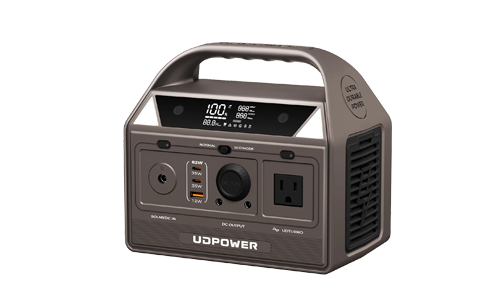
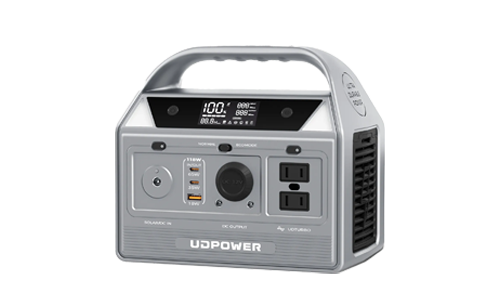
UDPOWER C400 — Best for Light Remote Farm Loads
The C400 is the model I would look at when the job is genuinely low-power and portability matters more than long capacity.
- Capacity: 256Wh
- Rated AC output: 400W pure sine wave
- Surge: up to 800W
- Weight: approximately 6.88 lb
- Solar charging input: up to 150W
- Best farm uses: low-power fence energizer, brief monitoring loads, farmstand electronics, lights, phones, radios and portable charging
At a constant 5W load, the simplified 90%-efficiency runtime is about 46 hours. At 20W it drops to about 11.5 hours, which shows how quickly adding cameras and communications equipment can change a small remote-power setup.
View UDPOWER C400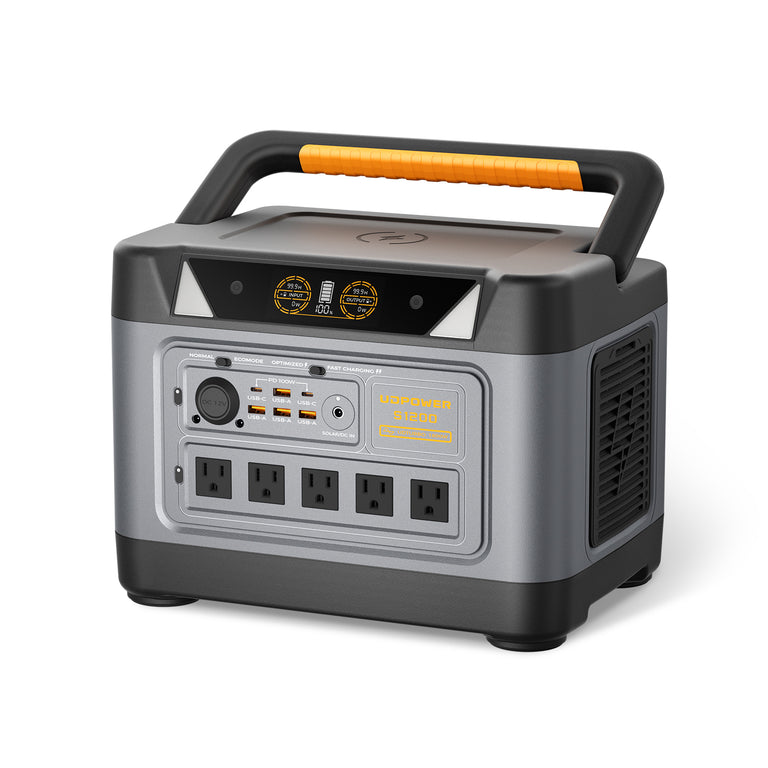
UDPOWER S1200 — Best All-Around Farm and Ranch Starting Point
The S1200 gives a much more useful balance of capacity and portability for mixed farm loads. It is still manageable to move between a barn, truck, pasture site, greenhouse or work area, but its 1,190Wh battery is far better suited to all-day electronics and monitoring than a compact station.
- Capacity: 1,190Wh
- Rated AC output: 1,200W pure sine wave
- Higher-power support: up to 1,800W for compatible loads
- Weight: approximately 26 lb
- Solar charging input: up to 400W
- UPS mode: response time ≤10ms
- Best farm uses: cameras, communications, barn lights, tool charging, farmstand systems, greenhouse controls, compatible smaller pumps and mobile maintenance
For critical continuous planning, I still size around the 1,200W rated AC output instead of treating 1,800W as the normal continuous budget.
Approximate simplified runtime:
- 20W load: ~53.5 hours
- 50W load: ~21.4 hours
- 100W load: ~10.7 hours
- 500W load: ~2.1 hours
- 1,000W load: ~1.1 hours
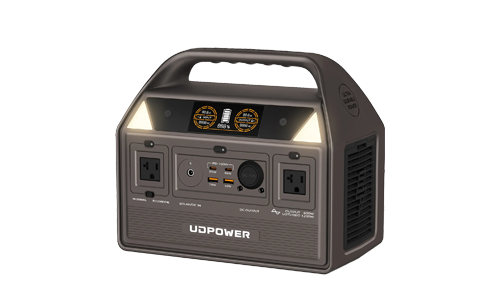
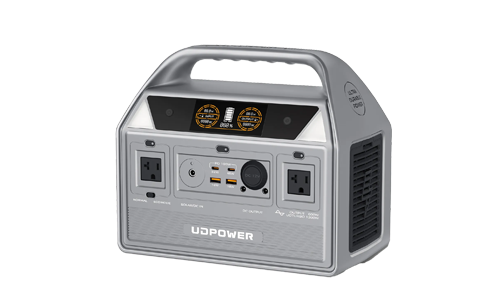
UDPOWER S2400 — Best for Higher-Load Mobile Farm Work and More Reserve
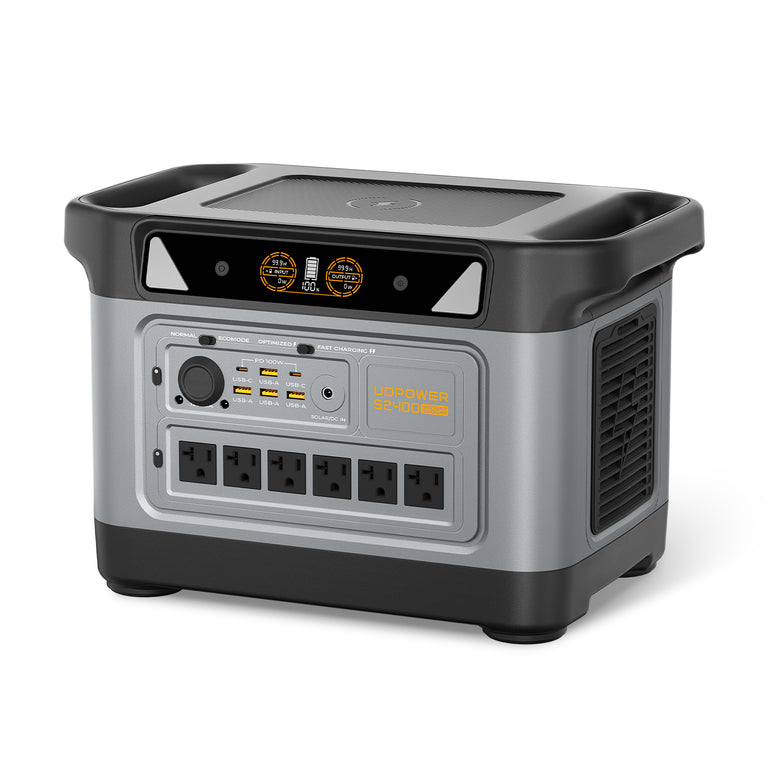
The S2400 is the stronger option when the job includes higher-wattage 120V tools, compatible pumps, compressors, several simultaneous loads, or when a longer reserve matters more than easy one-hand portability.
- Capacity: 2,083Wh
- Rated AC output: 2,400W pure sine wave
- Startup / higher-power support: up to 3,000W for compatible loads
- AC output: 120V, 60Hz
- Weight: approximately 40.8 lb
- Solar input electrical range: 12–50V, 10A max
- Recommended UDPOWER solar configuration: up to 420W nominal panel capacity
- UPS mode: response time ≤10ms
- Best farm uses: higher-output mobile repair, multiple chargers, compatible 120V pumps, larger monitoring systems, greenhouse support and emergency reserve
Approximate simplified runtime:
- 20W load: ~93.7 hours
- 50W load: ~37.5 hours
- 100W load: ~18.7 hours
- 500W load: ~3.7 hours
- 1,000W load: ~1.9 hours
- 1,500W load: ~1.2 hours
The last two numbers are important. A 2,083Wh battery can have enough inverter output to operate a high-wattage heater but still have far too little stored energy for all-night heating.
View UDPOWER S2400| Farm Use | C400 | S1200 | S2400 |
|---|---|---|---|
| Low-power fence energizer only | Good starting point | Longer reserve | Usually more capacity than needed |
| Fence + camera + cellular gateway | Shorter runtime | Strong starting point | Best for extended reserve |
| Farmstand POS and electronics | Short/light setup | Best all-day starting point | Useful if refrigeration or additional loads are added |
| Barn lights + tool charging | Light/short use | Strong fit | More charging and tool headroom |
| Small compatible 120V pump | Usually too limited | Depends on pump/startup | Better output headroom |
| Small 120V compressor | Not a preferred match | Model-dependent | Better starting point, still verify startup |
| 1,000–1,500W stock-tank heater | No | Very limited runtime / output-dependent | Can power compatible load, but runtime is short |
| 230V well pump | No | No direct 230V output | No direct 230V output |
When a Portable Power Station Is the Wrong Farm Power Source
I would look beyond a single portable station when the job depends on:
- 230V or 240V well pumps
- Three-phase agricultural equipment
- Large grain augers
- Large air compressors
- Welders beyond the station's output and voltage capability
- Large dairy or barn ventilation systems
- Electric space heating
- Multiple stock-tank heaters
- Large refrigeration systems
- Several kilowatts of continuous load for many hours
- Critical animal-care systems without a secondary backup source
Those jobs may call for permanent electrical service, a larger stationary battery system, an appropriately sized generator, or another professionally designed backup solution.
Can Solar Keep Farm Loads Running Indefinitely?
Sometimes, but only if the daily solar energy going back into the battery is at least as large as the daily energy coming out.
That means you should stop thinking only about battery runtime and start thinking about an energy budget.
Example: remote pasture system
If the pasture electronics use 672Wh per day but your panels only replace 450Wh during a cloudy day:
The system can appear to work on day one while the battery slowly loses charge every day.
That is why solar-backed farm systems need both:
- Enough battery capacity for night and poor weather
- Enough solar recovery to replace typical daily consumption
| UDPOWER Model | Battery Capacity | Solar Guidance | Best Farm Solar Role | Official Source |
|---|---|---|---|---|
| C400 | 256Wh | Up to 150W solar input | Fence sites, small electronics, temporary monitoring | C400 specifications |
| S1200 | 1,190Wh | Up to 400W solar input | Pasture monitoring, barns, farmstands, greenhouse controls | S1200 specifications |
| S2400 | 2,083Wh | 12–50V, 10A input range; up to 420W recommended nominal panel configuration | Larger remote loads, mobile repair, more cloudy-day reserve | S2400 specifications |
Before combining panels, check voltage, current, connector type and the exact supported configuration. More panel wattage does not automatically mean a compatible system.
For solar fundamentals, read Can You Charge a Portable Power Station with a Solar Panel?
If you are considering more nominal panel wattage than the station's maximum usable charging power, see Can You Overpanel a Portable Power Station?
Cold Weather Changes Farm Battery Planning
Winter is where theoretical runtime and actual farm use can separate quickly.
Current UDPOWER specifications list:
| Model | Discharge Temperature | Charging Temperature | Farm Planning Implication |
|---|---|---|---|
| C400 | -4°F to 113°F | 32°F to 104°F | Do not assume a battery that can discharge below freezing can also be charged below freezing |
| S1200 | -4°F to 113°F | 23°F to 104°F | Charging limits still matter for winter pasture and barn use |
| S2400 | -4°F to 113°F | 32°F to 104°F | Plan a protected charging environment during freezing weather |
Follow the product manual and temperature limits for the exact unit you own.
Also remember that winter creates the worst combination for remote farm power:
- Longer nights
- Higher heating demand
- Possible snow or cloud cover
- Lower solar availability
- Cold-battery charging limitations
- More serious consequences if livestock water or brooder heat fails
A system sized from a mild October test may not be adequate for January.
Farm and Ranch Electrical Safety
Keep the power station dry
Do not place a power station in wet grass, beside an open stock tank, under a leaking roof, or where irrigation can reach the outlets.
A portable solar panel and a battery station may have different environmental ratings. Do not assume the station itself is rainproof.
Protect cords from livestock
Cattle, horses, goats, poultry, rodents and equipment traffic can all damage cords.
Route cables where animals cannot chew, rub, step on or pull them. Keep electrical connections away from water and bedding.
Do not bury or permanently improvise extension-cord wiring
For temporary work, use appropriately rated cords and inspect them regularly. OSHA notes that extension cords used with portable tools can be damaged through abrasion, crushing and normal jobsite wear, and construction-use cords must meet applicable hard-service requirements.
Read OSHA's extension-cord guidance.
Be especially careful around wet locations
Water troughs, wash areas, irrigation equipment, wet concrete, mud and outdoor work increase electrical risk. Follow applicable electrical requirements and use proper ground-fault protection where required.
Keep ventilation openings clear
Do not place the battery inside a sealed feed bin, enclosed cabinet or pile of bedding. Leave cooling airflow around the unit.
Keep the station away from excessive dust and debris
Barns, feed rooms, shops and field work can create dust, chaff, sawdust and other debris. Keep vents clean and follow the manufacturer's maintenance instructions.
Do not backfeed farm wiring
Never connect a portable power station to a building electrical system through an improvised outlet-to-outlet cable. Permanently installed circuits and transfer equipment should be handled with an appropriate electrical design.
If you use a fuel generator, keep carbon monoxide out of occupied areas
Battery stations do not produce combustion exhaust during operation. Fuel generators do.
The CDC recommends operating portable generators outdoors and more than 20 feet from doors, windows and vents.
Review CDC generator and carbon-monoxide guidance.
A Farm Power Checklist Before You Buy
- List every device you actually want to run.
- Separate equipment by barn, pasture, greenhouse, farmstand and mobile-work zones.
- Record the voltage of every AC load.
- Record running watts.
- Check startup demand for pumps, fans, compressors and tools.
- Estimate realistic operating hours per day.
- Convert each load to Wh/day.
- Add continuous electronics such as cameras and gateways for the full 24 hours.
- Do not confuse a fence energizer's joule rating with AC power consumption.
- Treat electric heaters as a separate high-energy category.
- Build reserve into animal-welfare and monitoring loads.
- Check charging temperature for winter use.
- Plan how the station will recharge.
- Verify solar voltage and current before connecting panels.
- Protect the station and cords from water, livestock, dust and equipment traffic.
- Test the complete setup before relying on it during an outage or livestock emergency.
Frequently Asked Questions
What size portable power station do I need for a farm or ranch?
Size the station from the equipment, not the size of the property. Check voltage first, then add the running watts of equipment that may operate simultaneously. Calculate watt-hours from each device's watts multiplied by actual operating hours. Low-power fence and monitoring systems may need only a few hundred watt-hours, while pumps, tools, heaters and all-day mixed loads may require 1,000–2,000Wh or much more.
Can a portable power station run an electric fence?
Yes, many plug-in electric fence energizers are low-power loads and can be a good fit for portable battery power. Use the energizer's actual electrical input specification rather than its joule rating. Also include cameras, gateways, lights or other devices connected to the same remote power site.
How long can a portable power station run an electric fence energizer?
It depends on the energizer's actual input watts. As a simplified example, at a constant 5W load and 90% conversion efficiency, a 256Wh C400 calculates to about 46 hours, an S1200 to about 214 hours, and an S2400 to about 375 hours. Actual runtime varies, and other connected equipment reduces those figures.
Can the UDPOWER S2400 run a stock tank heater?
It can run many compatible 120V heaters that remain within its 2,400W rated AC output, but battery runtime is the bigger limitation. At a constant 1,000W load, the simplified 90%-efficiency estimate is only about 1.9 hours. A stock-tank heater that cycles for several hours on a cold night can require far more energy than one S2400 stores.
Can a portable power station run a well pump?
Only if the specific pump's voltage, running power and startup demand are compatible. Many farm and residential well pumps use 230V, while UDPOWER S1200 and S2400 AC outlets provide 120V. A 230V pump cannot be directly powered from these 120V outlets. Always check the pump nameplate and manufacturer specifications first.
Can I run a chicken brooder from a portable power station?
Possibly for limited periods, but electric brooder heat is energy-intensive. A 250W heat lamp operating continuously consumes 3,000Wh in 12 hours and 6,000Wh in 24 hours. That is more energy than a single S2400 stores, so continuous brooder heat needs a larger energy plan and reliable backup.
What portable power station is best for livestock cameras?
The best size depends on the complete camera system rather than the number of cameras. Include cameras, NVR or recorder, PoE switch, router, modem or cellular gateway, and nighttime functions. S1200 is a useful starting point for many focused monitoring systems, while S2400 provides longer reserve for larger or more critical setups.
Can I use a portable power station for a remote gate opener?
You can, but it may not be the most efficient design. Many gate openers already operate from a 12V battery maintained by a small dedicated solar panel. A portable power station becomes more useful when the gate site also needs cameras, communications, lighting or temporary work power.
Can a portable power station run a small air compressor on a ranch?
Some 120V compressors may be compatible, but motor startup is the main concern. Check the compressor's voltage, running load and startup requirements. S2400's higher rated output provides more headroom than smaller models, but compatibility should be tested with the exact compressor.
Is the S1200 large enough for barn lighting and tool charging?
It often can be, provided the combined load remains within its 1,200W rated AC output and the total energy requirement fits its 1,190Wh battery. Calculate lighting watt-hours and tool-charging energy separately, then add them together with any cameras, routers or other equipment that must remain on.
Can I leave a portable power station outside in a pasture?
Do not assume a portable power station is weatherproof. Protect it from rain, standing water, irrigation, snow, mud, livestock contact and blocked ventilation. Solar panels and the battery station may have different environmental protection ratings, so check each component separately.
Can solar panels keep my electric fence and cameras running continuously?
They can if the system consistently replaces at least as much energy as the equipment consumes and the battery has enough reserve for nighttime and poor weather. Calculate daily load in Wh, then compare it with realistic daily solar recovery rather than panel nameplate wattage alone.
Which UDPOWER model is best for a farm?
C400 is best suited to light, low-energy remote loads. S1200 is the most versatile starting point for cameras, communications, barn lighting, farmstand electronics, chargers and moderate off-grid loads. S2400 is better when you need more battery reserve or higher 120V output for tools, compatible pumps, compressors and multiple simultaneous devices.
Can a portable power station replace a farm generator?
For selected low-to-moderate loads, sometimes. For large pumps, 230/240V equipment, electric heating, large compressors, welders, grain handling, large ventilation systems or multi-kilowatt continuous operation, a portable battery may not be the right replacement. Farms often benefit from using battery power for quiet low-energy and mobile loads while keeping another properly sized source for heavy equipment.
Final Takeaway
The biggest advantage of portable power on a farm or ranch is not raw wattage. It is the ability to put clean, quiet electrical power exactly where a specific job needs it without running a permanent circuit to every pasture, gate, shed, greenhouse or repair location.
But farm equipment spans an enormous range.
An electric fence energizer may use only a few watts. A camera and cellular gateway may operate all day on a modest energy budget. Barn lights and tool chargers fit comfortably into many portable systems.
Then the calculation changes completely when you add a pump, compressor, brooder heater or stock-tank de-icer.
The practical sequence is simple:
- Check voltage.
- Check running watts.
- Check motor startup demand.
- Calculate actual daily watt-hours.
- Keep reserve for critical livestock loads.
- Plan how the battery will recharge.
- Test the real equipment before relying on it.
For light remote loads, the C400 can be a useful compact tool. For all-day monitoring, barn electronics, farmstands and mobile work, the S1200 offers a stronger balance of capacity and portability. For higher-output 120V tools, compatible pumps, larger mixed loads and more emergency reserve, the S2400 provides substantially more headroom.
And when the load is 230V, several kilowatts, or mission-critical for animal welfare, the right answer may be a larger dedicated backup system rather than forcing the job onto a portable battery.
Build the Right Farm Power Setup
Start with your equipment list, calculate runtime, then compare the capacity and rated output that match the job.
Calculate Your RuntimeRelated Articles


