

Transfer Switch vs Interlock Kit: Which Is Better?
Last updated: October 16, 2026 · Reviewed for U.S. residential backup-power use, generator interlocks, manual transfer switches, portable power stations, panel compatibility, and current UDPOWER specifications.

Choose a manual transfer switch if you want a small, predetermined group of essential circuits and a simpler outage routine. It is especially useful when several people may need to operate the backup system and you do not want them deciding which breakers can run each time the power goes out.
Choose an interlock kit when your exact electrical panel supports an approved kit, you want access to more of the circuits already in the panel, and you are comfortable managing the backup source's limited power manually.
Neither option increases generator or battery output. An interlock may give you access to nearly every breaker, but that does not mean your backup source can run them all at once.
Transfer Switch vs. Interlock Kit: Side-by-Side Comparison
A transfer switch and an interlock kit solve the same basic problem in different ways: they keep normal utility power and backup power from being connected to the home's wiring at the same time.
That sounds simple, but the homeowner experience is very different.
| Factor | Manual Transfer Switch | Generator Interlock Kit | What It Means for You |
|---|---|---|---|
| Basic design | Dedicated transfer equipment installed separately from or as part of the distribution system | Mechanical interlock coordinates the utility main breaker and backup-source breaker | Both control which electrical source can feed the home |
| Circuits available | Usually the circuits selected during installation | Potential access to circuits in the existing panel | Interlock provides more flexibility |
| Load management | Partly controlled by the circuits chosen during installation | Homeowner usually manages loads breaker by breaker | Interlock requires more attention during an outage |
| Ease of operation | Usually easier for a household with a fixed essential-load plan | Requires understanding which circuits can safely operate together | Transfer switch often has the simpler outage routine |
| Panel-specific hardware | Depends on transfer-equipment design and installation | Kit must be suitable for the exact panel configuration | Do not buy an interlock just because it physically looks similar |
| Older electrical panels | May offer more options depending on the installation | A compatible manufacturer-approved interlock may not exist | Panel age can decide the choice before price does |
| Automatic operation | Available with certain automatic transfer-switch systems | Normally manual | Interlock is not the answer for hands-off automatic backup |
| Hardwired loads | Can serve selected compatible hardwired circuits | Can make compatible panel circuits available | Source voltage and output still determine what can run |
| 240V loads | Possible when the switch and backup source are designed for 120/240V operation | Possible with an appropriately designed 120/240V source and panel arrangement | A 120V-only power source cannot become a 240V source through either device |
| Typical portable-generator use | Excellent for predetermined essential circuits | Excellent when panel compatibility and manual load management are acceptable | Either may work depending on the home |
| Typical portable-battery use | Potentially suitable in a professionally reviewed compatible setup | Often a poor assumption for a 120V-only portable battery | Check the battery's output architecture before choosing transfer hardware |
| Hardware cost | Usually more equipment | Interlock hardware itself is often less expensive | Total installed cost matters more than the bracket price |
| Source | Generac HomeLink manual transfer-switch information · Schneider Electric generator interlock operation | ||
There is no universal winner. The better system is the one that matches your electrical panel, backup source, desired circuits, household operating habits, and local installation requirements.
What Is a Transfer Switch?
A transfer switch changes a load from one electrical source to another while preventing the two sources from being connected together incorrectly.
In a typical portable-generator installation, a manual transfer switch may be mounted near the main electrical panel. The electrician identifies the circuits that should receive backup power and integrates those circuits into the transfer system.
During an outage, those selected circuits can be moved from utility power to generator power.
Generac's current HomeLink manual transfer-switch line, for example, is designed to power a defined group of essential circuits and supports hardwired loads such as furnaces, well pumps, and lighting when the complete installation and generator are compatible. See the Generac HomeLink documentation.
A transfer switch does not always mean the same thing
This is where many comparisons become misleading.
There are several types of transfer equipment:
- Selected-circuit manual transfer switch: commonly used with portable generators and a limited number of essential circuits.
- Manual whole-service transfer equipment: can transfer a larger portion of an electrical system but still requires the user to manage available generator capacity.
- Automatic transfer switch: commonly paired with permanently installed standby generators and automatically changes sources when designed to do so.
When homeowners search for “transfer switch vs. interlock,” they are usually comparing a selected-circuit manual transfer switch with a main-panel generator interlock.
What Is a Generator Interlock Kit?
An interlock kit works directly with the existing electrical panel rather than moving a fixed list of circuits to a separate transfer panel.
The mechanical interlock coordinates two breakers:
- the normal utility main breaker; and
- the breaker used for the backup-power source.
The mechanism prevents both from being switched on simultaneously.
Schneider Electric describes its generator interlock kits as mechanical arrangements that allow either the utility main breaker or the generator breaker to be in the ON position, but not both. See Schneider Electric's explanation of generator interlock operation.
Once the home is properly isolated from utility power and the backup source is supplying the panel, the homeowner can select which circuits to use by controlling their individual breakers.
That flexibility is the main attraction.
It is also the main responsibility.
Why Both Systems Exist: Preventing Backfeed
The most important part of either system is not convenience. It is source isolation.
Connecting a generator to household wiring without appropriate transfer equipment can allow electricity to travel backward through the home's electrical system and onto utility lines.
The U.S. Consumer Product Safety Commission specifically warns homeowners never to power house wiring by plugging a generator into a household wall outlet. This practice, commonly called backfeeding, can create an electrocution hazard for utility workers and others and can bypass household protection devices. See the CPSC Portable Generator Safety Alert.
The Electrical Safety Foundation International likewise recommends transfer equipment installed by a qualified electrician to isolate utility and generator power. See ESFI generator safety guidance.
The Biggest Everyday Difference: Fixed Circuits vs. Flexible Circuits
Transfer switch: decide before the outage
With a selected-circuit manual transfer switch, you normally decide during installation which circuits matter most.
For example:
- refrigerator;
- freezer;
- gas furnace blower;
- well or sump pump if compatible;
- internet equipment;
- essential lighting;
- selected kitchen outlets;
- one office or bedroom circuit.
Once installed, the household has fewer decisions to make during the outage.
Interlock: decide during the outage
An interlock can make many more panel circuits available, but the backup source still has a finite output.
A 7,500W generator connected through an interlock does not become a 200A utility service. A 2,400W battery source does not become capable of running every breaker merely because those breakers are physically accessible.
The homeowner has to control simultaneous loads.
| Outage Situation | Transfer Switch | Interlock |
|---|---|---|
| Refrigerator needs power | Use it if refrigerator circuit was included | Turn on the refrigerator circuit |
| Want to use microwave temporarily | Possible only if its circuit is included | May switch another load off and enable microwave circuit |
| Want to move backup power to another room | Limited by circuits chosen at installation | Usually more flexible |
| Someone accidentally starts multiple heavy loads | Fixed circuit selection may reduce the opportunity | More circuits are available, so active load management becomes more important |
| Different needs in summer and winter | Fixed circuits may be less flexible | Interlock makes seasonal circuit choices easier |
For outage load planning, see UDPOWER's Power Priorities: What to Run First During a Power Outage.
120V vs. 240V Matters More Than the Switch Type
Before comparing transfer equipment, identify what the backup source actually produces.
A typical U.S. residential service uses 120/240V split-phase power. Many portable generators designed for panel backup provide both 120V and 240V outputs.
Many portable battery power stations, however, provide only 120V.
No transfer switch or interlock kit can create the missing second hot leg required for normal 240V operation.
| Load | Typical Voltage | 120V-Only Backup Source | 120/240V Backup Source |
|---|---|---|---|
| Refrigerator | 120V | Potentially compatible | Potentially compatible |
| Lighting circuits | Usually 120V | Potentially compatible | Potentially compatible |
| Gas furnace blower | Often 120V | Potentially compatible | Potentially compatible |
| Sump pump | Often 120V | Depends on startup demand | Depends on startup demand |
| Deep well pump | 120V or 240V | Only if the actual pump is compatible 120V | Potentially, depending on source capacity |
| Central air conditioner | Usually 208/240V | No | Only if generator capacity and installation support it |
| Electric clothes dryer | Usually 240V | No | Possible electrically but often a poor backup priority because of high demand |
| Electric water heater | Usually 240V | No | Requires substantial generator capacity |
| Level 2 EV charger | Usually 208/240V | No | Usually a very large backup load |
If you are unsure how much your home actually draws, start with How Many Watts Does a House Use?.
Do not confuse breaker amperage with available generator power
A 30A generator inlet or a 30A transfer switch does not mean every connected source can deliver 30A.
For example, a 2,400W source at 120V represents approximately:
2,400W ÷ 120V = 20A
The switch may be capable of carrying more, but the backup source still sets the available power.
Interlock Compatibility Is Panel-Specific
This is one of the most important differences between shopping for an interlock and shopping for ordinary backup accessories.
An interlock should not be selected simply by:
- breaker-panel width;
- the distance between two breaker handles;
- a photo that “looks the same”;
- the home's service amperage;
- the brand name alone.
Exact panel family, series, main-breaker configuration, breaker position, enclosure design, and manufacturer instructions can matter.
For example, Schneider Electric's Homeline documentation lists different interlock-kit part numbers for specific load-center series and explicitly notes that some series have no generator interlock kit available. See Schneider Electric Homeline interlock compatibility.
Schneider also states that certain older QO and Homeline load centers do not have compatible manual transfer/interlock accessories. See Schneider Electric guidance for older load centers.
Take these photos before calling an electrician
- The full electrical panel with the door open.
- The manufacturer's label inside the panel door.
- The model, catalog, and series number if visible.
- The main breaker.
- The complete breaker layout.
- Any separate main disconnect near the meter.
- The meter-main or outdoor service equipment if your home uses one.
- The nameplates of major loads you want to run, especially pumps, HVAC equipment, and hardwired appliances.
- The output label and receptacles on your generator or battery backup.
This information is far more useful than telling the electrician, “I have a 200-amp house.”
Neutral, Grounding, and GFCI Compatibility Still Matter
The transfer mechanism is only one part of the electrical system.
Your electrician may also need to verify:
- whether the backup source has a bonded or floating neutral;
- whether the proposed transfer equipment switches the neutral;
- how equipment grounding is handled;
- whether the generator uses GFCI-protected receptacles;
- whether AFCI or GFCI branch-circuit protection remains compatible;
- whether any selected circuits share a neutral;
- whether a back-fed breaker requires a retaining device;
- whether the installation is service-rated where required.
These details are a major reason transfer equipment should be selected as a complete electrical system rather than as an isolated accessory.
Interlock Kit vs. Transfer Switch Cost: Compare the Whole Installation
An interlock bracket itself is usually simpler hardware than a dedicated manual transfer switch, which is why interlocks are often described as the cheaper option.
But hardware price alone is a poor way to budget the project.
| Cost Item | Transfer Switch | Interlock Kit | Why It Can Change the Quote |
|---|---|---|---|
| Transfer hardware | Usually larger dedicated equipment | Usually smaller mechanical hardware | Interlock often starts with a lower hardware cost |
| Generator inlet | Often required | Often required | Location and cable routing affect labor |
| Generator breaker | Depends on switch design | Typically required as part of the panel arrangement | Must match the equipment and source |
| Branch-circuit work | Selected circuits may need integration into transfer equipment | Usually stays in existing panel | Transfer-switch installation may require more circuit work |
| Panel compatibility | Depends on design | Exact compatibility is critical | Unsupported panel may eliminate the low-cost interlock route |
| Available breaker space | Varies | Can be important | Panel changes may increase project cost |
| Old or obsolete panel | May still require electrical upgrades | Compatible kit may not exist | Panel replacement can dominate total cost |
| Permit and inspection | Depends on jurisdiction | Depends on jurisdiction | Local requirements affect installed price |
| Load monitoring | Some systems provide easier load indication | Usually depends on generator display or separate monitoring | May matter for smaller backup sources |
For reference, Generac currently sells dedicated HomeLink manual transfer-switch systems for portable-generator applications, while manufacturers such as Schneider Electric offer panel-specific generator interlock accessories. These are fundamentally different product categories, so comparing only the price of the switch or metal plate is not an apples-to-apples comparison. See Generac HomeLink 30A and Schneider Electric interlock compatibility.
Which Is Easier During a Real Power Outage?
This is where specification sheets stop being useful and household behavior starts to matter.
A transfer switch is usually more predictable
Suppose your backup circuits are:
- refrigerator;
- furnace;
- living-room lights;
- router and office;
- sump pump;
- one kitchen circuit.
Everyone in the household can be shown exactly what the transfer panel does before an outage.
There is less temptation to turn on a 4,500W water heater or central air conditioner because those circuits may simply not be part of the backup system.
An interlock gives you more options but more opportunities to overload the source
With an interlock, the panel may present dozens of available breakers.
The homeowner therefore needs to understand which combinations are acceptable.
For example, a generator may handle a refrigerator and furnace blower individually but struggle if the well pump, microwave, furnace, refrigerator compressor, and other motor loads all start together.
Startup current is especially important with pumps, compressors, and motors. See What Does Surge Current Mean? for a detailed explanation.
A Human-Factors Comparison Most Buying Guides Miss
| Household Situation | Usually Easier Choice | Why |
|---|---|---|
| Only one person understands electrical loads | Transfer switch | Reduces the number of decisions other household members need to make |
| Several adults understand breaker and load management | Interlock can work well | Flexibility becomes more useful when users know how to manage it |
| Critical refrigerator, furnace, pump, and lights rarely change | Transfer switch | Fixed essential circuits match the real requirement |
| Seasonal loads change significantly | Interlock | You can select different circuits during different outages |
| Backup source has limited output | Transfer switch often easier | Preselection can make accidental overload less likely |
| Large portable generator and many possible loads | Interlock may be attractive | Flexible access can make better use of generator capacity |
| Automatic unattended backup is required | Neither a normal manual transfer switch nor interlock | Consider a properly designed automatic standby system |
Transfer Switch or Interlock Kit: Which Should You Choose?
-
Choose a manual transfer switch if:
You have a clear list of critical loads and want the simplest repeatable outage routine. -
Choose a manual transfer switch if:
Your backup source is relatively small and you want to limit how many circuits can be used from it. -
Choose a manual transfer switch if:
Different household members may have to operate the system and ease of use matters more than maximum flexibility. -
Consider an interlock if:
Your exact panel has an appropriate manufacturer-listed or otherwise approved interlock arrangement and your electrician confirms the complete installation. -
Consider an interlock if:
You want the freedom to alternate loads rather than permanently choosing a limited group of backup circuits. -
Consider an interlock if:
Your backup generator has enough output that flexible access to the panel is genuinely useful. -
Do not decide yet if:
Your panel is old, discontinued, unusually configured, part of a meter-main combination, or has no clearly identified compatible interlock. -
Do not decide yet if:
Your backup source is a 120V-only portable power station but the proposed panel connection is designed around a conventional 120/240V generator. -
Choose an automatic backup architecture instead if:
You need power restoration without someone being home to operate the system.
What Changes When the Backup Source Is a Portable Power Station?
This is where a generator-focused transfer-switch comparison can give battery owners the wrong answer.
A fuel generator and a portable battery have two very different limitations.
A generator is primarily limited by:
- continuous output;
- starting power;
- fuel availability;
- runtime between refueling.
A battery power station is limited by:
- AC voltage;
- rated inverter output;
- startup or higher-power capability;
- stored watt-hours;
- recharging rate.
This makes the interlock's biggest advantage—access to many circuits—potentially dangerous to battery runtime.
Example: a 2,083Wh battery does not behave like an unlimited utility service
Using approximately 90% conversion efficiency for planning, a 2,083Wh battery provides about:
2,083Wh × 0.90 ≈ 1,875Wh of planning energy
| Average Load | Approximate Planning Runtime | What It Shows |
|---|---|---|
| 100W | About 18.7 hours | Low-draw essentials can run for a long time |
| 250W | About 7.5 hours | A disciplined essentials-only plan works much better |
| 500W | About 3.7 hours | Several moderate loads quickly reduce reserve time |
| 1,000W | About 1.9 hours | High continuous usage drains a portable battery quickly |
| 1,500W | About 1.25 hours | Heating and other resistive loads are poor long-outage choices |
These are planning estimates rather than guaranteed runtimes. Real results vary with load cycling, inverter overhead, battery condition, temperature, and operating conditions.
For a complete battery-backup strategy, see Can a Solar Generator Power a House? and Portable Power Station Runtime Planning for Outages.
Where Does the UDPOWER S2400 Fit?
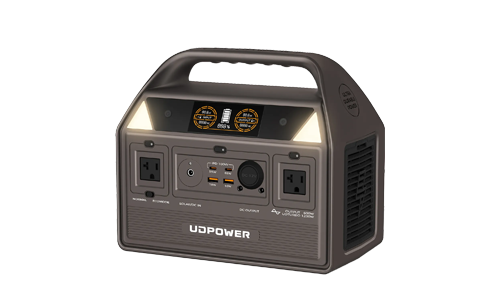
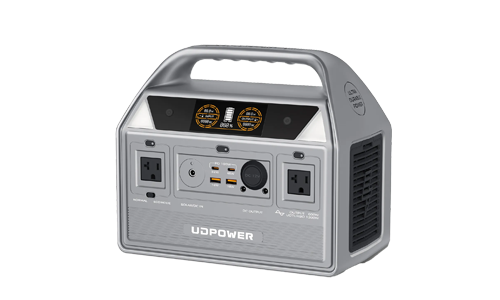
The UDPOWER S2400 is the strongest current UDPOWER option for larger portable home-backup loads, but it is important to place it in the correct category.
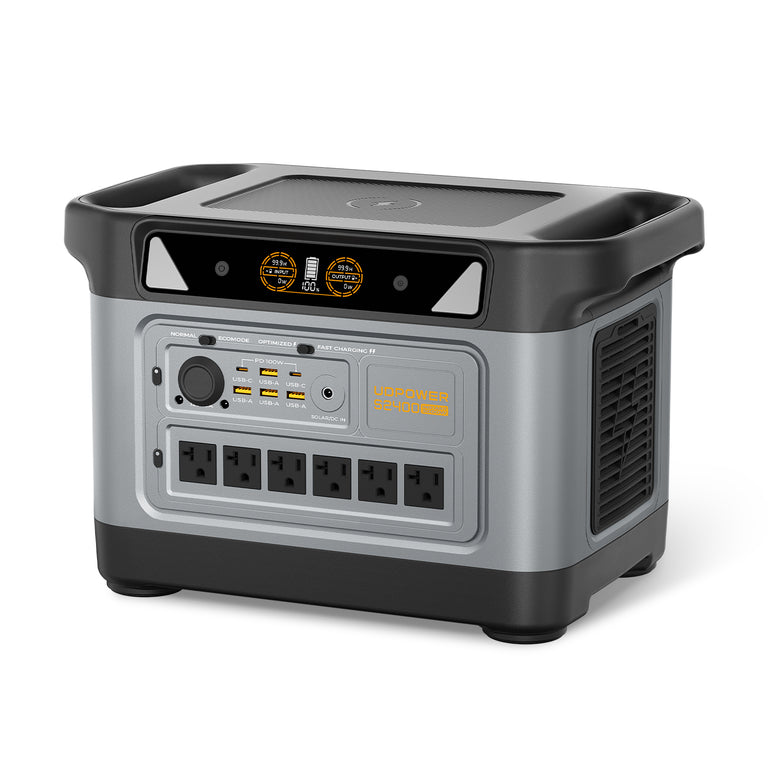
UDPOWER S2400 for Essential Home Backup
| Specification | UDPOWER S2400 | Why It Matters Here |
|---|---|---|
| Battery capacity | 2,083Wh LiFePO4 | Useful for refrigerator, communications, lighting, CPAP, electronics, and selected appliances |
| Rated AC output | 2,400W | Use the rated output as the primary simultaneous-load planning figure |
| AC output | 120V, 60Hz pure sine wave | It is not a native 120/240V split-phase whole-home source |
| AC outlets | 6 | Direct appliance backup may eliminate the need for panel integration entirely |
| Higher-power battery/inverter operation | Up to 3,000W under supported conditions | Provides extra capability for compatible loads, but the 2,400W rated output remains the appropriate baseline for backup-system planning |
| UPSPrime | ≤10 ms | Useful for compatible devices plugged through the unit; it does not turn a manual panel interlock into an automatic whole-home UPS |
| Solar input | Up to 400W | Can help extend an essentials-first plan during a multi-day outage when solar conditions allow |
The key limitation: the S2400 provides standard U.S. 120V AC output and does not provide native 240V split-phase output.
That means you should not look at a typical 120/240V generator interlock installation and assume that the S2400 can simply replace the generator.
UDPOWER's current product guidance recommends direct device operation through the S2400's AC outlets and states that any home transfer-switch connection should first be reviewed and installed by a licensed electrician who confirms compatibility.
For many S2400 owners, direct backup is actually the cleaner approach:
- refrigerator;
- Wi-Fi equipment;
- CPAP;
- LED lighting;
- TV and laptop;
- small kitchen appliances;
- compatible 120V equipment within the station's output limits.
Generator vs. Portable Power Station: The Transfer Equipment May Change the Answer
| Backup Source | Transfer Switch | Interlock Kit | Typical Best Approach |
|---|---|---|---|
| 120/240V portable generator | Common option | Common option when exact panel supports it | Choose based on circuit flexibility and load-management preference |
| Large standby generator | Automatic transfer equipment commonly used | Not normally the preferred architecture | Purpose-built standby system |
| 120V-only portable power station | Only with a professionally confirmed compatible arrangement | Do not assume compatibility with a conventional residential interlock setup | Direct essential-load backup is often simpler |
| Installed 120/240V home battery system | Manufacturer-specific transfer equipment may be available | Depends on system architecture | Follow the battery-system manufacturer's approved design |
If you are still choosing the backup source itself, read Portable Power Station vs. Generator for Power Outages.
When an Interlock Kit Is the Better Choice
An interlock can be an excellent fit when all of the following are true:
- your exact electrical panel has a compatible and accepted interlock arrangement;
- you use a properly matched panel backup source;
- you want to choose different circuits for different outages;
- you understand generator load management;
- you have enough backup capacity to make broad circuit access useful;
- someone will be present to operate the system manually;
- your electrician and local authority accept the complete installation.
A practical example is a home where summer outages prioritize a refrigerator, freezer, window AC, and kitchen circuit, while winter outages prioritize the furnace blower, refrigerator, lighting, and office.
The interlock lets the household change priorities without rewiring the backup circuits.
When a Transfer Switch Is the Better Choice
A selected-circuit manual transfer switch is often preferable when:
- the essential circuits rarely change;
- the backup source is relatively limited;
- the household wants a clear and repeatable outage routine;
- multiple people may operate the backup system;
- you want to make accidental use of large nonessential circuits less likely;
- the existing panel does not have a suitable interlock option;
- you need to supply compatible hardwired essential loads without giving the backup source access to every panel circuit.
When Neither Option Solves the Real Problem
Sometimes homeowners compare transfer switches and interlocks when the actual issue is that the backup source is too small.
Neither device will make a small generator or portable battery capable of running:
- central air conditioning;
- multiple electric heating loads;
- a large 240V well pump;
- an electric range;
- an electric dryer;
- an electric water heater;
- Level 2 EV charging;
- several large motors simultaneously.
Start with the loads first, then select the power source, then select the transfer method.
That order prevents a surprisingly common mistake: installing a convenient panel connection and discovering afterward that the generator or battery cannot support the circuits you intended to use.
A Better Way to Plan Backup Power
-
Step 1: Decide what must stay powered.
Separate genuine outage essentials from normal household convenience. -
Step 2: Record voltage.
Identify which loads are 120V and which are 240V. -
Step 3: Record running and startup demand.
Use appliance nameplates and manufacturer specifications rather than generic internet estimates when possible. -
Step 4: Choose the backup source.
Select the generator or battery around the actual loads. -
Step 5: Choose transfer equipment.
Only now decide whether fixed circuits or flexible panel access make more sense. -
Step 6: Verify the exact electrical panel.
Do not assume interlock compatibility from brand name alone. -
Step 7: Have the complete design reviewed.
Voltage, breaker arrangement, inlet, overcurrent protection, neutral, grounding, and local requirements all need to work together.
For a complete outage plan, use UDPOWER's 24/48/72-Hour Power Outage Checklist.
What to Ask Your Electrician Before Choosing
- Does my exact electrical panel have an approved generator interlock option?
- What is the panel model and series number?
- Would a selected-circuit transfer switch be easier or more appropriate for this panel?
- Is my backup source 120V-only or 120/240V split phase?
- Which of the loads I want to run actually require 240V?
- How much continuous backup power is available?
- What motor or compressor startup loads should we account for?
- What inlet and breaker arrangement is appropriate for this source?
- How is the source neutral configured?
- Does the transfer equipment switch the neutral?
- Are any circuits multi-wire or shared-neutral branch circuits?
- Will existing GFCI and AFCI protection remain compatible?
- Does the back-fed breaker require a retaining device?
- Are there local permit or inspection requirements?
- Can you provide a labeled operating procedure next to the panel?
Build a Breaker-Level Load Plan Before the Next Outage
If you choose an interlock, create a small load sheet and keep it next to the panel.
| Circuit | Voltage | Normal Load | Startup Concern | Outage Priority | Can Run Together With |
|---|---|---|---|---|---|
| Refrigerator | 120V | Record measured/nameplate data | Compressor | High | Record after testing |
| Furnace blower | Check equipment | Record measured/nameplate data | Motor | High in winter | Record after testing |
| Well or sump pump | Check equipment | Record measured/nameplate data | Often significant | High where applicable | Record after testing |
| Internet / office | 120V | Usually modest | Low | Medium to high | Usually compatible with other small loads |
| Microwave | 120V | Often high | Check input rating | Temporary | Turn off other large loads if necessary |
| Central AC | Usually 240V | High | Compressor | Only with appropriately sized system | Requires specific backup design |
This sheet is more useful than memorizing breaker positions in the dark.
Common Transfer Switch and Interlock Mistakes
Buying a universal-looking interlock online
Physical fit is not enough. Verify the exact panel, series, breaker arrangement, product instructions, and local acceptance.
Assuming a 200A panel requires a 200A generator
Your utility service rating and your backup load are different numbers. Size the backup source around the circuits you actually intend to operate.
Assuming an interlock lets you run the entire house
It may give the backup source access to the panel, but the generator still has a finite output. The individual circuit breakers do not collectively become available at full utility capacity.
Choosing by hardware price alone
The less expensive bracket may require panel work, an inlet, breaker changes, permits, or even panel replacement. Compare complete installed proposals.
Ignoring 240V loads
A 120V-only power source cannot run a normal 240V load through either an interlock or transfer switch.
Ignoring startup current
Pumps, refrigerator compressors, air conditioners, furnace blowers, and other motors may need substantially more power at startup than while running.
Using a larger transfer switch to “get more watts”
A switch rating does not increase power-source capacity.
Treating a portable battery exactly like a generator
A battery may have plenty of inverter power but limited stored watt-hours. An unnecessary 1,500W load can consume an emergency reserve quickly.
Waiting until the outage to learn the system
After installation, have everyone who may need to operate the system learn the approved procedure while utility power is available and conditions are calm.
Backfeeding through a wall or dryer outlet
Never use an improvised cord to energize household wiring. Use professionally installed transfer equipment designed for the purpose.
Frequently Asked Questions
Is an interlock kit better than a transfer switch?
Neither is universally better. An interlock is usually more flexible because it can make more circuits in the existing panel available, while a selected-circuit transfer switch normally provides a simpler, predetermined backup plan. The right choice depends on your panel, backup source, loads, and how comfortable the household is with manual load management.
Is an interlock kit cheaper than a transfer switch?
The interlock hardware itself is often less expensive than dedicated transfer-switch equipment, but total installed cost can be different. Generator inlet work, breakers, panel modifications, available breaker space, permits, labor, and an older or incompatible panel can significantly change the final quote.
Is a generator interlock safe?
A properly selected and installed interlock can be part of a safe backup-power system when it is appropriate for the exact electrical panel and the complete installation meets applicable requirements. Do not use a generic or improvised interlock simply because it appears to fit.
Can an interlock kit power the whole house?
An interlock may make many circuits in the main panel available, but it does not increase generator output. You can only operate the combination of loads that the backup source can support. Large loads may need to remain off or be alternated.
Does a transfer switch limit how many circuits I can use?
A selected-circuit manual transfer switch normally supplies only the circuits included in that transfer system. This reduces flexibility but can make load management simpler. Other types of transfer equipment may serve larger portions of an electrical system.
Can a transfer switch power 240V appliances?
Yes, when the transfer equipment, backup source, wiring, and load are all designed for 120/240V operation. A transfer switch cannot create 240V from a power source that provides only 120V.
Can an interlock kit be used with a portable power station?
Do not assume that it can. Many residential interlock installations are designed around a conventional 120/240V generator and a two-pole generator breaker. Many portable power stations provide only 120V. Have a qualified electrician confirm the exact source and panel arrangement before considering a panel connection.
Can I use the UDPOWER S2400 with an interlock kit?
The S2400 provides 120V, 60Hz AC output and does not provide native 240V split-phase output. UDPOWER recommends powering devices directly from the station and does not recommend connecting it to home transfer equipment unless the complete setup has been reviewed and installed by a licensed electrician. Do not assume a typical 120/240V generator interlock installation is compatible.
Can I use the UDPOWER S2400 with a transfer switch?
Potentially only in a specifically compatible 120V arrangement confirmed by a licensed electrician. The electrician needs to evaluate the transfer equipment, circuit voltage, inlet or connection method, neutral and grounding configuration, protective devices, and local requirements.
Does an interlock automatically transfer power during an outage?
No. A typical generator interlock is manually operated. If you need the backup source to start and transfer loads automatically when utility power fails, you need equipment specifically designed for automatic standby operation.
Does a transfer switch automatically transfer power?
Not necessarily. Manual transfer switches require user operation. Automatic transfer switches are a separate category commonly used with permanently installed standby generator or home-energy systems.
Do I still need a power inlet with an interlock?
A conventional portable-generator interlock installation commonly includes a properly rated generator inlet and associated wiring so the generator can supply the dedicated panel breaker. The exact components depend on the generator, panel, installation, and local requirements.
Can I backfeed a generator if I turn off the main breaker first?
No. Do not plug a generator into a household wall or dryer outlet as a substitute for proper transfer equipment. A mechanical or electrical transfer arrangement is intended to prevent unsafe source overlap rather than relying solely on someone remembering to operate the main breaker correctly.
Do I need an electrician to install a transfer switch or interlock?
These systems alter how a backup source connects to household electrical wiring and the service panel. A qualified electrician should select and install the equipment and confirm panel compatibility, source voltage, breaker configuration, grounding, neutral behavior, overcurrent protection, and applicable permit or inspection requirements.
Which is better for a small generator?
A selected-circuit transfer switch can be attractive with a small generator because it limits the household to a defined group of essential circuits. An interlock can also work with an appropriately matched generator, but the user must be disciplined about keeping larger and nonessential loads off.
Which is better for a large portable generator?
An interlock can become more useful as generator capacity increases because flexible access to existing panel circuits lets you alternate loads as conditions change. A transfer switch may still be preferred when simple operation or a fixed critical-load list matters more than flexibility.
Bottom Line: Transfer Switch vs. Interlock Kit
A manual transfer switch is usually the better fit when simplicity, fixed essential circuits, and predictable load management matter most. An interlock kit is usually the better fit when flexibility matters most, your exact panel supports an appropriate interlock, and the household is comfortable managing loads manually.
The more important decision, however, comes before either one: choose the loads and backup source first.
A transfer switch cannot make a generator larger. An interlock cannot turn a 120V battery into a 240V source. Neither can make every breaker in a 200A panel run from a small backup system.
If you are using a portable battery such as the UDPOWER S2400, an essentials-first strategy is usually more useful than trying to duplicate normal whole-home operation. Its 2,083Wh battery, 2,400W rated pure sine wave output, and six AC outlets make it well suited to direct backup of selected 120V essentials, while any connection to home transfer equipment should first be evaluated by a qualified electrician.
Build the Right Backup Power Setup
Start with what you actually need during an outage, calculate the load, then choose the power source and connection method that fit the job.
Compare UDPOWER Portable Power Stations View UDPOWER S2400 View the Essential-Load Selection Guide Get the Home Backup Power GuideSources & Further Reading
- U.S. Consumer Product Safety Commission — Portable Generator Safety Alert
- Electrical Safety Foundation International — Generator and Backfeed Safety
- Generac — HomeLink Manual Transfer Switches
- Generac — HomeLink 30A Manual Transfer Switch
- Schneider Electric — How Generator Interlock Kits Function
- Schneider Electric — Homeline Generator Interlock Compatibility
- Schneider Electric — Interlock Availability for Older Load Centers
- UDPOWER S2400 Official Specifications
- UDPOWER Power Outage Checklist
- UDPOWER Power Priorities Guide
- UDPOWER — How Many Watts Does a House Use?
- UDPOWER — What Does Surge Current Mean?
- UDPOWER — Portable Power Station vs. Generator for Power Outages
Related Articles


