

12V Solar Battery Guide: 50Ah vs 100Ah vs 200Ah Size & Runtime
Last updated: September 18, 2026
A 12V solar battery can be small enough to run lights and charge phones for a weekend, or large enough to support an RV refrigerator, CPAP machine, laptop, fans, and other off-grid loads for days. The confusing part is that battery labels such as 50Ah, 100Ah, and 200Ah tell only part of the story.
To choose the right battery, you need to know three different things: how much energy the battery stores, how much of that energy you can actually use, and whether the battery and its BMS can safely deliver enough current for your appliances.
This guide focuses specifically on battery sizing and runtime. If you are looking for solar-panel wattage, charge controllers, series versus parallel panel wiring, or solar charging time, see the separate 12V Solar Panel Kit: Components, Sizing, Wiring & Battery Guide.
Quick Answer: 50Ah vs 100Ah vs 200Ah
For a typical 12V-class LiFePO4 battery using a nominal voltage of 12.8V:
- 50Ah stores about 640Wh of nominal energy.
- 100Ah stores about 1,280Wh of nominal energy.
- 200Ah stores about 2,560Wh of nominal energy.
A 50Ah battery is often enough for light camping, electronics, lights, and modest overnight loads. A 100Ah battery is a more practical starting point for an RV refrigerator, CPAP, laptop, fans, and general weekend use. A 200Ah battery makes more sense when you want longer off-grid runtime, heavier daily energy use, or one to several days of reserve between charging opportunities.
Do not choose from Ah alone. A battery also needs enough discharge current, a suitable BMS, proper wiring, compatible charging equipment, and enough solar or other charging capacity to replace the energy you use.

What Is a 12V Solar Battery?
A 12V solar battery is simply a battery used to store energy in a nominal 12V solar or off-grid electrical system. It is not a separate battery chemistry.
A 12V solar battery may be:
- LiFePO4, also called LFP or lithium iron phosphate
- AGM lead-acid
- Gel lead-acid
- Flooded lead-acid
These batteries are commonly used in RVs, vans, boats, trailers, cabins, sheds, portable off-grid systems, telecommunications equipment, emergency backup systems, and other applications where energy needs to be stored for use after the sun goes down.
In a conventional solar setup, the energy path usually looks like this:
The battery's job is storage. The solar array's job is energy generation. Those are related, but they should not be sized from the same number.
A larger battery gives you more runtime between charges. A larger solar array determines how quickly you can put that energy back.
For the panel side of the system, use our 12V Solar Panel Kit Guide. This article stays focused on battery capacity, runtime, current and system voltage.
12V vs 12.8V: Why Are Both Called “12V”?
This is one of the first things that confuses people shopping for LiFePO4 batteries.
A battery may be sold as a 12V LiFePO4 battery while the specification sheet says 12.8V nominal voltage. Both descriptions can be correct.
“12V” describes the electrical system class. A typical LiFePO4 battery uses four approximately 3.2V nominal cells in series:
For example, Victron's current technical data lists its LiFePO4 50Ah, 100Ah and 200Ah batteries as 12.8V nominal batteries with 640Wh, 1,280Wh and 2,560Wh of nominal energy respectively.
| Battery Label | Nominal Voltage Used for Calculation | Capacity | Nominal Energy | Source |
|---|---|---|---|---|
| 12V-class LiFePO4 | 12.8V | 50Ah | 640Wh | Victron Technical Data |
| 12V-class LiFePO4 | 12.8V | 100Ah | 1,280Wh | Victron Technical Data |
| 12V-class LiFePO4 | 12.8V | 200Ah | 2,560Wh | Victron Technical Data |
That extra 0.8V matters when converting amp-hours into watt-hours. If you simply multiply every lithium battery by 12V, you slightly understate the nominal stored energy.
50Ah vs 100Ah vs 200Ah Battery
If all three batteries use the same 12.8V LiFePO4 architecture, the energy relationship is straightforward:
| Battery Size | Nominal Energy | 90% Battery Use Planning Value | Approx. AC Energy After 90% Inverter Efficiency | Typical Role |
|---|---|---|---|---|
| 50Ah | 640Wh | 576Wh | About 518Wh | Light camping, lights, charging electronics, modest overnight loads |
| 100Ah | 1,280Wh | 1,152Wh | About 1,037Wh | RV refrigerator, CPAP, laptops, fans, weekend travel |
| 200Ah | 2,560Wh | 2,304Wh | About 2,074Wh | Longer RV stays, larger overnight loads, multi-day off-grid use |
The table uses a 90% battery-use planning value for the LiFePO4 examples and a 90% inverter efficiency assumption for AC loads. These are planning assumptions, not universal specifications for every battery or inverter.
Always follow the depth-of-discharge, charge, discharge and temperature limits published by the manufacturer of the battery you actually own.
When 50Ah Makes Sense
A 50Ah battery is attractive when weight, space and cost matter more than maximum runtime. It can work well for:
- Phone and camera charging
- LED lighting
- Small fans
- Short CPAP use when consumption is low
- Day trips and weekend camping
- Small DC loads
- A compact emergency reserve
Its main limitation is not that 640Wh is “small.” The limitation is that refrigerators, heated CPAP setups, inverter loads and cloudy-day reserve can consume that energy surprisingly quickly.
When 100Ah Makes Sense
A 100Ah LiFePO4 battery is a common middle ground because roughly 1.28kWh of nominal storage is enough to support many practical RV and camping loads without immediately turning the battery bank into a large installation.
It is often a better starting point when you expect to run:
- A 12V compressor refrigerator
- A CPAP machine overnight
- Laptop and phone charging
- Lights and fans
- Water pumps
- Occasional moderate inverter loads
When 200Ah Makes Sense
A 200Ah bank becomes useful when your issue is no longer “Can the battery run this device?” but “Can the battery run all of my daily loads and still leave enough reserve for tomorrow?”
It is better suited to:
- Longer RV boondocking trips
- Refrigeration plus electronics plus CPAP
- Remote cabins with modest daily loads
- Users who want one to several days between charging opportunities
- Higher daily energy budgets
But doubling battery capacity without increasing charging capacity can create a new problem: the battery may take too long to refill after several cloudy days.
How Much Energy Does Each Battery Actually Store?
Battery capacity in amp-hours is only useful when voltage is known.
For a 12.8V 100Ah LiFePO4 battery:
For a 200Ah battery:
This is why watt-hours are a much better unit for comparing batteries across different voltages.
| Battery | Voltage | Ah | Nominal Wh | Compared With 100Ah | Reference |
|---|---|---|---|---|---|
| 12.8V 50Ah LiFePO4 | 12.8V | 50Ah | 640Wh | Half the nominal energy | Victron |
| 12.8V 100Ah LiFePO4 | 12.8V | 100Ah | 1,280Wh | Baseline | Victron |
| 12.8V 200Ah LiFePO4 | 12.8V | 200Ah | 2,560Wh | Twice the nominal energy | Victron |
| 25.6V 50Ah battery | 25.6V | 50Ah | 1,280Wh | Same nominal Wh as 12.8V 100Ah | Wh = V × Ah |
You can also use the UDPOWER Battery Unit Conversion Tools when converting between Ah, Wh, watts, volts and other battery units.
How Long Will a 50Ah, 100Ah or 200Ah Battery Run an Appliance?
For a steady AC load, a useful planning formula is:
If we use:
- 90% usable battery capacity for the LiFePO4 planning examples
- 90% inverter conversion efficiency
a 100Ah battery becomes:
A steady 100W AC device would therefore have a planning runtime of:
This is an estimate, not a guarantee. Real runtime changes with battery temperature, state of charge, battery age, BMS behavior, inverter idle consumption, cable losses and the appliance's changing power demand.
For refrigerators and compressors, a 24-hour measured average is far more useful than the compressor's maximum running wattage.
12V Battery Runtime Chart
The following table compares the three battery sizes under the same assumptions: 12.8V nominal LiFePO4, 90% usable battery capacity and 90% inverter efficiency.
| Average AC Load | 50Ah / 640Wh | 100Ah / 1,280Wh | 200Ah / 2,560Wh | Example Use |
|---|---|---|---|---|
| 20W | About 25.9 hours | About 51.8 hours | About 103.7 hours | Low-power electronics or CPAP without heavy heated features |
| 40W | About 13.0 hours | About 25.9 hours | About 51.8 hours | CPAP, fan or efficient cycling load |
| 60W | About 8.6 hours | About 17.3 hours | About 34.6 hours | Example refrigerator average or electronics bundle |
| 100W | About 5.2 hours | About 10.4 hours | About 20.7 hours | TV, larger fan or moderate appliance average |
| 300W | About 1.7 hours | About 3.5 hours | About 6.9 hours | Moderate inverter load |
| 600W | About 0.9 hour | About 1.7 hours | About 3.5 hours | Higher-power appliance if the battery, BMS, inverter and wiring support it |
How Large a Battery Do You Need for an RV?
The best way to size an RV battery is to measure or estimate daily watt-hours.
Do not begin with RV length. A 30-foot RV with propane cooking and efficient DC appliances can use less battery energy than a much smaller van running electric cooking, a large inverter and several electronics.
Example RV Daily Energy Budget
| Example Load | Daily Use | Example Daily Energy | Planning Note |
|---|---|---|---|
| 12V refrigerator | Cycling throughout the day | 400Wh | Use measured 24-hour energy if available. |
| LED lights | 20W × 4 hours | 80Wh | Actual use varies by number of lights. |
| Water pump | 60W × 0.5 hour | 30Wh | Pumps normally operate intermittently. |
| Laptop | 60W × 3 hours | 180Wh | Charging demand varies by laptop. |
| Phones and small electronics | Daily charging | 50Wh | Planning allowance. |
| Total | 740Wh/day | Example only. |
With approximately 740Wh of daily use, a 50Ah LiFePO4 battery with about 576Wh available under a 90% planning depth is not enough for a complete day without charging.
A 100Ah battery with about 1,152Wh at that same battery-use assumption gives substantially more room. A 200Ah battery gives roughly 2,304Wh before allowing for any additional inverter or DC conversion losses.
Simple RV Battery Size Guide
| Daily Battery Use | 50Ah | 100Ah | 200Ah | Interpretation |
|---|---|---|---|---|
| 300Wh/day | About 1.9 days | About 3.8 days | About 7.7 days | Light DC use, before other system losses. |
| 500Wh/day | About 1.2 days | About 2.3 days | About 4.6 days | Moderate camping or efficient RV use. |
| 800Wh/day | Less than 1 day | About 1.4 days | About 2.9 days | Refrigeration plus electronics and lighting. |
| 1,000Wh/day | About 0.6 day | About 1.2 days | About 2.3 days | Higher daily RV energy use. |
These figures use 90% of nominal LiFePO4 energy and assume no solar or alternator charging during the period. They are intended to show how battery size changes autonomy, not predict a specific RV's exact runtime.
If RV use is your main application, also see UDPOWER RV & Camping Power Solutions.
How Large a Battery Do You Need for Camping?
Camping power tends to fall into three distinct groups.
| Camping Style | Typical Battery Demand | Battery Size to Consider | Why |
|---|---|---|---|
| Light camping | Phones, lights, camera, small fan | 50Ah | Low daily Wh makes a compact battery practical. |
| Weekend camping with fridge | 12V fridge, phones, lights, laptop, fan | 100Ah | More reserve for refrigeration and overnight loads. |
| Extended off-grid camping | Fridge, CPAP, laptops, fans, electronics and larger reserve | 200Ah or larger system | Provides more stored energy between good charging days. |
The important word is consider. A camper using 250Wh per day can stay out much longer on 100Ah than someone using 1,000Wh per day.
Daily energy use remains the deciding number.
How Large a Battery Do You Need for a Refrigerator?
Refrigerators are one of the easiest appliances to size incorrectly because the compressor does not normally run continuously.
Do not take a refrigerator labeled “150W” and automatically multiply 150 × 24. The compressor cycles. Defrost heaters, ambient temperature, insulation, door openings and thermostat settings all change daily energy use.
For home refrigerators, a 24-hour watt-meter measurement or the EnergyGuide annual kWh figure is often more useful. Our Portable Power Station Refrigerator Guide explains this method in more detail.
Example Using a 60W Average AC Load
| Battery | Planning AC Energy | Runtime at 60W Average | What It Means |
|---|---|---|---|
| 50Ah LiFePO4 | About 518Wh | About 8.6 hours | Usually too little for a full day at this average draw without charging. |
| 100Ah LiFePO4 | About 1,037Wh | About 17.3 hours | Useful for partial-day or overnight backup. |
| 200Ah LiFePO4 | About 2,074Wh | About 34.6 hours | More practical for extended refrigerator backup. |
If the refrigerator is a native 12V DC model and can operate directly from the battery system through appropriate regulated/protected wiring, inverter losses may be avoided.
For example, a 40W average DC load using the 90% battery-use assumption gives approximately:
- 50Ah: 14.4 hours
- 100Ah: 28.8 hours
- 200Ah: 57.6 hours
Actual refrigerator consumption must still be measured. A 40W compressor rating is not automatically the same as a 40W 24-hour average.
How Large a Battery Do You Need for a CPAP?
CPAP battery sizing depends heavily on heated humidification and heated tubing.
A CPAP running without heated features may consume much less power than the same machine with the humidifier and hose heater operating throughout the night.
For a detailed CPAP-specific calculation, see Sleep Apnea Equipment Backup Power: CPAP Battery Guide.
Estimated Runtime by Average CPAP Load
The table below uses the same LiFePO4 and 90% inverter-efficiency assumptions used throughout this guide.
| Average CPAP Load | 50Ah Battery | 100Ah Battery | 200Ah Battery |
|---|---|---|---|
| 20W | About 25.9 hours | About 51.8 hours | About 103.7 hours |
| 40W | About 13.0 hours | About 25.9 hours | About 51.8 hours |
| 65W | About 8.0 hours | About 16.0 hours | About 31.9 hours |
| 90W | About 5.8 hours | About 11.5 hours | About 23.0 hours |
A person whose CPAP averages 20W may get several nights from a 100Ah battery. A heated setup averaging 90W can use the same battery much faster.
How Large a Battery Do You Need for Overnight Use?
“Overnight” is not a battery size. It is an energy requirement.
Use:
If your combined overnight loads average 75W for 10 hours:
If those loads are AC-powered and you plan around 90% inverter efficiency:
If you also want to use only 90% of a LiFePO4 battery:
That places the requirement within the energy range of a 12.8V 100Ah battery at 1,280Wh nominal.
Now imagine the overnight load is 150W:
A 100Ah battery is no longer enough under the same assumptions. This is why the phrase “I just need it overnight” cannot determine battery size by itself.
One Battery vs Two Batteries in Parallel
Two compatible 12.8V 100Ah batteries connected in parallel create a 12.8V-class bank with approximately 200Ah nominal capacity.
That is the same nominal energy as one 12.8V 200Ah battery.
But the two systems are not automatically identical in every other respect.
| Factor | One 200Ah Battery | Two 100Ah Batteries in Parallel |
|---|---|---|
| Nominal energy | About 2,560Wh at 12.8V | About 2,560Wh total |
| Physical installation | One larger enclosure | Two smaller enclosures |
| Wiring | Simpler battery connection | Requires correctly designed parallel connections |
| BMS | One BMS | Two independent battery BMS units |
| Current sharing | Internal to one battery | Depends on matched batteries, cable resistance and system design |
| Replacement flexibility | Whole battery is one unit | Modular, but batteries must remain compatible |
| Space | Needs one larger location | Can sometimes fit separate spaces if approved by system design |
12V 100Ah vs 24V 50Ah: Same Wh, Different System
This comparison shows why amp-hours can be misleading.
Both batteries store the same nominal amount of energy.
That does not mean they are interchangeable. The 24V battery requires a 24V-compatible inverter, charger, solar controller, DC equipment and other system components.
Why Higher Voltage Reduces Current
Ignoring conversion losses:
For a 1,000W load:
| Battery System | Nominal Voltage | Ideal Current at 1,000W | Approx. Battery Current With 90% Inverter Efficiency |
|---|---|---|---|
| 12V-class LiFePO4 | 12.8V | About 78.1A | About 86.8A |
| 24V-class LiFePO4 | 25.6V | About 39.1A | About 43.4A |
At approximately twice the voltage, the battery-side current for the same power is approximately halved.
That can make high-power systems easier to design because cable current, connector current, fuse requirements and voltage drop become easier to manage.
When Should You Move From 12V to 24V?
There is no single wattage where every system must switch to 24V. The decision depends on cable length, inverter size, battery current capability, equipment availability and installation requirements.
However, it is worth seriously considering 24V when:
- Your inverter loads regularly reach roughly 1,500W to 2,000W or more.
- Battery-side current is becoming difficult to manage.
- The cable run between the battery and inverter is long.
- Your battery bank is growing well beyond a basic 100Ah system.
- You are building a permanent cabin, van or off-grid electrical system rather than a small portable setup.
- Your preferred inverter and charge-controller ecosystem is better suited to 24V.
For example, a 2,000W load at 12.8V theoretically requires about 156A before inverter losses. With a 90% efficient inverter, battery-side current can approach 174A.
The same 2,000W load at 25.6V requires roughly half that current.
Battery BMS Current Limits: The Number Many Buyers Miss
A battery's amp-hour capacity tells you stored charge. It does not tell you the maximum appliance power it can safely support.
For LiFePO4 batteries, the Battery Management System, or BMS, normally places limits on:
- Continuous discharge current
- Peak discharge current
- Charge current
- High and low cell voltage
- Temperature
- Short-circuit conditions
Consider a hypothetical 12.8V battery with a 100A continuous BMS limit.
That does not mean you should automatically connect a 1,280W AC appliance. The inverter consumes energy, battery voltage changes under load and manufacturers may specify additional continuous and surge restrictions.
Why BMS Rating Can Matter More Than Ah
| Example BMS Continuous Limit | Approx. DC Power at 12.8V | What to Check Before Choosing an Inverter |
|---|---|---|
| 50A | About 640W | Battery manual, inverter input current, surge demand and cable rating |
| 100A | About 1,280W | Same checks plus continuous inverter demand |
| 150A | About 1,920W | High-current wiring and protection become increasingly important |
| 200A | About 2,560W | Very high current requires an appropriately designed battery system |
These are simple voltage × current calculations, not universal inverter recommendations.
Two 100Ah batteries from different manufacturers may store almost the same watt-hours but have very different continuous-current limits.
Why Ah Alone Can Be Misleading
There are five reasons an Ah number alone cannot tell you how useful a battery will be.
1. Voltage Changes the Energy
100Ah at 12.8V is 1,280Wh. 100Ah at 25.6V is 2,560Wh.
2. Battery Chemistry Changes Usable Capacity
Different battery chemistries have different recommended discharge behavior and cycle-life characteristics.
3. BMS Current Changes Available Power
Two 100Ah batteries can have different continuous discharge ratings.
4. Temperature Changes Capacity and Charging Behavior
Cold temperatures can reduce available capacity, and many LiFePO4 batteries restrict or block charging near or below freezing unless designed for low-temperature charging.
For example, Victron's published LiFePO4 technical data shows lower measured nominal capacity as temperature drops, demonstrating why room-temperature capacity should not automatically be treated as guaranteed winter capacity.
View Victron battery technical data.
5. AC Appliances Add Conversion Losses
A 1,280Wh battery does not normally deliver 1,280Wh to a 120V AC appliance because the inverter consumes some of that energy.
When comparing batteries, convert to watt-hours first, then check usable depth, BMS current and the actual load type.
LiFePO4 Usable Capacity vs Lead-Acid Usable Capacity
Comparing a 100Ah lithium battery directly with a 100Ah lead-acid battery can be misleading because the usable portion of the nameplate capacity can differ significantly.
Lead-acid batteries generally experience much greater cycle-life penalty when repeatedly discharged deeply. Battery University, for example, shows substantially more deep-cycle battery cycles at 50% depth of discharge than at 100% depth of discharge.
LiFePO4 batteries are commonly designed for deeper cycling, although the exact allowable depth of discharge depends on the battery manufacturer.
| Example | Nominal Energy | Illustrative Planning Depth | Illustrative Usable Energy | Source / Note |
|---|---|---|---|---|
| 12.8V 100Ah LiFePO4 | 1,280Wh | 80% | 1,024Wh | Victron publishes cycle-life data at multiple DoD levels |
| 12V 100Ah lead-acid | About 1,200Wh nominal | 50% | About 600Wh | Battery University shows deeper discharge reducing lead-acid cycle life |
The 80% and 50% values above are comparison assumptions, not universal hard limits.
Some LiFePO4 batteries are rated for deeper discharge. Some lead-acid applications may use more or less than 50%. Always follow the actual battery manufacturer's specifications.
For a deeper chemistry comparison, see Pros and Cons of LiFePO4 Batteries and Deep Cycle Batteries Explained.
How Many Days of Autonomy Should an Off-Grid Battery Have?
Battery autonomy means how long the battery can support the planned loads when meaningful solar charging is unavailable.
For off-grid planning, the National Renewable Energy Laboratory notes that systems commonly plan for roughly one to three days of autonomy, although the correct amount depends on the loads, climate, backup options and required resilience.
NREL: Understanding Off-Grid Systems
That does not mean every camper needs three days of battery storage.
A weekend RV that can recharge from the alternator tomorrow may only need one day of battery reserve. A remote cabin with no generator and unreliable winter solar may need significantly more planning margin.
Battery Autonomy Formula
For AC loads:
If you consume 800Wh per day, want two days of autonomy, use 80% of the battery and assume 90% inverter efficiency:
At 12.8V:
A 200Ah-class battery bank therefore provides a more appropriate capacity class than 100Ah for that particular example.
Autonomy Sizing Table
| Daily Load | 1 Day | 2 Days | 3 Days | Assumptions |
|---|---|---|---|---|
| 500Wh/day | 694Wh / about 54Ah | 1,389Wh / about 109Ah | 2,083Wh / about 163Ah | 80% battery use, 90% inverter efficiency, 12.8V |
| 800Wh/day | 1,111Wh / about 87Ah | 2,222Wh / about 174Ah | 3,333Wh / about 260Ah | Same assumptions |
| 1,200Wh/day | 1,667Wh / about 130Ah | 3,333Wh / about 260Ah | 5,000Wh / about 391Ah | Same assumptions |
This table highlights an important point: once daily consumption rises, arguing over 50Ah versus 100Ah can miss the bigger issue. A user consuming 1,200Wh every day and asking for three days without charging is no longer shopping for a small battery. The calculated bank approaches 5kWh.
How Much Solar Should You Pair With a 50Ah, 100Ah or 200Ah Battery?
Battery capacity and solar-panel size should not be linked with a rigid rule such as “100Ah always needs 200W solar.”
Solar should be sized around the energy you need to replace.
A 200Ah battery may only lose 300Wh during a light-use day. In that case, you do not need to replace the full 2,560Wh every afternoon.
On another trip, you may use 1,500Wh overnight. The same battery then needs a much larger solar contribution if you want it recovered in one day.
| Battery | Nominal Energy | Main Sizing Question | Detailed Solar Guide |
|---|---|---|---|
| 50Ah | 640Wh | How many Wh did you actually use? | 12V Solar Panel Kit Guide |
| 100Ah | 1,280Wh | How quickly must the daily energy be replaced? | Solar Sizing & Charging Guide |
| 200Ah | 2,560Wh | Do the array and controller have enough recovery capacity? | Solar Panel Kit Guide |
This separation is useful:
Battery size determines how much energy you can store.
Solar size determines how much energy you can recover during available sunlight.
Don't Want to Build a 12V Battery System? Consider a Portable Power Station
A traditional 12V battery bank gives you significant flexibility, especially when you are hardwiring an RV, van, boat or cabin.
But it also requires you to correctly match several components:
- Battery
- BMS
- Inverter
- Solar charge controller
- AC charger
- Fuses or breakers
- Busbars
- Cabling
- Connectors
- Battery monitoring
If your main goal is portable camping, temporary RV use, refrigerator backup, CPAP backup or emergency power, an integrated portable power station may be simpler.
UDPOWER S1200: Similar Energy Class to a 100Ah 12V Battery
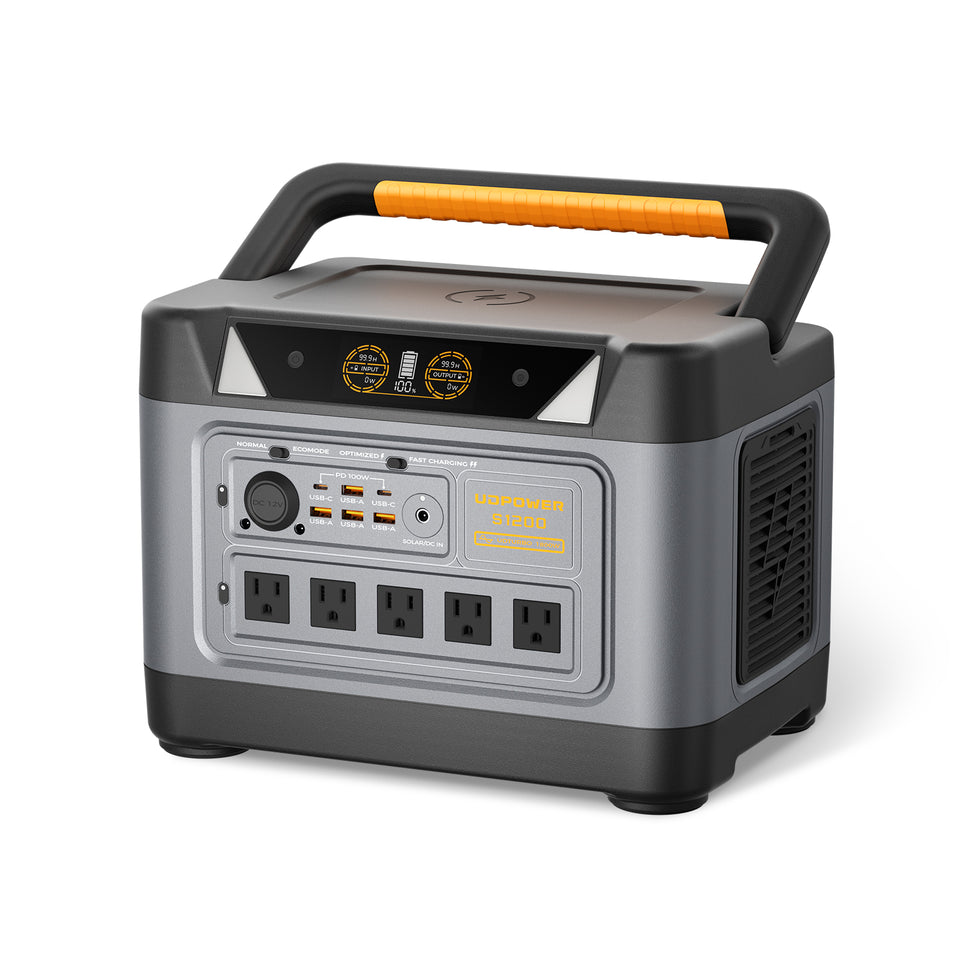
The UDPOWER S1200 has a 1,190Wh LiFePO4 battery and 1,200W rated pure sine wave AC output.
For energy-scale comparison only, a conventional 12.8V 100Ah LiFePO4 battery stores about 1,280Wh nominally. That puts the S1200 in a broadly similar stored-energy class, but the S1200 also integrates the inverter, charging system, BMS, AC outlets, USB ports, DC outputs and display.
| S1200 Specification | Official Value | Why It Matters | Source |
|---|---|---|---|
| Battery capacity | 1,190Wh class | Comparable in stored-energy scale to a conventional 100Ah-class 12V battery setup. | Official S1200 Page |
| Battery chemistry | LiFePO4 | Designed for repeated portable backup and outdoor use. | Official Specifications |
| Rated AC output | 1,200W | The inverter is already integrated. | Official Specifications |
| Solar input | Up to 400W | Supports portable solar charging within the stated input limits. | Official S1200 Page |
| Weight | Approximately 26.0 lb | Portable between home, RV and campsite. | Official Specifications |
UDPOWER S2400: More Storage for Longer Runtime
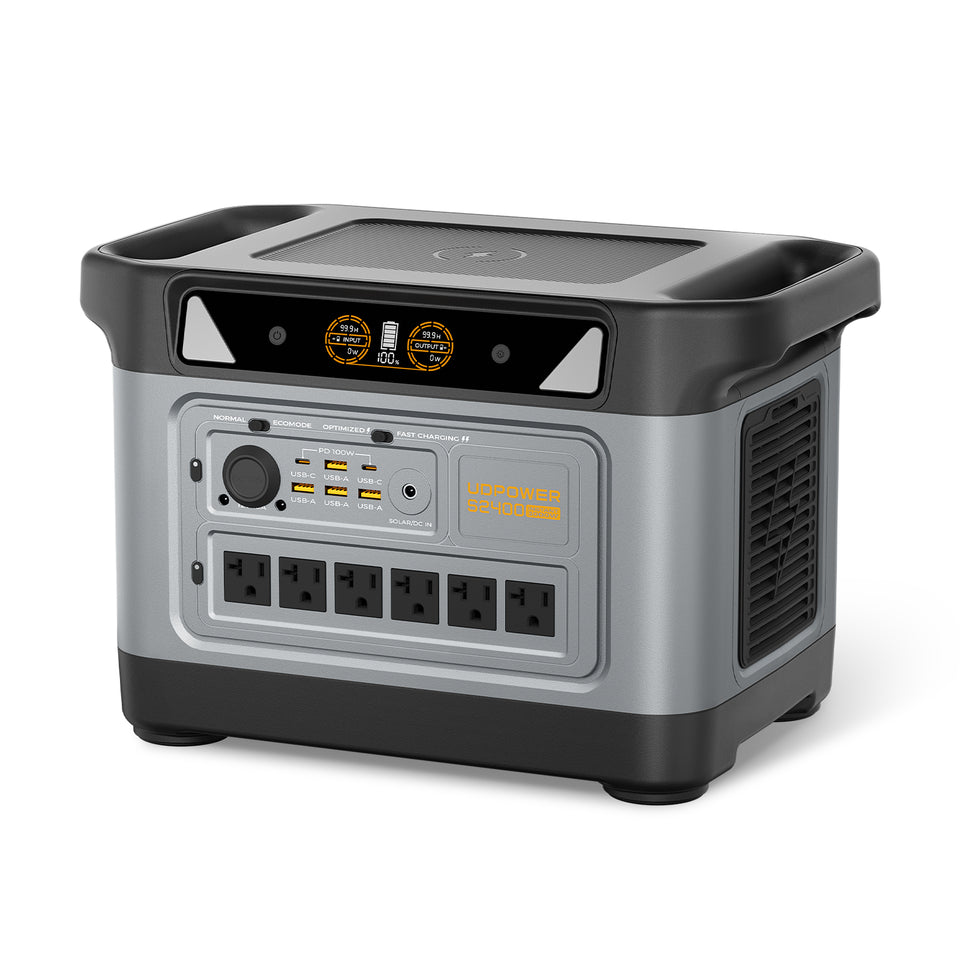
The UDPOWER S2400 increases stored energy to 2,083Wh and rated AC output to 2,400W.
For comparison, a conventional 12.8V 200Ah battery stores approximately 2,560Wh nominally. The S2400 stores less nominal energy than that standalone battery example, but it includes the inverter, BMS, charging hardware and outputs in one portable system.
| S2400 Specification | Official Value | Why It Matters | Source |
|---|---|---|---|
| Battery capacity | 2,083Wh | More than double the energy of many compact power stations. | Official S2400 Page |
| Battery chemistry | LiFePO4 | Suitable for frequent backup, RV and outdoor cycling. | Official Specifications |
| Rated AC output | 2,400W | Handles considerably larger simultaneous AC loads than a small DIY inverter setup. | Official Specifications |
| Solar input | 12V–50V, 10A max, up to 400W | Solar panels must remain within the station's electrical input limits. | Official Specifications |
| Weight | Approximately 40.8 lb | Higher-capacity option for RV, camping and backup applications. | Official Specifications |
Standalone 12V Battery vs Portable Power Station
| Need | Standalone 12V Battery System | Portable Power Station |
|---|---|---|
| Hardwired RV DC circuits | Usually better suited | Depends on available DC outputs and integration |
| Component customization | High | Limited to product design |
| Installation work | Higher | Low |
| Built-in inverter | Usually separate | Yes |
| Built-in solar charging | Requires controller | Integrated on compatible models |
| USB and AC outlets | Require additional components | Integrated |
| Move between home and campsite | Usually inconvenient | Designed for portability |
Common 12V Solar Battery Sizing Mistakes
1. Choosing Battery Size From Ah Alone
Always convert Ah to Wh before comparing batteries at different voltages.
2. Assuming Nameplate Wh Equals AC Output Energy
Inverters use some of the stored energy themselves. Battery protection settings may also reserve part of the nominal capacity.
3. Ignoring the BMS Current Rating
A battery may have enough energy for a high-wattage appliance but still be unable to supply the required current.
4. Sizing From Appliance Maximum Watts Instead of Daily Wh
Maximum watts tell you how much power is required at one moment. Daily Wh tells you how much energy the appliance consumes over time.
5. Buying a 200Ah Battery With a Tiny Charging System
More storage is useful only if you have a practical way to recharge it before the next time you need the energy.
6. Assuming 100Ah Lithium Equals 100Ah Lead-Acid in Real Use
Same Ah does not guarantee the same usable energy, weight, current capability, cycle life or charging behavior.
7. Forgetting Overnight Loads
Refrigerators, CPAP machines, fans, routers and standby electronics continue to draw power while you sleep.
8. Ignoring Winter Conditions
Temperature affects available battery capacity and charging behavior. Cold-weather battery specifications matter in RVs, cabins and outdoor systems.
9. Adding Batteries in Parallel Without Checking the Manual
Parallel connection must be specifically supported by the battery manufacturer and designed with appropriate wiring and protection.
10. Increasing Inverter Size Without Checking Battery Current
A bigger inverter can demand enormous current from a 12V bank. The inverter wattage label does not change what the battery and BMS can safely deliver.
11. Designing for Zero Reserve
A battery that works only when every watt-hour calculation is perfect is likely to disappoint when temperatures, appliance use or weather change.
12. Confusing Battery Capacity With Solar Production
A 200Ah battery does not generate energy. It only stores energy supplied by solar, shore power, an alternator, generator or another charging source.
12V Solar Battery Buying Checklist
- Daily energy use: How many Wh do your loads consume in 24 hours?
- Battery voltage: Is the system 12V, 24V or 48V?
- Nominal Wh: Convert Ah × V before comparing batteries.
- Battery chemistry: LiFePO4, AGM, gel or flooded lead-acid?
- Usable depth: How much of the battery does the manufacturer allow you to use?
- Continuous discharge current: Can the BMS support your inverter and DC loads?
- Peak current: Can it handle startup demands where applicable?
- Charge current: Is the battery compatible with your charger and solar controller?
- Temperature protection: Does the battery support the environment where you will use it?
- Parallel or series support: Does the manufacturer allow bank expansion?
- Days of autonomy: How long must the system operate without meaningful charging?
- Solar recovery: Can your solar array replace your normal daily Wh use?
- Inverter efficiency: Include conversion loss when sizing for AC loads.
- Future growth: Will you add a refrigerator, CPAP, larger inverter or additional appliances later?
- Installation: Are cable, fuse, breaker, busbar and connector ratings appropriate?
Frequently Asked Questions About 12V Solar Batteries
What is a 12V solar battery?
A 12V solar battery is a battery used to store energy in a nominal 12V solar or off-grid electrical system. It may use LiFePO4, AGM, gel or flooded lead-acid chemistry. The term describes its role and system voltage class rather than a unique battery chemistry.
Why does a 12V LiFePO4 battery say 12.8V?
A typical 12V-class LiFePO4 battery uses four cells with a nominal voltage of about 3.2V each. Four cells in series equal approximately 12.8V nominal. “12V” is the conventional system class, while 12.8V is the more precise nominal battery voltage used for energy calculations.
How many watt-hours are in a 12V 50Ah battery?
A 12.8V 50Ah LiFePO4 battery stores approximately 640Wh of nominal energy because 12.8 × 50 = 640. A nominal 12V 50Ah battery would be approximately 600Wh, so voltage should always be included when converting Ah to Wh.
How many watt-hours are in a 12V 100Ah battery?
A 12.8V 100Ah LiFePO4 battery stores approximately 1,280Wh of nominal energy. The amount delivered to an appliance will usually be lower after battery reserve, inverter losses, temperature effects and other system losses are considered.
How many watt-hours are in a 12V 200Ah battery?
A 12.8V 200Ah LiFePO4 battery stores approximately 2,560Wh of nominal energy. That is twice the nominal energy of a 12.8V 100Ah battery.
Is a 100Ah battery enough for an RV?
It can be. A 12.8V 100Ah LiFePO4 battery stores about 1,280Wh nominally and is a practical starting size for many RV users running a refrigerator, lights, electronics, fans and pumps. Heavy inverter loads or multi-day boondocking can justify 200Ah or more. The correct size should be based on measured daily watt-hours.
Is 50Ah enough for camping?
For light camping loads such as phones, lights, cameras and a small fan, 50Ah can be enough. Refrigeration, CPAP use, laptops and longer trips can make 100Ah or 200Ah more practical.
How long will a 100Ah battery run a refrigerator?
Runtime depends on the refrigerator's average energy use. Using a 60W average AC load, a 12.8V 100Ah LiFePO4 battery with 90% usable capacity and 90% inverter efficiency provides an estimated runtime of about 17.3 hours. A refrigerator that averages less power may run longer, while a higher-consumption refrigerator will run for less time.
How long will a 100Ah battery run a CPAP?
With the planning assumptions used in this guide, a 100Ah LiFePO4 battery could support an average 20W CPAP load for about 51.8 hours, a 40W load for about 25.9 hours, a 65W load for about 16 hours, or a 90W heated setup for about 11.5 hours. Actual CPAP consumption should be measured because heated humidification and tubing can substantially increase power use.
Is two 100Ah batteries the same as one 200Ah battery?
Two compatible 12.8V 100Ah batteries connected in parallel provide approximately 12.8V and 200Ah total capacity, or about 2,560Wh nominal energy. That matches the nominal energy of one 12.8V 200Ah battery, but the wiring, BMS arrangement, current sharing, physical installation and expansion requirements are different.
Is 12V 100Ah the same capacity as 24V 50Ah?
In energy terms, yes. A 12.8V 100Ah battery and a 25.6V 50Ah battery both store about 1,280Wh nominally. They are not electrically interchangeable because they require equipment designed for different system voltages.
Is 200Ah twice the runtime of 100Ah?
Under the same voltage, battery chemistry, usable depth, efficiency, temperature and load conditions, a 200Ah battery has approximately twice the nominal stored energy of a 100Ah battery and can provide approximately twice the runtime. Real systems may differ because BMS limits, temperature and conversion losses are not always identical.
When should I use a 24V battery system instead of 12V?
Consider 24V when continuous inverter power becomes large, battery current is difficult to manage, cable runs are long or the battery bank is becoming much larger. Doubling system voltage approximately halves current for the same power, although all chargers, inverters and DC equipment must be compatible with the higher system voltage.
Does a 100Ah battery support a 1,000W inverter?
Not automatically. A 1,000W AC load can require roughly 87A from a 12.8V battery when 90% inverter efficiency is assumed. The battery's BMS continuous-current rating, inverter surge demand, wiring, fuse and terminals must all support the required current.
How many days of battery storage do I need for off-grid solar?
The right amount depends on local weather, daily energy use, backup charging options and the importance of the loads. NREL notes that off-grid systems commonly plan for approximately one to three days of autonomy. Mobile systems with frequent charging opportunities may need less, while remote systems may require more resilience.
How much solar do I need for a 100Ah battery?
There is no fixed panel wattage based only on the 100Ah label. Solar should be sized around how many watt-hours you use each day, how many peak sun hours are available, system losses and how quickly you want the battery restored. A lightly used 100Ah battery may require much less solar than the same battery that is deeply discharged every night.
Related UDPOWER Guides
Final Takeaway
For a 12V-class LiFePO4 solar battery, the jump from 50Ah to 100Ah to 200Ah is essentially a jump from roughly 640Wh to 1,280Wh to 2,560Wh of nominal stored energy.
But capacity is only the first check.
A properly sized battery also needs enough BMS current for the inverter or DC loads, enough charging capacity to recover the energy you use, enough reserve for the number of days you plan to operate without charging, and the correct system voltage for the power level you expect.
For light camping and electronics, 50Ah may be plenty. For a refrigerator, CPAP and normal weekend RV loads, 100Ah is a useful starting point. For higher daily consumption, longer boondocking or multi-day reserve, 200Ah provides much more flexibility.
Once power demand becomes high enough that a 12V system requires extremely high current, moving to a 24V architecture can make more sense than simply adding more amp-hours to the 12V bank.
If you do not want to design the battery bank, BMS, inverter, charge controller, protection and outputs separately, a LiFePO4 portable power station provides a simpler integrated alternative.
Choose the Right Power Capacity for Your Trip or Backup Plan
Compare UDPOWER LiFePO4 portable power stations by battery capacity, output and use case.
View Portable Power Stations Compare UDPOWER Models Explore RV & Camping Power Use Battery Conversion ToolsTechnical references: LiFePO4 voltage, energy and cycle-depth examples are based on published battery-manufacturer technical data from Victron Energy. Lead-acid depth-of-discharge context is available from Battery University. Off-grid autonomy planning context is available from the National Renewable Energy Laboratory. Always follow the specifications and installation instructions for the battery, inverter and charging equipment you actually use.
Related Articles


