

Can You Overpanel a Portable Power Station? Solar Input Limits Explained
Last updated: October 19, 2026

A common example is a power station rated for roughly 400W of solar charging paired with 420W, 500W, or even more nameplate panel capacity. At first glance that sounds like an overload. In practice, panel wattage and the amount of power a station actually accepts are not the same thing.
The key is understanding what each solar specification controls. A 420W array does not continuously force 420W into a power station. Solar panels provide a voltage-current source, while the power station's MPPT charging electronics operate the array within their supported electrical range. Real solar output also changes every minute with sunlight, panel temperature, angle, shading, wiring losses, and battery state of charge.
That does not mean you can connect any oversized solar array. Voltage, current, wiring method, and manufacturer approval still matter. This guide shows you how to tell the difference between useful overpaneling and a setup that can damage equipment.
What Does Overpaneling a Portable Power Station Mean?
Overpaneling means connecting solar panels whose combined nameplate wattage is higher than the power station's nominal or usable solar charging limit.
For example:
- 420W of panels connected to a 400W solar input
- 500W of panels connected to a 400W solar input
- 600W of panels connected to a 500W solar input
- 800W of panels connected to a 600W solar input
The important word is nameplate. Solar panels receive their watt rating under standardized laboratory conditions. The National Renewable Energy Laboratory describes Standard Test Conditions as 1,000 W/m² solar irradiance with a 25°C cell temperature. Outdoor conditions rarely sit at those exact values for an entire day.
Source: National Renewable Energy Laboratory — Understanding Solar Photovoltaic System Performance.
A 210W panel therefore does not deliver exactly 210W from sunrise to sunset. It may produce much less during the morning, under clouds, when the panel is hot, when it is not aimed directly at the sun, or when part of it is shaded.
That is the main reason mild overpaneling can sometimes make sense: the array may have more potential power than the station can accept at peak conditions, while producing closer to the station's usable limit during less-than-perfect conditions.
A Power Station Has More Than One Solar Limit
Many buyers look at only one number: maximum solar watts. That is not enough.
Before connecting a solar panel or array, check at least these four things.
| Specification | What It Means | Why It Matters When Overpaneling | What You Should Check |
|---|---|---|---|
| Solar input wattage | How much solar charging power the station is designed to use | Extra available panel power may be limited or clipped | Manufacturer's stated maximum or recommended array size |
| Input voltage range | The DC voltage range in which the solar charger can operate | A panel can have the right wattage but the wrong voltage | Panel Vmp and array configuration |
| Maximum PV voltage | The highest voltage the input electronics are designed to tolerate | Exceeding it can damage the solar controller | Array Voc, including cold-weather increase |
| Maximum input current | The maximum current the solar input is designed to use or accept | Parallel panels increase available current | Imp, Isc, wiring method and manufacturer guidance |
Is It Safe to Connect More Solar Watts Than a Power Station Is Rated For?
Sometimes, yes. Not automatically.
A mild nameplate oversize can be perfectly normal when it is explicitly supported by the power station manufacturer. In other cases, the same percentage of overpaneling may violate the manufacturer's limits.
There is no universal rule such as "20% over is always safe" or "the power station only takes what it needs, so any wattage is fine."
| Situation | Generally Acceptable? | Reason |
|---|---|---|
| Manufacturer sells or approves the exact oversized array | Yes, when installed as specified | The panel and wiring combination has been selected for that model |
| Panel watts exceed input rating slightly, but manufacturer provides no guidance | Do not assume | You still need voltage, current and controller limits |
| Array Voc exceeds maximum PV voltage | No | Over-voltage can damage the charge controller |
| Series wiring pushes voltage above the station's limit | No | Series wiring adds voltage |
| Parallel array exceeds current specifications without manufacturer approval | Do not assume | Different controllers handle excess available current differently |
| Connector fits but electrical specifications do not match | No | Connector compatibility does not guarantee electrical compatibility |
Morningstar, a solar charge-controller manufacturer, specifically warns that maximum PV open-circuit voltage must be evaluated at the lowest expected temperature and that exceeding the controller's Voc limit can cause damage.
Source: Morningstar Solar Charge Controller FAQ.
Why Would You Connect More Solar Watts Than the Power Station Can Use?
Because the number printed on a solar panel is a peak laboratory rating, not an all-day production guarantee.
1. More usable power during imperfect sunlight
Suppose a power station can accept 400W and you connect exactly 400W of panels. If real conditions allow the panels to produce only 75% of their rated output at a particular moment, you have roughly 300W available.
A 500W array operating at the same 75% level could theoretically make about 375W available.
That does not mean you should automatically install a 500W array on every 400W power station. It simply explains why manufacturers sometimes allow a panel array whose nameplate rating is slightly larger than the charger rating.
2. Better morning and afternoon harvest
A larger array may reach useful charging power earlier in the morning and hold useful output later in the afternoon, even if both arrays hit the same power-station limit around solar noon.
3. Better cloudy-weather recovery
Clouds can reduce panel production far below nameplate output. Additional panel area gives the system more solar collection capability when irradiance is weak.
4. More daily watt-hours, even when peak watts are capped
This is one of the most important distinctions in solar charging:
Watt-hours = energy collected over time
An overpaneled system may not raise the maximum displayed charging watts, but it can sometimes increase the total watt-hours collected over the course of the day.
If you want to estimate daily solar production rather than just peak charging watts, use the UDPOWER Solar Panel kWh Calculator.
What Happens to the Extra Solar Power?
When a manufacturer-approved array has more available solar power than the station can use, the MPPT controller generally operates the panels at a point that keeps input within the station's usable charging range.
This is commonly described as solar clipping or input limiting.
For example, imagine:
- Solar array nameplate rating: 500W
- Power station usable solar input: 400W
- Available panel power at noon: 470W
The station will not necessarily charge at 470W. If the charging electronics are designed to accept only about 400W, input is limited around that level.
The unused potential does not need to be "burned off" inside the power station. The MPPT controller changes the operating point of the solar array so the panels are not delivering their theoretical maximum power.
For a deeper explanation of how the controller changes the panel operating point, see What Is MPPT? MPPT Solar Charging Explained.
Series vs. Parallel: Wiring Can Matter More Than Total Watts
Two arrays can have the same total panel wattage and behave completely differently electrically.
| Connection | Voltage | Current | Main Risk With Portable Power Stations |
|---|---|---|---|
| Series | Panel voltages add together | Current stays roughly the same | Exceeding maximum PV voltage |
| Parallel | Voltage stays roughly the same | Panel currents add together | Exceeding or reaching input-current limits |
The U.S. Department of Energy explains the same electrical relationship: series connections increase voltage, while parallel connections increase current.
Source: U.S. Department of Energy — Solar Thermal & Photovoltaic Systems.
Example: two identical 210W panels
The current UDPOWER 210W portable solar panel is rated at:
- Rated power: 210W
- Open-circuit voltage (Voc): 48.0V
- Maximum-power voltage: 40.0V
- Running current: 5.00A
- Short-circuit current: 5.40A
Official product source: UDPOWER 210W Portable Foldable Solar Panel.
Two of these panels have a combined nameplate rating of 420W.
If connected in parallel
Vmp ≈ 40V
Imp ≈ 10A
Voc ≈ 48V
Isc ≈ 10.8A
If connected in series
Vmp ≈ 80V
Imp ≈ 5A
Voc ≈ 96V
Isc ≈ 5.4A
The total wattage is the same, but the electrical compatibility is completely different.
This is why the question "Can my power station handle 420W of panels?" cannot be answered from 420W alone.
How to Check Whether an Oversized Solar Array Is Compatible
Use this process before connecting third-party panels or changing how multiple panels are wired.
- Find the power station's solar input voltage range.
- Find the station's maximum solar or DC input voltage.
- Find its maximum input current.
- Find its maximum or recommended solar wattage.
- Check the solar panel's Voc.
- Check the panel's Vmp.
- Check the panel's Imp and Isc.
- Calculate the array values after series or parallel wiring.
- Account for cold-weather Voc increase if applicable.
- Confirm that the exact configuration is supported by the manufacturer.
Step 1: Calculate total panel watts
Two 210W panels:
Step 2: Calculate series voltage correctly
For identical panels in series:
Two 48V Voc panels in series:
If the station has a 50V or 75V maximum input voltage, that configuration is not compatible.
Step 3: Calculate parallel current correctly
For identical panels in parallel:
Two 5A operating-current panels in parallel:
Step 4: Calculate the overpaneling ratio
The overpaneling ratio is useful for describing a system, but it is not a universal safety limit.
A 420W array connected to a 400W input:
Overpaneling ratio = 105%
That is only a 5% nameplate oversize. Whether it is permitted still depends on the exact station and manufacturer guidance.
Can You Put 420W, 500W, 600W or 800W on a 400W Power Station?
Watts alone cannot answer the safety question. The table below shows how to interpret common examples.
| Station Solar Rating | Panel Array | Overpanel Ratio | Can Watts Alone Tell You It Is Safe? | What Must Be Checked |
|---|---|---|---|---|
| 400W | 400W | 100% | No | Voc, Vmp, current, connector, polarity and wiring |
| 400W | 420W | 105% | No | Manufacturer approval plus all voltage/current limits |
| 400W | 500W | 125% | No | Manufacturer-approved oversizing range, Voc and current |
| 400W | 600W | 150% | No | Do not assume the controller is designed for a 50% oversize |
| 400W | 800W | 200% | No | Requires explicit manufacturer support and compatible electrical limits |
Notice that even the 400W-to-400W example still requires electrical compatibility. Matching watt numbers does not protect you from a panel whose voltage is too high.
Real UDPOWER Examples: S2400 and S1200
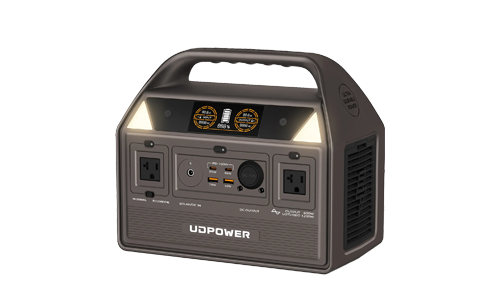
UDPOWER S2400: Up to 420W Solar Charging
The current UDPOWER S2400 product page lists:
- Battery capacity: 2,083Wh
- Rated AC output: 2,400W
- Solar charging: up to 420W
- DC7909 solar input: 12V–50V, 10A max
UDPOWER also offers an official S2400 + 2×210W solar panel configuration. Two 210W panels equal 420W of nameplate solar capacity.

Each current UDPOWER 210W panel is listed at 48.0V Voc, 40.0V maximum-power voltage and 5.00A running current. UDPOWER's dual-panel bundles use a parallel Y cable, so voltage remains approximately at the single-panel level while available current increases.
The official XT60 to DC7909 Y Parallel Adapter Cable is specifically designed to connect two compatible solar panels in parallel.
UDPOWER S1200: A Useful Example of Mild Overpaneling
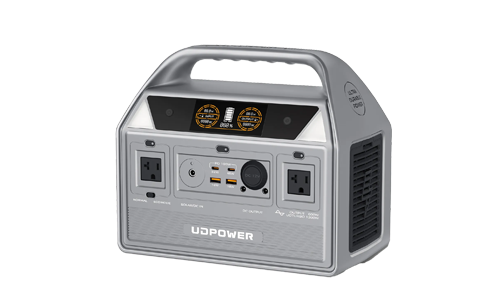
The UDPOWER S1200 lists the following solar input specification:
- DC7909 solar input: 12V–75V
- Maximum current: 12A
- Maximum solar input: 400W
At the same time, UDPOWER offers an official S1200 bundle with two 210W panels, giving 420W of panel nameplate capacity.

This is a useful real-world example of why panel watts and accepted charging watts should not be treated as identical numbers.
The two-panel array has 420W of potential STC-rated output, but the S1200's charging electronics are rated for up to 400W solar input. Under strong conditions the station may therefore limit the usable charging power, while the additional 20W of nameplate panel capacity can provide a small amount of headroom when the panels are producing below laboratory-rated output.
| UDPOWER Setup | Panel Nameplate Capacity | Station Solar Specification | Panel Wiring | Official Source |
|---|---|---|---|---|
| S2400 + 2×210W | 420W | Up to 420W; 12–50V, 10A max | Parallel dual-panel configuration | S2400 Product Page |
| S1200 + 2×210W | 420W | 12–75V, 12A, 400W max | Parallel dual-panel configuration | S1200 Product Page |
| UDPOWER 210W Panel | 210W each | 48V Voc, 40V Vmp, 5A operating current | Check station before combining | 210W Panel Specifications |
| UDPOWER 120W Panel | 120W each | 21.5V Voc, 17.92V operating voltage, 5.582A running current | Compatible configuration depends on station | 120W Panel Specifications |
Why Cold Weather Makes Maximum Voltage More Important
One of the easiest mistakes to make is checking a panel's rated Voc on the label and assuming that number never changes.
Solar-panel open-circuit voltage normally rises as cell temperature falls. That means a string that is close to the power station's maximum voltage on a warm afternoon can rise above that limit on a cold, bright morning.
This matters most with series-connected panels because their voltages add together.
Morningstar recommends using the lowest expected system temperature when determining whether an array remains below a charge controller's maximum Voc limit.
Source: Morningstar — Maximum PV Open Circuit Voltage Guidance.
When Overpaneling Can Be Worth It
Overpaneling is most useful when it solves a real energy-harvesting problem rather than simply increasing the number printed on your solar array.
You regularly charge in cloudy or variable weather
A larger array can provide more useful input when solar irradiance is well below ideal conditions.
You need more morning and late-afternoon production
Extra panel area can extend the part of the day when charging power is high enough to meaningfully refill the battery.
You use the station while it is charging
If a refrigerator, laptop, CPAP machine, RV electronics or another load is drawing power while the station is charging, additional solar collection may help offset those daytime loads.
You cannot reposition panels constantly
Portable panels rarely stay at the perfect solar angle all day. Additional compatible panel capacity can provide more margin when orientation is less than ideal.
The manufacturer already offers an approved oversized configuration
This is the easiest case. Instead of building a third-party combination based on guesswork, use the panel size and wiring method the power-station manufacturer has already specified.
When More Solar Panels Are Probably a Waste of Money
More panel capacity is not always better.
Your station already reaches its solar-input limit for hours
If your existing panels already hold the station near its maximum solar input through most useful daylight hours, adding more panels mainly increases clipping.
Your battery reaches 100% early in the day
A larger array cannot store energy once the battery no longer needs it unless you are simultaneously powering loads.
Your real problem is shading
Buying more panels does not necessarily fix poor placement. Moving the existing panels out of tree, RV, roof-rack or building shadows may produce a larger improvement.
Your array voltage is already close to the station limit
In that case, adding panels in series can turn a marginal setup into an over-voltage risk.
You are paying for watts the power station cannot use
A huge 800W array on a small station may have a poor cost-to-benefit ratio even if a technically compatible controller arrangement were possible.
Overpaneling vs. Simply Buying a Bigger Solar Input
If you routinely need more charging power than your current station can process, a power station with a larger solar-input capability is usually a cleaner solution than dramatically oversizing the solar array.
| Your Goal | Better Approach |
|---|---|
| Improve weak-light charging | Moderate manufacturer-approved overpaneling can help |
| Increase maximum charging watts | Choose a station with a higher solar input rating |
| Charge faster every sunny day | Higher station solar-input capacity is more effective |
| Run more appliances while charging | Consider both battery capacity and solar-input power |
| Improve cloudy-day energy harvest | More compatible panel area may help |
Panel Nameplate Watts vs. Actual Input Watts
Seeing 420W printed on two solar panels does not mean your power station display should continuously show 420W.
Actual charging input can be affected by:
- Sun angle
- Cloud cover
- Panel temperature
- Partial shading
- Dust or dirt on the panel
- Cable resistance
- Connector resistance
- MPPT operating point
- Power station input limits
- Battery temperature
- Battery state of charge
NREL notes that PV module ratings are measured at standardized conditions and that real-world irradiance and cell temperatures are normally different from those test conditions.
Source: NREL PV System Performance.
For more detail on the difference between panel watts and daily energy production, see How Many kWh Does a Solar Panel Produce?.
Why "The Power Station Only Pulls What It Needs" Is an Incomplete Rule
You will often see the claim that a power station is always safe with an oversized solar array because it "only pulls what it needs."
There is a piece of truth behind that statement: an MPPT controller controls the electrical operating point of a compatible solar array rather than passively accepting the panel's full nameplate wattage at all times.
But the statement becomes dangerous when it is used to ignore electrical limits.
A power station cannot safely "pull less voltage" from a solar string whose open-circuit voltage exceeds the hardware's absolute input limit. Likewise, manufacturers may specify limits on allowable source current, array size, wiring method or connector configuration.
A more accurate rule is:
Troubleshooting: What If an Oversized Solar Setup Does Not Charge Correctly?
| Symptom | Likely Cause | What to Check |
|---|---|---|
| No solar input at all | Voltage outside input range, wrong connector, reversed polarity or protection triggered | Voc, connector type, polarity and station specifications |
| Input stops when two panels are connected | Series voltage too high or incorrect wiring | Confirm whether panels are actually in parallel or series |
| 420W array only shows 300W | Normal real-world solar conditions, angle, heat, clouds or battery charging behavior | Panel placement, weather, battery SOC and station limit |
| Input reaches a fixed ceiling | Power station is limiting solar intake | Compare display reading with maximum solar input specification |
| Charging drops as battery fills | Battery-management system is reducing charging power | Battery state of charge and temperature |
| Connector becomes hot | Poor connection, undersized cable, corrosion or unsuitable adapter | Stop charging and inspect connector and cable ratings |
If your main issue is identifying the correct plug or adapter, see Solar Panel Connector Types: MC4, XT60, DC7909 & More.
What Not to Do When Adding More Solar Panels
- Do not exceed the station's maximum PV voltage.
- Do not assume matching wattage means electrical compatibility.
- Do not put panels in series without calculating combined Voc.
- Do not assume excess source current is harmless unless the manufacturer allows the configuration.
- Do not mix panels with very different electrical characteristics without understanding the effect.
- Do not rely on connector shape alone.
- Do not use an adapter as if it were a voltage converter.
- Do not build a string right at the maximum voltage without considering cold weather.
- Do not expect an oversized array to raise charging power beyond the station's own charging capability.
Recommended UDPOWER Solar Setups
If you prefer a matched power-station-and-panel configuration rather than calculating third-party panel combinations, UDPOWER offers solar-ready S-Series systems with official panel pairings.
UDPOWER S2400 + 420W Solar Setup
Best for: home backup, RV use, basecamp power, extended outages and higher-power appliances.
- 2,083Wh LiFePO4 battery capacity
- 2,400W rated AC output
- Up to 420W solar charging
- 12–50V, 10A max DC7909 solar input
- Official 2×210W solar configuration available
UDPOWER S1200 + 420W Solar Setup
Best for: camping, RV weekends, refrigerator backup, CPAP backup and medium-size home emergency loads.
- 1,190Wh-class LiFePO4 battery capacity
- 1,200W rated AC output
- 12–75V solar-input range
- 12A input-current limit
- 400W maximum solar input with an official 420W nameplate panel bundle available
UDPOWER 210W Portable Foldable Solar Panel

The 210W panel is the higher-output portable option for compatible UDPOWER S-Series power stations.
- 210W rated power
- 48.0V open-circuit voltage
- 40.0V maximum-power voltage
- 5.00A running current
- 5.40A short-circuit current
- ≥22% listed conversion efficiency
- IP65 weather resistance
Related UDPOWER Guides
For more detail on solar charging and panel selection, continue with these guides:
- What Is MPPT? MPPT Solar Charging Explained
- UDPOWER Solar Panel Pairing Guide: 120W vs 210W vs 2×120W
- Solar Panel Connector Types: MC4, XT60, DC7909 & More
- Solar Panel kWh Calculator: Estimate Daily Solar Output
- Can You Charge a Portable Power Station With a Solar Panel?
- Solar Charging During a Power Outage: Panel Sizing and Input Voltage Safety
Shop by Solar Power Scenario
- Portable Solar Panels
- Solar Generator Kits
- Portable Power Stations
- Portable Power Stations for Home Backup
- Portable Power Stations for Outdoor Use
- Portable Power Stations for Camping and RV Use
Frequently Asked Questions
Can you connect more solar watts than a power station is rated for?
Sometimes. Some manufacturers support a solar array whose nameplate wattage is slightly higher than the station's maximum usable solar charging power. You still need to stay within the manufacturer's approved configuration, voltage range, maximum voltage, current limits and wiring requirements.
Can I connect a 500W solar panel to a 400W power station?
Do not decide from wattage alone. Check the panel's Voc, Vmp, Imp and Isc against the station's solar-input specifications and confirm whether the manufacturer allows an oversized array. A compatible 500W array may be limited to roughly the station's maximum charging power, but a 500W panel with excessive voltage may be incompatible even though the wattage difference looks small.
Will a 500W panel damage a 400W solar input?
Not necessarily, but it can be unsafe if the panel exceeds the station's voltage, current or manufacturer-approved array limits. The fact that the solar controller can limit charging watts does not mean every 500W panel is safe.
What happens if solar panel wattage is higher than the power station's maximum input?
In a manufacturer-approved setup, the power station may limit or clip solar charging once it reaches its usable input ceiling. The extra nameplate panel capacity can still help when sunlight is weaker, but it will not force the station to charge above its designed maximum.
Is voltage more important than solar-panel wattage?
Voltage is one of the most critical safety limits. An oversized wattage rating may simply result in clipping in a supported system, while exceeding the maximum permitted PV voltage can damage the charging electronics. Always verify open-circuit voltage before connecting a panel or series string.
Can I exceed the solar input amps?
Do not assume that excess available current is safe. Some MPPT controllers limit the current they draw from an array, but allowable source-current oversizing varies by product. Use the manufacturer's approved panel configuration or confirm the limits for your exact model.
Is overpaneling better in series or parallel?
There is no universal answer, but parallel wiring is commonly used for portable-power-station dual-panel kits because it increases available current while keeping voltage close to that of one panel. Series wiring increases voltage and can exceed a portable power station's PV voltage ceiling very quickly.
Can I connect two 210W panels to the UDPOWER S2400?
Yes, UDPOWER offers an official S2400 configuration with two 210W panels for 420W total nameplate solar capacity. The panels should be used in the supported parallel configuration rather than series. The S2400 solar input is listed at 12–50V and 10A max.
Can I connect two 210W panels in series to the S2400?
No. Each current UDPOWER 210W panel has a 48V open-circuit voltage. Two in series would produce approximately 96V Voc under rated conditions, which exceeds the S2400's listed 50V solar-input maximum.
Why does UDPOWER offer 420W of panels with the S1200 if the station says 400W max solar input?
The 420W figure is the combined STC nameplate rating of two 210W panels. The S1200's solar charger is rated for up to 400W input. Real panels frequently operate below nameplate power, so the small 5% panel oversize can provide additional solar collection headroom while the station still limits how much charging power it uses.
Does overpaneling make a power station charge faster?
It can improve charging during weak or variable sunlight, but it cannot increase charging beyond the station's own maximum solar-input capability. Once the charger reaches its ceiling, additional available panel power is clipped or unused.
Can overpaneling increase total daily solar energy?
Yes, in some conditions. A larger compatible array can produce more useful power during mornings, afternoons, clouds or imperfect panel angles. Even if peak charging watts are capped, the station may collect more watt-hours over the full day.
Can cold weather make an otherwise compatible solar array unsafe?
It can if the array is close to the maximum PV voltage. Solar-panel open-circuit voltage increases as cell temperature falls. For third-party fixed panels or series strings used in cold climates, calculate worst-case cold-weather Voc before connecting them.
Does the connector type tell me whether a solar panel is compatible?
No. A compatible connector only means the plugs can physically connect. You must also confirm voltage, current, polarity, panel wattage, cable rating and manufacturer compatibility.
Should I overpanel or buy a power station with a larger solar input?
If your goal is better weak-light harvesting, moderate manufacturer-approved overpaneling can be useful. If your goal is substantially faster peak charging, choose a power station with a higher solar-input capability instead.
Bottom Line
Yes, a portable power station can sometimes use more nameplate solar watts than its maximum usable charging wattage. But the safe way to think about overpaneling is not "extra watts are always fine."
Use this order instead:
- Check manufacturer approval.
- Check maximum PV voltage.
- Check operating voltage range.
- Check current limits.
- Check series or parallel wiring.
- Check the panel's Voc, Vmp, Imp and Isc.
- Then compare total panel watts with the station's solar charging capability.
That approach explains why a manufacturer-approved 420W array can work with a power station whose usable charging power is around 400W, while another 400W panel may be incompatible because its voltage falls outside the station's supported range.
Overpaneling can improve real-world solar harvest. It cannot override the electrical limits of the power station.
Build a Solar Setup That Matches Your Power Needs
Compare UDPOWER portable power stations, solar panels and matched solar-generator kits before choosing your setup.
Related Articles


