

How Long Do Solar Batteries Last? Lifespan by Battery Type & When to Replace Them
Last updated: September 20, 2026
Quick answer: A solar battery can last anywhere from about 3 years to well over 10 years, depending largely on battery chemistry, temperature, depth of discharge, charging conditions and how frequently it is cycled.
Flooded lead-acid batteries commonly fall near the shorter end of that range, while well-designed lithium iron phosphate batteries can often provide roughly 10 to 15 years of practical service. Modern residential solar batteries as a broader category are commonly expected to last around 10 to 15 years.
But age alone should not decide when a battery is replaced. A battery at 80% of its original capacity is not automatically dead. Replacement makes sense when the remaining usable energy can no longer cover your required backup period, when reliability becomes unpredictable, or when the battery develops a safety or hardware problem.

There are actually two different questions hidden inside “How long do solar batteries last?” One is how many years the battery survives before replacement. The other is how long a solar battery runs appliances on one charge.
This guide focuses mainly on service life and replacement. If you are trying to determine how many hours a particular battery can run your refrigerator, CPAP, lights or RV equipment, see our 12V Solar Battery: 50Ah vs 100Ah vs 200Ah Runtime Guide.
Solar Battery Lifespan by Battery Type
Battery chemistry is one of the strongest predictors of lifespan, but published life numbers should always be treated as planning ranges rather than expiration dates. Two batteries using the same chemistry can age very differently if one spends every summer in a hot enclosure while the other operates indoors at moderate temperatures.
| Battery Type | Typical Planning Lifespan | Cycle Characteristics | Best Fit | Main Lifespan Concern | Source |
|---|---|---|---|---|---|
| Flooded lead-acid | About 3–5 years in many applications | More sensitive to repeated deep discharge than lithium batteries | Budget-focused stationary systems where maintenance is acceptable | Deep discharge, heat, water loss and undercharging | Renogy battery lifespan guide |
| AGM lead-acid | Roughly 4–8 years depending on use | Maintenance-free but still affected strongly by deep cycling | RV, backup and compact sealed-battery systems | High temperature, chronic undercharge and deep discharge | Renogy battery lifespan guide |
| Gel lead-acid | Often within roughly 4–8 years | Can tolerate cycling well when charged correctly | Applications where sealed construction is useful | Incorrect charging voltage and excessive heat | Renogy battery lifespan guide |
| Lithium-ion solar storage | Commonly about 10–15 years for modern home-storage batteries | Usually supports substantially more cycling than traditional lead-acid storage | Home solar storage and frequent cycling | Heat, high state of charge, cycling conditions and calendar aging | EnergySage |
| LiFePO4 / LFP | Often around 10–15 years or more in a well-designed system | Thousands of cycles are common | Solar storage, portable power, RVs and frequent off-grid cycling | Heat, charging outside specified temperatures and calendar aging | Renogy / UDPOWER LiFePO4 guide |
The range is wide because chemistry alone does not determine life. Cell quality, battery management, charging controls, thermal management, depth of discharge and the environment around the battery all matter.
If you are choosing between lead-acid and lithium for repeated solar cycling, our Deep Cycle Batteries Explained guide goes deeper into flooded lead-acid, AGM, gel and LiFePO4 designs.
The Three Clocks That Determine Solar Battery Life
A useful way to think about battery lifespan is that every solar battery is running on three clocks at the same time.
1. The Cycle Clock
Every time energy is removed and returned, some electrochemical aging occurs. The important measurement is not necessarily the number of times you plug in a charger. It is the amount of energy moved through the battery.
For example, using 25% of a battery four separate times is approximately one equivalent full cycle, assuming those partial cycles total 100% of the battery's capacity.
2. The Calendar Clock
A battery also ages while sitting unused. Chemical reactions continue slowly inside the cells even when the battery has very few cycles.
This is why dividing 4,000 cycles by one camping trip per month does not mean a battery will last hundreds of years. For lightly used backup batteries, calendar aging will usually become important long before the theoretical cycle count is exhausted.
3. The Reserve Clock
This is the one that matters most to the owner: does the battery still store enough energy for the job you bought it to do?
A battery can still operate perfectly at 75% of its original capacity. For someone who only needs 40% of the original capacity during a blackout, that may be completely acceptable. For someone whose system was already sized tightly, the same battery may need replacement much sooner.
How Many Years Is 3,000 or 4,000 Battery Cycles?
Cycle ratings are easy to misunderstand because solar batteries are rarely discharged from 100% to 0% every day.
If you use an average of 40% of the battery each day, that works out to roughly 146 equivalent full cycles per year, not 365.
| Average Capacity Used per Day | Approx. Equivalent Full Cycles per Year | 3,000 Cycles ÷ Annual Cycles | 4,000 Cycles ÷ Annual Cycles | How to Read the Result |
|---|---|---|---|---|
| 20% | 73 | About 41 years | About 55 years | Calendar aging would almost certainly become the limiting factor first. |
| 40% | 146 | About 20.5 years | About 27.4 years | The math describes cycle consumption, not guaranteed physical lifespan. |
| 60% | 219 | About 13.7 years | About 18.3 years | Both cycle aging and calendar aging may matter. |
| 80% | 292 | About 10.3 years | About 13.7 years | Representative of a heavily used daily solar-storage system. |
| 100% | 365 | About 8.2 years | About 11 years | Heavy daily cycling can consume the rated cycle allowance relatively quickly. |
The year figures above are mathematical cycle equivalents, not battery-life guarantees. For more detail, see Battery Cycle Life Explained: What 4,000 Cycles Mean.
Why “4,000 Cycles” Does Not Automatically Mean 11 Years
The simple 4,000 ÷ 365 calculation gives about 11 years if you consume one full equivalent cycle every day. But real battery aging is not controlled by cycle count alone.
A battery exposed to high temperatures, kept at a very high state of charge for long periods or charged outside its approved temperature range may lose capacity faster. Conversely, a battery that sees shallow cycles in moderate temperatures may reach calendar-age limits before it reaches its published cycle count.
What Does “80% Battery Capacity Remaining” Actually Mean?
Many battery cycle-life specifications use a remaining-capacity threshold such as 70% or 80%. That threshold is frequently misunderstood as the point where the battery stops working.
It is not.
If a 10 kWh battery has degraded to 80% state of health, it can theoretically store about 8 kWh instead of the roughly 10 kWh it stored when new, subject to the system's usable-capacity limits.
| Original Capacity | Remaining State of Health | Approx. Remaining Battery Capacity | What It Means in Practice |
|---|---|---|---|
| 10 kWh | 100% | 10 kWh | New-battery baseline |
| 10 kWh | 90% | 9 kWh | Some degradation, often difficult to notice unless runtime is measured |
| 10 kWh | 80% | 8 kWh | Still usable if 8 kWh is enough for your required load |
| 10 kWh | 70% | 7 kWh | Replacement becomes more attractive if the lost reserve affects outages or overnight use |
The important question is therefore not “Has my battery reached 80%?” but “Does the remaining usable capacity still cover my needs with a reasonable reserve?”
What Shortens the Life of a Solar Battery?
High Temperature
Heat accelerates battery aging. A battery installed in an unconditioned garage, metal shed, RV compartment or outdoor enclosure can experience a very different life from the same battery operated in a moderate indoor environment.
The battery manufacturer's published charging, discharging and storage temperature limits should always be treated as operating boundaries, not targets.
Repeated Very Deep Discharge
Lead-acid batteries are particularly sensitive to deep discharge. Regularly draining them much farther than intended can shorten useful life significantly.
LiFePO4 batteries generally tolerate deeper cycling better, but unnecessary extreme cycling still consumes battery throughput and can contribute to aging.
Leaving the Battery Empty for Long Periods
Long-term storage at a very low state of charge can create problems, particularly if normal self-discharge or the battery's electronics continue drawing a small amount of power.
Follow the manufacturer's storage instructions and check a stored backup battery periodically instead of putting it away for several years and assuming it will be ready during an emergency.
Keeping the Battery Hot and Fully Charged for Months
A high state of charge is useful when a battery needs to be ready for an outage, but storing certain lithium batteries continuously at full charge in high heat can increase calendar aging.
There is no universal storage percentage for every solar battery. Follow the instructions for the specific battery or power station rather than applying a generic number to every chemistry.
Incorrect Charging Equipment
A charger or solar charge controller must match the battery chemistry and charging requirements. This becomes especially important when replacing a lead-acid battery with lithium.
A system that worked with an AGM battery should not automatically be assumed to have the correct charge profile, voltage limits or low-temperature protections for a new LiFePO4 battery.
Chronic Undercharging of Lead-Acid Batteries
Lead-acid batteries can suffer when they repeatedly remain partially charged instead of reaching the charge conditions required by the manufacturer. In solar systems with undersized panels, this can happen during several cloudy days followed by only partial recovery.
Poor Cell Balance or Weak Battery Management
A lithium battery is more than a collection of cells. A battery management system monitors conditions such as current, voltage and temperature and helps protect the pack from operating outside its intended limits.
This is one reason two batteries advertising the same chemistry and nominal capacity can have very different long-term behavior.
Signs a Solar Battery May Need Replacement
Most batteries do not wake up one morning and suddenly become “old.” Capacity normally declines gradually. That means the first sign of aging is often a shorter overnight runtime rather than complete failure.
| Symptom | Possible Meaning | Replace Immediately? | What to Do |
|---|---|---|---|
| Runtime is gradually shorter than when new | Normal capacity degradation | Not necessarily | Measure usable runtime and compare it with your actual backup requirement. |
| Battery reaches low state of charge much earlier than expected | Capacity loss, inaccurate state-of-charge estimate or system issue | Not automatically | Perform a controlled capacity comparison and check system settings. |
| Battery repeatedly shuts down under loads it previously handled | Battery, BMS, connection or inverter problem | Needs investigation | Stop stressing the system and contact the manufacturer or installer. |
| Charging time or charge behavior changes dramatically | Capacity loss, BMS behavior, charger issue or cell imbalance | Needs diagnosis | Check charger, temperature and battery diagnostics. |
| Visible swelling, leaking, deformation, smoke or unusual overheating | Potential safety failure | Yes, stop using it | Disconnect it if this can be done safely and follow the manufacturer's safety and disposal instructions. |
| Lead-acid battery shows persistent corrosion or abnormal electrolyte condition | Maintenance, charging or end-of-life problem | Depends on condition | Follow the battery manufacturer's service procedure or use a qualified technician. |
A swollen, leaking, smoking, physically damaged or abnormally hot battery should not be kept in service simply because it still holds a charge. Do not open a sealed battery pack or attempt internal cell repair unless the product is specifically designed for qualified service.
How to Check Solar Battery Health at Home
You do not need laboratory equipment to notice meaningful capacity loss. A repeatable runtime test can provide a useful practical comparison.
Step 1: Start With a Fully Charged Battery
Charge the battery normally according to the manufacturer's instructions. Make sure the temperature is within the product's normal operating range.
Step 2: Use a Known, Steady Load
A relatively steady load is easier to evaluate than a refrigerator, air conditioner or other appliance that cycles on and off. If your system has an AC output display or plug-in power meter, note the approximate wattage.
Step 3: Record Runtime
Run the same load from a full battery until reaching your normal stopping point or the system's low-battery cutoff.
Step 4: Compare With an Earlier Baseline
The most useful comparison is the same battery, same load and similar temperature when the battery was newer.
For example, if a power station originally ran your controlled test load for 10 hours and now runs the same load for 8 hours under similar conditions, its practical usable runtime is roughly 80% of the original result.
This is not a laboratory state-of-health test, because inverter efficiency, temperature, battery-management limits and load variation can affect the result. It is, however, much more useful than guessing from battery age alone.
Why You Should Compare Runtime Instead of Nameplate Watt-Hours
A battery labeled 1,000Wh does not necessarily provide exactly 1,000Wh through an AC outlet. Energy is consumed by the inverter and other electronics, and the battery management system may reserve some capacity.
For this reason, comparing today's real-world runtime against your own original baseline is often a better home test than trying to calculate cell capacity from the label.
When Should You Actually Replace a Solar Battery?
The best replacement point is different for a daily off-grid system, an RV battery and an emergency backup battery.
| Use Case | Most Important Replacement Trigger | Why |
|---|---|---|
| Emergency home backup | Battery can no longer cover the required outage reserve | A battery may work normally but no longer provide enough hours for critical loads. |
| Daily solar self-consumption | Capacity loss materially reduces overnight solar use or increases grid dependence | The economic value of the battery depends on usable daily energy. |
| Off-grid home or cabin | Remaining storage cannot reliably bridge low-sun periods | Reserve capacity is more important when there is no grid fallback. |
| RV or van | Battery no longer covers overnight loads between charging opportunities | Usable capacity directly determines how long you can remain off-grid. |
| Occasional camping | Runtime becomes inconvenient or reliability becomes uncertain | Calendar age may matter more than cycle count. |
| Any application | Safety-related damage or abnormal behavior | Safety problems override remaining capacity. |
A Better Replacement Test Than “Is My Battery 10 Years Old?”
Start with the amount of energy you actually need.
Suppose your essential loads require 6 kWh overnight and you want a 20% reserve. Your practical target is therefore about 7.2 kWh of usable energy.
- If your aging battery still reliably supplies 8 kWh, immediate replacement may not be necessary.
- If it now supplies only 6.5 kWh, the system no longer meets your reserve target even though the battery still works.
- If it supplies enough energy but has begun producing abnormal errors or overheating, capacity is no longer the deciding factor.
This approach turns battery replacement into an energy-planning decision instead of an arbitrary age limit.
Should You Replace a Solar Battery at 80% Capacity?
Not automatically.
Eighty percent is frequently used as a battery-life benchmark because it gives manufacturers and engineers a consistent way to compare degradation. It is not a universal instruction telling owners to dispose of a battery at exactly 80%.
If the battery still meets your required runtime, remains safe and operates normally, it may continue to provide useful service below that point.
Should You Mix a New Battery With an Old Battery?
Be cautious. Batteries with different ages, capacities, internal resistance or states of health may not share charging and discharging evenly.
For a multi-battery bank, follow the battery manufacturer's rules for adding or replacing batteries. In many systems, replacing an entire matched bank is preferable to putting one new battery beside several heavily aged batteries.
Can You Replace Lead-Acid With LiFePO4?
Sometimes, but it should not be treated as a simple drop-in swap without checking the rest of the system.
You may need to verify:
- Battery voltage
- Solar charge-controller settings
- AC charger compatibility
- Alternator or DC-to-DC charging behavior in an RV
- Maximum charge and discharge current
- Low-temperature charging protection
- Fuse and cable ratings
- Battery-management requirements
For readers building a traditional 12V system, our 12V Solar Panel Kit: Components, Sizing, Wiring & Battery Guide explains how the panel, controller, battery and inverter work together.
Do Solar Panels Last Longer Than Solar Batteries?
Usually, yes.
The U.S. Department of Energy reports that modern photovoltaic modules can commonly operate for decades. DOE information notes that residential solar panels are often expected to last roughly 20 to 25 years, while more recent industry data puts average operational lifetimes in roughly the 25-to-35-year range.
That is substantially longer than many batteries, especially lead-acid batteries. A rooftop solar array may therefore continue operating through one or more battery replacements.
| Solar System Component | Typical Planning Perspective | What Usually Happens Over Time | Source |
|---|---|---|---|
| Solar panels | Often 20–30+ years | Output normally declines gradually rather than stopping suddenly. | U.S. Department of Energy |
| Modern solar battery | Often around 10–15 years for current lithium-based home storage | Usable capacity declines with cycle and calendar aging. | EnergySage |
| Lead-acid solar battery | Often substantially shorter than the PV array | May require multiple replacements during the solar array's operating life. | U.S. Department of Energy |
This distinction matters when budgeting a solar project. “25-year solar system” does not necessarily mean every component in the system will remain unchanged for 25 years.
A Simpler Alternative to a DIY Solar Battery Bank: UDPOWER LiFePO4 Power Stations
A traditional solar battery system gives you maximum flexibility, but it also requires compatible charging equipment, wiring, protection devices and an inverter if you need 120V AC power.
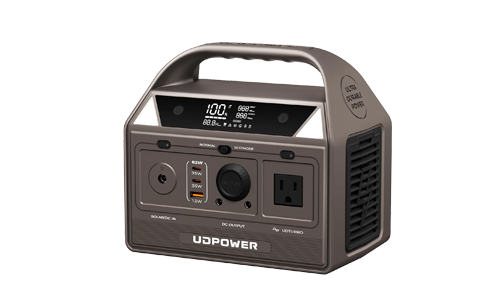
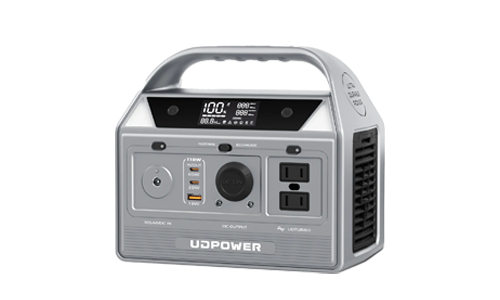
For camping, RV trips, temporary off-grid use and emergency backup, an all-in-one portable power station can be simpler because the LiFePO4 battery, battery-management system, charging hardware, inverter, display and output ports are integrated into one unit.
These products are not a replacement for every permanently installed whole-home battery system. They are better suited to users who want portable solar storage without building a battery bank from individual components.
UDPOWER S1200 Portable Power Station
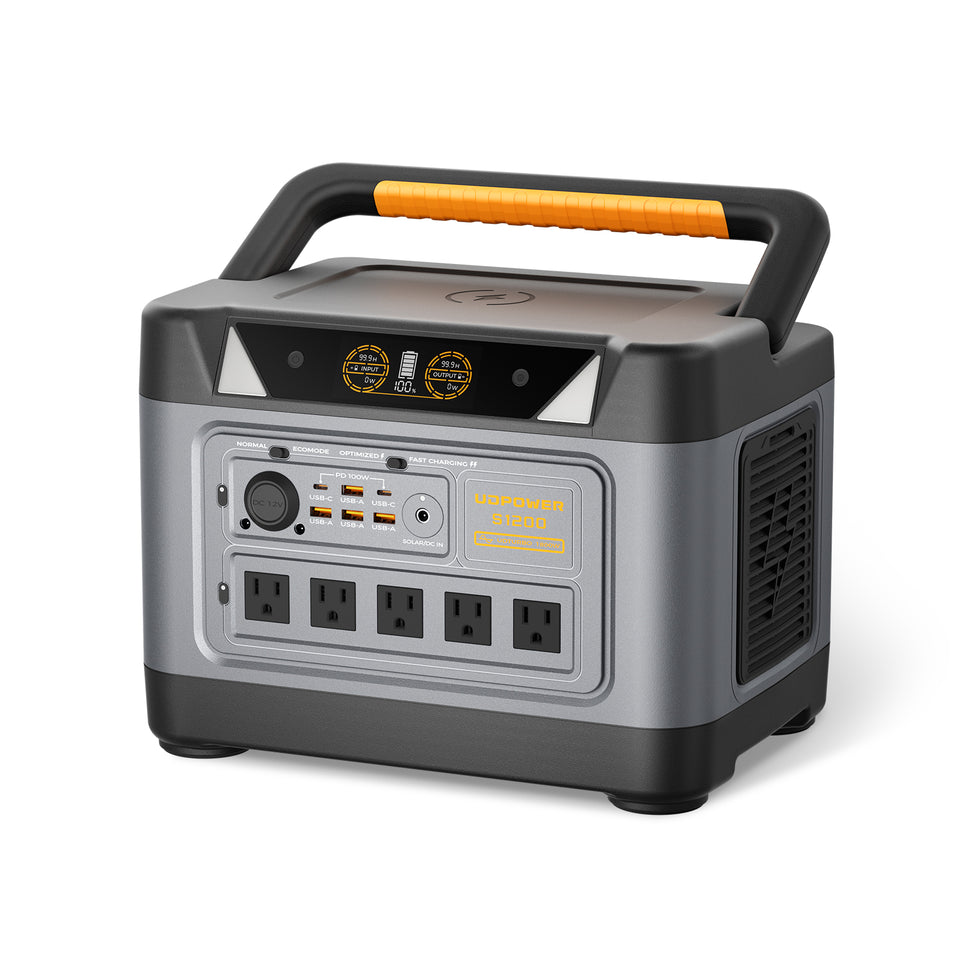
The S1200 is a practical choice when you want roughly 1.2kWh of portable storage for refrigerators, CPAP equipment, electronics, camping or shorter backup periods.
| S1200 Specification | Official Value | Why It Matters for Solar Storage | Source |
|---|---|---|---|
| Battery capacity | 1,190Wh class | Determines how much energy can be stored between charging opportunities. | Official S1200 page |
| Battery chemistry | LiFePO4 | Designed for repeated cycling and long service life. | Official specifications |
| Detailed cycle specification | 80%+ capacity after 3,000 cycles | Provides a measurable capacity-retention benchmark. | Official specifications |
| Rated AC output | 1,200W pure sine wave | Suitable for many common household and camping loads within the rated limit. | Official S1200 page |
| Higher-power mode | UDTURBO up to 1,800W for compatible loads | Expands appliance compatibility, although conversion efficiency may decrease above rated output. | Official S1200 page |
| Solar input | DC7909, 12–75V, 12A, up to 400W | Allows daytime solar recharging within the station's input limits. | Official specifications |
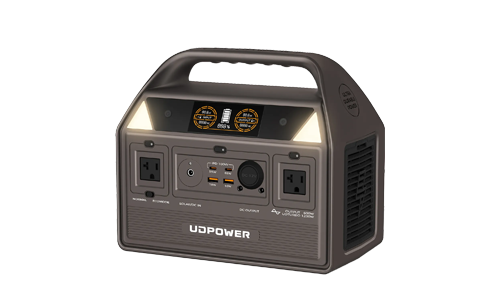
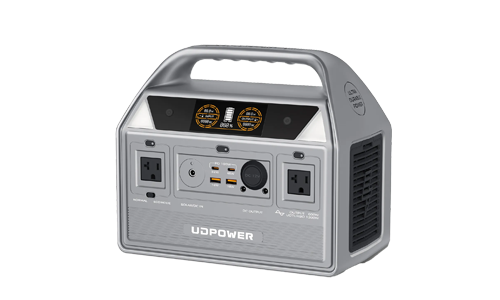
UDPOWER S2400 Portable Power Station
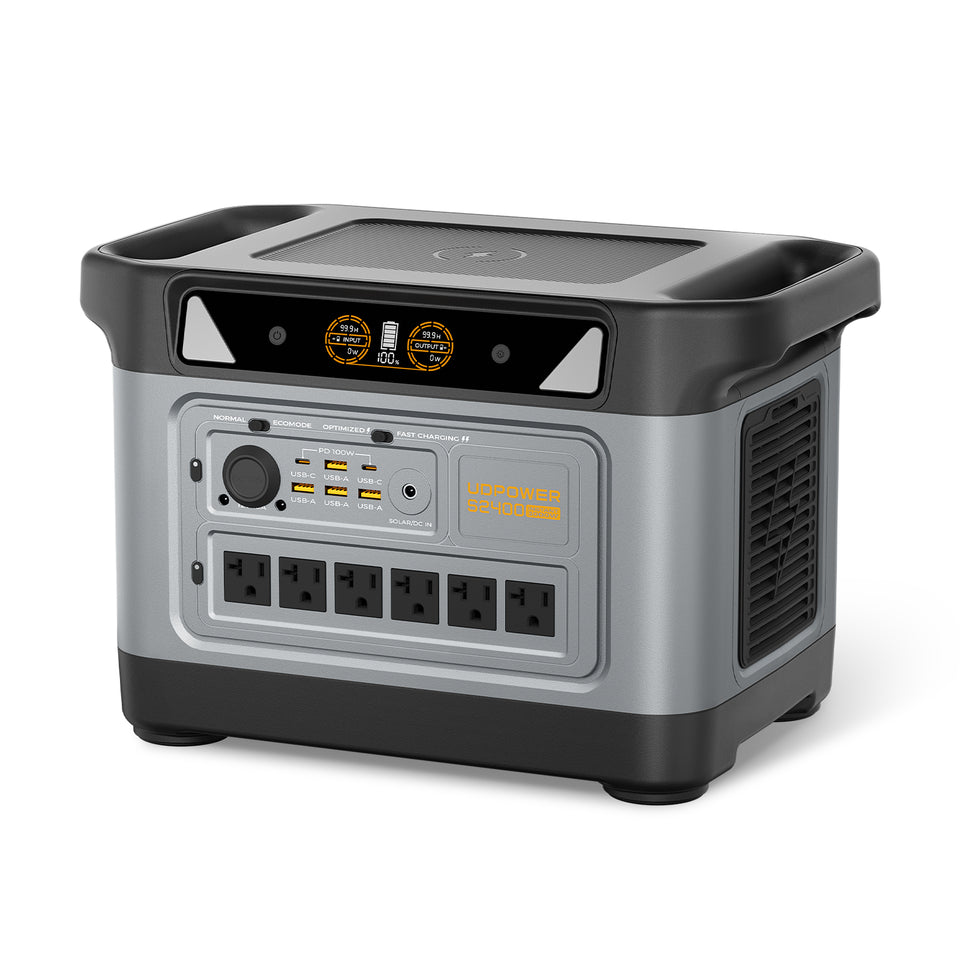
The S2400 increases both stored energy and output capacity, making it better suited to longer outages, larger campsites, RV use and households that need to operate several essential devices.
| S2400 Specification | Official Value | Why It Matters for Solar Storage | Source |
|---|---|---|---|
| Battery capacity | 2,083Wh | Provides substantially more stored energy than the S1200 for longer backup periods. | Official S2400 page |
| Battery chemistry | LiFePO4 / LFP | Suitable for frequent backup and off-grid cycling. | Official specifications |
| Detailed cycle specification | 80%+ capacity after 3,000 cycles | Provides a measurable long-term capacity-retention benchmark. | Official specifications |
| Rated AC output | 2,400W pure sine wave | Supports considerably larger loads than a compact portable station. | Official S2400 page |
| Higher-power mode | UDTURBO up to 3,000W for compatible loads | Provides additional appliance compatibility above the normal 2,400W rating, with lower conversion efficiency possible above rated output. | Official S2400 page |
| Solar charging input | DC7909, 12–50V, 10A max | Supports off-grid daytime recharging when compatible solar panels remain within the input limits. | Official specifications |
If you want the power station bundled with solar charging equipment rather than purchasing the components separately, browse the UDPOWER Solar Generator collection.
How to Make a Solar Battery Last Longer
Keep It Within Its Approved Temperature Range
A garage or RV compartment that feels merely warm to you can become much hotter around a battery during summer. Provide the ventilation and operating environment specified by the manufacturer and avoid placing the battery beside major heat sources.
Avoid Unnecessary Full Discharges
You do not need to drain a rechargeable solar battery to zero before recharging it. Partial cycling is normal, especially with lithium batteries.
Use the Correct Charger and Solar Controller
Match the charging equipment to the battery chemistry, voltage and current limits. This becomes particularly important when upgrading an older lead-acid system to LiFePO4.
Give the Battery Enough Solar to Recover
An undersized solar array may leave a battery chronically undercharged. Rather than choosing panels solely from battery Ah, calculate how many watt-hours you use each day and how much energy the solar array needs to replace.
Our 12V Solar Panel Kit Guide covers array sizing, controllers and recovery time in more detail.
Do Not Ignore Long-Term Storage
Backup batteries need occasional attention even when no outage occurs. Follow the manufacturer's storage state-of-charge recommendation, inspect the unit periodically and make sure it remains ready before storm season or an emergency.
Track Runtime Once or Twice a Year
A simple repeatable capacity check creates a baseline. If a battery that once provided 10 hours under the same test load now gives 9.5 hours, the change is minor. If it suddenly drops to 6 hours, you have a reason to investigate before the next outage.
Do Not Chase the Highest Cycle Number Alone
A 5,000-cycle claim is not automatically better than a 3,000-cycle claim unless you know the test conditions, end-of-life capacity threshold, battery temperature, discharge depth and usable capacity.
For many buyers, usable watt-hours, warranty, battery management, temperature protections and the manufacturer's definition of cycle life matter as much as the headline number.
Solar Battery Lifespan vs Runtime per Charge
Battery lifespan and battery runtime answer different questions.
| Question | Main Factors | Typical Unit |
|---|---|---|
| How long will my battery run an appliance tonight? | Battery Wh, usable capacity, appliance watts, inverter efficiency and duty cycle | Hours |
| How long will the battery remain useful before replacement? | Chemistry, cycle count, temperature, depth of discharge, calendar aging and required reserve | Years and cycles |
A simple AC runtime estimate is:
For UDPOWER planning examples, a 90% conversion assumption is useful for estimating AC runtime, although actual efficiency changes with load, temperature and operating conditions.
For detailed battery sizing examples, use the 50Ah vs 100Ah vs 200Ah Solar Battery Guide. If you are specifically trying to understand how battery aging affects a portable unit, see How Long Does a Power Station Last?.
Solar Battery Lifespan FAQ
How long do solar batteries usually last?
Many modern lithium-based solar batteries provide roughly 10 to 15 years of practical service, while lead-acid batteries generally have shorter service lives. Actual lifespan depends on chemistry, temperature, depth of discharge, charging behavior and cycle frequency.
How often do solar batteries need to be replaced?
There is no universal replacement schedule. Lead-acid batteries may need replacement after only several years in heavily cycled solar applications, while quality lithium and LiFePO4 systems may remain useful for a decade or longer.
Can a solar battery last 20 years?
It is possible for some batteries under favorable conditions, but a high cycle rating alone should not be interpreted as a guaranteed 20-year service life. Calendar aging continues even when a battery is used lightly.
How long does a LiFePO4 solar battery last?
A quality LiFePO4 battery commonly offers thousands of cycles and may provide around 10 to 15 years or more of practical use when properly designed, charged and operated. For a deeper explanation, read our LiFePO4 Battery Life Guide.
How long do lead-acid solar batteries last?
Flooded lead-acid batteries commonly last roughly 3 to 5 years in many applications, while AGM and gel designs can often last longer. Frequent deep discharge, high temperatures and chronic undercharging can shorten that range.
Does charging a solar battery every day shorten its life?
Daily charging is normal in a solar system. What matters more is how much energy moves through the battery, the depth of each cycle, temperature and whether charging remains within the manufacturer's limits. A 30% daily discharge does not consume the same cycle throughput as draining the battery completely every day.
Is a battery dead when it reaches 80% capacity?
No. An 80% capacity threshold normally means the battery can store about 80% of the energy it could store when new. It may continue operating for years if that remaining capacity is sufficient for your needs and the battery remains safe and reliable.
What is the biggest cause of solar battery degradation?
There is no single cause for every chemistry, but heat, repeated deep cycling, calendar aging and unsuitable charging conditions are among the most important factors. Lead-acid batteries are particularly sensitive to deep discharge and incomplete charging.
Do solar panels wear out the battery faster?
No. A properly designed solar charging system does not inherently damage a battery. Problems arise when voltage, current, charging profile or temperature are outside the battery manufacturer's limits.
Should I replace my solar battery when the warranty expires?
Not simply because the warranty ended. Warranty duration and useful service life are different. If the battery still provides sufficient usable capacity, operates normally and has no safety issue, it may remain useful beyond the warranty period.
How can I tell how much capacity my old battery has left?
A practical home method is to fully charge the battery and run the same known load used when the battery was newer. Compare current runtime with your earlier baseline. More advanced systems may also provide state-of-health data through their battery-management software.
Should I replace one battery or the entire battery bank?
That depends on the battery design and manufacturer's requirements. Mixing a new battery with significantly aged batteries can create imbalance in some systems, so matched-bank replacement may be preferable. Always follow the manufacturer's instructions for multi-battery systems.
Is LiFePO4 worth it for a solar system?
For frequent solar cycling, LiFePO4 is attractive because of its long cycle life, high usable capacity, relatively low maintenance and lower weight compared with traditional lead-acid storage. The higher upfront cost should be compared with expected lifetime energy throughput rather than purchase price alone.
Related Solar Battery Guides
- 12V Solar Battery Guide: 50Ah vs 100Ah vs 200Ah Size & Runtime
- 12V Solar Panel Kit: Components, Sizing, Wiring & Battery Guide
- LiFePO4 Battery Life: How Many Years and Cycles Can You Expect?
- Battery Cycle Life Explained: What 4,000 Cycles Mean
- Deep Cycle Batteries Explained: Types, Size, Life & Uses
- How Long Does a Power Station Last?
Final Takeaway
Solar battery lifespan is not a single fixed number. Flooded lead-acid batteries may provide only several years of useful service, while modern lithium and LiFePO4 batteries can often remain useful for a decade or longer.
More importantly, a battery's useful life should be judged by remaining capacity, reliability and the amount of reserve your household, RV or campsite actually needs. Reaching 80% capacity does not automatically make a battery unusable, just as having thousands of unused theoretical cycles does not guarantee decades of life.
If you remember only one rule, use this one: replace a solar battery when it can no longer safely and reliably deliver the energy reserve you need—not simply because a calendar or cycle counter reached an arbitrary number.
Looking for Portable LiFePO4 Solar Storage?
Compare UDPOWER portable power stations for camping, RV use and emergency backup, or choose a solar generator kit that combines portable battery storage with solar charging.
View Portable Power Stations | View Solar Generator Kits | Get Product & Battery Guidance
Related Articles


