

What Does Surge Current Mean?
Last updated: October 14, 2026

Quick answer: Surge current is a temporary increase in electrical current above a device's normal operating current. In household appliances, it often appears when a motor, compressor, transformer, or electronic power supply is first energized.
A refrigerator may need much more current while its compressor starts than after it is running. A pump or power tool may do the same. Even an LED driver can draw a very short current spike while its internal capacitors charge.
Surge current and running current are therefore not the same thing. Running current tells you what a device normally needs after startup. Surge or starting current helps determine whether a circuit, inverter, generator, or portable power station can get the device started in the first place.
There is also no universal rule such as "startup current is always 3× running current." The actual surge depends on the type of load, motor or compressor design, starting method, supply voltage, mechanical load, capacitor bank, and how long the startup event lasts.
What Is Surge Current?
Surge current is a temporary current that is higher than the normal steady operating current of a device or circuit.
For everyday appliances, the easiest example is an electric motor.
Once a motor is spinning normally, it may draw a fairly stable amount of current. At startup, however, the motor is stationary and has not yet developed the electrical and mechanical conditions that limit its normal running current. The result can be a much higher initial current.
Fluke describes inrush current as the momentary burst of current that flows when electrical equipment is first powered on. Depending on the motor type, Fluke notes that motor inrush can be several times normal running current.
See Fluke's explanation of inrush current measurement.
But motors are not the only source of surge current. High initial current can also occur when:
- a refrigerator or air-conditioner compressor starts;
- a pump motor begins turning;
- a transformer is energized;
- large capacitors charge;
- an LED driver or switching power supply is turned on;
- a vacuum or power tool motor accelerates;
- multiple devices start at the same time.
The important part is not just the peak number. A startup event has both a magnitude and a duration. A very high current lasting only a tiny fraction of a second can behave very differently from a smaller overload that continues for several seconds.
Surge Current vs. Inrush Current vs. Starting Current
These terms are often used as if they mean exactly the same thing. In everyday appliance and backup-power discussions they often describe the same startup problem, but technically they are not always interchangeable.
| Term | Practical meaning | Common application | Important distinction |
|---|---|---|---|
| Running current | Current after the device reaches normal operation | Normal appliance load | Does not show startup demand |
| Starting current | Higher current associated with getting a motor or compressor started | Motors, pumps, compressors, tools | May cover the entire acceleration period rather than one instantaneous peak |
| Inrush current | Initial current drawn immediately after energization | Motors, transformers, power supplies, capacitors | Usually associated specifically with turn-on |
| Surge current | Broader term for a temporary current above normal operating current | Startup loads, switching events and electronic components | Can describe events other than appliance startup |
| LRA | Locked Rotor Amps | Compressors and motors | Represents current under locked-rotor conditions, not normal running current |
For a homeowner trying to size backup power, "startup surge," "starting current," and "inrush current" will often point to the same practical question:
For engineering specifications, however, always use the exact term and test condition provided by the manufacturer.
Surge Current vs. Running Current
Running current tells you what an appliance normally draws after it has stabilized.
Surge current tells you what happens during a short transition such as startup.
Consider a compressor-driven appliance. The sequence may look like this:
1. Device off: Current is essentially zero.
2. Compressor receives a start command: Current rises sharply.
3. Motor begins accelerating: Current starts falling as the motor approaches normal speed.
4. Normal operation: Current settles near its running level.
This explains a common backup-power problem: an appliance can run perfectly well once started but still shut down a small inverter every time it tries to start.
| Characteristic | Running current | Surge or starting current |
|---|---|---|
| When it occurs | During normal operation | During startup or another transient event |
| Duration | Continuous or cycling | Usually short |
| Useful for inverter sizing | Yes | Yes |
| Useful for battery runtime | Very important | Usually much less important for total energy consumption |
| Can prevent an appliance from starting | Not usually by itself if within the continuous rating | Yes |
This is why UDPOWER's portable power station sizing guide treats running watts, startup demand, and battery capacity as separate checks.
Why Do Motors, Compressors, Transformers and Capacitors Create Startup Surge?
Different loads produce high startup current for different reasons. Treating all surge current as the same phenomenon can lead to poor sizing decisions.
Electric motors
When an induction motor is stationary, it does not yet have the operating conditions that limit current after it reaches speed. The initial current can therefore be much higher than normal running current.
As the motor accelerates, current generally drops toward its normal operating value.
Compressors
A compressor adds mechanical load to the motor-starting problem.
The compressor may need to start against refrigerant pressure. Starting conditions can therefore vary depending on system design, temperature, pressure equalization, compressor type, and the method used to start the motor.
This is why refrigerators and air conditioners with similar running wattage can have very different startup behavior.
Transformers
Transformer inrush is different from motor startup.
When a transformer is first connected to AC power, the exact point in the AC waveform and residual magnetism in the core can drive the core toward magnetic saturation. The primary winding may then draw a large magnetizing current until the magnetic conditions settle.
See the transformer inrush explanation from All About Circuits.
Capacitors
An uncharged capacitor initially accepts a large charging current. As its voltage rises, charging current falls.
Large input capacitors are found inside many:
- switching power supplies;
- LED drivers;
- computer power supplies;
- chargers;
- audio equipment;
- inverters;
- electronic appliances.
This means a relatively low-running-watt electronic device can still create a very sharp turn-on current.
Which Devices Have High Startup Surge?
You cannot determine surge current from appliance category alone, but the type of electrical load gives you a useful clue.
| Load type | Startup-surge tendency | Why | Examples |
|---|---|---|---|
| Simple resistive load | Usually low | No compressor or large motor needs to accelerate | Many basic heaters and heating elements |
| Traditional compressor | Often significant | Motor starts under compressor load | Refrigerator, freezer, fixed-speed AC |
| Induction motor | Often significant | High current while accelerating from zero speed | Pumps, blowers, some tools |
| Universal motor | Can be noticeable | Motor accelerates rapidly from rest | Vacuum cleaners, saws, some handheld tools |
| Transformer | Can be high and variable | Core magnetization and possible saturation at energization | Transformers, older power equipment |
| Capacitive electronic load | Can be very high but very brief | Input capacitors charge at turn-on | LED drivers, computer PSUs, switching power supplies |
| Variable-speed inverter compressor | Generally more controlled | Electronics can ramp motor speed rather than applying a direct full-speed start | Inverter refrigerators and inverter HVAC systems |
The table describes general behavior, not fixed multipliers. Actual startup current must be checked from the device specification or measured.
Refrigerator Surge Current
A conventional refrigerator compressor is one of the most familiar examples of startup current.
The refrigerator may consume relatively modest power after the compressor is running, yet require considerably more current for startup.
This creates two separate questions when using backup power:
Those are not the same calculation.
GE Appliances, for example, advises generator users to account for compressor surge when sizing power for refrigerators, freezers, and air conditioners, while also noting that appliance-specific ratings can change the calculation.
See GE Appliances' generator sizing guidance.
If your main concern is refrigerator current rather than surge theory, see How Many Amps Does a Refrigerator Use?.
For backup selection, see Can a Portable Power Station Run Your Refrigerator?.
Air Conditioner Startup Current
Fixed-speed air conditioners can create a demanding compressor startup load.
When a conventional compressor receives power, it must accelerate from a stop toward operating speed. A generator or portable power station that comfortably supports the AC's running wattage may still fail if it cannot handle that startup event.
Inverter-driven air conditioners behave differently.
Instead of repeatedly switching a compressor directly between off and full-speed operation, the inverter can control motor frequency and increase compressor speed more gradually.
Daikin describes its inverter compressor control as gradually raising compressor speed to restrain starting current, while Mitsubishi Electric similarly notes that inverter-driven compressors can ramp instead of starting like fixed-speed systems.
See Daikin's inverter compressor explanation.
See Mitsubishi Electric's fixed-speed vs. inverter comparison.
Do not size AC backup from BTU alone. Check supply voltage, normal electrical input, compressor startup behavior, and the output capability of the backup power source.
For portable AC selection and electrical requirements, see How to Choose a Portable Air Conditioner.
Pump Starting Amps
Water pumps are another category where running wattage can hide the real startup challenge.
A pump motor may have to accelerate the rotor while simultaneously moving water against system pressure. Starting behavior varies significantly among:
- sump pumps;
- well pumps;
- transfer pumps;
- utility pumps;
- circulation pumps;
- pressure booster pumps.
Do not choose a generator or power station from horsepower alone.
Check:
- voltage;
- running amps or watts;
- starting current, LRA, or manufacturer startup data;
- whether the pump is 120V or 240V;
- the backup power source's rated output;
- its higher-power output capability.
For pump-specific sizing examples, see How Many Watts Does a Water Pump Use?.
Vacuum Cleaner and Power Tool Startup Current
Vacuum cleaners and power tools can also create startup demand because their motors accelerate rapidly from rest.
The effect is particularly important when the appliance's normal wattage is already close to the output limit of the power source.
Suppose a vacuum is rated close to 1,200W. Even if a power station is rated for 1,200W continuous output, that does not automatically make the combination ideal. There may be little margin for motor startup, a powered brush roll, voltage variation, or another device operating at the same time.
The same principle applies to:
- circular saws;
- miter saws;
- grinders;
- shop vacuums;
- drills;
- compressors;
- other motor-driven workshop equipment.
For vacuum-specific electrical calculations, see How Many Watts Does a Vacuum Cleaner Use?.
LED and Power Supply Inrush Current
High inrush is not limited to motors.
Many modern electronic devices rectify incoming AC and charge internal capacitors immediately after power is applied. The initial capacitor-charging current can be much higher than the equipment's normal input current.
This is common in:
- LED drivers;
- computer power supplies;
- battery chargers;
- switching power supplies;
- some televisions and displays;
- audio amplifiers;
- electronic control systems.
MEAN WELL notes that LED power supplies are designed with protection related to input inrush current, illustrating why this is an important design consideration even for loads without a compressor or large mechanical motor.
See MEAN WELL's LED power supply technical guidance.
This creates an important distinction: A power supply may have very low running current yet still create a sharp turn-on current. That spike may be too fast for a normal household energy meter display to show.
What Does LRA Mean?
LRA means Locked Rotor Amps.
You may see this specification on compressors, air conditioners, refrigeration equipment, and motor documentation.
LRA represents the current associated with a motor when the rotor is not turning under the specified test condition.
That makes it much higher than normal running current.
Copeland's compressor documentation explains that locked-rotor amperage is established under locked-compressor test conditions and uses it as an important starting-current reference.
See Copeland compressor technical information.
LRA is not the same as normal running amps. It should also not automatically be treated as the current a compressor will draw continuously during every real startup. Startup waveform, voltage, pressure conditions, starting components, compressor design, and duration all matter.
| Specification | Meaning | Best use | Do not use it for |
|---|---|---|---|
| LRA | Locked Rotor Amps | Understanding high motor/compressor current under locked-rotor conditions | Daily energy-use calculations |
| Running amps | Current during normal operation | Normal circuit and continuous power calculations | Predicting startup by itself |
| Measured inrush | Actual captured startup-current event | Checking real startup behavior | Long-term energy consumption |
Surge Amps vs. Surge Watts
This is one of the easiest startup-power calculations to get wrong.
For a DC load or a nearly resistive AC load, the familiar relationship is:
But many surge-current loads are motors or electronic power supplies operating on AC.
For AC loads:
Real power is more accurately described as:
The complication is that power factor may change during startup, and supply voltage may also sag while a large current is being drawn.
Therefore:
but that does not automatically prove the load is drawing exactly 1,800 real watts.
If a manufacturer provides actual starting watts, use that figure. If only starting amps are available, volts × amps gives you a useful apparent-power reference, but exact inverter compatibility may require appliance or power-source manufacturer data or a suitable measurement.
| Starting current | At 120V | Apparent power | Important note |
|---|---|---|---|
| 5A | 120V × 5A | 600VA | Not automatically 600 real watts for every AC load |
| 10A | 120V × 10A | 1,200VA | Power factor and waveform matter |
| 15A | 120V × 15A | 1,800VA | Useful sizing reference, not a guaranteed real-watt value |
| 20A | 120V × 20A | 2,400VA | Check source capability and actual startup behavior |
| 25A | 120V × 25A | 3,000VA | Do not assume watt compatibility from VA alone |
For more on AC power calculations, see Volts to Watts Conversion and Volts vs. Amps.
Why Can't You Just Use 3× Running Watts for Surge?
You will often see advice such as:
That may be useful as a rough placeholder for some motor loads when no better information exists, but it is not an electrical law.
Startup demand can change with:
- motor type;
- compressor design;
- mechanical load at startup;
- refrigerant pressure;
- supply voltage;
- power factor;
- motor efficiency;
- start capacitor and relay design;
- soft-start equipment;
- variable-frequency drive or inverter control;
- temperature;
- how the manufacturer defines its rating.
Fluke notes that motor inrush can range roughly from four to ten times running current depending on motor type. Other equipment can behave very differently.
Meanwhile, manufacturer guidance for some household appliances may use much smaller practical multipliers.
That is exactly why a universal 2×, 3×, or 5× assumption cannot replace actual data.
Best order of preference: manufacturer startup specification → measured inrush → LRA or other motor data interpreted correctly → conservative rule of thumb only when nothing better is available.
How Long Does Surge Current Last?
There is no universal surge-current duration.
A capacitor-charging event inside an electronic power supply can be extremely brief. A motor may require elevated current while it accelerates. A compressor struggling against load may remain in a high-current state longer.
That creates a useful way to think about startup loads:
| Load | Typical behavior | What matters most |
|---|---|---|
| Input capacitor | Sharp charging spike immediately after turn-on | Peak magnitude and very short duration |
| Transformer | High magnetizing current after energization | Switching phase, core condition and decay time |
| Motor | High current during acceleration | Mechanical load and time required to reach speed |
| Compressor | High startup load that falls after successful acceleration | Pressure, voltage, compressor design and start method |
| Stalled motor | High current does not quickly fall because the rotor is not accelerating | Protection must act before overheating or damage occurs |
Fluke's dedicated inrush measurement function samples the motor-start event over a 100-millisecond measurement window to calculate starting current. That should not be interpreted as meaning every motor completes its entire startup in exactly 100 milliseconds.
See how Fluke measures inrush current.
Why duration matters: Two devices can show the same peak amperage but behave very differently on an inverter if one spike collapses almost immediately while the other remains elevated long enough to trigger overload protection.
How to Measure Surge Current
The most practical way to measure motor startup current is with a clamp meter specifically equipped with an inrush mode.
A regular current reading is not the same thing.
Method 1: Use a clamp meter with inrush capture
Step 1: Make sure the clamp meter is rated for the circuit and has a dedicated inrush-current function.
Step 2: With the equipment off, place the clamp around one current-carrying conductor.
Step 3: Select AC current and activate inrush mode according to the meter instructions.
Step 4: Start the appliance.
Step 5: Record the captured starting-current value.
Step 6: Repeat several starts if you need to understand normal variation.
Fluke explains that its inrush function is triggered by the startup event and samples the current over a defined short interval to calculate starting current.
View Fluke's measurement procedure.
Important: Do not simply clamp around an entire two-conductor appliance cord. Current flowing out on the hot conductor and back on neutral produces opposing magnetic fields, so the clamp may read approximately zero. Use a properly rated line splitter or have a qualified person access a single conductor safely.
Method 2: Use equipment with startup or peak-power capture
Some suitable power analyzers and appliance meters can capture short-duration maximum power.
Check the meter's actual sampling and peak-capture specifications before relying on the reading. A screen labeled "MAX" does not automatically mean it can capture a fast inrush event accurately.
Method 3: Use manufacturer data
For critical equipment, manufacturer specifications are often safer than guessing.
Look for terms including:
- starting amps;
- starting watts;
- inrush current;
- LRA;
- locked rotor current;
- maximum input;
- motor starting current.
Why Might a Normal Watt Meter Miss Surge Current?
Because startup can happen faster than the meter display updates.
A basic plug-in watt meter may be excellent for measuring:
- running watts;
- average watts;
- kWh;
- long-term energy use;
- electricity cost.
But a very brief startup event can occur between display refreshes.
For example, the screen might show:
Before startup: 0W
Motor starts: short high-current event occurs
Display refreshes: 420W
You may never see the true startup event on screen.
The same issue applies to a portable power station's built-in display. Its displayed output is useful for monitoring everyday load, but it should not automatically be treated as laboratory-grade transient measurement equipment.
A clue that surge is the problem: the appliance runs from wall power, the power station has enough rated output for the normal wattage, but the station immediately reports overload or shuts its AC output off when the appliance attempts to start.
Why Doesn't a Circuit Breaker Trip During Brief Surge Current?
A common question is:
If a motor briefly draws more current than the breaker's amp rating, why does the breaker not trip every time it starts?
Because a circuit breaker does not behave like an instantaneous numerical limit under every overload condition.
Protection devices are designed around a time-current relationship.
A moderate overload can be tolerated for a period of time, while a much larger fault causes much faster operation.
Fluke gives the example of motor starting current exceeding breaker rating without immediate tripping because the breaker operates according to a time-versus-current curve.
See Fluke's explanation of breaker behavior during motor inrush.
Manufacturers such as Eaton publish time-current curves for circuit breakers so engineers can determine how quickly a particular breaker responds at different current levels.
See an example of Eaton breaker time-current documentation.
A breaker tolerating normal motor startup does not mean repeated overloads, incorrect circuit sizing, or unusually long starting events are safe. If a breaker regularly trips when equipment starts, investigate the load and circuit instead of simply installing a larger breaker.
How Does a Soft Starter Reduce Startup Current?
A motor connected directly to full line voltage can produce a large starting current because electrical and mechanical conditions change abruptly.
A soft starter controls the way power is applied during acceleration.
Instead of applying the full electrical condition immediately, it can limit or ramp motor voltage and current while the motor gains speed.
This can reduce:
- starting current;
- voltage drop on the electrical system;
- mechanical shock;
- stress on couplings and driven equipment;
- startup demand on upstream power equipment.
Schneider Electric's soft-starter documentation shows motor-starting applications operating at controlled multiples of nominal current rather than relying on unrestricted direct-on-line starting.
See Schneider Electric Altivar soft-starter technical guidance.
A soft starter is not a universal plug-in fix. It must be compatible with the motor, load, voltage, starting torque requirements, protection system, and equipment manufacturer's requirements.
Why Does an Inverter Compressor Usually Start More Smoothly?
A traditional fixed-speed compressor frequently operates by switching between stopped and normal operating speed.
An inverter-driven system can control the electrical frequency supplied to the compressor motor and change its speed gradually.
That allows the system to ramp compressor operation instead of repeatedly applying a direct full-speed start.
Daikin specifically describes inverter control as gradually raising compressor revolutions to reduce starting current.
This is why two refrigerators or air conditioners with similar cooling capacity can behave very differently when connected to a generator or portable power station.
| Characteristic | Traditional fixed-speed compressor | Inverter-driven compressor |
|---|---|---|
| Speed control | Primarily on/off operation | Variable motor speed |
| Startup | Direct acceleration from stop | Can ramp speed electronically |
| Startup-current behavior | Can create substantial inrush | Generally more controlled |
| Power variation | Large difference between off and operating state | Power can adjust with load |
| Backup-power sizing | Startup surge deserves close attention | Still check manufacturer electrical specifications rather than assuming zero surge |
Inverter systems vary by manufacturer. See Daikin inverter compressor technology for an example of controlled startup current.
What Does Surge Current Mean for a Portable Power Station?
For a portable power station, startup current creates a separate compatibility test from normal running wattage.
You need to check at least four things.
1. Voltage must match
A standard UDPOWER AC outlet supplies 120V AC. A 240V well pump or central air-conditioning system is therefore not made compatible simply because its wattage appears low enough.
2. Running load must fit the rated output
The appliance's normal demand must be within the station's continuous operating capability.
3. Startup behavior must fit the station's higher-power capability
A motor can exceed its normal running load while starting.
If that startup event exceeds what the inverter can support, the station may shut AC output down even though normal running watts appear compatible.
4. Duration matters
A very short transient and an extended overload are not the same condition.
Do not assume that a peak number on either the appliance or power station tells you everything about compatibility.
| Check | Appliance specification | Power station specification | Pass condition |
|---|---|---|---|
| Voltage | Required AC voltage | AC output voltage | Must be compatible |
| Running load | Normal watts or amps | Rated AC output | Normal demand must fit |
| Startup load | Starting amps, watts, inrush or LRA | Higher-power output capability | Startup event must be supported |
| Duration | Startup time | Overload behavior | Source must support the demand long enough for the device to accelerate |
| Runtime | Average operating watts | Battery capacity in Wh | Enough stored energy for required use |
One of the most useful rules: battery capacity does not solve a surge problem. A very large Wh battery can still fail to start a motor if the inverter cannot supply the required startup power.
UDPOWER Options for Appliances With Startup Surge
For motor and compressor loads, choose a power station by verified running demand and startup behavior rather than battery capacity alone.
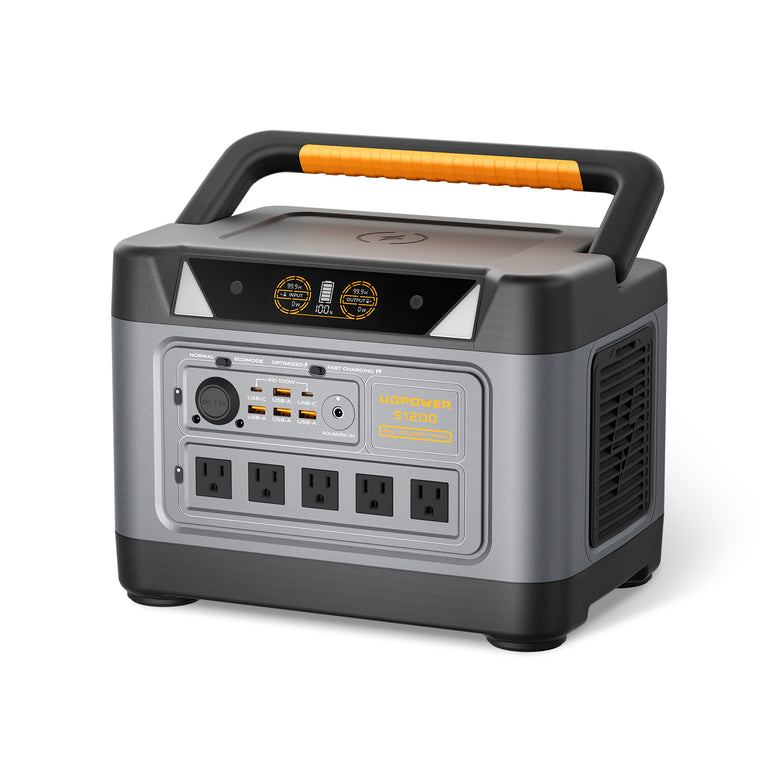
UDPOWER S1200
The S1200 is a practical option for compatible 120V household appliances and motor-driven devices that remain within its verified output capability.
- Battery capacity: 1,190Wh LiFePO4
- Rated AC output: 1,200W pure sine wave
- UDTURBO: up to 1,800W for compatible higher-power loads
- AC voltage: 120V, 60Hz
- UPSPrime response: ≤10ms
- Solar input: up to 400W
- Weight: approximately 26 lb
Best fit: Appliances whose normal load remains below the S1200's rated AC output and whose verified startup behavior is compatible with the unit's output capability.
Do not assume that every appliance with a calculated startup figure below 1,800VA is automatically compatible. Motor waveform, power factor, startup duration, voltage drop, and appliance design can affect the result.
View UDPOWER S1200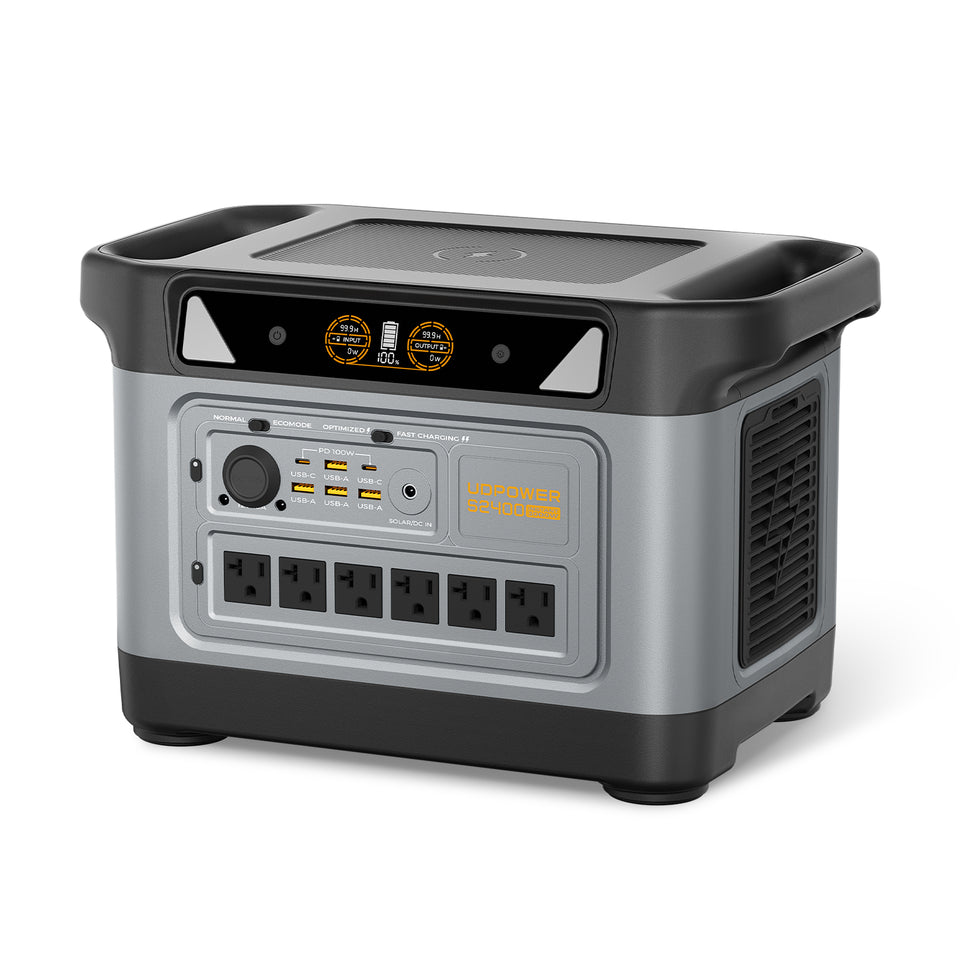
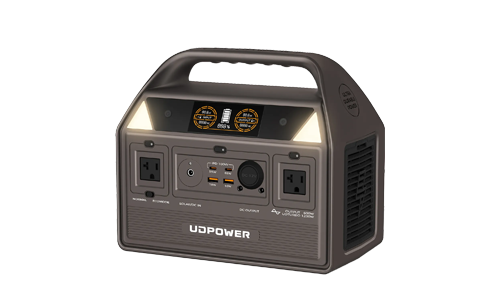
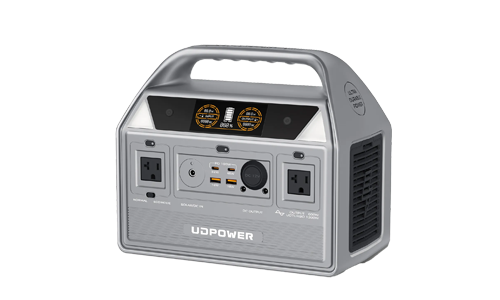
UDPOWER S2400
The S2400 provides substantially more rated-output headroom for larger 120V appliances, compressors, pumps, workshop loads, and combinations of several devices.
- Battery capacity: 2,083Wh LiFePO4
- Rated AC output: 2,400W pure sine wave
- UDTURBO: up to 3,000W for compatible higher-power loads
- AC voltage: 120V, 60Hz
- AC outlets: 6
- UPSPrime response: ≤10ms
- Solar input: up to 400W
- Weight: approximately 40.8 lb
Best fit: Higher-wattage 120V appliances or applications where more output margin is desirable for motor and compressor loads.
The same rule still applies: check the appliance's real startup behavior rather than assuming every load under a headline peak figure will behave identically.
View UDPOWER S2400To compare other capacities, visit the UDPOWER portable power station collection.
Frequently Asked Questions
What is surge current?
Surge current is a temporary increase in current above a device's normal operating level. It commonly occurs when motors, compressors, transformers, capacitors, LED drivers, and switching power supplies are first energized.
Is surge current the same as inrush current?
They are often used interchangeably when discussing appliance startup, but surge current is a broader term. Inrush current normally refers specifically to the initial current drawn when equipment is energized, while surge current can describe other temporary high-current events as well.
What is the difference between starting current and running current?
Starting current is the higher current a motor or compressor may draw while starting and accelerating. Running current is the lower current required after the device reaches normal operating conditions.
How many times higher can startup current be than running current?
There is no universal multiplier. Fluke notes that motor inrush can be roughly four to ten times normal running current depending on motor type, but individual appliances can be lower or higher. Use manufacturer data or an actual measurement whenever possible.
Are surge amps and surge watts the same thing?
No. Amps measure current, while watts measure real power. At 120V, 15A equals 1,800VA of apparent power. For an AC motor, exact real watts also depend on power factor and the electrical waveform, so 15A does not automatically equal exactly 1,800 real watts.
What does LRA mean on a compressor?
LRA means Locked Rotor Amps. It describes current under locked-rotor conditions and can be much higher than normal running current. It is useful when evaluating compressor starting requirements, but it should not be confused with normal operating amps or daily energy use.
How do you measure surge current?
A clamp meter with a dedicated inrush mode is one of the most practical tools for motor startup measurements. The clamp must be placed around one current-carrying conductor rather than the complete two-conductor appliance cord. Follow the meter manufacturer's procedure and applicable electrical safety practices.
Why doesn't my watt meter show startup surge?
The surge may occur faster than the meter's screen or normal measurement mode can update. A meter designed to capture peak or inrush events is more appropriate when startup current is the value you need.
Why doesn't a circuit breaker trip every time a motor starts?
Circuit breakers operate according to a time-current relationship rather than treating their amp rating as an instantaneous hard cutoff for every brief event. A normal short motor-starting current can therefore exceed the nominal breaker rating without immediately opening the circuit.
How does a soft starter reduce inrush current?
A soft starter controls the electrical conditions applied to a motor during acceleration instead of applying an abrupt direct start. This can reduce starting current, voltage drop, mechanical shock, and stress on the electrical system.
Do inverter refrigerators and air conditioners have lower startup current?
They often have more controlled startup behavior because inverter electronics can increase compressor motor speed gradually instead of repeatedly starting a fixed-speed compressor directly at full operating conditions. Exact behavior still depends on the appliance, so manufacturer specifications should be checked.
Why can't I simply multiply running watts by three?
Startup current depends on motor design, mechanical load, supply voltage, compressor pressure, starting components, power factor, soft-start technology, and other factors. A three-times multiplier is only a rough rule of thumb and can either overestimate or underestimate actual startup demand.
How long does surge current last?
It depends on the load. Electronic capacitor inrush can be extremely brief, while a motor or compressor may remain above normal running current during its acceleration period. A stalled motor can remain in a high-current condition until protection operates. Peak magnitude and duration both matter.
Can surge current overload a portable power station?
Yes. A device may have running wattage below the station's rated AC output but still trigger overload protection if its startup demand is too high or lasts too long. Check voltage, running load, startup behavior, and the power station's output capability separately.
Does a larger battery mean a power station can handle more surge current?
Not necessarily. Battery capacity in watt-hours primarily affects runtime. Inverter output capability determines whether the station can support the device's normal and startup power requirements. A high-capacity battery with an undersized inverter can still fail to start a motor.
Not Sure Whether Your Appliance Will Start?
Check the appliance's voltage, normal running watts or amps, and startup demand before choosing a backup power source. For motor and compressor loads, do not size from running watts alone.
View the Power Station Sizing Guide View Portable Power Stations View High-Output S2400Sources and Further Reading
- Fluke — How and Why to Measure Inrush Current
- Copeland — Compressor Starting Current and Locked Rotor Amps
- Schneider Electric — Altivar Soft Starter Technical Guidance
- Daikin — Inverter Compressor Technology and Starting Current
- Mitsubishi Electric — Fixed-Speed vs. Inverter Compressor Technology
- MEAN WELL — LED Power Supply and Inrush Current Guidance
- All About Circuits — Transformer Inrush Current
- GE Appliances — Appliance and Generator Power Sizing
- UDPOWER S1200 — Current Official Product Specifications
- UDPOWER S2400 — Current Official Product Specifications
Related Articles


