

ComEd Chicago Power Outage: Outage Map, Status, Reporting & Restoration Times
Last updated: October 15, 2026

Chicago Power Outage Today: Check the Live ComEd Map
A Chicago outage can change from one block to the next and from minute to minute. Rather than publishing a static customer-out number that may already be outdated when you read it, use ComEd's official tools for the current status.
A search for Chicago power outage today usually has a very practical purpose: you want to know whether the problem is already known, how large it is, whether your address is included, and when electricity may return.
Those questions are related, but they are not the same. A citywide outage map can show the scale of a problem, while an address-level status is more useful for determining what is happening at your specific home. And an estimated restoration time is an estimate, not a guaranteed appointment.
This guide explains how to use the official ComEd tools, how to interpret the information you see, what to do when your outage does not appear on the map, and how to plan backup power for a Chicago outage that lasts longer than expected.
How to Check a Chicago Power Outage Right Now
If your lights suddenly go out, use this order:
- Check whether the outage extends beyond your home. Look through a window for nearby exterior lights, streetlights or neighboring buildings. Do not walk toward damaged electrical equipment or downed wires.
- Open the official ComEd Outage Map. Use cellular data if your home internet is down.
- Search your exact address. Address-level information is more useful than assuming every customer in your ZIP code or neighborhood is affected.
- Check your individual ComEd outage status. Your account-linked status may provide information specifically associated with your service address.
- Report the outage if necessary. Do not assume that a neighbor has already reported the same problem.
- Save the estimated restoration time, then check again later. The estimate can change after crews inspect the site.
| What You Need to Know | Best Tool | Why Use It | Official Source |
|---|---|---|---|
| Is there an outage near me? | ComEd Outage Map | Shows active outage locations and affected areas across the service territory. | ComEd Outage Map |
| Is my specific address affected? | Check My Outage Status | More useful for your individual service address than a broad regional count. | Check Outage Status |
| How do I tell ComEd my power is out? | Online, app, text or phone | Creates an outage report tied to your service information. | ComEd Reporting Options |
| Was the shutdown scheduled? | Planned Outages | Separates planned maintenance interruptions from unexpected outages. | ComEd Planned Outages |
How to Use the ComEd Outage Map
The ComEd outage map should be your first stop when searching for a power outage in Chicago. It is more useful than a social-media post or a generic outage website because ComEd is the utility responsible for electric distribution across Chicago and much of northern Illinois.
1. Open the official map
Go directly to the official ComEd Outage Map.
2. Search your location
Use your street address when possible. The map can also provide broader summaries, including affected ZIP codes and Chicago wards, but your exact address is the better starting point when the question is simply, “Is my house part of this outage?”
3. Look beyond the customer count
A large customer number tells you the event is significant, but it does not tell you whether your particular electrical circuit has the same damage as another part of the neighborhood.
Two homes separated by only a few streets can sometimes be supplied through different parts of the local distribution system. One group may be restored before another even though both appear inside the same Chicago neighborhood or ZIP code.
4. Check the status and restoration estimate
If an estimated restoration time is available, treat it as the utility's current working estimate. Save it, but check again later because field conditions can change.
5. Check your address again after nearby power returns
If most of the block comes back on but your building stays dark, do not assume ComEd still knows your individual service is out. Recheck your address and report the continuing outage if needed.
Chicago Power Outage by ZIP Code, Ward or Address: Which Should You Use?
People often search for Chicago power outage by ZIP code or Chicago power outage near me. ComEd's map provides several geographic ways to understand an outage, but they answer different questions.
| Search Method | Best For | Limitation | Recommended Use |
|---|---|---|---|
| Exact address | Your home or business | Requires the specific location | Best choice when checking your own outage |
| ZIP code | Understanding outage activity in a wider area | A ZIP code can contain many separate circuits and outage events | Use for area context, then check the address |
| Chicago ward | Seeing the broader impact within city administrative areas | Ward boundaries are not electrical circuit boundaries | Useful for community-scale awareness |
| County | Large storm events affecting Cook County or surrounding counties | Too broad for determining whether one building is affected | Useful during widespread severe weather |
The official ComEd map includes outage summaries by county, cities and towns, Chicago wards and affected ZIP codes. For an individual customer, however, location-specific status remains the more useful check.
How to Report a ComEd Power Outage
If you are experiencing a ComEd power outage in Chicago, there are several ways to report it.
| Method | How to Use It | Best For | Source |
|---|---|---|---|
| Online | Use ComEd's outage reporting service | Smartphone or computer users with internet access | ComEd |
| Text message | Enroll by texting ADD OUTAGE to 26633, then text OUT to report an outage | Fast reporting from an enrolled mobile phone | ComEd Mobile Reporting |
| Text status | Text STAT to 26633 after enrolling | Checking an outage without repeatedly opening a webpage | ComEd Outage Alerts |
| Mobile app | Use the ComEd mobile app to report and monitor an outage | Customers who already manage their account on mobile | ComEd |
| Phone | Call 1-800-334-7661 | Reporting by phone or reporting dangerous electrical conditions | ComEd Contact |
What does FULL or PARTIAL outage mean?
ComEd's text reporting process may ask whether you have a FULL or PARTIAL outage.
A full outage means the property has lost electric service completely. A partial outage can include symptoms such as some electrical service remaining, flickering or abnormal power behavior.
Partial power problems should not be ignored. Avoid repeatedly switching major appliances on and off, and report unusual electrical conditions to ComEd. If you smell burning, see sparking, hear abnormal buzzing from electrical equipment or see water around electrical equipment, keep your distance and seek qualified help.
How Long Does a ComEd Power Outage Last?
There is no single reliable answer to “How long will a Chicago power outage last?” A small localized equipment problem can be very different from a storm that damages trees, poles and multiple sections of the distribution network.
ComEd states that estimated restoration times can change based on what crews discover at the outage site. That detail matters because the first estimate may be made before the complete extent of the damage is known.
How to interpret a ComEd restoration time
| What You See | What It Means for You |
|---|---|
| No restoration estimate yet | The outage may still be under assessment. Keep checking the official status instead of assuming the outage will be short. |
| An estimated restoration time appears | Use it for planning, but do not treat it as a guaranteed deadline. |
| The estimated time changes | Crews may have found additional damage or updated the repair plan. |
| Nearby homes regain power but yours does not | Your service may be connected to a different damaged section, or a more localized problem may remain. Recheck and report your address. |
| Your outage is listed as planned | Check ComEd's planned outage information for the scheduled start, status and expected end. |
Official source: ComEd outage reporting and restoration information.
Why can one Chicago neighborhood come back before another?
Power restoration is not simply a queue where the first outage reported is always the first outage repaired. Damage can occur at different points of the electrical system, and one repair may restore a large group of customers while another requires crews to replace or repair equipment serving a much smaller area.
That is why comparing your estimated restoration time with a friend a few blocks away can be misleading.
Why Does the Power Go Out in Chicago?
Chicago and northern Illinois face a combination of weather conditions capable of damaging electric distribution equipment throughout the year.
| Outage Cause | What Can Happen | Chicago Relevance |
|---|---|---|
| Severe thunderstorms | High winds can knock trees and branches onto power lines and damage poles or equipment. | Frequent warm-season severe weather risk across northern Illinois. |
| Straight-line winds and derechos | Large areas can experience extensive tree, wire and pole damage at the same time. | NWS Chicago documented multiple destructive wind events during 2026. |
| Tornadoes | Localized but severe damage can affect lines, poles and substations. | Northern Illinois experienced multiple confirmed tornado events in 2026. |
| Winter storms and ice | Ice and snow can damage trees and power infrastructure while cold weather increases the consequences of an outage. | NWS Chicago specifically warns that winter storms and ice storms can cause multi-day outages. |
| Vehicle or equipment incidents | A damaged pole, transformer or other distribution component can create a highly localized outage. | Can affect only a small area even during otherwise normal weather. |
| Planned work | Power may be intentionally interrupted so utility work can be completed safely. | ComEd maintains a separate planned outage service. |
Recent severe weather shows why Chicago outage plans matter
The Chicago area does not need a hurricane to experience a large power disruption.
On July 27, 2026, the National Weather Service Chicago documented severe thunderstorms that produced tornadoes and extensive straight-line wind damage. Parts of southern Cook and eastern Will counties experienced estimated wind gusts of roughly 80–105 mph. Local reporting following the event said more than half a million ComEd customers lost power across northern Illinois during the storms.
On August 11, 2026, another powerful derecho produced widespread 70 to locally 100+ mph winds across parts of northeastern Illinois and northwestern Indiana.
These events show why a Chicago outage plan should account for more than a quick 30-minute interruption. Severe wind damage can involve trees, wires and poles across many repair locations at the same time.
Sources: National Weather Service Chicago — July 27, 2026 severe weather and National Weather Service Chicago — August 11, 2026 derecho.
What If Your House Has No Power but the ComEd Outage Map Shows Nothing?
This is one of the most useful distinctions to make during a Chicago electricity outage: is the problem on the utility system, inside the building, or only inside your unit?
| What You Observe | Possible Situation | What to Do |
|---|---|---|
| Entire block is dark | Likely utility-side outage | Check the ComEd map and report the outage if necessary. |
| Your building is dark but nearby buildings have power | Localized utility service or building electrical problem | Check ComEd status, report the outage and contact building management if appropriate. |
| Only your apartment or home is dark | Possible breaker, building circuit or service issue | If conditions are dry and there is no sign of electrical damage, check whether a breaker has tripped. If you are unsure, contact a qualified electrician or building manager. |
| Some lights work but others do not, or lights flicker abnormally | Possible partial outage or electrical fault | Report the condition to ComEd and avoid using large appliances until the cause is understood. |
| You see a downed wire | Potentially energized electrical hazard | Stay away and call ComEd immediately. |
Special note for Chicago apartments and condos
In a multi-unit building, an outage may affect:
- the entire neighborhood,
- only your building,
- only part of the building,
- or just one unit.
That is why an address-level ComEd check plus communication with the property manager is often more useful than looking only at a Chicago-wide outage count.
What to Do During a Chicago Power Outage: First 10 Minutes
Once you have confirmed the outage, your first goal is not to power every appliance in the home. It is to protect safety, food, communication and essential health needs.
- Check for immediate hazards. Look for downed wires, fire, smoke, flooding or damaged electrical equipment.
- Report the outage and check ComEd status.
- Keep the refrigerator and freezer closed.
- Charge or conserve your phone. Use low-power mode if the outage may continue.
- Unplug unnecessary sensitive electronics.
- Identify essential loads. Prioritize medical equipment, communications, refrigeration and basic lighting.
- Check the restoration estimate. A two-hour outage and an overnight outage require different battery strategies.
For a more detailed timeline, see the UDPOWER 24-, 48- and 72-hour power outage checklist.
If you already have backup power but are not sure what to connect first, use the power outage priority guide for refrigerators, medical devices, Wi-Fi and essential loads.
How Long Is Food Safe During a Chicago Power Outage?
Food safety becomes important faster than many people expect.
According to USDA guidance, an unopened refrigerator generally keeps food safely cold for about 4 hours. A full freezer can hold a safe temperature for approximately 48 hours, while a half-full freezer lasts about 24 hours if the door remains closed.
| Appliance | Typical Safe Window With Door Closed | What to Do | Source |
|---|---|---|---|
| Refrigerator | About 4 hours | Keep the door closed. Use a cooler with ice if the outage will continue. | FoodSafety.gov |
| Full freezer | About 48 hours | Keep the door closed as much as possible. | USDA FSIS |
| Half-full freezer | About 24 hours | Keep frozen items grouped together and minimize door openings. | FoodSafety.gov |
An appliance thermometer is much more useful than guessing. Refrigerated food should remain at 40°F or below. Never taste questionable food to decide whether it is safe.
You can also use UDPOWER's portable power station refrigerator runtime calculator to estimate battery runtime at different refrigerator loads.
How Much Backup Power Do You Need for a Chicago Outage?
A useful outage backup plan starts with energy priorities, not with trying to reproduce normal household electricity use.
Most households can dramatically extend backup time by separating appliances into three groups:
Priority 1: Keep running
- essential medical equipment,
- phones,
- basic LED lighting,
- router and modem when the internet connection is still operating,
- refrigeration when needed to maintain safe food temperatures.
Priority 2: Run only when needed
- laptops,
- TV,
- fans,
- small kitchen appliances,
- additional lighting.
Priority 3: Avoid during battery backup unless necessary
- space heaters,
- high-watt cooking appliances,
- hair dryers,
- large resistive heating loads,
- anything that uses a large amount of electricity but provides little outage-critical value.
Watts and watt-hours are different
Watts (W) tell you how much power a device needs at one moment.
Watt-hours (Wh) tell you how much energy the battery stores.
For planning UDPOWER runtime in this guide, the calculation uses a 90% conversion-efficiency assumption:
Estimated runtime = Battery capacity × 0.90 ÷ average device watts
Actual runtime varies with appliance cycling, inverter load, temperature, battery condition and device behavior.
Recommended UDPOWER Power Stations for Chicago Power Outages
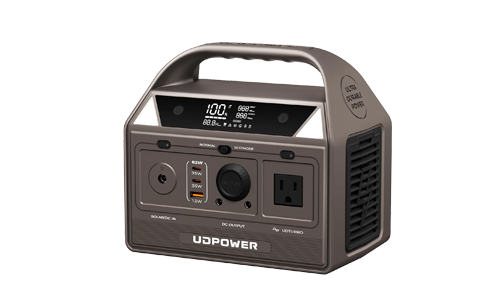
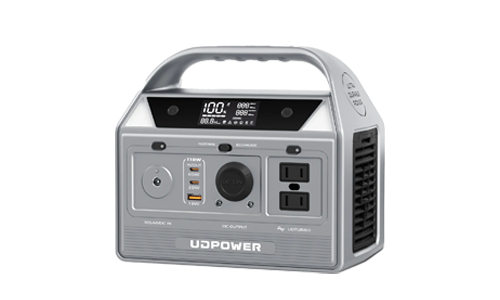
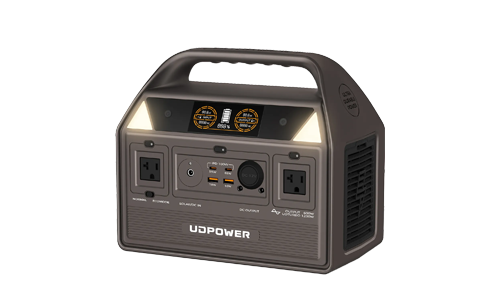
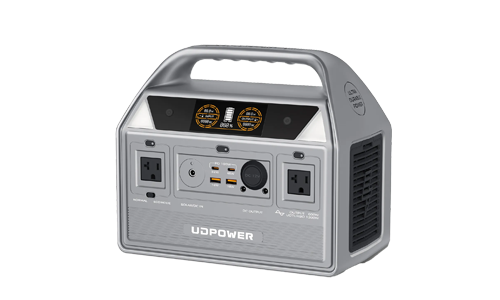
For a home outage, the most useful UDPOWER options are the S1200 and S2400. Both use LiFePO4 battery chemistry and pure sine wave AC output, but they serve different outage plans.
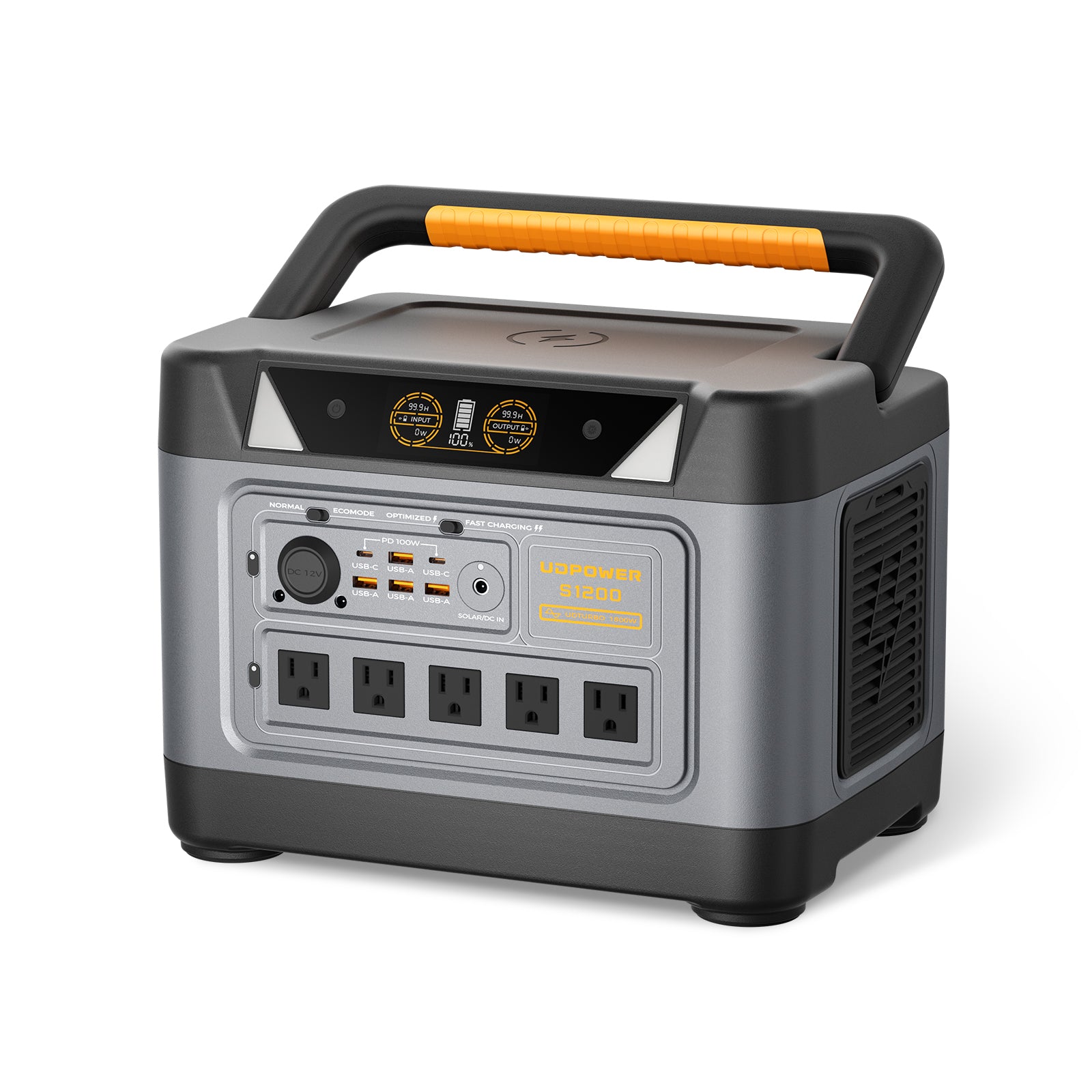
UDPOWER S1200 Portable Power Station
The S1200 is the better fit when your outage plan centers on a refrigerator, router, phones, lights, CPAP equipment, laptops and other selected 120V household essentials rather than trying to run an entire home.
- Battery capacity: 1,190Wh
- Rated AC output: 1,200W pure sine wave
- UDTURBO: supports compatible higher-power loads up to 1,800W when operating from battery
- UPS switching: ≤10 ms
- Solar input: up to 400W
- Weight: approximately 26 lb
- Battery chemistry: LiFePO4
- Battery lifecycle: approximately 80% capacity after 3,000 cycles and approximately 70% after 4,000 cycles
Best Chicago outage use: keeping core household electronics and selected appliances operating through short-to-medium outages without storing gasoline or running a combustion generator indoors.
View UDPOWER S1200 →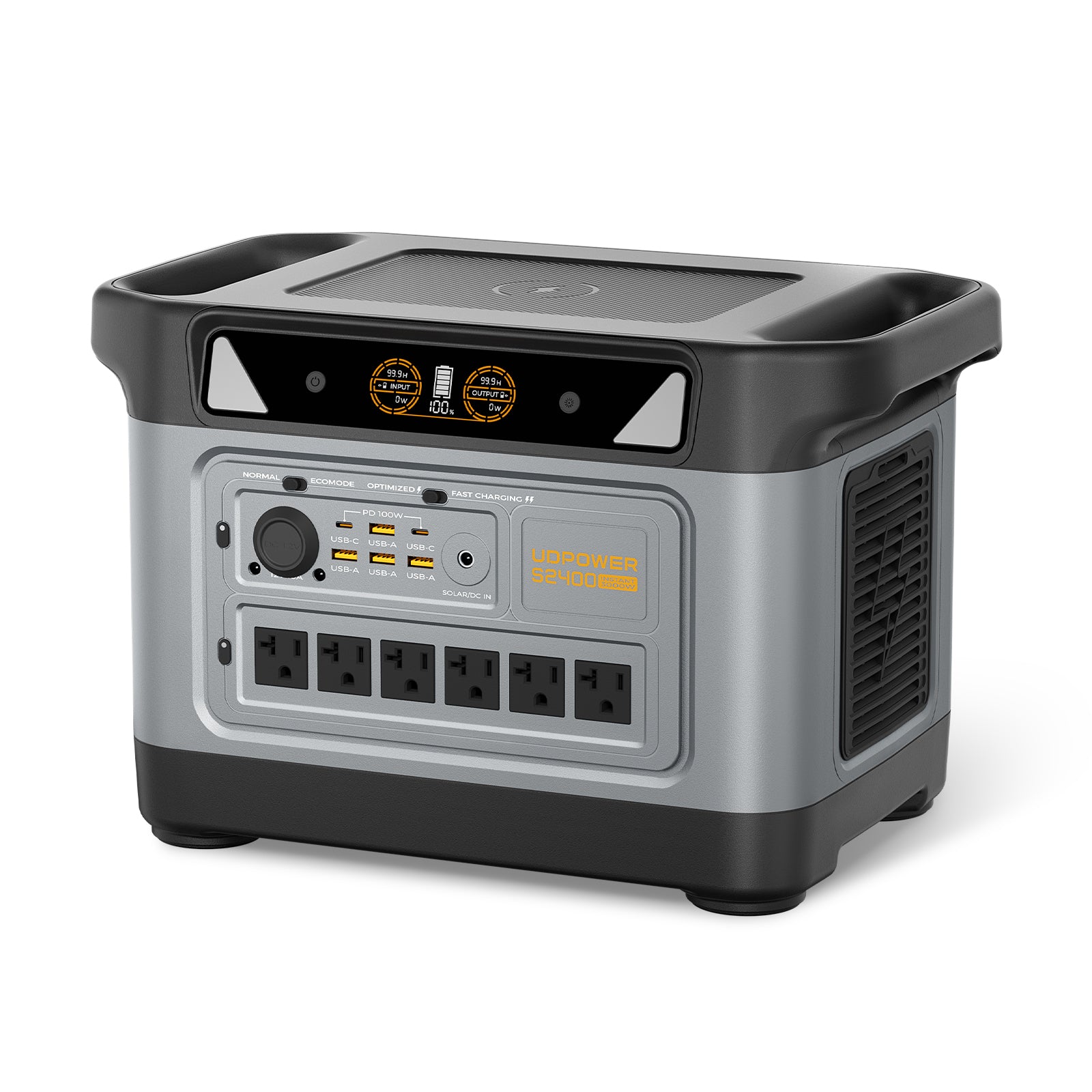
UDPOWER S2400 Portable Power Station
The S2400 provides substantially more stored energy and twice the S1200's rated AC output, making it a stronger choice when you want longer refrigerator runtime, more simultaneous household loads or greater power headroom.
- Battery capacity: 2,083Wh
- Rated AC output: 2,400W pure sine wave
- Battery/inverter mode: supports up to 3,000W constant-power output for compatible loads
- UPS/bypass mode: applicable output limit remains 2,400W
- UPS switching: ≤10 ms
- Solar input: up to 400W
- AC outlets: 6
- Weight: approximately 40.8 lb
- Battery chemistry: LiFePO4
- Battery lifecycle: approximately 80% capacity after 3,000 cycles and approximately 70% after 4,000 cycles
Best Chicago outage use: extended backup for a refrigerator plus communications, lighting, electronics and additional 120V appliances when you want more runtime and output headroom.
View UDPOWER S2400 →To compare additional capacities, visit the UDPOWER portable power station collection or the home backup power station collection.
You can also compare these two models directly in the UDPOWER S1200 vs. S2400 guide.
Estimated S1200 and S2400 Runtime During an Outage
The table below uses the same simple planning method throughout:
Capacity × 90% ÷ average load
| Example Load | Planning Load | S1200 1,190Wh | S2400 2,083Wh | Planning Note |
|---|---|---|---|---|
| Router + modem | 20W | About 53.5 hours | About 93.7 hours | Your internet provider's local equipment must still be operating. |
| LED lighting | 10W | About 107.1 hours | About 187.5 hours | Low-power lighting is one of the most efficient outage loads. |
| CPAP example | 40W | About 26.8 hours | About 46.9 hours | Actual CPAP consumption varies significantly with pressure, humidifier and heated-tube settings. |
| Efficient box fan | 50W | About 21.4 hours | About 37.5 hours | Lower fan speeds can reduce power use. |
| Laptop | 65W | About 16.5 hours | About 28.8 hours | Actual draw usually changes with charging state and workload. |
| Refrigerator average-load example | 80W average | About 13.4 hours | About 23.4 hours | A refrigerator cycles on and off. Check startup demand and actual measured average consumption. |
| TV | 100W | About 10.7 hours | About 18.7 hours | During a long outage, limiting entertainment loads preserves energy for essentials. |
These are planning estimates rather than guaranteed operating times. Real appliances may draw more or less power than the examples above.
Which model makes more sense for a Chicago outage?
| Your Backup Plan | Better Fit | Why |
|---|---|---|
| Phones, lights, router, laptop and occasional refrigerator support | S1200 | Good balance of 1,190Wh capacity, 1,200W rated output and portability. |
| Refrigerator plus multiple household essentials | S2400 | 2,083Wh capacity provides substantially more energy reserve. |
| Higher-power 120V appliances | S2400 | 2,400W rated AC output provides more load headroom. |
| Apartment where indoor combustion-generator use is impractical | S1200 or S2400 | Battery power stations provide AC power without gasoline combustion or engine exhaust. |
| Central AC, electric range, 240V water heater or whole electrical panel | Neither | These portable stations are intended for selected 120V devices, not whole-home 240V service. |
Summer vs. Winter Chicago Outage Planning
A Chicago backup plan should change with the season.
Summer outage priorities
- refrigerator and freezer temperature,
- fans,
- phone and communications,
- medical equipment,
- weather alerts,
- safe hydration and indoor temperature.
A portable power station can run a fan, but it should not be confused with a central air-conditioning backup system. If indoor temperatures become unsafe, follow local emergency guidance and relocate when necessary.
Winter outage priorities
- communications,
- medical equipment,
- safe lighting,
- pipe protection,
- maintaining a safe indoor temperature,
- a relocation plan if the home becomes dangerously cold.
The National Weather Service Chicago winter preparedness guidance notes that winter storms can knock out power and that ice storms can cause outages lasting several days.
Before the Next Chicago Power Outage
The best time to prepare is while the grid is still working.
- Save the official ComEd outage map in your phone bookmarks.
- Enroll in ComEd outage text alerts before a storm arrives.
- Know where your electrical panel is.
- Keep flashlights where they can be found in the dark.
- Keep refrigerator and freezer thermometers installed.
- Write down the wattage of the devices you consider essential.
- Charge power banks and portable power stations before forecast severe weather.
- Test your backup setup with the actual refrigerator, router, CPAP or other device you intend to use.
- Keep charging cables together with the power station rather than scattered around the home.
- Have a plan for outages that exceed your battery capacity.
For CPAP users, see the UDPOWER CPAP battery backup guide and product selection.
Frequently Asked Questions About Chicago and ComEd Power Outages
Is there a Chicago power outage today?
The most reliable way to determine whether there is a current outage at your location is to check the official ComEd outage map and search your address. Outages change continuously, so a static citywide count may become outdated quickly.
Where can I find the Chicago power outage map?
Use ComEd's official outage map. It covers Chicago and the wider ComEd service territory and provides geographic information about current outages.
How do I check a Chicago power outage by ZIP code?
The ComEd outage map includes affected ZIP-code information. Use ZIP-code data to understand the wider area, then search your exact address for a more specific status.
How do I check for a Chicago power outage near me?
Open the ComEd outage map on your phone and search your address. Address-level checking is generally more useful than relying only on a neighborhood name or ZIP code.
How do I report a ComEd power outage?
You can report an outage through ComEd's online services, mobile app or telephone service. Customers enrolled in outage text alerts can also text OUT to 26633.
What is the ComEd power outage phone number?
ComEd lists 1-800-334-7661, also written as 1-800-EDISON-1, for customer service and outage reporting.
Can I check my ComEd outage status by text?
Yes. Customers enrolled in ComEd Outage Alerts can text STAT to 26633 to request an outage status update.
How long does ComEd take to restore power?
There is no fixed restoration time for every outage. Repair time depends on the cause, number of damaged locations, weather, access and the equipment that must be repaired or replaced. Use the estimated restoration time associated with your outage for the best current indication.
Why did my ComEd restoration time change?
ComEd states that estimated restoration times may change based on what crews discover at the outage site. A preliminary estimate can therefore move earlier or later after field assessment.
Does ComEd show planned power outages?
Yes. ComEd maintains a separate Planned Outages page where customers can review scheduled outage information.
What should I do if ComEd says power is restored but my house is still out?
Check whether neighboring properties have power, verify your address status again and report the continuing outage. If only your home or apartment is affected, there may also be a building-side electrical issue. Check the electrical panel only if conditions are safe and dry, and contact your building manager or a qualified electrician when appropriate.
Why does my neighbor have power while I do not?
Nearby properties can be supplied through different circuits, transformers or sections of the distribution system. Restoration of one damaged section does not always restore every customer in the surrounding neighborhood.
How long will a refrigerator stay cold during a Chicago power outage?
USDA guidance says an unopened refrigerator generally keeps food safely cold for about four hours. A full freezer can maintain temperature for approximately 48 hours, or around 24 hours if half full, as long as the door remains closed.
Can the UDPOWER S1200 run a refrigerator during a power outage?
Many household refrigerators can be supported by the S1200 when their running and startup requirements are within the unit's capabilities. The S1200 provides 1,200W rated AC output and 1,190Wh of battery capacity. Always check your refrigerator's actual power requirements rather than relying only on a generic wattage estimate.
Is the UDPOWER S2400 better for a long power outage?
The S2400 is generally the stronger choice for longer outages because it provides 2,083Wh of battery capacity compared with 1,190Wh for the S1200. It also provides 2,400W rated AC output, allowing more power headroom for multiple selected 120V appliances.
Can the S2400 power an entire Chicago home?
No. The S2400 is a 120V portable power station intended to power selected devices directly. It is not a whole-home 240V power system and should not be used to backfeed a household wall outlet or electrical panel.
Bottom Line
When a Chicago power outage happens, start with the official ComEd map rather than a social post or an old outage count. Search your address, report the outage, monitor the restoration estimate and be prepared for that estimate to change as crews learn more about the damage.
For a short interruption, preserving phone battery and keeping the refrigerator closed may be enough. During severe thunderstorms, derechos, tornado damage or winter weather, however, an outage can become a much longer household problem. That is when a realistic backup-power plan becomes useful.
The goal is not to run everything. It is to keep the devices that matter most operating for as long as possible.
Prepare for the Next Power Outage
Compare UDPOWER backup options based on the appliances you actually need to keep running.
View Home Backup Power Stations → Compare All Portable Power Stations → Get the 24/48/72-Hour Power Outage Guide → See What to Power First During an Outage →Related Articles


