

UDPOWER S1200 vs EcoFlow DELTA 3 Classic: Which One Fits Your Power Needs?
Last updated: October 12, 2026
Quick answer: The UDPOWER S1200 and EcoFlow DELTA 3 Classic emphasize different things. The S1200 provides a larger 1,190Wh battery, dedicated 12V DC outputs, a slightly lower listed weight, and a lower direct-store price at the time of this update. The DELTA 3 Classic provides a higher 1,800W continuous AC output, faster AC charging, up to 500W solar input, and Wi-Fi/Bluetooth app features.
If most of your devices stay within the S1200's 1,200W rated AC output and your priority is stored energy, 12V equipment, camping, refrigerator backup, electronics, or general outage runtime, the S1200 may be the more practical fit.
If you routinely use AC appliances above 1,200W, need rapid wall charging, or specifically want connected app features, the DELTA 3 Classic has clear specification advantages.
UDPOWER S1200 vs EcoFlow DELTA 3 Classic Specifications
Both products sit in the roughly 1kWh portable-power category and use LiFePO4 battery chemistry, but the specifications show that they are designed around different priorities.
| Specification | UDPOWER S1200 | EcoFlow DELTA 3 Classic | What the Difference Means | Official Source |
|---|---|---|---|---|
| Rated battery capacity | 1,190Wh | 1,024Wh | S1200 has about 16.2% more nameplate battery capacity. | UDPOWER · EcoFlow |
| Battery chemistry | LiFePO4 | LiFePO4 | Both use lithium iron phosphate chemistry. | UDPOWER · EcoFlow |
| Rated AC output | 1,200W pure sine wave | 1,800W pure sine wave | DELTA 3 Classic provides more continuous AC headroom for higher-wattage appliances. | UDPOWER · EcoFlow |
| Higher-power specification | Up to 1,800W listed maximum / surge | 3,600W surge; X-Boost up to 2,600W | These figures should not be treated as equivalent to continuous rated AC output. | UDPOWER · EcoFlow |
| AC charging input | 800W max | 1,400W max | EcoFlow accepts substantially more power from a wall outlet. | UDPOWER · EcoFlow |
| Published fast-charge information | About 1.5 hours for fast charging | 0–80% in about 45 minutes under EcoFlow's stated conditions | DELTA 3 Classic is designed around faster wall recharge. | UDPOWER · EcoFlow |
| Maximum solar input | 400W | 500W | DELTA 3 Classic can accept a higher maximum solar charging wattage. | UDPOWER · EcoFlow |
| Solar input range | 12–75V, 12A, 400W max | 11–60V, 15A, 500W max | S1200 has the higher published voltage ceiling; EcoFlow has the higher current and wattage ceiling. | UDPOWER · EcoFlow manual |
| UPS transfer specification | ≤10ms | 10ms | The published transfer specifications are very close. | UDPOWER · EcoFlow |
| 12V car-style output | Yes, 12V / 12A, 144W max | No dedicated 12V DC output port listed | This can materially affect 12V refrigerators and other DC-native equipment. | UDPOWER · EcoFlow |
| DC5521 output | 2 ports, 144W total DC limit | No dedicated 12V DC output listed | S1200 provides more options for compatible DC-native devices. | UDPOWER · EcoFlow |
| USB-A | 4 ports, 54W total listed | 1 port, 18W max | S1200 offers more USB-A connection points. | UDPOWER · EcoFlow |
| USB-C | 2 ports, up to 100W total listed | 1 × 100W + 1 × 30W | Both provide two USB-C connections, but the published combined capability differs. | UDPOWER · EcoFlow |
| Wi-Fi / Bluetooth | No comparable app connectivity listed on the current S1200 product page | Wi-Fi + Bluetooth | EcoFlow provides remote monitoring and supported app controls. | UDPOWER · EcoFlow |
| External expansion battery | No external expansion battery listed on the current product page | No | Neither model is positioned as an expandable-capacity system. | UDPOWER · EcoFlow |
| Weight | About 26.0 lb | About 26.7 lb | The difference is small, but S1200 combines slightly lower listed weight with more rated capacity. | UDPOWER · EcoFlow |
| Dimensions | 13.7 × 9.5 × 9.7 in | 15.67 × 7.87 × 11.14 in | The shapes differ enough that actual cabinet or vehicle fit should be checked directly. | UDPOWER · EcoFlow |
| Warranty | 5 years | 5 years, listed as 3-year standard warranty plus 2-year extension after EcoFlow App registration | Review the current terms and registration requirements before purchase. | UDPOWER warranty · EcoFlow |
What Actually Changes the Buying Decision?
The specification table shows a clear tradeoff: S1200 provides more battery capacity and more dedicated DC connectivity, while DELTA 3 Classic provides more continuous AC power and faster charging.
That means the useful question is not simply, “Which has the bigger number?” It is:
- How many watts does your equipment actually require?
- How many watt-hours do you need between charges?
- Do your devices use AC, USB, or 12V DC connections?
- How quickly do you need to recharge?
- Do you want app-based monitoring?
If your load stays below 1,200W, battery capacity becomes more important
If both products can comfortably operate the device, the DELTA 3 Classic's extra inverter headroom does not automatically make that device run longer.
The S1200 stores 1,190Wh compared with 1,024Wh in the DELTA 3 Classic. That is about 16.2% more rated energy.
If your appliance regularly draws 1,300W–1,800W, inverter rating becomes more important
The DELTA 3 Classic is rated for 1,800W continuous AC output. The S1200's normal rated AC output is 1,200W.
A buyer who expects to operate a 1,500W appliance regularly should therefore give significant weight to EcoFlow's higher continuous AC rating rather than choosing solely on battery capacity.
If your gear uses a 12V car plug, the connection itself may decide the purchase
The S1200 includes a 12V car outlet and two DC5521 outputs. EcoFlow's current DELTA 3 Classic comparison specifications explicitly list no dedicated 12V DC output port.
For some RV, portable-refrigerator, camping, or DC-electronics setups, that physical connection difference can matter more than a few hundred watts of inverter capacity.
Battery Capacity and Estimated Runtime
The S1200's rated battery capacity is 1,190Wh. The DELTA 3 Classic is rated at 1,024Wh.
For a neutral planning comparison, the table below applies the same 90% usable-energy assumption to both products:
Estimated runtime = rated capacity × 0.90 ÷ continuous device watts
| Continuous Load | S1200 Planning Estimate | DELTA 3 Classic Planning Estimate | Approximate Difference |
|---|---|---|---|
| 10W | 107.1 hours | 92.2 hours | 14.9 hours |
| 40W | 26.8 hours | 23.0 hours | 3.8 hours |
| 60W | 17.9 hours | 15.4 hours | 2.5 hours |
| 100W | 10.7 hours | 9.2 hours | 1.5 hours |
| 500W | 2.14 hours | 1.84 hours | About 18 minutes |
| 1,000W | 1.07 hours | 0.92 hours | About 9 minutes |
The important pattern is that additional battery capacity tends to matter most when the device can already be operated comfortably by both units.
For example, a router, fan, TV, laptop setup, or other moderate load generally does not benefit directly from having a 1,800W inverter instead of a 1,200W inverter. In those cases, stored energy, standby losses, connection method, and actual device consumption deserve more attention.
Refrigerator runtime needs a different calculation
A refrigerator does not normally run its compressor continuously. It cycles on and off depending on temperature, room conditions, door openings, and thermostat settings.
That means a refrigerator's instantaneous running wattage should not automatically be treated as its 24-hour average consumption.
For a more accurate method, see Can a Portable Power Station Run Your Refrigerator?
Low-power AC loads also have inverter overhead
Very small AC devices can produce shorter runtime than a simple capacity-divided-by-device-watts calculation suggests because the power station's inverter consumes energy while it is operating.
This is another reason the table above should be used as a sizing estimate rather than a guaranteed runtime chart.
1,200W vs 1,800W AC Output: Where the EcoFlow Specification Matters
Continuous AC output is one area where the difference is straightforward.
The S1200 is rated for 1,200W continuous AC output. EcoFlow lists the DELTA 3 Classic at 1,800W continuous AC output.
| Device Load | UDPOWER S1200 | EcoFlow DELTA 3 Classic | Practical Consideration |
|---|---|---|---|
| Below 600W | Within rated output | Within rated output | Capacity, connections, price, and recharge method may matter more than inverter size. |
| 600–1,000W | Within rated output | Within rated output | Both have substantial headroom for many devices in this range. |
| 1,000–1,200W | Within rated output | Within rated output | Check startup demand and total connected load. |
| 1,201–1,800W continuous | Above the S1200's normal rated AC output | Within EcoFlow's published 1,800W continuous rating | DELTA 3 Classic has the more appropriate continuous-output specification for regular use in this range. |
| Above 1,800W continuous | Outside normal rated output | Outside normal rated output | Consider a higher-output power station instead of sizing primarily around boost modes. |
Rated output, surge power, and boost modes are not the same thing
The S1200 product page lists a 1,200W rated output and up to 1,800W maximum/surge capability.
EcoFlow lists 1,800W continuous output, 3,600W surge, and X-Boost support for certain compatible devices up to 2,600W.
These figures describe different operating conditions and should not be compared as though they were all continuous inverter ratings.
For routine appliance sizing, use the normal continuous output rating first. Then check startup requirements and any manufacturer guidance for higher-power operating modes.
If you are unsure how to do that, see How to Know If a Portable Power Station Can Run Your Device.
Ports and 12V Equipment: A Difference That Matters Outside the House
Comparing only battery capacity and inverter wattage can overlook how equipment actually connects.
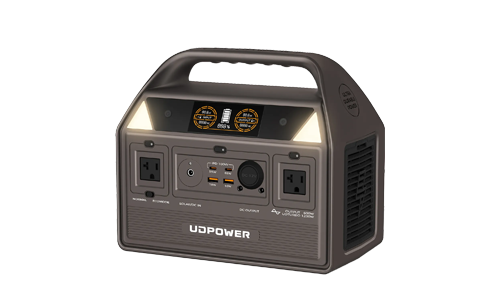
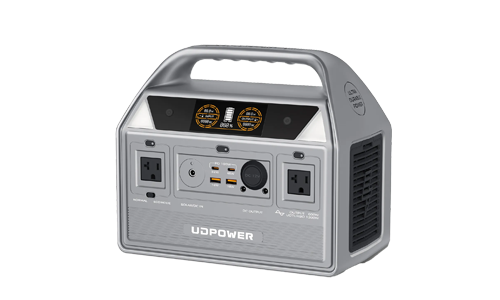
The current five-AC version of the S1200 lists:
- 5 AC outlets;
- 4 USB-A ports;
- 2 USB-C ports;
- 2 DC5521 outputs;
- 1 12V car outlet.
EcoFlow's current DELTA 3 Classic specification page lists one USB-A port, two USB-C ports, and explicitly identifies the dedicated 12V DC output as unavailable.
Rather than comparing a single “total ports” number between the brands, it is more useful to look at the exact connector your equipment requires.
| Equipment | S1200 Connection Options | DELTA 3 Classic Consideration |
|---|---|---|
| Household AC appliance | AC outlet | AC outlet |
| USB-C laptop | USB-C available | 100W USB-C available |
| Multiple USB-A accessories | Four USB-A ports | One USB-A port listed |
| 12V car-plug refrigerator | Dedicated 12V car outlet | No dedicated 12V DC output listed |
| Compatible DC5521 equipment | Two DC5521 outputs | No dedicated 12V DC output listed |
This difference is especially relevant for camping and RV users because some portable refrigerators and vehicle accessories are designed to run directly from 12V DC.
Charging: Faster Recovery or More Battery Capacity?
AC charging
EcoFlow lists a maximum AC charging input of 1,400W for the DELTA 3 Classic and states that it can charge from 0% to 80% in about 45 minutes under its specified conditions.
The S1200 lists a maximum AC input of 800W and approximately 1.5 hours for fast charging.
If you regularly drain a power station and only have a short window to recharge from the grid, EcoFlow's faster charging specification is a meaningful advantage.
If the unit normally sits charged for emergency use or is recharged overnight, the practical importance of the difference may be smaller.
Solar charging
| PV Specification | UDPOWER S1200 | EcoFlow DELTA 3 Classic |
|---|---|---|
| Maximum solar input | 400W | 500W |
| Published voltage range | 12–75V | 11–60V |
| Published current limit | 12A | 15A |
DELTA 3 Classic accepts more maximum solar wattage and current, while S1200 has a higher published input-voltage ceiling.
Neither of those numbers should be considered alone when pairing third-party panels.
Check the solar array's:
- open-circuit voltage;
- maximum-power voltage;
- current;
- combined wattage;
- connector;
- polarity.
For UDPOWER-compatible options, browse portable solar panels or solar generator kits.
UPS and Home Backup
UDPOWER lists the S1200's UPS response at 10 milliseconds or less. EcoFlow lists 10ms for the DELTA 3 Classic.
Based on those published figures alone, there is not enough difference to make transfer time the main reason to choose one over the other.
For home backup, consider three separate questions instead:
- Will the inverter support the appliance's running and startup requirements?
- How much battery capacity will be available once the outage begins?
- Does the connected equipment tolerate the manufacturer's stated transfer time?
A larger inverter and a larger battery solve different problems
The DELTA 3 Classic's 1,800W inverter can support a broader range of high-wattage AC loads within its normal continuous rating.
The S1200's larger 1,190Wh battery can provide additional theoretical runtime for the same supported load.
Which matters more depends on what you are trying to keep powered.
For additional home-backup options, see portable power stations for home backup.
Camping and RV Use
Both units weigh around 27 pounds, so neither is intended for ultralight backpacking. They are more naturally suited to car camping, RV use, cabins, tailgating, vehicle-supported trips, and emergency power.
S1200 may fit mixed AC and 12V setups more naturally
A typical campsite can include:
- a 12V portable refrigerator;
- USB devices;
- a laptop;
- lighting;
- camera or drone batteries;
- a fan;
- small AC appliances.
The S1200's combination of AC, USB, car-style 12V, and DC5521 outputs can reduce the need for additional adapters in setups that already use DC-native equipment.
DELTA 3 Classic may fit AC-heavy campsites better
If your camping setup relies primarily on high-wattage AC appliances and those loads can exceed 1,200W, the EcoFlow's 1,800W continuous inverter rating deserves more weight in the decision.
For trip planning, see How Many Wh Do I Need for Camping? or browse portable power stations for RV and camping.
Published Operating Temperature
The two manufacturers list different operating-temperature ranges.
| Published Range | UDPOWER S1200 | EcoFlow DELTA 3 Classic |
|---|---|---|
| Charging | 23°F to 104°F (-5°C to 40°C) | 32°F to 113°F (0°C to 45°C) |
| Discharging | -4°F to 113°F (-20°C to 45°C) | 14°F to 113°F (-10°C to 45°C) |
| Storage | 32°F to 104°F (0°C to 40°C) | 14°F to 113°F (-10°C to 45°C) |
S1200's published specifications allow charging and discharging at lower temperatures, while EcoFlow lists a higher maximum charging temperature and a broader storage range.
Those published limits should not be interpreted as proof that one unit delivers better measured battery performance at every temperature.
Battery output, usable capacity, charging behavior, and internal protection systems can all change with cell temperature.
Battery Chemistry and Long-Term Ownership
Both products use LiFePO4 battery chemistry.
Because manufacturers can describe battery longevity using different cycle definitions, test temperatures, depths of discharge, retention thresholds, and internal test methods, this comparison does not declare a cycle-life winner based on marketing figures alone.
Instead, buyers should look at:
- battery chemistry;
- warranty terms;
- how often the unit will be cycled;
- storage temperature;
- charging habits;
- whether the capacity can be expanded later.
EcoFlow's current specifications state that the DELTA 3 Classic does not support an expandable battery.
The current S1200 product page also does not list an external expansion-battery system.
If you already know that you need substantially more than roughly 1kWh, starting with a larger-capacity power station can make more sense than choosing either product with the expectation of adding capacity later.
For background on LFP batteries, read Pros and Cons of LiFePO4 Batteries.
Size, Weight, and Energy per Pound
| Metric | UDPOWER S1200 | EcoFlow DELTA 3 Classic |
|---|---|---|
| Rated capacity | 1,190Wh | 1,024Wh |
| Listed weight | About 26.0 lb | About 26.7 lb |
| Calculated rated Wh per pound | About 45.8Wh/lb | About 38.4Wh/lb |
| Dimensions | 13.7 × 9.5 × 9.7 in | 15.67 × 7.87 × 11.14 in |
Using published capacity and weight, the S1200 provides roughly 19% more rated watt-hours per pound.
This calculation describes nameplate energy relative to listed product weight. It does not measure inverter efficiency, internal battery energy density, construction quality, or real-world runtime.
Price Snapshot as of October 12, 2026
Prices for portable power stations change frequently because of seasonal promotions, bundles, coupon codes, and retailer discounts.
For that reason, the following figures are a dated snapshot rather than a permanent price comparison.
| Configuration | Direct-Store Price Checked October 12, 2026 | Source |
|---|---|---|
| UDPOWER S1200 3-AC unit-only version | $399.99 | UDPOWER |
| UDPOWER S1200 5-AC unit-only version | $449.99 | UDPOWER |
| EcoFlow DELTA 3 Classic 1,024Wh unit | $499 | EcoFlow |
At the manufacturer-direct prices checked on that date, the listed S1200 configurations were priced below the DELTA 3 Classic. Promotions may change this relationship, so check the live product pages before using price as the deciding factor.
Which Model Fits Different Scenarios?
| Scenario | What to Prioritize | How the Two Compare |
|---|---|---|
| Refrigerator backup | Startup requirement, average energy use, runtime | S1200 has more battery capacity; DELTA 3 Classic has more continuous inverter headroom. The better fit depends on the refrigerator. |
| CPAP backup | Actual device wattage, humidifier/tube use, manufacturer requirements | Both have substantially more inverter capacity than a typical low-power electronics load, but actual compatibility and runtime must be checked for the specific CPAP setup. |
| Router and modem | Runtime and inverter standby consumption | S1200's larger battery gives it more nameplate energy; actual runtime depends on total system losses. |
| 1,500W AC appliance | Continuous inverter rating | DELTA 3 Classic's 1,800W continuous rating covers a 1,500W load within its published normal AC rating. |
| 12V portable refrigerator | Native connection type | S1200 provides a dedicated 12V car outlet. DELTA 3 Classic does not list a dedicated 12V DC output. |
| Multiple USB-A accessories | Number of physical USB-A ports | S1200 lists four USB-A ports; EcoFlow lists one. |
| Fast wall recharge | Maximum AC input | DELTA 3 Classic lists 1,400W AC input versus 800W for S1200. |
| Maximum solar charging power | PV input limit | DELTA 3 Classic lists 500W maximum solar input versus 400W for S1200. |
| App monitoring | Wi-Fi/Bluetooth connectivity | DELTA 3 Classic includes Wi-Fi and Bluetooth. Comparable connectivity is not listed for the current S1200. |
| Expandable battery system | Future capacity growth | Neither product is currently listed as supporting an external expansion battery. |
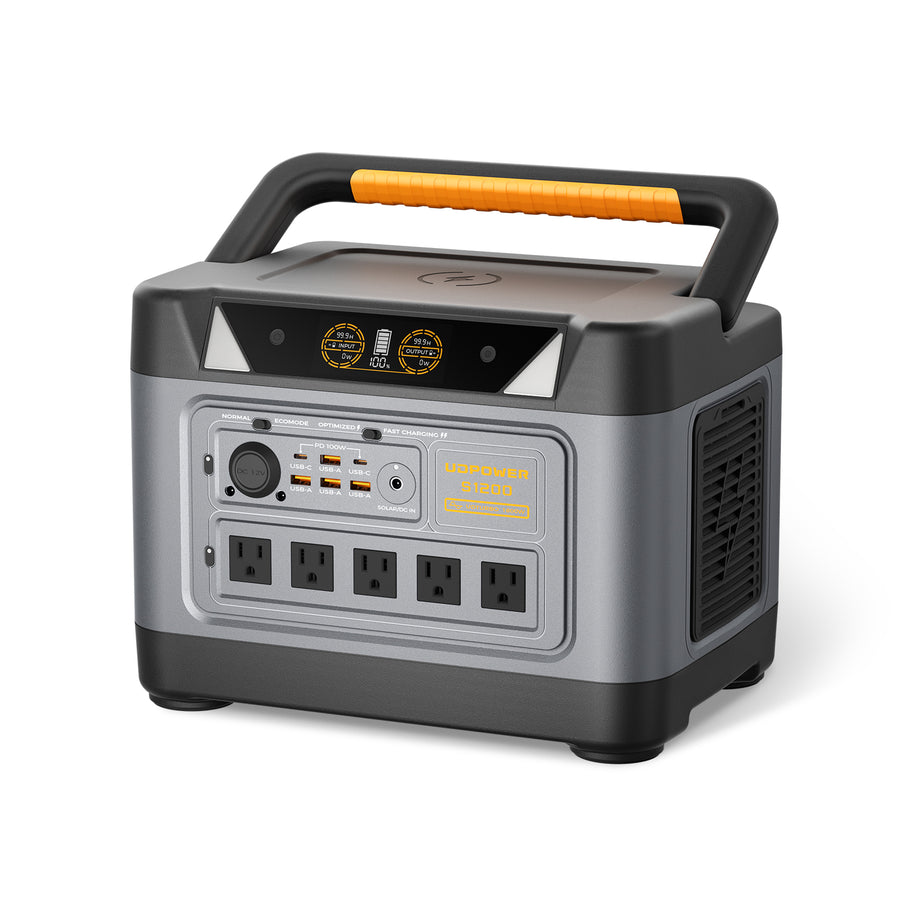
When the UDPOWER S1200 Makes Sense
The S1200 is worth considering when your main appliances remain within its rated output and your priorities include battery capacity, 12V connectivity, multiple device connections, home essentials, or portable off-grid use.
- Rated capacity: 1,190Wh
- Rated AC output: 1,200W pure sine wave
- Solar input: up to 400W
- UPS response: ≤10ms
- Weight: approximately 26 lb
- Dedicated DC options: car outlet and DC5521
- Warranty: 5 years
If your normal AC loads frequently exceed 1,200W, choose a product whose continuous rated output covers those loads rather than relying on the S1200 solely because it has more battery capacity.
UDPOWER S1200 or DELTA 3 Classic: Which One Should You Consider?
S1200 may be the better fit if:
- your normal AC loads stay within 1,200W;
- you want more rated battery capacity;
- you use a 12V car-plug device;
- you need DC5521 outputs;
- you connect several USB-A devices;
- you prioritize energy storage over maximum inverter wattage;
- the current direct price difference is important to your purchase.
DELTA 3 Classic may be the better fit if:
- you regularly run AC loads above 1,200W and up to its 1,800W rated output;
- fast wall recharging is important;
- you want up to 500W solar input;
- you want Wi-Fi and Bluetooth connectivity;
- you do not need a dedicated 12V DC output;
- 1,024Wh of fixed battery capacity is sufficient for your use.
What if both are too small?
If you regularly need more than 1,800W of continuous AC power, want substantially more than 1kWh of battery capacity, or expect to power several major appliances together, moving to a larger power-station class may be more appropriate.
The UDPOWER S2400 provides 2,083Wh of capacity and 2,400W rated AC output for higher-demand use cases.
Frequently Asked Questions
Which is better, UDPOWER S1200 or EcoFlow DELTA 3 Classic?
Neither is better for every use case. The S1200 provides more rated battery capacity and dedicated 12V DC outputs, while the DELTA 3 Classic provides a higher continuous AC output, faster AC charging, higher maximum solar input, and Wi-Fi/Bluetooth connectivity. The better fit depends on the equipment you plan to run.
Which one has more battery capacity?
The UDPOWER S1200 is rated at 1,190Wh, while the EcoFlow DELTA 3 Classic is rated at 1,024Wh. That gives the S1200 about 16.2% more nameplate battery capacity.
Which one has the higher continuous AC output?
The EcoFlow DELTA 3 Classic has the higher published continuous AC output at 1,800W. The UDPOWER S1200 is rated at 1,200W continuous AC output.
Can the S1200 run longer than the DELTA 3 Classic?
At the same supported load, the S1200 starts with more rated battery capacity, which can provide a runtime advantage. Actual runtime cannot be determined from capacity alone because inverter losses, standby consumption, temperature, battery condition, and the connected device all affect the result.
Which one is a better fit for a refrigerator?
It depends on the refrigerator. The S1200 has more rated battery capacity, while the DELTA 3 Classic has more continuous inverter headroom. Check the refrigerator's startup requirement, normal running power, and actual daily energy use before choosing either model.
Can either power station be used with a CPAP?
A power station may be suitable for a CPAP when the CPAP's electrical requirements fall within the power station's specifications. Runtime varies significantly with the CPAP model, humidifier, heated tubing, pressure settings, and connection method. Check the CPAP manufacturer's requirements and test the complete setup before relying on it for backup power.
Does the DELTA 3 Classic have a 12V car outlet?
EcoFlow's current U.S. comparison specifications list no dedicated 12V DC output port for the DELTA 3 Classic. The S1200 includes a 12V car-style output and two DC5521 outputs.
Can the EcoFlow DELTA 3 Classic use an extra battery?
EcoFlow's current official specifications list the DELTA 3 Classic as not supporting an expandable battery. This is one feature that differs from some other DELTA 3-series products.
Can the UDPOWER S1200 use an expansion battery?
The current S1200 product page does not list support for an external expansion battery. If substantially more than 1,190Wh is required, consider a larger-capacity power station.
Which one charges faster from a wall outlet?
The DELTA 3 Classic has the higher published maximum AC charging input at 1,400W and EcoFlow states that it can charge from 0% to 80% in about 45 minutes under specified conditions. The S1200 lists an 800W maximum AC input and approximately 1.5 hours for fast charging.
Which one accepts more solar power?
The DELTA 3 Classic accepts up to 500W of solar input, while the S1200 accepts up to 400W. Solar compatibility also depends on voltage, current, connector type, and polarity, so maximum wattage should not be used as the only compatibility check.
Which one is more suitable for camping?
The answer depends on the equipment you carry. S1200 offers more rated battery capacity and dedicated 12V DC connections, which can be useful for compatible camping refrigerators and vehicle accessories. DELTA 3 Classic provides more continuous AC output and faster charging for campsites that rely more heavily on higher-wattage AC appliances.
Which one supports app control?
The EcoFlow DELTA 3 Classic supports Wi-Fi and Bluetooth connectivity. Comparable Wi-Fi or Bluetooth app control is not listed in the current S1200 product specifications.
Are both power stations LiFePO4?
Yes. Both manufacturers list LiFePO4 battery chemistry for these models.
Is the DELTA 3 Classic the same as the regular DELTA 3?
No. EcoFlow lists the DELTA 3 Classic and DELTA 3 as separate models. The Classic has a different port configuration and EcoFlow currently lists it without a dedicated 12V DC output or expandable battery support.
Sources and Comparison Method
Specifications in this article were checked against manufacturer-published information on October 12, 2026. Calculated percentages and runtime examples are identified as calculations and should not be interpreted as independent laboratory test results.
Official product sources:
- UDPOWER S1200 official product page
- UDPOWER portable power station collection
- EcoFlow DELTA 3 Classic official U.S. product page
- EcoFlow DELTA 3 Classic official specifications
- EcoFlow DELTA 3 Classic official manual
Specifications, prices, bundles, promotions, software features, and warranty terms may change. Check the current manufacturer pages before making a purchase decision.
Trademark notice: EcoFlow and DELTA are trademarks of their respective owner. UDPOWER is not affiliated with, endorsed by, or sponsored by EcoFlow. Competitor names are used solely to identify the products being compared.
Choose by Your Actual Load, Not Just the Largest Number
If your normal devices remain within 1,200W and you prioritize battery capacity, 12V connectivity, and everyday backup flexibility, explore the S1200.
If your equipment requires more power, compare the rest of the UDPOWER lineup before choosing a model.
Related Articles


