

How Many Watts Does a Water Pump Use? Wattage Guide
Last updated: July 29, 2026
How Many Watts Does a Water Pump Use?
A water pump can use less than 100 watts or more than 3,000 watts, depending on the pump type, horsepower, voltage, flow rate, lift height, motor efficiency, and operating speed.
For common household pumps, a small utility pump may use about 200–500 running watts, a 1/3 HP sump pump may use about 450–800 watts, a 1/2 HP sump or transfer pump may use about 650–1,000 watts, and a 1 HP pump may use roughly 1,100–1,700 watts. The power needed when the motor starts can be two to five times higher than its normal running draw.
Do not choose backup power from horsepower alone. Before buying a generator or portable power station, check the pump’s voltage, running watts or amps, starting demand, and whether it is plug-in or hardwired.

Water Pump Wattage by Pump Type
“Water pump” can describe everything from a small aquarium pump to a deep-well system. Pump type is often more useful than horsepower when making a first estimate.
| Pump type | Common running-power range | Startup concern | Typical voltage | Backup-power notes |
|---|---|---|---|---|
| Aquarium or small fountain pump | 5–100W | Usually low | 12V, 24V or 120V | Easy load for most small battery systems, but continuous operation makes capacity important. |
| Condensate pump | 40–150W | Low to moderate | 120V | Usually runs briefly. Confirm the HVAC system itself does not require separate backup power. |
| Small utility or transfer pump | 200–600W | Moderate | 120V | Often suitable for a compact power station if the startup demand remains within its limit. |
| 1/3 HP sump pump | 450–800W | Moderate to high | 120V | Check actual inrush. Sump pumps may cycle frequently during heavy rain. |
| 1/2 HP sump or sewage pump | 650–1,100W | High | 120V | Startup compatibility often matters more than normal running watts. |
| Shallow-well jet pump | 700–1,600W | High | 115V or 230V | Many models are dual-voltage. Confirm how the motor is wired before connecting backup power. |
| Deep-well submersible pump | 700–3,000W+ | High to very high | Usually 230/240V | Many standard portable power stations cannot supply the required 240V output. |
| Single-speed pool pump | 800–2,500W+ | High | 115V or 230V | Long daily run times can consume substantial battery capacity. |
| Variable-speed pool pump | About 100–2,500W+ | Usually better controlled | 115V or 230V | Power draw changes dramatically with speed and programmed flow. |
| Irrigation or booster pump | 750–3,000W+ | High | 115V, 230V or three-phase | Head pressure, zone size, piping and motor voltage must all be checked. |
These are planning ranges, not guaranteed specifications. Manufacturer data shows that pumps with similar horsepower can have very different amperage and voltage requirements. See the official Zoeller drain-pump comparison chart, Franklin Water voltage information, and Pentair variable-speed pump specifications for real manufacturer examples.
Water Pump Wattage by Horsepower
One mechanical horsepower equals approximately 746 watts, but that does not mean a 1 HP pump draws only 746 watts from an outlet. Horsepower describes useful mechanical output. The motor must draw more electrical power to overcome motor, wiring and hydraulic losses.
| Motor size | Mechanical output | Estimated running input | Planning range for startup | Common applications |
|---|---|---|---|---|
| 1/4 HP | About 187W | 350–600W | 900–1,800W | Small utility pumps, light drainage and compact sump pumps |
| 1/3 HP | About 249W | 450–800W | 1,200–2,400W | Residential sump pumps and light transfer pumps |
| 1/2 HP | About 373W | 650–1,000W | 1,800–3,000W | Sump pumps, sewage pumps, shallow-well and transfer pumps |
| 3/4 HP | About 560W | 900–1,400W | 2,500–4,000W | Well, irrigation, booster and pool pumps |
| 1 HP | About 746W | 1,100–1,700W | 3,000–5,000W | Well pumps, pool pumps and larger transfer systems |
| 1.5 HP | About 1,119W | 1,600–2,300W | 4,500–7,000W | Pool, irrigation and higher-flow well systems |
| 2 HP | About 1,492W | 2,100–3,000W | 6,000–9,000W | Large well, irrigation, booster and commercial applications |
Startup values are conservative planning ranges for conventional single-phase motors. Soft-start controllers, variable-frequency drives and electronically controlled pumps may start differently. A motor with a high locked-rotor current may also exceed these ranges.
A useful real-world comparison: Zoeller’s published chart lists one 1/3 HP pump at 3.1 amps and several 3/10 HP pumps at 9.7 amps. The horsepower ratings are similar, but the electrical demand is not. This is why the actual model number and nameplate are more reliable than a generic HP chart.
Why Two Pumps With the Same Horsepower Can Use Different Watts
1. Horsepower measures output, not wall power
A pump motor converts electrical input into mechanical output. A less-efficient motor needs more input power to provide the same shaft horsepower.
Electrical input watts ≈ horsepower × 746 ÷ motor efficiency
For example, a theoretical 1 HP motor operating at 70% efficiency would require about 1,066 watts before accounting for other operating conditions:
2. Voltage changes current, not necessarily total work
A dual-voltage motor may operate at either 115V or 230V. At the higher voltage, it generally draws fewer amps for approximately the same mechanical job. That does not make a 230V pump compatible with a 120V-only power station.
3. Total dynamic head affects the operating point
Total dynamic head includes vertical lift, pressure requirements and friction through pipes, fittings, valves and filters. A pump moving water a short distance through a large pipe may operate differently from the same pump pushing water uphill through a narrow hose.
4. Pump design matters
Submersible pumps, jet pumps, centrifugal pumps, sewage pumps and positive-displacement pumps do not share one universal wattage-to-horsepower relationship. Impeller design, speed, motor type and control method all affect input power.
5. Variable-speed pumps do not have one fixed wattage
A variable-speed pool or circulation pump may use relatively little power at a low filtration speed and much more at maximum speed. Pentair’s SuperFlo VST, for example, supports variable-speed operation and displays watt use on its control interface. Its power requirement must be evaluated at the actual programmed speed, not only from its maximum horsepower label.
6. Pump condition changes consumption
Clogged strainers, damaged bearings, blocked discharge pipes, a failing check valve, low voltage and excessive cycling can increase operating stress. An older pump that struggles to start may behave very differently from a clean, correctly sized pump.
How to Find Your Water Pump’s Exact Wattage
Step 1: Find the pump nameplate
Look on the motor housing, control box, manual, electrical panel label or manufacturer product page. Record:
- Model number
- Voltage
- Full-load amps or rated amps
- Horsepower
- Phase
- Frequency
- Locked-rotor amps, starting amps or maximum current, when provided
Step 2: Use published input watts when available
If the manufacturer provides electrical input watts, use that figure. It is more useful than converting horsepower because it already reflects the motor’s electrical design.
Step 3: Estimate from volts and amps
When only voltage and current are available, multiply them for a conservative apparent-power estimate:
A 120V pump rated at 8 amps has an apparent demand of 960VA:
For an AC motor, volts multiplied by amps is not always equal to true watts because power factor is involved. It is still a useful preliminary figure for backup-power screening.
Step 4: Measure a plug-in 120V pump
A plug-in watt meter can show actual running watts and accumulated kilowatt-hours. The meter must be rated for the pump’s voltage and current. Many basic meters do not capture the motor’s brief startup peak accurately.
Step 5: Have startup current measured when necessary
For a hardwired pump, 240V pump or high-consequence backup system, ask a qualified electrician or pump technician to measure startup current with suitable equipment. Do not open a live panel or handle exposed conductors merely to obtain a reading.
Best evidence, from most reliable to least reliable:
- Manufacturer input-watt and starting-current specifications
- Measured running watts and inrush current
- Nameplate voltage and current
- Model-specific manual or technical sheet
- Generic horsepower chart
Running Watts Versus Starting Watts
Running watts are the power a pump uses after its motor reaches normal speed. Starting watts describe the higher electrical demand while the motor accelerates.
A pump that runs at 800 watts may briefly demand 2,000 watts or more when it starts. A battery inverter that can continuously supply 1,200 watts may still shut down if it cannot handle that startup event.
| Specification | What it controls | What happens if undersized |
|---|---|---|
| Output voltage | Electrical compatibility | The pump cannot be connected correctly, even when wattage looks sufficient. |
| Starting or maximum output | Whether the motor can begin turning | The inverter may trip, reset or show an overload error. |
| Rated output | Normal pump operation | The power source may overheat, shut down or operate inefficiently. |
| Battery watt-hours | How long the pump can operate | The pump may start normally but the battery may empty too quickly. |
Why a pump may start successfully one time and fail the next
Startup demand is affected by supply voltage, water pressure, motor temperature, extension-cord resistance, pump condition and whether the motor restarts against pressure. A single successful test does not prove that every future start will succeed.
For reliable emergency backup, avoid choosing a system whose maximum output exactly matches a generic startup estimate. Leave practical headroom for normal variation and any other devices sharing the inverter.
120V Versus 240V Water Pumps
Voltage is the most important compatibility check because a high-wattage 120V power source does not automatically produce 240V.
| Pump setup | Can a standard 120V power station run it? | What to verify |
|---|---|---|
| 120V plug-in utility pump | Possibly | Running watts, startup demand, plug type and extension-cord requirements |
| 120V plug-in sump pump | Possibly | Inrush power, cycling frequency and required backup duration |
| Dual-voltage pump configured for 115V | Possibly | Confirm the motor is actually wired for 115V and remains within output limits |
| Dual-voltage pump configured for 230V | No, not without a compatible 240V system | Do not assume an adapter changes the electrical output |
| 240V deep-well pump | No, not from a 120V-only station | Use equipment designed to provide the correct 240V supply and startup current |
| Hardwired pump | Not through an improvised cord | Have a licensed electrician design a code-compliant connection method |
Important: UDPOWER C600, S1200 and S2400 power stations provide U.S. standard 120V AC output. They do not provide 240V split-phase power. The S2400’s 2,400-watt rating does not make it a 240V source.
A plug adapter only changes the physical connector. It does not create the missing voltage, phase relationship or circuit configuration. Never backfeed a home, well circuit or electrical panel through a homemade cable.
For a detailed explanation, read 120V vs. 240V Power Differences.
How to Size Backup Power for a Water Pump
1. Confirm the pump voltage
If the pump requires 230V or 240V, stop comparing ordinary 120V power stations. You need a source designed for the pump’s voltage and circuit configuration.
2. Find the highest startup demand
Use locked-rotor amps, inrush amps or manufacturer starting watts when available. A broad multiplier based on running watts is only a fallback estimate.
3. Check normal running power
Keep the pump’s sustained draw within the power station’s rated AC output whenever possible. If an applicable UDPOWER model operates above its rated output through UDTURBO, conversion efficiency may decrease. Do not use the upper-load figure as a substitute for checking motor startup behavior.
4. Add every load that may run at the same time
A refrigerator, freezer, router or light sharing the station reduces the available output and battery capacity. Two motors starting at the same moment can create a much larger peak than either device alone.
5. Estimate how often the pump runs
Sump pumps and well pumps normally cycle. A pump that runs five minutes every hour uses much less energy than one running continuously, even though both require the same startup capability.
6. Decide how much reserve you need
For flood protection or household water, planning to use every last watt-hour leaves little margin for unexpected cycling, low temperature, battery aging or delayed recharging.
Minimum information to collect before choosing backup power:
- Pump make and model
- 120V or 240V requirement
- Running watts or full-load amps
- Starting watts or locked-rotor amps
- Plug-in or hardwired connection
- Estimated minutes of operation per hour
- Other devices sharing the backup system
- Required number of backup hours
How Long Can a Portable Power Station Run a Water Pump?
Output wattage determines whether the pump can operate. Battery watt-hours determine how long it can operate.
Battery capacity in Wh × 0.90 ÷ pump running watts
UDPOWER runtime planning uses a 90% AC conversion-efficiency estimate. Actual results vary with inverter self-consumption, battery temperature, motor power factor, pump cycling, battery condition and operation above rated output.
Example: 800W pump on a 1,190Wh battery
This does not mean the pump will provide only 1.34 hours of household water. A well pump may run for a few minutes, refill the pressure tank, and remain off until water use lowers the pressure again.
| Continuous pump load | C600 596Wh / 600W rated |
S1200 1,190Wh / 1,200W rated |
S2400 2,083Wh / 2,400W rated |
|---|---|---|---|
| 250W | About 2.15 hours | About 4.28 hours | About 7.50 hours |
| 500W | About 1.07 hours | About 2.14 hours | About 3.75 hours |
| 800W | Above the recommended rated-output plan | About 1.34 hours | About 2.34 hours |
| 1,000W | Not recommended | About 1.07 hours | About 1.87 hours |
| 1,500W | Not compatible | Above rated output; do not use the standard runtime estimate | About 1.25 hours |
| 2,000W | Not compatible | Not compatible | About 0.94 hours |
The table assumes continuous operation and 90% conversion efficiency. It does not confirm startup compatibility. Above-rated UDTURBO operation can reduce efficiency, so the standard runtime formula should not be treated as an accurate estimate in that mode.
How duty cycle changes backup time
| Pump behavior | 800W pump operating time per hour | Average pump energy per hour | Approximate S2400 duration before reserve |
|---|---|---|---|
| Continuous operation | 60 minutes | 800Wh | About 2.34 hours |
| 50% duty cycle | 30 minutes | 400Wh | About 4.69 hours |
| 25% duty cycle | 15 minutes | 200Wh | About 9.37 hours |
| 10% duty cycle | 6 minutes | 80Wh | About 23.43 hours |
These duty-cycle examples do not include inverter standby consumption or other connected devices. Frequent starts may also reduce real-world performance even when total run minutes are low.
Real-World Water Pump Backup Examples
Example 1: Small 120V utility pump
Assume the pump uses 350 running watts and starts below 1,000 watts. A C600 may be suitable after confirming the actual startup requirement.
This setup may be practical for occasional tank transfer or drainage. It is less suitable for unattended flood protection unless the expected cycling and recharging plan are known.
Example 2: 1/3 HP 120V sump pump
Assume the pump uses 650 running watts and requires 1,700 watts at startup. The running draw fits within an S1200’s 1,200W rated output, and the estimated startup is within its 1,800W upper-output capability. The exact pump still needs to be tested because motor startup can vary.
If the pump runs for 10 minutes each hour, the calendar backup period can be much longer than 1.65 hours. Heavy rain may sharply increase the duty cycle.
Example 3: 1/2 HP 120V sump pump
Assume 900 running watts with an estimated 2,700-watt start. The running load fits both the S1200 and S2400, but the startup estimate exceeds the S1200’s 1,800W upper-output figure. The S2400 is the more realistic candidate because it provides 2,400W rated output and up to 3,000W through UDTURBO.
Because the startup estimate is close to the S2400’s upper limit, the model-specific inrush current should be verified before relying on it for flood protection.
Example 4: 1 HP 230V deep-well pump
Assume the pump draws 7 amps at 230V. Its apparent running demand is about 1,610VA:
The wattage may appear to fit within an S2400’s output rating, but the pump is still incompatible because the S2400 supplies 120V, not 230/240V. A correctly designed 240V backup system is required.
Example 5: Variable-speed pool pump
A variable-speed pump may draw several hundred watts at a low filtration speed and much more at high speed. Use the pump’s display, manual or measured consumption for the exact programmed schedule. Do not size a battery from maximum horsepower alone.
Running an 800W pool pump for eight hours would require approximately 7,111Wh of battery capacity at 90% conversion efficiency:
This explains why a portable power station may be useful for short emergency circulation but not necessarily for a full normal pool schedule.
Recommended UDPOWER Power Stations for 120V Water Pumps
The following recommendations apply only to compatible 120V pumps. Always confirm actual startup demand before relying on a power station for a sump pump, well system or other critical application.

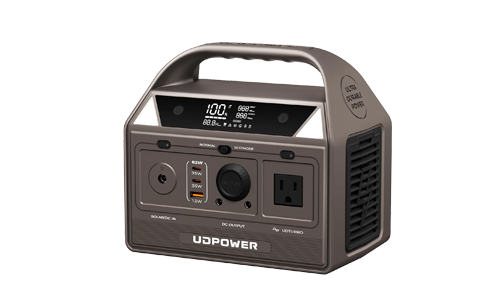
UDPOWER C600
- 596Wh LiFePO4 battery
- 600W rated pure sine wave AC output
- Up to 1,200W maximum output
- 120V, 60Hz AC outlets
- Approximately 12.3 lb
Best match: Small transfer, drainage, condensate or utility pumps whose normal draw remains below 600W and whose verified startup demand is within the C600’s capability.
Not the best match: Most conventional 1/2 HP sump pumps, large well pumps or any 240V pump.
View UDPOWER C600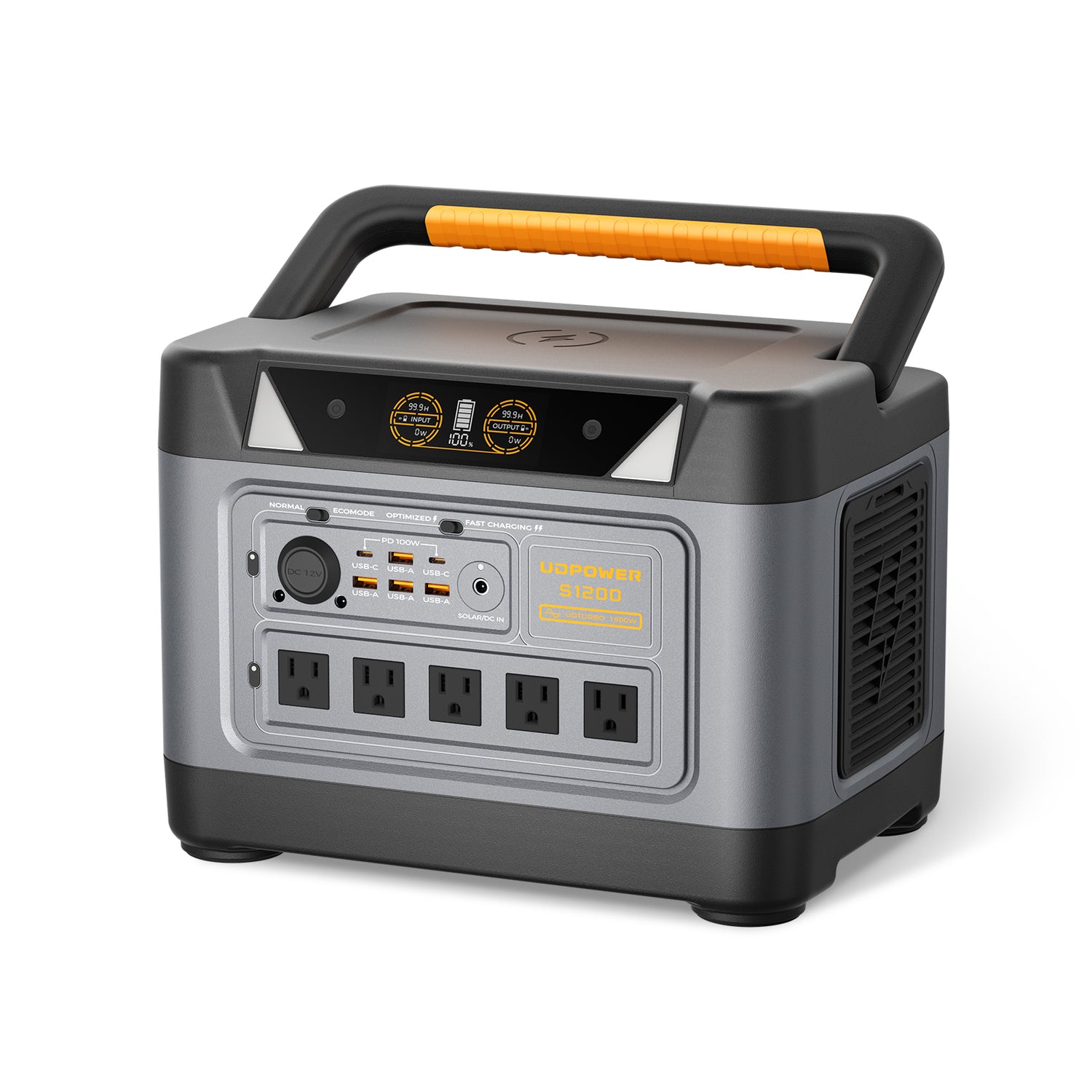
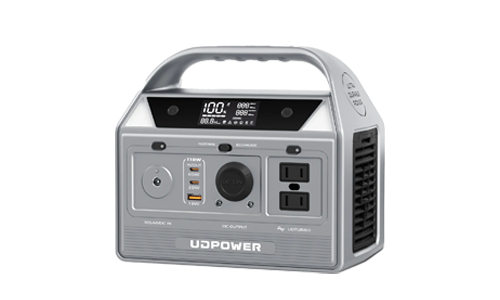
UDPOWER S1200
- 1,190Wh LiFePO4 battery
- 1,200W rated pure sine wave AC output
- Up to 1,800W through UDTURBO
- 120V, 60Hz AC output
- Five AC outlets on the current gray version
- Approximately 26 lb
Best match: Compatible 120V utility, transfer and smaller sump pumps with running power below 1,200W and verified startup demand within the unit’s output capability.
Important: Operation above the 1,200W rated output may reduce conversion efficiency. An 1,800W upper-output figure does not guarantee that every motor with a nominal 1,800W startup estimate will start successfully.
View UDPOWER S1200 See What a 1200W Power Station Can Run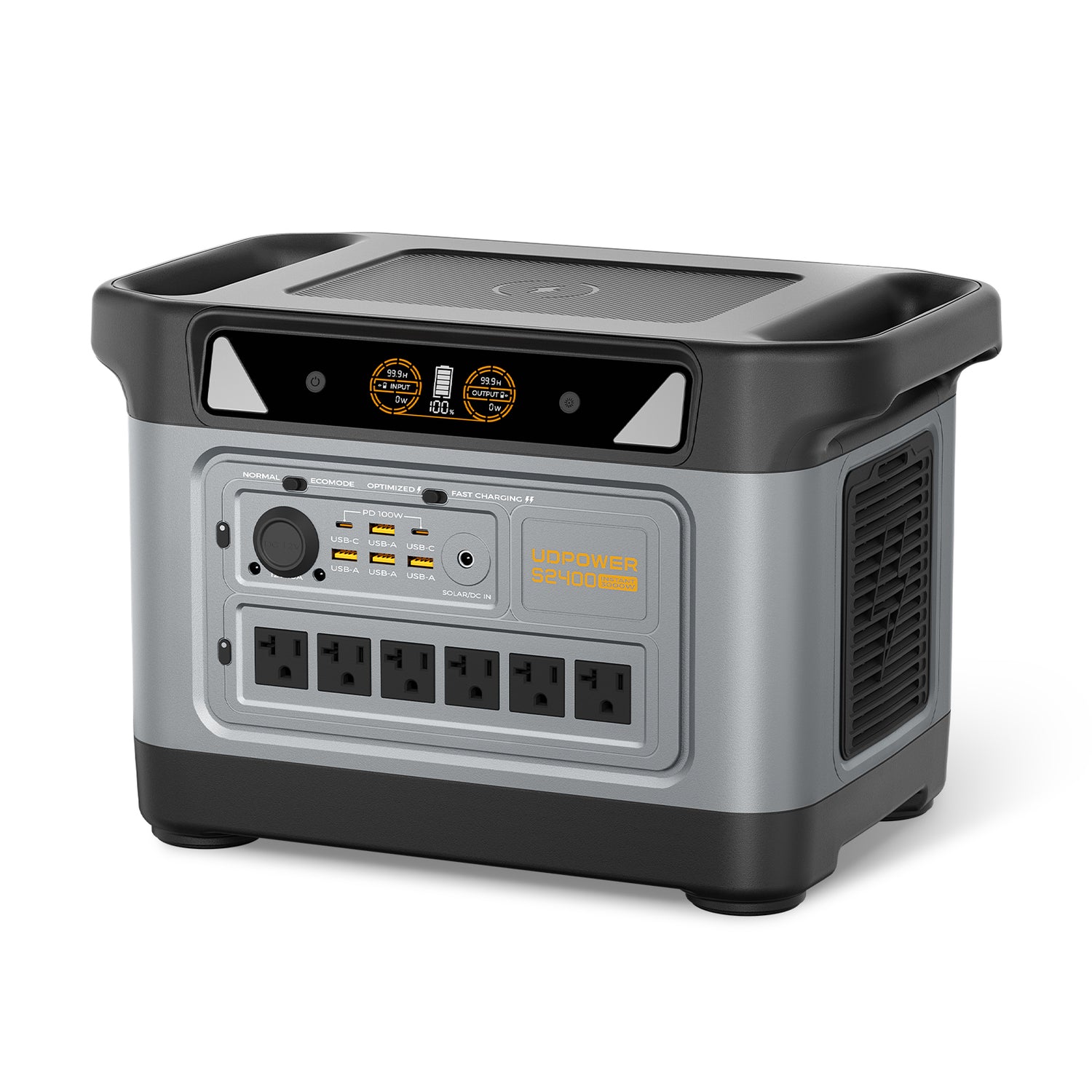
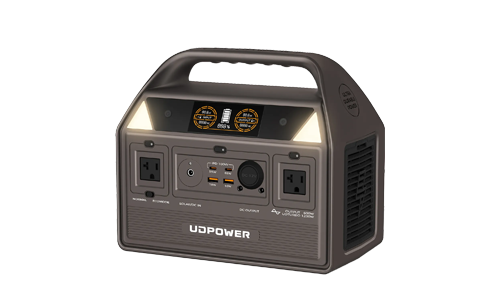
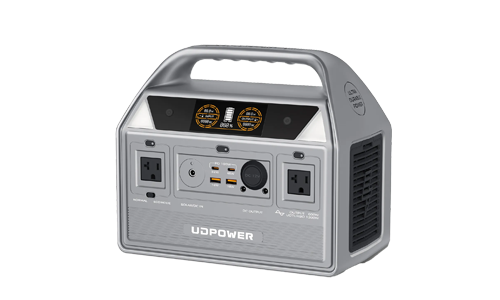
UDPOWER S2400
- 2,083Wh LiFePO4 battery
- 2,400W rated pure sine wave AC output
- Up to 3,000W through UDTURBO
- 120V U.S. AC output
- Six AC outlets
- Approximately 40.8 lb
Best match: Larger 120V sump, transfer, surface and utility pumps whose verified running and startup requirements remain within the S2400’s limits.
Critical limitation: The S2400 does not provide 240V output. It cannot directly run a conventional 230/240V deep-well pump, regardless of whether the pump’s wattage appears to fit.
View UDPOWER S2400 See 2,000Wh Runtime ExamplesProduct-selection rule: Do not select a power station solely because the pump’s running wattage fits. Confirm voltage, startup behavior, plug type and expected operating time. For a critical sump-pump system, test the complete setup under realistic conditions before an emergency.
Safe Water Pump Backup Setup and Common Mistakes
Keep the power station dry
Water pumps are often used in wet environments, but portable power stations and AC connections must remain dry. Keep the station away from standing water, rainfall, splashing, wet floors and leaking hoses while maintaining clear ventilation.
Do not use an undersized extension cord
A long or light-duty extension cord creates voltage drop. A motor may run poorly, draw more current, overheat or fail to start. Use the shortest practical outdoor-rated cord that meets the pump manufacturer’s conductor-size requirements.
Do not leave an extension cord tightly coiled
A heavily loaded cord can retain heat when coiled. Fully extend it and keep plugs and connections dry.
Do not connect a 240V pump with a simple adapter
An adapter cannot convert a standard 120V outlet into a proper 240V supply. Use purpose-designed equipment and qualified installation.
Do not backfeed a home circuit
Never connect a portable power station to a home outlet, well circuit or electrical panel through a male-to-male cable or improvised wiring. Hardwired backup connections require an approved transfer method designed by a licensed electrician.
Test the float switch or pressure switch
A sump pump must start when the water level rises. A well pump must respond correctly to the pressure switch. Test the normal automatic controls, not just manual operation.
Test multiple starts
Allow the pump to start several times under realistic pressure and water conditions. Monitor the power station for overload warnings, unexpected shutdowns, abnormal noise and rapid battery depletion.
Keep other large loads disconnected during pump startup
A refrigerator compressor, freezer, microwave or power tool starting at the same moment may push the total load beyond the inverter limit.
For broader indoor and outdoor precautions, see the portable power station safety guide.
How to Reduce Water Pump Energy Use
Reduce unnecessary cycling
A well pump that starts too frequently wastes energy and adds motor wear. A waterlogged or undersized pressure tank, leaking check valve, plumbing leak or incorrect pressure setting can cause short cycling.
Keep strainers and filters clean
Blocked strainers, dirty pool filters and restricted intake screens can increase run time and reduce useful flow.
Use the correct hose and pipe size
Long, narrow hoses and unnecessary fittings add resistance. Follow the pump manufacturer’s recommended discharge size instead of reducing the pipe immediately after the outlet.
Reduce lift and pressure when the task allows
Moving water farther uphill or maintaining higher pressure requires more work. Position tanks, hoses and discharge points efficiently when the installation allows it.
Use lower speeds on a variable-speed pump
For pool and circulation systems, a lower speed operated for a longer period can use much less energy than maximum speed. The correct setting still needs to maintain filtration, sanitation and required flow.
Repair leaks
A leaking toilet, irrigation line or pressure system can make a well pump cycle repeatedly even when no useful water is being delivered.
Maintain the check valve
A failed check valve can allow water to flow backward, causing repeated starts and reducing backup duration.
Frequently Asked Questions
How many watts does a 1/2 HP water pump use?
A typical 1/2 HP residential pump may use roughly 650–1,000 running watts, but the actual draw varies by pump type, voltage and motor efficiency. Startup demand may reach approximately 1,800–3,000 watts or more. Check the model-specific nameplate and manual.
How many watts does a 1 HP water pump use?
A 1 HP pump often uses approximately 1,100–1,700 running watts. Some pumps fall outside this range, and starting demand can be several times higher. A 1 HP label alone is not enough to choose a generator or battery inverter.
Why is a 1 HP pump not only 746 watts?
The 746-watt figure represents one horsepower of mechanical output. The motor draws more electrical input because it is not 100% efficient and must overcome electrical and mechanical losses.
Can a 1,000W power station run a water pump?
It may run a small 120V pump whose normal and startup requirements remain within the station’s limits. A pump using 800 running watts may still fail to start if its inrush exceeds the power station’s maximum output.
Can a 1,200W power station run a sump pump?
It can run some 120V sump pumps, especially smaller models, but compatibility depends on startup demand. Compare the pump’s measured or manufacturer-listed inrush with the power station’s maximum output before relying on it.
Can the UDPOWER S1200 run a 1/2 HP sump pump?
Possibly, but not every 1/2 HP pump will be compatible. The S1200 provides 1,200W rated output and up to 1,800W through UDTURBO. Many conventional 1/2 HP pumps can require more than 1,800W at startup, so the exact pump must be checked.
Can the UDPOWER S2400 run a 1 HP water pump?
It may run a compatible 120V 1 HP pump if the running load remains within 2,400W and startup demand remains within the S2400’s capability. It cannot directly run a 230/240V pump because its AC output is 120V.
Can a portable power station run a 240V well pump?
A standard 120V portable power station cannot directly run a 240V well pump. The backup source must provide the correct 240V configuration as well as sufficient starting and running power.
Can I use a transformer to run a 240V pump from a 120V power station?
A properly engineered transformer can change voltage, but it does not reduce the pump’s power requirement and may add losses and startup complications. The power station, transformer, wiring and protection equipment must all be correctly sized. This is not a simple plug-adapter solution.
How long will a 2,000Wh battery run a sump pump?
At 90% conversion efficiency, a 2,000Wh battery provides approximately 1,800Wh of usable AC energy. It could run an 800W pump for about 2.25 hours continuously. If the pump cycles, the elapsed backup period may be much longer.
Does a water pump use power when it is not running?
A basic pump motor uses little or no motor power while off, but electronic controls, monitoring devices and the power station’s inverter may continue consuming a small amount of energy. This standby consumption matters during long backup periods.
Does higher water pressure increase pump power use?
Higher pressure generally requires the pump to work against greater head. The exact change in wattage depends on the pump curve, flow rate, motor and system design. It can also increase run time if the pump struggles to reach the pressure-switch cutoff.
Can solar panels run a water pump through a portable power station?
Yes, when the pump is compatible with the power station. The battery and inverter must still handle startup demand. Solar input can offset some energy use or recharge the battery, but a 400W solar input does not turn a 400W inverter into a source capable of starting a larger motor.
Should I use a gas generator or portable power station for a pump?
A portable power station is quiet, produces no engine exhaust and can be used indoors when kept dry and ventilated. A gas generator may offer higher 240V and startup capacity for large well pumps, but it must operate outdoors away from doors, windows and vents. The correct choice depends on voltage, startup power and required runtime.
Choose Backup Power Without Guessing
Start with the pump’s voltage and startup demand, then compare rated output and battery capacity. For a critical sump or well system, verify the exact pump model and test the complete setup before an outage.
View Portable Power Stations Compare S1200 and S2400 Get the 120V vs. 240V GuideRelated Articles


