How Do You Know If a Portable Power Station Can Power Your Device?
This guide explains how to determine whether a portable power station can power a specific device by checking running watts, startup surge, battery capacity, and estimated runtime. It walks readers through finding device wattage, calculating watt-hours, avoiding overload mistakes, and choosing the right UDPOWER model for phones, laptops, CPAP machines, refrigerators, microwaves, RV use, and home backup.
Latest updated: July 6, 2026
Quick Answer
To know if a portable power station can power your device, check three things: running watts, startup surge watts, and runtime in watt-hours. The power station’s continuous AC output must be higher than your device’s running watts, its surge rating must handle startup spikes, and its battery capacity must be large enough for the number of hours you want to run the device.
A simple rule: Watts decide whether it can run. Watt-hours decide how long it can run.

The 3 Numbers You Need to Check First
A portable power station is not chosen by battery size alone. A large battery with low output may still fail to run a high-watt appliance. A high-output model with a small battery may run the device, but not for very long.
| Number to Check | What It Means | Why It Matters | Where to Find It |
|---|---|---|---|
| Running watts | The power your device uses while operating normally. | The power station’s continuous output must be higher than this number. | Device label, user manual, AC adapter, product page, or a watt meter. |
| Startup surge watts | A short power spike when a motor, compressor, pump, or heater starts. | If the surge is too high, the power station may shut off even if the running watts look safe. | Device manual, manufacturer support, or test with a power meter that captures peak load. |
| Battery capacity in Wh | The amount of stored energy inside the power station. | This determines runtime after conversion losses are considered. | Power station product page or specification label. |
How to Find Your Device’s Wattage
The safest answer is always on your own device, not a generic chart. Two refrigerators with the same size can behave differently. A CPAP with heated humidification can use much more power than a CPAP without heat. A laptop may draw 30W while browsing and much more during charging or heavy work.
- Check the device label. Look at the back, bottom, AC adapter, or nameplate.
- Look for W, watts, V, A, or input rating. If it only shows volts and amps, calculate watts.
- Use the correct side of the adapter. For a laptop charger, check the AC input or rated output. For power station sizing, the real wall draw may be slightly higher than DC output.
- Check the manual for startup surge. This is especially important for refrigerators, freezers, pumps, coffee makers, and power tools.
- Use a plug-in watt meter when possible. This gives a more realistic reading than a brochure number.
Watts formula:
Watts = Volts × Amps
Example: 120V × 2A = 240W
For larger home appliances, the yellow EnergyGuide label can help you understand long-term energy use. It shows estimated yearly electricity use, but it does not always tell you the exact startup surge. For instant compatibility, you still need running watts and surge watts. Source: FTC EnergyGuide label guide
Running Watts vs. Surge Watts: The Compatibility Test
A device can fail on a power station for two different reasons. It may need too much continuous power, or it may briefly demand too much startup power.
| Device Type | What to Check | Why It Can Be Tricky | Safe Buying Advice |
|---|---|---|---|
| Phone, tablet, camera, LED light | USB watts or charger watts | Usually low power, but fast charging may need USB-C PD support. | Small models are usually enough. Check USB-C output if fast charging matters. |
| Laptop | Charger wattage, usually 45W–140W | The laptop may draw more while charging and under heavy workload. | Use USB-C PD if supported, or AC outlet if your charger requires it. |
| CPAP | Average watts with and without humidifier | Heated humidifier and heated tube can greatly increase draw. | For overnight use, calculate with your actual settings before traveling. |
| Refrigerator or freezer | Running watts and compressor startup surge | Startup surge can be several times higher than normal running power. | Choose a model with enough surge headroom, not just enough battery capacity. |
| Microwave, kettle, coffee maker, hair dryer | High continuous watts | These devices use a lot of power even if used for a short time. | Choose a higher-output model and avoid running multiple heat appliances together. |
| Power tools, pumps, portable AC | Motor surge and continuous draw | Startup demand can overload smaller stations quickly. | Leave extra output headroom and confirm the device’s startup behavior. |
How to Estimate Runtime
Runtime depends on battery capacity, device watts, conversion efficiency, and how the device cycles on and off. For UDPOWER portable power stations, a practical quick estimate is to use about 90% usable capacity for typical real-world calculations.
Runtime formula:
Estimated runtime = Battery capacity (Wh) × 0.9 ÷ Device watts
Example: 1,190Wh × 0.9 ÷ 100W = about 10.7 hours
This formula works well for steady loads such as lights, routers, TVs, laptops, and many CPAP setups. For refrigerators and freezers, use average running power over time, because the compressor cycles on and off. For very small AC loads, inverter self-consumption can reduce runtime, so a 10W device may not run as long as a simple formula suggests if powered through the AC outlet.
| Power Station | Battery Capacity | Estimated Usable Energy at 90% | Runtime with 40W Load | Runtime with 100W Load | Runtime with 500W Load |
|---|---|---|---|---|---|
| UDPOWER C400 | 256Wh | About 230Wh | About 5.8 hours | About 2.3 hours | Not recommended; exceeds rated continuous output |
| UDPOWER C600 | 596Wh | About 536Wh | About 13.4 hours | About 5.4 hours | About 1.1 hours |
| UDPOWER S1200 | 1,190Wh | About 1,071Wh | About 26.8 hours | About 10.7 hours | About 2.1 hours |
| UDPOWER S2400 | 2,083Wh | About 1,875Wh | About 46.9 hours | About 18.8 hours | About 3.8 hours |
Common Device Power Requirements and What Size Power Station You Need
The table below gives practical starting points. Always check your own device label before buying, because real wattage varies by brand, setting, age, and operating condition.
| Device | Typical Running Power | Startup Surge Concern? | What to Check Before Plugging In | Recommended UDPOWER Level | Helpful Source |
|---|---|---|---|---|---|
| Phone / small camera battery | Often measured by Wh per charge, not steady watts | No | USB-A, USB-C, or fast-charge requirement | C400 or larger | UDPOWER C400 product page |
| Wi-Fi router | About 8W–20W | No | AC adapter voltage, DC plug size, or whether AC outlet is needed | C400 for short backup; C600/S1200 for longer backup | Energy use label guidance |
| Laptop | About 45W–140W depending on charger and workload | Usually no | USB-C PD wattage or original charger wattage | C400 for light work; C600 or S1200 for longer use | UDPOWER portable power station collection |
| CPAP without heated humidifier | Often around 20W–40W | Usually no | Whether humidifier and heated tube are off | C400 can work for short overnight use; C600/S1200 gives more safety margin | UDPOWER CPAP power guide |
| CPAP with heated humidifier | Often 60W–100W or more depending on settings | Usually low, but runtime drops quickly | Humidifier, heated tube, pressure, and 8-hour runtime target | C600 minimum for many users; S1200 for stronger overnight backup | CPAP wattage reference |
| TV | About 50W–150W for many household TVs | No | TV wattage plus streaming device, router, or soundbar | C400 for a few hours; C600/S1200 for longer viewing | UDPOWER TV power station guide |
| Mini fridge | About 40W–100W while running | Yes | Compressor startup surge, temperature, door openings | C600 or S1200 depending on surge and runtime needs | UDPOWER refrigerator guide |
| Full-size refrigerator | Often around 60W–200W average over time | Yes, important | Compressor startup surge and whether other devices run at the same time | S1200 for essentials; S2400 for longer backup and more headroom | UDPOWER refrigerator guide |
| Microwave | Usually 900W–1,500W input power | Moderate | Input watts, not just cooking watts | S1200 for smaller microwaves; S2400 for better headroom | UDPOWER S2400 product page |
| Coffee maker / electric kettle / hair dryer | Often 800W–1,800W | Usually low, but continuous watts are high | Rated input watts and whether another load is running | S1200 for moderate loads; S2400 for higher-watt devices | UDPOWER S2400 product page |
Recommended UDPOWER Models by Device Type
Choose based on the device you actually need to run, not just the biggest discount or the largest capacity. Below is a practical product bridge for common real-life use cases.

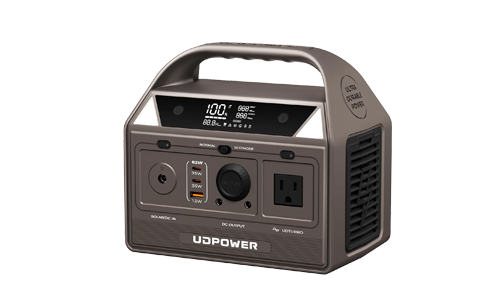
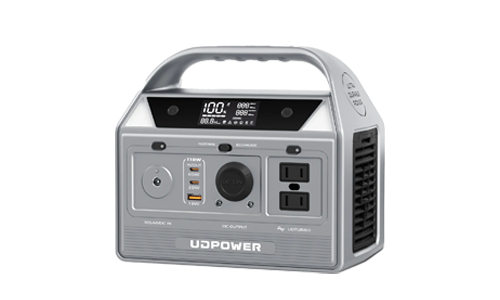
UDPOWER C400 Portable Power Station
The C400 is the compact choice for phones, cameras, laptops, routers, LED lights, small fans, and light camping backup. It is rated at 256Wh capacity and 400W AC output, with 800W surge support. It is also useful when portability matters more than long runtime.
- Capacity: 256Wh
- AC output: 400W pure sine wave
- Surge: 800W
- Best fit: light electronics, short camping, emergency phone/laptop/router backup
UDPOWER C600 Portable Power Station
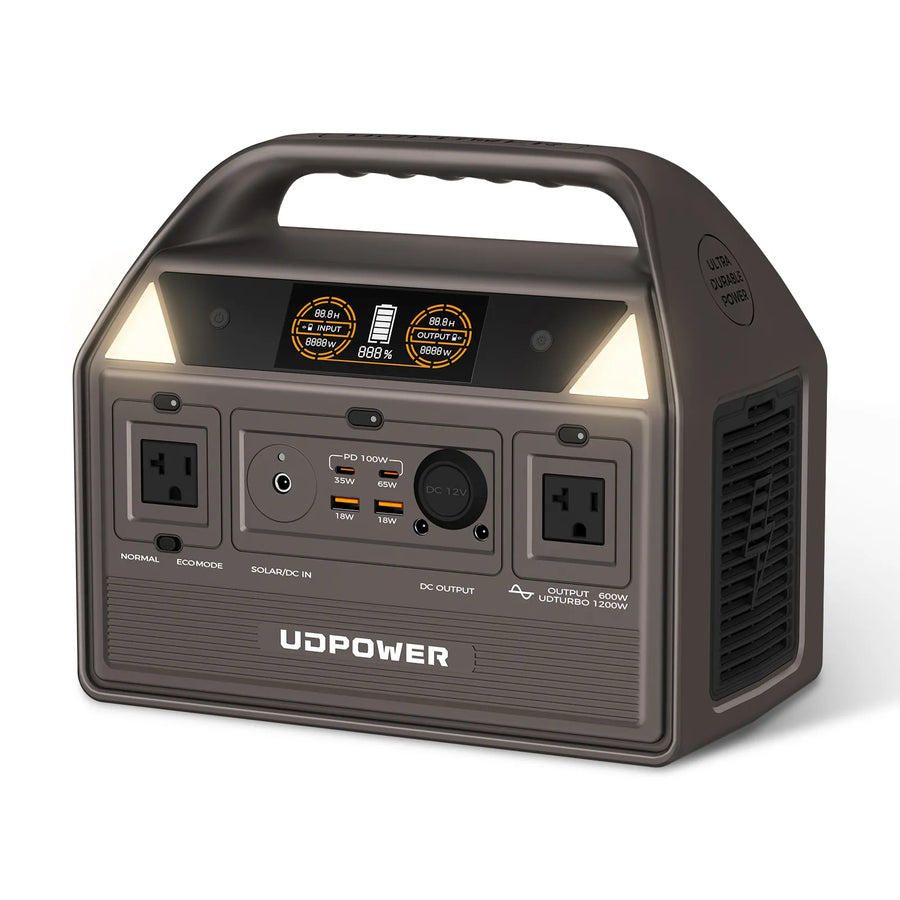
The C600 is a stronger fit for users who want more runtime than a mini station but still want an easy-to-carry unit. With 596Wh capacity and 600W output, it works well for routers, laptops, CPAP setups, small TVs, camping lights, camera gear, and some compact fridge use cases where startup surge is within range.
- Capacity: 596Wh
- AC output: 600W pure sine wave
- Surge: 1200W
- Best fit: CPAP, laptop, TV, router, small fridge, medium camping backup
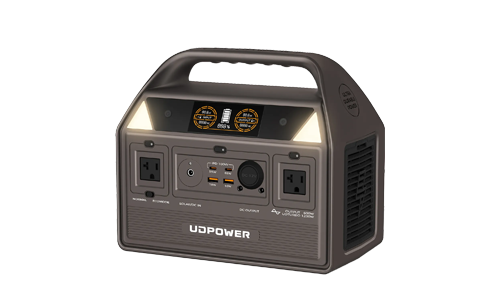
UDPOWER S1200 Portable Power Station
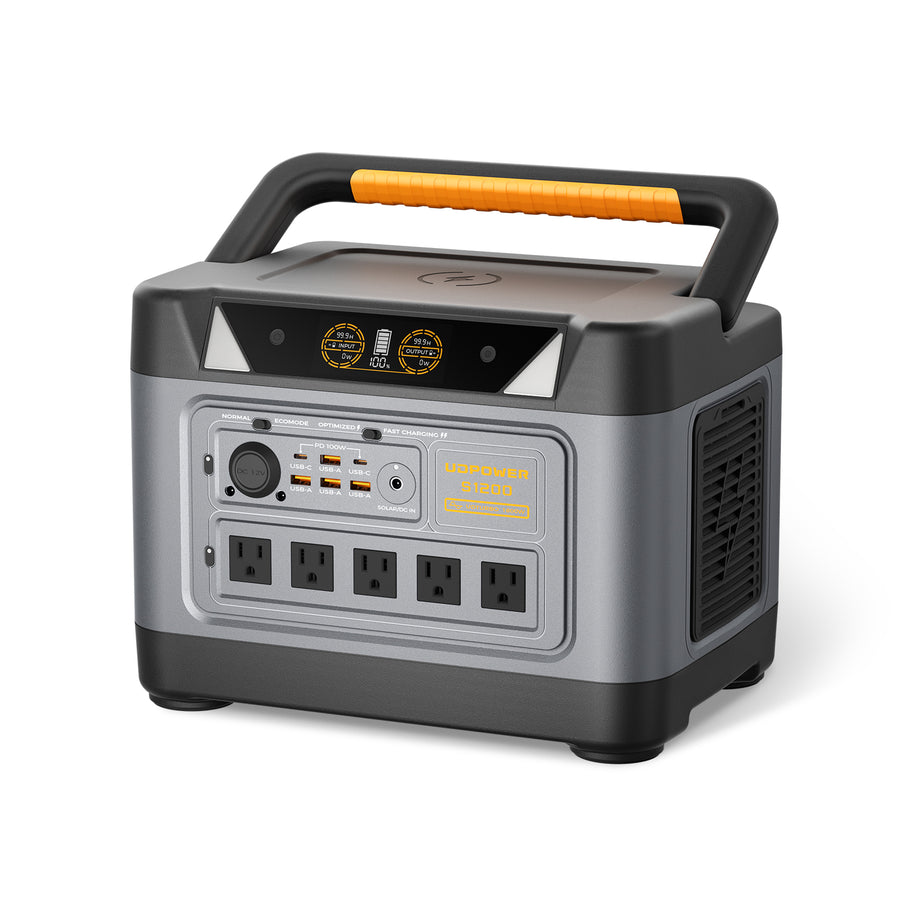
The S1200 is the safer choice when you need to move beyond small electronics. It is suitable for refrigerators, CPAP backup, routers, lights, laptops, TVs, camping appliances, and short-term emergency home backup. Its 1,200W continuous output and 1,800W surge support provide more headroom than entry-level stations.
- Capacity: 1,190Wh
- AC output: 1,200W pure sine wave
- Surge: 1,800W
- Best fit: refrigerator, CPAP, router, lights, TV, camping, RV, emergency essentials
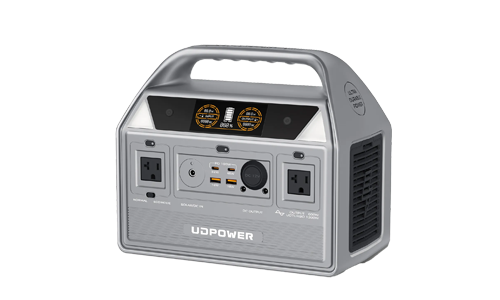
UDPOWER S2400 Portable Power Station
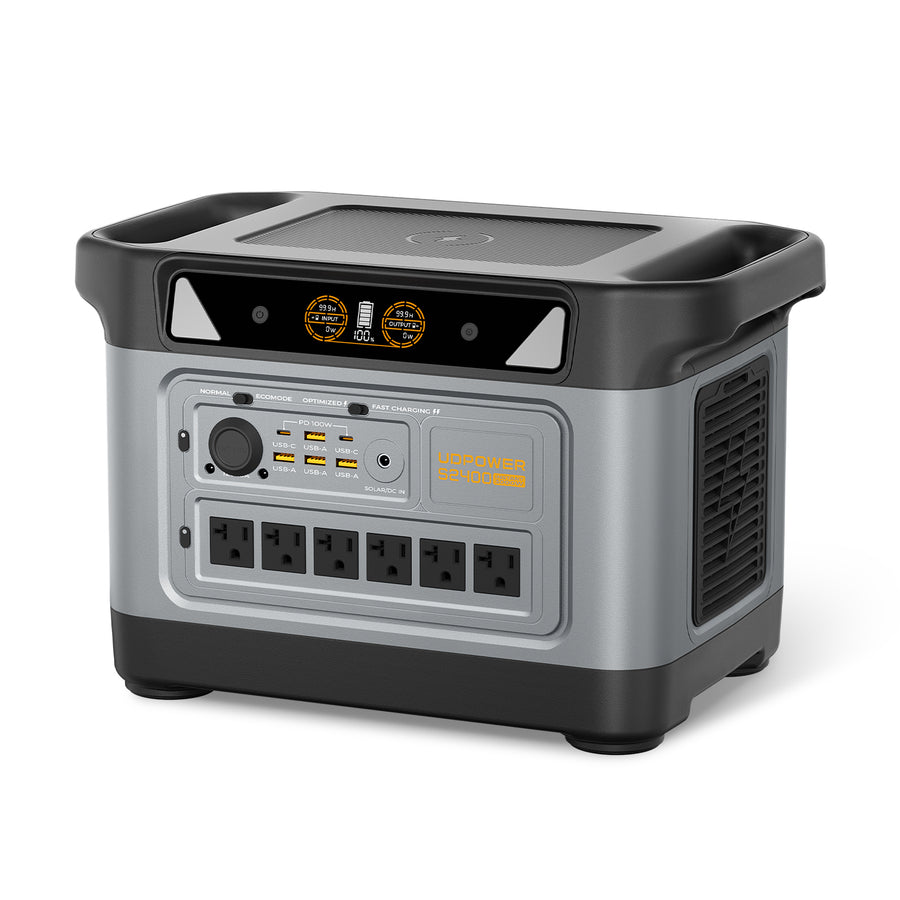
The S2400 is built for heavier use cases: refrigerator backup, RV power, microwaves, coffee makers, multiple devices, and longer emergency runtime. Its 2,083Wh capacity, 2,400W continuous output, 3,000W surge support, and 6 AC outlets make it the strongest fit when you want more power headroom.
- Capacity: 2,083Wh
- AC output: 2,400W pure sine wave
- Surge: 3,000W
- Best fit: refrigerator, microwave, RV, home essentials, power tools, multi-device backup
Which UDPOWER Model Should You Choose?
| Your Main Use | Choose This Level | Why | Recommended Product |
|---|---|---|---|
| Phones, tablets, cameras, small lights, short laptop charging | Compact 400W class | Low-watt devices do not need a large inverter, and portability matters. | UDPOWER C400 |
| CPAP, router, laptop, TV, fan, longer camping use | Mid-size 600W class | More battery capacity gives better overnight or weekend usefulness. | UDPOWER C600 |
| Refrigerator, freezer, several home essentials, CPAP plus router and lights | 1000W-class backup | Higher continuous output and surge support help with compressor loads. | UDPOWER S1200 |
| Microwave, coffee maker, RV loads, multiple AC devices, longer fridge backup | 2000W-class backup | More output headroom and larger capacity reduce overload risk and extend runtime. | UDPOWER S2400 |
Still comparing sizes? See the full UDPOWER portable power station collection or read the UDPOWER S1200 vs. S2400 comparison.
Common Mistakes That Cause Overload or Short Runtime
- Only checking battery capacity. A 1,000Wh battery does not mean it can run a 1,500W appliance.
- Ignoring startup surge. A fridge that runs at 150W may need much more power for a few seconds when the compressor starts.
- Using cooking watts instead of input watts. Microwaves are often marketed by cooking power, but the wall input can be higher.
- Adding devices without adding watts. A fridge, router, lights, TV, and laptop charger all draw power at the same time.
- Assuming lab runtime equals real runtime. Heat, cold, battery age, AC conversion, and device cycling all affect results.
- Running near maximum output for too long. Leave headroom for reliability, especially with heat-producing appliances and motor loads.
- Using AC when DC or USB-C would be more efficient. For small electronics, direct DC or USB-C output can reduce conversion loss.
A Simple 60-Second Compatibility Checklist
Before you plug in a device, run this checklist:
- Find the device’s running watts.
- Find or estimate startup surge if the device has a motor, compressor, pump, or heater.
- Make sure the power station’s continuous AC output is higher than the running watts.
- Make sure the power station’s surge rating can handle startup demand.
- Add the watts of all devices you plan to run at the same time.
- Estimate runtime using: capacity × 0.9 ÷ total watts.
- Leave extra headroom for real-world conditions.
Real-World Example: Can a Power Station Run a Refrigerator?
A refrigerator is one of the most common devices people want to back up, and it is also one of the easiest to miscalculate.
| Refrigerator Factor | Why It Matters | What to Do |
|---|---|---|
| Running watts | This is the power used while the compressor is running. | Check the label or measure with a watt meter. |
| Startup surge | The compressor may briefly need much more power when it starts. | Choose S1200 or S2400 if you want stronger surge headroom. |
| Duty cycle | The fridge does not run at full power every minute. | Estimate average power over time, not just momentary draw. |
| Room temperature | Hot weather makes the compressor run more often. | Use a larger capacity model during summer outages. |
| Door openings | Frequent opening increases energy use. | Keep the door closed and pre-cool before an expected outage. |
For a deeper refrigerator-specific guide, read Can a Portable Power Station Run Your Refrigerator?
Real-World Example: Can a Power Station Run a CPAP Overnight?
CPAP sizing depends heavily on settings. Without heated humidification, many CPAP machines are manageable for compact power stations. With heated humidification or heated tubing, the same CPAP can require much more energy.
Example without humidifier:
40W × 8 hours = 320Wh needed before conversion loss
A C600 with about 536Wh usable energy has a better overnight margin than a 256Wh compact station.
Example with humidifier:
90W × 8 hours = 720Wh needed before conversion loss
For this case, an S1200 is a safer choice than a small power station.
For a dedicated CPAP sizing guide, read CPAP Power Consumption: How Much Power Does Your CPAP Use?
FAQs
How do I know if my portable power station can run my device?
Check your device’s running watts, startup surge watts, and the power station’s continuous output, surge output, and battery capacity. The continuous output must be higher than your device’s running watts. The surge output must handle startup spikes. Battery capacity determines runtime.
What is the difference between watts and watt-hours?
Watts measure how much power a device needs at a moment. Watt-hours measure how much energy a battery can store over time. Watts tell you whether the station can run the device. Watt-hours tell you how long it can run.
Can a 300W power station run a 500W device?
Usually no. If a device truly needs 500W continuously, a 300W power station is not enough. Surge power is only for short startup spikes, not continuous operation.
Why does my device shut off even though the battery is not empty?
The device may be exceeding the power station’s continuous output or startup surge limit. Overload protection can shut the AC output off even when battery capacity remains.
Can a portable power station run a refrigerator?
Yes, if the power station has enough continuous output, enough surge output for the compressor, and enough battery capacity for the runtime you need. For many household refrigerator backup use cases, a higher-output model such as the UDPOWER S1200 or S2400 is a better fit than a compact station.
Can a portable power station run a microwave?
It depends on the microwave’s input wattage. Many microwaves need 900W to 1,500W or more from the wall. Smaller microwaves may work with a 1,200W-class station, while higher-watt models are better matched with a 2,400W-class station such as the UDPOWER S2400.
How much extra capacity should I leave?
For important backup loads, avoid sizing too close to the limit. Leave headroom for startup surge, AC conversion loss, battery aging, temperature, and any extra devices plugged in at the same time.
Is pure sine wave output important?
Yes, especially for sensitive electronics, refrigerators, CPAP machines, TVs, laptops, and motor-driven appliances. A pure sine wave inverter provides cleaner AC power that is more similar to a household wall outlet.
Why is actual runtime shorter than the formula?
Runtime can be shorter because of inverter loss, standby consumption, high temperature, cold weather, device cycling, battery age, or extra devices connected at the same time. Very small AC loads can also be affected by inverter self-consumption.
What UDPOWER model is best for home essentials?
For small electronics and short backup, the C400 or C600 can work well. For refrigerators, CPAP plus router and lights, or emergency home essentials, the S1200 offers stronger output and capacity. For high-watt appliances, longer runtime, or multiple AC devices, the S2400 is the better fit.
Ready to Choose the Right Size?
If you already know your device wattage, choose by output first and runtime second. For phones, laptops, routers, and short camping trips, start with the C-Series. For refrigerator backup, RV power, CPAP plus home essentials, or higher-watt devices, compare the S1200 and S2400.
Get the Watt-Hour Planning Guide
Related Reading
Related Articles