

Why Does Bad Weather Make the Power Go Out?

Quick Answer: Why Does Bad Weather Make the Power Go Out?
Bad weather causes power outages because the electric grid is a physical delivery system exposed to wind, trees, lightning, water, ice, heat, and other hazards. Wind can push branches or entire trees into power lines. Lightning can create electrical faults or damage equipment. Ice can overload wires and tree limbs. Floodwater can affect substations, transformers, and underground equipment. Extreme heat can strain equipment at the same time electricity demand rises.
Sometimes the weather does not directly destroy anything. Instead, the grid detects an unsafe electrical fault and automatically shuts off the affected section. That protective shutdown keeps damaged or energized equipment from creating a larger hazard.
What is more likely to cut off power, wind or lightning? For long-lasting, widespread storm outages, wind is generally the bigger concern, especially when it pushes trees and branches into overhead distribution lines. Lightning can absolutely cause outages, but some lightning-related faults are temporary and can be cleared automatically by grid protection equipment. The exact balance varies by location and utility, so there is no single current U.S. percentage that applies everywhere.
Why Does the Power Go Out?
Electricity has to travel through several layers of infrastructure before it reaches a wall outlet in your home. A simplified path looks like this:
Power plant or generating source → high-voltage transmission lines → substation → local distribution feeder → neighborhood transformer → service line → your home.
A failure anywhere upstream can interrupt the electricity reaching you. That is why the cause of an outage may be several miles away even when your own street looks undamaged.
During bad weather, the most vulnerable part of the system is often the local distribution network. These are the poles, wires, transformers, switches, and service lines running through neighborhoods. Many are located close to trees, roads, buildings, and other objects that can be affected by storms.
That fault may cause breakers, fuses, or automated protection devices to disconnect part of the network. In other words, some outages are the direct result of damaged equipment, while others happen because the grid is doing exactly what it was designed to do: isolate an unsafe condition.
What Is More Likely to Cut Off Power: Wind or Lightning?
For widespread and sustained storm outages, wind is usually the greater practical threat, particularly in areas with overhead power lines and mature trees.
Wind does not need to damage the power line itself. It can break a tree limb, uproot a tree, bend a pole, bring conductors into contact with each other, or throw debris into electrical equipment. One wind event can therefore produce many separate failure points across a utility's service territory.
Lightning works differently. A direct or nearby strike can create a sudden electrical fault, damage insulation, trip protective equipment, or damage transformers and other components. However, not every lightning-related fault results in permanent physical damage. If the fault clears quickly, automatic protection may restore service without a repair crew replacing equipment.
| Factor | Wind | Lightning |
|---|---|---|
| Common mechanism | Trees, branches, debris, pole damage, conductor contact | Electrical fault, equipment damage, insulation breakdown |
| Can cause a brief outage | Yes | Yes |
| Can cause physical damage requiring crews | Very often during severe wind events | Yes, especially when equipment is damaged |
| Potential geographic impact | Can create many simultaneous faults across a large area | Often more localized, although thunderstorms may contain thousands of strikes |
| Outage duration | Can be long when trees, poles, or conductors must be repaired | Can be seconds or minutes if protection clears the fault, or much longer if equipment is damaged |
| Which is usually the bigger concern for widespread storm outages? | Wind, especially wind plus trees | Important, but not always the dominant cause of long-duration widespread outages |
A peer-reviewed analysis published in 2025 discusses earlier nationwide outage research covering 1984–2006 in which wind or precipitation was associated with roughly 31% of outages while lightning accounted for about 9%. Those numbers are useful directional evidence, but they should not be treated as a current 2026 national breakdown. Utilities classify outage causes differently, and local vegetation, geography, line design, and weather patterns can change the picture dramatically.
For example, a wooded community with overhead distribution lines may be highly vulnerable to wind-driven tree damage. A lightning-prone region may experience far more lightning-related faults than the national average.
How Different Types of Bad Weather Make the Power Go Out
“Bad weather” is not a single outage mechanism. Wind, lightning, ice, flooding, heat, and tropical systems stress the grid in different ways.
| Weather | What Happens to the Grid | What You May Notice | Repair Complexity |
|---|---|---|---|
| High wind | Branches or trees contact lines, poles break, conductors slap together, debris strikes equipment | Flickering followed by an outage, repeated trips, scattered neighborhood outages | Moderate to high when physical repairs or tree removal are needed |
| Lightning | Electrical faults, damaged insulators, transformers or other equipment, protective devices trip | A sudden blink, brief outage, or localized longer outage | Low if the fault clears automatically; high if equipment is damaged |
| Heavy rain | Saturated soil makes trees easier to uproot; water can enter vulnerable equipment or accompany flooding | Outages may increase as the storm continues even after the strongest wind passes | Depends on whether equipment or access routes are affected |
| Flooding | Substations, pad-mounted equipment, underground components, and access roads may be affected | Localized or broader outages that may remain until water recedes and equipment is inspected | Often high because equipment may need inspection, drying, testing, or replacement |
| Ice and wet snow | Extra weight accumulates on wires and tree limbs, which can sag, snap, or fall onto lines | Outages may expand gradually as accumulation increases | Often high when damage is widespread |
| Extreme heat | Heavy electricity demand and high temperatures increase stress on transformers and other equipment | Localized equipment failures or broader reliability problems during peak demand | Varies by failure type and system conditions |
| Hurricanes and tropical storms | Wind, rain, flooding, storm surge, fallen trees, debris, and access problems occur at the same time | Large-area outages that can last much longer than a typical thunderstorm outage | Very high because thousands of individual damage points may need inspection and repair |
| Dangerous fire weather | Utilities in some regions may intentionally de-energize lines when extreme wind and wildfire conditions make energized equipment especially hazardous | Power may be shut off even before infrastructure is physically damaged | Restoration may require weather improvement and line inspection before re-energization |
How a Weather Event Actually Turns Into a Power Outage
The simplest way to understand a storm outage is to follow the chain from weather to your outlet.
- Weather affects the system. A branch touches a line, lightning creates a fault, ice pulls a conductor down, or water affects equipment.
- The electrical system detects an abnormal condition. Current or voltage changes in a way that indicates a fault.
- Protection equipment opens the circuit. Breakers, fuses, or automated devices disconnect the affected section.
- The utility isolates the problem. If the fault is temporary, power may return automatically. If it remains, that part of the system stays de-energized.
- Crews inspect, repair, switch, and re-energize. Damaged trees, poles, conductors, transformers, or other equipment may have to be cleared or replaced first.
This explains why asking “what broke?” does not always have a simple answer. In some cases, the outage is caused by a visibly broken pole. In others, a protective device several miles away opened because something briefly contacted a line.
Why Do the Lights Flicker Before the Power Goes Out?
A flicker does not necessarily mean the grid is failing randomly. It can be a sign that protective equipment is responding to a temporary fault.
Many overhead distribution systems use automatic devices commonly called reclosers. When a fault appears, the device opens the circuit. It may then attempt to restore power automatically. If the fault is gone, the electricity stays on. If the fault remains, the device opens again.
That is one reason you might see the lights blink, return for a few seconds, blink again, and then stay off.
Dominion Energy's outage guidance explains that events such as a tree limb brushing a line can trigger automatic opening and reclosing before the system ultimately remains open if the problem does not clear.
Why Can Your Power Go Out When the Weather Near Your House Looks Fine?
This is common during large storms. Your home's electricity may travel through equipment located miles away, so the weather directly over your roof does not tell you what is happening across the entire circuit.
Your lights can go out because:
- A tree fell on the feeder serving your neighborhood several miles away.
- A substation lost power.
- A transmission problem interrupted electricity feeding the local network.
- The strongest part of the storm crossed another part of the utility's service territory.
- A fault required the utility to isolate a larger section of the circuit.
- Crews intentionally switched parts of the system off while making repairs.
This also explains why power can go out after the worst weather seems to have passed. Saturated soil can allow trees to fall later, damaged equipment can fail after being stressed, and utility switching may temporarily interrupt service during restoration.
Can Underground Power Lines Still Go Out During a Storm?
Yes. Underground distribution removes many direct wind-and-tree contacts, but it does not make a neighborhood independent of the rest of the grid.
An underground neighborhood may still depend on an overhead feeder or substation outside the development. If that upstream equipment fails, the underground section loses power too.
Underground systems also contain their own equipment, including cables, joints, switches, and pad-mounted transformers. Flooding, equipment failure, excavation damage, or underground cable faults can still interrupt service.
Underground lines can reduce exposure to certain storm hazards, but “underground” does not mean “weather-proof.”
Why Does My Neighbor Have Power but I Do Not?
Two houses next to each other are not always supplied by exactly the same equipment.
Your neighbor may have power because:
- The homes are connected to different transformers or distribution sections.
- A damaged lateral line serves only part of the street.
- Your individual service line was damaged.
- A fuse or transformer serving a small group of homes opened.
- The problem is inside your home's electrical system rather than on the utility network.
If nearby homes have power but yours does not, check your utility's outage map or reporting system. If conditions are dry and safe, you can also check whether your main breaker has tripped. Do not approach damaged electrical equipment, and do not enter a wet electrical area to inspect a panel.
If you see sparking, smoke, damaged service equipment, or downed wires, stay away and contact the utility or emergency services as appropriate.
What Current U.S. Power Outage Data Tells Us
Individual utilities record outage causes differently, so there is no perfect national database that assigns every local outage to wind, lightning, trees, equipment failure, or another specific cause. However, national reliability data makes one point very clear: major weather events have an outsized effect on how long Americans spend without electricity.
| Data Point | Result | What It Means | Source |
|---|---|---|---|
| Major U.S. outages, 2000–2023 | About 80% were weather-related | This applies to major outage events meeting federal reporting thresholds, not every small local outage. | Climate Central analysis of DOE data |
| Weather-related major outages, 2000–2023 | 58% severe weather | The category includes events involving high winds, rain, and thunderstorms. | Climate Central / DOE OE-417 reports |
| Weather-related major outages, 2000–2023 | 23% winter weather | Snow, ice, and extreme cold can create widespread system problems. | Climate Central / DOE OE-417 reports |
| Weather-related major outages, 2000–2023 | 14% tropical cyclones | Hurricanes and tropical storms are less frequent than ordinary severe weather but can cause exceptionally large outages. | Climate Central / DOE OE-417 reports |
| Average U.S. customer interruption time in 2024 | 662.6 minutes, about 11 hours | This includes major event days. | U.S. Energy Information Administration |
| Average interruption time excluding major event days in 2024 | 131.6 minutes, about 2.2 hours | The difference illustrates how strongly major events affect annual outage time. | U.S. Energy Information Administration |
| Share of 2024 U.S. interruption hours attributed to major events | About 80% | Major events including Hurricanes Beryl, Helene, and Milton accounted for most interruption time that year. | U.S. Energy Information Administration |
At the time of this October 14, 2026 update, 2024 is the latest finalized nationwide reliability year available in the EIA table used above.
These numbers also explain why your personal experience may feel very different from the “normal” annual outage average. A household can go months without a meaningful interruption, then spend many hours or days without power after one hurricane, ice storm, or widespread wind event.
Why Do Some Storm Outages Take Much Longer to Restore?
Restoration is not simply a matter of driving to the first house that reports an outage. Utilities generally have to repair the grid in an order that allows downstream equipment to be energized safely.
| Typical Restoration Stage | Why It Usually Comes First |
|---|---|
| Transmission and major supply infrastructure | Large parts of the distribution system cannot operate without upstream power. |
| Substations | A substation can supply thousands of customers and multiple distribution feeders. |
| Critical services | Hospitals, emergency response, water systems, and other essential facilities may receive restoration priority. |
| Main distribution feeders | Restoring a main feeder can return power to large groups of customers at once. |
| Neighborhood laterals and smaller sections | Crews work progressively toward faults affecting smaller groups. |
| Individual service problems | Damage affecting only one or a few homes may remain after the larger network is operating again. |
The U.S. Department of Energy illustrates this upstream-to-downstream approach in its power restoration process guidance.
Why estimated restoration times can change
A utility may know that a circuit is out before it knows exactly what is damaged. Initial estimates can change after crews discover:
- Multiple trees on the same line.
- Broken poles instead of a simple branch contact.
- Damaged transformers or conductors.
- Flooded or inaccessible roads.
- Additional faults farther downstream.
- Unsafe wind, lightning, or flooding that prevents crews from beginning certain repairs immediately.
This is one reason a nearby neighborhood can come back online hours before another area affected by the same storm.
What to Do When the Power Goes Out During Bad Weather
1. Check whether the outage is larger than your home
Look outside only from a safe location. Check your utility's outage map or alerts. If nearby homes also appear dark, report the outage through the utility's official channel.
2. Stay away from downed lines
Never assume a fallen wire is de-energized. Keep people and pets away from downed lines, damaged poles, and anything a line may be touching.
3. Keep the refrigerator and freezer closed
According to FoodSafety.gov, an unopened refrigerator can generally keep food cold for about four hours. A full freezer may hold a safe temperature for about 48 hours, or about 24 hours when half full, if the door remains closed.
For a more detailed plan, see our guide to protecting refrigerator food during a long outage.
4. Prioritize communication before convenience
Keeping your phone, internet equipment, lights, and essential devices operating often requires far less energy than trying to run large heating, cooling, or cooking appliances.
Our power outage priority guide explains how to decide which loads should get backup power first.
5. Use fuel-powered generators only outdoors
If you use a gasoline, propane, or other combustion generator, carbon monoxide is a serious hazard. The CDC recommends operating generators outdoors at least 20 feet away from your home, doors, windows, and vents.
Never operate a combustion generator inside a house, garage, basement, shed, or other enclosed or partially enclosed space.
6. Do not backfeed power through a household outlet
Do not attempt to energize home wiring by connecting a generator or portable power station to a wall outlet. Whole-home or circuit-level backup connections require compatible equipment and a properly installed transfer solution.
7. Keep backup power focused on the loads that matter
A battery power station is most useful when you know your priorities before the outage begins. Instead of plugging in everything at once, start with communication, lighting, refrigeration, and other essential plug-in devices.
How Much Backup Power Do You Actually Need?
A storm backup system should be sized around what you need to run and for how long, not simply around the biggest battery you can buy.
A practical planning formula for a portable power station is:
The 90% factor is a practical allowance for conversion losses. Real-world runtime will still vary with appliance behavior, temperature, inverter efficiency, standby consumption, battery condition, and startup loads.
| Example Essential Load | Planning Load | UDPOWER S1200 1,190Wh |
UDPOWER S2400 2,083Wh |
|---|---|---|---|
| Modem + Wi-Fi router | 20W | About 53.6 hours | About 93.7 hours |
| Low-power essential device | 40W | About 26.8 hours | About 46.9 hours |
| Refrigerator planning average | 80W average | About 13.4 hours | About 23.4 hours |
| Mixed essential loads | 200W average | About 5.4 hours | About 9.4 hours |
| Larger combined load | 500W average | About 2.1 hours | About 3.7 hours |
These are planning estimates, not guaranteed runtimes. A refrigerator, for example, does not draw exactly 80 watts continuously. Its compressor cycles on and off and may require substantially more power during startup.
If refrigeration is your primary concern, our refrigerator backup power guide covers capacity planning in more detail. If staying connected is the priority, see how to keep Wi-Fi running during a power outage.
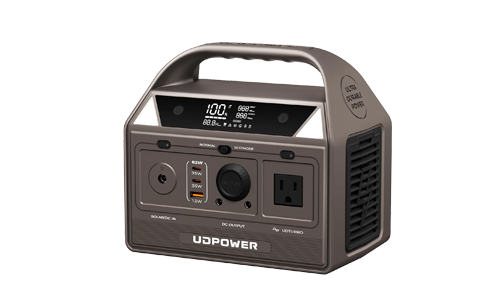
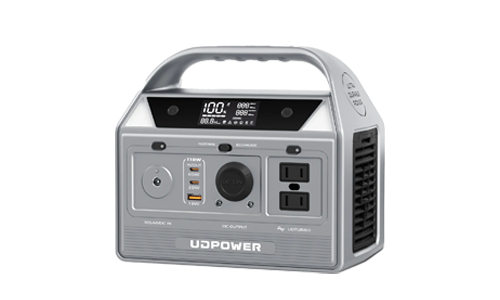
UDPOWER Portable Power Stations for Storm Backup
Portable power stations are especially useful for indoor-safe battery backup of individual plug-in devices such as refrigerators, routers, phones, laptops, lights, and compatible medical or personal equipment.
They do not replace every function of a permanently installed whole-home backup system, but they provide a practical way to keep selected essentials operating without running a combustion engine indoors.
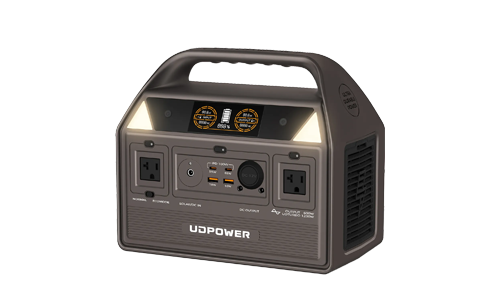
UDPOWER S1200: A Balanced Option for Essential Loads
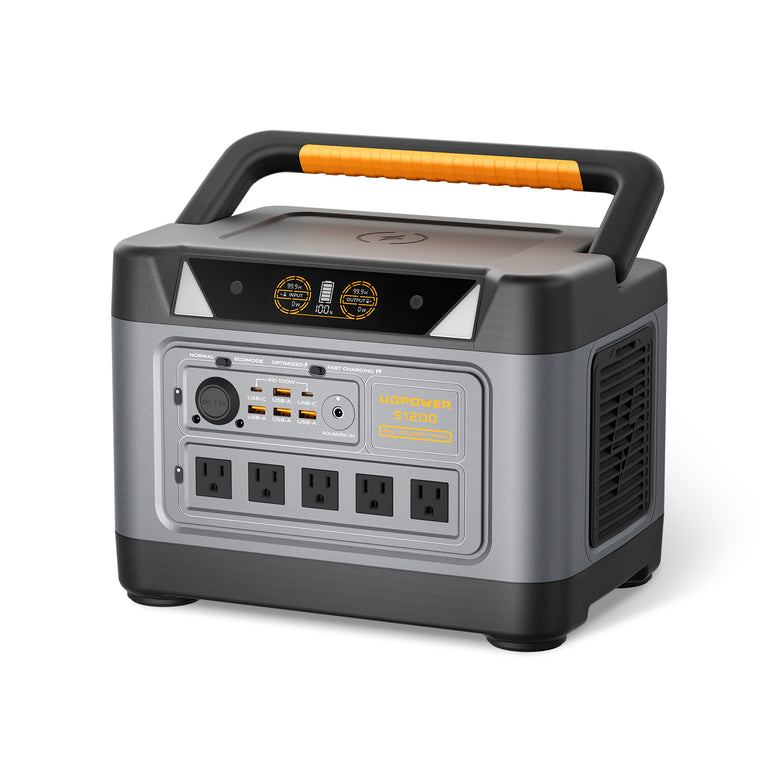
The UDPOWER S1200 is a practical choice when your storm plan focuses on refrigeration, communication, lighting, laptops, charging, and other essential plug-in equipment rather than large whole-home loads.
- Battery capacity: 1,190Wh
- Rated AC output: 1,200W pure sine wave
- Total outputs: 14
- AC outlets: 5
- UPSPRIME transfer response: ≤10 ms
- Solar input: up to 400W
- Weight: approximately 26.0 lb
For a household that mainly wants to protect food, internet access, phones, lights, and smaller electronics during a typical outage, the S1200 provides a useful balance between capacity and portability.
View UDPOWER S1200UDPOWER S2400: More Capacity for Longer or Heavier Outages
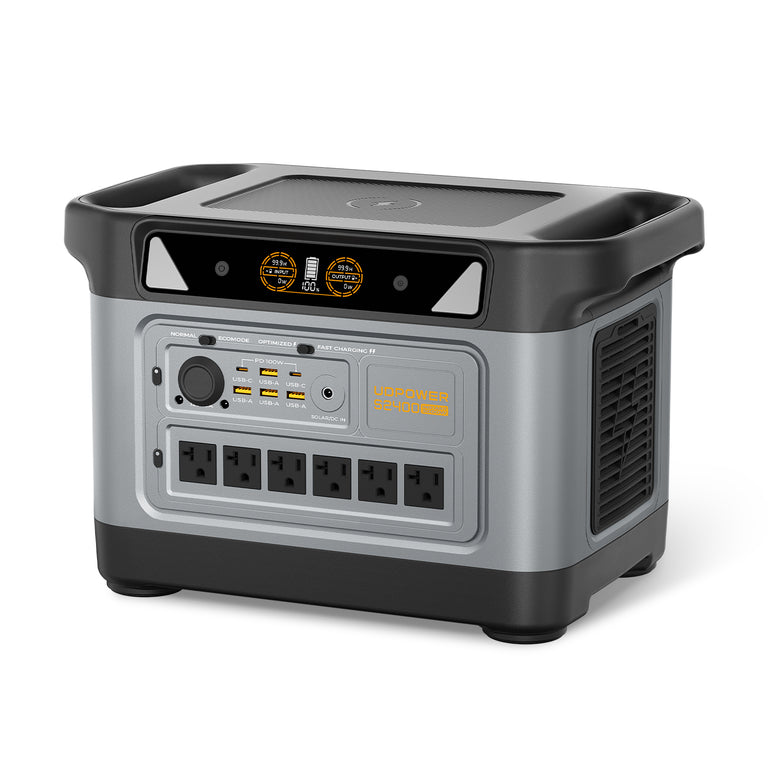
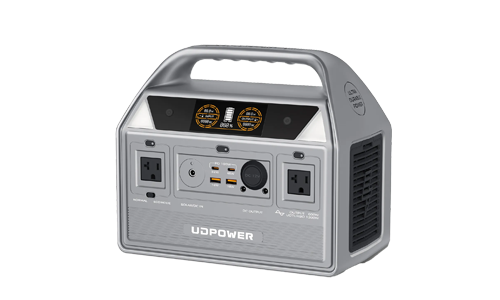
The UDPOWER S2400 increases both stored energy and AC output, making it better suited to longer outages, multiple simultaneous essentials, or households that want more operating margin.
- Battery capacity: 2,083Wh
- Rated AC output: 2,400W pure sine wave
- Total outputs: 15
- AC outlets: 6
- UPSPRIME transfer response: ≤10 ms
- Solar input: up to 400W
- Weight: approximately 40.8 lb
Its larger capacity is particularly useful when a refrigerator needs to run alongside communication equipment, lighting, laptops, and other household essentials for an extended period.
View UDPOWER S2400S1200 vs. S2400 for Power Outages
| Feature | UDPOWER S1200 | UDPOWER S2400 |
|---|---|---|
| Capacity | 1,190Wh | 2,083Wh |
| Rated AC output | 1,200W | 2,400W |
| Total outputs | 14 | 15 |
| AC outlets | 5 | 6 |
| UPSPRIME response | ≤10 ms | ≤10 ms |
| Maximum solar input | Up to 400W | Up to 400W |
| Approximate weight | 26.0 lb | 40.8 lb |
| Best fit | Core plug-in essentials and easier portability | Longer runtimes, more simultaneous loads, and greater power headroom |
If you are unsure which capacity fits your outage plan, use the UDPOWER portable power station comparison before choosing a model.
A Better Storm Backup Strategy: Think in Layers
One of the biggest mistakes in outage planning is trying to recreate normal household electricity use from a battery. A better approach is to build your backup plan in layers.
Layer 1: Communication and safety
Phones, internet equipment, rechargeable lights, weather alerts, and essential communication equipment usually consume relatively little energy. Keeping these loads available gives you information and a way to ask for help.
Layer 2: Food and essential equipment
Refrigeration is usually the next major priority. Depending on the household, this layer can also include compatible health-related equipment or other devices that cannot simply remain off until utility power returns.
Layer 3: Comfort and productivity
Laptops, televisions, fans, additional lighting, and other convenience loads can be added when battery capacity allows.
Layer 4: High-power appliances
Electric heaters, large air conditioners, electric ranges, clothes dryers, water heaters, and similar loads can consume energy extremely quickly. A device being within the inverter's wattage limit does not necessarily mean running it for hours is practical.
Prepare Before the Weather Arrives
The easiest outage to manage is the one you planned for before the lights went out.
- Charge portable power stations and smaller battery packs before the storm.
- Write down the wattage of the devices you consider essential.
- Know which refrigerator, freezer, communication, and lighting loads you will power first.
- Enable utility outage notifications and emergency weather alerts.
- Keep flashlights where they can be found in the dark.
- Know how to open an electric garage door manually if power is lost.
- Keep refrigerator and freezer doors closed as much as possible during an outage.
- If you own solar panels for a portable power station, confirm connectors and cables are ready before the event.
- If you use a fuel generator, store and operate it according to its manufacturer instructions and carbon-monoxide safety guidance.
If your main concern is deciding between battery backup and a fuel generator, see our portable power station vs. generator guide for power outages.
Frequently Asked Questions
Why does the power go out during a storm?
Storms can push trees and branches into power lines, damage poles, trigger electrical faults with lightning, overload wires with ice, flood electrical equipment, or damage upstream transmission and substations. Protective equipment may then disconnect the affected section of the grid to isolate the fault.
What's more likely to cut off power: wind or lightning?
For sustained and widespread storm outages, wind is generally the bigger practical concern because it can damage trees, poles, wires, and many locations at the same time. Lightning can cause both temporary faults and permanent equipment damage, but there is no single current nationwide wind-versus-lightning percentage because utility cause classifications and local conditions vary.
Can heavy rain by itself cause a power outage?
Yes, although rain often contributes indirectly. Saturated soil can make trees easier to uproot, flooding can affect electrical equipment, and rain combined with wind can increase the chance of branches or debris contacting lines.
Why does the power flicker during a thunderstorm?
A temporary electrical fault may cause protective equipment to open the circuit and then automatically attempt to restore power. If the fault clears, power stays on. If it remains, the system may disconnect the circuit again, which can look like several quick flickers followed by a sustained outage.
Can lightning make the power go out without hitting my house?
Yes. Lightning only needs to affect part of the electrical system supplying your area. A strike can create a fault or damage equipment elsewhere on the feeder, at a transformer, or at another upstream location.
Why did my power go out when the storm wasn't directly over my house?
Your home may be supplied by a feeder, substation, or other equipment located miles away. A fault elsewhere on that electrical path can disconnect your home even when local weather looks relatively calm.
Do underground power lines prevent storm outages?
They can reduce exposure to falling trees, branches, and wind-driven debris, but they cannot eliminate outages. Underground neighborhoods still depend on upstream substations and feeders, and underground cables, switches, transformers, and other equipment can also fail or be affected by flooding.
Why does my neighbor have electricity when my house is out?
Adjacent homes can be connected to different transformers, laterals, or sections of a distribution circuit. Your individual service line or home electrical system can also experience a problem that does not affect the house next door.
How long do weather-related power outages usually last?
There is no single typical duration. A temporary fault may clear in seconds, while a damaged transformer or fallen branch may require hours. Widespread hurricanes, ice storms, floods, and severe wind events can require much longer because crews may have thousands of separate damage locations to inspect and repair.
How long is refrigerator food safe during a power outage?
FoodSafety.gov says an unopened refrigerator can generally keep food cold for about four hours. A full freezer can maintain temperature for about 48 hours and a half-full freezer for about 24 hours if the door remains closed.
Can a portable power station keep a refrigerator running during an outage?
Yes, if the power station can handle both the refrigerator's running power and compressor startup demand. Runtime depends on battery capacity and the refrigerator's actual average energy use. A planning estimate can be calculated as battery capacity in watt-hours multiplied by 0.90 and divided by average load in watts.
Should I unplug electronics when the power goes out?
Disconnecting sensitive nonessential electronics can be reasonable when utility power is unstable, especially if the lights have been repeatedly flickering. Keep equipment disconnected until service has stabilized, while following the recommendations of your utility and equipment manufacturers.
What size portable power station is best for a storm outage?
Start with your essential devices and desired runtime. Around 1,000–1,200Wh can be a practical starting range for communication, lighting, refrigeration, and smaller plug-in loads, while roughly 2,000Wh or more gives substantially more runtime and flexibility. Output wattage also matters because the inverter must be able to start and run each connected appliance.
The Bottom Line
Bad weather makes the power go out because electricity depends on a long chain of physical infrastructure. Wind, trees, lightning, rain, flooding, ice, heat, and tropical storms can damage that infrastructure or create electrical faults that force protection systems to disconnect part of the grid.
If you are wondering whether wind or lightning is more likely to cut off power, wind-driven tree and line damage is generally the greater concern for sustained, widespread storm outages. Lightning remains an important cause of faults, but some lightning-related events are cleared automatically and never turn into a long outage.
The most useful preparation is not trying to predict the exact cause of the next outage. It is knowing which devices you need, how much power they consume, how long your backup can support them, and how you will use electricity safely until the grid is restored.
Sources and Further Reading
- U.S. Energy Information Administration — Electric Power Annual, Reliability Metrics
- U.S. Energy Information Administration — U.S. electricity customers averaged 11 hours of interruptions in 2024
- Climate Central — Weather-Related Power Outages Rising
- U.S. Department of Energy — National Electricity Emergency Response Capabilities
- U.S. Department of Energy — Power Restoration Process
- Dominion Energy — Outage Restoration and FAQs
- Peer-Reviewed Research — Weather and Power Outage Analysis
- FoodSafety.gov — Food Safety During Power Outages
- CDC — Carbon Monoxide and Generator Safety
Build a Better Power Outage Plan
Choose backup capacity based on the devices you actually need to keep running, their wattage, and the length of outage you want to prepare for.
Compare UDPOWER Power Stations View Home Backup Power Stations Read the Storm Power Outage GuideRelated Articles


