

How Does an Inverter Generator Work?
Last Updated:
An inverter generator makes electricity in three main stages: a fuel engine spins an alternator, the raw AC power is converted into DC power, and inverter electronics rebuild it into cleaner, stable AC power for household devices. That extra electronics step is why inverter generators are usually quieter, more fuel-efficient at lighter loads, and better suited for sensitive electronics than many conventional open-frame generators.
Quick Answer
An inverter generator still burns fuel, but it does not send rough alternator power straight to your outlets. It first creates raw electricity, smooths it into DC, then converts it back into controlled 120V AC power. For many people, the easier question is not only “how does it work?” but “do I actually need a fuel generator, or would a quiet portable power station handle my real loads better?”
Use an inverter generator outdoors when you need long runtime from fuel. Use a battery power station indoors when you need quiet, no-exhaust power for routers, CPAP machines, lights, phones, laptops, TVs, projectors, and many refrigerator backup situations.

What Is an Inverter Generator?
An inverter generator is a portable fuel-powered generator that uses extra power electronics to clean up and stabilize the electricity before it reaches your devices. It normally includes an engine, an alternator, a rectifier, an inverter module, a control board, outlets, and safety protection.
The simplest way to understand it is this: a conventional generator mainly tries to keep the engine spinning at a steady speed so the output stays usable. An inverter generator lets the engine speed change with demand because the inverter electronics rebuild the output power into a more controlled AC waveform.
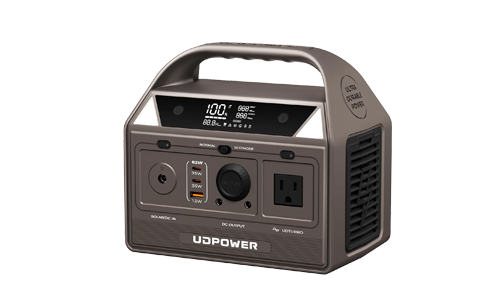
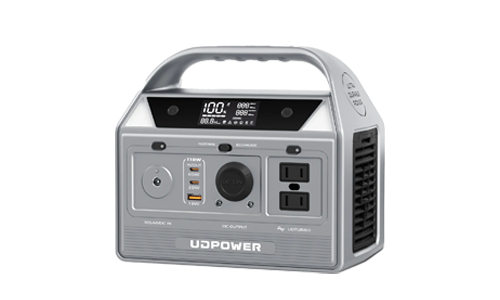
A battery power station is not the same thing as an inverter generator. A power station has a battery and inverter, but no fuel engine, no exhaust, and no gasoline maintenance. That is why it can be used indoors when operated according to the product manual.
How Does an Inverter Generator Work?
Different brands design the electronics differently, but the basic path is similar. Think of the power flow as “engine power → raw electricity → cleaned-up electricity.”
Gasoline or propane runs a small engine. That engine turns an alternator, which creates raw alternating current. At this early stage, the electricity can fluctuate as the engine speed and load change.
The raw AC passes through a rectifier. The rectifier changes it into direct current, and filtering components help smooth out dips and spikes. This DC stage gives the inverter electronics a cleaner base to work from.
The inverter converts the DC power back into AC power, typically 120V/60Hz for U.S. household outlets. A good inverter design produces a smoother waveform that is friendlier to laptops, TVs, routers, gaming consoles, CPAP machines, and many modern appliances.
When your load is light, the engine can slow down. When you plug in more devices, the controller tells the engine to speed up. This is why many inverter generators are quieter and use less fuel when they are not near full load.
| Part | What it does | Why it matters to the user | Source |
|---|---|---|---|
| Engine | Burns gasoline or propane to create mechanical motion. | Determines fuel use, maintenance needs, noise, and exhaust safety limits. | Honda Power Equipment |
| Alternator | Turns engine rotation into raw electrical power. | Provides the starting point for the generator’s output. | Honda Power Equipment |
| Rectifier | Changes raw AC into DC. | Prepares the power for the inverter stage. | Honda Power Equipment |
| Inverter | Changes DC back into controlled AC output. | Helps produce cleaner, more stable power for modern electronics. | Honda Power Equipment |
| Control board | Monitors load and manages engine behavior. | Allows “eco mode” behavior, lower noise at light load, and better fuel use. | Honda Power Equipment |
Key Terms: Watts, Surge, THD, and Pure Sine Wave
A lot of generator confusion comes from labels. Before choosing a generator or power station, make sure you understand these four terms.
| Term | Plain meaning | Example | Buying tip |
|---|---|---|---|
| Running watts | The power a device needs while it is already operating. | A router may use 10–20W. A mini fridge may average far less than its compressor startup draw. | Choose a generator or power station with enough continuous output for the devices you plan to run at the same time. |
| Surge watts | A short burst of extra power needed when some motors or compressors start. | Refrigerators, pumps, compressors, and some tools can pull much higher power for a moment. | Do not size only by average watts. Check startup surge for motor-driven appliances. |
| Watt-hours | Stored energy capacity. This mainly matters for batteries. | A 1,191Wh power station stores more usable energy than a 596Wh model. | Use Wh to estimate runtime; use W to confirm the unit can handle the load. |
| THD | Total harmonic distortion. Lower distortion means cleaner AC power. | Lower THD is preferred for electronics, audio gear, computers, and some medical devices. | For sensitive electronics, look for an inverter generator or a pure sine wave power station. |
| Pure sine wave | A smooth AC waveform similar to normal household power. | Commonly preferred for laptops, TVs, CPAP machines, routers, and modern appliances. | Choose pure sine wave output when powering expensive or sensitive equipment. |
Inverter Generator vs. Conventional Generator vs. Portable Power Station
All three can provide backup power, but they solve different problems. The right choice depends on where you will use it, how long you need power, and whether noise, exhaust, and fuel storage are acceptable.
| Feature | Inverter generator | Conventional portable generator | Portable power station |
|---|---|---|---|
| Energy source | Gasoline, propane, or dual fuel depending on model. | Usually gasoline, propane, or dual fuel. | Rechargeable battery; recharged from wall outlet, car outlet, or compatible solar panels. |
| Output quality | Cleaner AC power because it converts AC to DC and back to AC. | More dependent on engine speed and voltage regulation. | Pure sine wave output on quality models such as UDPOWER S-series and C-series units. |
| Noise | Usually quieter than open-frame generators, especially at lighter loads. | Usually louder because the engine often runs at a fixed high speed. | No engine noise; only fan noise when cooling is needed. |
| Indoor use | No. Fuel generators produce carbon monoxide and must run outdoors. | No. Fuel generators produce carbon monoxide and must run outdoors. | Yes, when used according to the product manual, because there is no combustion exhaust. |
| Runtime style | Runs as long as fuel, maintenance, and safe operation allow. | Runs as long as fuel, maintenance, and safe operation allow. | Limited by stored Wh capacity, but can be recharged by wall, car, or solar input. |
| Best fit | Outdoor backup, RV use, camping where fuel use is allowed, long outages. | High-watt outdoor loads where noise and power quality are less important. | Indoor essentials, nighttime use, medical-adjacent devices, routers, laptops, TVs, small appliances, short outages. |
| Reference | Honda inverter generator explanation | OSHA generator safety factsheet | UDPOWER portable power stations |
If you need to run heavy loads for days and can place the equipment outdoors safely, an inverter generator can make sense. If you need quiet power inside a room, tent, RV, apartment, or bedroom, a battery-based portable power station is usually the more realistic option.
Safety: The Part People Should Not Skip
The inverter electronics make the electricity cleaner, but they do not remove generator exhaust risk. Any fuel-powered generator can produce carbon monoxide. That means “inverter generator” does not mean “safe indoors.”
Run fuel generators outdoors only, far from windows, doors, and vents. CDC guidance says to operate generators outside more than 20 feet from windows, doors, and vents, and to use a battery-powered or battery-backup CO detector in the home.
| Safety topic | What to do | Why it matters | Source |
|---|---|---|---|
| Carbon monoxide | Use fuel generators outdoors only, away from openings into the home. | CO is odorless and can become deadly before people notice symptoms. | CDC |
| Transfer switch | Do not connect a generator directly to home wiring unless a qualified electrician installs a proper transfer switch. | Improper backfeeding can endanger utility workers and people nearby. | OSHA |
| Extension cords | Use grounded, intact, properly rated cords. Avoid damaged or underrated cords. | Underrated cords can overheat and create fire or shock hazards. | OSHA |
| Overloading | Add up running watts and leave room for surge loads. | Overload can cause shutdowns, overheating, or poor performance. | OSHA |
| Indoor essentials | Use a battery power station instead of a fuel generator for indoor loads. | No fuel engine means no generator exhaust inside your living space. | UDPOWER portable power stations |
UDPOWER Battery Alternatives to Gas Generators
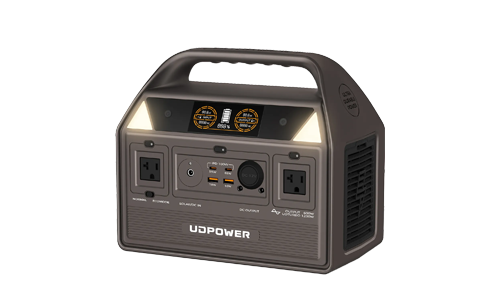
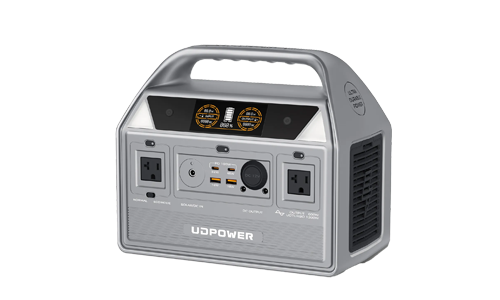
If you came here because you want clean AC power but do not want fuel, exhaust, or engine maintenance, a portable power station may be a better fit. UDPOWER power stations use battery storage plus pure sine wave inverter output, so they can power many everyday devices without the gasoline side of a generator.
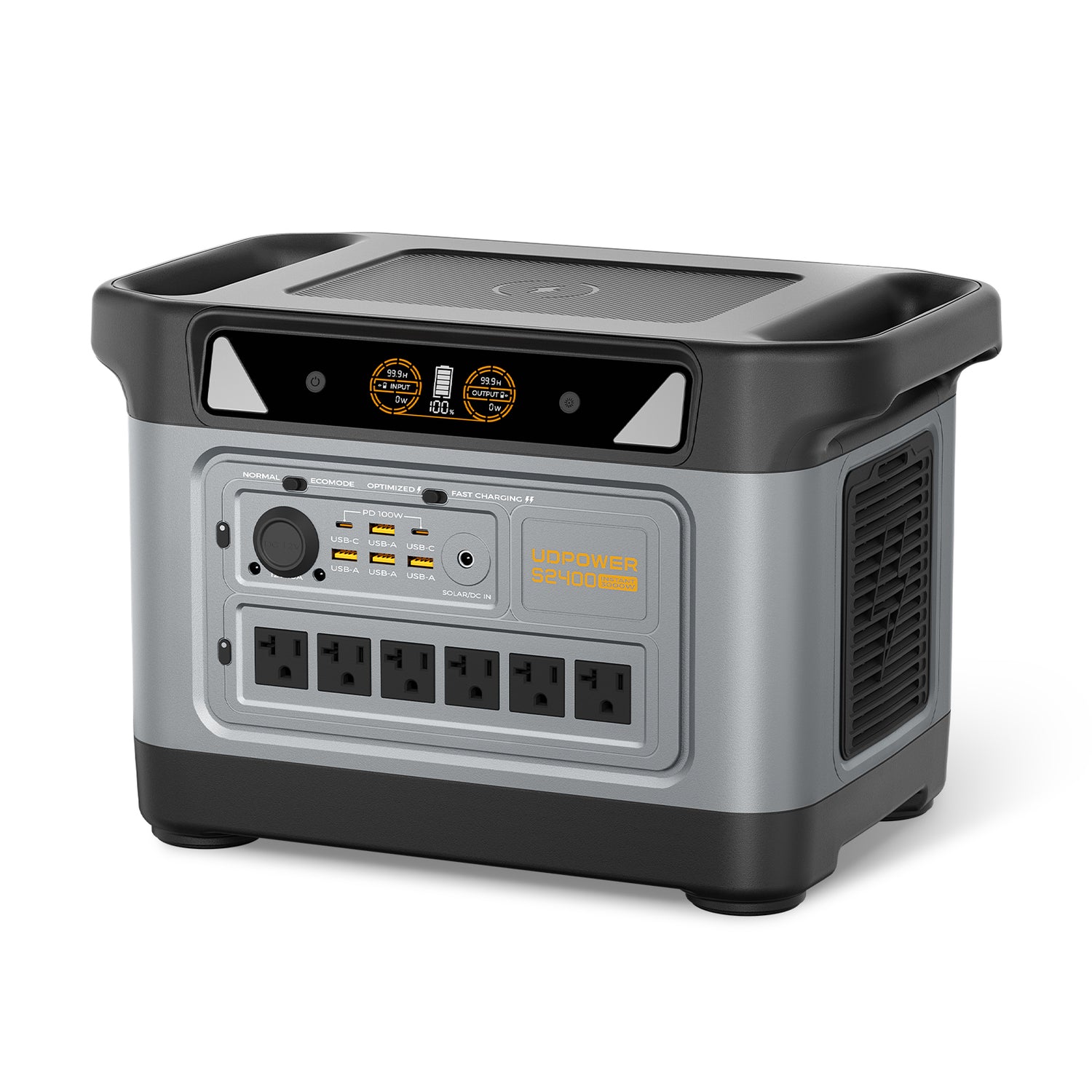 Best for larger home backup loads
UDPOWER S2400 Portable Power Station
The UDPOWER S2400 is the strongest fit when you want a gas-free backup option for higher-wattage essentials.
- 2,083Wh LiFePO4 battery capacity
- 2,400W pure sine wave AC output
- UDTURBO supports up to 3,000W constant-power output when running from the battery/inverter; conversion efficiency is lower above the 2,400W rated output, and UPS/bypass operation remains limited to 2,400W
- 15 total outputs: 6 AC outlets, 4 USB-A ports, 2 USB-C ports, 2 DC5521 outputs, and 1 12V car outlet; wireless charging is not supported
- UPSPRIME switchover time ≤10ms for brief power interruptions
- Solar input supports 12–50V, 10A max, up to 400W solar charging
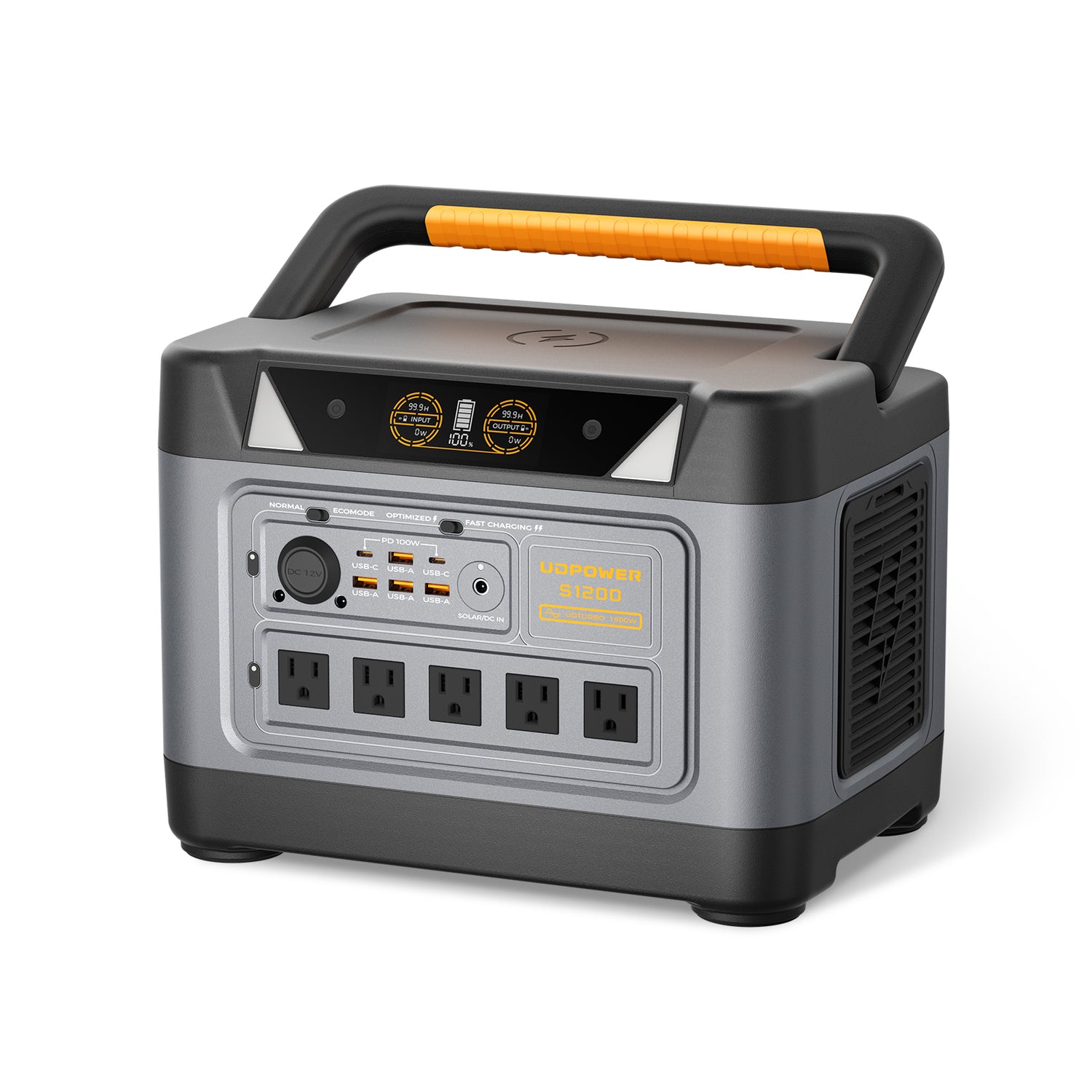 Best for RV, refrigerator, router, and outage essentials
UDPOWER S1200 Portable Power Station
The UDPOWER S1200 is a practical middle ground for people who want quiet backup power without buying a fuel generator for every short outage.
- 1,191Wh nominal LiFePO4 battery capacity
- 1,200W rated pure sine wave AC output
- UDTURBO supports up to 1,800W constant-power output when running from the battery/inverter; conversion efficiency is lower above the 1,200W rated output, and UPS/bypass operation remains limited to 1,200W
- Fast charging in about 1.5 hours
- Port count varies by version: the 3-AC model has 3 AC outlets plus 7 DC/USB outputs, while the 5-AC model has 5 AC outlets plus 9 DC/USB outputs; wireless charging is not supported
- <10ms UPSPRIME switchover and low-noise operation
 Best for camping and smaller essentials
UDPOWER C600 Portable Power Station
The UDPOWER C600 is a compact choice for weekend camping, laptops, cameras, phones, portable fridges, projectors, and short emergency backup.
- 596Wh LiFePO4 battery capacity
- 600W rated output and 1,200W peak output
- 2 AC outlets, USB-C, USB-A, and 12V car outlet
- Below 30dB low-noise operation
- 12.3 lb portable body
| Model | Capacity | AC output | Best use case | Product link |
|---|---|---|---|---|
| UDPOWER S2400 | 2,083Wh | 2,400W rated; up to 3,000W constant-power output on battery/inverter with reduced efficiency above rated output (2,400W max in UPS/bypass mode) | Home backup, larger refrigerator setups, RV essentials, multiple devices | S2400 product page |
| UDPOWER S1200 | 1,191Wh | 1,200W rated; up to 1,800W constant-power output on battery/inverter with reduced efficiency above rated output (1,200W max in UPS/bypass mode) | Short outages, refrigerator support, CPAP, Wi-Fi, TV, camping/RV loads | S1200 product page |
| UDPOWER C600 | 596Wh | 600W rated pure sine wave; up to 1,200W peak | Camping, projectors, laptops, camera gear, portable fridge, small backup loads | C600 product page |
| UDPOWER C400 | 256Wh | 400W rated pure sine wave; up to 800W surge | Car camping, roadside backup, small electronics, laptop/phone/router loads | C400 product page |
How to Choose the Right Backup Power Setup
Start with the devices, not the marketing label. A person who wants to keep Wi-Fi, phones, a laptop, and a CPAP running overnight has a very different need from someone trying to run a well pump, large air conditioner, and multiple kitchen appliances.
- List your must-run devices. Separate essentials from nice-to-have appliances.
- Find running watts. Check the label, manual, adapter, or a plug-in power meter.
- Check surge loads. Refrigerators, pumps, compressors, and tools may need extra startup power.
- Decide where it will run. Indoor use points toward a battery power station. Fuel generator use must stay outdoors.
- Estimate runtime. For batteries, compare watt-hours against your average load. For generators, compare fuel tank size, load level, and safe refueling needs.
- Plan recharging. A power station can recharge from wall power, vehicle power, or compatible solar panels. A generator depends on fuel availability and safe storage.
Approximate runtime = battery capacity in Wh × real-world efficiency ÷ average load in W. For AC loads, using about 85–90% efficiency is a realistic planning range. Actual runtime depends on device behavior, temperature, inverter load, and whether the appliance cycles on and off.
Real-World Load Planning Table
This table shows why average load matters more than the largest number printed on an appliance. Always check your own device label before relying on an estimate.
| Device | Typical planning watts | What to watch | Recommended direction |
|---|---|---|---|
| Wi-Fi router + modem | 15–30W | Often runs continuously during an outage. | A C-series or S-series power station is usually more convenient than a fuel generator. |
| CPAP machine | 30–90W depending on humidifier and heated hose settings | Humidifier heat can dramatically increase power draw. | Use a power station indoors; see CPAP battery backup planning. |
| Full-size refrigerator | Often 60–150W average, with higher compressor startup surge | Compressor cycles on and off. Startup surge must be considered. | S1200 or S2400 for battery backup; inverter generator outdoors for longer multi-day backup. |
| TV + streaming device | 70–200W depending on TV size and brightness | Easy to power, but runtime depends on screen size. | C600, S1200, or S2400 depending on desired runtime. |
| Projector | 150–350W depending on model | Startup draw and lamp/LED mode vary. | C600 or larger for outdoor movie nights; S-series for longer sessions. |
| Microwave | 1,000–1,800W input while heating | High short-duration load. | S2400 is more realistic than smaller battery units; generator may make sense outdoors for repeated cooking. |
| Space heater | 750–1,500W continuous | Very high energy use; drains batteries quickly. | Not ideal for battery backup except very short use. Prioritize safe non-electric heat planning. |
| Sump pump | Varies widely; startup surge can be high | Motor surge is the key number, not only running watts. | Check pump label and startup requirement before choosing S2400 or an outdoor generator. |
For outage planning, it is usually smarter to power essentials in order: medical devices, communication, refrigeration, basic lighting, and then comfort devices. UDPOWER’s portable power station runtime planning guide goes deeper into priority loads and runtime tables.
The Hybrid Setup: Generator Outside, Battery Inside
For many homes, the best answer is not “generator or battery.” It is both, used in the right place.
Use a portable power station for quiet, no-exhaust essentials: Wi-Fi, phones, laptop, CPAP, lamps, small TV, baby monitor, and selected appliances within the unit’s output rating.
Use a fuel-powered inverter generator only outdoors and only in a safe location when you need longer runtime, higher power, or a way to recharge batteries during a multi-day outage.
Use compatible solar panels to recharge a power station when weather allows. This reduces fuel dependence and gives you a quieter backup layer for nighttime.
This hybrid plan is especially useful for people who dislike running a generator all night. You can use the generator outdoors for heavier daytime charging and keep the battery station indoors for quiet overnight essentials.
Maintenance: Inverter Generator vs. Power Station
One of the biggest differences is the ownership experience after you buy it.
| Task | Inverter generator | Portable power station |
|---|---|---|
| Fuel storage | Requires safe gasoline or propane storage and fuel rotation. | No fuel storage needed. |
| Oil changes | Required according to the generator manual. | No engine oil. |
| Startup testing | Should be run periodically so it starts when needed. | Should be charged and checked periodically. |
| Indoor use | Never indoors due to CO risk. | Designed for indoor device power when used properly. |
| Noise | Lower than many conventional generators, but still engine noise. | Very quiet except cooling fan operation. |
| Best long-term habit | Keep fuel fresh, follow oil/service schedule, store safely. | Store with appropriate charge level, avoid extreme heat, recharge before storms. |
FAQ
Is an inverter generator better than a regular generator?
It is better for many modern use cases, especially when you care about quieter operation, better fuel efficiency at lighter loads, and cleaner power for electronics. A conventional generator may still be cheaper per watt and useful for rougher high-power outdoor loads.
Can an inverter generator be used indoors?
No. An inverter generator is still a fuel-burning generator and can produce carbon monoxide. It must be used outdoors, away from windows, doors, and vents. For indoor backup power, use a properly rated battery-based portable power station instead.
Does an inverter generator produce pure sine wave power?
Many inverter generators are designed to produce cleaner AC power with low distortion, but quality still depends on the model. If you are powering sensitive electronics, check the manufacturer’s THD or waveform specification. A high-quality pure sine wave portable power station is also a strong option for electronics.
Can an inverter generator power a refrigerator?
Yes, if the generator has enough running wattage and enough surge capacity for the refrigerator’s compressor startup. For short indoor backup, a power station such as the UDPOWER S1200 or S2400 can also be a good option, depending on the refrigerator’s wattage and desired runtime.
What size inverter generator do I need for home backup?
List only the devices you truly need first: refrigerator, router, lights, medical devices, phone charging, and maybe a small cooking or cooling device. Add their running watts, then account for startup surge. If you want to connect to home circuits, speak with a licensed electrician about a proper transfer switch.
Is a solar generator the same as an inverter generator?
No. A “solar generator” usually means a battery power station that can recharge from solar panels. It has an inverter, but it does not have a fuel engine. An inverter generator burns fuel and uses inverter electronics to clean up the AC output.
When is a portable power station better than an inverter generator?
A portable power station is usually better for indoor, quiet, low-maintenance power. It is ideal for routers, laptops, phones, CPAP machines, lights, projectors, small appliances, and short outage essentials. For multi-day heavy loads, an outdoor fuel generator may still be useful as a supplement.
Can I connect an inverter generator to a transfer switch?
Some generators can be used with an appropriate transfer switch setup, but this must be done correctly. Do not connect any generator directly to home wiring unless a qualified electrician has installed the proper transfer switch and the generator is compatible with that setup.
Related Reading
Need Clean Backup Power Without Gas?
Choose an inverter generator when you need outdoor fuel-based runtime. Choose a UDPOWER portable power station when you want quiet, no-exhaust power for indoor essentials, camping, RV trips, and short outage backup.
Related Articles


