Are Solar Generators Any Good?
ZacharyWilliamPortable Power Station Knowledge
Updated: April 20, 2026
Yes, solar generators are genuinely good when your goal is quiet, clean, indoor-safe backup power for essentials like a fridge in short cycles, Wi-Fi, phones, lights, laptops, CPAP machines, and camping or RV gear. They are usually not a great fit if you expect them to behave like a whole-house gas generator, run resistance heat all night, or magically power everything at once.
That is the honest answer most articles bury under generic “pros and cons.” The real question is not whether solar generators are good in the abstract. The real question is whether they are good for your load, your outage plan, and your recharge plan.

The Quick Answer
Solar generators are good because they solve a very specific problem well: they give you battery-based power with wall-style outlets, USB ports, and solar recharging without gasoline, fumes, or engine noise. In real life, that makes them useful in apartments, homes, RVs, campsites, and outage situations where quiet, portability, and indoor safety matter more than brute-force power.
What many shoppers call a “solar generator” is really a portable power station plus solar panels. The battery station stores energy. The panels help refill it when conditions are good. That setup is practical, but it comes with limits: runtime is finite, recharging is slower than refueling a gas unit, and weather affects solar recovery.
| Situation | Are solar generators good here? | Why | Better option if not | Source / related read |
|---|---|---|---|---|
| Router, modem, phones, lights, laptop | Yes | Low steady draw, quiet, indoor-safe, easy runtime planning | None needed for most households | Wi-Fi outage guide |
| CPAP backup | Usually yes | Portable, quiet, practical for overnight planning when sized correctly | Larger battery if humidifier/heated hose usage is high | CPAP outage planning |
| Short fridge protection during outages | Yes, if you use timed cycles and plan loads | Very useful for food protection, not for careless all-day “everything on” use | Bigger battery or gas generator for longer heavy cooling loads | Food safety guide |
| Camping, vanlife, RV basics | Yes | Quiet, no fuel smell, easy for lights, devices, fans, camera gear | Gas generator only if you need long high-watt AC use | Worth-it guide |
| Apartment blackout prep | Yes | No fuel storage, no exhaust, easy indoor use | None for essentials-first planning | Outage checklist |
| Running a space heater all night | No, usually a bad fit | Resistance heat drains batteries fast | Alternative heating plan or much larger backup strategy | Power station disadvantages |
| Whole-house backup like “normal life” continues | No | Most portable units are meant for essentials, not whole-home everything-on use | Standby generator or permanent home battery system | Power station vs generator |
| Central AC, electric dryer, large resistance loads | Usually no | High sustained power draw burns through capacity too fast | Permanent backup system or generator | Runtime planning |
What Most Buyers Get Wrong
The biggest buying mistake is assuming battery size alone tells you whether a solar generator is “good.” It does not. Three things matter together:
- Output watts — what it can run right now.
- Battery capacity in watt-hours — how long it can keep running.
- Recharge reality — how fast you can fill it back up by wall power, car charging, or solar.
People often shop by one headline number and ignore the rest. That is how someone buys a unit that can technically start an appliance but cannot keep it running long enough to matter. Or they buy enough battery but too little inverter. Or they buy solar panels without checking voltage compatibility.
Another common mistake: people compare solar generators to gas generators as if they are trying to win the exact same job. They are not. Gas units still win when you need long-duration high-output power and fast refueling. Solar generators win when you care more about indoor use, lower maintenance, quiet operation, and plug-and-play convenience.
| What buyers focus on | What they should focus on instead | Why it changes the decision |
|---|---|---|
| “How many watts is it?” | “What are my must-run loads, and are they steady or bursty?” | A fridge, router, and lights behave very differently from a heater or hot plate. |
| “Can solar panels charge it?” | “How much usable energy can I recover in my actual conditions?” | Sun, season, angle, and cloud cover all matter more than optimistic marketing. |
| “Can it power my whole house?” | “What do I need to protect first for 12, 24, or 48 hours?” | Essentials-first planning makes portable backup far more realistic. |
| “Bigger is always better.” | “Do I need portability, or do I need longer runtime?” | The wrong balance gives you either unnecessary weight or not enough headroom. |
| “The connector fits, so the panel works.” | “Is the panel voltage inside the unit’s published input range?” | Voltage limits matter more than many first-time buyers realize. |
When Solar Generators Are Actually Good
1) You want outage power for essentials, not fantasy backup
This is where solar generators earn their keep. If your real goal is to keep phones charged, keep the internet alive, run lighting, protect food strategically, support a CPAP, or power work-from-home gear during an outage, a good portable solar generator is often one of the cleanest and easiest solutions you can own.
2) You live where indoor-safe backup matters
Gas generators have real safety rules because of carbon monoxide risk. If you live in an apartment, condo, townhouse, or just do not want to deal with fuel storage and outdoor generator operation during bad weather, a battery-based unit is simply easier to live with.
3) You value low-friction ownership
Solar generators appeal to normal households because they feel manageable. No oil changes. No pull starts. No stale gasoline. No “where do I keep this fuel can?” problem. You charge the unit, test it occasionally, and it is ready when you need it.
4) You want one tool for outages, travel, and everyday utility
A gas generator is mostly an outage or jobsite tool. A good solar generator can pull triple duty: home backup, RV or camping power, and a quiet everyday power source for outdoor work, charging stations, tailgates, events, and car travel.
5) You are willing to manage loads like an adult
The best solar generator owners are not the ones who buy the biggest box. They are the ones who understand what to leave off, what to run in short windows, and what is truly non-negotiable. When used that way, these units feel far more capable than the spec sheet alone suggests.
When They Disappoint
1) You expect “set it and forget it” whole-home power
If your goal is to have central AC, space heating, kitchen appliances, entertainment, and laundry all working as if the utility never failed, a portable solar generator is the wrong tool. That expectation is what creates most negative reviews.
2) You mainly need to run high-heat appliances
Space heaters, electric kettles, hot plates, air fryers, coffee makers, and hair dryers can be useful in short bursts if the inverter supports them, but they chew through battery capacity fast. If your backup plan depends on heating elements running for hours, portable solar starts looking expensive and frustrating.
3) You are buying without a recharge plan
A solar generator is only as good as your recovery plan. If you live somewhere with limited sun, plan to keep panels in shade, or assume “200W of panels” means full-speed charging all day, you are setting yourself up for disappointment.
4) You need the cheapest possible power per hour
Solar generators are about convenience and cleaner ownership, not the absolute lowest upfront cost for long-duration heavy loads. If your only goal is raw outage endurance and you are comfortable with fuel, the math may push you toward a generator.
The 5-Question Reality Test
Before buying any solar generator, answer these five questions honestly. This one exercise will save more money than hours of scrolling “best of” lists.
| Question | What a “good fit” answer looks like | What a “bad fit” answer looks like |
|---|---|---|
| What absolutely must stay on? | Wi-Fi, phones, a lamp, CPAP, laptop, fridge in planned cycles | Whole house, large HVAC, all kitchen loads, “everything” |
| How long do I need power? | Overnight, workday, or 24–48 hours of essentials-first use | Unlimited runtime without cutting loads |
| What can run in short windows? | Fridge bursts, coffee maker, microwave, laptop charging blocks | Continuous high-draw heating or cooling |
| How will I recharge? | Wall charging before storms, some solar recovery in daylight | No realistic recharge path, just wishful thinking |
| Do I care about quiet, indoor-safe use? | Yes, that is a major reason I am buying | No, I only care about raw output and refueling speed |
If your answers mostly fall in the left column, solar generators are probably very good for you. If your answers mostly fall in the right column, you are more likely shopping for the wrong category.
The Numbers That Matter More Than Hype
You do not need an engineering lecture to buy well. You just need to read a spec sheet in the right order.
| Spec | Why it matters in real life | What to watch for | Source |
|---|---|---|---|
| AC output watts | Controls whether the unit can run your appliance at all | Do not confuse runtime with output capability | S1200 / S2400 |
| Battery capacity (Wh) | Controls runtime | Usable AC energy is always lower than the headline Wh | Runtime basics |
| Surge support | Helps with startup loads like fridges and some motor-driven devices | Surge is not the same as sustained continuous power | S1200 / S2400 |
| Solar input range | Controls safe panel matching | Voltage limits matter more than connector shape | Voltage guide |
| Wall recharge speed | Determines how quickly you can recover after use | Fast recharge matters more than many buyers expect | S1200 / S2400 |
| Noise / indoor practicality | Huge advantage in homes, apartments, RVs, and night use | Gas wins on refueling speed, battery wins on daily livability | Comparison guide |
Real-world runtime math beats brand slogans
A quick planning formula for AC use is:
For conservative planning, many people use an efficiency factor around 0.85 for AC loads. That is not magic. It is just a practical way to stop overestimating.
| Model | Official capacity | Assumed usable AC energy (approx. 85%) | 50W load | 100W load | 300W load | 600W load | Source |
|---|---|---|---|---|---|---|---|
| UDPOWER S1200 | 1,190Wh | ~1,012Wh | ~20.2 hrs | ~10.1 hrs | ~3.4 hrs | ~1.7 hrs | Official product page |
| UDPOWER S2400 | 2,083Wh | ~1,771Wh | ~35.4 hrs | ~17.7 hrs | ~5.9 hrs | ~3.0 hrs | Official product page |
These are planning estimates, not guarantees. Actual runtime changes with inverter losses, temperature, cycling loads, battery reserve behavior, and whether your appliance briefly surges above its average draw.
Two overlooked rules that make solar generators feel “better” in real life
- Run smart, not continuously. A fridge often makes more sense in planned cycles than as a “leave it on and hope” load.
- Recovery speed matters. A battery you can recharge quickly is far more useful than a bigger battery that takes forever to refill.
| Practical rule | Why it matters | Helpful source |
|---|---|---|
| Keep fridge and freezer doors closed during an outage | Protects food and reduces the pressure to run the fridge constantly | FDA food safety guidance |
| Refrigerated food is generally safe about 4 hours if unopened; a full freezer about 48 hours, half-full about 24 hours | Stops people from wasting battery too early | FoodSafety.gov power outage chart |
| Gas generators must be used outside, more than 20 feet from windows, doors, and vents | Explains why battery backup is often the easier indoor choice | CDC carbon monoxide safety |
| More efficient appliances stretch battery runtime | An efficient fridge can make the same battery feel much bigger | ENERGY STAR refrigerators |
Best UDPOWER Picks by Use Case
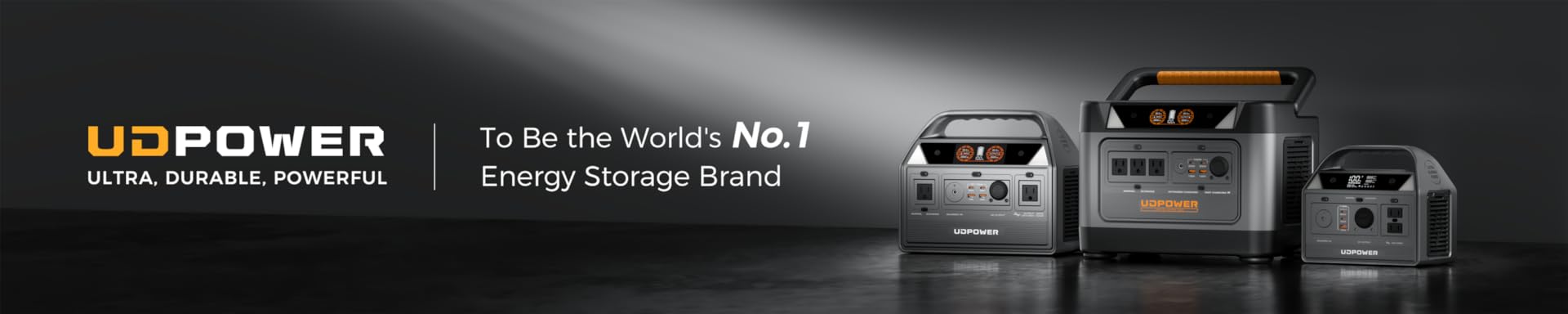
If you already know solar generators are good for your situation, the next move is picking the right size. For most readers, the decision is less about brand slogans and more about whether you want a carry-friendlier essentials unit or a bigger-output longer-runtime unit.
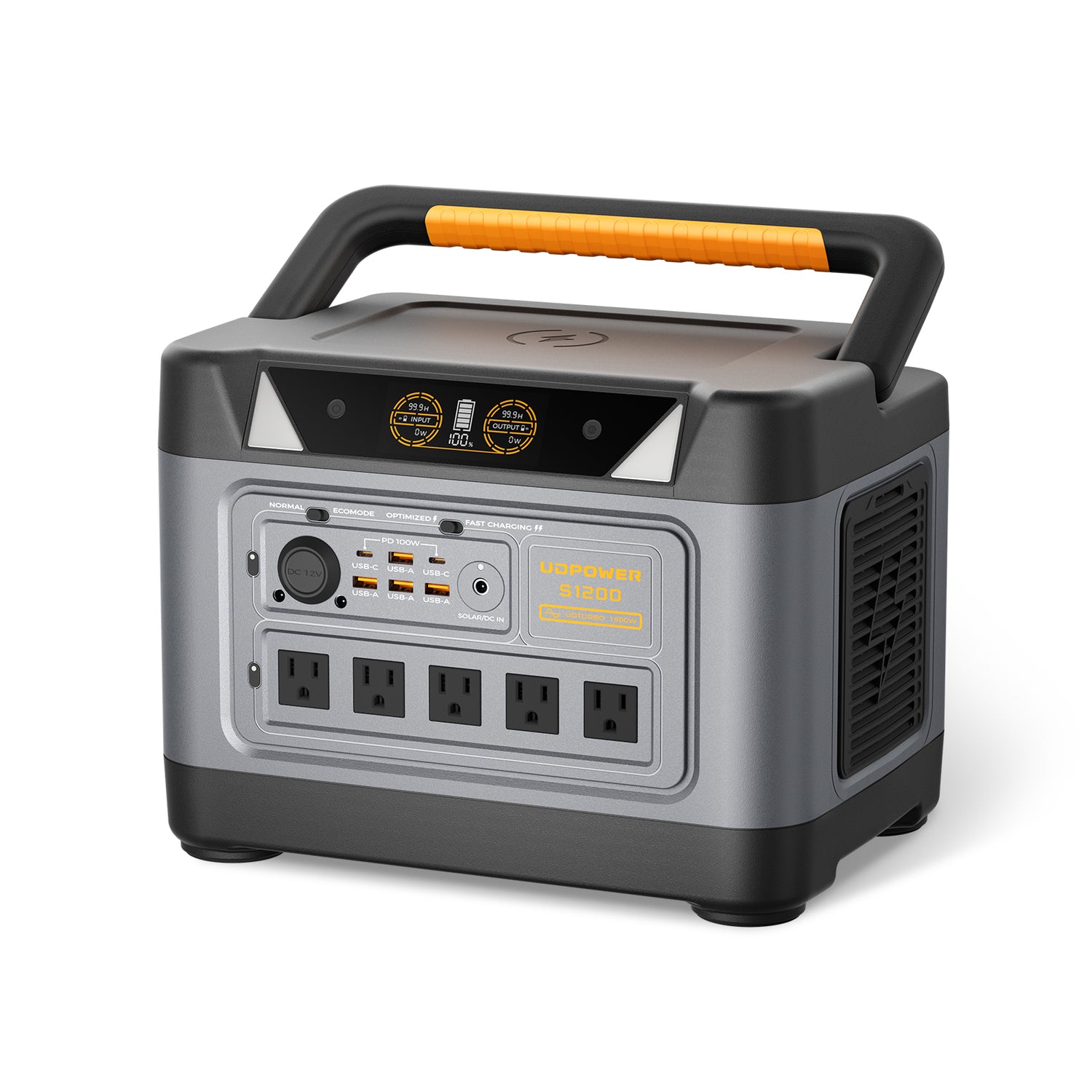
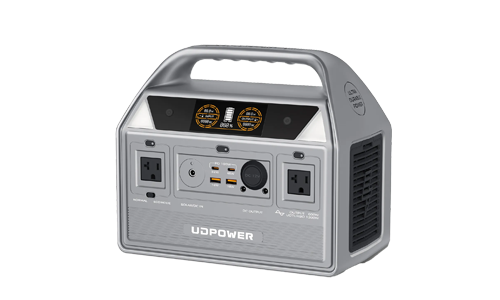
UDPOWER S1200
The UDPOWER S1200 is the better fit if you want a unit that feels practical to move, easy to store, and strong enough for common outage essentials. On the official product page, UDPOWER lists it at 1,190Wh capacity, 1,200W rated output, 1,800W surge, fast 1.5-hour AC charging, 4,000+ cycle life, and UPS-style switchover under 10ms. The related voltage guide also shows a 12V–75V, 12A, 400W max solar input window, which gives it wider solar matching flexibility than many first-time buyers expect.
| Why choose it | Official highlights | Best for | Source |
|---|---|---|---|
| More carry-friendly than larger home-backup units | 1,190Wh / 1,200W / 1,800W surge / approx. 26 lb | Wi-Fi, phones, laptops, lights, CPAP, modest kitchen loads, apartment backup | Product page |
| Fast recovery | 1.5-hour AC recharge; 0–100% with 420W solar in about 2.8 hours | Users who care about fast turnaround | Product page |
| Good for essentials, not “everything” | Official fridge example: about 10–15 hours for a standard 60–100W refrigerator | Short-to-medium outage planning | Product page |
| Solar flexibility advantage | 12V–75V input range, 12A, 400W max | Buyers who want more panel-matching flexibility | Voltage guide |
In plain English: if your answer to “Are solar generators any good?” is really “I want one for outages, work, travel, and general life without making my setup too heavy,” the S1200 is the more balanced answer.
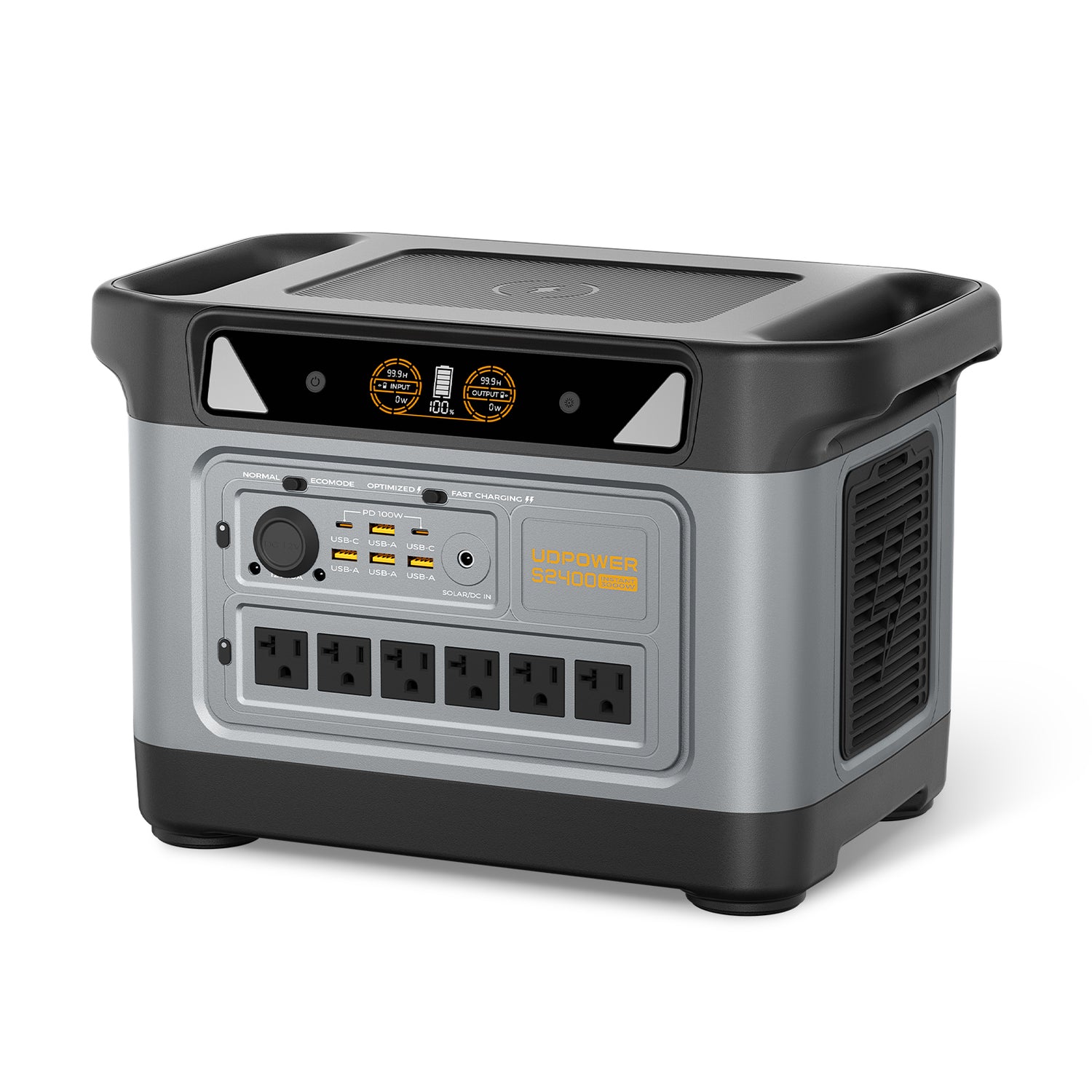
UDPOWER S2400
The UDPOWER S2400 is the better pick when your real bottleneck is not portability but headroom. UDPOWER’s official page lists 2,083Wh capacity, 2,400W AC output, up to 3,000W surge support, 6 AC outlets plus 10 DC outputs, 1.5-hour fast charging, and UPS-style switchover up to 10ms. The voltage guide lists a 12V–50V, 10A, up to 400W solar input.
| Why choose it | Official highlights | Best for | Source |
|---|---|---|---|
| More inverter headroom | 2,400W pure sine wave output, up to 3,000W surge | Larger appliances, more simultaneous loads, longer outage support | Product page |
| More runtime breathing room | 2,083Wh battery | Fridge + Wi-Fi + lights plans that need more cushion | Product page |
| Useful official fridge estimate | About 18–30 hours for a standard 60–100W average refrigerator | Longer food-protection windows and essentials backup | Product page |
| Better if output headroom matters more than weight | Approx. 40.8 lb; 12V–50V, 10A, up to 400W solar input | Homes, RV users, and heavier backup plans | Voltage guide |
In plain English: if smaller units feel “good in theory” but not quite enough for how you actually live, the S2400 is the point where solar backup starts feeling comfortably capable instead of merely adequate.
Which one should most readers choose?
Pick the S1200 if your life looks like essentials, moderate portability, fast recharge, and practical everyday ownership. Pick the S2400 if you already know your loads are bigger, your outage plan is longer, or you want more output headroom so you do not have to micromanage every appliance.
If you want to go deeper before buying, these internal reads pair naturally with this guide:

Want a complete solar-ready setup?
If the whole point is to use sunlight as part of your backup plan, a station-plus-panel bundle makes more sense than buying the battery now and “figuring out solar later.” The S1200 + 420W setup is a strong fit for faster daytime recovery, while the S2400 + 420W setup makes more sense if you need more output and more stored energy.

The detail many buyers miss: solar input window
One of the most useful buying details on UDPOWER’s own materials is that the S1200 has a wider published solar-input window than the S2400. The S1200 is listed at 12V–75V, 12A, 400W max, while the S2400 is listed at 12V–50V, 10A max, up to 400W. That does not automatically make one better than the other. It means your panel matching strategy should change with the model.
If you are comparing models and solar kits, that single spec line can matter more than the marketing headline.
Common Mistakes That Cause Buyer Regret
Buying for peak output instead of daily reality
People get excited that a power station can run a coffee maker, microwave, or countertop appliance. Then they forget that short bursts are very different from long-duration use. The machine may be capable. The battery may still disappear fast.
Ignoring the “recovery gap”
A unit can feel great on day one and frustrating on day two if you have no realistic way to recharge. A power station you can recover quickly is often more useful than a slightly larger one with a weaker recharge plan.
Using solar panel wattage as a promise
Panel wattage is a rating, not a guarantee. Sun angle, clouds, season, heat, cable losses, and panel orientation all affect actual harvest. This does not make solar charging bad. It just means planning should be based on reality, not ideal noon conditions.
Skipping a home test before an outage
The calmest people during an outage are the ones who tested everything earlier: Wi-Fi chain, fridge startup, CPAP setup, charging bricks, extension needs, and what the real watt number looks like on the display.
Thinking “portable” means “tiny” or “weak”
Modern units can be surprisingly capable. But capability still depends on matching the machine to the job. A good portable solar generator is not supposed to replace a standby whole-home system. It is supposed to make your most important hours and loads far easier to manage.
FAQ
Are solar generators good for home backup?
Yes, for essentials-first home backup they are often excellent. They are especially good for phones, Wi-Fi, lights, laptops, medical gear planning, and food protection strategies during short or medium outages. They are usually not a full replacement for whole-house backup.
Are solar generators better than gas generators?
Better for some jobs, worse for others. Solar generators are quieter, easier indoors, lower-maintenance, and simpler to own. Gas generators are still stronger for long-duration heavy loads and fast refueling.
Do solar generators really work on cloudy days?
They work, but usually at reduced solar input compared with strong direct sun. That is why solar should be part of a recovery plan, not an excuse to ignore battery capacity and load management.
Can a solar generator run a refrigerator?
Often yes, but the right question is “for how long, and how should I run it?” A fridge is one of the most common and practical backup loads, but it works best when paired with sensible food-safety habits and a realistic runtime plan.
Are solar generators worth it for apartments?
Very often yes. Apartments are one of the strongest use cases because battery units avoid fuel storage and exhaust issues that make gas generators inconvenient or unsafe in many apartment situations.
How long do solar generators last?
That depends on battery chemistry, cycle life, storage habits, and operating conditions. On UDPOWER’s current official pages, both the S1200 and S2400 are listed with LiFePO4 batteries and 4,000+ cycle life, which is one reason many shoppers prefer this category for frequent use.
What size solar generator is good for most people?
For many households, something in the “essentials backup” range is enough: Wi-Fi, phones, lights, laptop, and occasional kitchen or fridge support. Once you add longer outages, bigger appliances, or more simultaneous loads, moving up in both capacity and output becomes worth it.
Should I buy the power station first and solar later?
You can, but it is often cleaner to decide up front whether solar recovery is part of your real plan. If the answer is yes, make sure the panel setup matches the station’s published solar-input limits before you buy.
Final Verdict
Solar generators are good — sometimes very good — but only when you judge them by the job they are actually designed to do.
They are a smart buy for people who want quiet, portable, indoor-safe power for essentials, travel, and outage planning without gasoline headaches. They are a poor buy for people who want whole-house normalcy, all-night electric heat, or gas-style refueling speed.
The best way to decide is simple: map your critical loads, plan your runtime honestly, and choose a model based on output, battery size, and recharge strategy instead of whichever brand uses the loudest headline.
If that is how you shop, a solar generator stops being a trendy gadget and starts being one of the most useful backup tools you own.