Can a Solar Generator Power an AC?
ZacharyWilliamSolar generator + air conditioner: what actually works, what doesn’t, and how to size it without guessing.
Yes—sometimes. A solar generator (portable power station + inverter + solar charging) can run certain air conditioners, but the “right answer” depends on three things: voltage, running watts, and startup surge. Get those wrong and the AC won’t start (or it’ll trip the inverter). Get them right and you can cool a room, an RV, or keep a small unit going through an outage.
Not sure what your AC actually draws—or whether a power station can handle it? Use this quick checklist first: How Do You Know if a Portable Power Station Can Power Your Device?
If you’re shopping in the “1,200W class” and want realistic expectations (not just marketing numbers), this guide helps: What Can a 1200W Portable Power Station Run?

Quick answer (when it’s yes vs no)
- Usually “yes” for many 120V window ACs, some portable ACs, and many RV rooftop ACs (see typical RV AC watts) —if your power station has enough continuous watts and enough surge to start the compressor.
- Often “no” for central air (most are 240V and high surge), unless you’re using a much larger system (or your HVAC has a soft starter / inverter compressor and your backup system is designed for it).
- Runtime is almost always the limiter. Even when an AC can start, it can drain a battery fast—especially in hot weather.

Step 1: Identify your AC type and voltage
Before you do any math, look at what you’re trying to run. This saves a lot of time—especially with central HVAC.

| AC type | Most common voltage in the U.S. | What this means for solar generators |
|---|---|---|
| Window AC (room unit) | 120V | Most portable power stations can output 120V AC—this is the easiest category to run. |
| Portable AC (single/dual hose) | 120V | Can work, but these often draw more power than people expect for the cooling they deliver. |
| RV rooftop AC | 120V | Common off-grid use case. Startup surge is the main challenge; a soft starter helps a lot. |
| Mini-split | Often 240V (some 120V models exist) | Many mini-splits won’t run from a 120V-only power station. Check nameplate voltage first. |
| Central AC / heat pump (whole home) | 240V | Most portable solar generators are not built for this out of the box. The voltage + surge are major hurdles. |
If you’re picking an AC for off-grid use, the U.S. Department of Energy’s sizing rule of thumb (BTU per square foot) is a helpful starting point: Energy.gov – Room Air Conditioners.
Step 2: Find your AC’s real power numbers (watts + surge)

The fastest way is to read the label. Look for any of these:
- Watts (W) – best-case: the label tells you directly.
- Amps (A) – you can estimate watts as Volts × Amps (for 120V units, a quick estimate is 120 × amps).
- BTU/hr + EER or CEER – you can estimate running watts with efficiency ratings.
- LRA (Locked Rotor Amps) / startup surge – common on bigger systems; indicates how hard the compressor is to start.
Air conditioner efficiency is commonly expressed as EER (BTU/hr per watt). So:
Estimated running watts ≈ (BTU/hr) ÷ (EER)
Source (definition of EER): GE – EER explanation and ENERGY STAR PDF – EER definition.
Startup surge matters because compressors can demand a brief burst of power when they kick on. If your solar generator can’t supply that surge, the AC may fail to start (or it may start and then immediately trip off).
If you’re dealing with a compressor that’s hard to start, a soft starter can dramatically reduce startup current (some products claim reductions up to ~75%). Source: Micro-Air EasyStart (soft starter) – reduced startup current.
Step 3: Match inverter output and surge capability

To run an AC reliably, your solar generator needs to meet both of these:
- Continuous AC output (watts) ≥ your AC’s running watts (and ideally with headroom).
- Surge / motor-start support ≥ your AC’s startup surge (especially for fixed-speed compressors).
If your AC label says 900W running, aiming for a 1,200W inverter is workable only if the startup surge is within the unit’s surge capability. If you don’t know surge, you’ll have a much smoother experience stepping up to a higher-output inverter (and/or using a soft starter).
If you’re deciding between a 1,200W class unit and a 2,400W class unit for compressor loads, here’s a plain-English breakdown: Product Comparison: UDPOWER S1200 vs S2400
Also keep in mind what else is on the power station at the same time. If the AC is pulling 900W and you add a 1,000W kettle, you didn’t “overload the battery”—you overloaded the inverter output.
Step 4: Estimate runtime the right way (and why AC runtime is weird)
Air conditioners don’t draw a single steady wattage all the time. They cycle. They ramp. Fans keep running after the compressor pauses. Outdoor temperature and insulation matter more than most people expect.

Still, you can get a solid estimate with a simple approach:
Runtime (hours) ≈ Battery (Wh) × 0.85 ÷ Average AC load (W)
The 0.85 factor is a practical way to account for inverter conversion losses and real-world inefficiencies. If your AC cycles (compressor on ~50% of the time), your average load might be closer to half of the “running watts.”
Example: a small 8,000 BTU window AC might run around ~600–900W when the compressor is on (varies by model and efficiency). If it averages ~450W over time because it cycles:
- ~1,200Wh class battery: 1,190Wh × 0.85 ÷ 450W ≈ ~2.2 hours
- ~2,000Wh class battery: 2,083Wh × 0.85 ÷ 450W ≈ ~3.9 hours
Those are “ballpark” numbers on purpose. On a mild day in a shaded room, you may do better. In a hot sun-baked space, the compressor can run nearly nonstop and runtime drops fast.
Typical AC wattage ranges + sizing table
If you don’t have your exact model’s label handy, use ranges like this only as a starting point—then confirm on the nameplate. For how efficiency is measured (EER/CEER), see: ENERGY STAR (PDF).

| AC type / size | Typical running watts (range) | Startup surge (what to expect) | Recommended inverter sizing (practical) | Best match notes |
|---|---|---|---|---|
| Window AC ~5,000–6,000 BTU | ~400–700W | Often 2×–3× running (model-dependent) | 1,000–1,500W + strong surge | Common “yes” case for portable solar generators. |
| Window AC ~8,000–10,000 BTU | ~600–1,000W | Often 2×–3× running | 1,500–2,500W + strong surge | Works best with headroom or a unit that starts gently. |
| Window AC ~12,000 BTU | ~900–1,400W | Can be challenging without surge support | 2,000–3,000W class inverter | Doable for many high-output power stations; runtime is the limiter. |
| Portable AC (often “8k–14k BTU”) | ~900–1,600W (varies widely) | 2×–3× spikes are possible | 2,000–3,000W class inverter | Can work, but these may drain batteries quickly for the cooling delivered. |
| RV rooftop AC (13.5k BTU is common) | ~1,200–1,800W (varies) | Startup surge can be the biggest hurdle | 2,400W+ with strong motor-start / soft starter recommended | Soft starters are popular here because they reduce startup demand. |
| Central AC (whole home) | Often several thousand watts | High surge; usually 240V | Not a typical portable-solar-generator job | Usually requires a dedicated 240V backup system + load management. |
For more background on AC selection and sizing, see: Energy.gov – Room Air Conditioners.
UDPOWER examples: which model fits which AC use case
Here are two real-world reference points from our lineup. The goal isn’t “buy this”—it’s helping you match specs to the AC you already own. Always verify your AC’s label (running watts + startup behavior).

| Model | Battery capacity | AC output (continuous) | Surge / motor-start support | AC voltage | Solar input | Best AC-related fit |
|---|---|---|---|---|---|---|
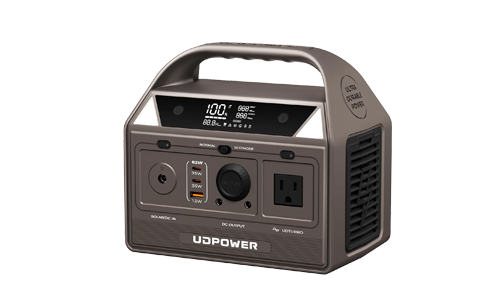
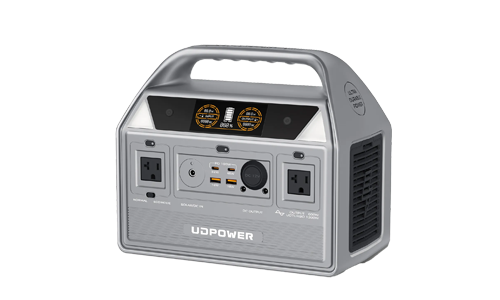
| UDPOWER S1200 | 1,191Wh | 1,200W | Up to 1,800W (UDTURBO) | 120V~60Hz (pure sine wave) | 12–75V, 12A, up to 400W | Smaller 120V window ACs (especially efficient units) and short cooling bursts. |
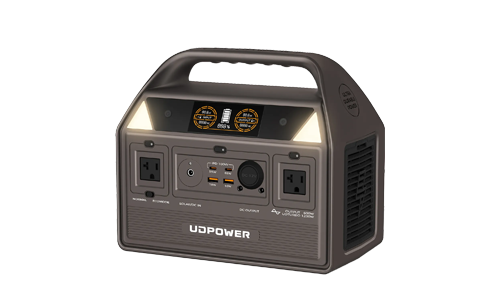
| UDPOWER S2400 | 2,083Wh | 2,400W | Up to 3,000W (UDTURBO motor-start surge) | 120V~60Hz (pure sine wave) | 12–50V, 10A max, up to 400W | Higher-watt 120V ACs and tougher startups; better runtime for hot-day cycling. |
- If your AC is small and efficient (and starts easily), a 1,200W-class inverter can work.
- If your AC has a stubborn compressor start (or you’re in RV territory), stronger surge support is the difference between “starts every time” and “keeps tripping.”
- If you care about running longer than a quick cooldown, battery capacity (Wh) matters as much as inverter watts.
Solar recharging reality check (can solar “keep up” with AC?)

This is where expectations get people. Running an AC is a heavy load. Solar charging is great—but with portable systems, solar often can’t fully offset AC use in real time.
- If your AC averages ~700W while cooling and your solar input is capped at ~400W, you’re still draining the battery at ~300W even under perfect sun.
- In real conditions (heat, panel angle, clouds), solar output can be much lower than the panel’s rated watts.
Practical takeaway: solar is excellent for extending runtime and for refilling between cooling cycles, but “all-day AC from one portable solar generator” usually requires a much bigger system (or a smaller cooling load).
Want to go deeper on “solar math” (why real solar watts are lower than the sticker)? These two explain it clearly: the 33% rule and how solar charging actually works.
If you’re choosing between 120W, 210W, or 2×120W setups (common for camping/RV), this pairing guide helps you avoid mismatches: UDPOWER Solar Panel Pairing Guide. You can browse compatible panels here: Solar panels.
Need cables or adapters (parallel/extension/car charging) for cleaner routing? See: Accessories.
If you’re planning a backup setup for multiple appliances (not just AC), these guides help you think in watt-hours and priorities: Can a Solar Generator Power a House? and What Size Solar Generator Do You Need (with charts)?
Tips to make an AC work better on battery

If you want the best “comfort per watt,” these moves help more than people expect:
- Pre-cool the space while grid power is available, then maintain temperature on battery.
- Raise the setpoint a couple degrees and use a fan—often feels similar with less compressor runtime.
- Seal leaks: close blinds, reduce sun load, cover gaps around window units.
- Avoid stacking big loads while the compressor is starting (microwave + AC start is a classic trip scenario).
- Consider a soft starter for fixed-speed compressors if startup surge is the problem: Micro-Air EasyStart.
- Measure it once: a plug-in watt meter can reveal whether your AC is truly a 700W load—or a 1,200W one in disguise.
FAQ
Will a solar generator run a portable AC (the kind on wheels)?
Often yes, but portable ACs can be power-hungry. Check the label for running watts and expect noticeable battery drain. If it’s near 1,200–1,600W running, you’ll want a higher-output inverter with strong surge support and a larger battery.
Why does my AC trip the inverter even though the running watts look “under the limit”?
Startup surge. Compressors can draw a brief spike when they kick on. If that spike exceeds surge capability, the inverter protects itself and shuts off. A unit with stronger motor-start surge support (or a soft starter) usually fixes this.
How do I estimate watts from BTU?
Use efficiency ratings if you have them. EER is BTU/hr per watt, so watts ≈ BTU/hr ÷ EER. Sources: GE – EER and ENERGY STAR (PDF).
Can I run central air from a portable solar generator?
Usually not in a straightforward way. Central AC is typically 240V and has high startup surge. Portable power stations are commonly 120V. Whole-home HVAC backup typically needs a dedicated 240V-capable system designed for that load.
Does “inverter AC” mean I can use a smaller solar generator?
Sometimes. Many inverter-driven systems start more gently and can be easier on surge requirements, but it varies by model. Always verify real-world watts and startup behavior.
What’s more important for AC: watts (W) or watt-hours (Wh)?
Watts determine whether the AC can start and run. Watt-hours determine how long it can run. For AC use, you need both—many setups fail on surge even when battery capacity is large enough.
Can solar panels keep my AC running all day?
For most portable setups, solar helps a lot but typically doesn’t fully offset AC demand in real time. If your AC averages more watts than your solar input can provide, the battery will still drain—just more slowly.
What’s the easiest AC to run on a solar generator?
Efficient 120V window units (especially smaller BTU models) are usually the most realistic. They often deliver more cooling per watt than portable ACs.
Does pure sine wave matter for air conditioners?
It’s generally preferred for motor-driven appliances and electronics. UDPOWER portable power stations provide pure sine wave AC output (see product pages for details).