


1) Big Game “Don’t-Lose-the-Feed” Checklist

Must-have (the “keep the game on” core)
- TV (or projector) + remote batteries
- Streaming device / cable box (Apple TV, Roku, Fire TV, set-top box)
- Internet chain: modem/ONT + Wi-Fi router (and any mesh node the TV depends on)
- Phone charging (USB-C/Lightning cables)
Nice-to-have (comfort without blowing your runtime)
- Soundbar / speakers (or keep volume modest)
- 1–2 LED lamps (skip halogen work lights)
- Small fan (if air is stuffy)
- Mini-fridge for drinks (optional plan below)
Rule of thumb (so you don’t accidentally “eat” your battery)
Every “extra” you plug in is a runtime trade-off. If the goal is “don’t miss the big moments”, prioritize: TV + internet chain + phones — then add comfort items only if your numbers still work.
2) Wattage Table: Common Big Game Devices (and Where the Numbers Come From)
Use this table to ballpark your setup fast. Then—before the big day—confirm your real draw using the device label or a plug-in power meter. (If a device only lists amps, the quick conversion is in the next section.)

| Device | Typical running power (W) | Surge / spikes? | Quick “how to verify” | Source |
|---|---|---|---|---|
| LED TV (50"–60" 4K) | ~120 W (0.12 kWh per hour) | Low surge (usually negligible) | Check the EnergyGuide/label or measure with a plug-in watt meter | Silicon Valley Power chart |
| LED TV (60"–75" 4K) | ~150 W (0.15 kWh per hour) | Low surge | Measure during actual viewing brightness settings | Silicon Valley Power chart |
| Standby power (ENERGY STAR TVs) | ≤ 0.5 W (standby-passive) | N/A | Use a watt meter in standby to see if anything is “always on” | ENERGY STAR TV criteria |
| Cable box / set-top box | ~16 W average (139 kWh per year) | Can draw meaningful power even when “off” | Measure over 10–15 minutes; don’t trust the “sleep” label | Silicon Valley Power chart + EIA note on standby draw |
| Wi-Fi router | ~5–20 W | No surge | Check the router power brick (V × A) or measure | EnergySage router wattage |
| Modem / ONT | ~5–15 W (gateways often < ~20 W) | No surge | Look at the modem/ONT power adapter label or measure | UDPOWER modem watt guide |
| Speakers (25 W × 2, normal volume) | ~50 W (0.05 kWh per hour) | Low surge | Measure at your usual volume (audio draw climbs with volume) | Silicon Valley Power chart |
| CFL/LED light (60 W equivalent) | ~15 W (0.015 kWh per hour) | No surge | Bulb wattage is printed on the bulb (use that number) | Silicon Valley Power chart |
| Mini-fridge (compact) | ~50–100 W (varies) | Compressor startup spike (brief) | Use the EnergyGuide label (kWh/year) or measure over a few hours | EnergySage fridge + mini-fridge guide |
Why the ranges? Real power draw changes with screen brightness, volume, Wi-Fi traffic, and whether a fridge compressor is cycling. For your most accurate number, measure your setup during a normal watch session. A simple how-to is here: Energy.gov: estimating device energy use.
3) The Sizing Method That Actually Works: Running Watts + Surge + Hours

Step A — Add your continuous (running) watts.
Example: TV (120 W) + cable/streaming (16–20 W) + router (10 W) + modem (10 W) = ~155–160 W.
Step B — Check surge/spike needs (the “starting watts” moment).
Most electronics have tiny surges. The big spikes come from motors/compressors (like a fridge). If you add a mini-fridge, your power station must handle that brief compressor startup.
Step C — Pick your target runtime (hours), then do the math.
Battery capacity is measured in watt-hours (Wh). A practical estimate for AC loads is: Estimated runtime (hours) = (Battery Wh × 0.85 × 0.90) ÷ Load W
The 0.85 factor accounts for inverter losses. The 0.90 factor keeps a little reserve so you’re not draining to zero. (Your results vary—this is a planning estimate, not a lab test.)
Don’t want to do any of this by hand? Skip down to the calculators section—plug in your wattage list and let it do the work.
4) Three Big Game Power Plans (Pick the One That Matches Your Risk Tolerance)
These are the three setups that cover most households without turning your living room into a disaster-response command center. Each plan includes a suggested “budget” for watts and a realistic way to stretch runtime.

Plan 1 — “Just Keep the TV On”
- TV only (or TV + a low-power streaming stick)
- Good for: antenna/cable TV, or when your internet is unreliable anyway
Target load: ~125 W (typical mid-size 4K LED TV).
Plan 2 — “TV + Wi-Fi (Stream-Proof)”
- TV + cable/streaming box + modem + router
- Good for: streaming households, live stats, and not losing the feed mid-drive
Target load: ~155 W (TV 120 + cable box 16 + modem 10 + router 10 ≈ 156 W).
Plan 3 — “TV + Wi-Fi + Mini-Fridge (Comfort Mode)”
- Everything in Plan 2, plus a compact fridge for drinks
- Good for: longer outages where you still want the room functional
- Watch-outs: compressor startup spike (brief) + higher average draw
Target load: ~225 W (Plan 2 ~155 W + mini-fridge average ~70 W).
Estimated runtimes (example numbers you can sanity-check)
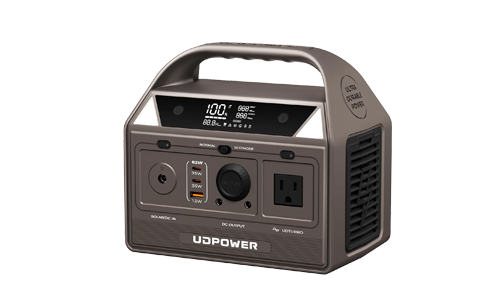
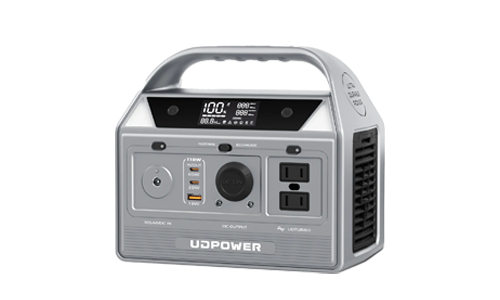
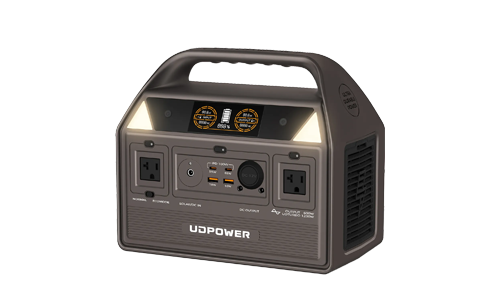
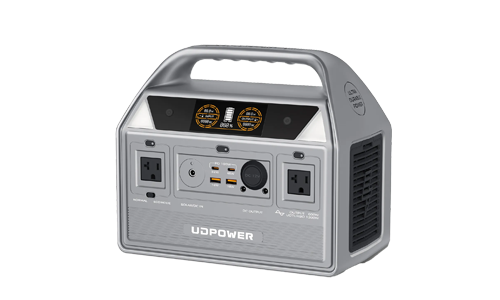
| Portable power station example | Picture | Battery (Wh) | Plan 1: ~125 W | Plan 2: ~155 W | Plan 3: ~225 W | Source for product specs |
|---|---|---|---|---|---|---|
| UDPOWER S1200 |  |
1,190 Wh | ~7.3 hours | ~5.9 hours | ~4.0 hours | UDPOWER S1200 product page |
| UDPOWER S2400 |  |
2,083 Wh | ~12.7 hours | ~10.3 hours | ~7.1 hours | UDPOWER S2400 product page |
How to stretch runtime without “feeling” it
- Drop TV brightness 10–20% (often a bigger savings than people expect)
- Turn off extra mesh nodes if your main router covers the room
- Use 1–2 LED lamps instead of multiple overhead fixtures
- Charge phones early, then top off intermittently
Common runtime killers (avoid these)
- Space heaters (high watts; they drain batteries fast)
- Microwaves / coffee makers during an outage watch session
- Leaving a full-size refrigerator on if you only need drinks cold
- Stacking power strips and plugging in “mystery extras”
5) Safety: Generator CO Risk (and the “20 Feet Outside” Rule)

Portable generators can be useful—but carbon monoxide (CO) is a real hazard. If you use a generator, keep it at least 20 feet away from your home, doors, windows, and vents, and never run it in a garage or enclosed space.
Official guidance: CDC generator + CO safety
A portable power station avoids the CO issue entirely indoors (it’s battery-based). Still: keep it on a stable surface, allow ventilation around the unit, and use appropriately rated cords.
6) The 15-Minute Pre-Game Test (Do This Once, Then Relax)
- Build the exact chain: TV + set-top/streaming + modem + router (and soundbar if you’ll use it).
- Run it for 10 minutes and check the power station’s display for total watts.
- Toggle Wi-Fi and confirm the stream stays stable (some setups depend on a mesh node you forgot).
- If adding a mini-fridge, plug it in and watch for any overload messages during compressor start.
- Write down your “game day load” number (that’s the one to use in the calculator).
If you want a simple method for measuring appliance watts with a monitor, this guide is a good baseline: Energy.gov: measuring and estimating watts.
7) Use the Calculators to Self-Check Your Exact Setup
If you only take one action from this article, make it this: put your real device watts into a calculator once, and you’ll stop guessing forever.
Related reading (if you want a deeper backup plan)
A gentle nudge before you buy anything
Don’t shop by “marketing watts” alone. Shop by: (1) your running watts + (2) your biggest surge + (3) the hours you want. Once those three are clear, the right size usually becomes obvious.
If your “Plan 2” load is ~155 W and you want 6–10 hours, you’re generally looking at a mid-to-large battery capacity range. If you’re trying to add heating or cooking appliances, the math changes fast.


