

Can You Connect a Portable Power Station to a Transfer Switch?
Last updated: October 16, 2026 · Reviewed for U.S. home-backup use, transfer-switch compatibility, voltage limitations, backfeed safety, and current UDPOWER specifications.

Yes, some portable power stations can supply selected home circuits through a properly matched transfer switch. But the power station, inlet, transfer equipment, voltage, amperage, neutral/ground configuration, and the circuits being backed up all have to be compatible.
A 120V-only portable power station cannot become a 120/240V split-phase source just because it is connected to a 30A or 50A generator transfer switch. If the station only provides 120V, your backup plan should normally be limited to compatible 120V loads unless the equipment manufacturer and a licensed electrician specifically approve another configuration.
Never connect a portable power station to a wall outlet, dryer outlet, or other household receptacle in an attempt to backfeed the electrical panel.
How Does a Transfer Switch Work With a Portable Power Station?
A portable power station normally powers appliances directly from the AC outlets built into the unit. That works well for a refrigerator, router, CPAP machine, laptop, TV, lamp, or other plug-in equipment.
The situation changes when you want to power something that is part of the home's wiring. Ceiling lights, some furnaces, sump pumps, permanently wired appliances, and normal wall receptacles are supplied through the electrical panel rather than through an extension cord.
A transfer switch provides a controlled way to choose which source feeds a circuit: normal utility power or approved backup power.
-
1. Portable power station
Provides the backup AC power. -
2. Approved connection method
Connects the backup source to transfer equipment using equipment that matches the source voltage, current, plug type, and installation. -
3. Transfer switch
Separates the utility source from the backup source so they are not unintentionally connected together. -
4. Selected household circuits
Receive backup power within the limits of the power station and transfer equipment.
This is fundamentally different from plugging a power station into a household receptacle. A properly installed transfer system controls the power path; backfeeding through an ordinary wall outlet does not.
The Five Compatibility Checks That Matter
The question is not simply, “Does my power station have enough watts?” A transfer-switch setup has several separate compatibility requirements. Passing four out of five is not enough.
| Compatibility Check | What to Confirm | Why It Matters | Common Mistake |
|---|---|---|---|
| Voltage | 120V only or true 120/240V split-phase output | The source voltage must match the circuits being supplied. | Assuming an adapter can turn 120V into 240V. |
| Continuous output | Total rated watts and available AC current | The selected circuits must stay within the power station's normal output capability. | Sizing from surge or peak watts instead of rated output. |
| Connection interface | Outlet, inlet, plug type, cord rating, and transfer-switch input | A 120V household outlet is not automatically compatible with a 125/250V L14-30 transfer inlet. | Buying an adapter solely because the connectors physically fit. |
| Neutral and grounding | How the power station and transfer equipment handle neutral and ground | Different transfer switches treat the neutral differently, and an incorrect configuration can create faults or nuisance trips. | Assuming all battery power stations have the same neutral configuration. |
| Branch circuits | Voltage, breaker size, startup current, shared neutrals, AFCI/GFCI requirements, and actual loads | The home wiring has to be compatible with the source as well as the switch. | Choosing circuits only by appliance running watts. |
1. Match the voltage first
This is the fastest way to eliminate an incompatible setup.
If a portable power station provides only 120V AC, it is fundamentally a 120V source. It can be useful for many important household loads, but it does not provide the two opposite 120V legs used to create 240V in a typical U.S. residential electrical system.
That means a 120V-only station should not be expected to run 240V equipment such as most central air-conditioning systems, electric clothes dryers, large electric water heaters, electric ranges, Level 2 EV charging equipment, or many deep-well pumps.
2. Use rated output for system planning
Transfer-switch planning should be based on the station's normal rated output, not simply the largest number printed in a surge or higher-power mode specification.
For example, a 2,400W power station operating at 120V represents approximately:
2,400W ÷ 120V = 20A
Connecting that station to transfer equipment rated for 30A does not suddenly give the station 30A of continuous power. The source remains the limiting factor.
3. The plug and inlet must actually be designed for each other
Many traditional generator transfer switches use a 30A L14-30 inlet or a 50A 125/250V inlet because they are designed for generators that provide 120/240V split-phase power.
For example, Reliance Controls lists its R310A transfer switch as a 125/250V, 30A unit with an L14-30 inlet.
That specification is materially different from a 120V-only portable power station with ordinary household-style AC receptacles.
There are also transfer products designed specifically for 120/125V applications. Reliance, for example, lists a 125V, 15A single-circuit transfer switch intended for loads such as a forced-air furnace and capable of accepting backup power from generators, inverters, and other standby sources.
The lesson is simple: choose transfer equipment around the actual power source, not the other way around.
4. Neutral and ground configuration cannot be guessed
This is one of the biggest differences between connecting an appliance directly and connecting backup power to household wiring.
Some transfer switches switch the neutral. Others do not. Some backup sources have a bonded neutral, while others use a floating arrangement. GFCI-protected outputs can also behave differently depending on the transfer equipment.
You do not need to become an electrician to own a portable power station. You do need the electrician installing or reviewing the transfer equipment to confirm how the specific power station, inlet, transfer switch, grounding system, and branch circuits work together.
5. Check the circuits, not just the appliances
A refrigerator may be a 120V appliance, but the circuit feeding it may also serve other outlets. A furnace blower may run on 120V but have a large startup requirement. A pump may look manageable by running wattage but draw much more while starting.
Before choosing the circuits you want to back up, record:
- circuit voltage;
- breaker rating;
- normal running watts;
- motor or compressor startup demand;
- whether other loads share the circuit;
- whether the circuit uses AFCI or GFCI protection;
- whether it is part of a shared-neutral or multi-wire branch circuit;
- whether the load is hardwired or plug-connected.
If startup power is unfamiliar, see What Does Surge Current Mean? for a practical explanation of running current, inrush current, compressor startup, and motor loads.
120V vs. 240V: The Difference That Decides the Project
A large battery capacity does not automatically make a portable power station suitable for every home circuit. Voltage is a separate limitation.
| Household Load | Typical U.S. Voltage | Possible With a 120V-Only Power Station? | What to Check |
|---|---|---|---|
| Refrigerator | 120V | Often yes | Running watts and compressor startup |
| Wi-Fi router / modem | 120V | Yes | Total energy use |
| Lighting circuits | 120V | Often yes | Total load and transfer-switch circuit arrangement |
| Gas furnace blower | Often 120V | Potentially | Hardwired connection, startup load, controls, transfer equipment |
| Sump pump | Often 120V | Potentially | Motor startup current and duty cycle |
| Microwave | 120V | Potentially | Actual electrical input can be much higher than cooking-output rating |
| Small window air conditioner | Often 120V | Sometimes | Running watts and compressor startup |
| Central air conditioner | Usually 208/240V | No, not from a 120V-only source | Requires suitable 240V backup equipment |
| Electric clothes dryer | Usually 240V | No | High voltage and high wattage |
| Electric range | Usually 240V | No | High voltage and high wattage |
| Large electric water heater | Usually 240V | No | High continuous demand |
| Deep-well pump | 120V or 240V depending on system | Depends | Read the pump nameplate before making any backup plan |
For a broader explanation of what a portable battery can and cannot realistically supply in a home, see Can a Solar Generator Power a House?.
Which Type of Transfer Switch Makes Sense for a Portable Power Station?
Not every home-backup connection needs the same hardware. The most appropriate design depends on how many circuits you want to power and what voltage the power station actually provides.
| Setup | Best Use | 120V-Only Power Station | Main Limitation |
|---|---|---|---|
| Direct appliance connection | Fridge, router, CPAP, lights, electronics | Excellent fit | Does not energize built-in household circuits |
| Single-circuit transfer switch | One important hardwired 120V circuit such as a compatible furnace | Potentially a strong fit | Only one circuit; professional installation still required |
| Selected-circuit manual transfer switch | Several essential household circuits | Possible only with compatible 120V configuration | Voltage, neutral, circuit arrangement, inlet, and source current must match |
| Standard 30A 120/240V generator transfer switch | Traditional split-phase portable generators | Not automatically compatible | Often expects two 120V hot legs and a 125/250V inlet |
| Panel interlock + generator inlet | Generator feeding selected circuits through main panel | Requires careful professional evaluation | Many installations are designed around 120/240V split-phase sources |
| Manufacturer-specific smart transfer system | Integrated battery-home backup | Only if specifically supported | Usually limited to designated power-station ecosystems |
Manual transfer switches are often the simplest concept
A manual transfer switch lets you decide when selected circuits change from utility power to the backup source. There is no assumption that the battery automatically powers the entire home.
That makes selected-circuit backup particularly sensible for a finite battery. Instead of trying to imitate normal grid usage, you can reserve energy for refrigeration, communications, lighting, a furnace blower, or other priorities.
Automatic transfer does not automatically mean compatible
Some larger home-battery ecosystems offer proprietary automatic or smart transfer equipment. Those systems are designed around specific power stations, voltages, communication systems, and output connectors.
A general-purpose portable power station should not be assumed to support an automatic transfer switch simply because both products use AC electricity.
What Household Circuits Should You Actually Put on Battery Backup?
The best battery transfer-switch plan is usually not the plan with the most circuits. It is the one that preserves your battery for the loads that matter.
A practical priority order for many homes is:
- Medical or essential personal equipment
- Refrigerator or freezer
- Internet equipment and phone charging
- Essential lighting
- Heating-system controls or a compatible furnace blower
- Sump pump where applicable
- Limited convenience outlets
- Short-duration cooking loads only when adequate power remains
For a more complete outage priority plan, see Power Priorities: What to Run First During a Power Outage.
Loads that are usually poor battery priorities
Even when an appliance technically fits within the inverter rating, it may consume battery energy so quickly that it is a poor outage choice.
| Load | Why It Is Difficult | Better Outage Strategy |
|---|---|---|
| Space heater | Often consumes 1,000–1,500W continuously | Preserve battery for furnace controls, blankets, communications, and food protection where practical |
| Electric water heater | Often 240V and several thousand watts | Exclude from a small portable battery plan |
| Electric range | Usually 240V and very high power | Use lower-energy cooking alternatives if safe and available |
| Clothes dryer | Usually 240V and high wattage | Delay laundry during an outage |
| Central air conditioning | Usually 240V with substantial running and startup demand | Use a compatible 120V fan or appropriately sized small room AC if the backup system supports it |
How Big Should the Portable Power Station Be?
There are three different numbers to check:
- Voltage: Does the power source provide the voltage the circuit requires?
- Watts: Can the inverter support the highest simultaneous load?
- Watt-hours: Does the battery hold enough energy for the runtime you want?
Do not confuse watts and watt-hours. A 2,400W inverter rating tells you how much load the station can support at one time. A 2,083Wh battery rating tells you roughly how much stored energy is available.
For UDPOWER planning examples, a practical estimate uses approximately 90% conversion efficiency:
Estimated runtime ≈ battery capacity × 0.90 ÷ average load watts
If you want a more detailed home-sizing framework, see What Size Solar Generator Do You Need to Power a House?.
Do not add every breaker rating together
Suppose a transfer switch contains four 15A circuits. That does not mean your power station must provide 60A. Breaker ratings are circuit protection limits, not a prediction that every circuit continuously draws its maximum current.
What matters to the battery system is the actual simultaneous load.
If a refrigerator is using 90W on average, a router is using 20W, several LED lights total 40W, and a laptop is drawing 65W, the approximate running load is only 215W before considering appliance cycling and startup events.
Portable Power Station Runtime Through a Transfer Switch
A transfer switch does not increase battery capacity. Once household circuits are connected, it is actually easier to consume energy without noticing because devices behave like they normally do.
For a 2,083Wh battery using UDPOWER's 90% planning efficiency, usable planning energy is approximately:
2,083Wh × 0.90 ≈ 1,875Wh
| Average Combined Load | Approx. Planning Runtime | Example Backup Role | Important Note |
|---|---|---|---|
| 100W | About 18.7 hours | Very light communications, lighting, electronics | Actual inverter overhead and device cycling affect results |
| 250W | About 7.5 hours | Fridge cycling, router, lights, laptop, small electronics | Good example of essentials-first planning |
| 500W | About 3.7 hours | Several household essentials or a motor load while running | Elapsed runtime may be longer when loads cycle off |
| 750W | About 2.5 hours | Heavier selected-circuit use | Watch simultaneous loads carefully |
| 1,000W | About 1.9 hours | Short high-load periods | Battery energy becomes the main limitation |
| 1,500W | About 1.25 hours | High-power appliance use | Usually inefficient for a long outage |
| 2,000W | About 56 minutes | Near-full-load operation | Not an efficient way to preserve emergency runtime |
These calculations are planning estimates, not guaranteed runtimes. Refrigerator compressors, furnace blowers, sump pumps, and other equipment cycle on and off, so their elapsed runtime may differ significantly from a simple continuous-load calculation.
A realistic essential-load example
| Essential Load | Illustrative Average Power | Planning Consideration |
|---|---|---|
| Refrigerator | 90W average | Compressor startup can be substantially higher |
| Router + modem | 20W | Continuous low load |
| Four LED lights | 40W | Easy load to reduce when battery gets low |
| Laptop | 65W | Can be charged periodically rather than continuously |
| CPAP | 50W example | Actual power varies with machine, humidifier, and heated tubing |
| Total example | 265W | Approx. 7.1 hours if every load averaged this continuously |
Because the refrigerator cycles and the laptop may not charge continuously, real elapsed backup time could be longer. On the other hand, inverter overhead, higher appliance consumption, cold or hot temperatures, battery condition, and unexpected loads can reduce runtime.
Can You Connect the UDPOWER S2400 to a Transfer Switch?
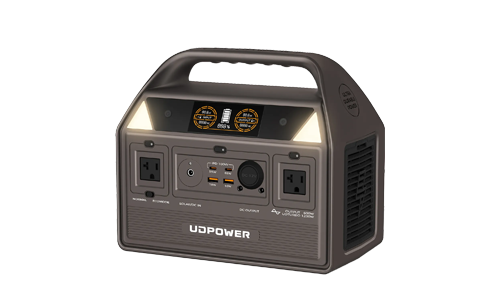
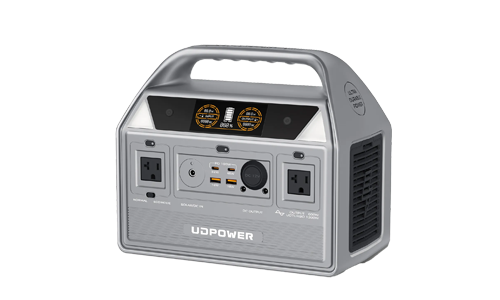
The UDPOWER S2400 is the most relevant UDPOWER model for larger home-essential backup because it provides substantially more inverter output and stored energy than smaller models.
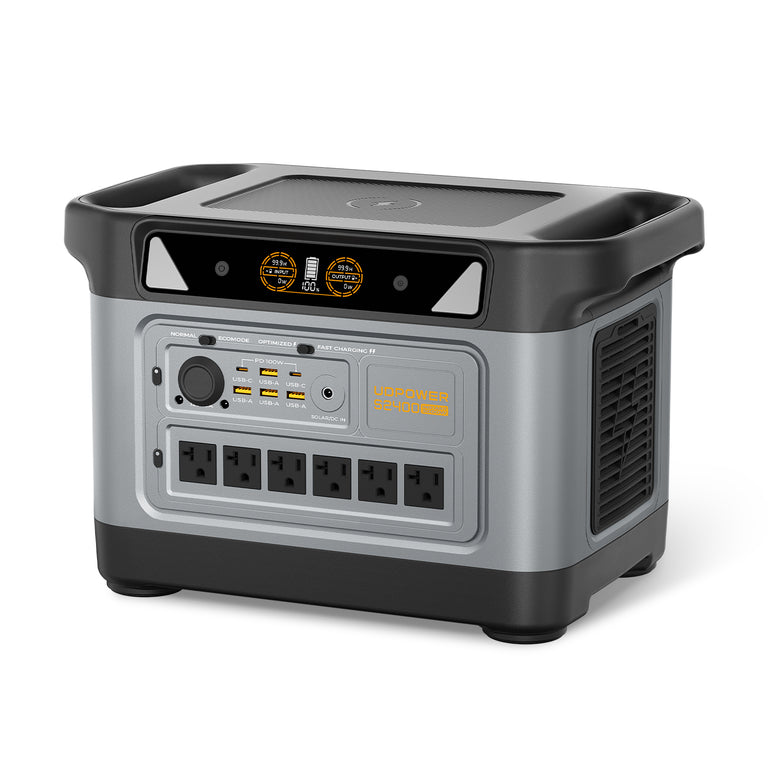
UDPOWER S2400: Best UDPOWER Option for Larger 120V Essential-Load Backup
| Specification | S2400 | What It Means for Transfer-Switch Use |
|---|---|---|
| Battery capacity | 2,083Wh LiFePO4 | Provides a useful energy reserve for selected essential loads |
| Rated AC output | 2,400W | Use this rating as the primary transfer-switch load-planning limit |
| AC voltage | 120V, 60Hz | Suitable only for compatible 120V backup loads; it does not provide 240V output |
| Approx. rated current equivalent | 20A at 120V | A 30A transfer switch does not increase the power station's 2,400W rated capability |
| AC outlets | 6 | Useful for direct appliance backup when panel integration is unnecessary |
| Higher-power capability | Up to 3,000W in supported battery/inverter operation | Do not use the higher-power mode as the basic transfer-switch continuous design target |
| Battery lifecycle reference | About 80% capacity after 3,000 cycles; about 70% after 4,000 cycles | LiFePO4 chemistry is designed for repeated backup use |
| UPS response | ≤10 ms | Applies to supported UPS operation through the unit; it does not turn a manual transfer-switch installation into an automatic whole-home UPS |
Important: UDPOWER does not recommend treating the S2400 as a plug-and-play whole-home transfer-switch system. The unit provides standard U.S. 120V output and no 240V output. Any connection to home transfer equipment should first be evaluated by a licensed electrician for voltage, circuit selection, inlet compatibility, neutral/ground configuration, protective devices, and local code requirements.
View UDPOWER S2400What about the UDPOWER S1200?
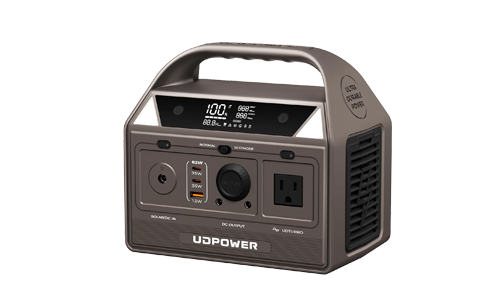
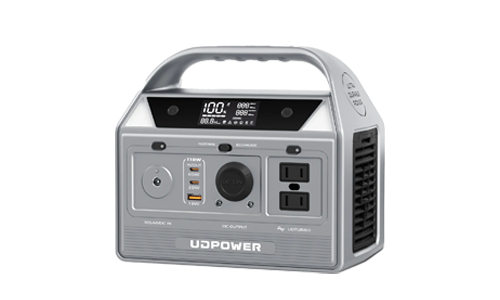
The UDPOWER S1200 uses the same basic 120V-only home-backup concept but at a lower power and capacity level.
| Model | Battery | Rated AC Output | Voltage | Best Role |
|---|---|---|---|---|
| UDPOWER S1200 | 1,190Wh | 1,200W | 120V | Direct backup for refrigerator, router, lights, electronics, CPAP, and other modest essential loads; electrician-reviewed low-load 120V transfer applications where appropriate |
| UDPOWER S2400 | 2,083Wh | 2,400W | 120V | Better choice when multiple 120V essentials, longer runtime, or higher startup demand are expected |
If you do not need hardwired circuits, direct appliance connection is often simpler. You avoid paying for transfer equipment, and you can see exactly what is plugged into the battery.
Browse the full UDPOWER portable power station collection or the portable power stations for home backup.
Why a Transfer Switch Can Actually Make Battery Management Harder
This is an important difference between a battery and a gasoline generator.
A fuel generator can be refueled. A portable battery starts with a fixed number of watt-hours. Once the stored energy is used, it must be recharged.
When appliances are plugged directly into a power station, it is obvious what is consuming energy. Once normal household circuits are energized, it becomes easier for someone to switch on another light, television, coffee maker, microwave, fan, or appliance without realizing it is drawing from the same battery.
For that reason, selected-circuit battery backup works best when the household follows an outage load plan.
- Keep only essential transfer circuits enabled.
- Avoid running multiple heating or cooking appliances simultaneously.
- Check the power station's output display before adding a large load.
- Leave output headroom for refrigerators, pumps, and motor startup.
- Charge laptops and portable electronics when other large loads are off.
- Turn off unnecessary lights and entertainment equipment during long outages.
- Plan how and when the battery will be recharged if the outage lasts more than one day.
How to Use a Professionally Installed Transfer-Switch System During an Outage
The exact sequence must follow the instructions for your specific transfer switch and power source. Once a compatible system has been professionally installed, a typical manual-backup routine looks like this from the homeowner's perspective:
- Confirm the utility outage and check the power station's remaining battery level.
- Turn off or disconnect unnecessary high-demand appliances.
- Connect the power station only through the approved backup-power connection installed for the system.
- Turn on the power station's AC output.
- Operate the transfer equipment according to its manufacturer instructions.
- Bring essential circuits online gradually rather than switching every load on at once.
- Watch the station's output wattage while refrigerators, pumps, blowers, or other motor loads start.
- Disable nonessential circuits if the load approaches the station's rated output.
- Monitor battery percentage and estimated runtime throughout the outage.
- When utility power returns, follow the transfer-switch manufacturer's procedure for returning circuits to utility power before disconnecting the backup source.
Common Portable Power Station + Transfer Switch Mistakes
Using a male-to-male cord to backfeed a receptacle
Never do this. Household receptacles are outputs, not backup-power inlets. Backfeeding can energize wiring unexpectedly and bypass the controlled isolation provided by proper transfer equipment.
Assuming a 30A transfer switch means you have 30A available
The power source sets the available power. A 2,400W, 120V source is approximately a 20A source at its rated output, regardless of whether the transfer equipment itself is rated for 30A.
Buying an L14-30 adapter before checking voltage
An L14-30 connector is commonly associated with 125/250V generator equipment. A physical adapter does not give a 120V-only power station split-phase 240V capability.
Trying to energize both sides of the panel from one 120V source
This can interact with 240V loads, shared-neutral circuits, breaker arrangements, and the transfer equipment itself. Do not improvise this configuration.
Ignoring motor startup
A 500W furnace blower, refrigerator compressor, or pump may briefly require substantially more power when it starts. A backup system must satisfy both normal running demand and startup behavior.
Putting every convenient circuit on backup
A battery is most useful when it is reserved for priorities. The fewer unnecessary loads you energize, the longer the outage reserve lasts.
Assuming 240V equipment will work because its wattage looks low
Voltage comes first. A 1,000W 240V appliance is still a 240V appliance. A 120V portable power station does not become compatible simply because it has more than 1,000W of inverter capacity.
Forgetting about recharge strategy
A transfer switch solves distribution, not energy supply. If your essential circuits use 1,500Wh per day but you can only recharge 400Wh per day, the battery reserve will continue shrinking.
For longer outages, solar can extend runtime when weather and panel size allow. See UDPOWER's solar panel options and the guide Can a Solar Generator Power a House?.
Transfer Switch vs. Extension Cords: Which Is Better?
| Factor | Direct Extension-Cord / Appliance Use | Transfer Switch |
|---|---|---|
| Installation | No panel modification | Professional installation generally required |
| Cost | Lower | Higher upfront cost |
| Hardwired appliances | Usually cannot be powered directly | Selected compatible hardwired circuits can be supplied |
| Existing lights and wall outlets | Usually unavailable unless individually connected | Selected circuits operate normally |
| Load visibility | Very obvious what is plugged into the battery | Requires more household load discipline |
| Portability | Maximum flexibility | Backup connection is tied to the installed home system |
| Best for renters | Usually yes | Usually impractical without property-owner approval |
| Best for a hardwired furnace | Not normally | A compatible transfer solution can be much better |
Questions to Ask Your Electrician Before Installation
You can make the consultation much more productive by bringing the portable power station's specifications and asking specific questions.
- My power station provides 120V only. Which household circuits can safely be backed up?
- Does this transfer switch require 120/240V split-phase input, or can it be configured for my 120V source?
- What inlet and cord arrangement is appropriate for the station's output?
- What is the maximum backup load we should design around?
- Does the transfer switch switch the neutral?
- What is the power station's neutral-to-ground arrangement, and is it compatible with this installation?
- Will existing AFCI or GFCI protection continue operating as required?
- Are any selected circuits multi-wire or shared-neutral circuits?
- Do any desired loads require 240V?
- Can the refrigerator, furnace blower, sump pump, or other motor loads start within the station's rated capability?
- Which circuits should remain excluded so the battery cannot be accidentally overloaded?
- What is the correct homeowner operating sequence when utility power fails and returns?
When a Portable Power Station Is Not the Right Transfer-Switch Source
A portable battery may not be the best solution if your outage plan requires:
- central air conditioning;
- large 240V well pumps;
- electric water heating;
- electric resistance heating;
- electric clothes drying;
- full electric-range operation;
- Level 2 EV charging;
- several kilowatts of continuous power for many hours;
- automatic whole-home operation with little or no load management.
Those situations usually point toward a larger 120/240V split-phase battery system, permanently installed home energy-storage system, appropriately sized fuel generator, or another professionally designed backup solution.
If you are trying to understand how much power a home actually uses before choosing a backup system, read How Many Watts Does a House Use?.
When a Portable Power Station Makes Excellent Sense
A portable battery becomes much more attractive when the goal is modest and clearly defined:
- keep food refrigerated;
- keep internet and phones available;
- maintain basic lighting;
- support compatible medical or comfort equipment;
- operate a compatible 120V furnace blower;
- run a 120V sump pump intermittently;
- avoid gasoline, fumes, engine noise, and outdoor generator operation;
- use the same battery for camping, RV travel, job-site power, and emergencies.
Unlike a fuel generator, a battery power station can also be used indoors because it has no combustion engine or exhaust. For more on that distinction, see Indoor Generator Guide: Safe Home Backup Power.
Frequently Asked Questions
Can any portable power station connect to a transfer switch?
No. The station's voltage, rated output, AC outlet, neutral and grounding arrangement, protective devices, and manufacturer requirements all need to match the transfer equipment and selected household circuits.
Can I connect a 120V portable power station to a 240V transfer switch?
Do not assume that you can. Many traditional 30A generator transfer switches are designed for 120/240V split-phase sources. A 120V-only station does not provide the second hot leg needed for normal 240V operation. A licensed electrician must determine whether the specific transfer equipment supports an approved 120V-only configuration.
Can an adapter turn a 120V power station into a 240V source?
No. An adapter can change connector shapes or wiring interfaces, but it cannot create true 120/240V split-phase output from a source that only produces 120V.
Can I power both sides of my breaker panel from a 120V power station?
Do not attempt to do this with an improvised adapter. Residential panels can contain 240V loads, shared-neutral circuits, and other wiring arrangements that require proper source and transfer-equipment design. Have an electrician identify which 120V circuits can be backed up safely.
Can a portable power station run a furnace through a transfer switch?
Potentially. Many gas-furnace blowers and controls use 120V, but the circuit is often hardwired and the motor may have significant startup demand. A properly installed 120V transfer solution can be useful when the furnace voltage, starting load, controls, grounding, and transfer equipment are compatible.
Can a portable power station run a well pump through a transfer switch?
It depends on the pump. Some pumps use 120V while many deep-well pumps use 240V. A 120V-only station such as the UDPOWER S1200 or S2400 cannot directly supply a 240V pump. Even a 120V pump must be checked for startup current.
Can I run central air conditioning from the UDPOWER S2400 through a transfer switch?
No for a typical 208/240V central air-conditioning system. The S2400 provides 120V AC output and does not provide 240V split-phase power. Some smaller 120V window or portable air conditioners may be possible when their running and startup demands fit within the station's capabilities.
Does a 30A transfer switch mean the S2400 can supply 30 amps?
No. The S2400 is rated at 2,400W at 120V, which is approximately 20A at rated output. A higher-rated switch does not increase the output available from the power station.
Is a transfer switch better than running extension cords?
It depends on the goal. Direct appliance connection is cheaper and simpler. A transfer switch is more convenient when you need selected built-in circuits or hardwired 120V equipment, but installation costs more and requires much more compatibility planning.
Can I backfeed my house through a wall outlet during an outage?
No. Do not connect a portable power station or generator to an ordinary household outlet to feed power backward into the home's wiring. Use appropriately designed transfer equipment installed for the purpose.
Should I use surge watts when sizing the transfer switch?
Use the power station's rated continuous output as the primary load-planning limit. Startup or higher-power capability matters for motors and compressors, but it should not replace the rated output when deciding how much normal household load the backup source should carry.
Does a transfer switch make the battery last longer?
No. It only changes how power reaches the loads. Runtime still depends on battery capacity and actual energy consumption. In fact, panel-connected circuits can make it easier to consume more energy unless the household follows a load-management plan.
Can a portable power station automatically take over when the grid fails?
Only when the power station and transfer equipment are specifically designed for that function. A manual transfer switch requires manual operation. A power station's built-in UPS feature for devices plugged directly into the unit should not be confused with automatic transfer of household circuits.
Bottom Line
Yes, a portable power station can be used with a transfer switch, but compatibility is determined by the electrical system—not simply by battery size.
For a 120V-only power station, the most sensible goal is usually a carefully selected group of 120V essential circuits. Voltage, rated output, connector type, neutral and ground configuration, branch-circuit arrangement, motor startup demand, and transfer-switch design all need to agree.
For UDPOWER specifically, the S2400's 2,083Wh battery and 2,400W rated output make it the strongest current option for substantial 120V essential-load backup. However, it is still a 120V portable power station rather than a native 120/240V whole-home battery system. Direct appliance use remains the simplest approach, while any transfer-switch installation should be reviewed and installed by a qualified electrician.
Build Your Home Backup Plan
Start with the loads that actually matter during an outage, then choose the battery capacity and output that can support them without paying for power you will never use.
Compare UDPOWER Portable Power Stations View UDPOWER S2400 Get the Home Backup Sizing GuideSources & Further Reading
- UDPOWER S2400 Official Product Specifications
- UDPOWER S1200 Official Product Specifications
- Electrical Safety Foundation International — Generator Safety
- Generac — Manual Power Transfer and Transfer-Switch Safety
- Reliance Controls — 125/250V 30A L14-30 Transfer Switch
- Reliance Controls — 125V Single-Circuit Transfer Switch
- NFPA — NFPA 70 National Electrical Code
Related Articles


