





How Many Watts Does a House Use? Average & Peak Watts
Last updated: August 11, 2026
But that does not mean a typical house only needs a 1,200W power source. Household demand rises and falls constantly. A home may draw only a few hundred watts during a quiet period, several thousand watts when cooking or doing laundry, and considerably more when air conditioning, electric water heating, an EV charger, an electric range, or other large loads operate at the same time.
If you are sizing a generator, inverter, or battery backup, use your home's simultaneous running watts and startup/peak demand rather than the national continuous average.

That distinction is the answer to most confusion around the question, “how many watts does a house use?” There are really three numbers involved:
- Average continuous watts: long-term energy consumption converted into an hourly average.
- Instantaneous household load: what your home is drawing right now.
- Peak watts: the highest demand your electrical system or backup source may need to handle when multiple loads operate or motors start.
863 kWh/month × 12 months ÷ 8,760 hours ≈ 1.18 kW, or 1,182W average continuous demand.
If you want to understand your home's total energy use rather than its instantaneous wattage, see How Many kWh Per Day Is Normal in the U.S.? The two measurements answer different questions.
How Many Watts Does the Average House Use?
Using the latest complete annual residential data currently published by the U.S. Energy Information Administration, the average U.S. residential electric customer used 863 kWh per month in 2024.
That equals approximately:
- 10,356 kWh per year
- 28.4 kWh per day
- 1.18 kWh per hour when averaged across the year
- About 1,182W of continuous-equivalent power
| Measurement | Approximate U.S. Average | What It Tells You | What It Does Not Tell You | Source |
|---|---|---|---|---|
| Monthly energy | 863 kWh/month | Average electricity purchased by a residential customer over a month | Exact power being drawn at any moment | EIA 2024 Table 5A |
| Daily energy | About 28.4 kWh/day | Long-term energy consumption expressed per day | Peak load or generator size | Calculated from EIA 2024 data |
| Average continuous power | About 1,182W | The constant power level that would equal the same annual energy consumption | The real-time load of an actual house | Calculated from EIA annualized consumption |
| Instantaneous load | Changes continuously | What appliances are drawing right now | Monthly energy consumption by itself | Your meter, utility portal, or home energy monitor |
| Peak load | Home-specific | Maximum demand your backup source may need to support | Cannot be reliably calculated from national kWh averages alone | Your appliances, HVAC, pumps, EV charger, and measured load profile |
This is why two seemingly conflicting answers—“about 1,200 watts” and “several thousand watts”—can both be reasonable depending on what is being measured.
The 1,182W figure is a time-averaged equivalent. Real homes do not consume electricity at a flat rate for 24 hours. Refrigerators cycle, air conditioners turn on and off, ovens heat intermittently, water heaters recover after showers, and EV chargers can add thousands of watts for several hours.
The Three Watt Numbers That Matter
1. Average Continuous Watts
Average continuous watts are useful for understanding overall energy consumption.
For 10,356 kWh/year:
This number is useful for comparing households and understanding why monthly kWh translates into an average electrical load. It is not the number you should automatically use to size an inverter or generator.
2. Instantaneous Household Load
Instantaneous load is the total wattage of everything drawing electricity at one specific moment.
Imagine checking your smart meter at 2:00 a.m. The refrigerator may be cycling, the router is running, a few chargers are connected, and HVAC may be off. Your load could be relatively low.
Check again while the air conditioner, microwave, coffee maker, electric water heater, and laundry equipment are operating and the result can be several times higher.
That changing number is what matters when asking whether a generator or inverter can support your home at a particular moment.
3. Peak Watts
Peak watts describe the highest demand the power source must be prepared to handle.
Peak demand comes from two sources:
- Several high-wattage appliances operating simultaneously.
- Motor-driven equipment drawing additional power when starting.
Refrigerators, air conditioners, well pumps, sump pumps, freezers, and other compressor or motor loads can require more power during startup than during normal running.
Watts vs. kWh: Why They Are Not Interchangeable
A major reason homeowners get conflicting answers is that watts and kilowatt-hours measure different things.
| Unit | Measures | Simple Question | Example | Useful For |
|---|---|---|---|---|
| Watt (W) | Power | How much electricity is being used right now? | A microwave drawing 1,200W | Generator and inverter output sizing |
| Kilowatt (kW) | Power | How much power is being used right now? | 1.2 kW = 1,200W | Whole-home and larger appliance loads |
| Watt-hour (Wh) | Energy | How much energy was used over time? | 100W for 5 hours = 500Wh | Battery capacity and runtime |
| Kilowatt-hour (kWh) | Energy | How much electricity did the home consume? | 1,000W for 1 hour = 1 kWh | Utility bills and daily/monthly consumption |
Output wattage determines whether a device can run. Battery watt-hours determine how long it can run.
How Household Load Changes During the Day
One of the most useful ways to understand home wattage is to stop thinking of the house as one appliance. A home is a collection of loads that overlap in different combinations throughout the day.
The following examples are not national averages. They are simplified load snapshots showing why instantaneous household load can be very different from the 1,182W annual continuous-equivalent average.
| Example Moment | Loads Operating | Illustrative Combined Load | Why It Matters |
|---|---|---|---|
| Quiet period | Refrigerator cycle, router, standby electronics, a few lights | About 200–600W | Shows why overnight or idle load can be well below the daily average |
| Morning kitchen use | Refrigerator, coffee maker, microwave, lights, electronics | About 2,000–3,500W | Several short-duration appliances can overlap |
| Laundry and cooking | Electric dryer, oven or cooktop, refrigerator, household electronics | Potentially 5,000–10,000W+ | Large resistance-heating appliances dominate load |
| Heavy all-electric period | Central AC or heat pump, electric water heater, cooking, EV charging, other loads | Potentially 10,000W+ | Whole-home peak demand can be far above long-term average watts |
The exact result can differ dramatically between homes. A house with natural-gas heat, gas water heating, and a gas range may have a much lower electrical peak than an otherwise similar all-electric home.
Climate matters as well. EIA data shows that air conditioning, space heating, and water heating are major categories of household electricity consumption, and HVAC demand is strongly seasonal. See EIA electricity use in homes .
Typical Household Appliance Wattage
The most reliable wattage for any appliance is the value on its nameplate, manual, electrical specification sheet, or a measurement taken with an appropriate power meter. The ranges below are useful for first-pass planning only.
| Household Load | Planning Running-Watt Range | Startup / Peak Consideration | Backup-Power Impact |
|---|---|---|---|
| Wi-Fi router / modem | About 5–25W | Minimal | Small continuous load; easy to overlook because it runs all day |
| LED light bulb | About 8–15W each | Minimal | Several lights usually remain a relatively small backup load |
| Laptop | About 30–100W | Minimal | Useful work-from-home backup load |
| Television | About 50–200W | Usually modest | Screen size and display technology matter |
| Refrigerator | Often about 100–300W while compressor is running | Compressor startup can be significantly higher | Check both running and startup demand |
| Coffee maker | About 600–1,500W | Usually close to operating wattage | High power but short runtime |
| Microwave | About 1,000–1,700W input | Check input rating rather than cooking-output rating | Common reason small inverters overload |
| Window air conditioner | About 500–1,500W+ | Compressor startup can exceed running watts | BTU rating and efficiency strongly affect load |
| Central air conditioner | Often several thousand watts while running | Compressor startup can be much higher | One of the biggest challenges for portable backup systems |
| Electric water heater | Commonly several thousand watts | Usually resistive rather than large motor surge | High load that can dominate simultaneous demand |
| Electric clothes dryer | Often about 3,000–6,000W | Motor plus heating-element load | Usually excluded from small backup plans |
| Electric range / oven | Several thousand watts depending on elements in use | Multiple elements can overlap | Whole appliance demand can be much higher than one burner |
| Level 2 EV charging | Several thousand watts; commonly multiple kW | Generally sustained rather than a short startup event | Can become one of the largest continuous household loads |
| Well or sump pump | Model-specific; often hundreds to thousands of watts | Motor startup matters | Use exact pump specifications for backup planning |
For appliance-specific guides, see:
Does House Size Tell You How Many Watts You Need?
Square footage matters, especially because larger homes generally require more heating, cooling, lighting, and ventilation. But square footage alone is not enough to determine instantaneous household wattage.
Consider two 2,000-square-foot homes:
| Feature | Home A | Home B |
|---|---|---|
| Space heating | Natural gas | Electric heat pump with auxiliary heat |
| Water heating | Natural gas | Electric tank |
| Cooking | Gas | Electric range |
| Dryer | Gas | Electric |
| EV | No | Level 2 charging |
| Likely electrical peak | Much lower | Potentially much higher |
Both houses have the same floor area, but their electrical systems face very different loads.
So if you are asking, “How many watts does a 2,000-square-foot house use?” the most accurate answer is: use the house's actual appliance mix and measured electrical demand rather than relying on square footage alone.
How to Calculate Your Home's Real Wattage
There are three practical ways to find your own number. The best method depends on whether you want average consumption, real-time demand, or backup-power sizing.
Method 1: Convert Your Electric Bill Into Average Continuous Watts
Find your annual electricity consumption from your utility account. Using a full 12 months is better than using one summer or winter bill because it smooths out seasonal changes.
A home using 12,000 kWh/year:
12,000 × 1,000 ÷ 8,760 ≈ 1,370W average continuous load.
Again, this is not the home's peak demand.
Method 2: Use Your Utility's Hourly or Real-Time Data
If your utility offers smart-meter data, examine your home's usage during:
- overnight quiet hours,
- morning cooking,
- the hottest afternoon of summer,
- the coldest winter morning,
- EV charging,
- laundry and cooking at the same time.
This is far more useful for generator or inverter planning than dividing your monthly bill by the number of hours in the month.
Method 3: Build a Backup Load List
If your goal is emergency power, you normally do not need to calculate every circuit in the house. Instead, list the devices you actually plan to operate during an outage.
| Essential Load Example | Planning Watts | Hours / Duty Cycle | Why Include It? |
|---|---|---|---|
| Refrigerator | Use nameplate / measured running and startup watts | Cycles throughout the day | Food protection |
| Router / modem | Usually low | Continuous | Communication |
| LED lights | Low | Evening use | Basic visibility |
| Laptop / phones | Low to moderate | Intermittent | Work and communication |
| CPAP or other approved medical equipment | Use exact device specification | Often overnight | Health-related continuity |
| Fan | Moderate | Several hours | Comfort |
| Microwave / coffee maker | High | Short use | Convenience without large daily energy use |
This “essentials-first” method often produces a much smaller and more realistic backup target than trying to reproduce normal grid-powered life during an outage.
For a deeper home-backup planning guide, see Can a Solar Generator Power a House?
How Many Watts Do You Need for a Generator or Inverter?
Generator and inverter sizing should be based on the loads that can operate at the same time.
Do not simply add every appliance in your house unless you genuinely expect all of them to operate simultaneously.
Step 1: Add Simultaneous Running Watts
List the equipment you want running at the same time.
- Refrigerator while compressor runs: 200W
- Router: 15W
- Lighting: 60W
- Laptop: 65W
- Television: 100W
- Fan: 75W
Step 2: Add Startup Headroom Correctly
A common mistake is to add an appliance's full starting wattage on top of its running wattage, which can count the same load twice.
Instead, calculate the additional startup requirement.
Then:
Additional startup demand = 800 − 200 = 600W.
If the other loads total 315W, the estimated startup event becomes:
515W combined running load + 600W additional compressor demand = 1,115W.
This is a more useful way to think about generator and inverter sizing than looking only at long-term average watts.
Step 3: Leave Operating Headroom
Do not design a backup plan that requires the power source to operate at its maximum output every minute. Appliances change operating states, measurements are imperfect, and you may plug in another device during an outage.
A practical plan leaves reasonable headroom between your normal simultaneous running load and the power source's continuous rating.
What About a Whole-House Generator?
Whole-home sizing is a different project from portable essential-load backup. A home with central air conditioning, electric heat, a well pump, electric water heating, electric cooking, a dryer, and EV charging can require substantially more power than a home that uses gas for several of those functions.
If you are planning an installed generator or battery system connected to the home's electrical panel, use an electrician or qualified installer to review your service, circuits, large motor loads, local electrical requirements, and transfer equipment.
You can also read Can a 3000-Watt Generator Run a House? for a practical example of what a limited power budget can and cannot support.
CPSC generator safety guidance
Watts Are Not Enough When Sizing Battery Backup
Watts tell you whether a battery power station's inverter can handle the load. Watt-hours tell you how long the battery may support it.
You need both.
| Question | Measurement | Example |
|---|---|---|
| Can the power station run my appliances at the same time? | Watts | Compare simultaneous load with rated AC output |
| Can it handle a higher-demand appliance? | Peak / UDTURBO capability where applicable | Compare appliance demand with the model's supported output range |
| How long will the system last? | Watt-hours | Battery capacity × usable efficiency ÷ load |
For practical UDPOWER runtime planning, a conservative estimate can use approximately 90% conversion efficiency:
2,083 × 0.90 ÷ 500 ≈ 3.75 hours.
Real results vary with appliance cycling, temperature, battery condition, operating mode, startup events, DC vs. AC use, and other factors.
This also shows why a portable power station should not be judged against the 1,182W national continuous-equivalent household average alone. A real home may require far more than 1,182W at peak, while an emergency essentials plan may require far less.
If you want to size a larger solar backup system around energy use as well as inverter output, see What Size Solar Generator Do You Need to Power a House?
UDPOWER Options for Essential Home Backup
Portable power stations such as the UDPOWER S1200 and S2400 are best viewed as targeted home-backup systems, not replacements for an unlimited utility connection.
They make the most sense when you deliberately prioritize loads such as a refrigerator, router, lights, CPAP, phones, laptop, fan, TV, and short-duration kitchen appliances.
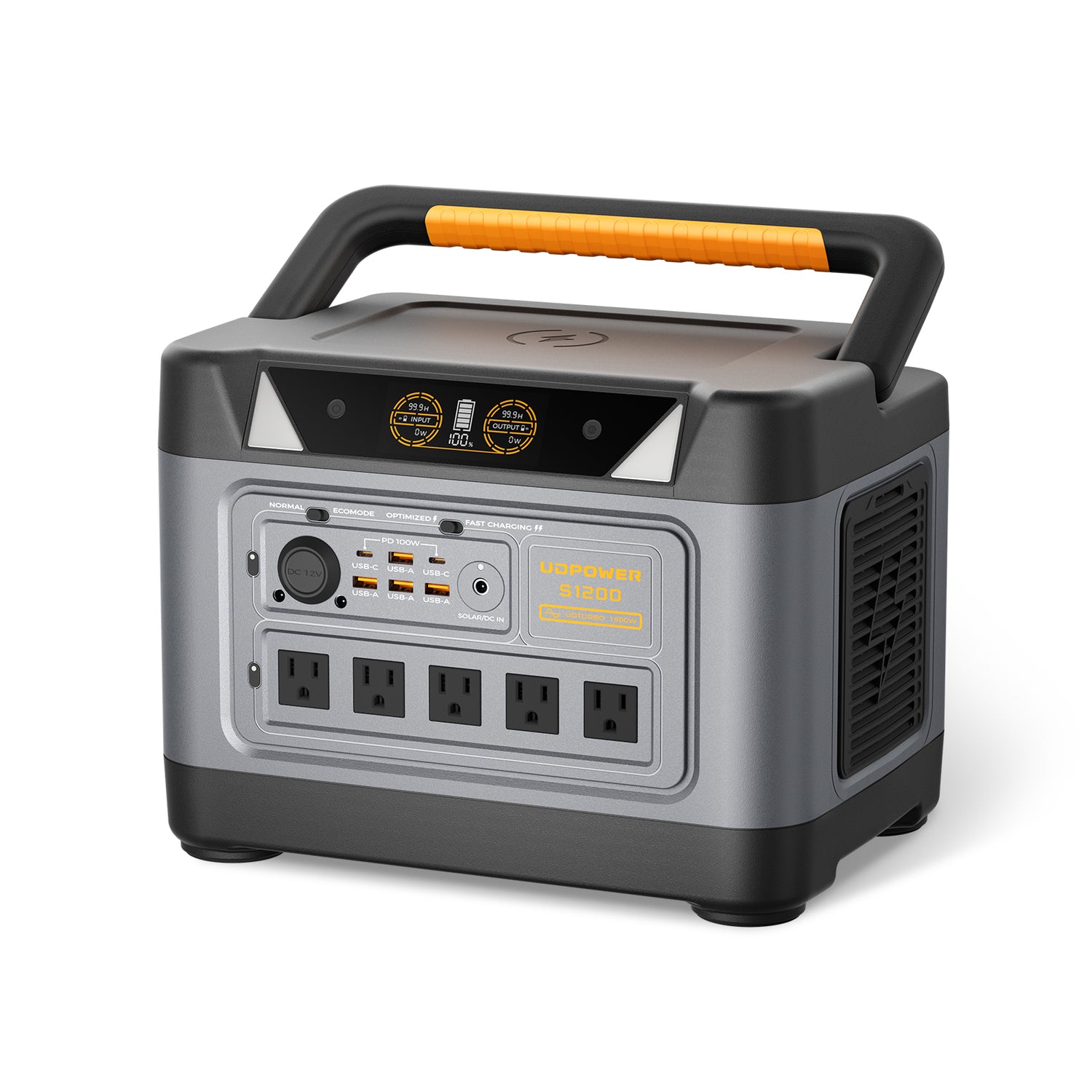
UDPOWER S1200 Portable Power Station
The S1200 is a practical fit when your outage plan focuses on a refrigerator, networking equipment, lighting, CPAP, laptops, phones, fans, and other selected household essentials rather than high-power whole-home loads.
- Battery capacity: 1,190Wh
- Rated AC output: 1,200W pure sine wave
- UDTURBO: up to 1,800W for compatible higher-power devices
- Battery: LiFePO4, 4,000+ cycles
- Output ports: 14 total on the current 5-AC-outlet version
- UPS: <10 ms UPSPRIME switchover
- Weight: 26.0 lb
| Example Steady Combined Load | Estimated Runtime at 90% Efficiency |
|---|---|
| 500W | About 2.14 hours |
| 800W | About 1.34 hours |
| 1,000W | About 1.07 hours |
These are simplified continuous-load estimates. A cycling refrigerator or intermittent appliance may produce different real-world runtime.
View UDPOWER S1200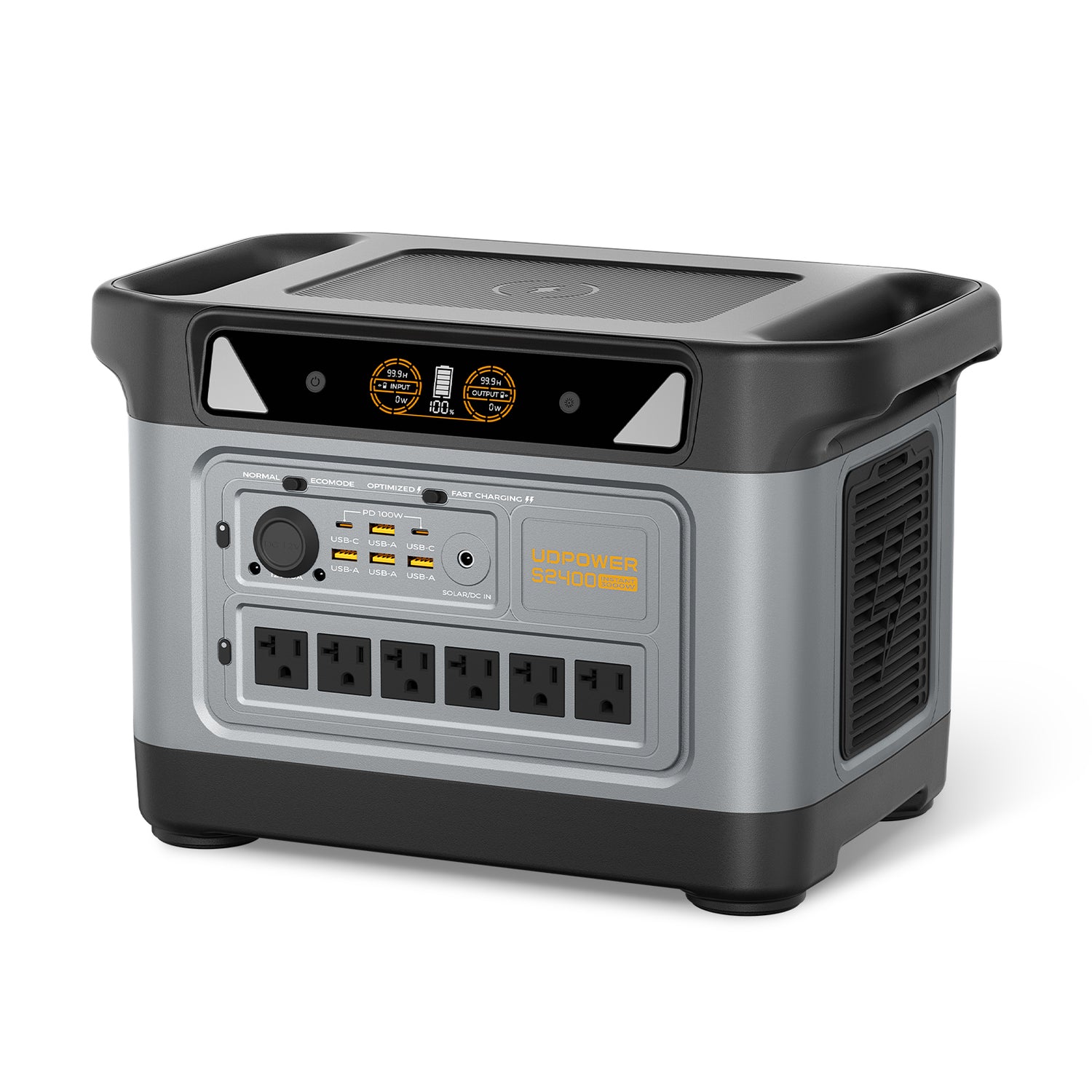
UDPOWER S2400 Portable Power Station
The S2400 provides more output headroom and battery capacity for households that want to support a larger combination of essential loads or occasionally operate higher-wattage appliances.
- Battery capacity: 2,083Wh
- Rated AC output: 2,400W pure sine wave
- UDTURBO: up to 3,000W for compatible higher-power devices
- Battery: LiFePO4, 4,000+ cycles
- Output ports: 15 total
- AC outlets: 6
- UPS: <10 ms UPSPRIME switchover
- Weight: 40.8 lb
| Example Steady Combined Load | Estimated Runtime at 90% Efficiency |
|---|---|
| 500W | About 3.75 hours |
| 800W | About 2.34 hours |
| 1,000W | About 1.87 hours |
| 1,500W | About 1.25 hours |
Runtime examples assume a constant load. Household appliances that cycle on and off will behave differently.
View UDPOWER S2400Which One Makes More Sense for a House?
| Backup Goal | S1200 | S2400 |
|---|---|---|
| Router, lights, phones, laptop | Strong fit | Strong fit with longer runtime |
| Refrigerator plus small electronics | Good fit when total load stays within output limits | More runtime and output headroom |
| CPAP plus overnight electronics | Good fit | Better if combining more loads |
| Microwave or coffee maker plus other devices | Check combined wattage carefully | Better output headroom |
| Whole-home central AC, electric dryer, electric range and EV charger together | Not designed for this use | Not designed as an unlimited whole-home system |
Browse all UDPOWER portable power stations or use the UDPOWER power station comparison to compare output and battery capacity.
For solar-ready combinations, see UDPOWER solar generators and portable solar panels .
How to Reduce Peak Household Wattage During an Outage
Increasing generator size is not the only way to handle a home's electrical demand. Load management can dramatically reduce the required wattage.
Run High-Wattage Appliances One at a Time
A microwave, coffee maker, toaster, hair dryer, electric kettle, and portable heater may each be manageable individually but can overload a smaller backup system when used together.
During an outage, staggering them is often more effective than buying enough inverter capacity to run every high-wattage appliance simultaneously.
Keep Large Heating Loads Off the Backup Circuit
Electric resistance heating consumes substantial power. Electric dryers, conventional electric water heaters, space heaters, and electric ranges can quickly dominate a portable backup plan.
Watch Compressor Startup Events
Avoid deliberately starting several motor-driven devices at the same time when operating near the limit of your power source.
Prioritize Energy Per Hour as Well as Watts
A 1,200W microwave used for five minutes may consume relatively little battery energy. A 500W load running continuously for eight hours consumes far more.
1,200W × 5/60 hour = about 100Wh.
Continuous 500W load:
500W × 8 hours = 4,000Wh.
This is why both watts and watt-hours matter when deciding what stays powered during a long outage.
What Number Should You Actually Use?
| Your Goal | Number to Use | Best Data Source |
|---|---|---|
| Compare your electricity use with the U.S. average | Monthly or annual kWh | Utility bill + EIA benchmark |
| Find your home's average continuous power | Average watts | Annual kWh ÷ total annual hours |
| Find what your house is drawing right now | Instantaneous watts / kW | Smart meter or home energy monitor |
| Size a generator or inverter | Simultaneous running watts + startup headroom | Appliance specifications + measured loads |
| Size battery capacity | Wh or kWh | Watts × required runtime |
| Plan whole-home installed backup | Peak load + daily energy + circuit requirements | Load data + qualified electrical assessment |
Frequently Asked Questions
How many watts does the average house use?
Based on the EIA's 2024 average of 863 kWh per month, the average U.S. residential customer's electricity purchases are equivalent to approximately 1,182 watts if spread evenly across every hour of the year. Actual instantaneous household demand moves above and below that number throughout the day.
How many watts does a house use at one time?
There is no single national number. A quiet house may draw only a few hundred watts at a particular moment, while cooking, laundry, air conditioning, electric water heating, pumps, or EV charging can push instantaneous demand into several kilowatts. Your utility's smart-meter data or a home energy monitor is the best way to see your real load.
Is 1,200 watts enough to run a house?
Usually not if you mean operating a normal house without changing your habits. About 1,182W is the continuous-equivalent average derived from annual U.S. electricity consumption, not a typical household peak. A 1,200W power source can still run a useful group of carefully selected essential devices if their combined demand stays within its limits.
How many watts does a 2,000-square-foot house use?
Square footage alone cannot provide an accurate wattage. A 2,000-square-foot home using natural gas for heat, water heating, cooking, and drying can have a very different electrical demand from an all-electric 2,000-square-foot home with central AC and EV charging. Use actual utility and appliance data for sizing.
How many watts does it take to run a whole house?
It depends on which appliances are operating simultaneously. Homes with central HVAC, electric water heating, electric cooking, electric dryers, pumps, or EV charging can require many thousands of watts. An essentials-only outage plan can require much less power than normal whole-home operation.
Is 5,000 watts enough to run a house?
Five thousand watts can support many essential-load combinations, but it does not automatically mean every appliance in a house can operate normally at the same time. Central air conditioning, electric water heating, electric dryers, large pumps, cooking equipment, or EV charging can consume much of that capacity quickly.
Is 10,000 watts enough to run a house?
A 10,000W source provides much more flexibility, but whole-home suitability still depends on the home's actual simultaneous load and startup requirements. Large all-electric homes can exceed 10,000W when several major loads operate together.
What is the difference between running watts and peak watts?
Running watts are the power required while equipment operates normally. Peak or startup demand is the higher load that may occur when motors or compressors start or when multiple appliances overlap. Backup power systems must be able to handle both the normal combined load and the applicable higher-demand events.
What is the difference between watts and kWh?
Watts measure power at a moment in time. Kilowatt-hours measure energy used over time. Generator and inverter output is generally discussed in watts, while household electricity bills and battery-energy requirements are commonly discussed in kWh or Wh.
Can I calculate house watts from my electric bill?
You can calculate average continuous watts from your bill by converting annual kWh into watt-hours and dividing by 8,760 hours. That gives a useful long-term average, but it does not reveal your actual peak demand. Smart-meter or home-monitor data is better for that.
How do I size an inverter or generator for my house?
List the devices that will operate simultaneously, add their running watts, then account for the largest realistic additional startup requirement from motor-driven equipment. Leave reasonable operating headroom rather than planning to run continuously at the source's maximum rating.
Can a portable power station power an entire house?
A portable power station is usually better suited to selected household essentials than unrestricted whole-home operation. Refrigerator, router, lights, CPAP, phones, laptops, fans, and short-use kitchen appliances are more realistic targets. Running central HVAC, electric water heating, an electric dryer, an electric range, and EV charging together usually requires a much larger installed system.
Which UDPOWER power station is better for home backup?
The UDPOWER S1200 offers 1,190Wh of battery capacity and 1,200W rated output, making it useful for focused essential backup. The S2400 increases capacity to 2,083Wh and rated output to 2,400W, providing more runtime and output headroom for larger combinations of household essentials. Choose based on your measured simultaneous wattage and required runtime.
Build a Backup Plan Around Your Real Loads
Do not choose backup power from the average wattage of an American house alone. List what you actually need during an outage, check running and higher-demand loads, estimate runtime in watt-hours, and then match the power station to that plan.
Related Reading
- How Many kWh Per Day Is Normal in the U.S.? — Understand daily and monthly household electricity consumption.
- Can a Solar Generator Power a House? — Learn the difference between essential-load and whole-home backup.
- What Size Solar Generator Do You Need to Power a House? — Match inverter output, battery capacity, and solar charging to household needs.
- Can a 3000-Watt Generator Run a House? — See what a limited 3,000W power budget can realistically support.
- How Many Watts Does a Window Air Conditioner Use? — Estimate one of the largest common summer backup loads.
- How Many Watts Does a Coffee Maker Use? — Understand high-wattage, short-duration kitchen loads.
Sources
Related Articles


