

How Long Does a Portable Power Station Last? Runtime, Battery Life & Years
Last updated: October 30, 2026
Quick answer: A portable power station can last anywhere from less than an hour to several days on one charge, depending mainly on battery capacity and the power your devices consume. For UDPOWER runtime planning, I use this practical starting formula:
For example, a 1,190Wh S1200 running a steady 100W load works out to about 10.7 hours. A 2,083Wh S2400 under the same 100W load works out to about 18.7 hours.
Battery lifespan is a different question. UDPOWER's current cycle-life planning standard is approximately 80% remaining capacity after 3,000 cycles and 70% after 4,000 cycles. That does not mean a battery suddenly dies at either point. Capacity gradually decreases over time, and calendar age, heat, storage habits and usage can matter as much as cycle count.

When someone asks me, “How long does a power station last?” I usually have to ask what they mean by last.
Are they asking how many hours a refrigerator will run tonight? How many days a battery can support a campsite? How many years the battery will remain useful? Or how much charge will still be there after the station sits in a closet for six months?
Those are four different questions, and mixing them together is one of the main reasons portable power runtime estimates become misleading.
Table of Contents
- What Does “How Long Does a Power Station Last?” Actually Mean?
- How to Calculate Runtime on One Charge
- UDPOWER Runtime Comparison Table
- How Long Will It Run Real Devices?
- Why Refrigerators Need a Different Runtime Calculation
- Why Very Low-Watt Devices Can Miss the Simple Formula
- AC vs. USB-C/DC: Which Gives Longer Runtime?
- Can Solar Make a Power Station Last Indefinitely?
- How Many Years Does a Portable Power Station Battery Last?
- What Do 3,000 and 4,000 Battery Cycles Really Mean?
- Why Cycle Count Is Not the Same as Calendar Life
- How Long Will a Power Station Hold Its Charge in Storage?
- Does Leaving It Plugged In Shorten Battery Life?
- How Temperature Changes Runtime and Lifespan
- How to Make a Portable Power Station Last Longer
- Which UDPOWER Model Gives the Runtime You Need?
- Frequently Asked Questions
What Does “How Long Does a Power Station Last?” Actually Mean?
| Meaning of “Last” | What You Are Really Asking | Main Factors |
|---|---|---|
| Runtime per charge | How many hours will my appliance run? | Battery Wh, device watts, conversion losses, inverter overhead, appliance cycling |
| Runtime over several days | Can I stay powered through a trip or outage? | Daily energy use, solar/car/grid recharge, weather, charging time |
| Battery lifespan | How many years before capacity noticeably decreases? | Battery chemistry, equivalent cycles, heat, state of charge, calendar age |
| Storage retention | Will it still be charged when I need it months later? | Self-discharge, standby drain, storage temperature, starting state of charge |
I would not use the same answer for these four questions. A station may provide only ten hours of runtime per charge yet remain useful for many years. Another may sit unused for months and still age chemically even though the cycle counter barely changes.
How to Calculate Portable Power Station Runtime
For a steady load, runtime starts with a simple energy calculation.
The problem is that ideal runtime assumes every watt-hour printed on the battery reaches your appliance. Real power systems have losses.
For UDPOWER planning, I use about 90% as a practical starting efficiency:
Example: S1200 With a 100W Load
Example: S2400 With a 500W Load
This formula works best with relatively steady loads such as lamps, routers, TVs, many laptops and some CPAP configurations.
For refrigerators, freezers, pumps and other cycling loads, average energy consumption over time gives a more useful answer than instantaneous running watts.
For a full device-compatibility walkthrough, see How to Know If a Portable Power Station Can Power Your Device.
UDPOWER Runtime Comparison Table
The table below uses the same 90% planning factor for each current recommended model so the capacity difference is easy to see.
| Steady Load | C200 192Wh |
C400 256Wh |
S1200 1,190Wh |
S2400 2,083Wh |
|---|---|---|---|---|
| 10W | About 17.3 hr* | About 23.0 hr* | About 107 hr* | About 187 hr* |
| 20W | About 8.6 hr | About 11.5 hr | About 53.6 hr | About 93.7 hr |
| 40W | About 4.3 hr | About 5.8 hr | About 26.8 hr | About 46.9 hr |
| 60W | About 2.9 hr | About 3.8 hr | About 17.9 hr | About 31.2 hr |
| 100W | About 1.7 hr | About 2.3 hr | About 10.7 hr | About 18.7 hr |
| 200W | About 0.9 hr | About 1.2 hr | About 5.4 hr | About 9.4 hr |
| 300W | Above normal rated output | About 0.8 hr | About 3.6 hr | About 6.2 hr |
| 500W | Not a suitable normal load | Above normal rated output | About 2.1 hr | About 3.7 hr |
| 1,000W | Not suitable | Not suitable | About 1.1 hr | About 1.9 hr |
| 1,500W | Not suitable | Not suitable | Above normal rated output | About 1.2 hr |
| 2,000W | Not suitable | Not suitable | Above normal rated output | About 0.9 hr |
*Very low AC loads deserve special caution. The AC inverter itself consumes power, so a 10W appliance may not actually run for the simple calculated time. I explain that below.
These are planning estimates, not guaranteed runtimes. Device cycling, battery age, temperature, power factor, inverter overhead and higher-power operation can all change the result.
How Long Will a Portable Power Station Run Real Devices?
| Example Load | Planning Power | C400 | S1200 | S2400 |
|---|---|---|---|---|
| Wi-Fi router + modem | 20W | About 11.5 hr | About 53.6 hr | About 93.7 hr |
| CPAP planning example | 40W | About 5.8 hr | About 26.8 hr | About 46.9 hr |
| Laptop | 60W | About 3.8 hr | About 17.9 hr | About 31.2 hr |
| TV | 100W | About 2.3 hr | About 10.7 hr | About 18.7 hr |
| Several electronics together | 200W | About 1.2 hr | About 5.4 hr | About 9.4 hr |
| Moderate appliance load | 500W | Above normal rated output | About 2.1 hr | About 3.7 hr |
| High-power appliance | 1,000W | Not suitable | About 1.1 hr | About 1.9 hr |
These numbers also show why buying only by wattage can be misleading.
A 1,000W appliance may technically fit within a large inverter, but running it continuously drains even a large battery quickly. By contrast, a 20W router can run for a very long time because it consumes little energy.
Why Refrigerator Runtime Is Different
A refrigerator does not normally pull its compressor's running wattage every minute of the day.
The compressor cycles on and off. That means this calculation:
can significantly underestimate total refrigerator runtime if the compressor spends much of the day switched off.
A better method is to use the refrigerator's measured average energy consumption.
Method 1: Use a Watt Meter
Measure the refrigerator over several hours or, ideally, a full day. If it consumes 1.0kWh in 24 hours, that equals:
An S1200 using a 90% planning factor would then estimate:
That result is much more useful than assuming a 150W compressor draws 150W continuously for 24 hours.
Method 2: Use Annual Energy Consumption
If the EnergyGuide label says 400kWh per year:
That gives you a practical daily energy target for outage planning.
For a detailed refrigerator calculation, see Can a Portable Power Station Run Your Refrigerator?
Why Very Low-Watt Devices Can Run Shorter Than the Formula Predicts
This is one of the biggest gaps I see in generic runtime charts.
Suppose a 1,190Wh power station runs a 10W router through the AC outlet. The simple 90% calculation says more than 100 hours.
But the AC inverter has to remain awake the entire time. That inverter consumes power even before the connected device does.
If the inverter itself effectively adds several watts of overhead, a 10W appliance is no longer a 10W system load.
This overhead barely matters with a 1,000W microwave, but it can matter a lot with a 10W router.
Practical rule: the lower the AC load, the more cautious I am about using a simple Wh ÷ W calculation.
Does USB-C or DC Give Longer Runtime Than AC?
It can.
When you run a laptop through a 120V AC outlet, energy may follow this path:
If the same laptop supports direct USB-C PD, the power station may avoid the AC inverter entirely.
That can reduce conversion steps and may improve runtime, especially with smaller loads.
The same principle applies to compatible 12V DC appliances. Do not use an AC adapter just because the station has an AC outlet if a safe, compatible direct DC or USB-C connection is available.
Can Solar Make a Portable Power Station Last Indefinitely?
Potentially, but only when you recover at least as much energy as you consume over time.
The battery does not become infinite because solar panels are connected.
Think of the system as an energy budget.
If your devices use 800Wh per day and solar puts 900Wh back into the battery, the setup can theoretically maintain itself under similar conditions.
If your devices use 1,200Wh and solar replaces only 500Wh:
You are still draining 700Wh of stored battery energy each day.
| Model | Battery | Solar Input | Best Runtime Strategy | Source |
|---|---|---|---|---|
| C200 | 192Wh | Up to 150W | Small daily loads and short solar recovery windows | C200 Specs |
| C400 | 256Wh | Up to 150W | Camping electronics and light daily energy use | C400 Specs |
| S1200 | 1,190Wh | Up to 400W | RV, CPAP, refrigeration and outage energy recovery | S1200 Specs |
| S2400 | 2,083Wh | Up to 420W recommended solar setup | Larger daily energy budgets and extended off-grid use | S2400 Specs |
Actual solar production varies with clouds, shade, sun angle, season, panel temperature, cabling and the power station's input limits.
Solar therefore extends runtime only by the amount of energy it actually adds back.
How Many Years Does a Portable Power Station Battery Last?
There is no honest way to turn a cycle rating directly into an exact number of calendar years.
A modern LiFePO4 power station can remain useful for many years, but battery aging comes from two processes:
- Cycle aging from charging and discharging energy through the battery.
- Calendar aging that occurs simply because the battery exists and ages chemically over time.
That means a battery used once per week does not automatically last several decades simply because dividing 4,000 cycles by 52 produces a very large number.
Long before that theoretical cycle count is reached, temperature exposure, time, storage state of charge and component aging can become more important.
What Do 3,000 and 4,000 Battery Cycles Mean?
A battery cycle represents energy throughput equivalent to one full discharge and recharge.
You do not have to go from exactly 100% to 0% for a cycle to accumulate.
For example:
- 100% → 50%, recharge, then 100% → 50% again is roughly one equivalent full cycle.
- 100% → 75% four times is roughly one equivalent full cycle.
UDPOWER's current battery-life planning standard is:
| Equivalent Cycle Count | Approximate Remaining Capacity | What It Means |
|---|---|---|
| New | About 100% | Full rated battery capacity under normal conditions. |
| 3,000 cycles | About 80% | The battery is still usable but stores less energy than when new. |
| 4,000 cycles | About 70% | Capacity has declined further; it does not mean the battery suddenly stops operating. |
If an S1200 eventually retained 80% of its original 1,190Wh capacity, its effective battery capacity would be roughly:
At 70%:
The inverter can still operate, but you should expect shorter runtime from the same appliance.
For more detail, read Battery Cycle Life Explained: What 4,000 Cycles Really Mean.
Why Cycle Count Is Not the Same as Calendar Life
This is where I think many portable power station lifespan claims become too simplistic.
If a battery is rated for thousands of cycles, it is tempting to do this:
That arithmetic is mathematically correct but practically meaningless as a prediction of product life.
The battery, inverter, fans, capacitors, display, ports and other electronics all age with time. The battery itself also experiences calendar aging even when it is sitting unused.
High temperature can accelerate aging. So can long periods near extreme states of charge.
Better way to think about cycle life: cycle rating tells you how well the battery is designed to tolerate energy throughput. It is not a warranty that the entire power station will remain unchanged for the number of calendar years you get by dividing cycles by annual use.
How Long Will a Power Station Hold Its Charge in Storage?
Storage retention depends on battery self-discharge and how much power the electronics continue to consume when the unit appears idle.
A station that is fully powered off generally retains energy better than one left with AC, DC, Wi-Fi or other systems active.
For long-term storage, I use a different strategy than emergency-readiness storage.
| Situation | Practical Approach | Why |
|---|---|---|
| Long-term unused storage | Store roughly around mid-charge and power the unit fully off | Avoids leaving the battery at either extreme for months. |
| Emergency backup season | Keep more charge available when readiness matters | Maximum lifespan is less useful if the battery is not ready when an outage occurs. |
| Every 3–6 months | Check battery percentage and recharge if necessary | Prevents unexpectedly finding a deeply discharged battery. |
| After heavy use | Recharge instead of leaving it near empty | Long storage at very low charge is undesirable. |
The exact storage recommendation in your model's manual should take priority over a generic percentage rule.
Our 40–80 Rule guide explains why reducing time at extreme charge levels can help during routine use, but it is not a reason to refuse to charge to 100% before an outage when maximum runtime matters.
Does Leaving a Portable Power Station Plugged In Shorten Its Life?
It depends on what the power station is doing while plugged in.
A modern BMS prevents simple uncontrolled overcharging, but long-term battery aging is not only about overcharging.
The things I care about are:
- How long the battery remains at a very high state of charge
- Internal temperature
- Whether the station is repeatedly topping itself up
- Whether it is operating as a UPS or bypass supply
- How much heat the connected load creates
For backup use, keeping a station plugged in can make sense because readiness is the goal.
For long-term storage with no need for immediate backup, leaving it at full charge indefinitely is not necessary.
Read Can I Leave My Portable Power Station Plugged In All the Time? for the full discussion.
Does UPS Use Wear Out the Battery Faster?
Not automatically.
If incoming utility power is supporting the connected load through a bypass path, the battery may experience relatively little energy throughput until an outage occurs.
But UPS use can still affect long-term battery conditions because the station may remain connected, warm and at a high state of charge for long periods.
Small charge/discharge events, power interruptions and internal battery management can also contribute to total energy throughput.
For S1200 and S2400, remember that their higher UDTURBO capability applies through battery/inverter operation. In UPS/bypass use, keep the connected load within the normal rated output of the specific model.
How Temperature Changes Runtime and Battery Lifespan
Temperature affects both what the battery can deliver today and how quickly it ages over the long term.
Cold Weather
Cold temperatures can temporarily reduce available battery performance. Charging restrictions are usually more important than discharge restrictions with LiFePO4 batteries.
A battery that can still discharge in cold weather may not be allowed to accept a normal charge at the same temperature.
Hot Weather
High temperature increases battery stress and can cause:
- Reduced charging power
- Reduced output power
- More frequent fan operation
- Temperature warnings
- Protective shutdown
- Faster long-term battery aging
Do not leave a portable power station sitting in direct summer sun or a closed hot vehicle simply because its operating specification technically includes high temperatures.
The closer a battery spends its life to comfortable moderate temperatures, the better the conditions are for longevity.
How to Make a Portable Power Station Last Longer
- Do not store it empty. Recharge after deep use rather than leaving the battery near 0% for weeks.
- Avoid unnecessary months at 100%. Charge fully when you need maximum runtime, but do not assume full charge is the best long-term storage state.
- Keep it cool. Heat is one of the most important factors you can actually control.
- Keep the vents clear. The inverter and battery-management electronics need airflow during charging and high-power use.
- Use only the outputs you need. Turning on the AC inverter for a tiny USB device can waste energy.
- Use USB-C or DC directly when appropriate. Fewer conversion stages can improve runtime.
- Avoid unnecessary overloads. Repeatedly pushing a station beyond its normal use case creates more heat and stress.
- Test your backup load before an outage. A refrigerator or CPAP calculation is more useful when confirmed with the real device.
- Check stored stations periodically. An emergency battery that has been ignored for a year is not a preparedness plan.
- Follow the exact manual. Charging temperature, storage guidance and supported operating modes can differ between models.
For a full maintenance routine, see How to Maintain Your Portable Power Station.
Which UDPOWER Model Gives the Runtime You Need?
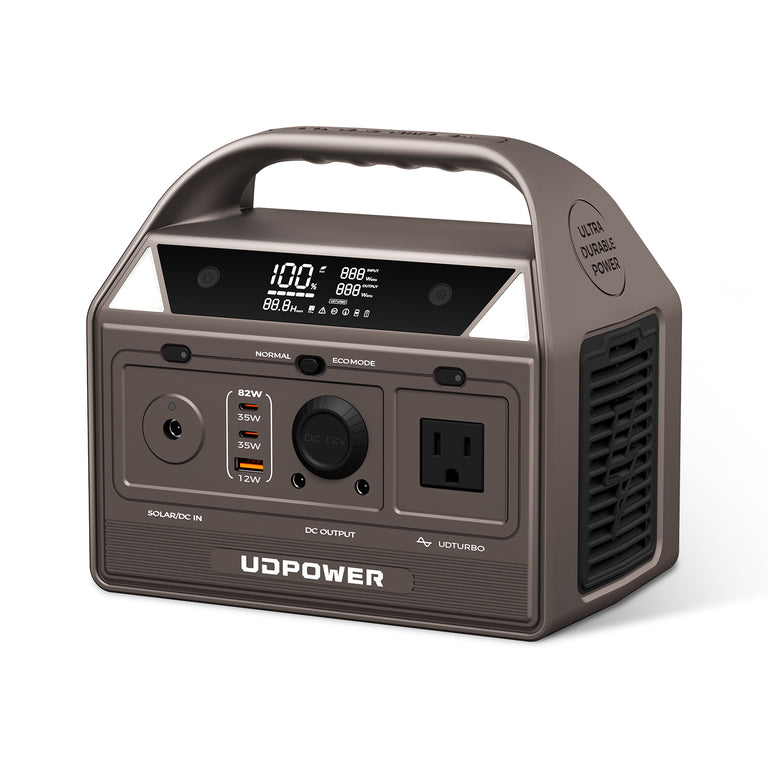
UDPOWER C200
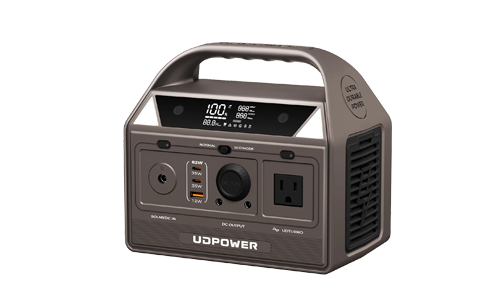
C200 makes sense when you value low weight more than long runtime. Its 192Wh battery is enough for phones, cameras, routers, lighting, laptops and other modest loads, but it is not intended to provide long refrigerator or high-power appliance backup.
- 192Wh LiFePO4 battery
- 200W rated pure sine wave AC output
- About 173Wh planning energy at 90%
- Approximately 5.4 lb
- Up to 150W solar input
40W planning runtime: about 4.3 hours.
100W planning runtime: about 1.7 hours.
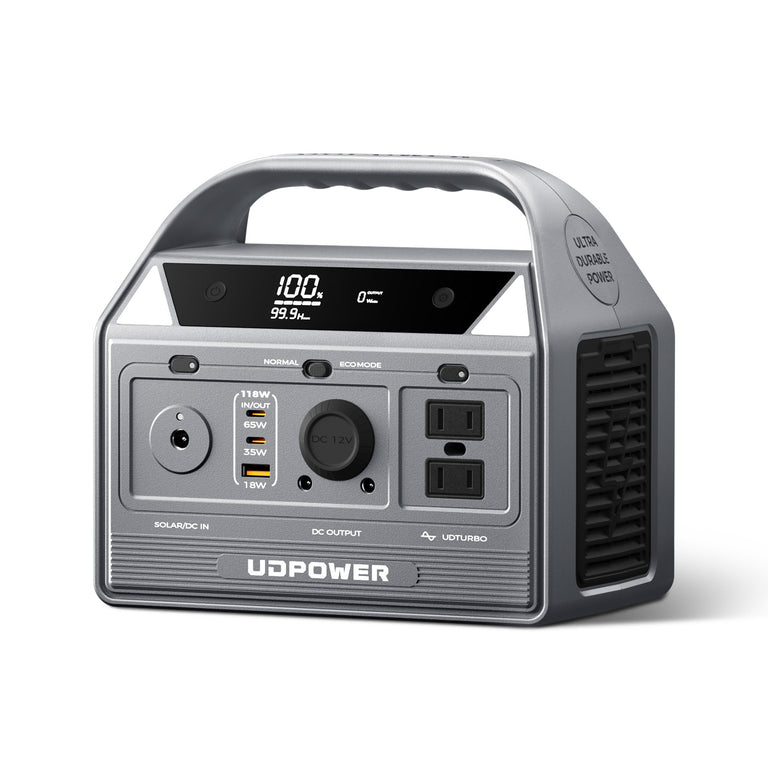
UDPOWER C400
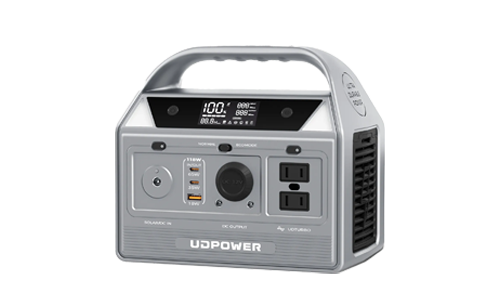
C400 gives you more usable output than C200 without moving into a heavy battery. It is a better fit for camping, laptops, fans, routers, camera equipment and lighter CPAP configurations.
- 256Wh LiFePO4 battery
- 400W rated pure sine wave AC output
- About 230Wh planning energy at 90%
- Approximately 6.88 lb
- Up to 150W solar input
40W planning runtime: about 5.8 hours.
100W planning runtime: about 2.3 hours.
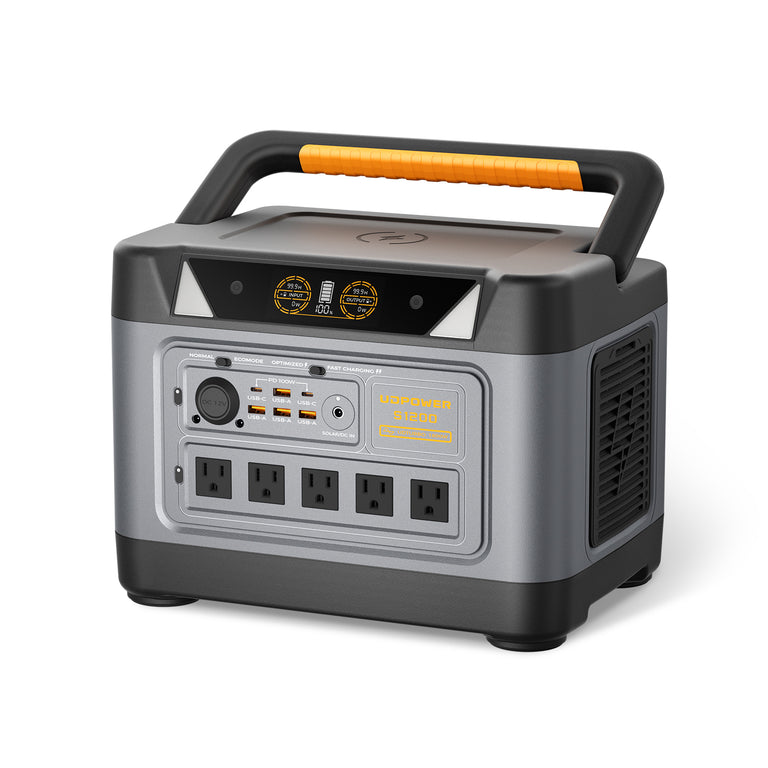
UDPOWER S1200
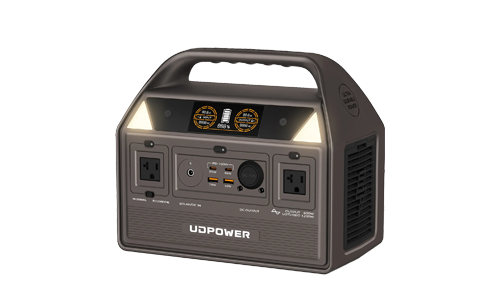
S1200 is the model I would start with when runtime matters enough that the station is supporting real household essentials rather than just charging electronics.
- 1,190Wh LiFePO4 battery
- 1,200W rated pure sine wave AC output
- UDTURBO higher-power operation up to 1,800W for compatible loads in battery/inverter mode
- About 1,071Wh planning energy at 90%
- Approximately 26 lb
- Up to 400W solar input
- UPSPrime transfer response of 10ms or less
- No wireless charging on current S-series models
40W planning runtime: about 26.8 hours.
100W planning runtime: about 10.7 hours.
500W planning runtime: about 2.1 hours.
Best fit: CPAP, refrigerators, routers, TVs, home-office equipment, camping, RV and outage essentials.
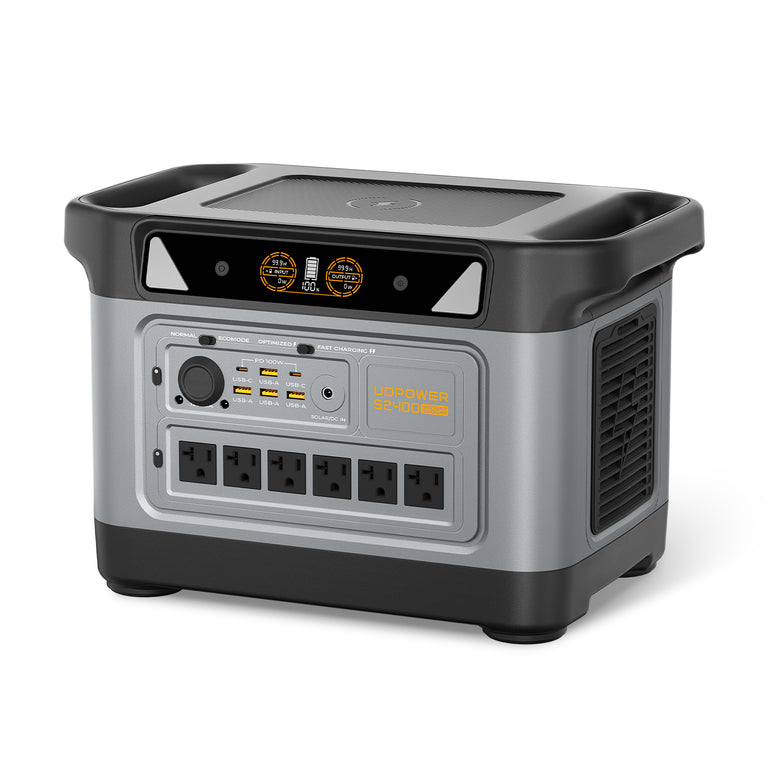
UDPOWER S2400
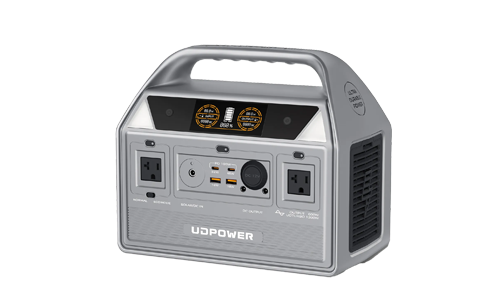
S2400 makes sense when both runtime and appliance wattage matter. Its 2,083Wh battery nearly doubles the stored energy of S1200 while its 2,400W rated output supports a much wider range of high-power appliances.
- 2,083Wh LiFePO4 battery
- 2,400W rated pure sine wave AC output
- UDTURBO higher-power operation up to 3,000W for compatible loads in battery/inverter mode
- About 1,875Wh planning energy at 90%
- Approximately 40.8 lb
- Up to 420W recommended solar setup
- UPSPrime transfer response of 10ms or less
- No wireless charging on current S-series models
40W planning runtime: about 46.9 hours.
100W planning runtime: about 18.7 hours.
500W planning runtime: about 3.7 hours.
1,000W planning runtime: about 1.9 hours.
Best fit: longer home outages, refrigerators plus other essentials, microwave use, coffee makers, tools, RV/basecamp systems and multi-device backup.
How Much Runtime Should You Actually Buy?
I do not recommend sizing a battery so precisely that the calculation works only under perfect conditions.
If your essential devices require 900Wh overnight, buying a battery with exactly 1,000Wh of advertised capacity gives you very little margin after conversion losses and real-world variation.
I prefer this process:
- Add the energy you realistically expect to use.
- Account for conversion losses.
- Add reserve for changing loads and battery aging.
- Check how much energy can be recovered before the next use period.
The last point matters more than many buyers realize.
A 2,000Wh battery can still run out during a multi-day outage if you consume 1,000Wh per day and recover almost nothing. A smaller battery can sometimes support a trip indefinitely if daily solar production consistently replaces daily use.
Frequently Asked Questions
How long does a portable power station last on one charge?
Runtime depends mainly on battery capacity and the connected load. For UDPOWER planning, use battery capacity in watt-hours × 0.90 ÷ device watts. A 1,190Wh S1200 running a steady 100W load has a planning runtime of about 10.7 hours, while a 2,083Wh S2400 under the same load has about 18.7 hours.
How many years does a portable power station last?
A well-maintained LiFePO4 portable power station can remain useful for many years, but an exact lifespan cannot be calculated from cycle count alone. Cycle aging, calendar aging, temperature, storage state of charge, usage patterns and the longevity of the inverter, fan and other electronics all affect total service life.
How long will a 1,000Wh power station last?
Using 90% planning efficiency, a 1,000Wh station provides roughly 900Wh of usable planning energy. That is about 18 hours at 50W, 9 hours at 100W, 3 hours at 300W or 1.8 hours at 500W, assuming a steady compatible load.
How long will a 2,000Wh power station last?
Using the same 90% planning factor, a 2,000Wh station provides roughly 1,800Wh of planning energy. That is about 36 hours at 50W, 18 hours at 100W, 6 hours at 300W, 3.6 hours at 500W or 1.8 hours at 1,000W.
How long will a portable power station run a refrigerator?
Refrigerator runtime depends on average daily energy use rather than compressor running watts alone. Because the compressor cycles on and off, measuring consumption over several hours or using annual EnergyGuide consumption gives a better estimate. S1200 is a practical starting point for shorter refrigerator backup, while S2400 provides more margin for overnight use or refrigerator plus other essentials.
How long will a portable power station run a CPAP?
CPAP runtime varies significantly with pressure settings, humidification and heated tubing. Using a 40W planning load, C400 works out to about 5.8 hours, S1200 about 26.8 hours and S2400 about 46.9 hours at 90% planning efficiency. Your actual CPAP may use more or less power.
Why does my power station run out faster than the runtime formula says?
Possible reasons include inverter self-consumption, conversion losses, device power changing over time, high or low temperature, battery aging, appliance power factor, startup loads and running multiple outputs. Very low AC loads are especially affected by inverter overhead.
Does using USB-C instead of AC improve runtime?
It can. When a compatible device receives power directly from USB-C or DC, the station may avoid converting battery DC to 120V AC and then back to DC through the device charger. Fewer conversion stages can reduce losses, especially for smaller loads.
Does solar charging extend portable power station runtime?
Yes. Solar extends runtime by adding energy back to the battery while you use it. If daily solar production equals or exceeds daily consumption, an off-grid system can potentially keep operating without steadily draining the battery. Weather and solar conditions make daily production variable.
What does 3,000 battery cycles mean?
A cycle represents energy throughput equivalent to one full battery discharge and recharge. UDPOWER's current planning standard is approximately 80% remaining capacity after 3,000 equivalent cycles. The battery remains usable at that point but stores less energy than when new.
What happens after 4,000 battery cycles?
Under UDPOWER's current cycle-life planning standard, approximately 70% capacity remains after 4,000 equivalent cycles. The battery does not suddenly stop working; runtime gradually becomes shorter as available capacity declines.
Can a battery reach its cycle rating and still be old?
Yes. Battery aging is not determined by cycle count alone. Calendar aging continues even while the battery is stored, and high temperature or prolonged storage at unfavorable charge levels can reduce capacity before the theoretical cycle limit is reached.
Should I keep my portable power station at 100%?
Charging to 100% is reasonable when maximum runtime is needed for an outage, trip or backup event. For long-term unused storage, leaving a lithium battery at full charge for extended periods is generally unnecessary. Follow the storage guidance for your exact model.
How often should I check a stored portable power station?
For long-term storage, checking the battery every three to six months is a practical routine. Recharge when necessary and do not allow the station to remain deeply discharged for long periods.
Does cold weather reduce runtime?
Yes. Cold temperatures can temporarily reduce available battery performance. Charging restrictions can also be tighter than discharge restrictions with LiFePO4 batteries, so always follow the charging temperature range for your specific model.
Does hot weather shorten battery life?
Prolonged high temperatures can accelerate battery aging and may cause charging or output power to be reduced. Keep the station ventilated and avoid unnecessary storage in hot vehicles, direct summer sun or other high-temperature environments.
Choose Runtime From Your Devices Backward
Start with the watts your devices actually use, calculate how many hours they need to run, add conversion loss and reserve, and then choose a battery large enough to cover that energy. For multi-day use, also calculate how much energy you can realistically put back each day.
Related Articles


