What are the disadvantages of a portable power station?
ZacharyWilliamPortable power stations are fantastic for clean, quiet backup power—but they’re not magic. If you’ve ever thought “This should run my whole house,” this guide will save you money and frustration.

Quick answer
The biggest disadvantages are: limited runtime on high-wattage appliances, surge limits for motor loads, slower refueling (recharging) than gas generators, solar performance that changes by weather and season, and the fact that usable energy is always less than the battery’s advertised watt-hours. Consumer Reports summarizes three common pain points well: power stations can’t deliver nearly as much power as gas generators, they take a while to charge, and solar charging can be inconsistent (source).

If you want a “keep life normal” solution for big loads (central AC, electric range, electric dryer, well pump, space heaters), a generator or a whole-home system is usually the better tool. If you want to keep essentials running quietly indoors—Wi-Fi, lights, phones, fridge time-sharing, medical devices—a power station is often the easiest tool. For outage decision-making, this comparison is a good starting point: Portable Power Station vs Generator for Power Outages.
The 12 disadvantages that actually matter (with fixes)
Most “pros/cons” lists repeat the same few points. Here’s the version that helps you buy the right tool and actually use it well. The goal is not perfection—it’s avoiding the top reasons people feel disappointed after purchase.
| Disadvantage | Who gets hit hardest | What to check before buying | Practical fix |
|---|---|---|---|
| High-watt appliances drain batteries fast | Anyone expecting heaters / cooking / AC | Your top 3 devices’ watts (running + surge) | Use a power station for essentials; use generator/propane for heat/cooking |
| Motor startup surge can trip smaller units | Fridge, freezer, pump, power tools | Surge rating + real device surge behavior | Pick higher surge capacity; time-share big loads |
| Usable energy is less than the battery label (Wh) | Anyone planning multi-day outages | Inverter type (pure sine wave), efficiency expectations | Plan with a buffer; prioritize DC power when possible |
| Recharging is slower than refueling a generator | Long outages, off-grid trips | AC charge time + solar input limit (W) | Choose fast-charging models; plan recharge windows |
| Solar charging is inconsistent | Anyone expecting “full recharge every day” | Panel watts + real sun hours where you live | Use realistic derating; angle panels; avoid shade |
| Solar input limits are strict (voltage/amperage) | DIY solar users | Allowed input voltage range + connector type | Match panel Voc safely; use proper cabling and parallel/series correctly |
| Port mix may not match your life | Work rigs, camera gear, medical devices | USB-C wattage, number of AC outlets, DC ports | Pick based on your actual devices; avoid “adapter soup” |
| Temperature affects performance and charging | Garage storage, winter storms | Charging temperature range | Store indoors; warm before charging; ventilate during use |
| Battery aging is real | “Buy once, forget for years” shoppers | Battery chemistry + cycle-life statement + warranty | Choose LiFePO4; store at moderate charge; do a quarterly test |
| “UPS mode” isn’t identical to a dedicated UPS | PCs, servers, sensitive electronics | Switchover time + real device tolerance | Test at home; keep critical loads small and stable |
| Noise and fan behavior can be annoying | Bedroom use, quiet cabins | Cooling design; fan triggers | Place unit away from headboard; keep airflow clear |
| Shipping/returns can be inconvenient (large batteries) | Buyers who “want to try it” | Return policy + return shipping cost | Do a 15-minute drill immediately; size correctly upfront |
Tip: If you’re buying for outages, start with a priority list and runtime plan before you buy. It makes every downside smaller. Use: Portable Power Station Runtime Planning for Outages.
The 4 numbers that decide success (Wh, W, surge, input)
1) Capacity (Wh)
Think of watt-hours as your “fuel tank.” Bigger Wh = longer runtime. But you won’t get 100% of it as usable AC power (see the next sections).
2) Output (W)
This is how much power it can supply continuously. If your device needs more watts than the unit can deliver, it won’t run—no matter how big the battery is.
3) Surge (peak W)
Motors and compressors often need a brief surge at startup. If surge is too low, you’ll see shutoffs when fridges/pumps kick on.
4) Input (charging limits)
Solar and car charging are limited by voltage/current ranges. Over-voltage is the fastest way to cause problems. If you use solar, the input range is a “must match.”
If you want a quick way to turn device watts into realistic runtime, these two guides help: How to Calculate Watt-Hours (Wh) and Big Game Outage Checklist (runtime math + watt chart).
Disadvantage #1: High-watt appliances drain batteries fast
This is the #1 reason people feel disappointed. A battery can be “big” and still feel small when you run a high-draw appliance continuously. Electric space heaters, hair dryers, kettles, toaster ovens, and window AC units don’t just use a lot of power—they use it nonstop.
Real example (official UDPOWER S2400 estimates for heater-like loads)
The UDPOWER S2400 includes official estimated runtimes at different watt loads (these are great for building intuition). Actual results vary by efficiency and usage patterns.

| Load (W) | Estimated runtime on S2400 | Source |
|---|---|---|
| 400W | ~4 hr 26 min | UDPOWER S2400 product page |
| 600W | ~2 hr 57 min | UDPOWER S2400 product page |
| 900W | ~1 hr 58 min | UDPOWER S2400 product page |
| 1500W | ~1 hr 11 min | UDPOWER S2400 product page |
If you’re planning for winter outages, this is why many people pair a battery with non-electric heat (propane-safe options) and use the battery for lights, Wi-Fi, charging, and fridge time-sharing.
Disadvantage #2: Motor startup surges can trip smaller units
A fridge might average 60–100W once it’s running, but the compressor can spike at startup. That spike can exceed a smaller unit’s surge capability and cause the station to shut off.
UDPOWER’s S2400 is designed to handle motor startup surges up to 3,000W (UDTURBO) with 2,400W continuous output (S2400 specs). The S1200 is rated 1,200W continuous with 1,800W surge and a 1,190Wh battery (S1200 specs).

Surge planning: the simple rule that prevents shutdowns
- Check running watts (the easy part).
- Assume the startup surge is the real gatekeeper for anything with a compressor or motor.
- If your device is mission-critical (fridge, medical), buy headroom.
- Test it once at home (see the 15-minute drill below) so you’re not learning during an outage.
If your goal is “keep food cold,” these two guides are more useful than generic wattage lists: Best Refrigerator Power Backup Options and Food Safety During a Power Outage.
Disadvantage #3: Usable energy is less than the label
A battery’s watt-hour rating is real—but converting battery power into AC power costs energy. Add normal overhead (inverter losses, internal electronics, and device “standby” draw), and your usable AC energy is lower than the nameplate.
A practical way to plan (without getting nerdy)
For AC loads, many people plan with a buffer and expect something like 70%–85% of the battery’s Wh to be available as usable AC energy, depending on load size and the device being powered. The point isn’t the exact percent—the point is avoiding “perfect math” that fails in real life.

| Battery size | What the label means | Safe planning estimate for AC loads | What to do if you need longer runtime |
|---|---|---|---|
| ~192Wh (UDPOWER C200) | Small “everyday essentials” tank | Plan like ~135–165Wh usable for AC loads | Keep loads DC/USB when possible; power only what matters |
| ~256Wh (UDPOWER C400) | Compact backup tank | Plan like ~180–220Wh usable for AC loads | Use it for Wi-Fi, lights, charging, short bursts for small appliances |
| ~596Wh (UDPOWER C600) | Medium essentials tank | Plan like ~420–505Wh usable for AC loads | Separate “always-on” loads (router/modem) from “sometimes” loads |
| ~1,190Wh (UDPOWER S1200) | Serious essentials tank | Plan like ~830–1,010Wh usable for AC loads | Time-share fridge + lights + Wi-Fi; recharge via solar when possible |
| ~2,083Wh (UDPOWER S2400) | Longer runtime + higher output | Plan like ~1,460–1,770Wh usable for AC loads | Run higher watt appliances in short windows; recharge aggressively |
Want a clean “runtime planning” workflow? Use: Runtime Planning for Outages.
Disadvantage #4: Recharging is slower than refueling
A generator can run as long as you have fuel. A portable power station runs until the battery is depleted—then you must recharge it. That recharge window is the “hidden downside” for multi-day outages.

UDPOWER fast charging (official highlights)
| Model | Capacity | Fast charging (official) | Source |
|---|---|---|---|
| UDPOWER C200 | 192Wh | 2.5H | C200 product page |
| UDPOWER C400 | 256Wh | 1.5H (and supports dual-input up to 165W) | C400 product page |
| UDPOWER S1200 | 1,190Wh | 1.5H | S1200 product page |
| UDPOWER S2400 | 2,083Wh | 1.5H | S2400 product page |
If you’re buying specifically for outages, the right strategy is: keep essentials running, then recharge in predictable windows. Don’t try to power everything continuously. This “power priorities” guide makes that strategy easy: Power Priorities: What to Run First.
Disadvantage #5: Solar charging is “weather math,” not wishful thinking
Solar is amazing when it’s sunny—and frustrating when it’s not. Most people overestimate daily harvest because panel ratings are lab-based (Standard Test Conditions) and real output drops with heat, angle, haze, and partial shading (STC reference).

Two quick solar reality checks
- Plan for less than the panel label. A “210W” panel will not deliver 210W all day.
- Your location matters. Use a solar estimator like PVWatts to see realistic production patterns for your area (PVWatts).
UDPOWER also has a plain-language solar planning guide with the same “reality check” approach: Is It Worth Getting a Portable Solar Panel? and an outage-focused solar recharge guide: Solar Recharging During a Power Outage.
Disadvantage #6: Solar input limits (voltage/amperage) are non-negotiable
This is where DIY solar setups go wrong: the station has a strict input voltage range. Stay inside it. If you’re not sure, don’t guess—use a voltage safety guide.
UDPOWER solar input limits (official specs)
| Model | Solar input limit | Notes | Source |
|---|---|---|---|
| UDPOWER C400 | 11V–28V, solar input up to 150W | Good for compact solar setups | C400 input specs |
| UDPOWER C600 | 11V–28V, solar input up to 240W | More headroom for portable panels | C600 input specs |
| UDPOWER S1200 | 12V–75V, 12A, up to 400W | Wide voltage range; verify panel Voc | S1200 input specs |
| UDPOWER S2400 | 12V–50V, 10A max; supports up to 400W solar charging | Stay within limits; confirm panel Voc | S2400 solar input |
If you’ll ever connect third-party panels or wire series/parallel, use this plain-language safety guide: Solar Charging During an Outage: Input Voltage Safety.

Disadvantage #7: Ports & adapters can surprise you
“It has outlets” isn’t enough. People run into frustration when: (1) there aren’t enough AC outlets, (2) USB-C isn’t powerful enough for their laptop, (3) they need a specific DC connector, or (4) their setup becomes a pile of adapters.

What “port planning” looks like in real life
- List your devices (phone, laptop, router/modem, lights, fridge).
- Write down the power method you prefer for each (USB-C, DC, or AC).
- Buy the station that matches your list so you’re not constantly adapting.
Example: The UDPOWER C600 lists multiple output ports including two AC outlets and USB-C ports (65W + 35W) plus DC outputs (C600 overview). The S2400 supports up to 16 devices simultaneously (6 AC outlets + DC outputs, including USB-C up to 100W) (S2400 FAQ/specs).
Disadvantage #8: Cold/heat affects performance
Batteries are happiest in moderate temperatures. In cold weather, output can feel weaker and charging can be restricted. In hot weather, fans may run more often and the system protects itself by limiting performance.

What to do (simple and effective)
- Store indoors (closet or interior room beats garage in winter).
- Don’t charge a frozen battery. Let it warm up first.
- Give it airflow. Keep vents clear during use and charging.
UDPOWER lists typical operating temperature ranges on product spec sections (example shown on C400 and C600 spec blocks) (C400 specs, C600 specs).
Disadvantage #9: Batteries age (even if you barely use them)
A portable power station is a battery first. Over time, batteries lose capacity. The best way to reduce this downside is choosing a chemistry designed for longevity and then storing/maintaining it sensibly.
What to look for (and what UDPOWER publishes)
- LiFePO4 chemistry for long cycle life. UDPOWER highlights LiFePO4 and long-life statements across models (example: S1200 lists LiFePO4 and 4,000+ cycles) (S1200 highlights).
- Clear warranty. UDPOWER publishes a 5-year limited warranty policy (Warranty Policy).
- Do a simple quarterly test: charge to full, run a known load for 10–20 minutes, and confirm everything behaves normally.
Disadvantage #10: “UPS mode” isn’t identical to a dedicated UPS
Some portable power stations include a UPS function, but your device still needs to tolerate the switchover and the way the station manages output. The only reliable answer is: test your exact setup.

UDPOWER UPS specs (official)
UDPOWER lists UPS switchover times ≤10ms on both S1200 and S2400 product pages (S1200 UPS, S2400 UPS).
Practical takeaway: If you want “no interruptions,” keep the UPS loads small (router/modem, small network gear), and do a quick unplug test at home. If your use case is internet uptime, this setup guide helps: Keep Wi-Fi Running During a Power Outage.
Disadvantage #11: Shipping/returns can be inconvenient and costly
Big batteries are not like returning a phone case. If you buy the wrong size and “want to try it,” returns can involve cost and effort. The best fix is doing a quick test immediately after delivery so you know whether it fits your needs.
UDPOWER return shipping cost examples (published policy)
UDPOWER’s Return & Refund Policy lists return shipping costs by product for certain items and notes additional fees may apply. Always verify current details before purchasing.
| Product | Published return shipping cost | Source |
|---|---|---|
| UDPOWER C400 Portable Power Station | $32 | Return & Refund Policy |
| UDPOWER C600 Portable Power Station | $49 | Return & Refund Policy |
| UDPOWER S1200 Portable Power Station | $59 | Return & Refund Policy |
| UDPOWER 120W / 210W Solar Panel | Based on actual shipping cost | Return & Refund Policy |
That’s why the “15-minute drill” below is worth doing the day your unit arrives.
How to pick UDPOWER models to minimize the downsides
If you buy the right size and the right port mix, most disadvantages become manageable. Here’s a practical lineup based on official specs (capacity/output/solar input/weight).
| Model | Picture | Capacity | Continuous output / Surge | Weight (approx.) | Solar input | Best for (simple) |
|---|---|---|---|---|---|---|
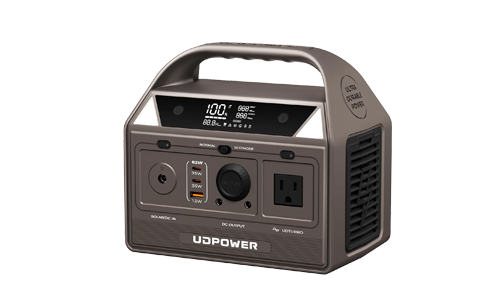
| UDPOWER C200 |  |
192Wh | 200W / Surge up to 400W | 5.40 lbs | Solar-compatible (see product page) | Phones, laptops, lights, router backup, day trips |
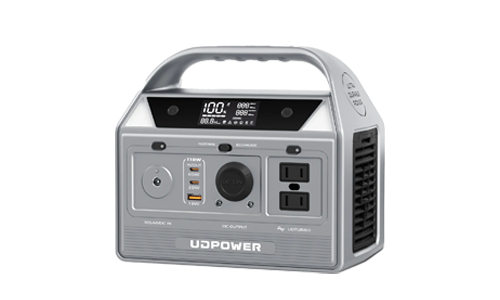
| UDPOWER C400 |  |
256Wh | 400W / 800W surge | ~6.88 lbs | 11V–28V, up to 150W | Compact backup + jump-starter use; weekend trips |
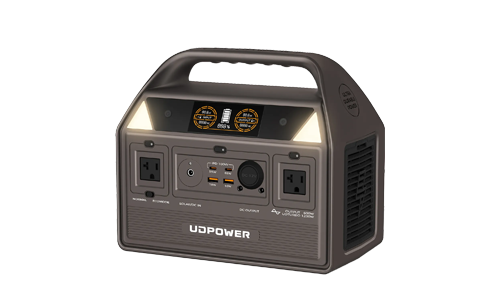
| UDPOWER C600 |  |
596Wh | 600W / Peak 1200W | ~12.3 lbs | 11V–28V, up to 240W | Longer essentials runtime; camera/drone + small fridge time-sharing |
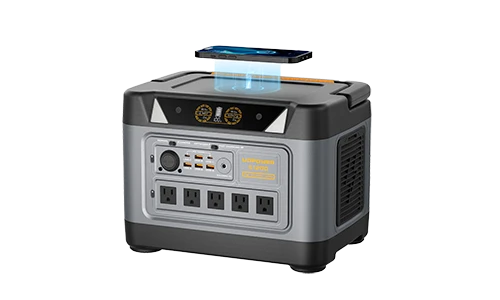
| UDPOWER S1200 |  |
1,190Wh | 1,200W / 1,800W surge | ~25.8 lbs | 12V–75V, 12A, up to 400W | Serious outage essentials: fridge time-sharing, CPAP, Wi-Fi, lights |
| UDPOWER S2400 |  |
2,083Wh | 2,400W / up to 3,000W surge | ~40.8 lbs | 12V–50V, 10A max; up to 400W | Higher-watt appliances in short windows + longer runtime |
If you want solar with verified safety credentials, UDPOWER’s portable panels highlight TÜV certification and IP65 rating (example: the “200W portable foldable” product page lists 210W output and TÜV-certified) (210W portable panel details).
A 15-minute “power outage drill” that prevents buyer’s remorse
Do this once and you’ll instantly know whether your power station fits your life. It also exposes the real downsides (surge issues, port issues, fan noise, runtime expectations) while you still have options.

The drill
- Charge the station to full.
- Plug in your “must-have” chain: modem/ONT + router (use the Wi-Fi guide if you’re unsure: Keep Wi-Fi Running).
- Add one comfort load: a lamp or fan.
- If you bought it for a fridge: test the fridge start-up (listen for compressor cycles; watch for shutdowns).
- Write down the total watts shown on the display and do a quick runtime estimate using Wh math: Wh basics.
- Unplug wall power for 30 seconds to check UPS behavior (if you’re using it as a UPS).
If your test fails, it usually fails for one of two reasons: (1) the station’s output/surge is too small, or (2) your plan includes high-watt loads that are better served by a generator. That’s exactly what the disadvantages list is trying to help you avoid.
FAQ (focused on disadvantages)
1) Why do portable power stations feel “smaller” than expected?
Because high-watt appliances drain batteries quickly and usable AC energy is less than the nameplate Wh. Plan with a buffer and prioritize essential loads.
2) Can a power station replace a generator?
Sometimes—if your needs are essentials-first and mostly indoor-friendly loads. For big continuous loads (heat, cooking, whole-home), a generator usually wins. Start here: Portable Power Station vs Generator.
3) Why is solar input lower than my panel’s watt rating?
Panel ratings are measured under lab test conditions and real output changes with sun angle, heat, haze, clouds, and shading. Use a realistic derate factor and confirm local solar conditions with an estimator like PVWatts (source).
4) What’s the most common “surge” mistake?
Assuming a fridge’s average watts equals its startup watts. Surge is often the real gatekeeper. If food protection matters, buy surge headroom and test once.
5) Is voltage really that important for solar charging?
Yes. Input voltage limits are strict. Stay within the station’s solar input range. Use this guide if you’re not sure: Solar Charging Voltage Safety.
6) What’s the downside of buying “too small”?
You’ll either trip overload/surge shutdowns or your runtime will be too short—then you’ll be forced into uncomfortable compromises during an outage.
7) What’s the downside of buying “too big”?
Cost and portability. Larger units are heavier and more expensive, and returns can be inconvenient. That’s why a quick at-home drill is worth doing.
8) How do I make a power station work better in a 24–72 hour outage?
Build an essentials-first plan, time-share big loads (like a fridge), keep Wi-Fi separate, and recharge in windows. Use: Runtime Planning for Outages.