

Is It Worth Getting a Portable Solar Panel?
If you’re deciding whether a portable solar panel is actually worth the money, the short answer is: it’s worth it when you’ll use it repeatedly for off-grid charging (camping, RV boondocking, work sites, emergencies)—and not worth it when you need guaranteed power on a fixed schedule (nighttime loads, heavy shade, or high-watt appliances for hours).

1) When a portable solar panel is worth it (and when it isn’t)
- Camping / RV boondocking: top off a power station daily without running a generator.
- Emergency backup (daytime outages): recharge essentials (phones, lights, router) when the grid is down.
- Remote work sites: keep batteries, laptops, radios, and tools charged where outlets don’t exist.
- Long trips: daily “maintenance charging” beats starting a gas engine for small loads.
- Mostly nighttime use: panels don’t produce power at night—so you’re relying on stored battery anyway.
- Heavy shade / apartment balconies: partial shade can slash output; portability doesn’t fix bad sun access.
- Running high-watt appliances for hours: panels charge batteries; they don’t replace a full home solar array.
- One-time “just in case” purchase: if it lives in a closet for years, value is low.
Decision table (fast way to decide)

| Your situation | Portable solar panel value | Why |
|---|---|---|
| Weekend camping, phones/lights, maybe a small fridge | High | Daily top-offs reduce generator time and extend battery runtime. |
| Power outages happen in daytime, you want essentials running | High | Sunlight lets you “refill” a power station for multi-day resilience. |
| You only want power at night | Medium–Low | Solar can still recharge the next day, but it won’t power night loads directly. |
| Shaded yard / dense trees / balcony with limited sun | Low | Output depends on direct sun. No sun = no useful charging speed. |
| You need guaranteed power on a schedule (medical equipment, critical loads) | Medium | Solar is weather-dependent; pair with enough battery capacity and a backup charging method. |
2) What you actually get from a portable panel
Think of a portable solar panel as a battery refiller. It’s most valuable when you can: (1) put it in strong sun for several hours, and (2) store that energy in a power station.
What it does well
- Silent charging: no fuel, no fumes, no idling engine.
- Low ongoing cost: after purchase, sunlight is free.
- Flexible placement: move it to follow sun, avoid shade, and improve angle.
What it can’t do (without enough battery)
- Guaranteed power anytime: clouds and night stop production.
- Continuous high-watt supply: big appliances still require big batteries (and often more solar than people expect).
3) Real-world output: what to expect
A panel’s watt rating is measured under Standard Test Conditions (STC). Real conditions usually differ: panel temperature rises in the sun, the sun angle changes, and even light haze reduces irradiance. That’s why it’s smart to estimate using a conservative planning factor.
Expected Daily Energy (Wh) ≈ Panel W × Peak Sun Hours × 0.75
(That 0.75 is a “real-world” cushion for losses and imperfect conditions.)
Example: daily energy harvested (planning estimate)
Use NREL PVWatts to estimate your location’s sun resource (peak sun hours vary by season and region).

| Panel size | 3 peak sun hours | 4 peak sun hours | 5 peak sun hours |
|---|---|---|---|
| 120W | ~270 Wh/day | ~360 Wh/day | ~450 Wh/day |
| 210W | ~473 Wh/day | ~630 Wh/day | ~788 Wh/day |
What changes your output the most

| Factor | What it does | What to do about it |
|---|---|---|
| Shade (even partial) | Can drop output sharply, especially when a section of cells is shaded | Move the panel; avoid tree shadows; re-check every 30–60 minutes |
| Sun angle / tilt | Flat panels waste sun when the sun is low | Use a stand; aim the panel at the sun (re-aim a few times a day) |
| Heat | Hot panels are less efficient than cool panels | Allow airflow behind the panel; don’t lay it on hot surfaces |
| Soiling (dust, sand, pollen) | Blocks light and reduces output | Wipe gently with a soft cloth when needed |
| Charge controller behavior | Your power station controls how much it accepts | Stay within the station’s voltage/current limits; don’t exceed solar input specs |
4) How to size a portable solar panel (simple math)
Sizing is easier if you think in watt-hours (Wh)—how much energy you use per day. Add up your essentials, then decide how many hours of good sun you usually have.

Step 1: estimate your daily “must-have” energy
| Device | Watts (W) | Hours/day | Daily energy (Wh) |
|---|---|---|---|
| Phone charging | 10 | 2 | 20 |
| LED lights (string or lantern) | 15 | 4 | 60 |
| Wi-Fi router | 10 | 8 | 80 |
| Small DC fridge (average draw) | 60 | 8 | 480 |
| Total (example) | — | — | 640 Wh/day |
Step 2: pick a realistic solar target
Use the planning formula: Panel W ≈ Daily Wh ÷ (Peak Sun Hours × 0.75)
Panel W ≈ 640 ÷ (4 × 0.75) ≈ 213W
In plain English: a ~200W-class portable panel is a sensible starting point for that load profile in decent sun.
Reminder: if your goal is “run heavy appliances,” the limiting factor is often battery size and inverter output—not the panel. Solar helps you recharge; it doesn’t magically make a small battery behave like a whole-home system.
5) Compatibility: voltage, connectors, and “will it charge my power station?”
This is where many people get burned: not every portable panel works with every power station. You must match the panel’s electrical output to what your power station accepts.

Compatibility checklist (don’t skip this)
- Solar input voltage range (power station): your station will list something like “11–28V” or “12–75V.”
- Panel open-circuit voltage (Voc): must not exceed the station’s max input voltage.
- Panel operating voltage (Vmp / “maximum voltage”): should fall within the station’s working range.
- Connector type: confirm what cable/adapter is needed (common ones include DC7909, MC4, XT60, DC5521).
- Watt limit: staying under the station’s max solar watts prevents throttling or refusal to charge.
UDPOWER station examples (why specs matter)
| Power station (example) | What the station supports (solar) | Practical pairing guidance |
|---|---|---|
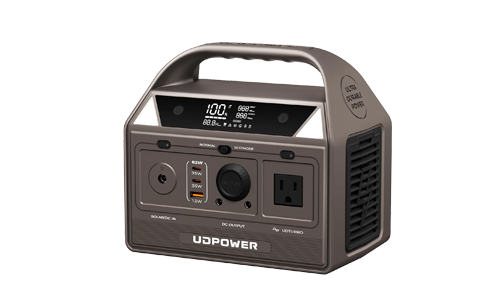
| UDPOWER C600 | Solar input within 11–28V (up to ~240W) | A 120W-class panel in the correct voltage range is a safe match. The C600 page also notes it can harness up to 240W in good sun. Avoid high-voltage panels outside the station range. (Source: UDPOWER C600) |
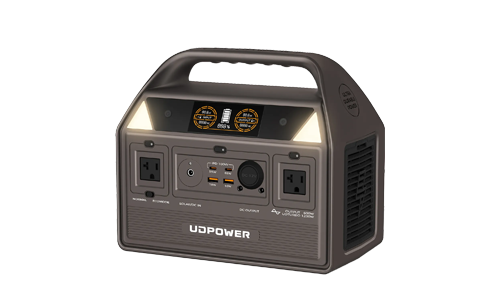
| UDPOWER S1200 | Solar charging input listed as 12–75V, 12A, up to 400W | A higher-voltage portable panel can be appropriate when it stays within 12–75V and under 400W. (Source: UDPOWER S1200) |
If you’re mixing brands: always verify voltage/current specs and connector type before plugging anything in. When in doubt, use the panel brand that’s designed for the station—or ask support with the exact model numbers and spec lines.
6) UDPOWER portable panel examples
If you want a concrete reference point, here are two UDPOWER portable options with published specs on the official site. (Links go to the product pages so you can verify details directly.)

Specs at a glance
| Model | Rated power | Voltage / current (as listed) | Efficiency / durability | Portability | Best for |
|---|---|---|---|---|---|
|
UDPOWER 120W Portable Solar Panel View on UDPOWER |
120W | Open Circuit Voltage: 17.8V Maximum Voltage: 21.7V Short Circuit Current: 6.65A Running Current: 6.17A |
≥22% efficiency IP65 Service life > 10 years Operating temp: -40℉ to 185℉ TÜV certified |
Weight: 8.93 lb Folded: 18.7 × 31.5 × 0.59 in Unfolded: 34.4 × 31.5 × 0.14 in |
Lightweight trips, smaller power stations, everyday top-offs |
|
UDPOWER 210W Portable Foldable Solar Panel View on UDPOWER |
210W | Open Circuit Voltage: 48.0V Maximum Voltage: 40.0V Short Circuit Current: 5.40A Running Current: 5.00A |
≥22% efficiency IP65 Service life > 10 years Operating temp: -40°F to +185°F ETFE + PET laminated surface TÜV certified |
Weight: 15.32 lb Folded: 23.66 × 23.15 × 0.79 in Unfolded: 86.22 × 23.66 × 0.14 in |
Faster daytime refills for compatible higher-input stations and longer off-grid days |

What those numbers mean in real life
| Panel | Watts per pound (approx.) | Unfolded area (approx.) |
|---|---|---|
| 120W | ~13.4 W/lb | ~7.5 sq ft |
| 210W | ~13.7 W/lb | ~14.2 sq ft |
Translation: the larger panel isn’t “more efficient” to carry—it’s just more total sun-harvesting surface, so it charges faster in the same sun.
UDPOWER’s own listings include model-specific notes (for example, smaller stations may have lower solar input limits, and some models are intended for lower-voltage panels). Always match the panel’s voltage to your station’s accepted range.
If you want to browse all official options: UDPOWER Solar Panels collection.
7) Buying checklist: what to compare before you buy

| What to check | Why it matters | What “good” looks like |
|---|---|---|
| Electrical match (Voc / Vmp vs station input range) | Prevents non-charging or potential damage | Panel voltage stays within station limits in all conditions |
| Rated watts (W) vs your daily Wh needs | Determines how much you can refill per day | Panel sized from your Wh/day and sun hours with a conservative factor |
| Durability (IP rating, materials) | Outdoor use = dust, splashes, abrasion | IP65-style rating and rugged surface (e.g., ETFE laminations) |
| Portability (fold size, weight) | Real-world convenience | Fits your storage spot; can be carried and deployed easily |
| Stand/tilt support | Angle drives output | Stable kickstands; easy re-aiming during the day |
| Parallel/expand options | Faster charging if your station supports more input | Clear, safe method to add panels without exceeding station limits |
| Warranty & support | Outdoor gear takes wear | Clear warranty terms and responsive support |
8) FAQs
Q1) Will a portable solar panel work on cloudy days?
Yes, but output is lower. Cloud cover reduces irradiance, so charging becomes slower. Plan for variability if you need daily reliability.
Q2) Do I need a charge controller?
Most modern portable power stations have built-in solar charge control (often MPPT). If you’re charging a standalone 12V battery directly, you typically need a controller—but with a power station, you usually don’t add a separate one unless the manufacturer requires it.
Q3) What size portable panel is “enough” for emergencies?
For essentials (phones, lights, router), a ~100–200W class panel paired with adequate battery capacity often covers basic needs—if you have decent sun access. Use your Wh/day needs to size it.
Q4) Can I run appliances directly from the panel?
Typically no (or not well). Most people charge a battery/power station first, then run appliances from the battery. Direct operation is unstable because sunlight changes minute to minute.
Q5) Why does my “120W” panel only show ~60–90W sometimes?
Normal reasons: imperfect sun angle, heat, thin clouds, shade, dirty surface, or the power station limiting intake. Re-aim the panel and confirm you’re within voltage limits.
Q6) Is higher watt always better?
Only if (1) your power station can accept it, (2) you can deploy the larger panel, and (3) you actually need the extra daily Wh. Bigger panels can be heavier and take more space.
Q7) Should I get one large panel or two smaller panels?
Two smaller panels can be easier to place around shade and can add flexibility—if your station supports combining them and you stay within the station’s max input.
Q8) Is portability worth paying for compared to a rigid panel?
For car camping and occasional use, portability is often worth it because setup and storage are much easier. If you have a dedicated RV roof setup, a rigid mounted system may be better long-term.
Q9) What’s the single biggest “deal breaker” spec?
Voltage compatibility (Voc vs the station’s max input). A mismatch is the fastest path to “it doesn’t work.”
Q10) What if I’m not sure about connectors?
Check both the panel output connector and your power station’s solar input port type. If needed, use the manufacturer-recommended cable/adapter, and confirm it’s rated for the current and voltage you’ll see.
9) Sources & methods
This guide uses a conservative “portable solar planning” approach: estimate daily harvested energy by combining your panel rating, your location’s sun resource, and an efficiency cushion to reflect real-world conditions.
- Sun resource estimates (by location): NREL PVWatts Calculator
- Why real-world performance differs from nameplate: U.S. DOE / FEMP “Understanding Solar Photovoltaic System Performance” (PDF)
- Background on PV performance & efficiency concepts: U.S. DOE Solar Performance & Efficiency
- UDPOWER published specs used in the tables: UDPOWER 120W panel, UDPOWER 210W panel, UDPOWER C600, UDPOWER S1200
Related Articles


