Everything You Need to Know About RV Traveling in the USA
Updated September 3, 2026 · A practical guide for first-time RV travelers, weekend campers, families, and long-distance road trippers
Quick answer: RV travel in the USA is easiest when you plan around four things: the size of your RV, where you are legally allowed to stay, how you will handle water and waste, and how you will keep essential devices powered. For a first trip, choose a manageable route, reserve campgrounds that explicitly fit your RV length, keep an emergency power source onboard, and avoid assuming that overnight parking or dispersed camping is legal everywhere.
For most beginners, a 2–4 night regional trip is a better first experience than an ambitious cross-country drive. You will learn how your RV handles fuel stops, hookups, leveling, dumping, weather and daily driving before committing to a much longer route.

What Is RV Travel Really Like?
RV travel gives you a combination that ordinary road trips cannot quite match: your transportation, bedroom, kitchen and campsite can move with you.
But an RV trip is not simply a hotel room on wheels. You have to think about vehicle dimensions, fuel consumption, campsite access, water tanks, wastewater, electricity, weather and driving time.
The biggest beginner mistake is usually trying to solve everything at once. A better approach is to build a trip around a few predictable systems:
- Drive: Know your RV's total length, height, width and weight.
- Sleep: Confirm exactly where you are allowed to stay overnight.
- Power: Know which appliances need AC power and which can run from 12V or USB.
- Water: Understand fresh, gray and black water before leaving home.
- Connectivity: Download maps and important information before entering areas with weak service.
- Emergency: Have a plan for flat tires, dead batteries, bad weather and unexpected campground closures.
Once these basics become routine, RV travel becomes much less intimidating.
How to Choose the Right RV
You do not need the biggest RV to have a great trip. In fact, a smaller RV can make a first trip easier because it is generally easier to maneuver, park and fit into older campgrounds.
| RV Type | Typical Characteristics | Best For | Main Trade-Off |
|---|---|---|---|
| Class A | Large motorhome with substantial living space | Families, full-time RVers, extended trips | Large footprint, higher fuel use and more demanding driving |
| Class B | Van-based and relatively compact | Couples, solo travelers, flexible road trips | Less interior living and storage space |
| Class C | Truck/van-based cab with a raised coach section | Families and first-time RV travelers | Larger than a van while still requiring careful maneuvering |
| Travel Trailer | Towed behind a compatible vehicle | Campers who want a separate tow vehicle | Requires towing skills and careful weight management |
| Fifth Wheel | Large towable attached through a fifth-wheel hitch | Long stays and high living-space requirements | Requires an appropriate heavy-duty tow vehicle |
If you are renting for the first time, resist the temptation to rent the largest RV available simply because it looks more comfortable. A vehicle that is difficult to park can turn every campground arrival into a stressful event.
RV Size Matters More Than Beginners Expect
One of the most important numbers in RV travel is the actual length of your rig.
Do not look only at the advertised length of the motorhome or trailer. If you are towing, consider the total vehicle-and-trailer combination where the campground's rules require it.
National Park Service campgrounds can have surprisingly tight vehicle-length limits. Yosemite, for example, notes that RV and trailer maximum lengths can differ because of campground access and turning radius.
Some roads can be even more restrictive than the campground itself. Sequoia National Park warns that its roads can be narrow, winding and steep, with specific restrictions and advisories for longer vehicles.
| Before Booking | What to Check | Why It Matters |
|---|---|---|
| RV length | Maximum RV length for the individual site | Your rig may physically not fit even if the campground accepts RVs. |
| Trailer length | Maximum trailer or combination length | Trailer maneuverability can be more restrictive than motorhome length. |
| Vehicle height | Low bridges, tunnels and overhead clearance | A route suitable for a car may not be suitable for a tall RV. |
| Road geometry | Sharp turns, steep grades and narrow roads | Some scenic roads are simply poor choices for large RVs. |
| Site type | Pull-through vs. back-in | Pull-through sites are often easier for first-time drivers. |
How to Plan an RV Route in the USA
Good RV route planning is different from planning a normal car trip. The fastest route is not always the best route.
Your route should account for fuel stops, campground access, weather, road grades, vehicle restrictions, cell coverage and how long you realistically want to drive each day.
Start with a realistic daily driving target
For a first trip, planning roughly 3–5 hours of actual driving per day can be more comfortable than trying to cover hundreds of miles every day. Fuel stops, meals, traffic, bathroom breaks, campground check-in and unexpected delays add time quickly.
Plan the route around the campsite
Do not book a campsite first and assume your navigation app will automatically find the perfect RV route. Check the route separately for low clearances, steep grades, vehicle restrictions and road conditions.
Build in one flexible night
For a longer trip, leaving one night uncommitted can be surprisingly useful. A delayed departure, weather event or mechanical problem can otherwise turn a small delay into a chain of missed reservations.
Use official park information
For national parks, use the National Park Service site for current park-specific restrictions and campground information. For many federal recreation reservations, Recreation.gov is the relevant booking platform.
Where Can You Stay in an RV?
There is no single nationwide rule that says where an RV can spend the night. Overnight parking and camping rules vary by land manager, city, business and campground.
Your main options are:
| Location Type | Typical Benefits | Things to Verify |
|---|---|---|
| National Park Campground | Access to major natural attractions | RV length, reservation windows, hookups, generator rules and seasonal closures |
| State Park | Often scenic with a mix of developed facilities | State-specific reservation system and RV restrictions |
| Private RV Park | More predictable hookups and amenities | Rates, cancellation policies, site size and utility setup |
| BLM/Public Land | Potentially excellent for dispersed camping | Local district rules, stay limits, fire restrictions and access conditions |
| Forest Service Land | Many scenic camping opportunities | District-specific dispersed camping rules and seasonal restrictions |
| Commercial Parking | Useful for overnight stops in some areas | Permission and local restrictions must be confirmed first |
Do not assume a parking lot is a campground
One of the most common RV travel myths is that a business parking lot automatically allows overnight RV stays. It does not.
If you are considering a Walmart, Cracker Barrel, truck stop or other private property, confirm with the specific location and check local rules. A national company's general policy is not a guarantee that every individual property permits overnight RV parking.
Likewise, parking at a scenic overlook or roadside pull-off is not automatically legal camping. Some public lands explicitly prohibit overnighting in those locations.
Boondocking and Dispersed Camping
Boondocking means camping without normal campground hookups. Depending on the location, you may have no electrical pedestal, no water connection, no sewer connection and limited cell service.
That independence is a major reason people love RV travel, but it changes how you prepare.
Before dispersed camping, verify five things
- Who manages the land?
- Is dispersed camping allowed at the exact location?
- How long may you stay?
- Are there current fire, weather or road restrictions?
- Can your RV physically reach the site and safely leave?
Do not treat a map pin from a social-media post as proof that camping is currently legal.
Rules can be very local. Stay limits, fire regulations and access rules can differ from one BLM field office or public recreation area to another.
How Far Ahead Should You Book an RV Campsite?
Popular national parks and holiday weekends can require much more planning than an ordinary roadside hotel.
When a campground uses reservations, search by your actual equipment type and length. Many reservation systems allow users to filter campsites based on vehicle or RV length.
Do not reserve a site that is technically shorter than your RV simply because you think you can "make it work." Access roads, turning radius and parking-pad length may all limit whether your equipment can safely fit.
Reserve earlier when:
- You are traveling during summer.
- Your trip includes a major national park.
- You are traveling around Memorial Day, July 4th or Labor Day.
- You need a large RV site.
- You require full hookups.
- You are traveling with several vehicles or a large group.
Use a cancellation strategy
If your preferred campground is sold out, do not immediately abandon the trip. Check nearby campgrounds, shorter stays, different site types and cancellation availability.
Popular campgrounds frequently see reservations return to the system after cancellations, so checking again can sometimes open up a workable site.
How to Power an RV on the Road
Power planning is one of the areas where RV travel differs dramatically between a full-hookup campground and an off-grid campsite.
At a developed campground, you may connect to shore power. When boondocking, however, your available electricity comes from your house batteries, solar panels, generator or portable power station.
Separate your electrical loads into three groups
| Load Type | Examples | Planning Priority |
|---|---|---|
| Essential low-power | Phones, USB devices, LED lights, communication equipment | Very easy to support with a small power station |
| Moderate loads | Laptops, fans, TV, small refrigerator or cooler | Requires more battery capacity for overnight use |
| High-power loads | Microwave, coffee maker, electric kettle, hair dryer, heater | Requires substantially higher inverter output |
| Very high-power loads | RV air conditioner, large electric heating appliances | Often unsuitable for mid-size portable power stations |
The important distinction is between watts and watt-hours.
- Watts (W) indicate how much power a device requires while operating.
- Watt-hours (Wh) indicate how much stored energy the battery contains.
For planning UDPOWER AC loads, a 90% conversion-efficiency planning factor can be used for normal loads within the rated output range. Actual runtime will vary with device cycling, temperature, battery condition and other loads.
For example, a 100W load on a 1,190Wh-class battery would be roughly:
This is a planning estimate, not a guarantee. A refrigerator is particularly difficult to estimate because its compressor cycles on and off instead of drawing its maximum rated power continuously.
Portable Power Stations for RV Travel
A portable power station is especially useful in an RV as a secondary power system. It does not have to replace the RV's entire electrical system to be valuable.
For many travelers, its most useful job is keeping essential electronics and selected appliances operating when shore power is unavailable or when running a gasoline generator would be unnecessary.
Which UDPOWER model makes sense for RV travel?
UDPOWER C400 — Best for Lightweight RV Essentials
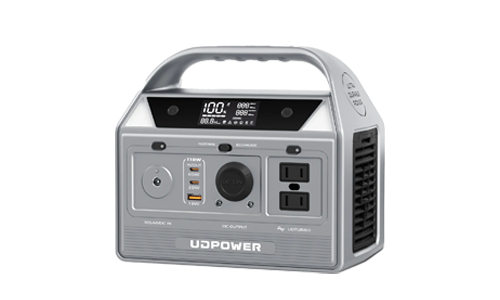
The C400 is a practical choice when the goal is portability rather than powering the entire RV. It works well for phones, laptops, LED lighting, cameras, small fans, CPAP equipment and other lower-power devices.
- Capacity: 256Wh
- Rated AC output: 400W pure sine wave
- Surge output: 800W
- Battery: LiFePO4
- Weight: approximately 6.88 lb
- Solar input: up to 150W
- AC outlets: 2
- USB-C: up to 100W total
- 12V car output: up to 136W
- Charging: AC, USB-C, vehicle and solar
UDPOWER S1200 — Best All-Around Choice for Longer RV Trips
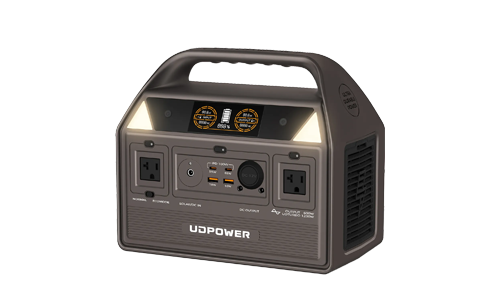
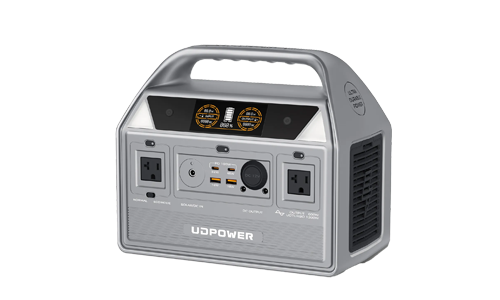
If your RV trips include a refrigerator, CPAP, laptops, fans, lighting and several devices, the S1200 gives you substantially more energy reserve than a compact camping power station.
- Capacity: 1,190Wh class
- Rated AC output: 1,200W pure sine wave
- UDTURBO output: up to 1,800W for compatible loads
- Battery: LiFePO4
- Weight: approximately 26 lb
- AC outlets: 5 on the current gray version
- USB-C: up to 100W total
- USB-A: 4 ports
- 12V car output: up to 144W
- Solar input: up to 400W
- UPS response: ≤10ms
UDPOWER lists approximately 10–15 hours for a standard refrigerator using an average 60–100W running load, although actual refrigerator runtime depends heavily on compressor cycling and ambient temperature.
UDPOWER C600 — A Middle Ground for Camping and RV Support
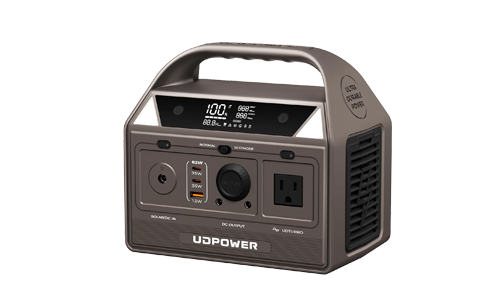
The C600 sits between compact emergency power and larger RV backup systems. Its 596Wh capacity and 600W rated output make it useful for weekend trips where you want more reserve than the C400 without carrying a 26-pound S1200.
- Capacity: 596Wh
- Rated AC output: 600W
- Peak output: 1,200W
- Battery: LiFePO4
- Weight: approximately 12.3 lb
- Best suited to: weekend camping, electronics, fans, small refrigerators and medium loads
RV power station comparison
| Model | Capacity | Rated Output | Weight | Best RV Use | Product |
|---|---|---|---|---|---|
| C200 | 192Wh | 200W | 5.4 lb | Phones, lights and basic electronics | View |
| C400 | 256Wh | 400W | 6.88 lb | Lightweight RV electronics and short backup | View |
| C600 | 596Wh | 600W | 12.3 lb | Weekend RV trips and medium loads | View |
| S1200 | 1,190Wh | 1,200W | 26 lb | Longer trips, refrigerator, CPAP and multiple devices | View |
| S2400 | 2,083Wh | 2,400W | 40.8 lb | Large off-grid setups and higher-power appliances | View |
Using Solar Power During an RV Trip
Solar charging becomes particularly valuable when you are staying away from electrical hookups for multiple days.
The basic idea is simple: use solar panels during daylight hours to replace some of the energy consumed overnight.
But solar output is not constant. Cloud cover, panel angle, shade, season, temperature and the sun's position all affect actual charging performance.
UDPOWER 120W Portable Solar Panel
The 120W folding panel is designed for portable charging during camping and RV trips. It uses A-class monocrystalline cells, has a rated output of 120W and a published efficiency of at least 22%.
- Rated output: 120W
- Open-circuit voltage: 21.5V
- Maximum voltage: 17.92V
- Running current: 5.582A
- Efficiency: ≥22%
- Water resistance: IP65
- Cell type: A-class monocrystalline silicon
- Folded size: 18.58 × 15.94 × 1.57 in
Solar charging mistakes to avoid
- Do not assume a 200W panel will always produce 200W.
- Do not leave a panel in shade and expect normal charging.
- Do not connect a panel simply because its connector physically fits.
- Check the power station's voltage and current input limits first.
- Do not leave solar panels permanently exposed to severe weather unless their specifications allow it.
For example, UDPOWER's current 120W panel documentation specifies compatibility with several UDPOWER stations while also giving model-specific solar-input notes. The C600 has its own solar voltage limitation, so users should verify the supported panel specification before connecting a larger panel. See the solar connector and panel pairing guide.
Water, Sewer and Dump Stations
New RVers often spend more time worrying about electricity than water. In practice, water management is one of the first systems you need to understand.
Know the three basic tanks
| Tank | What It Holds | Beginner Tip |
|---|---|---|
| Fresh Water | Clean water for drinking and RV use | Do not fill more than necessary when driving because water adds significant weight. |
| Gray Water | Water from sinks and showers | Monitor the level during longer stays. |
| Black Water | Toilet waste | Use appropriate holding-tank practices and dump only at permitted facilities. |
Full hookups vs. partial hookups
A full-hookup site normally gives you electrical service plus water and sewer connections. A partial-hookup site may provide only some of these services.
Always check the individual campsite description rather than assuming every RV site includes everything.
Some national park campgrounds have water fill stations and dump stations but no individual full hookups, so plan your fresh-water and wastewater stops before arrival.
RV Internet and Cell Service
Cell coverage can disappear quickly once you leave cities and major highways.
If you need reliable internet for work, navigation or emergencies, build redundancy into your setup.
- Download offline maps before leaving town.
- Save campground confirmation numbers locally.
- Download important park information as PDFs or screenshots.
- Carry charging cables for phones and hotspots.
- Consider multiple cellular networks if connectivity is mission-critical.
- Do not assume a campground listed as having "Wi-Fi" provides work-quality internet.
A small portable power station can be particularly useful here. A router or hotspot may consume only a small amount of power, but keeping it running overnight can be more important than powering a high-watt appliance.
How Much Does RV Travel Cost?
The cost of RV travel varies dramatically depending on whether you own or rent the RV, how far you drive, the type of campground you choose and how often you cook.
Instead of using one universal "RV trip cost," build your budget around the actual trip.
| Expense | What Changes the Cost | How to Control It |
|---|---|---|
| RV rental or ownership | RV class, age, season and rental duration | Rent before buying and compare total trip cost. |
| Fuel | RV size, fuel price, mileage and distance | Reduce unnecessary driving and plan fuel stops. |
| Campgrounds | Location, hookups, season and amenities | Mix developed campgrounds with legal low-cost public camping where appropriate. |
| Food | Restaurant frequency and group size | Use the RV kitchen for breakfasts and simple meals. |
| Propane | Heating, cooking and refrigerator configuration | Track consumption during cold-weather trips. |
| Dump/fill services | Location and campground facilities | Plan dump and water stops along the route. |
| Maintenance | RV age, mileage and mechanical condition | Inspect before leaving rather than after a problem occurs. |
The hidden cost: inefficient driving
Driving 150 extra miles because the original campground plan was unrealistic can cost more than choosing a slightly more expensive campsite near your destination.
For RV trips, convenience sometimes has real financial value.
RV Safety and Pre-Departure Checks
An RV is a vehicle first. Camping comfort comes after making sure the vehicle is safe to drive.
Pre-Departure RV Checklist
- ☐ Check tire pressure when tires are cold.
- ☐ Inspect tires for damage and unusual wear.
- ☐ Test brake lights and turn signals.
- ☐ Check engine oil and coolant where applicable.
- ☐ Verify mirrors and cameras are adjusted.
- ☐ Confirm the awning is fully retracted.
- ☐ Retract leveling jacks.
- ☐ Secure cabinets, drawers and loose equipment.
- ☐ Close exterior storage compartments.
- ☐ Confirm doors and windows are secured.
- ☐ Check propane equipment according to the RV manufacturer's instructions.
- ☐ Confirm the fresh, gray and black water plan.
- ☐ Make sure batteries are adequately charged.
- ☐ Confirm your emergency power source is ready.
Never rely on one safety system
Carry a fire extinguisher, first-aid supplies, flashlight or headlamp, reflective equipment and a way to contact roadside assistance.
For electrical connections, use equipment appropriate for the RV and campground pedestal. RV electrical safety standards continue to evolve, so owners of newer RVs should also follow the electrical requirements and instructions provided by the RV manufacturer.
RV Laws, Licenses and Restrictions
There is no single RV law covering every situation in every state.
Requirements can vary based on the state, vehicle type, vehicle weight, trailer configuration, road and campground rules.
Before a multi-state trip, check the relevant state DMV or transportation agency for licensing, towing, passenger, equipment and size requirements.
Important rules to check
- Driver's license requirements for the RV or combination.
- Trailer brake requirements.
- Maximum vehicle and trailer dimensions.
- Seat-belt requirements.
- Overnight parking rules.
- Propane restrictions in tunnels or other controlled areas.
- Road restrictions for oversized vehicles.
- Winter tire or chain requirements when applicable.
- Local fire restrictions.
Traveling With Kids or Pets
With kids
Long RV days are easier when children have predictable stops. Instead of driving until everyone is exhausted, plan regular breaks around food, bathrooms and short outdoor activities.
Keep the most frequently needed items accessible rather than buried inside storage compartments.
With pets
Bring food, water, medication if needed, identification information and a secure restraint system appropriate for the animal and vehicle.
Never assume a trail or campground allows pets simply because pets are allowed at the campsite. Park rules can differ by area and trail.
Temperature is another major consideration. An RV can become dangerously hot or cold if climate control fails. If pets will be left inside temporarily, have an emergency plan rather than relying on a single electrical source.
RV Campground Etiquette
Good RV etiquette is simple: treat the campground as a shared neighborhood.
- Respect posted quiet hours.
- Keep generators away from neighboring campers when permitted.
- Do not drive through another camper's site.
- Keep pets under control.
- Clean up immediately after pets.
- Keep outdoor lights reasonable at night.
- Do not dump wastewater outside approved facilities.
- Leave the site cleaner than you found it.
Generator rules can be much more restrictive than first-time RVers expect. Some national park campgrounds permit generators only during specific daytime windows, and rules can vary even between campgrounds in the same region.
This is one reason battery-based power can be useful for nighttime electronics and low-power devices.
Common First-Time RV Mistakes
1. Driving too far on the first day
RV driving takes more concentration than driving a normal car. Give yourself time to stop, fuel, eat and set up camp.
2. Booking a campsite without checking RV length
"RV allowed" does not necessarily mean "my RV fits."
3. Forgetting the total height
A route that works for a sedan may contain a bridge or tunnel that does not work for a tall RV.
4. Treating every parking lot as legal overnight camping
Always verify permission and local rules.
5. Trying to run every appliance from battery power
Large electric heaters, air conditioners, kettles and cooking appliances can consume battery capacity extremely quickly.
6. Ignoring startup power
Compressors, pumps and motors can draw more power when starting than their normal running load suggests.
7. Forgetting solar shade
A beautiful campsite underneath a dense tree canopy may be a poor location for solar charging.
8. Arriving after dark without practicing setup
Leveling, water connections, sewer connections and electrical hookups are much easier when you already know your equipment.
9. Not having offline information
Cell service is not guaranteed. Download your maps, reservation confirmations and important contact information.
A Simple 3-Day First RV Trip
You do not need to cross the country for your first RV adventure. A short regional loop lets you learn the RV without turning every mistake into a major problem.
Day 1 — Drive, arrive and set up
- Morning: Complete the vehicle inspection.
- Late morning: Fuel up and begin the drive.
- Afternoon: Arrive before dark.
- Late afternoon: Level the RV and connect utilities.
- Evening: Prepare a simple meal and test your electrical setup.
Day 2 — Explore locally
- Keep driving to a minimum.
- Use the RV as your base camp.
- Recharge portable electronics.
- Use solar charging during daylight if conditions allow.
- Check battery, water and waste levels before dinner.
Day 3 — Pack, dump and return
- Disconnect utilities.
- Secure all interior and exterior equipment.
- Complete a walk-around inspection.
- Visit a dump station if required.
- Take a less ambitious route home if possible.
First RV Trip Packing Checklist
| Category | Essential Items |
|---|---|
| Documents | Driver's license, registration, insurance, campground reservation details |
| Electrical | Charging cables, adapters, appropriate shore-power equipment, portable power station |
| Water | Potable-water hose, pressure regulator, water filter where appropriate |
| Sewer | Sewer hose, fittings and disposable gloves |
| Safety | Fire extinguisher, first-aid kit, flashlight, roadside emergency supplies |
| Navigation | Phone, offline maps, physical backup information |
| Comfort | Weather layers, bedding, towels, basic toiletries |
| Food | Drinking water, snacks, easy meals and coffee supplies |
| Outdoor | Chairs, leveling blocks, outdoor lighting and appropriate weather gear |
RV Travel FAQ
Is RV travel in the USA difficult for beginners?
It can feel complicated at first because driving, camping, electricity, water and waste management are all new systems. A short 2–4 night trip is usually easier to manage than starting with a cross-country journey.
How many days should my first RV trip be?
Three days and two nights is a good starting point. It is long enough to practice campsite setup, hookups, water management and packing without creating a large logistical problem if something goes wrong.
Can I sleep anywhere in an RV?
No. Overnight RV parking depends on the land manager, campground, city, business or property owner. Always verify that overnight parking or camping is allowed at the specific location.
Can I sleep overnight at Walmart?
Some individual Walmart locations may allow overnight RV parking, while others may prohibit it because of local laws, property rules or management decisions. Ask the specific store and check local restrictions instead of assuming it is allowed nationwide.
Can an RV use a portable power station?
Yes, but a portable power station is best treated as a supplemental power source unless its output and capacity have been specifically sized for the RV's electrical loads. It is particularly useful for phones, laptops, lights, CPAP equipment, fans, small refrigerators and selected appliances.
What size portable power station is best for RV travel?
For lightweight electronics, a C400-class unit can be sufficient. A C600 provides more reserve for weekend trips, while a 1,000Wh-class model such as the S1200 is more appropriate when you need longer runtime for refrigerators, CPAP equipment, fans, laptops and multiple devices.
Can a portable power station run an RV air conditioner?
Most mid-size portable power stations are not a practical solution for running an RV air conditioner for extended periods. RV air conditioners can require substantial continuous power and high startup power. Check the air conditioner's actual electrical requirements and the power station's rated output before attempting to connect it.
Can I charge a portable power station from solar while RV camping?
Yes, if the solar panel's voltage and current are compatible with the power station. Actual charging speed depends on sunlight, panel orientation, shade, temperature and the power station's maximum solar input.
How much battery capacity do I need for a weekend RV trip?
There is no universal number. A weekend focused on phones, lights and laptops may need only a few hundred watt-hours, while a trip involving a refrigerator, CPAP, fan and multiple devices can justify 1,000Wh or more.
Do national parks allow large RVs?
Many national parks accommodate RVs, but individual campgrounds and roads can have strict length restrictions. Always check the exact campground and route rather than relying on a park-wide "RV friendly" label.
Do RV campgrounds always have electricity?
No. Some RV campsites are non-electric. Others provide electric service but no water or sewer. Read the individual campsite description before booking.
Should I book RV campgrounds in advance?
For popular national parks, summer travel, holidays and large RVs, advance booking is strongly recommended. Check cancellation availability if your preferred campground is full.
Is boondocking legal everywhere on BLM land?
No. Dispersed camping rules vary by BLM field office and recreation area. Check the current rules for the exact location, including stay limits and fire restrictions.
Final Takeaway
RV travel in the USA becomes much easier when you stop treating the trip as one big decision and break it into manageable systems.
Choose an RV you can comfortably drive. Build a route that matches the vehicle. Verify campground length limits before booking. Know whether you have full hookups, partial hookups or no hookups. Plan your water and waste stops. Download maps before losing cell service. And have a backup power plan for the devices and appliances that matter most.
For power specifically, think in terms of watts and watt-hours rather than simply buying the biggest battery available. A compact C400 can be a smart lightweight companion. The C600 gives weekend travelers more breathing room. For longer RV trips, refrigerator backup, CPAP use and multiple devices, the S1200 provides a much larger energy reserve and higher output.
The best RV trip is not necessarily the one with the most miles or the most expensive equipment. It is the one where you have enough preparation to enjoy the road instead of constantly solving preventable problems.
Ready to Build Your RV Power Setup?
Start with your actual devices, estimated daily runtime and whether you will have campground hookups. Then choose the capacity and output that match the trip.
View All Portable Power Stations | Shop Solar Panels | View S1200
1 comment
good start