

RV Living in Texas: Costs, Laws, Weather, Campgrounds, and Power Planning
UDPOWER RV Living Guide
Last updated:
Texas gives RVers a rare mix of affordable long-term parks, warm winter destinations, major-city access, Gulf Coast beaches, Hill Country scenery, and remote West Texas camping. It also brings intense summer heat, severe thunderstorms, flash flooding, long driving distances, and local rules that can make one property legal for RV occupancy while another property a few miles away is not.
This guide explains what full-time RV living in Texas actually requires: where you can stay, what it may cost, how residency and vehicle rules work, which regions fit each season, how to inspect a monthly site, and how to build a realistic backup-power plan.
Quick answer: Is Texas a good state for RV living?
Yes, Texas can be an excellent state for RV living, especially when you use long-term RV parks and move with the seasons. The easiest legal setup is an established park that explicitly permits monthly or extended stays. Living in an RV on privately owned land may also be possible, but land ownership alone does not make full-time occupancy legal. Local zoning, septic, electrical, driveway, floodplain, address, deed, and HOA rules still have to be checked.
A practical 2026 living budget is roughly $1,500 to $4,300 per month before an RV payment and health insurance. A stationary rural setup can be near the lower end. Metro-area resorts, frequent towing, high summer electric use, insurance, maintenance, and repairs can push costs much higher.
Texas is easier to live in when treated as a seasonal state rather than one fixed campsite. South Texas and the Rio Grande Valley are strongest in winter. Hill Country, North Texas, and East Texas are usually more comfortable in spring and fall. During peak summer, prioritize reliable shore power, shade, a properly functioning air conditioner, and a location outside low-lying flood areas.

Is full-time RV living legal in Texas?
Full-time RV living is legal in Texas when the RV is located and occupied in a place where that use is permitted. What Texas does not provide is a blanket statewide rule allowing someone to park an RV on any parcel and turn it into a permanent residence.
In practice, your legal position depends on the type of site, local land-use rules, utility approvals, sanitation, floodplain restrictions, and the written policies of the property owner or RV park.
| Living arrangement | Practical legal position | What to verify before moving in | Useful source |
|---|---|---|---|
| Licensed or established long-term RV park | Usually the simplest route when the park explicitly permits monthly or extended occupancy. | Maximum stay, background checks, RV age rules, mail, utility billing, guest policy, and whether the quoted rate is truly monthly. | Texas Commission on Environmental Quality RV park resources |
| Privately owned land inside city limits | City zoning and occupancy ordinances may prohibit, limit, or permit RV habitation only under specific conditions. | Zoning classification, residential occupancy, utility permits, setbacks, driveway approval, address assignment, and temporary-use limits. | Example of a Texas city RV ordinance |
| Privately owned land outside city limits | There may be fewer zoning restrictions, but county subdivision, septic, floodplain, access, deed, and utility rules can still apply. | County development rules, permitted septic system, floodplain status, legal road access, deed restrictions, electric service, and emergency access. | Texas Local Government Code Chapter 232 |
| Friend or relative's driveway | Temporary parking may be allowed while sleeping in the RV is restricted. | Guest-occupancy limit, street-parking rules, sewer disposal, extension-cord restrictions, and HOA rules. | Contact the applicable city planning or code-compliance office. |
| Texas state park | Suitable for temporary travel, not normally a permanent residential base. | Site length, hookup type, reservation window, entrance fees, and park-specific stay limits. | Texas State Parks FAQ |
Local examples are included to show why one Texas town cannot be used as proof of what another town permits. Always verify the exact address.
Do not rely on the seller's statement that the land has no restrictions
A statement such as unrestricted land may refer only to deed restrictions. It does not automatically confirm legal RV occupancy, septic approval, floodplain clearance, road access, electric service, or city and county compliance.
Can you live in an RV on your own land in Texas?
You may be able to, but you should confirm the use before buying the property or paying to install utilities. The right question is not simply whether RVs are allowed on the land. Storage, temporary parking, guest use, and full-time residential occupancy may be treated as four different uses.
A 48-hour private-land verification process
Step 1: Identify every authority connected to the address
Determine whether the parcel is inside city limits, in an extraterritorial jurisdiction, or fully unincorporated. Then identify the city planning department, county development office, county floodplain administrator, utility provider, and any property owners association.
Step 2: Ask about occupancy, not only parking
Give the office the parcel address or property identification number and ask: Is continuous residential occupancy of a travel trailer, fifth wheel, or motorhome permitted on this parcel? Ask for the ordinance section, permit name, application, or written email response.
Step 3: Verify wastewater before electrical service
A legal electric meter does not prove that the site is approved as a residence. Determine whether the property can connect to public sewer or receive approval for an on-site sewage facility. Do not plan to discharge gray or black water onto the ground.
Step 4: Check floodplain and road access
Confirm whether the intended RV pad, entrance, and utility area are in a mapped flood hazard area. Also verify that the road and driveway can support your combined length, width, turning radius, and weight in wet conditions.
Step 5: Confirm the physical address and mail plan
An undeveloped parcel may not yet have a recognized residential address. Ask whether an address can be assigned and whether emergency services can locate the RV site. A mailing address, physical address, and legal domicile address are not always interchangeable.
Private-land questions to get answered in writing
- Is full-time RV habitation permitted at this exact parcel?
- Is there a time limit for occupied RVs?
- Is a primary house required before an RV can be occupied?
- What setbacks must the RV and utility equipment meet?
- Can the property obtain an approved septic system?
- Can a permanent electric pedestal be installed?
- Is the proposed pad or driveway in a floodplain?
- Are there deed or subdivision restrictions?
- Can the county assign a physical address?
- Is a building, temporary-use, electrical, or occupancy permit required?
Texas residency, registration, and driver-license rules
Where your RV is parked and where you establish legal residency are related, but they are not the same question. A Texas mailing address does not override a local rule that prohibits residential RV occupancy. Likewise, a legal monthly RV site does not automatically provide every document needed for a Texas driver license.
| Requirement | Current practical rule | What RV residents should do | Official source |
|---|---|---|---|
| Vehicle registration after moving to Texas | New residents are directed to title and register their vehicles within 30 days of moving to Texas. | Prepare proof of insurance, ownership documents, identification, and county tax-office requirements. | TxDMV New to Texas |
| Proof of Texas residency | DPS generally requires two printed documents containing the applicant's name and residential address. | Check the current acceptable-document list before relying on an RV park receipt or mail-forwarding address. | Texas DPS residency requirements |
| 30-day residency evidence | One document generally needs to show at least 30 days of Texas residency. The 30-day period is waived for applicants surrendering a valid, unexpired out-of-state license, but proof documents are still required. | Read the current DPS instructions before scheduling the appointment. | Texas DPS document checklist |
| Vehicle safety inspection | Most non-commercial vehicles have not required a safety inspection before registration since January 1, 2025. | Do not assume this removes emissions requirements or commercial-vehicle inspections. | TxDMV registration requirements |
| Emissions inspection | Emissions testing still applies to qualifying vehicles registered in designated counties. | Check the current county list before registering a motorhome or tow vehicle. | TCEQ emissions program |
| Driver-license class | License class is determined by the RV's GVWR or the combination's GCWR and the rating of the towed vehicle. | Read the ratings on the vehicle labels rather than estimating from actual loaded weight. | Texas driver-license classes |
| CDL exemption | Personal RV use may be exempt from CDL rules, but a heavy RV can still require a non-commercial Class A or Class B license. | Confirm your exact vehicle combination with Texas DPS. | Texas DPS CDL-exempt drivers |
Emissions update for late 2026
As of June 16, 2026, the established Texas emissions program covers 17 counties. Bexar County is scheduled to begin qualifying vehicle emissions inspections on November 1, 2026. Recheck the official TCEQ page before registering in San Antonio or Bexar County later in the year.
Do you need a special license for a large RV?
A common mistake is assuming personal use means every RV can be driven with a regular Class C license. Texas DPS lists non-commercial Class A and Class B thresholds for heavier vehicles and combinations.
- A combination with a GCWR of 26,001 pounds or more, when the towed vehicle has a GVWR above 10,000 pounds, may fall under Class A.
- A single vehicle with a GVWR of 26,001 pounds or more may fall under Class B.
- The rating shown by the manufacturer matters; do not rely only on a truck-scale reading after unloading.
Insurance is another separate issue. Tell the insurer that the RV is used full time, where it is normally stored, and whether it is a motorhome or towable. A recreational policy written for occasional vacations may not cover full-time use in the same way.
How much does RV living in Texas cost?
Texas can be inexpensive compared with paying nightly campground rates, but there is no reliable single statewide average. A basic rural monthly park, a coastal winter resort, and an Austin-area site can have completely different pricing.
The following budget is a planning framework, not a promise of what every household will spend.
| Monthly category | Stationary, budget-conscious plan | Comfortable long-term plan | Frequently traveling plan | What changes the number |
|---|---|---|---|---|
| RV site rent | $400–$650 | $650–$1,000 | $900–$1,400+ | Metro location, resort amenities, season, pull-through site, shade, covered pad, and stay length. |
| Metered electricity | $60–$130 | $100–$200 | $120–$250+ | Summer air-conditioning, RV insulation, rate per kWh, number of A/C units, and shade. |
| Propane | $25–$50 | $40–$80 | $50–$120 | Cooking, water heating, furnace use, refrigerator mode, and winter freezes. |
| Tow-vehicle or motorhome fuel | $100–$250 | $250–$500 | $500–$900+ | Distance moved, engine, combined weight, wind, speed, and sightseeing mileage. |
| RV and vehicle insurance | $100–$200 | $150–$275 | $200–$350+ | Vehicle value, full-time coverage, location, driving record, liability limits, and deductibles. |
| Internet and phone service | $70–$130 | $120–$200 | $160–$250+ | Single or dual carriers, hotspot limits, satellite service, and remote-work needs. |
| Maintenance reserve | $150–$250 | $250–$400 | $350–$600+ | Tires, roof sealing, brakes, bearings, appliances, suspension, and emergency repairs. |
| Groceries and household supplies | $500–$700 | $650–$850 | $750–$1,000+ | Household size, eating out, dietary needs, and location. |
| Approximate total | $1,405–$2,360 | $2,210–$3,505 | $3,030–$4,870+ | Excludes an RV loan, health insurance, debt, taxes, storage, and major unexpected repairs. |
For a simple headline budget, use about $1,500 to $4,300 per month, then add your RV payment, health insurance, major debt, pet expenses, and personal spending.
Current examples of posted Texas monthly RV rates
| Texas park or operator | Posted monthly example checked in June 2026 | Important limitation | Rate source |
|---|---|---|---|
| Patriot RV Parks | Several Texas locations list monthly starting rates from about $395 to $750 or more. | Many listings charge electricity separately, and rates vary by location. | View posted rates |
| Texas Palms RV Park | $475 per month plus electricity for a standard back-in site. | Availability and rates can change. | View posted rates |
| Blue Sky I-35 RV Park in the Waco area | Standard sites starting around $440 plus electricity; selected all-bills-paid options are also listed. | Covered pads and 50-amp service cost more. | View posted rates |
| Sun Retreats Texas Hill Country | Annual-site pricing lists a standard option at $792 per month. | Electricity and other resort-specific fees may be separate. | View posted pricing |
| Chimney Park RV Resort in the Rio Grande Valley | Posted monthly prices vary by site type, with lower long-term effective rates on extended leases. | Site size, riverside location, and stay length affect the price. | View posted rates |
These are examples rather than a statewide average. Ask for a written total that includes electricity, deposits, reservation fees, background checks, extra people, pets, storage, mail service, and taxes.
The most commonly missed Texas summer expense
A low monthly site price can become less attractive when electricity is separately metered and the RV needs air conditioning for much of the day. Before signing, request the electricity rate, administrative fees, deposit, billing method, and a recent summer usage range for a similar-size RV.
Best Texas regions for RV living
Texas is too large to treat as one climate or one RV market. The best location depends on the month, your tolerance for heat and humidity, your work needs, storm risk, and whether you want low-cost monthly living or resort amenities.
| Region | Strongest season | Why RVers choose it | Main challenge | Best fit |
|---|---|---|---|---|
| Rio Grande Valley | Late fall through early spring | Large winter-RV community, many extended-stay parks, services, activities, and generally milder winter conditions. | Intense summer heat, seasonal demand, wind, and distance from central and northern Texas. | Winter residents and long seasonal stays. |
| Texas Gulf Coast | Late fall, winter, and early spring | Beach access, fishing, coastal towns, and numerous private RV parks. | Hurricane evacuation, storm surge, salt corrosion, humidity, mosquitoes, and flood exposure. | RVers with a written evacuation plan and flexible reservations. |
| Hill Country | Spring and fall | Central location, rivers, small towns, parks, scenery, and access to Austin and San Antonio. | Summer heat, holiday demand, flash flooding near rivers and low-water crossings, and rising site prices. | Remote workers, couples, and travelers who want a central base. |
| North Texas and DFW | Spring and fall | Jobs, airports, hospitals, shopping, repair services, and major highways. | Hail, severe thunderstorms, tornado risk, traffic, heat, and metro-area rates. | Working RV residents who need urban services. |
| Piney Woods and East Texas | Spring and fall | Tree cover, lakes, greener scenery, fishing, and smaller communities. | Humidity, storms, insects, tree debris, muddy sites, and weak cellular service in some areas. | RVers prioritizing shade and outdoor recreation. |
| Panhandle and High Plains | Late spring, early summer, and early fall | Open landscapes, major east-west travel routes, and nights that can be more manageable than lower-elevation southern areas. | Strong wind, rapid temperature changes, hail, winter cold, and long distances. | Travelers moving between Texas, New Mexico, Colorado, and Oklahoma. |
| Far West Texas and Big Bend area | Late fall through early spring | Dark skies, desert scenery, hiking, solitude, and low humidity. | Remote services, limited fuel and groceries, weak connectivity, rough access roads, and dangerous summer heat. | Experienced, self-sufficient RVers with adequate water and fuel reserves. |
| Central Texas corridor | Spring and fall | Access to Waco, Temple, Austin, San Antonio, medical care, and interstate routes. | Traffic, rapid development, higher land and park costs, storms, and summer electricity demand. | People balancing work access with a long-term RV lifestyle. |
There is no single best year-round Texas RV city
A location that feels ideal in January may be difficult in August. A coastal site can be comfortable in winter yet become a poor choice when a tropical system threatens. A shaded East Texas park may reduce direct sun but still have high humidity. A West Texas site may be dry and scenic but far from a repair shop or hospital.
Choose a region by its weakest season, not only by its best photographs.
A practical 12-month Texas RV route
Full-time RVers do not have to leave Texas every season, but moving between regions can reduce air-conditioning demand, storm exposure, and high-season pricing.
| Months | Suggested Texas base | Reason | Reservation or safety priority |
|---|---|---|---|
| January–February | Rio Grande Valley, South Texas, or selected Gulf Coast parks | These areas are popular with winter RV residents and generally offer the strongest cold-season park network. | Reserve early, compare seasonal packages, and verify what utilities are included. |
| March–April | Hill Country, Central Texas, or East Texas | Good access to outdoor recreation before peak summer heat. | Monitor severe-weather forecasts and identify a sturdy storm shelter. |
| May–June | Panhandle, High Plains, or a shaded full-hookup park farther north | Moving north or to higher, more open areas may reduce some heat pressure compared with South Texas. | Expect wind, hail, thunderstorms, and rapidly changing conditions. |
| July–August | Reliable full-hookup park with shade, tested electrical service, and working A/C | These are the months when site infrastructure matters more than scenery. | Avoid depending on battery power as the primary source for continuous roof-air-conditioner use. |
| September–October | North Texas, East Texas, or Hill Country | Conditions may begin improving, but heat and severe storms can still occur. | Coastal RVers should continue monitoring tropical weather through November. |
| November–December | South Texas, Rio Grande Valley, Gulf Coast, or Far West Texas | These regions become more attractive as northern cold fronts arrive. | Prepare for occasional freezes even in traditionally mild-winter areas. |
This is a planning pattern rather than a weather guarantee. Texas cold fronts, thunderstorms, flooding, and heat waves do not follow a perfect calendar.
Where full-time RVers can stay in Texas
1. Private long-term RV parks
This is usually the easiest option for legal full-time living. Look for a park that clearly advertises monthly, seasonal, extended-stay, or annual sites rather than assuming every vacation campground accepts residents.
2. Texas state parks
Texas state parks are useful for travel between long-term bases, weekend trips, and testing your setup. They are usually not a permanent housing solution. Texas Parks and Wildlife says visitors can generally stay up to 14 consecutive days, although individual parks can establish different limits.
Most overnight reservations can be made up to five months ahead, so popular parks, holidays, spring weekends, and comfortable-weather dates should be booked early.
Official planning links: Texas State Parks reservation FAQ and Texas State Parks camping directory .
3. County, river-authority, and municipal parks
Local public parks can fill gaps between private resorts and state parks. Rules, reservation systems, stay limits, electrical service, and flood closures vary widely. Riverfront parks require extra caution because a beautiful waterfront site can also sit in a fast-rising flood area.
4. National park and federal campgrounds
Big Bend and other federal destinations are better treated as temporary travel experiences than utility-rich long-term bases. Check generator hours, maximum vehicle length, dump-station availability, seasonal closures, water access, reservation requirements, and the distance to fuel.
5. Membership and seasonal resorts
A membership can reduce effective nightly cost for frequent travelers, but it should be evaluated against reservation restrictions, blackout dates, annual dues, transfer terms, and the number of participating Texas parks you would actually use.
6. Private land with verified permission
Private land can offer stability and privacy, but it carries the most due-diligence responsibility. Do not install a pad, septic system, service pedestal, shed, deck, or permanent utility connection until the applicable authorities confirm what is allowed.
How to inspect a monthly RV site before paying
A park tour should happen at the hottest, wettest, or busiest realistic time you can arrange. A quiet weekday morning does not reveal evening cellular congestion, weekend noise, poor drainage after rain, or a pedestal that drops voltage when every air conditioner starts.
A 100-point Texas RV site scorecard
| Category | Points | What to inspect | Questions to ask |
|---|---|---|---|
| Legal stay and written terms | 20 | Monthly agreement, maximum stay, renewal process, deposits, refund terms, background checks, and mail policy. | Can this site be used continuously as my primary residence, and what can end the agreement? |
| Electrical service | 20 | 30- or 50-amp pedestal, breaker condition, outlet wear, meter, voltage, and surge or electrical-management requirements. | What is the electricity rate, and have there been summer low-voltage problems? |
| Heat management | 15 | Afternoon shade, site direction, nearby pavement, airflow, tree hazards, and permission for approved sunshades. | Which side receives the strongest afternoon sun? |
| Flood and storm exposure | 15 | Drainage, creek proximity, low areas, evacuation roads, tree limbs, shelter access, and previous closures. | Has this row flooded, and where do residents shelter during a tornado warning? |
| Internet and mobile coverage | 10 | Signal at the exact site, evening performance, park Wi-Fi limits, and antenna restrictions. | Which carriers work after 7 p.m., when residents are online? |
| Utility billing and hidden fees | 10 | Electricity, water, sewer, trash, cable, Wi-Fi, pets, extra vehicles, guests, storage, and credit-card fees. | What was the all-in total for this site last July and last January? |
| Rig fit and access | 5 | Road width, turning radius, branches, slope, pad length, slide clearance, tow-vehicle parking, and exit route. | Can I see another rig of similar length enter this row? |
| Daily-life policies | 5 | Pets, packages, laundry, repairs, mobile technicians, generators, outdoor furniture, vehicle washing, and quiet hours. | Are on-site RV repairs and package deliveries allowed? |
- 85–100 points: strong candidate after reviewing the written agreement.
- 70–84 points: workable, but price the weaknesses into your decision.
- Below 70 points: keep looking unless the site is only a short stop.
Perform these checks at the actual site
- Run a cellular speed test in the afternoon and again during the evening.
- Confirm the RV, slides, awning, tow vehicle, and utility connections all fit.
- Inspect the pedestal, sewer elevation, water connection, and pad drainage.
- Look up for dead branches and sideways for neighboring slide clearance.
- Drive the exit route without the RV and identify tight turns or low branches.
- Locate the nearest sturdy severe-weather shelter.
- Ask a current resident what the park is like in August and after heavy rain.
Texas heat, tornado, flood, freeze, and hurricane planning
Weather planning is not a side topic for Texas RV residents. An RV has less thermal mass and less wind protection than a conventional house, while towing requires roads, visibility, fuel, tire capacity, and enough time to leave before conditions worsen.
Summer heat
The National Weather Service warns that extreme heat can cause serious illness and can worsen existing health conditions. In an RV, a roof air conditioner, shaded site, sealed roof, clean A/C coils, protected windows, and reliable shore power are often more important than campground amenities.
Review the National Weather Service heat-safety guidance before peak summer.
- Choose shade that protects the RV during the late afternoon, not only in the morning.
- Service the air conditioner before summer rather than after it begins short-cycling.
- Use an electrical management system appropriate for the RV's shore-power connection.
- Keep vents around batteries and power equipment unobstructed.
- Do not store or operate a portable power station in direct sun or a sealed, overheated compartment.
- Know where you can go if both campground power and the RV air conditioner fail.
Tornadoes and severe thunderstorms
An RV is not a safe tornado shelter. Before checking into a park, identify a sturdy building or designated shelter you can reach before a warning. Do not wait until wind, hail, or debris makes travel unsafe.
Read the complete Texas Tornado Emergency Guide for watch-versus-warning actions, shelter selection, outage planning, and post-storm safety.
Flash flooding
Hill Country rivers, low-water crossings, dry channels, and urban drainage areas can rise rapidly. Never assume a gravel pad is safe simply because it is dry when you arrive.
- Do not select a campsite in a dry creek bed, wash, drainage channel, or obvious low spot.
- Ask whether the site row has ever been evacuated or closed for flooding.
- Keep the tow vehicle or motorhome ready to move when heavy rain is forecast.
- Never drive around a barricade or into water covering the road.
See the National Weather Service Texas flood-hazard information .
Gulf Coast hurricane planning
The Atlantic hurricane season officially runs from June 1 through November 30. Coastal RV residents should build their plan around leaving early rather than sheltering inside the RV.
| Stage | Trigger | Action | Do not wait for |
|---|---|---|---|
| Preparation | A tropical system may affect the Texas coast within several days. | Fill fuel, charge batteries, refill prescriptions, secure reservations inland, check tires, and confirm routes. | A mandatory evacuation order. |
| Early departure | Your area enters a realistic forecast risk window or the park advises residents to prepare to leave. | Disconnect utilities, secure loose items, dump tanks if appropriate, and depart during daylight before traffic builds. | Strong wind, heavy rain, or fuel shortages. |
| No-tow conditions | Crosswinds, flooding, road closures, or visibility make towing unsafe. | Follow emergency instructions and move to the safest available sturdy shelter. | A last-minute attempt to tow through dangerous weather. |
Monitor the National Hurricane Center and DriveTexas .
Winter freezes
South Texas is not freeze-proof. An occasional hard freeze can damage an exposed hose, water filter, pressure regulator, tank valve, or unheated plumbing section.
- Keep a heated or insulated water strategy appropriate for the RV.
- Disconnect and drain exposed hoses when conditions require it.
- Know whether the RV's underbelly and tanks are heated.
- Maintain propane and battery reserves before a cold front arrives.
- Do not use unvented combustion equipment inside the RV.
RV electricity and backup-power planning
A power plan should begin with loads, not with the size of the RV. A 40-foot motorhome running only a refrigerator, router, and laptop may need less backup energy than a compact trailer using an electric water heater, microwave, induction cooktop, and roof air conditioner.
Separate shore-power loads from backup loads
| Load group | Examples | Best primary source | Backup-power approach |
|---|---|---|---|
| Critical electronics | Phones, router, laptop, weather radio, camera batteries, and LED lighting. | Shore power | Easy to support with a compact or mid-capacity portable power station. |
| Health and sleep essentials | CPAP, approved medical electronics, small fan, and task lighting. | Shore power with a tested backup plan | Size from measured watts and required overnight hours. |
| Food preservation | 12V compressor refrigerator, residential refrigerator, or portable fridge. | Shore power or RV electrical system | Portable power station can bridge outages when startup and running wattage are compatible. |
| Short-duration cooking | Coffee maker, microwave, toaster, or small cooking appliance. | Shore power | A higher-output station may run one compatible appliance at a time, but cooking drains capacity quickly. |
| Climate control | Roof air conditioner, electric space heater, or large dehumidifier. | Reliable 30- or 50-amp shore power | Do not assume a portable station can replace the RV pedestal. Measure both continuous and startup demand. |
| Whole-RV electrical panel | Multiple A/C units, converter, electric water heater, refrigerator, outlets, and appliances together. | Proper shore-power connection or a professionally designed RV electrical system | A portable station should not be treated as a direct replacement for 30- or 50-amp service. |
A portable power station is not automatically an RV air-conditioner battery
Roof air conditioners can have high running demand and a much higher startup surge. The only reliable answer comes from the actual A/C data label, measured startup draw, soft-start configuration, ambient heat, and the power station's continuous and surge limits. Even when startup succeeds, battery runtime may be short.
For a broader explanation of battery capacity, inverter output, and charging paths, read How Does a Portable Power Station Work? and the Portable Power Station Safety Guide .
Choosing backup power for Texas RV living
The right model depends on the equipment you must keep running during a pedestal outage, overnight stop, storm recovery period, or off-grid day. The following options are ordered by load size rather than RV length.

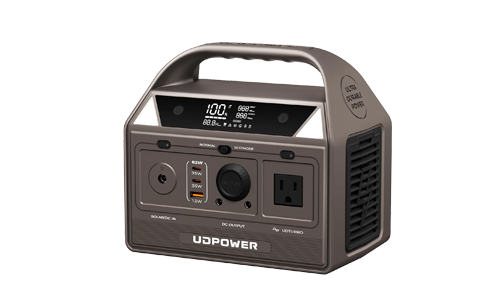
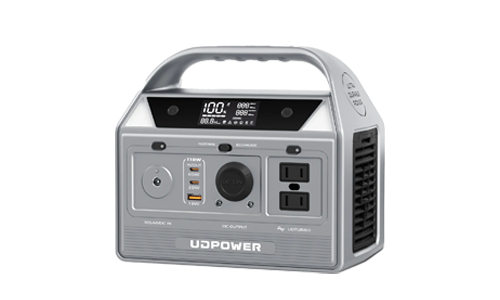
UDPOWER C600: compact support for essential electronics
- Battery capacity: 596Wh
- Rated AC output: 600W
- Peak output: up to 1,200W
- Battery chemistry: LiFePO4
- Outputs include two AC outlets, USB-C, USB-A, and a 12V car outlet
The C600 is best suited to phones, laptops, a router, lighting, CPAP use within the device's requirements, fans, cameras, and compatible small refrigerators. It is not intended to replace a 30-amp RV pedestal or continuously run a roof air conditioner.
View UDPOWER C600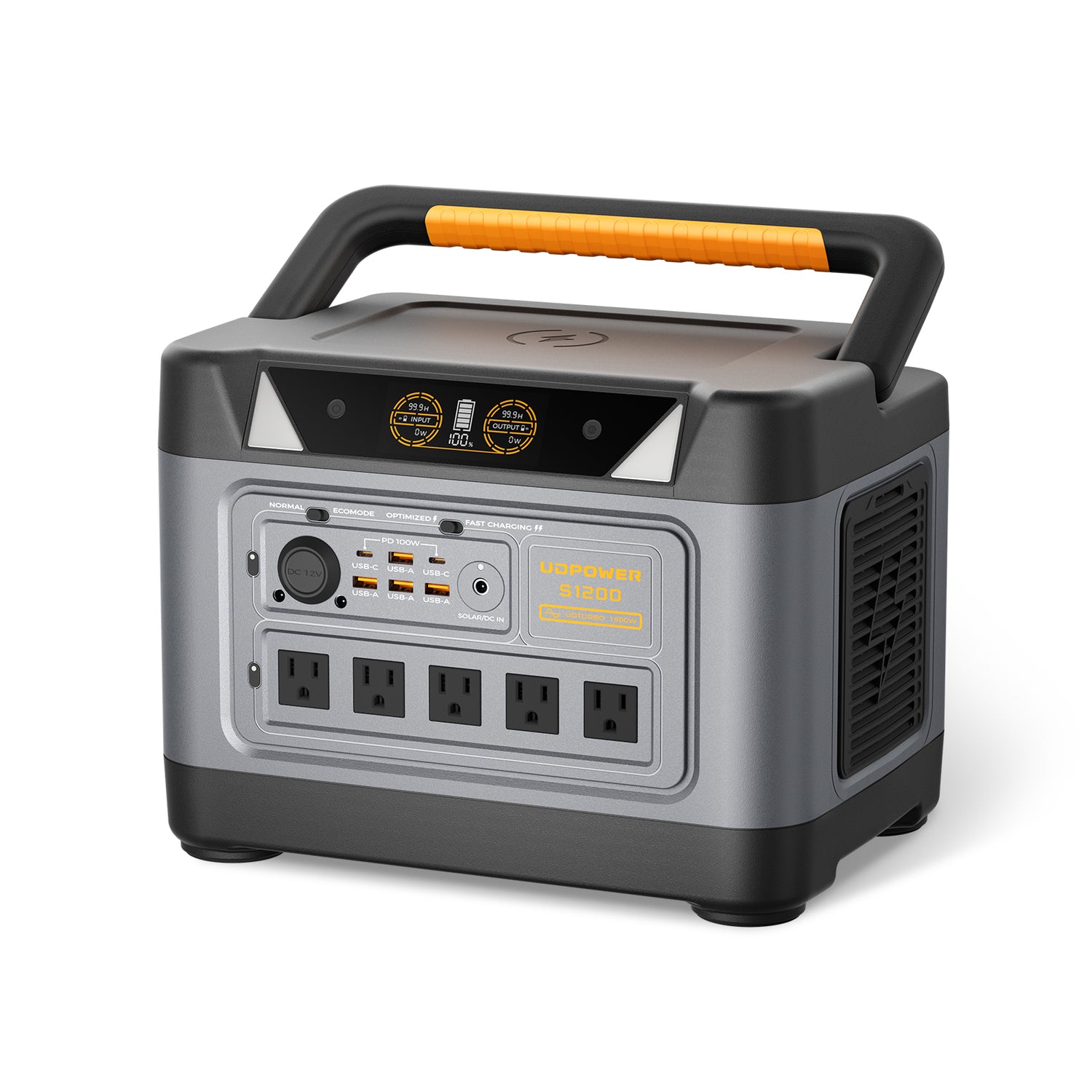
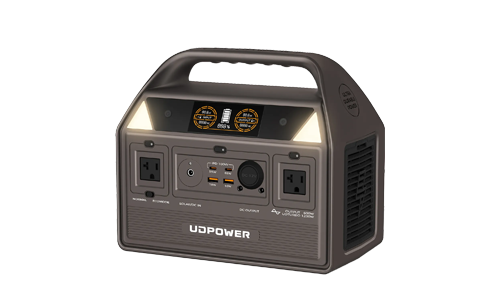
UDPOWER S1200: everyday RV essentials and longer backup
- Battery capacity: 1,190Wh
- Rated pure sine wave AC output: 1,200W
- Surge support: up to 1,800W
- Weight: approximately 26.0 lb
- 5 AC outlets plus 10 DC outputs on the 5-AC version
- UPSPrime switchover: less than 10 milliseconds
- Listed operating noise: below 25dB
- Fast AC recharge: approximately 1.5 hours under listed test conditions
The S1200 is a practical fit for an RV refrigerator, router, laptop, CPAP, lights, fans, communication gear, and selected appliances within its 1,200W continuous rating. It provides more useful margin than a small unit while remaining easier to move than a 2kWh-class station.
View UDPOWER S1200
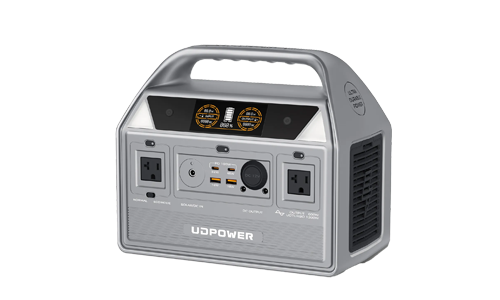
UDPOWER S2400: longer runtime and higher-wattage appliances
- Battery capacity: 2,083Wh
- Rated pure sine wave AC output: 2,400W
- Surge support: up to 3,000W
- 6 AC outlets plus 10 DC outputs
- UPSPrime switchover: less than 10 milliseconds
- Solar charging input: up to 400W
- Fast AC recharge: approximately 1.5 hours under listed test conditions
- Listed refrigerator example: approximately 18–30 hours at a 60–100W average load
The S2400 is the stronger choice for longer refrigerator support, multiple essential electronics, and compatible high-draw appliances used one at a time. Its 2,400W continuous rating creates more practical headroom than the S1200, but it is still not a substitute for the full 30- or 50-amp electrical service of an RV.
View UDPOWER S2400Estimated runtime for common RV essentials
Runtime depends on the device's actual watts, inverter losses, temperature, battery condition, cycling behavior, and other equipment running at the same time.
Runtime method used in this guide
Estimated runtime = battery capacity in Wh × 0.90 ÷ device running watts.
The 90% factor represents the standard UDPOWER planning assumption used here for conversion losses. Results are estimates rather than guaranteed operating times.
| Example RV load | Planning watts | C600 596Wh | S1200 1,190Wh | S2400 2,083Wh | Important note |
|---|---|---|---|---|---|
| CPAP without heated humidifier | 40W | About 13.4 hours | About 26.8 hours | About 46.9 hours | Use the actual adapter label or watt meter. Heated tubing and humidification can increase consumption. |
| 12V compressor refrigerator average load | 60W | About 8.9 hours | About 17.9 hours | About 31.2 hours | A refrigerator cycles. Hot weather and frequent door opening can increase average use. |
| Router and laptop | 75W | About 7.2 hours | About 14.3 hours | About 25.0 hours | Laptop charging demand changes as the battery fills and workload changes. |
| Fan, LED lights, and phone charging | 100W | About 5.4 hours | About 10.7 hours | About 18.7 hours | Turning off unused lighting substantially extends runtime. |
| TV, router, and laptop | 150W | About 3.6 hours | About 7.1 hours | About 12.5 hours | Measure the TV rather than relying on screen size alone. |
| 1,000W coffee maker | 1,000W | Not compatible with the 600W continuous AC rating | About 64 minutes of equivalent continuous heating | About 112 minutes of equivalent continuous heating | A normal brew cycle is much shorter than continuous use. Check startup and rated watts. |
| RV roof air conditioner | Varies widely | Do not assume compatibility | Do not assume compatibility | Check measured startup and running watts | Even when startup is possible, continuous summer runtime may be limited. |
Build an overnight power budget
Multiply each device's watts by the number of hours you expect to use it, then add the results.
| Device | Watts | Hours | Estimated energy |
|---|---|---|---|
| CPAP | 40W | 8 hours | 320Wh |
| 12V refrigerator average | 60W | 8 hours | 480Wh |
| Router | 10W | 8 hours | 80Wh |
| LED lighting | 20W | 4 hours | 80Wh |
| Phones and small electronics | 20W | 3 hours | 60Wh |
| Combined overnight requirement | — | — | 1,020Wh |
In this example, the S1200 is close to the calculated overnight requirement after conversion losses, leaving little room for unexpected refrigerator cycling or extra loads. The S2400 provides more reserve. This is why sizing from a complete energy budget is safer than choosing only by an appliance's wattage.
Portable solar planning in Texas
Texas sun can support useful daytime recharging, but the panel's advertised wattage is not the same as the energy you will collect every day. Clouds, panel heat, angle, shade, dust, cable loss, charging limits, and the time spent at full battery all affect production.
A practical solar-harvest estimate
Use this starting formula:
Daily solar energy = panel watts × peak-sun hours × 0.70
For example:
400W × 5 peak-sun hours × 0.70 = approximately 1,400Wh per day
This is a planning example, not a forecast. Use NREL PVWatts to compare solar conditions by location and season.
| Panel nameplate | Four peak-sun-hour example | Five peak-sun-hour example | Best use |
|---|---|---|---|
| 120W | About 336Wh | About 420Wh | Phones, lighting, router, cameras, and topping up a smaller station. |
| 210W | About 588Wh | About 735Wh | Compact refrigerator support and moderate daily electronics. |
| 240W | About 672Wh | About 840Wh | Mid-capacity stations and mixed daytime loads. |
| 400W | About 1,120Wh | About 1,400Wh | Higher-capacity stations and longer off-grid stays. |
Panel wattage and charging-input limits are different
A panel or combined array can have a higher nameplate rating than the power station's maximum accepted solar input. The station will still be limited by its supported voltage, current, connector, and wattage range. Never combine unmatched panels or exceed the input limits listed for the station.
Texas-specific portable solar practices
- Keep the full panel surface in direct sun; partial shade can reduce production sharply.
- Reposition portable panels as the sun moves instead of leaving them flat all day.
- Allow airflow behind the panels because excessive heat can reduce output.
- Secure portable panels before wind or thunderstorms arrive.
- Do not leave portable panels exposed to severe wind, hail, or flooding.
- Watch live input watts on the power station while adjusting the angle.
- Use compatible connectors and cables rather than unverified adapters.
Browse UDPOWER solar panels or read Are Solar Panels Worth It for Camping? for a more detailed sizing discussion.
Water, sewer, propane, and daily utilities
Fresh water
- Use a potable-water hose rather than a general garden hose.
- Use a pressure regulator appropriate for the RV plumbing system.
- Inspect the park connection for leakage and contamination before attaching.
- Replace filters according to their instructions instead of waiting for flow to stop.
- Sanitize the fresh-water system on an appropriate maintenance schedule.
Waste tanks
- Keep the black-tank valve closed until the tank is ready to dump.
- Use adequate water with each flush to reduce solid buildup.
- Support the sewer hose so it drains properly without creating low sections.
- Confirm that the site sewer inlet is not higher than the RV outlet.
- Never release black or gray water onto the ground.
Propane
- Know where the nearest refill location is before the cylinder is empty.
- Check hoses, regulators, and appliances according to the manufacturer's instructions.
- Keep propane appliances and exhaust openings unobstructed.
- Maintain working propane, smoke, and carbon-monoxide alarms.
- Do not operate outdoor cooking or fuel-burning equipment inside the RV.
Mail and packages
Ask whether the park accepts USPS mail, private-carrier packages, registered mail, oversized packages, and medications. Some parks accept parcels but do not permit residents to use the address for driver-license or registration purposes.
Internet and remote-work planning
A park advertisement that lists Wi-Fi does not guarantee a dependable work connection. Shared park networks can slow dramatically when residents begin streaming in the evening.
Use a two-connection strategy
- Choose one primary cellular or satellite connection for work.
- Keep a second carrier or park Wi-Fi as a backup.
- Download maps, documents, and entertainment before entering remote areas.
- Keep the router and laptop included in the backup-power calculation.
Test internet before committing to a month
- Run the test from the actual campsite, not the park office.
- Test during the evening when the network is busiest.
- Test inside the RV with doors and windows in their normal positions.
- Check upload speed, latency, and video-call stability, not only download speed.
- Ask whether external antennas or roof-mounted equipment are permitted.
- Confirm data limits and network-management rules.
Texas towing and travel-day planning
Texas distances make route planning important. A move that looks short on a state map can involve hours of wind, construction, heat, urban traffic, and limited fuel stops.
Know your combined length
Texas DPS states that a motor vehicle and house trailer or towable recreational vehicle combination may not exceed 65 feet under the general length rule. Verify your complete combination and any applicable exceptions before traveling.
Official source: Texas DPS vehicle-length rules .
Travel-day checklist
- Check tire pressure while tires are cold.
- Inspect tread, sidewalls, valve stems, lug nuts, and wheel condition.
- Confirm hitch, coupler, safety chains, breakaway cable, lights, and mirrors.
- Secure awnings, steps, antennas, windows, vents, doors, drawers, and exterior equipment.
- Check wind forecasts along the entire route, not only at the destination.
- Fuel before entering a remote corridor or a congested metro area.
- Use an RV-safe route that accounts for height, weight, propane restrictions, and turning radius.
- Review road closures and conditions through DriveTexas.
- Avoid arriving at an unfamiliar park after dark.
Set a wind limit before departure
Do not wait until the RV begins moving across the lane to decide the wind is too strong. Establish a conservative personal limit based on the rig, trailer profile, road direction, gusts, driver experience, and manufacturer guidance. Delay the move when conditions exceed that limit.
Your first 30 days of RV living in Texas
| Time period | Primary goal | Actions |
|---|---|---|
| Before arrival | Verify the site and travel route | Confirm monthly terms, total fees, rig length, electrical service, pet rules, mail policy, storm shelter, internet, arrival time, and route access. |
| First 24 hours | Establish a safe physical setup | Level and stabilize the RV, inspect pedestal power, regulate water pressure, check sewer slope, test alarms, locate emergency exits, and identify the severe-weather shelter. |
| First week | Measure real utility and connectivity performance | Record electricity use, cellular speeds, water pressure, refrigerator cycling, A/C runtime, shade pattern, park noise, and drainage after rain. |
| Second week | Complete administrative tasks | Review residency documents, vehicle registration, insurance disclosures, license class, mail, medical providers, prescriptions, and local emergency alerts. |
| Third week | Test outage readiness | Run an unplugged essentials test using the actual refrigerator, router, CPAP, lights, and charging equipment. Record watts and runtime. |
| Fourth week | Decide whether the site works long term | Compare actual cost, heat, internet, noise, storm exposure, driving access, park management, and maintenance needs with your original expectations. |
Perform one controlled power-outage test
Do not wait for a Texas thunderstorm to discover that the refrigerator startup load is too high, the CPAP cable is missing, or the router power adapter is packed in storage. With safe conditions and no critical risk, disconnect from shore power and run only your planned emergency loads. Record:
- Starting battery percentage
- Total displayed output watts
- Individual appliance watts when possible
- Battery percentage after one, four, and eight hours
- Any overload, low-voltage, temperature, or startup problem
- Which load you would remove first to extend runtime
RV living in Texas frequently asked questions
Is full-time RV living legal in Texas?
Yes, when the RV is parked at a site where long-term RV occupancy is permitted. Texas does not give one blanket permission to live in an RV on any parcel. Park rules, local zoning, floodplain, sanitation, utility, deed, and HOA restrictions still apply.
Can I live in an RV on my own land in Texas?
Possibly, but ownership alone does not make occupancy legal. Ask the city planning department or county development office in writing whether residential RV occupancy, septic, electric service, driveway access, floodplain clearance, and an address are allowed before purchasing land or connecting utilities.
How much does RV living in Texas cost per month?
A practical 2026 planning range is about $1,500 to $4,300 per month before an RV loan and health insurance. A stationary rural setup can land near the lower end, while metro resorts, frequent towing, high summer electricity use, insurance, and repairs push costs upward.
What is the best part of Texas for year-round RV living?
There is no single year-round winner. The Rio Grande Valley is attractive in winter, Hill Country and East Texas are strongest in spring and fall, and a shaded full-hookup park with dependable electricity becomes more important during peak summer. Many full-time RVers get better results by moving seasonally.
How long can I stay at a Texas state park?
Texas Parks and Wildlife says visitors can generally stay for 14 consecutive days, although individual parks may establish different limits or offer special weekly, monthly, or seasonal arrangements. Check the specific park before reserving.
Do I need a special Texas driver license for my RV?
It depends on the manufacturer's GVWR and GCWR ratings. Personal RV use may be exempt from CDL requirements, but a heavy motorhome or truck-and-trailer combination can still require a non-commercial Class A or Class B Texas license.
Does an RV need a Texas vehicle inspection?
Most non-commercial vehicles have not required a safety inspection before registration since January 1, 2025. Qualifying vehicles registered in designated emissions counties still need emissions testing, and commercial-vehicle inspection requirements remain in place. Bexar County emissions testing is scheduled to begin on November 1, 2026.
Can a portable power station run an RV air conditioner?
It may be possible with some air conditioners and power stations, but it should never be assumed. Check the A/C's measured continuous and startup watts, the effect of any soft-start device, ambient temperature, and the station's continuous and surge limits. A portable power station is not a direct replacement for 30- or 50-amp shore power.
Should I choose the UDPOWER S1200 or S2400 for RV living?
Choose the S1200 for everyday essentials such as a refrigerator, router, laptop, CPAP, lights, fans, and selected appliances within its 1,200W rating. Choose the S2400 when you need longer runtime, a 2,083Wh battery, and more output headroom for compatible higher-wattage appliances.
How much portable solar do I need for an RV in Texas?
Size solar from daily energy use rather than RV length. As a planning example, a 400W array receiving five peak-sun hours at a 70% system factor could collect about 1,400Wh. Actual production varies with season, location, heat, clouds, angle, shade, cable loss, and the power station's input limit.
Sources and further reading
- Texas Department of Motor Vehicles: New to Texas
- Texas Department of Motor Vehicles: Register Your Vehicle
- Texas DPS: Residency Requirements
- Texas DPS: Driver-License Classes
- Texas DPS: CDL-Exempt Drivers
- Texas DPS: Vehicle Length Rules
- Texas Parks and Wildlife: State Parks FAQ
- Texas Parks and Wildlife: Reservation FAQ
- Texas Commission on Environmental Quality: Vehicle Emissions Inspections
- National Weather Service: Heat Safety
- National Weather Service: Texas Flood Hazards
- National Hurricane Center
- DriveTexas Road Conditions
How this guide was prepared
Texas administrative requirements were checked against current TxDMV, Texas DPS, TCEQ, Texas Parks and Wildlife, National Weather Service, and National Hurricane Center resources. Campground prices are current posted examples checked on June 16, 2026, rather than a claimed statewide average.
UDPOWER specifications and product images were checked against the official C600, S1200, and S2400 product pages. Runtime estimates use battery capacity × 90% ÷ device watts and should be treated as planning estimates.
Build an RV power plan around your real loads
List the refrigerator, CPAP, router, laptop, lighting, fans, and emergency equipment you need to keep running. Record the actual watts, estimate daily watt-hours, and leave reserve capacity for Texas heat, longer outages, and changing weather.
View RV Power Options View All Portable Power Stations Get the Camping Power GuideRelated Articles


