

What Can a 2400 Watt Generator Run? Appliance Guide
Last updated: July 15, 2026
Quick Answer
A true 2,400-watt generator can run a refrigerator or freezer, Wi-Fi equipment, LED lights, televisions, laptops, CPAP machines, fans and phone chargers at the same time, provided their combined running load and startup surge remain within the generator's limits.
It can also run many microwaves, coffee makers, toasters, hair dryers, space heaters, small window air conditioners and power tools, but these high-wattage appliances should usually be operated one at a time.
Usually a good fit: refrigerator, freezer, router, lights, TV, laptops, CPAP, fans, chargers, coffee maker, microwave and small tools. Requires a startup check: sump pumps, air compressors, circular saws, window air conditioners and RV air conditioners. Usually not suitable: central air conditioning, electric dryers, electric water heaters, electric ranges, large well pumps or other 240-volt appliances. Most important warning: some generators advertised as “2400 watt” provide 2,400 starting watts but only 1,800 to 2,000 running watts. Check the rated continuous output before planning your load.The answer depends on more than the number printed on the generator. You need to know whether 2,400 watts refers to continuous output or brief peak output, how much startup power each motorized appliance requires and, for a battery power station, how many watt-hours are stored in the battery.
This guide separates those numbers, provides practical appliance tables and shows realistic combinations you could use during an outage, camping trip, RV stay or temporary worksite setup.

What Can You Power With 2400 Watts?
A 2,400W continuous output gives you enough power for a well-managed group of household essentials or one demanding 120V appliance plus a few low-power devices.
In practical terms, it is most useful in one of two ways:
- Essential-load mode: keep a refrigerator, router, lights, phones, laptops, a television, fans and medical equipment running together.
- High-power mode: temporarily run a microwave, coffee maker, toaster, hair dryer, space heater, small air conditioner or power tool while switching off other major loads.
| Use case | Typical devices | General result | Main limitation |
|---|---|---|---|
| Short home outage | Refrigerator, Wi-Fi, LED lights, TV, phones and laptop | Good fit | Refrigerator startup must stay within surge output |
| Overnight backup | Refrigerator, router, fan, lights and CPAP | Good fit with enough battery capacity | Runtime depends on watt-hours, not only 2,400W output |
| Kitchen use | Microwave, coffee maker, toaster, blender or rice cooker | Usually one major appliance at a time | Two heating appliances can exceed 2,400W quickly |
| RV or campsite | Portable fridge, lights, CPAP, fan, laptops and coffee maker | Strong fit | Rooftop AC startup can exceed the surge limit |
| Small workshop | Drill, sander, tool chargers, work lights and selected saws | Check each motor's startup demand | Large saws and compressors may need more surge power |
| Whole-house backup | Central HVAC, water heater, electric range, dryer and all circuits | Not suitable | Many systems are 240V and require substantially more power |
First Check: Is 2400 Watts Continuous or Peak Power?
This is the most important step because two products carrying a “2400W” label may have very different capabilities.
Continuous or running watts
Continuous output is the amount of power the generator can supply during normal operation. A true 2,400W-rated generator can support combined continuous loads up to 2,400 watts, subject to its outlet, current and operating limits.
Starting, surge or peak watts
Refrigerators, freezers, pumps, compressors, air conditioners and power tools may demand much more electricity for a brief moment when their motors start. That temporary demand is called starting watts or surge watts.
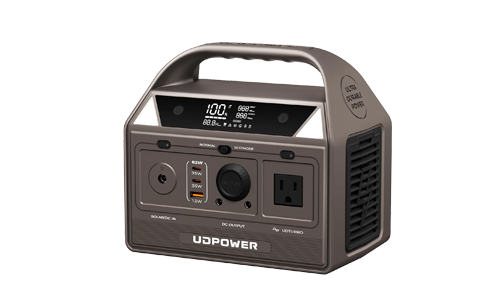
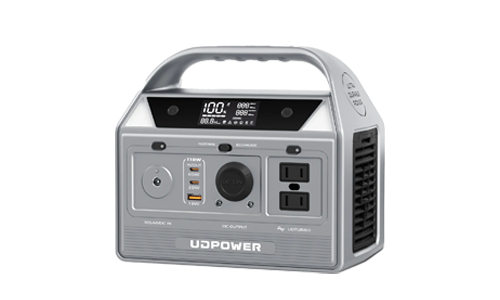
A compact gasoline generator may be advertised as a 2,400W model even though its normal running output is closer to 1,800W. In contrast, the UDPOWER S2400 provides 2,400W rated AC output and up to 3,000W of instantaneous startup support.
| Label on product | What it may mean | What to use for load planning |
|---|---|---|
| 2400 starting watts / 1800 running watts | 2,400W is available only briefly | Keep normal combined loads below 1,800W |
| 2400 rated watts / 3000 surge watts | 2,400W is the continuous output | Keep normal loads below 2,400W and startup below 3,000W |
| 2400Wh battery capacity | This describes stored energy, not output power | Check the separate inverter output rating |
The two calculations that prevent most overloads
Add the running watts of every device that will operate at the same time.
Total running watts must remain below the generator's rated continuous output.
Add the running watts of the devices already operating to the starting watts of the largest motorized appliance that may start.
That total must remain below the generator's surge output.
For example, suppose a refrigerator needs 150W while its compressor is running and 1,000W during startup. Your router, lights, television and laptops use another 250W. The normal load is only 400W, while the brief startup load is approximately 1,250W. Both values fit comfortably within a true 2,400W-rated generator with sufficient surge capacity.
2400 Watt Generator Appliance Chart
The following figures are planning ranges, not guaranteed ratings. Appliances with the same name can have very different electrical requirements. Always check the input label, owner's manual or measured power draw of the exact device you intend to use.
| Appliance or device | Typical running power | Possible startup power | 2400W fit | Practical guidance | Related source |
|---|---|---|---|---|---|
| Full-size refrigerator | About 60–100W average over time; often 100–400W while compressor is on | About 600–1,800W | Usually yes | Leave surge headroom and avoid starting another motor at the same moment | Refrigerator backup guide |
| Chest or upright freezer | About 40–100W average; often 100–300W during an active cooling cycle | About 500–1,200W | Usually yes | Older freezers may use more energy and have a stronger startup surge | ENERGY STAR freezer guidance |
| Wi-Fi router and modem | 10–25W combined | Minimal | Yes | An efficient priority load for communication during outages | UDPOWER generator load guide |
| LED light bulb | 8–12W each | Minimal | Yes | Ten 10W bulbs use only about 100W total | ENERGY STAR products |
| Television | 60–200W | Minimal | Yes | Large or older TVs may sit at the upper end of the range | Small-device power guide |
| Laptop | 30–100W | Minimal | Yes | Actual draw often drops after the battery reaches a high charge level | Electronics wattage guide |
| Desktop computer and monitor | 150–600W | Usually modest | Usually yes | High-performance gaming systems may draw more under heavy load | 2000W-class generator guide |
| CPAP machine | About 20–40W without heat; 60–90W or more with heated humidification | Minimal | Yes | Humidifier and heated tubing can significantly reduce battery runtime | CPAP power consumption guide |
| Box fan or pedestal fan | 30–100W | Usually modest | Yes | Lower speed settings extend battery runtime | 1200W appliance guide |
| Coffee maker | 800–1,500W while heating | Minimal | Usually yes | Turn off the microwave, toaster or heater while brewing | Generator appliance guide |
| Microwave | About 1,000–1,800W input | Usually modest | Usually yes | Use the electrical input rating, not only the advertised cooking wattage | S2400 official specifications |
| Toaster | 800–1,500W | Minimal | Yes by itself | A toaster and coffee maker together may exceed the limit | Generator appliance guide |
| Blender | 300–1,200W | About 600–1,800W | Usually yes | Dense or frozen ingredients can increase motor load | S2400 product page |
| Rice cooker | 300–1,000W while heating | Minimal | Yes | Keep-warm mode generally uses much less power than cooking mode | Appliance output guide |
| Slow cooker | 75–300W | Minimal | Yes | Low wattage but long cooking time can consume substantial battery energy | Generator planning guide |
| Hair dryer | 1,200–1,875W | Minimal | Usually yes by itself | Use a lower heat setting when battery runtime matters | S2400 rated output |
| Portable space heater | 750–1,500W | Minimal | Yes, but energy-intensive | A 1,500W heater can drain a 2,083Wh battery in roughly 1.25 hours | S2400 runtime estimates |
| Vacuum cleaner | 500–1,400W | About 800–2,000W | Usually yes | Check motor startup if other appliances remain connected | Load-planning guide |
| Small window air conditioner | About 500–900W | About 1,200–2,500W | Possible after verification | Startup demand and compressor cycling determine compatibility | Home backup guide |
| 13,500 BTU RV rooftop AC | About 1,300–1,800W | Often 2,500–3,500W or more | Not reliably without testing | A compatible soft-start device may reduce startup demand but is not a guarantee | RV solar generator sizing guide |
| 1/3 HP sump pump | About 800–1,200W | About 1,800–3,000W | Possible at the edge | Measure startup draw and remove unnecessary background loads | Home generator sizing guide |
| Electric drill | 300–900W | About 500–1,500W | Usually yes | Battery-powered tool chargers are much easier loads | Tool load guide |
| Circular saw | 1,200–1,800W | About 2,400–3,500W | Model-dependent | Some saws may exceed a 3,000W surge limit during startup or binding | S2400 surge specification |
| Small air compressor | 700–1,500W | About 1,500–3,000W or more | Verify before use | Tank pressure and motor design affect startup demand | Generator tool guide |
Refrigerator and freezer energy use varies with age, size, room temperature, door openings, compressor design and defrost cycles. ENERGY STAR also notes that larger refrigerators generally consume more energy. See ENERGY STAR refrigerator guidance and verify your own appliance's EnergyGuide label or input nameplate.
What Can a 2400 Watt Generator Run at the Same Time?
A 2,400W generator does not need to be limited to one device. The best combinations use several low-power essentials while reserving enough startup headroom for a refrigerator, freezer, pump or air conditioner.
| Example load plan | Estimated average load | Possible brief startup load | Result on a true 2400W / 3000W-surge source |
|---|---|---|---|
| Refrigerator, router, four LED bulbs, two phones and one laptop | About 200–300W average | About 900–2,000W when the refrigerator starts | Strong essential-outage combination |
| Refrigerator, router, CPAP, fan and two LED lights | About 200–350W average | About 900–2,100W during refrigerator startup | Practical overnight plan |
| Television, game console, router, laptop and room lighting | About 300–600W | Usually modest | Easy load for most true 2,400W units |
| 12V camping fridge, CPAP, fan, lights, phones and two laptops | About 150–350W average | Usually below 1,000W | Well suited to RV and basecamp use |
| Refrigerator, router and a 1,500W microwave | About 1,650–1,950W while microwave is operating | Could approach or exceed 2,400W if the refrigerator starts simultaneously | Usually workable, but pause other heavy loads and leave surge room |
| Coffee maker and toaster | About 1,600–3,000W combined | Minimal additional surge | Low-watt models may work; many combinations will overload the generator |
| 1,500W heater, refrigerator, TV and coffee maker | Potentially 2,500W or more | Higher when refrigerator starts | Too much to run together |
A better way to manage high-wattage appliances
- Keep critical low-power loads connected.
- Wait until the refrigerator or freezer compressor has completed its startup.
- Temporarily switch off the heater, toaster or other nonessential major load.
- Run the microwave, coffee maker or hair dryer for the required time.
- Switch back to the essential-load plan.
This load-rotation method often works better than buying a generator based on the sum of every appliance you might use during the entire day. The appliances do not all need to operate at the same moment.
How Long Will a 2400W Power Station Run Appliances?
A fuel-powered generator's runtime depends on fuel capacity, load and whether you can refuel it. A battery power station's runtime depends primarily on battery capacity, appliance energy use and conversion losses.
The UDPOWER S2400 stores 2,083Wh. Using a practical 90% AC conversion estimate provides approximately 1,875Wh of usable AC energy for planning.
Battery capacity in Wh × 0.90 ÷ appliance watts = estimated runtime in hours
2,083Wh × 0.90 ÷ 500W = approximately 3.75 hours
| Average connected load | Estimated S2400 runtime | Example use |
|---|---|---|
| 20W | About 93.7 hours | Router and modem |
| 40W | About 46.9 hours | Efficient CPAP without heated humidification |
| 60W | About 31.2 hours | Efficient refrigerator average or low-power medical setup |
| 80W | About 23.4 hours | Refrigerator average or CPAP with heated features |
| 100W | About 18.7 hours | Television, fan or refrigerator average |
| 200W | About 9.4 hours | Several home or campsite essentials |
| 300W | About 6.25 hours | Entertainment setup or larger essential group |
| 500W | About 3.75 hours | Desktop setup or moderate appliance load |
| 800W | About 2.34 hours | Small air conditioner or cooking appliance |
| 1,000W | About 1.87 hours | Coffee maker, cooker or compact microwave |
| 1,200W | About 1.56 hours | Microwave, toaster or tool under continuous load |
| 1,500W | About 1.25 hours | Space heater, hair dryer or high-power microwave |
| 2,000W | About 56 minutes | Near-maximum high-power load |
| 2,400W | About 47 minutes | Maximum rated continuous output |
High-watt appliances are often used for minutes, not hours
Continuous-runtime tables can make kitchen appliances look more demanding than they are. A microwave may draw 1,200W, but heating food for ten minutes uses only about 200Wh.
| Activity | Example power | Time per use | Approximate energy per use | Estimated uses from 1,875Wh |
|---|---|---|---|---|
| Microwave meal | 1,200W | 10 minutes | 200Wh | About 9 uses |
| Brew coffee | 1,000W | 10 minutes | 167Wh | About 11 brewing cycles |
| Use a toaster | 1,200W | 5 minutes | 100Wh | About 18 cycles |
| Dry hair | 1,500W | 10 minutes | 250Wh | About 7 sessions |
| Use a blender | 600W | 3 minutes | 30Wh | About 62 short sessions |
| Run a 100W electric blanket | 100W | 8 hours | 800Wh | About 2 full nights |
These estimates assume the listed appliance is the only load. Refrigerator, lighting, router and other background loads reduce the number of available uses.
Realistic Home Outage Load Plans
A 2,400W generator is better viewed as an essential-circuit substitute than a whole-house replacement. Decide which devices protect food, communication, health and comfort, then add convenience loads only when capacity remains.
Plan 1: Protect food and communication
| Device | Planning load |
|---|---|
| Refrigerator average over time | 80W |
| Router and modem | 20W |
| Four LED lights | 40W |
| Two phone chargers | 20W |
| Laptop | 60W |
| Estimated average total | 220W |
| Estimated S2400 runtime | About 8.5 hours before reserve and real-world variation |
This runtime estimate treats the refrigerator's cycling as an average load. The station still needs sufficient surge support when the compressor starts.
Plan 2: Overnight medical and cooling support
| Device | Planning load |
|---|---|
| Refrigerator average over time | 80W |
| CPAP with moderate heated features | 70W |
| Fan | 50W |
| Router and modem | 20W |
| Two LED lights | 20W |
| Estimated average total | 240W |
| Estimated S2400 runtime | About 7.8 hours before reserve and real-world variation |
Turning off CPAP heated humidification, lowering the fan speed or switching off unused lights can add meaningful reserve time. Read how long a CPAP can run on battery backup for a more detailed overnight calculation.
Plan 3: Refrigerator plus occasional cooking
Keep the refrigerator, router and lights running as the base load. When you need the microwave or coffee maker, temporarily switch off other nonessential appliances. A ten-minute microwave cycle may consume approximately 200–250Wh, which is much more manageable than leaving a heater or cooking appliance running continuously.
Will a 2400 Watt Generator Run a Refrigerator or Freezer?
Yes. A refrigerator is one of the most practical appliances to run from a 2,400W generator. Its normal average consumption is relatively low, but the compressor can require several times its running power during startup.
Before relying on the setup:
- Check the refrigerator's voltage, amperage and wattage label.
- Confirm the generator's continuous output.
- Confirm the generator's surge rating.
- Allow headroom for lights, routers and other devices already running.
- Test the refrigerator before an emergency.
Refrigerator runtime on the UDPOWER S2400
UDPOWER estimates approximately 18 to 30 hours for a standard refrigerator averaging 60 to 100 watts. Actual results depend on compressor cycling, refrigerator age, ambient temperature, door openings, thermostat setting and other connected loads.
For a deeper explanation of compressor startup and EnergyGuide calculations, see Can a Portable Power Station Run Your Refrigerator? and How Long Will a 2000W Power Station Run a Refrigerator? .
Will a 2400 Watt Generator Run Kitchen Appliances?
It can run many countertop kitchen appliances, but resistance-heating appliances use a large portion of the available output. The best approach is to use one major cooking appliance at a time.
| Kitchen appliance | Likely result | Recommended approach |
|---|---|---|
| Microwave | Usually runs | Check input watts and pause the coffee maker, toaster and heater |
| Coffee maker | Usually runs | Brew after other heating appliances are switched off |
| Toaster | Usually runs | Use separately from a high-watt coffee maker |
| Rice cooker | Usually runs | Cooking mode draws more than keep-warm mode |
| Slow cooker | Runs easily | Account for its long operating time when using a battery station |
| Blender | Usually runs | Leave surge room for hard or frozen ingredients |
| Electric kettle | Usually runs by itself | Many models draw 1,200–1,800W |
| Portable induction cooktop | Possible | Use a power setting below the generator's continuous limit |
| Full-size electric range or oven | Usually not suitable | Many are hardwired 240V appliances with much higher demand |
Will a 2400 Watt Generator Run an Air Conditioner?
Small window air conditioner
A small 5,000 to 8,000 BTU window unit may run if its normal consumption and compressor startup remain within the generator's ratings. A unit drawing 700W while operating and 1,800W during startup is generally a more realistic match than a large room air conditioner with a 3,000W-plus startup demand.
Portable air conditioner
Some compact portable AC units may work, but the exact label matters. Larger dual-hose units can draw more power, and compressor startup can occur while other appliances are already connected.
RV rooftop air conditioner
A 13,500 BTU RV air conditioner may consume approximately 1,300 to 1,800W while running, but startup demand can reach or exceed 3,000W. A 2,400W generator with 3,000W surge support is therefore not a universal solution for this load.
An appropriately installed soft-start device may reduce startup demand, but compatibility must still be tested with the exact air conditioner and generator. Do not assume that a soft starter automatically makes every RV AC compatible.
Central air conditioning
No. Most central air-conditioning systems require 240V power and substantially more running and startup capacity than a portable 2,400W generator can provide.
Is a 2400 Watt Generator Enough for an RV or Camping?
A 2,400W generator or power station is a strong match for most low-to-medium RV and campsite loads:
- 12V portable refrigerator
- CPAP or BiPAP equipment
- Fans and LED lighting
- Phones, tablets, laptops and camera batteries
- Wi-Fi or cellular equipment
- Television or projector
- Coffee maker, toaster or compact microwave used separately
- Selected small electric cooking appliances
The limiting factor is usually not the electronics. It is the rooftop air conditioner, electric water heater or simultaneous operation of several cooking appliances.
Example overnight RV load
| RV load | Estimated average power |
|---|---|
| 12V refrigerator | 50W average |
| CPAP without heated humidifier | 40W |
| Ventilation fan | 35W |
| LED lighting | 20W |
| Phones, laptop and connectivity | 75W average |
| Estimated total | 220W |
| Estimated S2400 runtime | About 8.5 hours before reserve and real-world variation |
Morning coffee adds a short burst of high power rather than an all-night load. A 1,000W coffee maker operating for ten minutes uses about 167Wh, leaving most of the battery available for the rest of the campsite.
For multi-day trips, battery capacity gets you through the night while solar input helps replace daytime consumption. Read Best Solar Generator Kit Size for RV Weekends vs. Boondocking or explore UDPOWER camping and RV power stations .
Can a 2400 Watt Generator Run Power Tools and Pumps?
Drills, sanders, chargers and many handheld tools are reasonable loads. Circular saws, air compressors, shop vacuums and pumps require more careful planning because the motor may draw a sharp startup surge or experience a temporary overload when the blade, pump or compressor is under pressure.
Usually suitable
- Cordless tool battery chargers
- Work lights
- Many drills
- Small sanders
- Rotary tools
- Selected jigsaws
- Small shop vacuums after startup verification
Check carefully
- Circular saws
- Miter saws
- Electric chainsaws
- Air compressors
- Sump pumps
- Well pumps
- Tools used under heavy mechanical load
For motor-driven equipment, read the tool label and test under realistic working conditions. A saw that starts successfully with no material may draw more when cutting dense lumber. A compressor may draw more when restarting against tank pressure.
What Can a 2400 Watt Generator Not Run?
A portable 2,400W generator is not a whole-home standby system. It is generally not suitable for the following loads:
| Appliance or system | Why it is usually unsuitable |
|---|---|
| Central air conditioner | Usually 240V with high running and compressor-starting demand |
| Electric clothes dryer | Commonly 240V and several thousand watts |
| Full-size electric range or oven | Commonly 240V with multiple high-power heating elements |
| Conventional electric water heater | Often 240V and approximately 4,500W or more |
| Large well pump | May be 240V and can have a high motor-starting surge |
| Large air compressor or welder | High running current, high surge or 240V requirement |
| Multiple heaters and cooking appliances | Combined resistance-heating load quickly exceeds 2,400W |
| Entire household electrical panel | A 2,400W portable source is designed for selected loads, not unrestricted whole-home use |
Why voltage matters as much as watts
At 120V, 2,400 watts equals approximately 20 amps:
2,400W ÷ 120V = 20A
That calculation does not mean a 120V generator can operate a 240V appliance. Voltage must match the equipment. Also treat the stated AC output as the total available across the generator's outlets, not 2,400W from every outlet at the same time.
Recommended 2400W Power Station: UDPOWER S2400
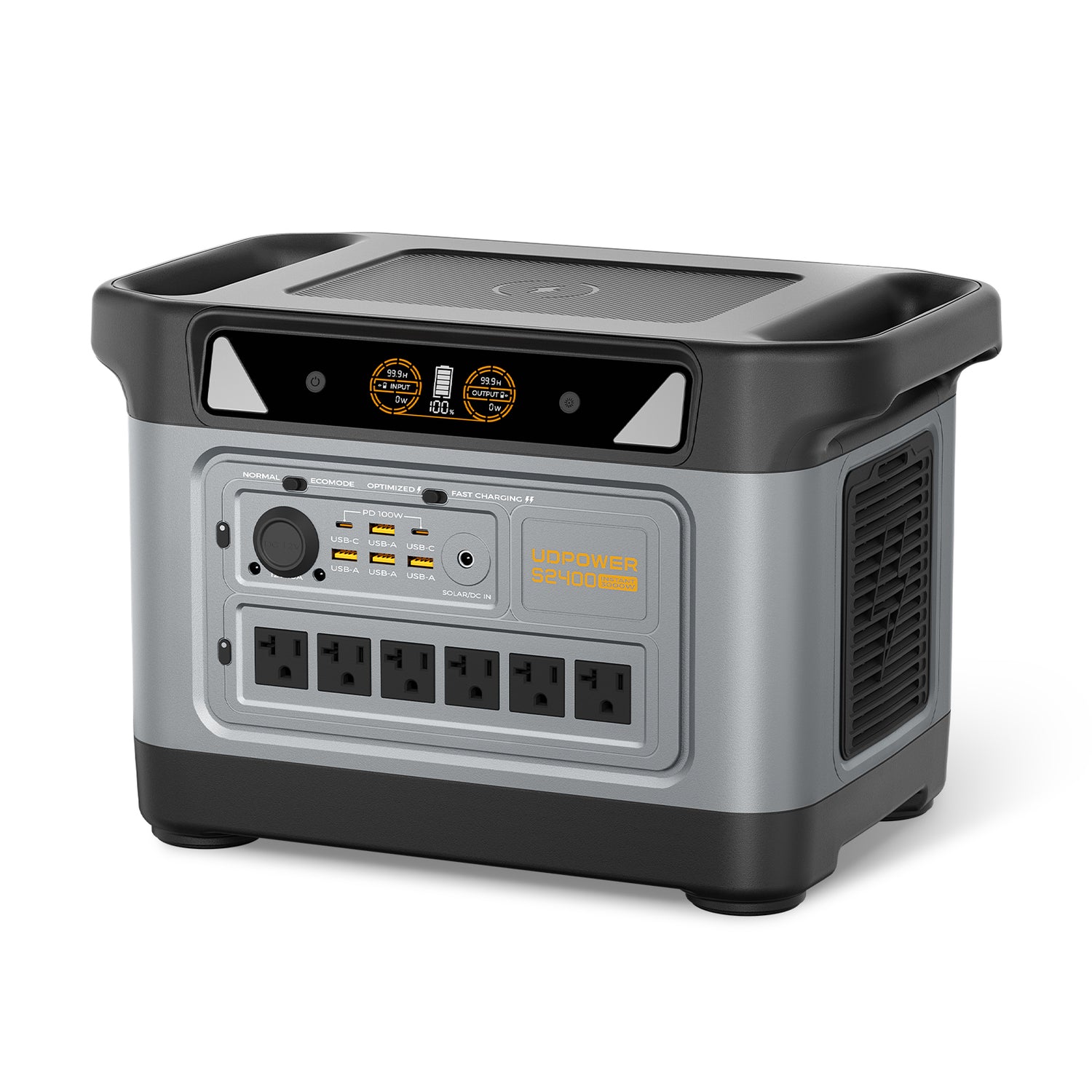
Why the S2400 fits this use case
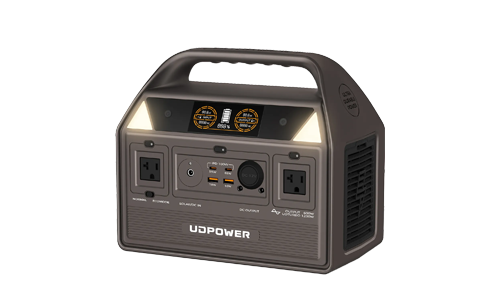
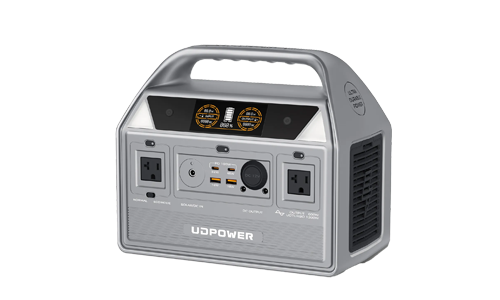
The UDPOWER S2400 is a battery-powered alternative for readers who need a true 2,400W-rated output rather than a gasoline generator that lists 2,400W only as its peak rating. It is designed for selected home-backup appliances, RV trips, camping, medical equipment, electronics and short-term high-wattage loads.
| S2400 specification | Official value | Why it matters |
|---|---|---|
| Battery capacity | 2,083Wh | Determines how long connected devices can operate |
| Rated AC output | 2,400W pure sine wave, 120V, 60Hz | Supports many household, RV and campsite appliances |
| Startup support | Up to 3,000W instantaneous surge | Provides headroom for selected compressors and motors |
| AC outlets | 6 | Allows multiple compatible devices to be connected |
| Total output ports | Up to 15 AC and DC outputs | Supports appliances, USB devices, 12V loads |
| USB-C output | 2 ports, up to 100W each | Useful for laptops, tablets and compatible electronics |
| Solar charging input | 12–50V, 10A maximum, up to 400W | Supports daytime recharging during camping or outages |
| UPS response | 10 milliseconds or less | Helps selected essential equipment stay powered through brief interruptions |
| Battery chemistry | LiFePO4 | Designed for frequent use and long service life |
| Cycle rating | 4,000+ cycles | Suitable for repeated backup and off-grid use |
| Weight | Approximately 40.8 lb | Portable between home, vehicle, RV and campsite |
| Dimensions | 15.8 × 9.5 × 10.1 inches | Compact enough for storage without becoming a pocket-sized unit |
| Warranty | 5 years | Long-term product protection |
Best uses for the S2400
- Refrigerator and freezer backup
- Router, lights, television and computer support
- Multi-night CPAP backup
- RV and camping basecamp power
- Microwave, coffee maker and selected cooking appliances
- Fans and selected small window air conditioners
- Power-tool charging and selected corded tools
- Quiet indoor backup without gasoline exhaust
When the S2400 is not the right solution
The S2400 provides 120V AC output. It is not intended to run a whole home, central air conditioning, an electric water heater, an electric dryer, a full-size electric range or other 240V household systems. Devices should be plugged into the station's outputs directly unless a compatible backup setup has been reviewed by a qualified electrician.
View the UDPOWER S2400 View S2400 Solar Generator Kits Compare UDPOWER S1200 vs. S24002400W Fuel Generator vs. 2400W Portable Power Station
Both products can supply electricity, but their runtime, safety rules and best use cases differ substantially.
| Comparison | Fuel-powered generator | Battery portable power station |
|---|---|---|
| Output label | “2400W” may describe peak output rather than continuous output | Check the inverter's rated and surge output separately |
| Runtime | Based on fuel-tank size, load and available fuel | Based on watt-hour capacity, load and conversion efficiency |
| Indoor operation | Never operate indoors or in enclosed spaces | No combustion exhaust; follow product ventilation and operating guidance |
| Noise | Engine noise during operation | Generally quiet, with cooling-fan noise under some loads |
| Maintenance | Fuel, oil, engine maintenance and periodic testing | Recharge, store properly and periodically check battery condition |
| Extended outage | Can continue when safely refueled | Needs grid, vehicle or solar recharging |
| Sensitive electronics | Prefer an inverter generator with stable output | Choose a pure sine wave power station |
| Best fit | Long outdoor operation where fuel storage and noise are acceptable | Indoor backup, RVs, camping, electronics, medical equipment and quiet operation |
Read Is a Portable Power Station Better Than a Generator? for a more detailed comparison of safety, maintenance, noise, charging and outage use.
Generator Safety Checklist
For gasoline, propane or other combustion generators
- Operate the generator outdoors only, at least 20 feet away from the home and other occupied structures.
- Point the exhaust away from doors, windows, vents and neighboring buildings.
- Never run a fuel generator in a house, garage, basement, shed, porch or carport.
- Install battery-powered carbon monoxide alarms on every level and near sleeping areas.
- Keep the generator dry and follow the manufacturer's wet-weather instructions.
- Switch the generator off and allow it to cool before refueling.
- Use properly rated, undamaged outdoor extension cords with intact grounding prongs.
- Do not exceed the generator's continuous or surge output.
- Do not plug a generator into a household wall outlet.
- Use an electrician-installed, code-compliant transfer system when powering household circuits.
Review the U.S. Consumer Product Safety Commission carbon monoxide guidance and Ready.gov power-outage guidance .
For battery portable power stations
- Keep the unit dry and away from standing water.
- Do not cover cooling vents.
- Use the station within its stated charging and discharging temperature range.
- Check appliance running watts and startup demand before connecting it.
- Do not exceed the total output across all ports.
- Do not connect a 120V-only station to a 240V appliance.
- Use compatible solar panels, voltage ranges and connectors.
- Do not backfeed a wall outlet or household panel.
- Use a licensed electrician for any transfer-switch or circuit-integration question.
How to Decide Whether 2400 Watts Is Enough
- Make a must-run list. Separate essential devices from convenience appliances.
- Record running watts. Use the product label, manual or a plug-in watt meter.
- Identify motorized loads. Refrigerators, pumps, air conditioners and tools may need startup headroom.
- Add simultaneous loads. Count only the devices that must operate at the same time.
- Test the largest startup event. Add the largest starting load to the equipment already running.
- Calculate runtime separately. For battery stations, compare watt-hour capacity with your energy needs.
- Add reserve. Avoid planning to consume 100% of the available output or battery energy.
- Test before the outage or trip. Verify real startup behavior, cords, ports and runtime while grid power is available.
Frequently Asked Questions
What can a 2400 watt generator run?
It can run refrigerators, freezers, routers, LED lights, TVs, laptops, CPAP machines, fans, chargers and many small appliances. It can also operate many microwaves, coffee makers, toasters, heaters and tools when high-wattage loads are managed one at a time.
Can a 2400 watt generator run a refrigerator?
Yes, in most cases. Check both the refrigerator's normal running power and compressor startup demand. Keep enough surge capacity available when the compressor starts.
Can a 2400 watt generator run a refrigerator and freezer together?
Often yes, because their average running power is relatively low. The critical moment occurs if both compressors start at nearly the same time. Add their possible startup requirements and compare the result with the generator's surge rating.
Can a 2400 watt generator run a microwave?
Most standard countertop microwaves can run from a true 2,400W-rated generator if their electrical input stays below the output limit. Use input watts from the label, not only the microwave's advertised cooking wattage.
Can a 2400 watt generator run a coffee maker and toaster?
Sometimes, but many combinations exceed 2,400W. A 1,200W coffee maker and 1,200W toaster already reach the full output before any refrigerator, lights or electronics are counted. Running them separately is safer.
Can a 2400 watt generator run a space heater?
Yes, most 750W to 1,500W portable heaters fit within the output limit. However, a heater consumes a great deal of energy. A 1,500W heater would run for only about 1.25 hours on a 2,083Wh battery power station using a 90% efficiency estimate.
Can a 2400 watt generator run a window air conditioner?
A small window unit may work if its running and compressor-starting requirements are within the generator's limits. Larger units or models with startup demand above the surge rating will not operate reliably.
Will a 2400 watt generator run an RV air conditioner?
It may run selected small RV air conditioners, but a standard 13,500 BTU rooftop unit can have a startup demand near or above 3,000W. Compatibility depends on the exact AC, generator surge rating and whether an appropriate soft-start system is installed.
Can a 2400 watt generator power an entire house?
No. It can power selected essentials, but it is not a whole-house generator. Central air conditioning, electric dryers, ranges, water heaters and other 240V systems generally require a much larger backup solution.
How many amps is 2400 watts at 120 volts?
Approximately 20 amps, calculated by dividing 2,400 watts by 120 volts. This represents the total theoretical AC power, not 20 amps from every outlet simultaneously.
How long will a 2400 watt generator run?
A fuel generator's runtime depends on its tank, load and fuel availability. A battery station's runtime depends on watt-hour capacity. The 2,083Wh UDPOWER S2400 provides approximately 18.7 hours at a steady 100W load or about 1.25 hours at 1,500W when calculated with 90% usable AC energy.
Is 2400 watts enough for camping?
Yes. It is more than enough for most camping fridges, lights, fans, phones, laptops, cameras, CPAP machines and small entertainment equipment. It also provides room for brief coffee-maker, microwave or cooking-appliance use.
Can a 2400 watt generator run a sump pump?
Some small 120V sump pumps may work, but startup demand must be checked carefully. A pump that uses 900W while running could require 2,000W to 3,000W briefly at startup. Larger or 240V pumps are not appropriate for a 120V-only power station.
Is a 2400 watt generator enough for power tools?
It is generally enough for drills, chargers, lighting and many smaller tools. Circular saws, air compressors and motor-heavy tools require startup verification and may need to be operated without other major loads.
Is a battery power station safer than a gas generator indoors?
A battery power station does not create combustion exhaust or carbon monoxide, so it can be used indoors when operated according to its manual. A gasoline, propane or other combustion generator must never be operated indoors, in a garage, on a porch or in another enclosed or partially enclosed area.
Final Verdict
A true 2,400W-rated generator can handle far more than phones and lights. It can support a practical group of home essentials, including a refrigerator, router, television, laptops, CPAP machine, fans and lighting, while still allowing short periods of microwave or coffee-maker use.
Its limits become clear when several resistance-heating appliances operate together or when a large motor requires more startup power than the generator can provide. Central air conditioning, electric dryers, electric water heaters, ranges and other 240V systems require a different class of backup power.
For a battery-powered solution, the UDPOWER S2400 combines a true 2,400W rated output with 3,000W startup support and 2,083Wh of stored energy. That makes it a practical choice for refrigerator backup, overnight essentials, RV trips, camping and selected high-wattage 120V appliances without fuel exhaust or engine noise.
View the UDPOWER S2400 Compare All UDPOWER Portable Power Stations View Solar Generator KitsRelated Articles


