

Indoor Generator Guide: Safe Home Backup Power
The phrase indoor generator sounds simple, but it can describe two completely different products. One is a rechargeable battery power station that stores electricity. The other is a fuel-burning generator that creates electricity by running an engine. Only the first type belongs inside a home.
Quick Answer: What Is a Safe Indoor Generator?
A safe indoor generator is normally a battery-powered portable power station, sometimes marketed as a battery generator or solar generator. It stores electricity in a rechargeable battery and supplies power through AC outlets, USB ports, or 12-volt outputs.
Never operate a gasoline, diesel, natural-gas, or propane generator indoors. This includes garages, basements, sheds, enclosed porches, carports, tents, RV interiors, and rooms with open windows. Fuel generators produce carbon monoxide and must remain outdoors, at least 20 feet from doors, windows, and vents, with the exhaust pointed away from buildings.
For most households, an indoor battery generator is best for refrigerators, Wi-Fi, lights, phones, laptops, CPAP machines, fans, TVs, and selected small appliances. It is generally not a complete replacement for a whole-house standby generator.

What Is an Indoor Generator?
In everyday shopping language, an indoor generator usually means a rechargeable portable power station. The word “generator” is convenient, but the device does not generate electricity by itself while sitting in your living room. It stores energy that was previously supplied by a wall outlet, vehicle charging port, compatible solar panel, or another approved charging source.
A typical indoor battery generator contains:
- A rechargeable lithium battery
- A battery management system that monitors temperature, voltage, and current
- An inverter that changes stored DC electricity into household AC electricity
- AC outlets for appliances and electronics
- USB-A and USB-C ports for phones, tablets, cameras, and laptops
- A display showing battery level, input power, output power, and estimated runtime
- Charging inputs for wall, vehicle, or compatible solar charging
A portable power station is therefore closer to a large rechargeable battery with a built-in inverter than to a gasoline generator. That difference is exactly why it can be used for indoor device backup without engine exhaust.
The Most Important Indoor Generator Safety Rule
Fuel-burning generators never belong indoors
A generator powered by gasoline, propane, diesel, or natural gas produces carbon monoxide. Carbon monoxide cannot be seen or smelled, and opening a garage door or window does not make indoor operation safe.
The Centers for Disease Control and Prevention and the U.S. Consumer Product Safety Commission state that portable fuel generators should be operated outdoors, at least 20 feet from homes and buildings, with exhaust directed away from doors, windows, and vents.
| Power source | Can the unit operate indoors? | Main concern | Correct use | Safety source |
|---|---|---|---|---|
| Battery portable power station | Yes, when undamaged and used according to its manual | Electrical overload, blocked ventilation, heat, moisture, or battery damage | Keep dry, maintain airflow, stay within rated output, and use approved charging equipment | U.S. Fire Administration battery guidance |
| Gasoline generator | No | Carbon monoxide, fuel fire, hot exhaust, and engine noise | Outdoors only, at least 20 feet from building openings | CDC carbon monoxide guidance |
| Propane generator | No | Carbon monoxide and fuel leakage | Outdoors only, following manufacturer clearance requirements | CPSC carbon monoxide center |
| Diesel generator | No | Carbon monoxide, exhaust particles, fuel, and fire hazards | Outdoors in a properly located and protected area | Ready.gov power outage guidance |
| Solar panel | Technically possible near bright light, but ineffective for practical charging | Insufficient sunlight through windows and improper cable routing | Place the panel outdoors in direct sunlight; keep the power station indoors if cable routing is safe | UDPOWER solar panels |
Battery-powered does not mean risk-free
A properly designed portable power station avoids combustion fumes, but it is still a high-energy electrical device. Safe indoor operation depends on product condition, placement, temperature, ventilation, charging equipment, and load management.
- Do not use a unit with a cracked case, swollen housing, unusual odor, leaking material, or damaged cable.
- Do not cover cooling vents with blankets, clothing, curtains, pillows, or luggage.
- Keep the unit away from sinks, showers, rain, standing water, and wet floors.
- Use the charging cable or adapter specified by the manufacturer.
- Do not place the unit beside a heater, fireplace, stove, radiator, or direct heat vent.
- Stop using the unit if it becomes unusually hot, produces smoke, makes abnormal noises, or displays a persistent fault.
- Keep children and pets away from cables and unused outlets.
For a deeper explanation of battery chemistry, BMS protection, charging conditions, and common misuse risks, see Are Portable Power Stations Safe?
How Does an Indoor Battery Generator Work?
An indoor generator follows a four-stage energy path. Understanding that path makes it easier to size the system and avoid unrealistic runtime expectations.
-
The battery is charged.
Energy enters through an AC wall outlet, compatible solar panel, vehicle charging cable, or another manufacturer-approved source. -
The battery stores energy as DC electricity.
Battery capacity is measured in watt-hours. A 1,000Wh battery stores roughly twice as much energy as a 500Wh battery. -
The inverter creates household AC power.
When the AC output is enabled, the inverter converts battery DC power into approximately 120-volt AC power for compatible U.S. appliances. -
The connected equipment consumes the stored energy.
Higher-watt appliances drain the battery faster. The station shuts down when the battery reaches its protection limit or when the connected load exceeds its supported output.
Capacity and output are not interchangeable. A large battery does not automatically mean a powerful inverter, and a high-watt inverter does not automatically mean long runtime.
| Specification | What it tells you | Why it matters indoors |
|---|---|---|
| Watt-hours (Wh) | How much energy the battery stores | Determines how long equipment can run |
| Rated watts (W) | How much continuous power the inverter can provide | Determines which appliances can remain connected |
| Surge watts | Short-duration power available for motor or compressor startup | Important for refrigerators, pumps, and selected power tools |
| Pure sine wave | The shape and quality of AC electricity produced by the inverter | Preferred for computers, CPAP machines, TVs, and many appliances |
| Solar input | Supported voltage, current, and charging power from solar panels | Determines how quickly the battery may recharge during a long outage |
| UPS or EPS response time | How quickly the unit changes from wall power to battery power | Important for routers, computers, medical equipment, and other interruption-sensitive loads |
Benefits and Limitations of an Indoor Generator
Main benefits
- No gasoline, propane, diesel, engine exhaust, or oil changes
- Quiet enough for bedrooms, apartments, offices, and nighttime use
- Simple direct connection through built-in outlets
- Rechargeable from wall power, vehicle power, or compatible solar panels
- Useful for renters who cannot install a standby generator or transfer switch
- Portable enough to move between rooms, vehicles, campsites, or temporary locations
- Can keep communication, lighting, refrigeration, and selected medical equipment available
Main limitations
- Battery energy is finite. Once the battery is empty, it must be recharged.
- High-heat appliances such as space heaters, electric kettles, hair dryers, and hot plates can drain even a large battery quickly.
- Most portable models provide 120-volt power, not the 240-volt service required by central air conditioners, electric dryers, electric ranges, and many well pumps.
- Solar charging depends on weather, panel position, daylight hours, and compatible input limits.
- A portable power station does not automatically power wall outlets throughout the home.
- Battery backup requires load planning. Running every available appliance at once can shorten runtime or overload the inverter.
What Can an Indoor Generator Run?
A properly sized indoor generator can run many common household essentials. The actual requirement must be checked on the appliance label, power adapter, manual, EnergyGuide label, or a plug-in watt meter.
| Device or appliance | Typical planning range | Startup concern | Indoor generator guidance | Related source |
|---|---|---|---|---|
| Phone charger | 5–20W | None | Suitable for nearly every portable power station | Use the runtime method below |
| Wi-Fi modem and router | 10–25W combined | Usually minimal | Excellent low-power outage load | View estimated runtimes |
| LED light | 8–15W per bulb or fixture | Minimal | Use a small number of efficient lights to conserve energy | Build an essential-load plan |
| Laptop | 45–100W while charging or working | Minimal | USB-C charging may reduce AC conversion losses when supported | Compare AC and DC use |
| CPAP machine | About 30–90W depending on pressure, humidifier, and heated hose | Usually modest | Check medical equipment requirements and test the full overnight setup before an outage | CPAP backup power guide |
| Portable fan | 30–100W | Small motor surge | Efficient fans are much easier to support than air conditioners | View estimated runtimes |
| Television | 60–180W | Usually modest | Check the rear label; brightness settings can affect consumption | Calculate runtime |
| Mini refrigerator | About 40–80W average while cycling | Compressor startup may reach several times running power | Verify surge capability, not only average consumption | Refrigerator power guide |
| Full-size refrigerator | About 60–150W average over time | Startup may range from several hundred watts to more than 1,000W | A 1,200W-class or larger model is the safer starting point for many refrigerators | 2000W-class refrigerator runtime guide |
| Coffee maker | 600–1,200W | Usually limited | High power but short operating time; suitable only for a station with enough rated output | 1200W power station appliance guide |
| Microwave | About 900–1,600W input power | Possible startup spike | Use the microwave’s input rating, not only its advertised cooking wattage | Check rated and surge output |
| Space heater | Often 1,500W on high | Usually limited | Possible with selected large models, but runtime is normally short | See why heating drains batteries quickly |
| Window air conditioner | About 500–1,500W running, depending on size and efficiency | High compressor startup surge | Requires model-specific testing and substantial battery capacity | Size for both running and startup watts |
| Central air conditioner, electric range, or electric dryer | Several thousand watts, often using 240V | High | Usually outside the scope of a standard portable indoor power station | Generator and whole-home load guide |
How Long Will an Indoor Generator Last?
Runtime depends mainly on battery capacity and the average load. The inverter, cooling system, display, wiring, and power adapter consume some energy, so the full labeled watt-hour capacity is not delivered to an AC appliance.
Practical runtime estimate
Usable battery energy = rated watt-hours × 0.90
Estimated runtime = usable watt-hours ÷ average appliance watts
Example: 1,191Wh indoor generator powering an 80W load
A 1,191Wh battery at an estimated 90% conversion efficiency provides approximately:
1,191Wh × 0.90 = 1,071.9Wh of estimated usable energy
At an average 80W load:
1,071.9Wh ÷ 80W = approximately 13.4 hours
Real runtime may be shorter or longer. Appliance cycling, ambient temperature, battery condition, AC versus DC connection, low-load inverter consumption, and automatic shutdown settings all affect the result.
Why refrigerator runtime is different
A refrigerator may draw 100W or more when its compressor is running, then drop close to zero when the compressor switches off. Dividing battery capacity by the refrigerator’s instantaneous running watts can therefore underestimate runtime.
For better refrigerator planning, use the annual EnergyGuide consumption or measure the appliance for at least 24 hours with a plug-in energy meter. UDPOWER’s refrigerator backup guide explains the calculation in more detail.
Estimated Indoor Generator Runtime Table
The following estimates use 90% conversion efficiency. They show energy runtime only. A model must also have enough rated output and startup surge capability for the connected equipment.
| Example load | Planning watts | UDPOWER C400 256Wh |
UDPOWER C600 596Wh |
UDPOWER S1200 1,191Wh |
UDPOWER S2400 2,083Wh |
|---|---|---|---|---|---|
| Wi-Fi router | 12W | About 19.2 hours | About 44.7 hours | About 89.3 hours | About 156.2 hours |
| LED lights and phone charging | 25W | About 9.2 hours | About 21.5 hours | About 42.9 hours | About 75.0 hours |
| CPAP without high heated-humidifier use | 40W | About 5.8 hours | About 13.4 hours | About 26.8 hours | About 46.9 hours |
| Efficient portable fan | 50W | About 4.6 hours | About 10.7 hours | About 21.4 hours | About 37.5 hours |
| Mini refrigerator average load | 60W | About 3.8 hours* | About 8.9 hours* | About 17.9 hours* | About 31.2 hours* |
| Laptop and Wi-Fi router | 75W | About 3.1 hours | About 7.2 hours | About 14.3 hours | About 25.0 hours |
| Refrigerator average load | 80W | About 2.9 hours* | About 6.7 hours* | About 13.4 hours* | About 23.4 hours* |
| TV or combined electronics | 100W | About 2.3 hours | About 5.4 hours | About 10.7 hours | About 18.7 hours |
| Combined emergency loads | 150W | About 1.5 hours | About 3.6 hours | About 7.1 hours | About 12.5 hours |
| High-power appliance | 1,000W | Not within rated output | Not within rated output | About 1.1 hours | About 1.9 hours |
| Space heater or other resistive load | 1,500W | Not supported | Not supported | Above rated output | About 1.2 hours |
*Refrigerator compatibility also depends on compressor startup surge. Runtime varies with cycling, room temperature, door openings, thermostat setting, and appliance condition. Product capacities and outputs are linked in the UDPOWER comparison section.
How to Choose the Right Indoor Generator Size
Do not start by asking, “How many watts should my generator have?” Start by deciding what must remain powered, for how long, and whether any item has a motor, compressor, heating element, or medical function.
Step 1: Create an essential-load list
Separate your devices into three groups:
- Must run: medical equipment, refrigerator, phone, emergency light, communication equipment.
- Useful: laptop, TV, fan, extra lighting, small kitchen appliance.
- Optional or inefficient: space heater, hair dryer, electric kettle, hot plate, large air conditioner.
Step 2: Add the simultaneous running watts
Add only the items that will operate at the same time. A coffee maker may draw 1,000W, but it does not need to run while a microwave or space heater is operating. Staggering high-power loads can reduce the required inverter size.
Step 3: Check the largest startup surge
Refrigerators, freezers, pumps, air conditioners, and motorized equipment can require much more power for a fraction of a second when starting. The power station must handle both the combined running load and the largest startup event.
Step 4: Calculate the required battery capacity
Required battery capacity ≈ average load × operating hours ÷ 0.90
Add another 15% to 25% reserve when the equipment is critical or the load is uncertain.
Step 5: Plan the recharge method before buying
A 2,000Wh battery may cover a long first night, but a multi-day outage requires a recharge plan. Consider wall charging before a storm, vehicle charging during travel, or compatible outdoor solar panels during daylight.
| Backup goal | Example load plan | Estimated energy need | Practical starting size |
|---|---|---|---|
| Four-hour communication backup | Router, phones, and two LED lights averaging about 40W | About 160Wh before reserve | 250Wh class |
| One-night CPAP backup | 40W CPAP, phone charging, and small bedside light for 8 hours | About 420–500Wh with reserve | Approximately 600Wh class |
| Full-day internet and lighting | Router, efficient lighting, phones, and occasional laptop use | Approximately 600–900Wh depending on laptop use | 1,000Wh to 1,200Wh class |
| Overnight refrigerator and essentials | Refrigerator averaging 80W plus router and limited lighting | Often around 1,000–1,400Wh depending on cycling | 1,200Wh to 2,000Wh class |
| Longer refrigerator, CPAP, internet, and lighting support | Multiple essential loads with careful scheduling | Often 1,500Wh or more per day | Approximately 2,000Wh class with a recharge plan |
A quick decision rule
Choose a compact 250Wh–600Wh model for electronics and short outages. Move to approximately 1,000Wh–1,200Wh when refrigerator startup, overnight CPAP use, or longer home backup matters. Consider approximately 2,000Wh when you need to combine refrigeration, communication, lighting, medical equipment, and selected appliances.
Are Indoor Generators Good for Apartments?
Battery power stations are especially useful in apartments because they do not need fuel storage, engine maintenance, exhaust routing, permanent installation, or an outdoor generator pad. They can provide direct backup power for selected devices without modifying the building’s electrical system.
Apartment residents should prioritize:
- Manageable weight for stairs, elevators, and emergency evacuation
- Quiet operation for nighttime use and shared walls
- Enough capacity for phones, router, lights, laptop, fan, CPAP, or a compact refrigerator
- A clear indoor operating location away from exits and walkways
- A wall-charging routine that keeps the battery ready before storm season
- A safe outdoor location for optional solar panels
What apartment residents should not do
- Do not run a gas or propane generator on a balcony.
- Do not operate a fuel generator in a hallway, stairwell, parking garage, or near neighboring windows.
- Do not place extension cords where they create a trip hazard or prevent a door from closing safely.
- Do not plug a portable power station into a wall outlet to energize apartment wiring.
- Do not block the building exit with the power station, solar cables, or connected equipment.
Can an Indoor Generator Work as a UPS?
Some portable power stations include an uninterruptible power supply or emergency power supply mode. In this setup, the power station connects to a wall outlet, and selected equipment connects to the power station. When grid power fails, the station switches to battery output.
UPS performance varies by model. The switching time, supported power, charging behavior, battery management, and long-term use conditions should be checked in the product manual.
The UDPOWER S1200 and S2400 list UPS response times of 10 milliseconds or less on their current official specification pages. This can make them useful for routers, desktop computers, selected network equipment, and other devices that benefit from fast power transfer.
Can You Charge an Indoor Generator With Solar Panels?
Yes. A compatible portable solar panel can recharge a battery generator during daylight. The battery unit may remain indoors in a dry, ventilated location while the solar panel is placed outdoors, provided the cable is routed safely and the product instructions permit the setup.
What determines solar charging speed?
- The power station’s maximum solar input
- The panel’s voltage, current, connector, and rated wattage
- Cloud cover, shade, season, location, and time of day
- Panel angle and orientation
- Cable length and electrical losses
- Battery temperature and state of charge
A “120W panel” will not produce exactly 120W all day. Real input changes continuously, and indoor window glass can significantly reduce practical solar performance.
Recommended UDPOWER Indoor Generator Options
The best model depends on whether you are backing up a few electronics, an overnight medical device, a refrigerator, or several household essentials. The following recommendations use current specifications from UDPOWER’s official product pages.
| Model | Capacity | Rated AC output | Surge or maximum output | Weight | AC outlets | Solar input | Best indoor use | Official source |
|---|---|---|---|---|---|---|---|---|
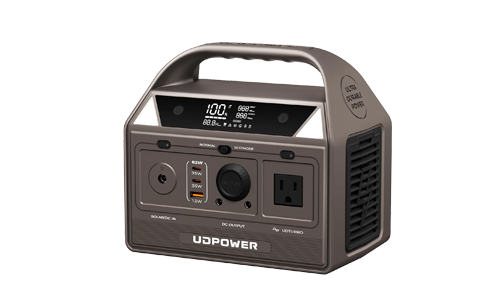
| UDPOWER C400 | 256Wh | 400W | 800W surge | Approximately 6.88 lb | 2 | Up to 150W | Phones, router, lights, laptop, travel, and short outages | C400 product page |
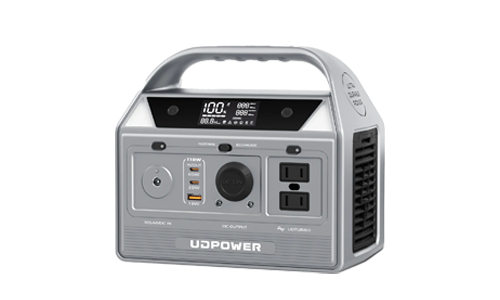
| UDPOWER C600 | 596Wh | 600W | 1,200W maximum | Approximately 12.3 lb | 2 | Up to 240W | CPAP backup, fans, electronics, mini fridges, and medium-length outages | C600 product page |
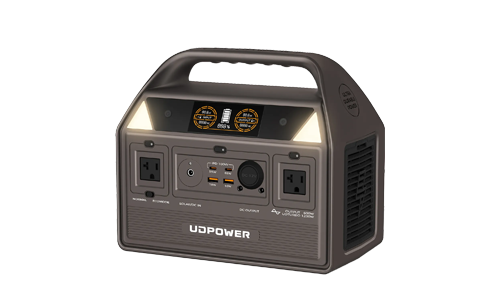
| UDPOWER S1200 | 1,191Wh | 1,200W | 1,800W maximum | Approximately 26 lb | 5 | Up to 400W | Refrigerators, CPAP, routers, electronics, TVs, and broader home essentials | S1200 product page |
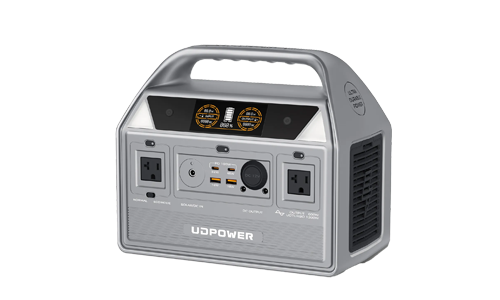
| UDPOWER S2400 | 2,083Wh | 2,400W | 3,000W startup surge | Approximately 40.8 lb | 6 | 12–50V, 10A maximum input | Longer refrigerator backup, multiple essentials, kitchen appliances, and heavier outage loads | S2400 product page |
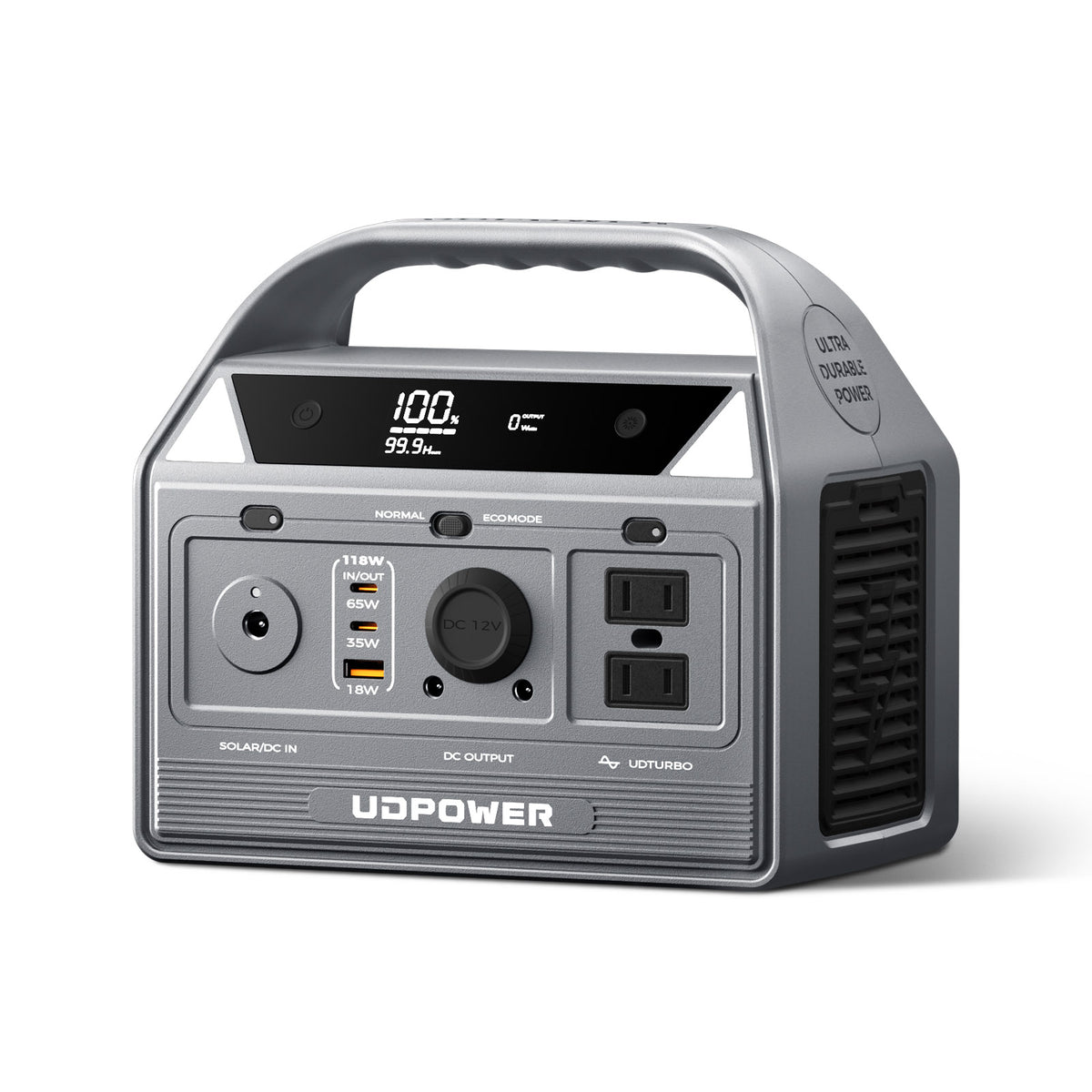
UDPOWER C400: Best for Compact Indoor Backup
The C400 is suited to people who want a lightweight power source for communication, lighting, laptops, phone charging, small medical devices, and short power interruptions. At approximately 6.88 pounds, it is easier to move between rooms, carry upstairs, or include in an emergency travel kit.
- 256Wh LiFePO4 battery
- 400W rated pure sine wave output
- 800W surge output
- Two AC outlets
- Up to 150W solar input
- Approximately 6.88 lb
Best fit: Router backup, phones, LED lights, laptop charging, travel, and short apartment outages.
Not the best fit: Full-size refrigerators with high startup requirements, microwaves, coffee makers, space heaters, and long multi-device outages.
View UDPOWER C400
UDPOWER C600: Best for Overnight Essentials
The C600 provides a useful balance between portability and battery capacity. Its 596Wh battery is better suited than a compact unit for overnight CPAP use, fans, laptops, routers, lighting, cameras, and selected compact refrigeration.
- 596Wh LiFePO4 battery
- 600W rated pure sine wave output
- Up to 1,200W maximum output
- Two AC outlets
- Up to 240W solar input
- Approximately 12.3 lb
- Official certifications listed include UL2743, FCC, RoHS, and UN38.3
Best fit: One-night CPAP planning, apartment backup, fans, phones, router, laptop, TV, cameras, and selected mini refrigerators.
Before using it with a refrigerator: Confirm that the compressor’s startup demand stays within the supported output.
View UDPOWER C600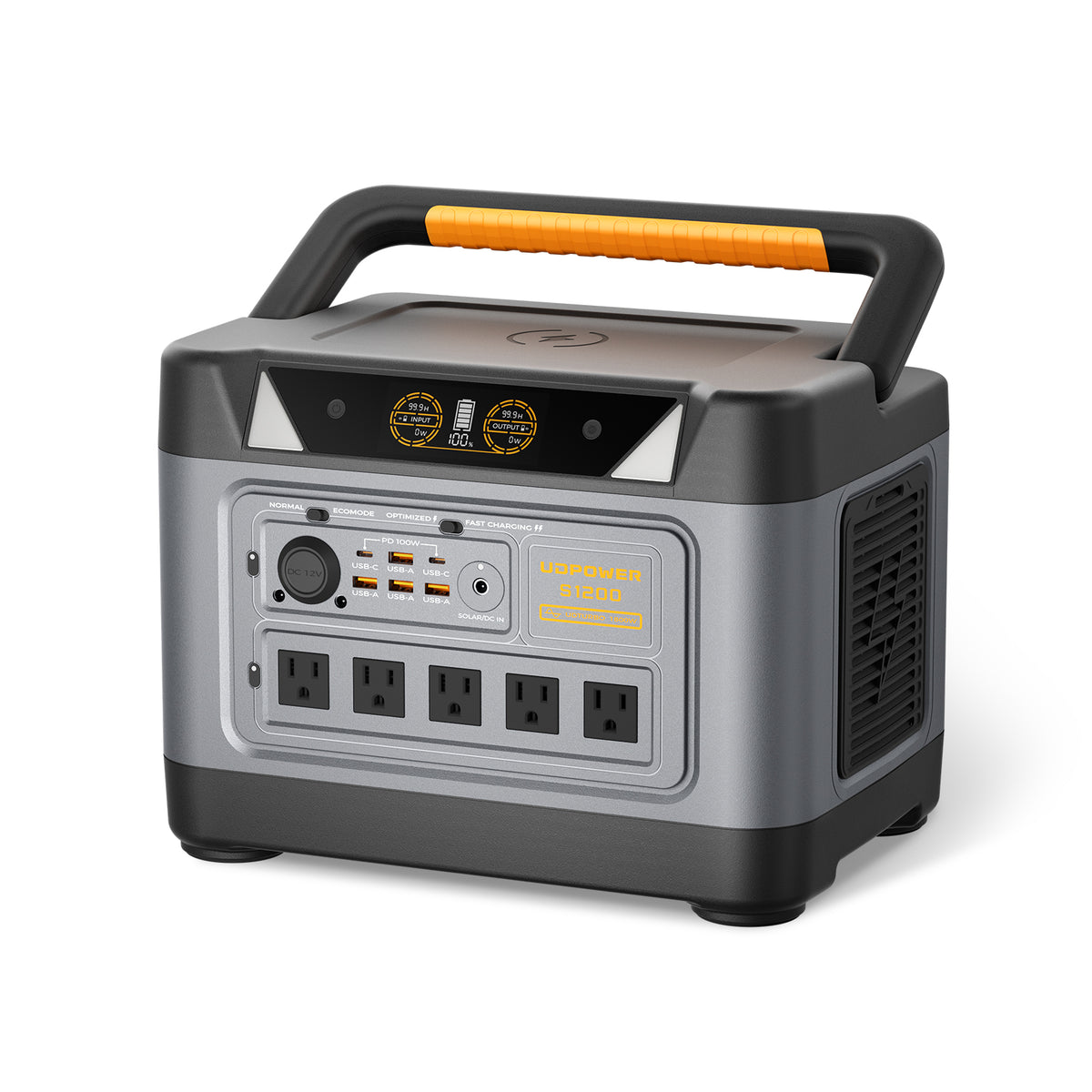
UDPOWER S1200: Best All-Around Indoor Generator
The S1200 is the most balanced option for households that need more than phone and laptop charging but still want a unit that can be moved without special equipment. Its 1,191Wh battery and 1,200W rated output make it a practical choice for refrigerators, CPAP machines, routers, lighting, computers, TVs, fans, and carefully selected kitchen appliances.
- 1,191Wh LiFePO4 battery
- 1,200W rated pure sine wave AC output
- Up to 1,800W maximum output
- Five AC outlets
- Up to 400W solar input
- UPS response time of 10 milliseconds or less
- Approximately 26 lb
Best fit: Full-size refrigerator backup, multi-night CPAP planning, home office equipment, router, lighting, TV, fans, and general outage preparation.
Limitation: It is still a 1,200W rated system. Do not assume it can continuously run every 1,500W heating appliance simply because it has surge capability.
View UDPOWER S1200 See What a 1200W Power Station Can Run
UDPOWER S2400: Best for Longer and Heavier Indoor Backup
The S2400 is designed for households that need greater battery reserve and more output headroom. Its 2,083Wh battery, 2,400W rated output, and six AC outlets make it better suited to longer refrigerator operation, multiple simultaneous essentials, larger kitchen appliances, home office equipment, and selected higher-power devices.
- 2,083Wh LiFePO4 battery
- 2,400W rated pure sine wave AC output
- Up to 3,000W startup surge
- Six AC outlets
- Two USB-C ports supporting up to 100W
- UPS response time of 10 milliseconds or less
- Approximately 40.8 lb
- 12–50V, 10A maximum solar charging input
Best fit: Refrigerator plus CPAP, router, phones, lighting, laptops, TV, fans, and scheduled kitchen appliance use during longer outages.
Limitation: The S2400 is not a whole-home 120/240V system and should not be connected to home wiring without compatible transfer equipment and qualified installation.
View UDPOWER S2400 See 2000W-Class Refrigerator RuntimeHow to Set Up an Indoor Generator for an Outage
-
Fully charge the power station.
Charge it before severe weather, planned grid work, travel, or periods when an outage is more likely. -
Choose a safe operating location.
Use a hard, dry, level surface with open space around the cooling vents. Keep the station away from bedding, curtains, water, heaters, direct sunlight, and exits. -
Check every essential device.
Read the appliance label and identify its running watts, startup requirement, plug type, and voltage. -
Connect the most important load first.
Start with medical equipment, refrigeration, communication, or lighting. Confirm stable operation before adding another device. -
Watch the output display.
Compare the displayed output with the station’s rated limit and note the estimated remaining runtime. -
Stagger high-watt appliances.
Turn off unnecessary loads before operating a coffee maker, microwave, or other high-power appliance. -
Conserve energy early.
Do not wait until the battery reaches 10% before reducing loads. An uncertain outage may last longer than expected. -
Recharge safely.
Use wall power when restored, a compatible vehicle-charging method, or properly matched solar panels outdoors.
Test the setup before you need it
A product specification cannot reveal every real-world issue. Run a controlled test while grid power is available:
- Charge the station to 100%.
- Connect the exact refrigerator, CPAP machine, router, or other critical equipment.
- Observe startup behavior and displayed output.
- Operate the setup for several hours or overnight.
- Record the battery percentage used.
- Check cable placement, noise, heat, and ventilation.
- Adjust your outage plan based on measured results.
First-time users can also follow How Easy Is a Portable Power Station to Use?
Common Indoor Generator Mistakes
1. Buying based only on inverter watts
A 2,000W inverter may run a powerful appliance, but a small battery will not run it for long. Check watt-hours and watts together.
2. Buying based only on battery capacity
A large battery with insufficient output may still fail to start a refrigerator, microwave, pump, or air conditioner.
3. Treating surge output as continuous output
Surge power is intended for brief startup events. Plan normal operation around the rated continuous output.
4. Ignoring appliance input watts
A microwave advertised as “1,000 watts” may consume considerably more than 1,000W from the outlet. Use the electrical input rating on the appliance label.
5. Running a space heater because the plug fits
A large battery may technically operate a 1,500W heater, but it can consume more than 1.5kWh in one hour. That leaves little energy for refrigeration, communication, or medical equipment.
6. Backfeeding a wall outlet
Never use a male-to-male cable or plug a portable power station into a wall outlet to energize home wiring. Plug appliances directly into the station unless the manufacturer provides a compatible home-integration system installed according to electrical requirements.
7. Operating the station in a closed cabinet
Cabinets and closets can trap heat and block cooling airflow. A stored unit may be kept in a cool, dry location, but an operating or charging unit needs ventilation.
8. Waiting until the storm arrives to charge it
A battery generator cannot help if it has been sitting at a low charge. Check and recharge it periodically according to the manual.
9. Expecting solar panels to work normally through a window
Glass, shadows, poor angles, and indoor positioning can sharply reduce solar input. Place compatible portable panels outdoors in direct sunlight.
10. Relying on one untested system for critical medical needs
Test the exact device, power adapter, humidifier, heated hose, cables, and power station together. Keep a secondary plan for critical health equipment.
Indoor Generator vs. Gas Generator vs. Standby Generator
| Feature | Indoor battery generator | Portable fuel generator | Whole-home standby generator |
|---|---|---|---|
| Indoor operation | Yes, when used correctly | No | Engine remains outdoors |
| Fuel | Stored electricity | Gasoline, propane, or diesel | Usually natural gas or propane |
| Carbon monoxide during operation | No combustion exhaust from the battery unit | Yes | Yes, exhausted outdoors |
| Noise | Low, mainly cooling fans | Engine noise | Engine noise outdoors |
| Installation | Usually plug-and-play for direct device connection | Outdoor placement, fuel, cords, and safe connection planning | Professional installation, permits, fuel connection, and transfer equipment |
| Refueling or recharging | Wall, vehicle, or compatible solar charging | Add fuel after safe shutdown and cooling | Connected fuel supply |
| Best use | Quiet essential-load backup | Longer high-output outdoor operation | Automatic whole-home or selected-circuit backup |
| Main limitation | Finite stored energy | Cannot operate indoors and requires fuel handling | Higher cost and installation complexity |
Indoor Generator FAQ
Can a generator be used indoors?
A battery-powered portable power station can generally be used indoors when it is undamaged, dry, ventilated, and operated within its limits. A gasoline, propane, diesel, or natural-gas generator must never be operated indoors.
Does an indoor battery generator produce carbon monoxide?
A battery power station does not burn fuel while supplying power, so it does not produce combustion exhaust or carbon monoxide during normal battery operation. This does not remove electrical, heat, moisture, or battery-damage risks.
Can an indoor generator run a refrigerator?
Yes, when the station has enough rated output for normal operation, enough surge capability for compressor startup, and enough battery capacity for the desired runtime. Many full-size refrigerators are better matched with a 1,200W-class or larger portable power station.
What size indoor generator do I need for an apartment?
A 250Wh to 600Wh model may be enough for phones, Wi-Fi, lights, laptops, fans, and short outages. Approximately 1,000Wh or more is more practical when overnight CPAP use, a refrigerator, or multiple essential devices are included.
Can an indoor generator power a whole house?
Most portable battery generators are designed for selected devices rather than every circuit in a house. Central air conditioning, electric water heaters, electric ranges, dryers, and other 240V loads normally require a larger installed backup system.
Can I plug an indoor generator into a wall outlet?
No. Do not connect a portable power station to a wall outlet in an attempt to power home wiring. Plug appliances directly into the station unless you have compatible transfer equipment professionally installed for that specific system.
Can I run a space heater from an indoor generator?
Some high-output models can operate a 1,500W space heater, but the heater may drain a 2,000Wh-class battery in little more than an hour. Heating appliances are usually poor choices when stored energy must also support refrigeration, communication, lighting, or medical equipment.
Can I use an indoor generator while it is charging?
This depends on the model and charging mode. Some portable power stations support pass-through or UPS-style operation. Check the manual for load limits, switching behavior, charging conditions, and whether continuous use is supported.
Can solar panels stay indoors with the generator?
The battery unit may remain indoors, but portable solar panels should be placed outdoors in direct sunlight for useful charging. Window glass, shadows, and poor angles can greatly reduce input.
Is a LiFePO4 battery better for an indoor generator?
LiFePO4 batteries are widely used in modern portable power stations because of their cycle life and thermal stability. They still need proper charging, ventilation, temperature control, and protection from physical damage.
Can I keep an indoor generator in a closet?
A powered-off unit may be stored in a cool, dry location according to its manual. Do not operate or charge it in a tightly closed closet where heat can build up or cooling vents can be blocked.
How often should I recharge a stored indoor generator?
Follow the manufacturer’s storage instructions. Check the battery periodically, avoid leaving it fully depleted for long periods, and perform a test before storm season, travel, or any situation in which backup power will be important.
Can an indoor generator run a CPAP machine all night?
Often, yes. Runtime depends heavily on CPAP pressure, humidifier use, heated tubing, connection method, and battery capacity. A roughly 600Wh model can cover one night for many low-to-moderate CPAP loads, while a 1,000Wh or larger model provides more reserve.
Is an indoor generator the same as a solar generator?
The terms often overlap. A solar generator is normally a battery power station paired with solar panels. The power station stores and supplies electricity, while the panels provide an optional recharging source.
Choose an Indoor Backup System Based on Real Loads
Start with the equipment that must remain available, add its actual wattage, check startup requirements, and estimate the number of hours you need. Then choose a battery capacity and rated output that leave a reasonable reserve.
View All Portable Power Stations View Solar Generator Kits Get Product and Runtime GuidanceRelated Articles


