

How Many Watts Does a Freezer Use?
Last updated: July 13, 2026
How Many Watts Does a Freezer Use?
Most residential freezers use about 100 to 250 watts while the compressor is actively running. A small, efficient chest freezer may use less, while a large frost-free upright freezer may use 300 watts or more during certain operating cycles.
Compressor startup is the bigger concern when choosing backup power. A freezer may briefly require several hundred to more than 1,500 starting watts, even when it uses only 100 to 200 watts after it starts.
Because the compressor turns on and off, the freezer does not draw its running wattage continuously. An efficient ENERGY STAR chest freezer using 215 kWh per year averages only about 24.5 watts across the entire year, even though its live draw will be much higher whenever the compressor is running.

That difference between running watts, starting watts, and average energy use explains why freezer wattage estimates often appear to contradict one another. One number tells you whether a power station can start the freezer. Another tells you how long the battery will last.
Freezer Wattage Chart by Type
The ranges below are practical planning estimates for residential equipment. Your freezer’s label, EnergyGuide data, manual, or measured power consumption should take priority over a general chart.
| Freezer type | Typical active running watts | Possible startup or peak demand | What can push usage higher? | Best way to verify |
|---|---|---|---|---|
| Compact freezer | About 50–100W | About 200–600W | Warm room, poor ventilation, heavy frost, aging compressor | Plug-in watt meter with maximum-watt recording |
| Small to midsize chest freezer | About 70–150W | About 300–900W | Hot garage, frequent opening, warm food, damaged door seal | 24-hour watt-meter test plus EnergyGuide label |
| Large chest freezer | About 100–250W | About 500–1,200W or more | Large compressor, hot ambient temperature, old insulation | Manufacturer data or a meter that captures startup surge |
| Manual-defrost upright freezer | About 80–200W | About 400–1,200W | Door openings, poor shelving airflow, worn gasket | EnergyGuide label and 24-hour energy measurement |
| Frost-free upright freezer | About 100–300W | About 600–1,500W or more | Defrost heater, fan motor, large compressor, warm room | Measure for at least 24–48 hours to capture defrost cycles |
| Commercial freezer | About 300–1,000W or more | May exceed 2,000–4,000W | Multiple fans, glass doors, frequent access, large compressors | Commercial equipment data plate and electrician-grade meter |
On a phone, swipe the table horizontally to view every column.
Running Watts, Starting Watts, and Average Watts Are Different
Before sizing a generator or portable power station, separate the freezer’s power use into three different numbers. Each answers a different question.
1. Running watts
Running watts are the power the freezer uses while the compressor, fan, or defrost system is operating. For many household freezers, active compressor draw falls somewhere near 100 to 250 watts.
2. Starting watts
Starting watts are the brief burst of power needed to start the compressor motor. This surge may last only a fraction of a second or several seconds, but it can still overload a small inverter.
One government appliance-planning example lists a refrigerator or freezer at about 180 running watts and 1,800 starting watts. That should not be treated as a universal freezer specification, but it shows why compressor surge must be checked separately from normal running power. See the government appliance generator guide.
3. Cycle-average watts
Cycle-average watts describe the freezer’s electricity use across many hours, including the time when the compressor is off. This number is usually much lower than the live running wattage.
For example, a compressor might draw 120 watts while running but operate only part of each hour. Its average energy use across the day could therefore be closer to 25, 40, or 60 watts, depending on conditions.
This distinction matters because output watts determine whether a power station can start the freezer, while watt-hours and average consumption determine runtime.
How Much Electricity Does a Freezer Use Per Day and Per Year?
ENERGY STAR reports that a certified chest freezer uses about 215 kWh per year, while a certified upright freezer uses about 395 kWh per year. Chest freezers are generally more efficient because their top-opening design allows less cold air to spill out when the lid is opened.
| ENERGY STAR freezer type | Typical annual energy | Average daily energy | Average power across a full year | Source |
|---|---|---|---|---|
| Certified chest freezer | About 215 kWh/year | About 589 Wh/day | About 24.5W | ENERGY STAR freezer guidance |
| Certified upright freezer | About 395 kWh/year | About 1,082 Wh/day | About 45.1W | ENERGY STAR freezer guidance |
The average-watt figure does not mean the compressor runs at 24.5 or 45.1 watts. It spreads the freezer’s total yearly energy consumption over every hour of the year, including compressor-off periods.
Daily and annual electricity examples
| EnergyGuide estimate | Average per day | Average watts over time | Cost at $0.15/kWh | Cost at $0.20/kWh | Cost at $0.25/kWh |
|---|---|---|---|---|---|
| 150 kWh/year | 411 Wh/day | 17.1W | $22.50/year | $30.00/year | $37.50/year |
| 215 kWh/year | 589 Wh/day | 24.5W | $32.25/year | $43.00/year | $53.75/year |
| 300 kWh/year | 822 Wh/day | 34.2W | $45.00/year | $60.00/year | $75.00/year |
| 395 kWh/year | 1,082 Wh/day | 45.1W | $59.25/year | $79.00/year | $98.75/year |
| 500 kWh/year | 1,370 Wh/day | 57.1W | $75.00/year | $100.00/year | $125.00/year |
Check the yellow EnergyGuide label for your model’s estimated annual kWh. The label is usually more useful for yearly cost and battery runtime planning than a single wattage number. The Federal Trade Commission’s EnergyGuide explanation shows how to compare similar appliances.
How to Find Your Freezer’s Actual Wattage
General wattage charts are useful for planning, but a real measurement is better when you are choosing emergency backup power. Use one or more of the following methods.
-
Read the freezer data plate.
Look inside the cabinet, around the door frame, on the back, or near the compressor compartment. The label may list volts, amps, watts, frequency, model number, and refrigerant information. -
Check the EnergyGuide label.
Use the listed annual kWh to estimate daily battery demand. This reflects cycling better than simply multiplying the compressor’s running watts by 24 hours. -
Search the exact model number.
The product manual or manufacturer specification sheet may list rated current, defrost-heater power, compressor information, or recommended circuit requirements. -
Measure live power with a plug-in watt meter.
Record running watts, maximum watts, and total kWh for at least 24 hours. A 48-hour test is better for frost-free models because it is more likely to include an automatic defrost cycle. -
Test the hardest restart condition.
A compressor may restart differently after it has been running, after a brief interruption, or when the cabinet is warm. Do not assume one successful cold start proves every future start will work.
Can you calculate watts from volts and amps?
You can use volts multiplied by amps as a conservative electrical-load estimate:
For example, 115 volts × 1.5 amps equals 172.5 volt-amps. However, a compressor is a motor load, so volt-amps are not always equal to true watts because power factor affects the result. Use a watt meter when you need an accurate real-power reading.
What Makes a Freezer Use More Electricity?
Ambient temperature
A freezer in a hot garage must remove more heat than the same freezer in a climate-controlled room. Compressor run time can increase sharply during summer, especially when airflow around the cabinet is restricted.
A “garage-ready” label does not mean energy use remains constant in every garage temperature. It means the appliance is designed to operate within a wider ambient range specified by the manufacturer.
Door or lid openings
Every opening allows heat and moisture to enter. Upright freezers lose more cold air through an open front door, while cold air tends to remain inside a chest freezer when its top lid is opened.
Warm food
Adding a large quantity of unfrozen food can keep the compressor running for hours. Runtime tests performed with an already-cold freezer may underestimate energy use after a bulk grocery trip, fishing trip, harvest, or meal-prep session.
Frost buildup
Heavy frost reduces usable space and can interfere with heat transfer or door sealing. Manual-defrost freezers should be defrosted when buildup becomes significant, following the manufacturer’s instructions.
Automatic defrost cycles
A frost-free upright freezer may temporarily power a defrost heater, fan, and compressor at different times. A five-minute measurement can miss this higher-energy cycle, which is why a 24- to 48-hour test is more useful.
Damaged gasket or poor door alignment
A worn seal allows warm, humid air to leak into the cabinet. Check for cracks, debris, loose sections, or areas where a sheet of paper slides out with almost no resistance.
Restricted ventilation
Freezers release heat through the condenser area. Placing the appliance too close to a wall, covering ventilation openings, or allowing dust to accumulate can increase compressor run time.
Freezer age and condition
Older insulation, dirty condenser components, worn seals, failing fans, or compressor problems can increase energy consumption. Compare an older unit’s measured kWh with newer EnergyGuide estimates before assuming replacement would not save electricity.
How Much Backup Power Does a Freezer Need During an Outage?
You may not need to power a freezer continuously from the first minute of an outage. A closed freezer acts like an insulated cold box.
FoodSafety.gov states that a full freezer can hold a safe temperature for approximately 48 hours, while a half-full freezer may hold temperature for approximately 24 hours, provided the door stays closed.
See the official Food Safety During a Power Outage chart.
A smarter outage plan
-
Keep the door closed.
Organize food before storm season so you do not need to search through the freezer during an outage. -
Monitor temperature.
Use an appliance thermometer that can be read without holding the door open for long. -
Prioritize the freezer over nonessential loads.
Avoid running high-wattage heaters, kettles, coffee makers, or microwaves from the same battery while freezer backup is the priority. -
Recharge whenever reliable power is available.
Use wall charging, solar charging, or vehicle charging within the power station’s supported specifications. -
Leave a battery reserve.
Do not plan around using every advertised watt-hour. Inverter losses, battery condition, temperature, and standby consumption reduce usable energy.
How to Size a Portable Power Station for a Freezer
A portable power station must pass two separate tests: it must be powerful enough to start the freezer, and it must store enough energy to run it for the desired outage period.
Step 1: Check continuous AC output
The station’s rated AC output should exceed the freezer’s active running wattage plus any other loads that may operate at the same time. Avoid planning to operate continuously at the inverter’s absolute limit.
Step 2: Check surge output
Compare the station’s surge capability with the freezer’s measured or manufacturer-specified startup demand. A unit that can run the compressor after startup may still shut down when the compressor restarts.
Step 3: Calculate usable battery capacity
For UDPOWER runtime planning, this guide uses a 90% conversion-efficiency estimate:
Step 4: Estimate runtime from daily energy
This daily-energy method is usually more realistic than dividing battery capacity by compressor running watts, because it accounts for the time the compressor is off.
Step 5: Add reserve capacity
Add at least 20% to 30% planning margin when the freezer is old, located in a garage, frequently opened, loaded with warm food, or sharing the power station with other devices.
- The freezer’s running load is below the power station’s rated AC output.
- The compressor startup demand is below the station’s surge capability.
- The power station has enough watt-hours for the target backup period.
- The AC output produces a pure sine wave suitable for motor-driven appliances.
- The freezer plug, power cord, and outlet are undamaged.
- The power station is dry, ventilated, and operated within its temperature limits.
Recommended UDPOWER Power Stations for Freezer Backup
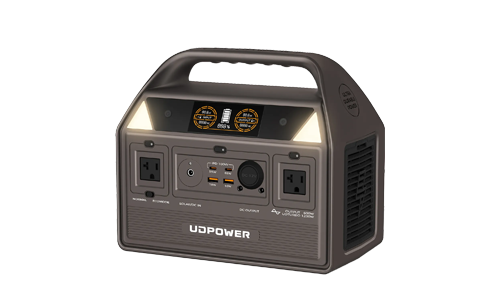
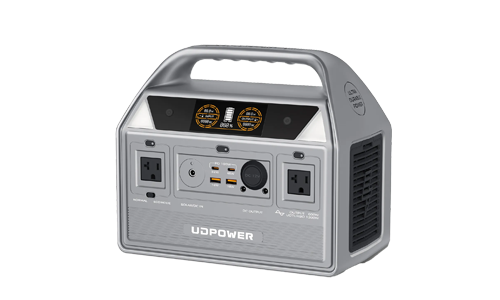
For household freezer backup, the S1200 and S2400 provide substantially more compressor-starting headroom and battery capacity than compact entry-level power stations.
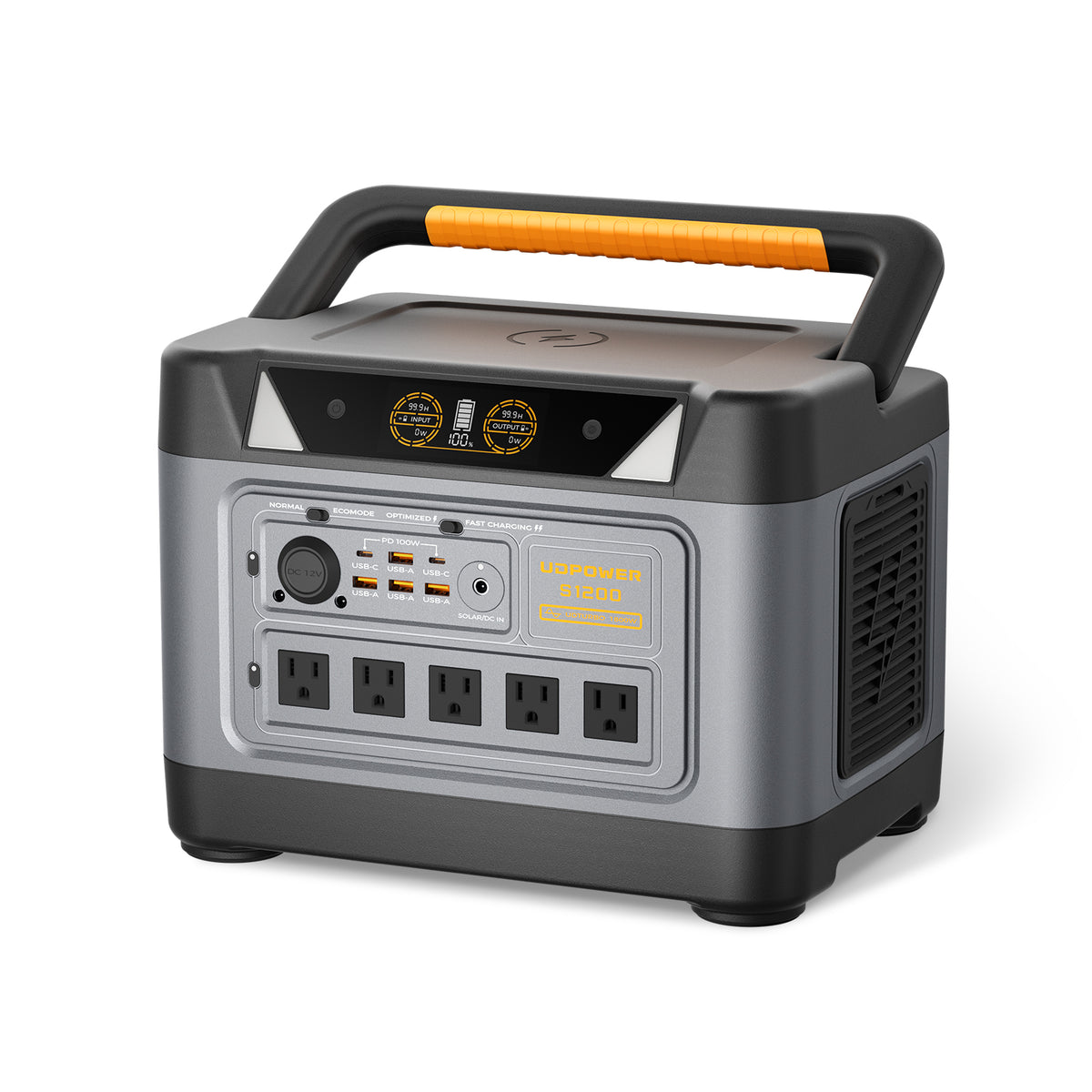
UDPOWER S1200: Practical Backup for One Residential Freezer
- Battery capacity: 1,190Wh
- Rated AC output: 1,200W
- Surge capability: Up to 1,800W
- Battery chemistry: LiFePO4
- Cycle life: 4,000+ cycles
- Solar input: Up to 400W
The S1200 is a strong starting point for an efficient chest freezer or many standard residential upright freezers, provided the freezer’s actual compressor surge remains within the S1200’s supported output.
Its 1,190Wh battery provides approximately 1,071Wh of estimated usable AC energy when calculated at 90% efficiency. That makes it well suited to short outages, overnight backup, and freezer-first emergency plans.
View the UDPOWER S1200
UDPOWER S2400: Longer Runtime and More Starting Headroom
- Battery capacity: 2,083Wh
- Rated AC output: 2,400W
- Surge capability: Up to 3,000W
- Battery chemistry: LiFePO4
- Cycle life: 4,000+ cycles
- Solar charging support: Up to 400W
The S2400 is the better option for a larger or older freezer, a frost-free upright freezer, longer outages, or a backup plan that includes both a freezer and other essential devices.
Its 2,083Wh battery provides approximately 1,875Wh of estimated usable AC energy at 90% efficiency. The higher 2,400W rated output and 3,000W surge capability also provide more margin for difficult compressor starts.
View the UDPOWER S2400Need to compare more capacities? Visit the UDPOWER portable power station collection.
How Long Will a UDPOWER Power Station Run a Freezer?
The most useful estimate starts with the freezer’s EnergyGuide annual kWh rather than its compressor running wattage. The table below uses:
- S1200 battery capacity: 1,190Wh
- S2400 battery capacity: 2,083Wh
- Estimated conversion efficiency: 90%
- No solar input during the runtime period
- No other devices connected
| Freezer annual energy use | Average daily energy | Estimated S1200 runtime | Estimated S2400 runtime | Typical planning context |
|---|---|---|---|---|
| 150 kWh/year | 411 Wh/day | About 62.5 hours | About 109.5 hours | Very efficient compact or chest freezer |
| 215 kWh/year | 589 Wh/day | About 43.6 hours | About 76.4 hours | ENERGY STAR chest-freezer benchmark |
| 300 kWh/year | 822 Wh/day | About 31.3 hours | About 54.7 hours | Midsize freezer or less-efficient chest model |
| 395 kWh/year | 1,082 Wh/day | About 23.8 hours | About 41.6 hours | ENERGY STAR upright-freezer benchmark |
| 500 kWh/year | 1,370 Wh/day | About 18.8 hours | About 32.8 hours | Large, older, frost-free, or high-use freezer |
These estimates assume the freezer continues using energy at the same average rate represented by its annual label. Actual outage runtime may be shorter in a hot garage, after loading warm food, during frequent door openings, or when battery temperature and condition reduce usable capacity.
Why dividing by running watts gives a different answer
The next table assumes the freezer draws a constant load without cycling off. It is useful for checking a worst-case continuous-compressor condition, but it may underestimate normal clock runtime.
| Constant AC load | S1200 estimated runtime | S2400 estimated runtime | How to interpret it |
|---|---|---|---|
| 60W | About 17.9 hours | About 31.2 hours | Low continuous load or highly efficient equipment |
| 80W | About 13.4 hours | About 23.4 hours | Compact freezer running continuously |
| 100W | About 10.7 hours | About 18.7 hours | Efficient residential compressor under continuous load |
| 120W | About 8.9 hours | About 15.6 hours | Common planning value for a chest freezer |
| 150W | About 7.1 hours | About 12.5 hours | Midsize residential freezer under continuous operation |
| 180W | About 6.0 hours | About 10.4 hours | Higher continuous compressor load |
| 250W | About 4.3 hours | About 7.5 hours | Large freezer or demanding operating condition |
Can Solar Panels Keep a Freezer Running?
Yes, a properly sized solar generator can help run a freezer, but panel wattage alone does not guarantee continuous operation. You need enough battery capacity for nighttime and cloudy periods, plus enough usable daytime solar energy to replace what the freezer consumes.
Simple daily solar calculation
Suppose a freezer uses 600Wh per day. After allowing for solar conditions and charging losses, you may need roughly 750–900Wh of panel production per day to replace that consumption reliably.
A 210W panel does not produce 210 watts all day. Actual output changes with:
- Sun angle and time of day
- Clouds, haze, and seasonal daylight
- Partial shade on any part of the panel
- Panel temperature
- Cable and conversion losses
- The power station’s maximum supported solar input
- Whether the battery is nearly full and limiting incoming power
Position the panel in direct sunlight, keep its entire surface free of shade, and adjust the angle while watching the power station’s live input display.
Explore UDPOWER solar generator kits or portable solar panels for compatible backup configurations.
How to Reduce Freezer Power Consumption
Keep the freezer reasonably full
Frozen contents add thermal mass and help the cabinet resist short temperature changes. Do not block required internal airflow or pack items against vents in a frost-free model.
Use containers of frozen water to fill unused space
Frozen water containers can help stabilize temperature and reduce empty air volume. Leave expansion space inside each container and do not interfere with baskets, vents, or the lid.
Organize food before an outage
Label baskets and keep frequently used items near the top or front. Faster access means the door stays open for less time.
Check the gasket
Clean the sealing surface and inspect it for cracks, hardened areas, or gaps. Replace damaged seals according to the freezer manufacturer’s instructions.
Allow proper ventilation
Follow the manual’s clearance requirements and keep ventilation openings unobstructed. Clean accessible condenser areas only as directed by the manufacturer.
Defrost when necessary
Excessive ice buildup reduces storage space and can interfere with normal operation. Do not use sharp tools to remove ice because puncturing a refrigerant line can permanently damage the appliance.
Avoid unnecessary temperature settings
Keep the freezer at the manufacturer-recommended food-storage temperature. Setting it far colder than necessary can increase energy use without providing a practical benefit.
Cool hot food before freezing it
Follow food-safety guidance, divide food into smaller containers, and avoid placing large quantities of hot food directly into the freezer. A large warm load can cause extended compressor operation.
Measure older freezers
Run a 24- to 48-hour watt-meter test and compare the result with the EnergyGuide estimates of current models. This gives you a factual basis for deciding whether repair, maintenance, or replacement makes sense.
Frequently Asked Questions
How many watts does a chest freezer use?
Many residential chest freezers use about 70 to 200 watts while the compressor is running. Small efficient models may use less, while large or older models may use more. Compressor startup can briefly require several times the active running load.
How many watts does a 7-cubic-foot freezer use?
A 7-cubic-foot chest freezer commonly falls near 70 to 150 running watts, but the exact number depends on the compressor, ambient temperature, age, thermostat setting, and insulation. Check the label and measure the actual model before choosing backup power.
How many watts does an upright freezer use?
Many residential upright freezers draw about 100 to 300 watts during active operation. Frost-free models may also power a fan and defrost heater, creating higher temporary demand than the compressor alone.
How many starting watts does a freezer need?
Residential freezer startup demand may range from several hundred watts to more than 1,500 watts. There is no universal multiplier that works for every compressor, so use manufacturer data or a meter capable of recording inrush or peak power.
Will a 1,000-watt generator run a freezer?
It may run an efficient freezer if both the generator’s continuous rating and surge rating exceed the freezer’s requirements. A 1,000-watt peak claim is not the same as 1,000 watts of continuous output, so check both ratings carefully.
Will a 300-watt power station run a freezer?
A 300-watt station may support the running load of a small freezer but often lacks enough surge power to start the compressor reliably. Its small battery may also provide limited runtime. Test the exact freezer and review both rated and surge output.
Can the UDPOWER S1200 run a freezer?
The S1200 provides 1,200W rated AC output, up to 1,800W surge capability, and 1,190Wh battery capacity. It can run many residential freezers when their measured running and startup requirements stay within those limits.
Can the UDPOWER S2400 run a freezer and refrigerator together?
The S2400 provides 2,400W rated output and up to 3,000W surge capability, giving it more headroom for multiple cold appliances. Compatibility still depends on whether the compressor startups overlap and whether the combined load remains within the station’s limits.
How much electricity does a freezer use in 24 hours?
An efficient chest freezer using 215 kWh per year averages about 589Wh per day. An efficient upright freezer using 395 kWh per year averages about 1,082Wh per day. Actual use changes with size, temperature, door openings, defrost cycles, and appliance condition.
Does a freezer run continuously?
Normally, no. The compressor cycles on when the cabinet warms above its thermostat target and turns off after cooling it again. It may run for long periods after warm food is added, during hot weather, after defrosting, or when a seal or cooling component has a problem.
Does a full freezer use less electricity?
A reasonably full freezer has more thermal mass and may hold temperature better during door openings and outages. However, overpacking can obstruct airflow in some models. Follow the appliance manual and keep internal vents clear.
How long will a freezer stay cold without power?
FoodSafety.gov advises that a full unopened freezer can hold a safe temperature for approximately 48 hours, while a half-full freezer may hold temperature for approximately 24 hours. Use an appliance thermometer and follow official guidance rather than relying only on elapsed time.
Can a solar panel run a freezer directly?
A household AC freezer should normally be connected to a compatible solar generator or power station rather than directly to a portable solar panel. The battery and inverter stabilize power, handle compressor startup, and continue supplying electricity when sunlight changes.
Why does my freezer use more power in the garage?
A hot garage increases the temperature difference between the freezer interior and the surrounding air. The compressor must run longer to remove the extra heat. Very cold garage conditions can also affect models that are not designed for that ambient range.
Choose Backup Power Based on Your Actual Freezer
Check the freezer’s running watts, startup surge, and daily kWh before choosing a battery. For a single efficient residential freezer, the S1200 offers a practical balance of capacity and portability. For longer outages, difficult compressor starts, or multiple essential appliances, the S2400 provides more battery capacity and output headroom.
View Portable Power Stations View the UDPOWER S1200 View the UDPOWER S2400 View Solar Generator KitsRelated Articles


