

How Much Does Starlink Internet Cost in 2026? A Complete U.S. Price Breakdown
Last updated:
Starlink pricing is no longer explained accurately by quoting one monthly fee. Your real cost depends on your service address, plan, hardware offer, data use, installation, electricity consumption, and whether you need backup power during an outage.
How Much Does Starlink Cost? The Direct Answer
In the United States, current Starlink personal service generally costs $55 to $175 per month. Residential plans are currently listed at $55, $85, or $130 per month, while Roam plans are listed at $55, $80, or $175 per month.
Hardware can start at $199 for a Starlink Mini Kit. A Standard Kit is commonly listed around $349, although qualifying residential addresses may see a $0 upfront hardware offer tied to a 12-month service commitment.
Before taxes, shipping, mounts, accessories, and electricity, a practical first-year budget is approximately:
- $660 to $1,909 for residential service, depending on the plan and hardware offer.
- $859 to $2,299 for Roam service when paired with a $199 Mini Kit.
- About $2.66 to $13.28 per month in electricity for a Mini or Standard system left on continuously, using the latest national residential electricity average available when this guide was updated.
Starlink prices and promotions can vary by service address. Enter your exact address on the official Starlink website before treating any advertised price as final.

Starlink Internet Cost at a Glance
| Cost category | Typical current cost | When you pay it | What to verify | Source |
|---|---|---|---|---|
| Residential service | $55, $85, or $130 per month | Monthly | Availability and plan options at your address | Starlink service plans |
| Roam service | $55, $80, or $175 per month | Monthly while active | High-speed data allowance and travel needs | Starlink Roam |
| Starlink Mini Kit | Starting at $199 | Upfront | Current sale price and compatible service plan | Starlink Mini |
| Standard Kit | Commonly around $349 when purchased outright | Upfront | Address-specific hardware promotion | Starlink Residential |
| Residential hardware promotion | As low as $0 upfront at qualifying addresses | At checkout | 12-month commitment and early-cancellation terms | Check address availability |
| Mounts and installation | Varies widely | Usually upfront | Roof access, cable route, obstructions, and local labor | Starlink accessories |
| Electricity | Approximately $2.66 to $19.92 per month | Through your electric bill | Dish model, operating hours, snow melt, and local utility rate | U.S. Energy Information Administration |
All totals in this guide are planning estimates before applicable taxes, shipping, professional installation, accessories, and temporary promotions.
How Much Are Starlink Residential Plans?
Residential service is designed for a fixed home address. It is generally the most cost-effective Starlink option for households that need internet in one location throughout the year.
| Residential plan | Current monthly price | Best suited for | Main limitation to consider | Annual service cost |
|---|---|---|---|---|
| Residential 100 Mbps | $55 | One or two users, browsing, remote work, HD streaming, and everyday home use | Lower maximum speed than the higher tiers | $660 |
| Residential 200 Mbps | $85 | Families, multiple connected devices, frequent streaming, and video calls | Costs $360 more per year than the 100 Mbps tier | $1,020 |
| Residential Max | $130 | Heavier households that value the highest available residential performance | Costs $900 more per year than the entry residential tier | $1,560 |
Source: Starlink U.S. service plans. Availability can differ by address and network capacity.
Best value for most fixed homes: Start by asking whether the $55 plan can handle your normal household use. Moving from $55 to $85 adds $360 per year, while moving from $55 to $130 adds $900 per year. Paying for a higher tier only makes sense when your household can use the extra performance.
Does Starlink Residential Have a Data Cap?
Starlink’s current residential plan descriptions include unlimited residential data. That does not mean every household will receive the same speed at every hour. Performance can still change with local network demand, weather, dish placement, and obstructions.
Review the latest details in the official Starlink service plan descriptions before ordering.
Who Should Choose Residential Service?
- You use Starlink at one primary home.
- You need internet throughout the year rather than only during trips.
- Your household regularly streams, works remotely, attends video meetings, or uses cloud services.
- You do not need to move the dish between campsites, RV parks, or vacation properties.
Residential service is usually a poor fit when mobility is the main reason you are buying Starlink. In that case, compare the Roam plans instead of assuming a residential account can be moved whenever needed.
How Much Does Starlink Roam Cost?
Starlink Roam is built for portable and travel use. It can make sense for RV owners, campers, mobile workers, seasonal travelers, and people who need an internet connection at changing locations.
| Roam plan | Current monthly price | High-speed data | Best suited for | Annual cost if active all year |
|---|---|---|---|---|
| Roam 100GB | $55 | 100GB | Occasional trips, email, maps, light browsing, and limited streaming | $660 |
| Roam 300GB | $80 | 300GB | Frequent trips, remote work, moderate streaming, and several connected devices | $960 |
| Roam Unlimited | $175 | Unlimited mobile data under the current plan terms | Full-time RV travel, extended remote work, or consistently heavy mobile use | $2,100 |
Source: Starlink Roam and Starlink service plans.
On capped Roam plans, the listed allowance applies to high-speed data. After the allowance is used, service may continue at a much lower speed under the current plan terms. That can be enough for basic messaging but frustrating for video, large downloads, or normal remote work.
The Price Difference Is Smaller Than the Data Difference
The jump from Roam 100GB to Roam 300GB costs $25 more per month, or $300 more over a full year. In exchange, the high-speed allowance triples.
For someone who works remotely during trips, that can be a better value than repeatedly running out of high-speed data. For someone who only checks email during two weekend camping trips each month, the 100GB plan may be enough.
Do not choose a Roam plan by price alone. First estimate how much data your household will use. A lower monthly bill is not a saving when the allowance is exhausted halfway through every trip.
What Do 100GB and 300GB Mean in Real Use?
Data allowances are easier to understand when translated into everyday activities. Streaming is usually the fastest way to consume a capped Roam plan.
Netflix states that video can use up to about 3GB per hour in HD and up to 7GB per hour in 4K, depending on playback settings. Using those maximum rates gives the following rough ceilings.
| High-speed allowance | Approximate HD streaming at 3GB per hour | Approximate 4K streaming at 7GB per hour | What the estimate excludes |
|---|---|---|---|
| 100GB | About 33 hours | About 14 hours | Email, app updates, cloud backups, video calls, security cameras, and other devices |
| 300GB | About 100 hours | About 42 hours | Email, app updates, cloud backups, video calls, security cameras, and other devices |
Streaming source: Netflix data usage settings.
These are not promises of how long a plan will last. They show how quickly streaming alone can use the allowance. Actual consumption depends on resolution, compression, automatic quality adjustments, and the number of connected devices.
100GB May Be Enough When You:
- Travel only a few days per month.
- Mainly use maps, email, messaging, and ordinary web browsing.
- Download entertainment before leaving home.
- Turn off automatic cloud photo uploads and operating-system updates.
- Limit streaming resolution instead of leaving every device on maximum quality.
Consider 300GB or Unlimited When You:
- Work remotely for several days or weeks at a time.
- Attend frequent video meetings.
- Stream television every evening.
- Travel with several people and multiple devices.
- Use cloud storage, game downloads, remote cameras, or large software updates.
What Is the True First-Year Cost of Starlink?
The first-year cost is more useful than the advertised monthly fee because it combines service and hardware. The basic formula is:
Residential First-Year Cost With a $349 Standard Kit
| Residential plan | 12 months of service | Assumed Standard Kit | Estimated first-year subtotal | Average per month during year one |
|---|---|---|---|---|
| Residential 100 Mbps | $660 | $349 | $1,009 | About $84.08 |
| Residential 200 Mbps | $1,020 | $349 | $1,369 | About $114.08 |
| Residential Max | $1,560 | $349 | $1,909 | About $159.08 |
Residential First-Year Cost With a Qualifying $0 Kit Offer
| Residential plan | 12 months of service | Upfront hardware | Estimated first-year subtotal | Important condition |
|---|---|---|---|---|
| Residential 100 Mbps | $660 | $0 | $660 | Address must qualify; 12-month commitment may apply |
| Residential 200 Mbps | $1,020 | $0 | $1,020 | Address must qualify; 12-month commitment may apply |
| Residential Max | $1,560 | $0 | $1,560 | Address must qualify; 12-month commitment may apply |
A $0 kit offer lowers the upfront cost, but it should not be treated as unconditional free equipment. Read the checkout terms for the minimum service period and any amount due if service is canceled early.
Roam First-Year Cost With a $199 Mini Kit
| Roam plan | 12 months of service | Assumed Mini Kit | Estimated first-year subtotal | Average per month during year one |
|---|---|---|---|---|
| Roam 100GB | $660 | $199 | $859 | About $71.58 |
| Roam 300GB | $960 | $199 | $1,159 | About $96.58 |
| Roam Unlimited | $2,100 | $199 | $2,299 | About $191.58 |
Mini Kit source: Starlink Mini. These examples assume the starting Mini price and do not include sales tax, shipping, mounts, or promotional discounts.
Why the first-year average matters: A $55 monthly plan paired with a $349 kit does not really cost $55 per month during the first year. Before other expenses, it averages about $84.08 per month when the hardware is spread across 12 months.
Additional Starlink Costs People Commonly Miss
The kit and monthly plan may be enough for a simple ground-level setup. Many homes, cabins, and RV installations require additional equipment or labor.
| Possible expense | Why it may be needed | How to control the cost |
|---|---|---|
| Sales tax | Applied according to your location and order | Review the complete checkout total rather than the advertised price |
| Shipping and handling | Depends on the order and current offer | Confirm shipping before submitting payment |
| Roof, wall, pole, or mobility mount | The included base may not suit a permanent or vehicle installation | Use the Starlink obstruction tool before buying a mount |
| Longer cable or cable-routing materials | The best dish location may be far from the router or indoor power source | Measure the full route before ordering accessories |
| Professional installation | Steep roofs, tall poles, difficult cable entry, or electrical work may require a professional | Get a written quote after confirming the mounting location |
| Ethernet adapter or networking hardware | Some users need wired devices, a third-party router, or network expansion | List every wired device and coverage problem before purchasing equipment |
| Mesh Wi-Fi | A single router may not cover a large or unusually shaped building | Test the included router before adding nodes |
| Backup power | Starlink stops working when power to the dish, router, or power supply is lost | Size the battery by watt-hours and desired runtime, not only output watts |
| Electricity | The dish and networking equipment may run 24 hours a day | Use your actual electric rate and measured power draw |
Is the 30-Day Starlink Trial Free?
Starlink offers a 30-day trial or return period under its current terms, but this should not be confused with a free first month of service. You generally purchase the equipment and begin service, then qualify for a refund if you return the kit within the applicable period and meet the return conditions.
Review the latest terms on the Starlink Residential page before ordering.
The Most Expensive Mistake Is a Poor Dish Location
Starlink needs a broad, unobstructed view of the sky. Trees, rooflines, utility poles, and nearby structures can cause recurring interruptions. A cheaper mount placed in the wrong location may lead to additional purchases, installation work, or disappointing service.
Use the obstruction-checking feature in the Starlink app before drilling holes, hiring an installer, or ordering a specialized mount.
How Much Does It Cost to Power Starlink?
Electricity is not the largest Starlink expense, but it is part of the true cost—especially at an off-grid property where every watt must come from solar panels, batteries, or a generator.
The latest U.S. Energy Information Administration data available when this article was updated lists an average residential electricity price of 18.44 cents per kilowatt-hour for May 2026.
| Starlink hardware | Typical average power range | Estimated monthly energy at 24/7 operation | Estimated monthly cost at $0.1844/kWh |
|---|---|---|---|
| Starlink Mini | 20–40W | 14.4–28.8 kWh | $2.66–$5.31 |
| Current Standard-class system | 75–100W | 54–72 kWh | $9.96–$13.28 |
| Performance-class system | 110–150W | 79.2–108 kWh | $14.60–$19.92 |
Sources: Starlink specifications and EIA residential electricity data.
These estimates cover the Starlink hardware only. A laptop, external router, mesh system, monitor, security camera, or other device adds to the total.
Why Your Actual Power Cost May Be Higher
- Snow-melt mode can increase dish power consumption.
- Cold conditions can increase the energy needed to keep equipment operating.
- A separate router or mesh network consumes additional electricity.
- Older or higher-performance Starlink hardware may draw more power than a Mini.
- Off-grid inverter losses mean the battery must supply more energy than the Starlink equipment alone receives.
For a deeper model-by-model explanation, read How Much Power Does Starlink Use?.
How Much Does Starlink Cost for Seasonal Use?
Seasonal users should calculate the cost across the full year, not just the months when the dish is actively used.
Starlink currently lists a paid Standby Mode for eligible Roam service. It is intended to keep a line available at a lower monthly cost when full-speed service is not required. Current pricing and eligibility should always be confirmed inside the Starlink account.
The following examples use a $55 Roam plan during active months and a $10 Standby cost during inactive months.
| Full-service months | Standby months | Estimated annual service cost | Savings versus 12 active months |
|---|---|---|---|
| 1 month | 11 months | $165 | $495 |
| 3 months | 9 months | $255 | $405 |
| 6 months | 6 months | $390 | $270 |
| 9 months | 3 months | $525 | $135 |
| 12 months | 0 months | $660 | $0 |
These examples exclude hardware, taxes, and accessories. Standby eligibility, price, and included functionality can change, so check the current options shown for your account.
For an RV used only a few times each year, hardware may become the largest long-term cost. For a full-time traveler, the monthly plan usually becomes the dominant expense.
How Much Backup Power Does Starlink Need?
Starlink depends on electricity at your location. A working satellite connection does not help when the dish, router, and power supply are off.
A portable power station can keep Starlink running during a household outage, at an off-grid cabin, or while camping. The important specification is battery capacity in watt-hours, not simply the station’s output rating in watts.
The runtime estimates below use:
- Starlink Mini average draw of 20–40W.
- Standard-class average draw of 75–100W.
- Approximately 90% usable battery energy for planning.
- No laptop, monitor, external router, refrigerator, or other load.
| Power station | Battery capacity | Estimated Mini runtime | Estimated Standard runtime | Best use |
|---|---|---|---|---|
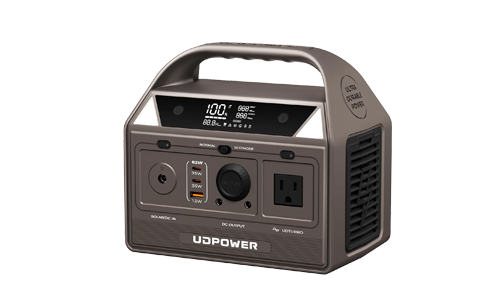
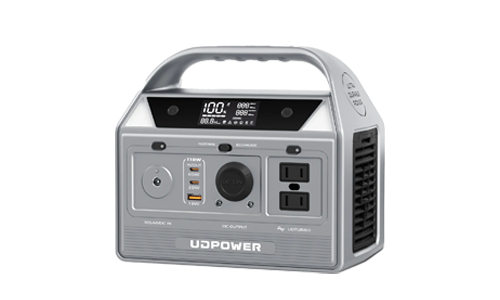
| UDPOWER C600 | 596Wh | About 13–27 hours | About 5–7 hours | Mini systems, short outages, and weekend trips |
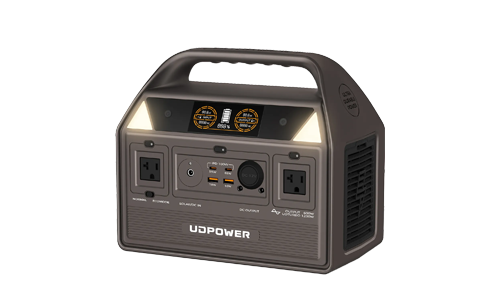
| UDPOWER S1200 | 1,190Wh | About 27–54 hours | About 11–14 hours | Remote work and overnight home backup |
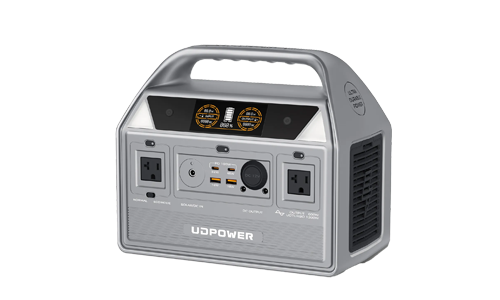
| UDPOWER S2400 | 2,083Wh | About 47–94 hours | About 19–25 hours | Extended outages, RV use, and multiple essential devices |
Real runtime can be shorter because Starlink power consumption changes with activity, temperature, signal conditions, and snow-melt operation. AC inverter consumption and additional devices also reduce runtime.

UDPOWER C600: Compact Backup for Starlink Mini
The C600 is a practical entry point for users who need to keep a Starlink Mini, phone, and small electronics running during a short outage or weekend trip.
- Battery capacity: 596Wh
- Rated AC output: 600W
- Peak output: 1,200W
- Maximum solar input: 240W
- Battery chemistry: LiFePO4
- Weight: Approximately 12.3 lb
It has far more output power than Starlink requires. Its main limitation is battery capacity when running a Standard dish for an entire night or when a laptop, monitor, or refrigerator is connected at the same time.
View UDPOWER C600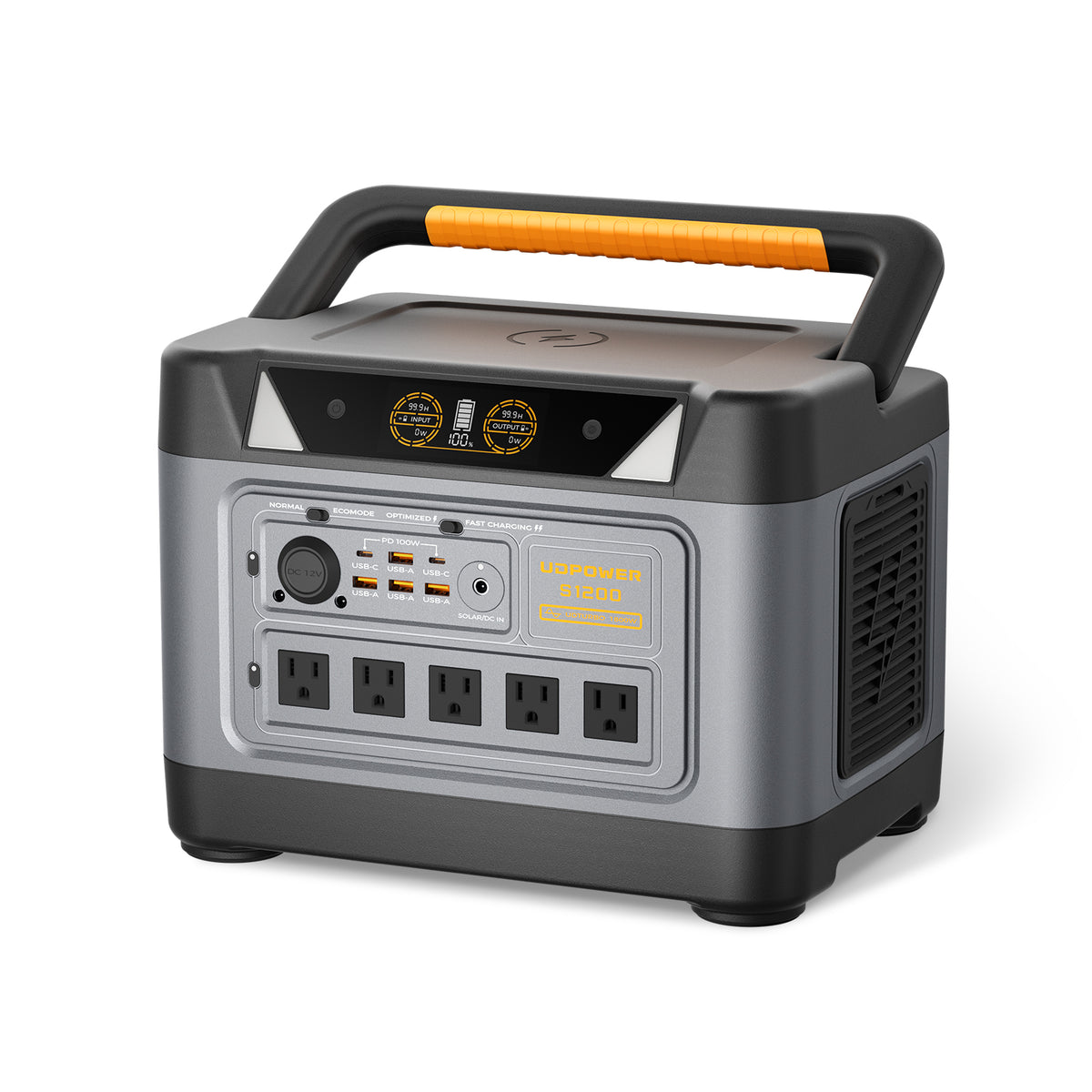
UDPOWER S1200: Best Overall Match for Home Starlink Backup
The S1200 provides a better capacity margin for a Standard Starlink system, a work laptop, phone charging, and other small essentials. It is a stronger choice for people who need to finish a workday or stay online overnight during a power outage.
- Battery capacity: 1,190Wh
- Rated AC output: 1,200W
- Peak output: 1,800W
- Maximum solar input: 400W
- Battery chemistry: LiFePO4
- UPS transfer time: Less than 10 milliseconds under the stated product conditions
- Weight: Approximately 26 lb
For Starlink alone, its output rating is more than necessary. The advantage is its larger battery, which allows longer internet runtime and enough power capacity for additional devices.
View UDPOWER S1200
UDPOWER S2400: Extended Runtime for Starlink and Other Essentials
The S2400 is larger than necessary for Starlink by itself. It becomes useful when the same battery must also support an RV refrigerator, work equipment, lighting, a CPAP machine, or other essential loads.
- Battery capacity: 2,083Wh
- Rated AC output: 2,400W
- Peak output: 3,000W
- Maximum solar input: Up to 400W
- Battery chemistry: LiFePO4
- UPS transfer time: Less than 10 milliseconds under the stated product conditions
- Weight: Approximately 40.8 lb
Choose this capacity when the goal is not simply “keep Wi-Fi on,” but “keep an off-grid workspace or group of essential devices operating.”
View UDPOWER S2400Runtime sizing rule: Add the average watts of the Starlink system and every device that will run with it. Then divide usable battery watt-hours by that combined load. Do not calculate Starlink backup time from the power station’s watt rating alone.
For a complete off-grid setup, see How to Power Starlink Off Grid and How to Keep Wi-Fi Running During a Power Outage.
Is Starlink Worth the Cost?
Starlink is often worth the cost when the alternative is unreliable DSL, a weak cellular hotspot, expensive metered internet, or no practical broadband connection at all.
It may offer less value when reliable fiber or cable service is already available at a similar price. In that situation, a wired provider may deliver more consistent latency, require less installation planning, and continue using less electricity.
| Situation | Starlink value | Reason | What to check first |
|---|---|---|---|
| Rural home with no cable or fiber | Often high | Starlink may provide a major speed and usability improvement | Clear sky view and address availability |
| Home with affordable fiber | Often low | Fiber generally offers strong consistency without a rooftop dish | Compare full monthly price, speed, fees, and outage history |
| Weekend RV traveler | Depends on usage | The equipment cost can be high relative to a few trips | Cell coverage, hotspot limits, and seasonal service cost |
| Full-time RV worker | Often high | Broad coverage can be more valuable than relying on one cellular carrier | Roam data needs, power supply, and campsite obstructions |
| Remote cabin | Often high | Satellite service may be the only realistic broadband option | Solar exposure, winter power needs, and mounting security |
| Emergency backup connection | Depends on preparedness | Starlink can help when local wired infrastructure fails, but it still needs electricity and a functioning Starlink network | Backup power runtime and clear outdoor placement |
Starlink Does Not Automatically Replace Every Internet Option
Compare it against the service you can actually buy at your location—not national advertising. A strong local 5G home internet connection may cost less and use less power. Fiber may provide better latency. Starlink may be dramatically better than old DSL or an overloaded rural hotspot.
For a direct technology comparison, read Is Starlink Faster Than 5G?.
A Simple Value Test
Starlink is more likely to be worth the cost when all three statements are true:
- Your available wired or cellular internet is missing, slow, unstable, or heavily capped.
- You have an unobstructed location for the dish.
- You will use the connection enough to justify the hardware, service, installation, and power costs.
Four Starlink Cost Mistakes to Avoid
1. Looking Only at the Monthly Price
A $55 plan can cost more than $1,000 during the first year after adding a purchased Standard Kit. Calculate the complete first-year subtotal before comparing Starlink with another provider.
2. Choosing 100GB Without Reviewing Streaming Habits
A household watching several hours of high-resolution video each day can use 100GB quickly. Check the data settings on every television, tablet, and phone before selecting the lowest Roam plan.
3. Buying a Mount Before Checking Obstructions
The lowest-cost mounting location may not provide reliable service. Use the Starlink app to find the best sky view, then choose the mount and cable route.
4. Buying Backup Power by Watt Rating Alone
A 1,000W power station can easily operate a 100W Starlink system, but the runtime depends on battery capacity in watt-hours. A high output rating does not guarantee long operation.
Starlink Cost Checklist Before You Order
- Enter the exact service address on Starlink’s website.
- Write down every plan available at that address.
- Confirm whether the hardware is purchased, discounted, or tied to a service commitment.
- Check the final tax and shipping amount at checkout.
- Use the Starlink app to inspect the sky for obstructions.
- Measure the cable route before ordering a mount or extension.
- Estimate monthly data use if choosing a capped Roam plan.
- Calculate electricity and backup-power needs if the system will run off grid or during outages.
- Add laptops, routers, monitors, and other equipment to the backup load.
- Compare the complete first-year cost with every realistic local internet option.
The practical decision: Buy the lowest-cost plan that meets your normal use, but do not save money by choosing equipment, data, or installation that makes the connection unreliable.
Frequently Asked Questions About Starlink Internet Cost
How much is Starlink per month in the United States?
Current personal service prices generally range from $55 to $175 per month. Residential plans are listed at $55, $85, and $130 per month, while Roam plans are listed at $55, $80, and $175 per month. Prices and availability can vary by address.
What is the cheapest Starlink plan?
The lowest currently listed personal service price is $55 per month. Both an entry Residential plan and the Roam 100GB plan may be available at that price, but they serve different purposes and have different limitations.
How much does Starlink equipment cost?
Starlink Mini currently starts at $199 in the United States. A Standard Kit is commonly listed around $349 when purchased outright. Some qualifying residential addresses may receive a $0 upfront kit offer tied to a 12-month service commitment.
Can I get Starlink equipment for free?
Some residential addresses may qualify for a $0 upfront hardware offer. This is not available everywhere and may require maintaining service for 12 months. Review the exact commitment and early-cancellation terms shown at checkout.
Does Starlink require a contract?
Standard service is often described as flexible, but a discounted or $0 hardware promotion may include a minimum service commitment. The terms shown for your address and order take priority over general advertising.
Is Starlink’s 30-day trial completely free?
No. The return or trial period should not be treated as a free month. Customers generally purchase the equipment and activate service, then may qualify for a refund if the kit is returned within the applicable period and all conditions are met.
Does Starlink Residential have unlimited data?
Starlink’s current Residential plan descriptions include unlimited residential data. Speeds can still vary with local network demand, weather, dish placement, and obstructions.
Is 100GB of Starlink Roam data enough?
It may be enough for occasional trips, email, maps, browsing, and limited video. At Netflix’s maximum estimated usage of 3GB per hour for HD, 100GB represents roughly 33 hours of HD streaming before accounting for every other connected device and activity.
What happens after I use my Roam high-speed data?
Under the current capped Roam plan structure, service may continue at a significantly reduced speed after the high-speed allowance is used. Check the latest plan description because data treatment and speeds can change.
Can Starlink Roam be paused?
Eligible Roam accounts may have a paid Standby Mode that keeps the line available at a lower monthly cost. Check the current options inside your Starlink account because eligibility, price, and functionality can change.
Are taxes and shipping included in Starlink’s advertised price?
Not necessarily. Taxes, shipping, and other checkout charges depend on the order and location. Review the final checkout total before comparing Starlink with another provider.
How much electricity does Starlink cost per month?
At the May 2026 U.S. residential average of 18.44 cents per kilowatt-hour, a Mini drawing 20–40W continuously costs approximately $2.66–$5.31 per month. A Standard-class system drawing 75–100W continuously costs approximately $9.96–$13.28 per month.
Will Starlink work during a power outage?
Only when the dish, router, and power supply continue receiving electricity and the Starlink network remains available. A portable power station can power the equipment at your location, but it cannot guarantee that the wider Starlink network will never experience an outage.
What size power station do I need for Starlink?
A 500–600Wh power station can cover a short outage or run a Starlink Mini for much of a day. Around 1,000–1,200Wh is a more practical target for overnight Standard Starlink backup and a work laptop. Larger capacities are useful when refrigerators, CPAP machines, lights, or other equipment must run too.
How long can a 1,190Wh power station run Starlink?
Using approximately 90% usable energy, a 1,190Wh power station may run a Starlink Mini for roughly 27–54 hours or a Standard-class system for roughly 11–14 hours by itself. Actual runtime varies with power draw, weather, inverter consumption, and additional devices.
Is Starlink cheaper than cable or fiber internet?
It depends on your address. Starlink can be more expensive than entry-level cable or fiber after hardware and installation are included. In rural areas where wired broadband is unavailable or unreliable, Starlink may provide much better value despite the higher total cost.
How much does Starlink cost for an RV?
An RV setup using a $199 Mini Kit and the $55 Roam 100GB plan starts around $859 for the first full year before taxes, mounts, power equipment, and accessories. Roam Unlimited paired with the same Mini would total about $2,299 for the first year before additional costs.
How much is Starlink Business?
Business and Priority plans use separate pricing and data structures. Entry pricing may appear similar to personal plans, but the included Priority data and hardware requirements can make the total much higher. Businesses should use the current quote and plan details on Starlink’s official Business page rather than applying residential pricing.
How These Costs Were Calculated
Pricing and plan details were checked against Starlink’s U.S. service, Residential, Roam, Mini, specifications, and legal pages on July 29, 2026. Electricity estimates use the U.S. Energy Information Administration’s May 2026 residential average of 18.44 cents per kilowatt-hour.
First-year totals use 12 monthly payments plus the stated hardware assumption. Backup runtimes use approximately 90% usable battery energy divided by Starlink’s typical average load. They are planning estimates rather than guaranteed operating times.
Because Starlink uses address-specific availability and regularly changes offers, the total shown during checkout should always be treated as the final price for your location.
Choose a Starlink Backup Power Setup
Match the battery to your Starlink model, desired runtime, work devices, and other essential equipment. A larger output number does not automatically mean longer internet runtime—compare battery capacity as well.
Compare UDPOWER Models View Portable Power Stations View Solar Generator Kits View RV and Camping Power OptionsRelated Articles


